From Pitch Deck Perfectionism to Timely Participation: The Send Rule

The 11:47 p.m. Upload Tab
If you are a freelance creative who has ever called version 14 “quality control” at 11:47 p.m., this may feel familiar.
Maya, a 28-year-old freelance creative strategist in London, joined my video call from a small East London flat. A radiator clicked beside her desk. The coffee at her elbow had gone cold enough to leave a metallic taste, and the trackpad was still warm beneath her fingertips as she shared a folder crowded with nearly identical PDFs.
She described the previous deadline to me in precise, painful detail. The submission portal had been open in one Chrome tab and version 14 of her pitch deck in another. With thirteen minutes left, she had changed “reimagine” to “reframe,” exported again, and watched the blue progress bar consume the remaining window.
“It was nearly there,” she said, rubbing the hinge of her jaw. “Which is exactly why I couldn't send it yet. I wanted to put the idea in the room while the opportunity was open, but showing it before it was perfectly polished felt like letting everyone see the part of me that might not be good enough.”
I could see the pressure in her body before either of us named it: her shoulders were held close to her ears, her eyes looked sanded dry by screen light, and her jaw seemed bolted around an invisible objection. It was as if she were trying to read a project brief while someone steadily tightened a drawstring around the page.
“I don't hear laziness or a lack of discipline in any of this,” I told her. “I hear someone using real professional care to protect herself from a moment that feels personally exposing. Let's see whether we can draw a map of that moment, separate useful improvement from diminishing returns, and find the point where clarity can become a choice.”

Choosing the Ladder Out of Deadline Paralysis
I asked Maya to place both feet on the floor, let one slow breath out, and hold the question in simple language: “Why do I keep polishing my pitch until I miss the chance to show it?” I shuffled while she did that. The pause was not a mystical performance. It was a psychological transition from being trapped inside the problem to looking at it together.
For anyone wondering how tarot works in a session like mine, I use the cards as an external cognitive map. The images let us place a subconscious pattern on the table, examine its structure, and test whether the interpretation matches lived evidence. I do not use them to predict whether a client will say yes or to claim authority over someone else's future.
I chose the Four-Layer Insight Ladder · Context Edition, a four-card tarot spread designed for a self-reinforcing loop. Maya's problem did not need a sprawling forecast. It needed a clean causal sequence: the visible behaviour, the belief maintaining it, the perspective capable of changing it, and the nearest action through which that change could become real.
I placed the cards in an ascending diagonal. The lower-left position would show the repeated revisions and diminishing returns. The next would reveal why stopping felt dangerous. The third, at the central threshold, would identify the transformation from private overwork to experimental visibility. The final card would turn that insight into a readiness rule and a timely act of communication. This structure is why card meanings in context can be more useful than isolated definitions: each image answers the one before it.
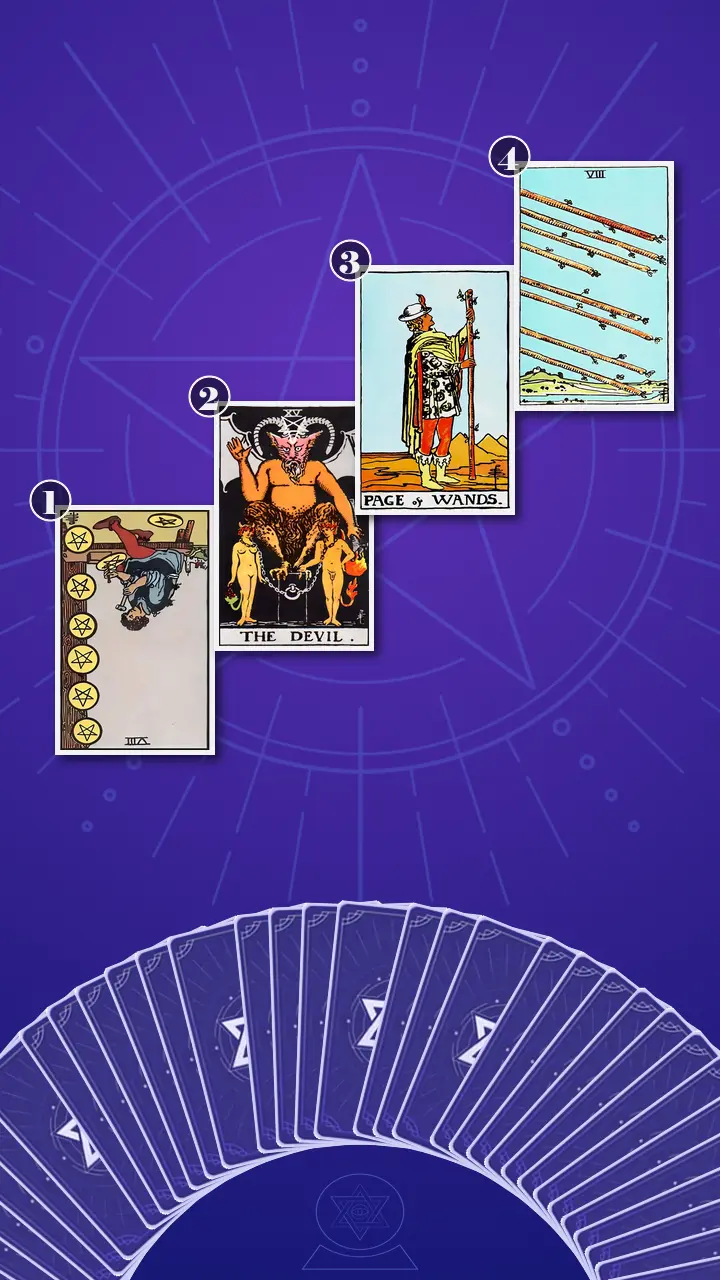
The Workshop That Never Opens Its Door
Position 1: Eight of Pentacles Reversed and the Endless Final Pass
I turned over the card representing Maya's visible present-state pattern: the repeated revisions, diminishing returns, and contracted work energy causing her to miss the pitch window. It was the Eight of Pentacles, reversed.
In the Rider-Waite-Smith image, a craftsperson bends closely over one pentacle while completed pieces already hang behind him. A town sits in the distance. Reversed, the card showed disciplined Earth energy being pushed into excess until it became a blockage. Maya was not short on skill or effort. Her attention had narrowed so tightly around one detail that she could no longer register the competent work already completed or the audience waiting beyond the workbench.
I connected the image to the scene she had shown me: a coherent deck, an open upload portal, thirteen previous exports, and version 14 magnified to 400 percent so she could adjust a text box. The extra labour briefly produced a feeling of control, but it no longer improved what the recipient would understand. One more pass could feel like quality control while functioning as an exit from visibility.
“Look at the final three changes you made,” I said. “Which changed the central idea, which fixed a real error, and which only reduced the discomfort of sending?”
Maya opened the version history. One change corrected a statistic. The other two adjusted spacing and replaced near-identical words.
“So the statistic mattered,” I said. “The other edits weren't wrong, but they were no longer carrying the pitch forward. Try finishing this sentence: I call this professional rigour, but if I am honest, I am changing the headline because sending would mean...”
She gave a brief laugh with no lightness in it. “Finding out whether they care. That is uncomfortably accurate. Almost cruel.”
I let the reaction settle before answering. “The card isn't mocking your standards. Quality does matter, and the corrected statistic proves that. It is showing us the point where craft stopped serving communication. Naming that point may sting because you have been working extremely hard, but nothing here says the work or the person making it is inadequate.”
Position 2: The Devil and the Self-Written Rule
I next turned over the card representing the psychological mechanism beneath the revisions: the belief that stopping before perfection could expose inadequate creative worth, along with the workaholic strategy Maya used to avoid that exposure. The card was The Devil, upright.
I always handle this card carefully. I do not read The Devil as punishment, corruption, or a bad omen. Through a Jungian psychological lens, I read it as an attachment that has started to feel like an external law. The most important detail here was not the central figure. It was the loose collars around the two people. The bond was real, but it was examinable rather than permanent.
“This looks like the moment you close your laptop after a useful review,” I said, “notice one inconsistent image crop, and immediately hear, A real professional would keep going. You sit back down, cancel dinner, and rebuild the opening. Working longer becomes proof that you care, while stopping starts to feel like a moral failure.”
The Devil's downward torch gave the dynamic another layer. Creative fire had not disappeared; it had been redirected into confinement. An ordinary pitch was being asked to do an impossible second job: communicate an idea and protect Maya from rejection while proving she deserved to be taken seriously. That was energy in excess, not because commitment was bad, but because commitment had become compulsory worth-testing.
I asked her to complete a second sentence: “If I stop before this is exceptional, they will see... and that will mean... about me.”
Her fingers stopped against the mug. Her eyes shifted away from the cards, as if she were replaying a sequence of late departures from the Farringdon coworking studio. After several seconds, the breath she had been holding came out slowly.
“They'll see that I can talk strategically but can't actually make the idea land,” she said. “And it will mean I've somehow bluffed my way this far.”
As I listened, I thought of creative rooms I had crossed while travelling between cultures. The vocabulary around success changed from place to place, but I had often seen the same physical reflex: shoulders lifting when belonging felt conditional. In Jungian terms, I called Maya's pattern the Bound Achiever, an archetype that mistakes a chosen agreement for an unavoidable condition. Her private terms of service read: visibility is available only after unlimited unpaid overtime.
“What would remain objectively true about your competence if this specific pitch received criticism, indifference, or no reply?” I asked.
Maya looked back at the cards. “I would still know how to find the audience problem. I would still have done the research. I would still have delivered good strategy for other clients.”
“Exactly. The discomfort of stopping is not evidence that the pitch is unfinished. It is evidence that stopping activates the fear this rule was built to contain.”
When the Page Lifted a Living Shoot
Position 3: Page of Wands and the Courage to Be in Development
The radiator went quiet as I reached the transformation position, and the sudden stillness made the room feel larger. I turned over the card representing Maya's leverage point: replacing forced maturity and private overwork with beginner-minded experimentation, timely visibility, and learning through contact. It was the Page of Wands, upright.
The Page holds one upright wand with green shoots growing from it. The idea is visibly unfinished, yet the leaves do not make it defective. They make it alive. The Page's fire was balanced here: curious enough to explore, grounded enough to carry a specific message, and free from the demand to perform total mastery before contact could begin.
I translated that image into Maya's workflow. Instead of building a deck as a final monument to her talent, she could create a focused five-slide concept covering the opportunity, audience, central idea, proposed expression, and explicit ask. At the midpoint of the pitch window, she could send it to an authorised reviewer with two bounded questions: “Is the core idea clear?” and “Where did you lose the thread?” That smaller share would not make her junior. It would make feedback part of professional development rather than a verdict delivered at the end.
“What if this isn't your final proof of talent?” I asked. “What if it is a clear message that allows another informed person to respond?”
I then used one of my core diagnostic tools, Imposter Syndrome Auditing. I drew a line down the centre of a page. On the left, I recorded verifiable professional evidence: Maya had been invited to pitch, had identified the audience problem, had built a coherent strategic route, and could distinguish a factual concern from a subjective preference. On the right, I wrote the fear-based claims: one weak adjective would expose her as fraudulent; one critical response would become a permanent opinion; visible incompleteness would cancel every previous achievement.
“This is not a positive-thinking exercise,” I said. “It is an evidence classification exercise. Your competence belongs in the audit because it is observable. The fear of exposure belongs there too, but it cannot be promoted into a quality criterion simply because it is loud.”
I brought us back to 11:47 p.m.: the upload tab open, version 14 technically ready, and thirteen minutes still real. Her hand had returned to the headline because another private edit felt safer than discovering what an actual person might think.
Your pitch does not need to prove your full creative worth; it needs to carry one clear, living idea into the room while the door is still open.
The pitch does not need to be a finished bloom before it is seen; let it be a living shoot, like the Page's sprouting wand, and carry it into conversation while the window is still open.
For one beat, Maya stopped breathing. Her fingers hovered above the mug without touching it. Then her focus moved past the screen, as though she were watching the previous deadline replay in the glass of the dark window. Her brow tightened first, not with relief but with the sting of recognition, and colour rose along her cheeks.
“But doesn't that mean all those late nights were pointless?” she asked, her voice low before it sharpened. “Doesn't it mean I did this to myself?”
I kept my voice steady. “It means the strategy gave you temporary protection from evaluation, and then outlived its usefulness. That is not the same as saying you were foolish or that every hour was wasted. Some of those hours built the work. Our task is to identify when building ended and hiding began.”
Her shoulders lowered by a fraction. The hand curled near her chest loosened one finger at a time, and she released a breath that trembled at the end. Her eyes brightened, but she did not look instantly reassured. I saw a brief, almost dizzy blankness in her expression, the vulnerability that can appear when a burden lifts and choice returns with it. Clarity had not removed responsibility. It had placed the decision back in her hands.
“Now, using this new perspective, think about last week,” I said. “Was there a moment when treating the pitch as a living invitation, rather than a finished proof of worth, could have changed how you felt?”
Maya remembered a WhatsApp message she had drafted to her designer friend: “Could you tell me if the central idea lands?” Her thumb had hovered over the send arrow before she deleted it because the deck did not look finished enough.
“The pitch didn't have to answer every objection,” she said slowly. “It only had to make the idea clear enough for that conversation to begin.”
I nodded. That sentence marked the real crossing in the reading: from worth-based evaluation fear and compulsive private polishing toward experimental self-trust. It did not require Maya to feel fearless. It allowed professional competence and visible development to coexist.
The Approved File Enters Open Air
Position 4: Eight of Wands and the Information Beyond Send
I turned over the action-layer card, representing the nearest observable expression of the change: define a readiness threshold, send within the real window, and treat the response as information rather than a verdict. It was the Eight of Wands, upright.
Eight wands travel together across an unobstructed sky. No figure clutches them, rearranges them, or pulls them back for another inspection. Their fire is balanced through direction. Unlike the stationary pentacles around the solitary worker in the first card, these creative materials become useful because they are in transit.
I pictured Maya setting a personal cutoff for 10:00 a.m., two hours before an official noon deadline. At that time, she would upload the approved PDF, verify the filename once, save the confirmation, and close the source deck. The action would not guarantee acceptance. It would simply allow the next useful information to come from the recipient rather than another private rehearsal.
“My next useful information cannot come from reopening the source file,” Maya said, testing the sentence aloud. “It has to come from sending.”
“Yes,” I said. “You are not short on discipline; your discipline is travelling in the wrong direction.”
The two Eights made that contrast visible. The Eight of Pentacles reversed showed stamina trapped in enclosed repetition. The Eight of Wands showed the same capacity redirected into timely participation. Maya did not need a stronger work ethic. She needed the equivalent of closing a Figma file whose endless branches had replaced the design decision it was meant to support, then moving one approved version into the channel where another person could actually encounter it.
I also noted what the spread did not contain. There were no Swords to provide a clean decision rule and no Cups to make room for the feelings that follow exposure. Maya could add those missing functions consciously: Air through a short definition of done, and Water through permission to feel unsettled without treating that feeling as a command to reopen the file.
She moved her mug aside and wrote “10:00 a.m. SEND” in her notebook. This time, I saw her jaw release before she smiled.
A Definition of Done That Can Survive Discomfort
I drew the whole reading together. Maya had begun with genuine creative energy, but as the pitch window narrowed, the reversed Eight of Pentacles converted craft into repetitive labour. The Devil revealed why the loop survived: more work briefly protected her from being evaluated and made stopping feel like proof of inadequacy. The Page of Wands restored choice by reframing the pitch as a living message, and the Eight of Wands redirected her existing stamina into communication.
The core metaphor was not a person failing to make a flower bloom. It was a person pulling at the petals because force seemed safer than waiting for contact with light, weather, and the wider world. The cognitive blind spot was equally precise: Maya had been treating the discomfort of stopping as project data. She assumed that if sending felt unsafe, the work must still be unfinished. The cards showed that emotional intensity and professional readiness were separate categories.
The key shift was therefore practical, not mystical: stop polishing when the pitch becomes immune neither to criticism nor uncertainty, but when it meets three observable criteria after one content review and one proofread. I turned that insight into three small experiments.
- Competence Anchor and Three-Criteria Rule Before opening the next pitch, spend seven minutes on my Competence Anchoring Exercise. Record three verifiable achievements using the structure: challenge, action, skill, observable result. Then write exactly three pitch-ready criteria: the core idea is understandable, the ask is explicit, and there are no errors that materially change the meaning. Complete one content pass and one proofread, then rename the export with the date and APPROVED.Tip: Keep the evidence factual rather than flattering. If seven minutes feels too activating, write one achievement and one readiness criterion, or practise on an old deck without sending it.
- The Living-Shoot Feedback Share By the midpoint of the next pitch window, create a five-slide conversation draft and send a view-only link to one authorised colleague or trusted reviewer. Ask only: “Is the core idea clear?” and “Where did you lose the thread?” Remove confidential client details before sharing.Tip: If five slides feels too exposed, send one slide or one paragraph with one bounded question. Ask for information about the idea, not a rating of your worth.
- The Two-Hour Send Window Put a personal send time on the calendar at least two hours before the official cutoff. At that time, upload the approved PDF, verify the file once, take a confirmation screenshot, and close the source deck. Record only the next external event, such as a reply date or follow-up date.Tip: Park subjective, noncritical edits in a separate note. Reopen the deck only for genuinely new information or necessary factual, legal, accessibility, safety, or confidentiality review.
I reminded Maya that these were experiments, not new instruments of punishment. A three-item rule could become another perfection ritual if she checked every criterion repeatedly. The boundary mattered: one content pass, one proofread, and no reopening to soothe discomfort. Let the audience answer the questions private polishing cannot.
“The cards have not promised a favourable reply,” I said. “They have shown where you still have agency. You choose the criteria. You choose the reviewer. You choose the send time. Tarot can make the loop visible, but it cannot press the button for you, and it should never pretend to own the decision.”

A Week Later, the Quiet Proof
Six days later, I received a screenshot: SUBMITTED, 9:58 a.m. Maya had slept through the night. Her first thought on waking was, “What if they hate it?” This time she laughed, made coffee, and waited for information instead of reopening the deck. No reply had arrived yet.
I did not consider the unread response a missing ending. The proof of Maya's Journey to Clarity was smaller and more important: she had felt the old fear, used an objective readiness threshold, and participated while the door was open. The Page had offered an image, but Maya had supplied the choice.
When the upload tab is open and your jaw locks over one more headline, I know it can feel safer to let the deadline reject you silently than to let a person see work that might not prove your worth. Simply noticing that bargain is already a loosening of the Devil's collar and a return of the living shoot to your own hands.
If your next pitch only had to carry one clear, living idea into a real conversation, what small, observable sign would tell you it is ready to leave the draft folder while the door is still open?