Why the Side-Project Launch Keeps Moving: From Tweaks to Testing
The 11:06 p.m. Figma Spiral
You are a Toronto product designer building something of your own after work, and every time the self-imposed launch date appears in Linear, a tiny copy or UI issue suddenly becomes a release blocker. That is perfectionism and procrastination wearing a quality-control badge. I saw that pattern arrive with Jordan (name changed for privacy) at 11:06 p.m. in a condo kitchen after a full day of product design work. Jordan reopened the side-project landing page instead of shutting the laptop; the fridge hummed beside a cold mug, blue screen light stretched across the counter, and restless fingers changed one button label.
“One more tweak is still progress, right?” Jordan asked. The sentence sounded practical, but I could hear the pressure underneath it. The project had a usable core and friends willing to try it, yet each approach to the launch date brought another revision, another postponed link, another brief release from the fear of being seen before the work felt perfectly balanced. Their apprehension was not an abstract mood. It was a tight jaw, a warm phone abandoned beside the keyboard, and hands that kept finding work because stopping would let the project become evidence about its maker.
“I am not avoiding the launch; I am protecting the quality,” Jordan said. I did not argue with the protective part. It made sense that a project built alone could feel unusually intimate. But I also named the tension clearly: wanting to launch the side project and let real people learn from it was pulling against delaying it for one more tweak. “We do not need to force confidence,” I told Jordan. “Let us draw a map of the fog, find the exact point where craft becomes protection, and make the next decision yours.”
Choosing a Compass for the Moving Finish Line
I invited Jordan to take one slow breath and hold the question in mind without trying to solve it. I shuffled slowly, treating the gesture as a transition from scattered product thoughts to focused observation, not as a supernatural test or a verdict.
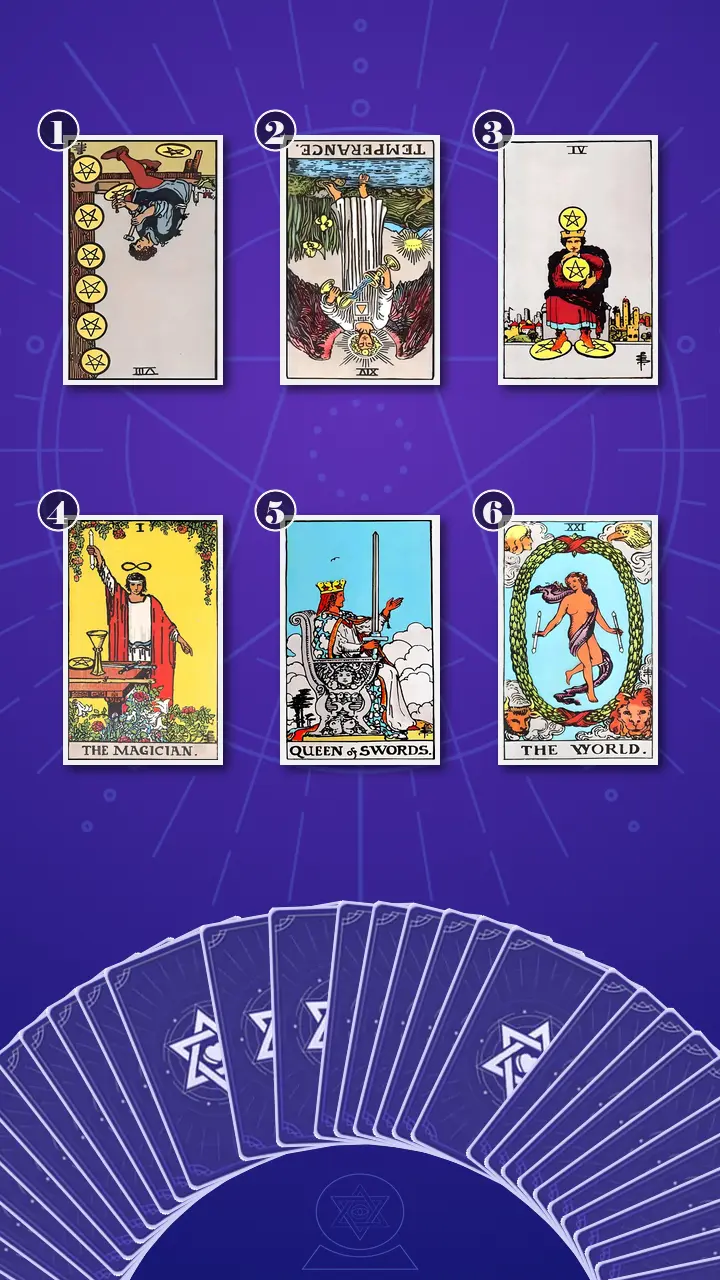
For this reading, I used the Transformation Path Grid (6) · Context Edition, a six-card tarot spread for a product launch block. I chose it because this question is a self-reinforcing system rather than a simple choice between two external options. The grid lets me trace the visible delay, the shifting moderation standard, the protected fear beneath it, the resource that can interrupt the loop, the boundary that can guide action, and the meaning of completion.
I explained the structure for anyone reading along: the top row shows the current behaviour, the active obstacle, and the root protection. The bottom row moves from catalyst to practical boundary to integration. I would read across the first row, drop diagonally from guarded control to the available tools, and then move across the action row. In other words, we would examine card meanings in context, not ask the cards to predict what Jordan must do.
The Workbench That Never Opens
Position 1: The Loop Behind “Final Polish”
Now I turned over the card representing the concrete current-state loop: reopening the side project, finding one more tweak, and delaying the launch despite having a usable core. It was the Eight of Pentacles, in reversed position.
In the Rider-Waite-Smith image, the apprentice keeps hammering at a pentacle while finished pieces line the wall. For Jordan, that repeated hammering became another evening at the digital workbench: changing labels, spacing, and micro-interactions that did not alter the core offer. Each edit looked responsible. Each edit briefly lowered the pressure of being judged. Yet the project stayed behind a private link and received no real-world information.
This is craft with blocked Earth energy. The skill and diligence are present, but repetition has lost its relationship to completion. One more tweak can be meaningful when it fixes a genuine usability problem; it can also become a polished way to stay unexposed. I asked, “When the launch checklist is nearly complete, what exact file, button, sentence, or task do you reopen? Does changing it alter whether a new user can actually use the project?”
Jordan gave a short, bitter laugh instead of nodding. “That is painfully accurate,” they said. “I change something small, and then suddenly three other things look wrong.” I watched their thumb stop moving across the mug. The laugh had loosened the surface of the explanation, but not yet the grip beneath it.
Position 2: The Drink That Never Gets Served
Now I turned over the card representing the Moderation Trap that keeps the delay active: endless calibration, shifting standards, and the belief that a perfectly balanced version must come before release. It was Temperance, in reversed position.
The angel's two cups became Jordan's feature set, pricing, launch copy, and visual system, repeatedly poured from one version into another. The onboarding was adjusted, then the pricing, then the landing-page language. Every correction revealed a new imbalance, as if an unfinished drink had to be transferred between containers until every level felt equally safe.
Temperance reversed shows moderation without a stopping point. The energy is not absent; it is over-calibrated. Jordan's inner monologue sounded familiar: I am not stuck; I am calibrating. If I can just make every part agree, I will finally feel safe. But “balanced enough to test” had quietly been replaced by “perfectly balanced before anyone can respond.” A launch threshold is a decision, not a mood.
Jordan's jaw tightened. Their eyes moved from the cups on the card to the growing feature list in the open browser tab, as if replaying the exact moment when a completed criterion had become a new exception. Then they said, “But if I write three criteria, I might be giving myself permission too easily.”
“That concern is useful,” I said. “It means the criteria need to be observable and tied to the core promise, not to your level of comfort. We are not replacing care with a reckless no-changes rule. We are separating a real user-facing issue from the feeling that exposure must become painless before it counts.”
Position 3: The Private Link Held to the Chest
Now I turned over the card representing the root protection beneath Strategic Surrender: the need to control judgment and the fear that an imperfect launch could prove a lack of self-worth. It was the Four of Pentacles, in upright position.
The figure on the card holds one pentacle against the chest, plants both feet on two more, and balances another above the head. I saw the same full-body arrangement in Jordan's private beta link: access settings checked twice, the project held close, feedback controlled before the work entered a real conversation. Keeping the product in draft mode protected it from immediate judgment, but it also prevented circulation and learning.
“What are you trying to control by keeping it private?” I asked. “Is it the product's response, or what that response might seem to prove about your judgment?”
Jordan looked down. “If someone sees an obvious flaw, it will not feel like they found a flaw in a version. It will feel like they found me careless.” Their fingers closed around the edge of the chair, then released it. I let the silence remain long enough for the distinction to become theirs: the project could be valuable without being a sealed container, and criticism of one version did not have to become a verdict on the person who made it.
In my own mind, I remembered trading floors where uncertainty was made heavier by pretending every variable could be controlled. A good risk process did not promise a painless outcome; it defined what information was needed, what exposure was acceptable, and when a position required a decision. I brought that memory into the room carefully. Protection can be intelligent. It becomes costly when it prevents the evidence the work needs.
When The Magician Put the Tools on the Table
Position 4: The Catalyst Already Within Reach
The room grew quieter when I turned over the card representing the catalyst that interrupts private refinement by activating the skills, tools, and core offer Jordan already has available. It was The Magician, in upright position. This was the hinge of the reading: the moment when the closed workbench could become a release path.
The cup, sword, pentacle, and wand on the table became Jordan's working prototype, design judgment, clear offer, and willing early testers. The raised wand was not a command to feel fearless. It was a choice to use what was already present. The resource question was simple: “What can this version already let you learn?”
Picture the Toronto evening again: the launch checklist is nearly green, your phone is warm in your hand, and you reopen the same file because one button label suddenly feels like proof that the whole project is not ready. The Magician interrupts that loop by making the existing inventory visible. Maybe the missing ingredient is not another tool. Maybe it is a decision to use what is already here.
I applied my Resource Readiness Assessment at that point. I asked Jordan to separate external timing from internal assets: Did the core flow work? Was the offer understandable? Was there a person willing to access the version? The assessment did not ask whether Jordan felt invulnerable. It checked whether the available resources matched a small, honest experiment. They did. The prototype, design skills, clear purpose, and willing testers were already on The Magician's table.
“You do not need one more tweak to earn permission to begin. Use the resources already on the table and let the launch become the next learning step,” I said. Then I delivered the central sentence slowly.
You are not required to perfect the work before it can count; place the tools already on The Magician's table into use, and let a real release teach you what another private tweak cannot.
Jordan's breath stopped first. Their fingers hovered above the phone, still holding the old question: What else do I need? For a few seconds their eyes went unfocused, as though a week of moving deadlines were playing back behind them. Then their shoulders lowered by a fraction, and the hand around the chair loosened.
“But does that mean I have been wrong this whole time?” Jordan asked. The question carried anger, not relief. Their mouth tightened; their eyes flashed toward the cards; then they looked away at the rain-dark window. I did not turn the anger into a lesson. “No,” I said. “Your care was trying to protect something important. We are changing the job of that care. It can protect the core user experience without protecting you from every possible reaction.”
Jordan took one uneven breath, then another, and let out a low exhale that sounded almost surprised. Their eyes became bright, their jaw softened, and the old pressure did not vanish so much as move into a shape that could be held. There was relief, followed by a brief, dizzy blankness: if the next step did not require perfect readiness, then Jordan would have to choose it. I asked, “Now, using this new view, can you remember a moment last week when this insight might have changed how the next tweak felt?”
“When my friend asked for the link,” Jordan said. “I could have heard that as a chance to learn, not a demand to prove the product.” That was the emotional shift in its first form: from apprehensive over-editing and fear of evaluation toward focused action and real-world learning. Not certainty. A usable opening.
Position 5: The Sword That Closes the Editing Window
Now I turned over the card representing the practical boundary: defining launch criteria, stopping scope growth, communicating the version's purpose, and choosing a contained feedback process. It was the Queen of Swords, in upright position.
Her upright sword became a written cutoff. Her raised hand became direct communication. Her clear sky became the separation Jordan needed between product information and personal judgment. The question was no longer “Do I feel balanced enough?” It was “What three observable conditions let this version do its intended job?”
“I can make criteria,” Jordan said, “but I do not have ten spare minutes, let alone another big launch process. I have a full-time job, and my evenings are already thin.”
I noticed the reaction chain before answering: their shoulders lifted, their breathing narrowed, and their hand reached toward the laptop as if a new planning system might be required. Then the practical obstacle settled into words. “That is exactly why the first version must be small,” I said. “You do not need a public campaign. You need one person, one purpose, one question, and one stopping point.”
I offered Jordan my Strategic Holding Pattern: a tactical plan for the waiting period that turns anxious stagnation into resource preparation. The pattern has a boundary: prepare briefly, hold new ideas outside the current scope, then let the smallest useful test happen when the chosen window arrives. Waiting is allowed; indefinite editing is not required.
Position 6: Completion Without the Locked Door
Now I turned over the card representing the conscious closing of one cycle, with future improvements placed in a new cycle rather than used to reopen the present delay. It was The World, in upright position.
The wreath around the dancer did not suggest a frozen perfect object. It suggested a boundary around a completed cycle. The movement inside it mattered. Jordan could label one version complete, record what real use revealed, and begin another cycle later. Complete for this cycle is not the same as perfect forever.
I pointed to the contrast between the trapped workshop of the Eight of Pentacles reversed and The World's moving wreath. At the beginning, work stayed inside because every unfinished edge demanded another private pass. Here, completion meant allowing the version to circulate and teach. The four figures around the card offered a wider field of perspective: product purpose, user experience, personal limits, and future learning could all exist without one small flaw swallowing the whole picture.
The Three-Criteria Launch Threshold
When I connected the cards, the story became clear. The reversed Eight of Pentacles showed effort looping back into the same file. Temperance reversed showed why the loop survived: a reasonable quality standard had lost its stopping point. The Four of Pentacles revealed the protective centre, where keeping the project private seemed to keep Jordan's worth protected as well. The Magician did not promise a successful external result; it made the available resources visible. The Queen of Swords gave those resources a boundary, and The World made completion an intentional learning cycle.
The blind spot was not a lack of discipline or ambition. It was the assumption that more private refinement would eventually create the feeling of safety that only real use can provide. The project cannot give you feedback while it is still being used as a shield. The transformation direction was from protecting self-worth through over-editing to gathering evidence through bounded action, with room to pause and revise from what users actually show you.
“Let us make the next step concrete,” I said. “You remain in charge of the audience, timing, and right to pause. These are not orders from the cards. They are tools for giving your decision a fair shape.”
- Write the thresholdThis week, open the current project in your plain-text notes or project board and write exactly three observable launch criteria: the main flow works on a fresh account, a new user can understand the offer in one sentence, and one trusted person can access the version.Set a 10-minute timer for writing, then a 30-minute polish window for only the three highest-impact changes. When the timer ends, close the editing file.
- Run a bounded betaChoose one to three willing friends or early testers and send the current link with one sentence explaining what this version is designed to test. Ask one focused question, such as “Where did you hesitate in the main flow?”Use the smallest audience that can answer the question. Give the test a clear end time, such as 20 minutes of use or one day of access.
- Protect the next cycleWrite a release note saying what the version is for, what it is not trying to solve, and what feedback you want. During the feedback window, collect observations without changing the product in real time; afterward, sort them into “core issue,” “preference,” or “next-cycle idea.”Keep future improvements on a separate list. You can revise later, but do not let a new detail silently rewrite the current launch criteria.
That was the point of the Strategic Holding Pattern: the waiting period became a defined place for preparation, not a disguised return to the workbench. I also named the timing question from my other analytical lens, Strike Timing Calibration. The right moment was not a magical date when apprehension disappeared. It was the point at which the core promise, the available tools, and a small feedback window were aligned well enough to produce useful information.

A Week Later, the Link Became a Question
Four days later, Jordan messaged me from a cafe near the Toronto Reference Library. They had written the three criteria, used the existing prototype, and sent the link to one friend with a single question. The friend found a confusing moment in the onboarding flow. Jordan did not fix it while the friend was still testing; they wrote it under “core issue,” placed two visual preferences under “next-cycle idea,” and closed the file.
The message ended with: “I still woke up thinking, what if I got this wrong? But I sent the link before I felt ready, and now I have something real to decide about.” Jordan was not celebrating with a dramatic launch post. They were sitting alone with a coffee, a little lighter and a little exposed, watching the current version become information instead of a private accusation.
That is what I mean by a Journey to Clarity. The cards did not take over Jordan's decision, remove every fear, or guarantee what the tester would say. They helped make the pattern visible enough for Jordan to choose a boundary, use the resources already available, and let one version count. The movement was from over-editing to bounded action, from imagined judgment to evidence, and toward grounded completion without requiring perfection.
When the launch checklist is almost green, your jaw may tighten and your hands may still find one more detail to fix, because letting the project be seen can feel uncomfortably close to letting people judge whether you are good enough. Seeing that reflex does not make you weak, and it does not force you to publish before you are ready. It gives you a moment in which the decision can belong to you again.
If this version could be a conversation rather than a verdict, what small part of it might you feel curious to let someone use first?