A Finished Plan Beside a Vanished Promotion Path: Choosing New Limits

The 10:47 p.m. Slack Glow
If you are a project manager in London whose company reorganisation erased the role you spent a year preparing for, overworking after a career setback can look like replying at 10:47 p.m. because finishing your assigned work no longer feels like enough. Jordan sat opposite me with their phone face down on the table, although I noticed their fingertips returning to its edge whenever the screen lit up.
The scene they brought into our consultation was painfully specific. A completed project plan glowed on one side of their monitor; the promotion framework for the senior role they had been pursuing sat archived on the other. The radiator hissed in their small London flat, cold tea left a metallic taste in their mouth, and the laptop fan pushed warm air across hands that should have been nowhere near a keyboard at that hour. Then a non-urgent Slack request appeared. Jordan answered immediately and offered to build an extra deck by morning.
“The path is gone,” they told me, pressing their tongue briefly against a clenched jaw, “but slowing down would make it feel like I gave up. If I can become indispensable, maybe the year still counts for something.”
The anxiety did not look like uncertainty from the outside. It looked like competence running at an unsafe temperature: a tight chest, a green status dot, and a mind humming like a laptop fan that could not cool itself because too many invisible processes were still open. Underneath it, I could hear grief about the lost role, shame about what the loss might imply, and resentment that the organisation had changed the terms while Jordan kept paying the bill in late nights.
“I do not hear a lack of ambition,” I said. “I hear effort being used to postpone the meaning of a loss. The road ended, but your foot is still on the accelerator. Let us use the cards to map that loop and find the point where you can recover your choices.”
I also made the boundary of my work explicit. I would not use tarot to predict another promotion, tell Jordan whether to stay or leave, or turn a difficult restructure into a mystical destiny. I would use it as a Jungian mirror: a way to make subconscious patterns visible enough for Jordan to evaluate them with their own judgment.

Choosing the Switchback Map
I invited Jordan to take one slow breath while I shuffled. The breath was not a mystical requirement. It was simply a transition from reacting to the next notification into staying with one clear question: “What keeps me working harder after my promotion track collapses?”
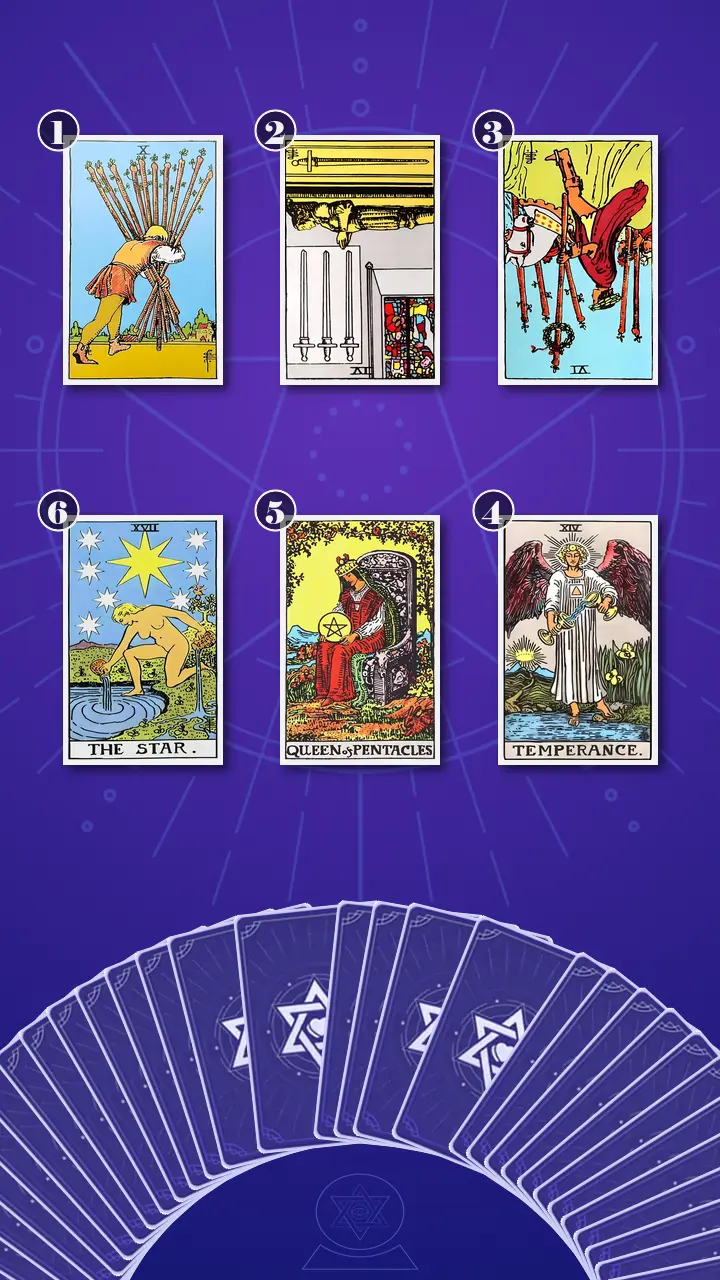
I chose the Transformation Path Grid · Context Edition, a six-card tarot spread for career setback and overwork reflection. I arranged the cards in two rows and read them along a switchback path. The upper row would diagnose the visible behaviour, the blockage that maintained it, and the belief underneath it. The lower row would identify a catalyst, turn that insight into a practical boundary, and show the integrated perspective Jordan might build. The final card would describe a direction for reflection, not a guaranteed outcome.
I chose this spread because Jordan's problem was not a single decision that needed a yes or no answer. It was a feedback system: the promotion route disappeared, harder work briefly restored control, recovery was postponed, and the unchanged route then seemed to prove that even more effort was required. A larger spread would have added breadth, but this six-position structure gave me the minimum complete map of present condition, blockage, root, catalyst, action, and integration.
This is how tarot works in my practice. The spread does not outrank the person sitting across from me. It slows the problem down, assigns each part of it a place, and lets me explain the card meanings in context. Jordan would remain the person who decided what was accurate, what was useful, and what their next steps should be.
The Burden That Still Looked Like Progress
Position One: Ten of Wands and the Obsolete Destination
I began with the position representing the observable problem: Jordan accumulating tasks, extending their hours, and carrying more responsibility after the promotion destination had disappeared. I turned over the Ten of Wands, upright.
The figure on the card is still moving toward a town, but ten bundled wands obscure the face and line of sight. I thought of the airport departure boards I had watched in cities across different cultures. Once a destination is cancelled, walking faster through the terminal does not reopen the gate. Movement can remain impressive while direction has expired.
I brought the image into Jordan's working life. At 5:58 p.m., their assigned actions could be complete, yet an unowned presentation in the project channel would prompt them to volunteer before checking the next day's deadlines or that evening's dinner plan. Carrying the extra task produced immediate relief because visible burden still resembled forward motion, even though the senior role that once gave those stretch assignments a destination no longer existed.
“The work is technically done,” I said, voicing the loop as I understood it, “but if I carry one more thing, maybe the year still counts.”
In energy terms, this was fire in excess. Jordan did not lack initiative. Initiative had accumulated until it blocked perspective. The burden narrowed the question from “Where is this work taking me now?” to “How much more can I prove I can carry?”
I asked, “Think about the last workday when your assigned tasks were complete. What extra task did you accept, and what did you hope carrying it would demonstrate?”
Jordan gave a brief laugh that held no amusement. Their hand tightened around the cup beside them, then loosened. “That is so accurate it is almost cruel,” they said. “I volunteered for a deck, cancelled dinner, and then felt angry that no one stopped me.”
“The card is not criticising your work ethic,” I replied. “It is asking whether effort still serves a current destination. Your capability is real. The question is whether every burden deserves access to it.”
Position Two: Four of Swords Reversed and the Pause That Never Begins
I moved to the position representing the immediate blockage: Jordan's habit of interrupting recovery with messages, planning, and revisions that were not actually required. I turned over the Four of Swords, reversed.
The card normally shows a figure in retreat beneath suspended swords. Reversed, the posture of rest becomes difficult to inhabit. I described the modern version Jordan knew: at 9:16 p.m. on a supposedly free evening, they closed the laptop but left Slack within reach. Six minutes later, they checked a non-urgent message, reopened an already finished document, and called the revision “getting ahead.” The activity prevented the quiet moment in which grief or anger about the cancelled promotion route might become nameable.
“It is like closing the laptop while every work process keeps running in the background,” I said. “The screen is dark, but the battery is still draining.”
This card showed restorative air in blockage and deficiency. Jordan's mind had no protected interval in which to distinguish a structural change from a personal failure. Stillness felt dangerous because it might make the loss feel final, so every pause was overwritten by another task.
I asked how long a planned evening off usually survived. Jordan looked toward the rain stippling the window. Their shoulders rose, their jaw tightened, and their gaze moved to the phone before returning to the card.
“About six minutes,” they said quietly. “I tell myself I can stop once I understand what the setback means. Then I decide I can only understand it by doing more.”
“Busyness can return control for an hour without returning the career path,” I said. “That temporary control makes sense. It also explains why the pattern is so persuasive. The extra work is not resolving the loss; it is delaying the moment when you can feel and assess it.”
Position Three: Six of Wands Reversed and the Missing Applause
I turned to the position representing the root belief: the fear that the collapsed promotion track proved insufficient worth, making recognition-seeking work feel safer than stopping. The card was the Six of Wands, reversed.
The upright image centres a mounted figure, a laurel wreath, and a witnessing crowd. Reversed, recognition is withheld, internalised, or made unstable. In Jordan's life, the wreath had become the senior title, the leadership announcement, and the public confirmation that the previous year of stretch assignments had counted.
I described the Jubilee line scene Jordan had mentioned earlier. A former colleague's “thrilled to announce” promotion post appeared between stations. The brakes shrieked, damp coats pressed close, and Jordan's thumb hovered over the reaction button while their chest tightened. They left a supportive comment, then accepted another visible stretch assignment before reaching the office. The private logic was painful and familiar: “Good for them, so why does this feel like evidence against me?”
The reversed Wands energy was not a deficiency of competence. It was recognition energy turned inward and blocked from settling. Because the original mechanism for advancement had been withdrawn, no amount of visibility could reliably answer the question Jordan was asking it to answer.
At this point I introduced a diagnostic lens I call Imposter Syndrome Auditing. I use it to separate objective professional competence from the subconscious fear of being exposed as inadequate. It is an audit, not a label. I asked Jordan to name only verifiable facts: completed work, responsibilities entrusted to them, problems they had solved, and feedback that existed before the restructure. Then I asked for the fear masquerading as evidence.
The facts were clear. Jordan had delivered complex projects, built cross-team trust, and completed the year's stretch work. The fear was equally clear but belonged in a different column: “If I were genuinely senior-role material, the path would not have vanished.”
My Jungian lens made the distinction especially visible. The public victor was the persona Jordan had learned to present, while the shadow carried the fear that no audience meant no value. The task was not to destroy the ambitious persona. It was to stop asking applause to settle a private question it could never permanently settle.
“A structural change is not a performance gap you can outwork,” I said.
Jordan's breath caught. Their eyes moved away from the cards as if replaying the internal announcement, then their palm flattened slowly against the table. “I know the reorganisation was not about my review,” they said, “but I have been treating it as if I failed an exam no one will show me.”
When Temperance Put Rest Inside the Plan
Position Four: The Two Cups of Sustainable Ambition
The rain had softened by the time I reached the position representing the catalytic shift: integrating ambition with recovery through explicit limits instead of using extra effort to reverse an organisational decision. The radiator clicked off. In the sudden quiet, a reflection from the water glass moved across the cards as I turned over Temperance, upright.
The angel pours water between two cups, with one foot on land and one in water. I read this as active calibration, not passive compromise. The card did not ask Jordan to care less about their career. It asked them to place measurable work choices and emotional recovery inside the same capacity plan.
In ordinary life, Temperance looked like Jordan opening two calendar views before accepting a Monday-afternoon request: the effort required by current goals and the recovery capacity needed to deliver it without borrowing from sleep, meals, or a promised evening. They would name the task's purpose, define its limit, and leave it unaccepted when visibility was the only benefit. Ambition and recovery would no longer compete for permission; both would enter the plan.
At 10:47 p.m., the assigned plan had been finished, Slack remained open, and a non-urgent request had become an offer to make a deck by morning. Jordan was still trying to solve a vanished route with visible effort because closing the laptop felt like a verdict.
I placed two blank slips of paper beside Temperance and turned the earlier Imposter Syndrome Audit into a two-cup exercise. On the first slip, Jordan wrote objective competence: “I delivered the plan, led the cross-team work, and met the agreed standard.” On the second, they wrote the exposure fear: “If I slow down, everyone will realise I was never worth promoting.”
“Temperance does not ask us to pretend those two statements are equally factual,” I said. “It lets us hold both without allowing the fear to impersonate evidence. One cup contains what you know. The other contains what hurts. Regulation means neither gets to flood the whole system.”
Working harder is not proof that you have recovered; build a sustainable rhythm by pouring effort and rest into the same plan, as Temperance pours between two cups.
I let the sentence remain in the room before adding, “You do not need to repair a vanished promotion path before you are allowed to recover. A bounded pace is how you find out which ambition is still genuinely yours.”
Jordan's breathing stopped first. Their fingers, which had been tracing the card's edge, froze a few millimetres above it. Then their gaze slipped out of focus, as though the Tuesday-night monitor had switched on behind their eyes: the finished plan, the archived framework, the message that could have waited. Their pupils widened, and the muscles beside their mouth tightened.
Relief did not arrive first. Anger did. “But does that not mean I spent the whole year getting this wrong?” they asked, their voice suddenly sharper. “And if I stop now, they still get to change the deal while I absorb the consequences.”
I kept my hands still. “No. It means you used the strategy that once appeared connected to a real destination. The organisation changed the structure, and your nervous system kept using the old route. Your anger belongs here because something was withdrawn. Recovering does not excuse that decision, erase the lost time, or require you to call it a lesson.”
Only then did Jordan's fist open. Their shoulders dropped on a long, uneven breath; their eyes reddened without spilling into tears. For a second they looked lighter, then almost disoriented, as if putting down the burden had exposed how much responsibility came with choosing where to walk next. “I thought clarity would feel more certain,” they said. “This feels like having space and not knowing what to do with it.”
“That space is not failure,” I said. “Now, using this new perspective, think back to last week. Was there a moment when this insight might have made you feel different?”
Jordan returned to Sunday evening. Rain had tapped the window while they rebuilt Monday's priorities from the sofa. “I might still have felt angry,” they said, “but I could have recognised that planning an extreme week was not a career strategy. It was a way to avoid admitting the role was gone.”
I gave them a deliberately small reinforcement exercise. I asked them to set an eight-minute timer, place work apps on Do Not Disturb, and divide a page into two columns: “What the organisation withdrew” and “What I can still choose.” One honest item in each column was enough. I then asked them to move one optional extra-work block in the coming week into a 45-minute recovery-and-review block, keeping the first 20 minutes completely free of output and using the remaining 25 only to review those two columns.
I stressed that this was not an instruction to ignore genuine on-call or incident duties. If 45 minutes felt too exposed, Jordan could keep the two written lines and test a ten-minute version instead. The aim was not to perform recovery perfectly. It was to create a protected interval in which recovery could finally begin doing its work.
I named the deeper transition I could see: this was one step from achievement-contingent overwork and blocked grief toward bounded, values-led ambition supported by recovery. It was not the end of Jordan's career question. It was the point at which the question could stop being answered automatically by more output.
Giving Balance a Calendar
Position Five: Queen of Pentacles and the Finite Week
I moved to the position representing grounded action: practical stewardship of time, workload, attention, and one visible boundary Jordan could maintain. I turned over the Queen of Pentacles, upright.
The Queen cradles the pentacle rather than holding it above a crowd. I saw balanced earth energy: value held, protected, and allocated with care. Where the Six of Wands had asked an audience to confirm worth, the Queen measured reliability through what could be sustained across an entire week.
I translated the card into a realistic workplace scene. Jordan chooses a 6:30 p.m. sign-off on three working days, protects one 20-minute lunch, and defines which channel is reserved for genuine urgency. When an optional task appears, they assess it beside existing deadlines, sleep, commuting time, and a promised evening with friends. The governing question becomes, “Can this fit without borrowing from lunch, sleep, or tomorrow?”
“Your weekly energy budget has been hiding its real costs,” I said. “Meals, relationships, travel, sleep, and attention are not invisible infrastructure. They are part of the cost of reliable work. Every new commitment needs a purpose, a limit, and a recovery cost.”
I also used my Authority Archetype Integration lens. Jordan had been trying to prove leadership readiness through an individual-contributor reflex: catching every loose task personally and remaining endlessly available. I explained that mature authority is not infinite personal absorption. It includes allocating finite resources, distinguishing genuine urgency from ordinary work, and allowing a team or system to carry responsibilities without turning every gap into a private test of worth.
“The friction is not that you lack leadership,” I said. “It is that you have been using visibility as the evidence of leadership. Being indispensable is not the same as being on a path.”
Jordan looked at the calendar on their phone without opening Slack. Their thumb hovered over Wednesday evening, when a friend had already asked about dinner. First their brow tightened; then they counted existing deadlines under their breath; finally, their shoulders settled against the chair.
“I could protect Wednesday,” they said. “The task I usually stay for can wait until Thursday. I know that. I just never let knowing it count.”
Position Six: The Star Beyond the Archived Framework
The final position represented the integrated perspective available when Jordan could acknowledge the loss, recover capacity, and define direction without making promotion the sole proof of professional value. I turned over The Star, upright.
The figure pours water onto land and into a pool beneath an unobstructed sky. Temperance had regulated the flow; The Star showed that flow becoming replenishment and orientation. I read the water as balanced renewal, spacious enough to carry disappointment without allowing disappointment to decide the whole future.
I was careful with this card. It did not promise Jordan a replacement title, a better employer, or a satisfying explanation from management. Its hope was more honest than prediction. It invited Jordan to close the archived promotion framework for ten minutes and write three headings on an empty page: “skills I want to use,” “conditions I need,” and “contribution I care about.”
In the scene suggested by the card, Jordan would not force an immediate career plan. They would identify work that remained meaningful without an announcement and save a role description because its responsibilities or working conditions interested them, not because its title could repair the setback. The public wreath of the Six of Wands had been replaced by an open point of reference that needed no crowd.
I asked, “If the old title disappeared from the page, what would you still want your next chapter of work to contain?”
Jordan became quiet. Their fingertips stopped moving, their eyes lowered to the open sky on the card, and a breath left their chest without the earlier catch. “I want to solve complicated service problems,” they said. “I want trust, enough autonomy to make decisions, and a pace where I am not cancelling my life. I do not know the replacement path yet, but I can name the conditions in which I want to work.”
That was The Star's contribution to finding clarity. It did not provide a destination on command. It helped Jordan choose coordinates: pace, contribution, autonomy, learning, and a life that did not have to disappear whenever a notification arrived.
The Plan That Did Not Need to Prove Anything
What the Six Cards Said Together
I gathered the cards into one causal story. During the previous year, stretch assignments and cross-team visibility had been attached to a believable progression route. When the organisation removed that route, Jordan's working habits continued as if the old exchange still applied. The Ten of Wands showed the visible result: more responsibility with less view of the destination. The Four of Swords reversed showed why the pattern could not update: rest was interrupted before reflection or grief could occur. The Six of Wands reversed revealed the emotional engine: withdrawn organisational recognition had been converted into a private verdict about competence.
Temperance supplied the leverage point by putting purposeful effort and recovery into the same plan. The Queen of Pentacles gave that principle material form through time, meals, sleep, relationships, and workload boundaries. The Star then opened a title-free reference point for career direction. The movement across the spread was from overheated proving and blocked thought toward emotional processing, practical stewardship, and honest hope.
The cognitive blind spot was not that Jordan had failed to notice their exhaustion. They knew they were tired. The blind spot was the belief that extra availability could still repair a structural withdrawal, and that stopping would prove the withdrawal had been deserved. Once we separated those ideas, the core contradiction became visible: Jordan had been trying to restore the collapsed promotion track through harder work while postponing the recovery needed to assess whether their current effort served any chosen destination.
The transformation direction was therefore precise. Jordan did not need to abandon ambition or pretend the role had never mattered. They needed to replace one proof-seeking work block with protected recovery and career review, separating what the organisation had withdrawn from what they could still choose. Recovery would become part of sound career judgment, not a reward granted after every task was finished.
Three Small Tests for the Next Working Week
I framed the following actions as experiments, not commandments. Each one was small enough to produce information without requiring Jordan to resign, confront a manager, choose a new profession, or feel certain about the future.
- The Competence-Anchored Recovery Review. Choose one optional 45-minute evening work block this week and rename it “Recovery + Career Review.” Spend the first 20 minutes away from screens. During the remaining 25 minutes, write one item under “What the organisation withdrew” and one under “What I can still choose.” Finish with one verifiable achievement that remains true without a title, announcement, or manager's praise. This is my Competence Anchoring Exercise: self-worth is tied back to evidence instead of the next external verdict. Tip: Treat the block as decision infrastructure, not a reward for finishing everything. If 45 minutes feels unrealistic, use five screen-free minutes and five minutes for the two written lines.
- The Purpose, Limit, and Recovery Cost Check. Before accepting the next optional stretch task, open Notes and write three lines: “Purpose,” “Limit,” and “Recovery cost.” Name the current goal or chosen skill the task serves, the boundary on time or scope, and what accepting it would require from sleep, lunch, or personal plans. Wait 24 hours when visibility or reassurance is the only purpose. Tip: Do not turn the check into a new performance tracker. Three plain sentences are enough, and genuine urgent or on-call responsibilities can be handled through their established channel.
- The Grounded Sign-Off Boundary. Choose a realistic sign-off time for two or three working days, place it in the calendar, and pause ordinary Slack or Teams notifications at that time. Define the route for genuine urgency. For one non-urgent after-hours message, reply during the next working period with: “Seen, thanks. I will pick this up tomorrow morning.” Tip: A boundary is information about sustainable capacity, not a guarantee that nobody will question it. Test two evenings first if a full working week is not feasible.
I asked Jordan to choose only one experiment as the minimum commitment. They chose the Recovery + Career Review block and put it on Tuesday evening. The decision took less than a minute. Their career situation remained unresolved, but the calendar now contained one place where the organisation's uncertainty was not allowed to consume another hour automatically.

A Week Later, the Quiet Proof
Six days later, I received a message from Jordan. They had kept the Tuesday block. Four minutes into the screen-free portion, their hand had reached for the phone almost without thought. They noticed the movement, left the phone face down, and stayed with the discomfort rather than converting it into a task.
Under “What the organisation withdrew,” they wrote: “A defined route to the senior role.” Under “What I can still choose,” they wrote: “I do not have to borrow from sleep to prove that the loss mattered.” For the competence anchor, they recorded a project they had delivered successfully before the restructure was announced. The achievement looked almost ordinary on paper, which was precisely the point. It remained true without applause.
Two evenings later, a non-urgent request arrived at 6:31 p.m. Jordan left it until morning and went to the dinner they would usually have cancelled. They told me they still checked the time twice and felt a hollow pull behind the ribs when they imagined someone else volunteering. The boundary had not erased the old reflex. It had simply prevented the reflex from making the decision.
That night they slept through. Their first thought at dawn was, “What if slowing down costs me?” They noticed it, smiled once, and left Slack closed until the working day began.
I did not regard that as proof that Jordan's career problem had been solved. I regarded it as evidence of a more important transfer of authority. Temperance had not granted Jordan permission to recover; Jordan had used the image to recognise permission they could give themselves. The six-card Transformation Path Grid had functioned as a map, but they were the one choosing the pace, the boundaries, and the coordinates.
Our Journey to Clarity moved from achievement-contingent overwork toward the first practice of sustainable ambition. Clarity did not arrive as certainty about the next role. It arrived as the ability to distinguish grief from incompetence, busyness from direction, and purposeful effort from work performed only to keep an old verdict away.
When a promotion path disappears, it can feel safer to keep your jaw tight and your status green than to close the laptop and meet the fear that stopping might make the loss, and what it seems to say about your worth, feel final. Noticing that fear does not make you less ambitious. It gives you a chance to decide whether the next hour belongs to a current value or to a destination that is no longer open.
If one extra-work block no longer had to prove anything, what might you want that hour to hold: rest, anger, honest review, or simply being off?