A Quiet Promotion, a Slack Request, and the Question Before Yes

The 9:40 p.m. Quiet Promotion
I call it the quiet promotion pattern: an operations specialist at a growing London tech company types "Absolutely" in Slack before checking her calendar when a manager hands her work above her remit.
When Alex joined our video session, it was 9:40 p.m. on a Tuesday. In the small living room of her flatshare, the radiator ticked behind her and the laptop fan hummed beneath the conversation. A presentation glowed in one corner of her screen, reopened for a project that had never been formally added to her role. Its blue-white light sharpened the tiredness around her eyes.
A Slack notification sounded. Alex glanced down, and I watched her shoulders rise almost to her ears. Someone wanted to know whether she could own another cross-team task. Her fingers moved towards the keyboard before she stopped herself.
"I was literally about to say yes," she told me, pressing two fingers against her jaw. "I am already doing the bigger job, so why does asking where it leads feel harder than doing it?"
She wanted career growth, but each new piece of next-level work made the question of progression harder to name. Her formal title had stayed still while her workload accumulated decision-making, coordination, and manager-level responsibility. Praise for being dependable gave her a brief lift; then the next late night arrived, and the unclear career path remained.
I heard frustration in her account, but it was not a clean, uncomplicated anger. It felt more like a Slack notification trapped beneath the sternum: a low vibration of resentment, guilt, and uncertainty that kept returning even after the urgent work was finished. Alex did not want to sound entitled. She also no longer wanted invisible labour to be mistaken for a development plan.
"I am not going to use tarot to predict whether your company will promote you," I said. "I want to help you see the pattern objectively, including what belongs to your workplace and what remains within your control. Let us give this fog a map, then identify one or two next steps that do not require another invisible late night."

Choosing the Grid That Could Find the Loop
I invited Alex to let both feet rest on the floor and take one slower breath before I shuffled. I treat this pause as a change of cognitive gear, not a performance of mystery. It gives the nervous system a moment to stop answering the newest notification and return to the real question.
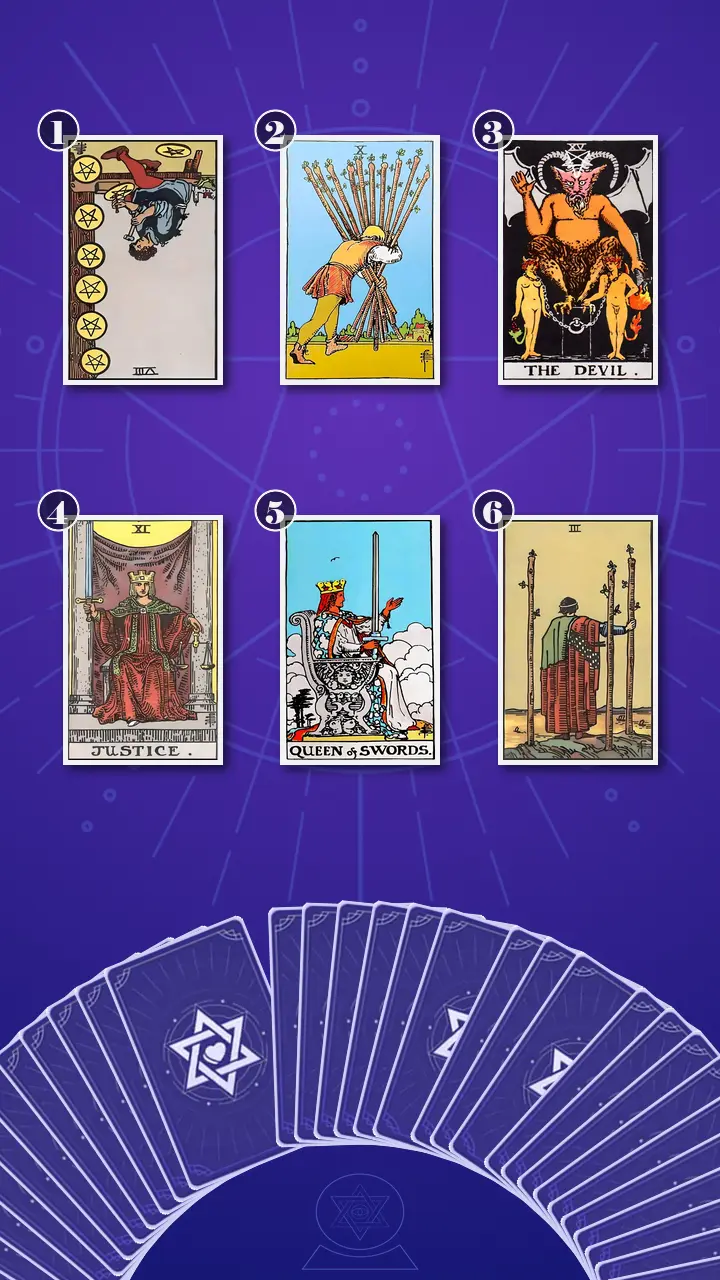
I chose the Transformation Path Grid (6) · Context Edition, a six-card tarot spread for career clarity. This is how tarot works in my practice: the spread does not issue a verdict; it separates a crowded problem into distinct positions so that card meanings can be examined in context.
I chose this structure because Alex was not deciding between two simple job offers. She was caught in a self-reinforcing cycle: bigger assignment, automatic agreement, temporary validation, expanded baseline, continued ambiguity, then another attempt to earn clarity through output. A binary decision spread would have flattened that loop into "stay or leave," when neither choice was yet the most useful question.
I arranged the cards in two rows of three. The top row would show the visible work pattern, the burden reinforcing it, and the worth-based rule underneath it. The lower row would identify the turning point, translate that insight into a communication practice, and open a wider career horizon. I told Alex that the most important movement would be from the hidden root in Position 3 to the transformation in Position 4, then from insight into speech in Position 5.
The layout looked like a crowded project board being redrawn as a navigable map. I could already see the practical purpose of the spread: it would let us ask why she felt stuck despite strong performance without assuming that overwork was either a personal failure or a guaranteed route to promotion.
Reading the Crowded Workboard
Position 1: When Craft Becomes Another Late-Night Revision
The first card I turned over represented the presenting symptom: Alex's visible pattern of accepting bigger work, repeatedly polishing deliverables, and postponing the conversation about career direction. It was the Eight of Pentacles, in the reversed position.
In the Rider-Waite-Smith image, an apprentice concentrates on one pentacle while completed pieces line the wall. I connected that workbench to Alex's Tuesday night. At 9:40 p.m., she had reopened a presentation that was already complete, made further revisions, and prepared to add the result to a private list of achievements. The output was visible, but she could not say whether the task had built a specific skill, strengthened a case for a title change, or clarified her next step.
The card did not criticise diligence. It showed diligence in excess, with intentional development blocked. The work itself was competent; the problem was that repeated production had started doing the psychological job of certainty. Each polished deliverable briefly reassured Alex that she was progressing, even when no progression criteria had been agreed.
"Think of the last substantial task you completed," I said. "What did it genuinely teach you, and what did it only add to your workload?"
Alex gave a short, bitter laugh. "That is so accurate it is almost rude. I coordinated a launch across four teams. I learned something, obviously, but mostly I proved I could survive coordinating another launch across four teams."
I let the distinction remain on the table. Survival, skill, recognition, and direction were related, but they were not interchangeable.
Position 2: The Bundle That Blocked the Destination
The next card represented the reinforcing blockage: the workload and short-term relief that kept the overwork cycle running while Alex's direction stayed stagnant. I turned over the Ten of Wands, upright.
The figure on the card carries ten wands in a bundle so dense that it blocks the town ahead. I asked Alex to picture her Google Calendar and project board as that bundle. She could list every launch, dashboard, meeting, escalation, and cross-team dependency she carried. Yet when I asked what role all of it was building towards, she went quiet.
Here, Wands energy had tipped into excess. Responsibility had expanded until it consumed the attention needed to evaluate responsibility. Delivery offered immediate relief because it gave Alex a concrete task and a measurable finish line. A progression conversation offered no such comfort; it required her to name what she wanted and risk hearing information she might not like.
"More responsibility can be evidence of capacity without being a promise of progression," I said. "If carrying the bundle leaves you no time to look at the destination, the burden begins to maintain the uncertainty it was supposed to solve."
Alex looked past her screen towards the darkened window. Her fingers tightened around her mug, then loosened. "My manager keeps saying the exposure will be good for me," she said. "I have never asked what the exposure is meant to become."
I did not tell her that the assignments were worthless or that the company was deliberately exploiting her. I asked for a more precise standard: which responsibility was developing something she wanted, and which one was merely becoming normal because she had carried it without renegotiating scope?
Position 3: The Rule Hidden Inside the Automatic Yes
The third card represented the underlying root: the worth-based fear that made output feel safer than asking for a clear career path. I turned over The Devil, upright.
I never use The Devil to frighten a client. In a Jungian psychological reading, I treat it as an image of an attachment that gains power by remaining unnamed. The loose chains around the figures matter. They do not suggest that Alex's employer bears no responsibility for vague expectations, nor do they blame her for adapting to them. They show that an external situation has connected with an internal rule, making one repeated response feel compulsory.
For Alex, the modern version of the chain appeared when a manager asked her to take on another project. A flash of fear arrived before the answer: "If I do not take this, they may decide I am not ambitious enough." Declining the project felt more dangerous to her professional identity than accepting another late night. She wanted clarity, but she kept offering more labour instead.
The energy here was blockage through attachment. Ambition itself was not blocked; Alex's freedom to evaluate an opportunity had narrowed because professional worth had become conditional on continued availability.
I used one of my core diagnostic lenses, Imposter Syndrome Auditing. I drew two columns on a sheet of paper. In the first, I recorded objective professional evidence: Alex had coordinated senior stakeholders, made decisions above her remit, delivered a cross-team launch, and repeatedly received trust from leadership. In the second, I recorded the fear-based interpretation: asking for criteria might expose that she was not ready, grateful, or ambitious enough.
"The audit does not prove that your company will promote you," I said. "It proves something narrower and more useful. Your competence is supported by evidence. The fear of exposure is a separate psychological signal, not an objective assessment of your ability."
Alex's breath paused. Her gaze dropped to the Devil's chains as if she were replaying a series of Slack exchanges. Then a quiet "Oh" escaped her, and her shoulders lowered by a fraction.
"So the rule is not just that I should work hard," she said. "It is that I am not allowed to ask what the work means until I have somehow worked enough."
"Yes," I replied. "And because 'enough' has never been defined, the subscription renews automatically. Your output can be real without becoming a loyalty test."
When Justice Put the Slack Thread on the Scales
Position 4: The Standard That Interrupts the Cycle
The fourth card represented the key transformation: the truth, standard, or boundary capable of interrupting the pattern of doing a bigger job without clearer direction. The room seemed to become quieter when I turned over Justice, upright. Even the radiator had stopped ticking.
Justice sits frontally, holding balanced scales in one hand and an upright sword in the other. I translated the scales into two columns in a real document. On one side: expanded responsibility, decision level, time cost, and skills demonstrated. On the other: title, pay, recognition, development plan, decision rights, review date, and the existing priority that would move. The sword was not a threat. It was one direct question that could cut through "good exposure" and reveal the actual terms.
I told Alex that doing next-level work was evidence of contribution, not a substitute for an agreed career path. She could show the evidence without putting her worth on trial. Justice restored balance by separating the fact that she was capable from the interpretation that she had to keep doing more before she deserved clarity.
I also recognised a deeper leadership transition, one I call Authority Archetype Integration. Alex had learned to succeed as the highly capable individual contributor who absorbed ambiguity and made problems disappear. But the emerging leader in her needed a different relationship with responsibility. Leadership was not merely carrying more. It included assessing cost, naming trade-offs, clarifying decision rights, and deciding whether the work served a chosen direction.
The friction was not ambition versus laziness. It was the old authority pattern, "I earn trust by absorbing the problem," meeting a more mature inner authority that could say, "I assess the exchange before I commit resources." Justice gave that inner authority a structure.
I brought Alex back to the instant that had opened our session: the urgent work finished, the laptop reopened, another Slack request glowing at 9:40 p.m. Her shoulders had risen while her fingers prepared the safer, questionless answer: "Absolutely."
You do not have to carry a heavier load to deserve a clearer path. Use Justice's scales and sword to measure the exchange and name the criteria before taking on another responsibility.
I stopped speaking.
For one beat, Alex's breathing froze. Her fingers hovered above the trackpad, perfectly still. Then her eyes lost focus, as though a week's worth of meetings were replaying behind them. Her pupils widened; the muscles around her mouth tightened. Recognition arrived first as anger rather than relief.
"But does that mean I have been doing this wrong for years?" she asked. Her voice sharpened, then cracked at the final word. A flush moved across her face, and her eyes became faintly red. She folded her arms, released them almost immediately, and pressed both palms against the desk. Only then did her shoulders drop. The exhale that followed carried relief, grief, and a brief dizziness at having no automatic answer to hide inside.
"No," I said. "It means your strategy worked well enough to make you trusted, and it now costs more than it clarifies. You were not foolish for using the tools that helped you succeed. The task is to notice when competence has become overcompensation, and when your workplace needs to supply information instead of receiving another proof."
I asked, "Now, with this new perspective, think back to last week. Was there a moment when this insight could have made you feel different?"
Alex remembered a Thursday meeting in a glass-walled room. Her manager had praised her reliability, then asked her to coordinate another launch. "I thought my choices were yes or looking unambitious," she said. "Justice gives me a third option. I can ask what changes if I take it."
I set a ten-minute timer and invited her to write three lines in her Notes app: the bigger responsibility she was carrying, what it was supposed to develop or lead towards, and the question she wanted answered. I reminded her that she did not have to send anything that night. If her jaw tightened again, she could stop after saving a single line: "What would this responsibility need to lead to for me to take it on?"
This was the first real movement from frustrated overwork and fear-based overcommitment towards self-respecting discernment. It did not settle her entire career. It changed where she expected clarity to come from. Instead of using bigger workloads to earn clarity, she could request clarity before agreeing to the next stretch assignment.
The Sword, the Open Hand, and the Horizon
Position 5: Giving the Evidence a Voice
The fifth card represented the actionable next step: a concrete communication and boundary practice for clarifying scope, progression criteria, and the conditions for taking on more work. I turned over the Queen of Swords, upright.
The Queen holds a raised sword while extending an open hand. I read that combination as direct but non-punitive communication. The sword protects time and distinguishes fact from assumption. The open hand remains receptive to information, including an answer Alex may not expect.
I asked her to imagine a short one-on-one with a written agenda. She would name the work she was already carrying, ask what evidence defined the next level, and state what would need to come off her list before she accepted more. Then she would let the silence remain instead of filling it with another promise to work harder.
The Queen's energy was balanced: neither silent compliance nor a dramatic ultimatum. Alex did not have to turn the conversation into a verdict on her worth. She could ask for information, listen carefully, and make her own decision with better evidence.
"Try three sentences," I said. "I am currently owning this level of work. I want to understand what the next level requires and how this responsibility would be assessed. Before I take on more, I need to agree which priority moves."
Alex read the sentences twice. Her jaw tightened at the second one, but she did not edit it into an apology.
"That sounds like someone who expects an answer," she said.
"It sounds like someone willing to use an answer," I replied. "That is different from demanding a guaranteed outcome."
Position 6: Looking Beyond the Next Available Task
The final card represented the integrated direction: a self-authored view of possible career horizons after separating contribution from the need to constantly prove worth. I turned over the Three of Wands, upright.
The card's figure stands at the shoreline, looking towards ships in the distance. I contrasted that outward gaze with the apprentice's downward gaze in the reversed Eight of Pentacles. At the beginning, Alex's attention had been fixed on the next task at the workbench. Here, she had enough distance to compare possible directions: operations leadership, programme management, or a role at a different kind of technology company.
The Wands energy had returned in a more balanced form. It was no longer indiscriminate action or a bundle she had to carry. It had become purposeful exploration. Alex could choose one conversation, observation, or time-boxed project to test a direction instead of treating every available task as the next step.
For a moment, the shoreline brought back memories of my own travel across cultures. I thought about passports: they can verify where someone has been, but they cannot choose the next destination. Alex's achievement list was valid evidence of her journey. It was not an itinerary.
I also noticed the spread contained no Cups. I did not treat that absence as a warning. I used it as a reflective opening. Alex had spent so much time asking what work would look impressive that very little space remained for the question of what kind of work felt worthwhile.
"Justice and the Queen can help you obtain better information," I said. "The Three of Wands asks what you want to explore once every option is no longer selected by whoever messages first."
Alex looked again at the six cards. "I do not need to decide my whole career tonight," she said. "I need to stop letting my inbox decide it by default."
Clarity Before Capacity: Two Actionable Next Steps
I read the spread back to Alex as one coherent story. The reversed Eight of Pentacles showed a successful work strategy that had narrowed into repetitive proof. The Ten of Wands showed the accumulated cost: the workload crowded out the perspective needed for career planning. The Devil revealed the hidden bargain underneath both cards, where constant output felt safer than risking a direct question about recognition and progression.
Justice then made the exchange measurable. The Queen of Swords gave that assessment a calm, direct voice. The Three of Wands restored enough distance for Alex to choose a horizon rather than automatically inherit another task.
I described the pattern as a professional algorithm trained on one repeated click. Every time Alex pressed yes, the system learned to recommend more of the same work and treated repeated availability as evidence that this was what she wanted. Updating the algorithm did not require her to reject all stretch work. It required a new input before the next commitment: What does this build, what moves, and what defines the next level?
The cognitive blind spot was now visible. Alex had been treating evidence of capacity as though it were evidence that a career path existed. Her expanded scope proved that she could contribute at a higher level; it did not, by itself, prove that her employer had agreed to a title, timeline, development plan, or progression criteria.
That distinction changed the direction of the work. Clarity was part of the exchange, not a reward for endless proof. Alex could remain ambitious while asking for terms, protect financial stability while gathering information, and explore other possibilities without forcing herself into an immediate stay-or-leave decision.
- Run the Competence Anchoring Exercise for one week. At the end of each workday, Alex would spend no more than ten minutes in Notes or Notion logging any task above her remit under four labels: scope, time cost, decision level, and skill demonstrated. On Friday, she would circle one example and write one sentence naming the recognition or development that would make the work meaningful. This would anchor her self-assessment to verifiable achievements without asking praise, perfection, or another assignment to determine her worth. Start with one neutral, non-confidential task if a full audit feels exposing. Facts are enough; no defence of worth is required.
- Prepare the Three-Sentence Progression Ask. Alex would request a 15- to 20-minute conversation with her manager and bring the single example from her log. She would name the work she already owned, ask which criteria and timeline defined the next level, and clarify what existing priority would move before she accepted additional scope. For the next stretch request, she would wait ten minutes, check her calendar, and send one question before confirming: "What should come off my list, and how will this responsibility be recognised or reviewed?" Draft the message in Slack first and keep the tone curious. If a full boundary feels too sharp, begin with the priority trade-off question and ask for time to check capacity.
I reminded Alex that these actions were information-gathering experiments, not tests she had to pass. A specific answer, a vague answer, or a refusal to define progression would each provide useful evidence. Tarot had organised the questions; Alex would decide what to do with the answers.

Six Days Later, One Different Reply
Six days later, I received a message from Alex. She had logged three pieces of work, not every task, and had circled the cross-team launch. When another Slack message began with "Quick one" and ended with "Could you own this?", she waited twelve minutes before responding.
She asked which current priority should move and what the assignment was intended to demonstrate. Her manager did not produce an instant promotion plan. He did agree to a separate progression conversation, acknowledge that the work sat above her documented remit, and move a reporting task from her list.
That night, Alex slept through until morning. Her first thought was still, "What if I handled that badly?" This time, she noticed it, smiled, and made coffee before opening Slack.
I did not see that message as proof that the cards had changed her career. I saw it as proof that Alex had used the cards to change one decision point. The Transformation Path Grid had helped her move from frustrated overwork towards clearer self-advocacy, but the authority to set a boundary, interpret her manager's response, and choose a career horizon remained entirely hers.
I have learned that clarity is not always a final answer. Sometimes it is the first visible line on a map that had previously been covered by tasks. If your laptop is still open after 9:40 p.m. and your jaw tightens around another automatic yes, consider whether your output is being asked to secure a career path that no one has clearly named.
Before your next Slack reply, what one honest question would you place on Justice's scales to make the kind of work you want to explore finally visible?