When One Text Made the Whole Evening Negotiable
If you coordinate shifting deadlines all day and still become your friends' unpaid after-hours project manager, friendship boundary guilt may be running your evenings. Jordan (name changed for privacy), a 27-year-old project coordinator at a Toronto digital agency, knew that pattern before our session even began.
Jordan described a Tuesday at 6:15 p.m. in their shared apartment. They were putting away groceries beside an open work laptop when their phone lit up with, “I really need you right now.” The refrigerator hummed. A cold produce bag dampened their palm. Before they had learned what had happened, their stomach dropped, their chest tightened, and their thumb was already typing, “Calling now.”
“I hadn't asked how urgent it was, what they actually needed, or whether anyone else could help,” Jordan told me. “But I'd already closed my laptop, left dinner on the counter, and decided my whole evening was cancelled.”
I heard anticipatory guilt in that sequence, but it did not arrive as a quiet moral concern. It hit Jordan like missing a stair in the dark: one sudden internal drop, followed by the restless pressure to grab the nearest railing before checking whether there was any real danger. Relief came when they became useful. Hours later, it curdled into exhaustion and the kind of resentment that sits behind the teeth because saying it aloud feels disloyal.
“I am everyone else's emergency contact and my own last priority,” Jordan said. “Why do I keep proving loyalty by dropping everything for friends?”
I kept my answer simple. “Because some part of you has learned that being needed is safer than making your actual capacity visible. I don't want to judge that part or predict what your friends will do. I want us to see the pattern clearly enough that you can choose your next response instead of being pushed into it. Let's make a map of the fog.”

Choosing the Bridge: A Relationship Spread
I invited Jordan to take one unforced breath and place their phone face down. I shuffled slowly while they held one question in mind: “What happens inside me between receiving a request and cancelling myself?” I treat this small ritual as a transition of attention, not as supernatural theatre.
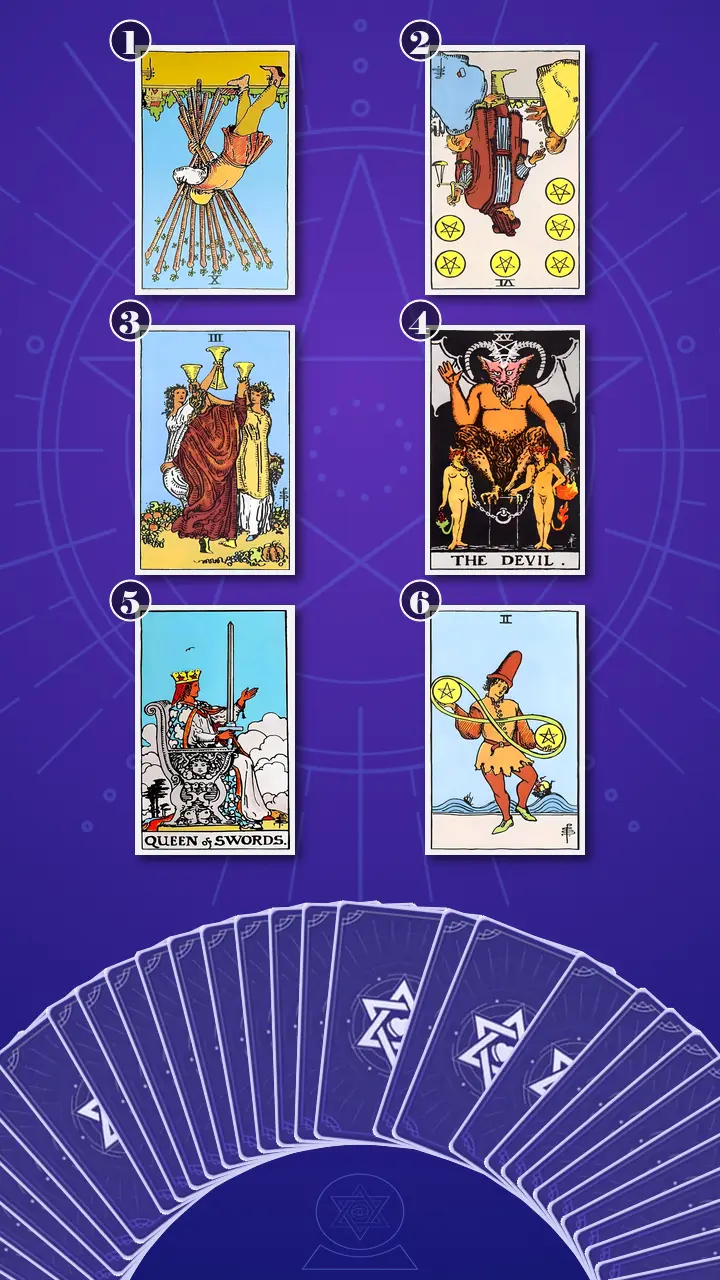
I chose a classic six-card Relationship Spread because the problem lived inside an exchange: Jordan's role, the request dynamic, the friendship's real value, the recurring challenge, the inner resource, and the practical response. A larger Celtic Cross could have added timelines and outside influences, but those layers would have distracted from the precise mechanism we needed to examine.
I arranged the cards in two columns and three rows, like a bridge with parallel supports. The upper row would show Jordan's observable role and the unequal request-response pattern. The middle row would place genuine friendship beside the hidden loyalty contract. The lower row would identify the capacity Jordan could develop and the next step that could make it real. This is how tarot works best for me: not as a verdict, but as a structured way to compare card meanings in context with choices already unfolding in ordinary life.
The Work Hidden Inside “Of Course”
Position 1: The Evening Beneath Ten Wands
I turned the card in the position representing Jordan's present role: the visible symptom of dropping prior commitments and carrying a friend's problem beyond personal capacity. It was the Ten of Wands, reversed.
I pointed to the figure bent beneath a tightly bundled load, with the wands blocking the road ahead. “This is your 6:15 p.m. scene,” I said. “The laptop closes. The groceries stay on the counter. Dinner disappears. You take the call and begin handling logistics before you even know what happened. One vague message becomes ten jobs.”
In reversal, the card showed blocked release. Jordan had exceeded their capacity, yet putting down even one part of the bundle felt more dangerous than continuing to strain. The energy of care was not absent; it had expanded into responsibility before anyone had established what responsibility was actually theirs.
“It is only one call, so why does my whole evening disappear?” I asked, giving language to the loop. “And which part of the load was freely chosen after you had the facts?”
Jordan gave a short laugh that carried no amusement. Their fingers tightened around the sleeve of their mug, then loosened. “That is so accurate it's a bit brutal.”
“I hear the sting,” I replied. “But the card is not calling your kindness a mistake. It is showing where kindness loses its edges. Resentment often records the limit you did not feel allowed to state. We can treat that resentment as information, not as proof that you are a bad friend.”
Position 2: The Scale That Forgot One Person
I turned the card in the position examining how requests, disappointed reactions, and perceived loyalty tests participate in the exchange without assuming malicious intent. It was the Six of Pentacles, reversed.
The traditional image contains a scale, but the reversal made the missing data obvious. I asked Jordan to imagine their usual capacity calculation. A friend's distress went on one side. On the other side, Jordan quickly calculated how fast they could arrive, which message they could rewrite, whether they should book an Uber, and how long they could stay. Their paid class, unfinished deadline, dinner, sleep, transit cost, and emotional energy never made it onto the scale.
“I measured how badly they needed me,” Jordan said slowly, “but not what saying yes would cost me.”
That was the imbalance. The reversed Earth energy did not tell me that Jordan's friends were exploiting them. It showed generosity being offered without a complete capacity check, which meant the consent underneath the offer was becoming blurred.
I brought in one of my working lenses, Clique Power Dynamics. In close friend groups, roles can harden through tiny repeated signals: who is expected to answer first, whose plans are treated as movable, who receives praise for being “the reliable one,” and how much moral weight gets packed into one word like “actually” in the message, “Would anyone actually be able to come?” Nobody has to plan that hierarchy for it to shape behaviour.
“The useful question isn't, 'Who is the villain?'” I told Jordan. “It is, 'Whose time has quietly become the group's most flexible resource?'”
Jordan looked away from the cards and mentally counted. I watched irritation flash across their face, followed almost immediately by the reflex to excuse everyone. “They do have real problems,” they said.
“They may,” I answered. “A real need and your real limit can exist in the same room.”
Position 3: Friendship When Nobody Needs Saving
I turned the card in the position identifying the genuine emotional value beneath the pattern: friendship, mutual support, enjoyment, and belonging. It was the Three of Cups, upright.
The three cups rose at equal height inside an open circle. I asked Jordan to remember an unhurried Saturday with friends, sharing food, laughing about a show, and making loose plans for the following month. Nobody was in crisis. Nobody had to earn a place by solving transport, rewriting a text, or staying on a call until 2 a.m. Attention and initiative moved around the group.
Here the Water energy was balanced. The card protected Jordan's desire for closeness instead of treating it as the problem. Compulsive caretaking had grown around a valid wish to belong, but genuine friendship was still visible beneath the emergency labour.
“I don't want less friendship,” Jordan said after a long exhale. Their shoulders lowered by a fraction. “I want friendship that also exists when nobody needs saving.”
“Exactly,” I said. “The Three of Cups is not asking you to withdraw. It is reminding you what you are trying to preserve: shared life, not permanent usefulness.”
The Notification That Felt Like a Command
Position 4: The Devil and the Unspoken Loyalty Contract
I turned the card in the position revealing the central challenge: the belief that constant usefulness is required to secure belonging. It was The Devil, upright.
I told Jordan immediately that I did not read this card as proof of a toxic friend, an evil influence, or a doomed relationship. In this position, The Devil described compulsion: an old bargain obeyed so quickly that it felt like fact. The figures in the card wore chains, but those chains were visibly loose. The image was not denying the pressure. It was showing that pressure and powerlessness were not identical.
“A notification arrives, and it feels like a command,” I said. “Your thumb moves toward yes while the thought says, 'If I pause, they will remember I was not there.' It is like an always-on workplace escalation channel that has quietly spread into every friendship, even though nobody agreed on service hours.”
The need may be real. The emergency setting may still be automatic.
“You are not answering a request,” I continued. “You are trying to pass a loyalty test nobody clearly set.”
Jordan's breathing caught. Their gaze settled on the loose chain, then went unfocused as if they were replaying years of typing bubbles, one-word replies, and “ride-or-die” posts. “If I wait, even for twenty minutes, I feel like I've already failed,” they said.
“That feeling is real,” I replied. “But a feeling can report an old rule without issuing a present instruction. The card gives us a catalytic moment: you can notice the contract before you renew it.”
When the Queen of Swords Opened the Sky
Position 5: Resigning From the Role, Not the Friendship
The rain against the window softened, and the heating pipe gave one clear click before the room became still. I turned the card in the position representing the inner resource Jordan needed to interrupt automatic compliance: discernment, direct language, and a boundary that preserves care. It was the Queen of Swords, upright, the key card of the reading.
I placed her beside the Ten of Wands. My eye made an immediate match cut from ten bundled responsibilities blocking the view to one upright sword beneath an open sky. The Queen held that sword with precision, but her other hand remained open. Her energy was balanced Air: clear enough to separate care from total responsibility, and receptive enough to stay in relationship.
I use a framework called Sidekick Syndrome Diagnosis, in a narrative rather than clinical sense, to identify the restrictive character someone has been assigned inside a group. Jordan had become the therapist, dispatcher, message editor, transport planner, and emergency contact. Friends may have reinforced that role, and Jordan had also stepped into it because the role offered reassurance. The Queen did not demand a dramatic exit from the group. She offered what I call The Role Resignation Act: refusing the assigned character while leaving the door open to real connection.
I asked Jordan to return to 6:15 p.m.: groceries still sweating on the counter, laptop open, the message glowing. They did not yet know what had happened, but the stomach-drop had already recut the evening, and the familiar demand to make the perfect loyal choice was gathering speed.
Loyalty is not proven by remaining chained to every emergency; name your capacity clearly, like the Queen of Swords holding one hand open and one sword upright.
I let the sentence sit between us.
Jordan did not relax at once. First, their breath stopped and their fingers hovered above the mug, held in a small physical freeze. Then their eyes lost focus, as though an internal highlight reel had started: the abandoned workouts, food gone cold, the two-hour calls offered as twenty minutes, the resentful mornings followed by cheerful group-chat replies. Colour rose along their cheeks. Their eyebrows pulled together, and their voice came out sharper than before. “But doesn't that mean I've been doing friendship wrong this whole time?” The anger lasted only a second before their jaw trembled. Under it I heard grief for all the promises to themselves that had been treated as optional. Finally, their fist opened against the table. Their shoulders descended on a long, uneven exhale, but the release left them looking briefly unsteady, as if putting down the bundle had revealed how much responsibility now belonged to them. “I know how to rescue,” they said quietly. “I don't know how to stay close without doing it.”
“You were not wrong to care,” I said. “You used a strategy that helped you feel secure. Now you can see its cost, which means you can revise it. Clarity can feel tender because it returns choice, and choice returns responsibility. Neither of those things requires self-blame.”
I leaned toward the Queen. “Now, with this new perspective, think back to last week. Was there a moment when this insight could have changed how the situation felt, even if it did not remove the guilt?”
Jordan remembered a dinner near Ossington. A friend had asked for help rewriting a difficult text while Jordan was sitting across from someone they had barely seen all month. They had left the table mentally before they left it physically. “I could have said, 'I care about what is happening, but I can't do this tonight. I can call for twenty minutes tomorrow morning,'” Jordan said. “They might still have been disappointed. But I wouldn't have disappeared from my own dinner.”
I nodded. A clear limit is not cold; it is care with an honest shape. In that moment, I could hear the first real movement from anticipatory guilt and automatic availability toward capacity-based loyalty and steadier belonging. The destination was not perfect comfort. It was the ability to feel discomfort without confusing it with betrayal.
“A boundary does not cancel your loyalty,” I told Jordan. “It stops loyalty from requiring your disappearance.”
Two Priorities in the Same Frame
Position 6: The Two of Pentacles Makes It Practical
I turned the final card in the position translating the reading into an actionable next step: balancing a friend's need with existing commitments through a bounded, specific offer. It was the Two of Pentacles, upright.
The figure held two visible pentacles inside an infinity-shaped ribbon while ships moved through changing waves behind them. I read this as balanced, adaptable Earth. Life would continue to move. Friends would still have difficult nights. Jordan would still have deadlines, dinner plans, limited energy, and days when even a short call did not fit. Balance did not mean holding everything perfectly still; it meant refusing to make each new wave the whole ocean.
I translated the card into Jordan's next real-life scene. Before replying, they could check the calendar, the existing deadline, dinner, their energy, and the friend's actual timeframe. They could offer one scheduled call or one practical task instead of cancelling the whole evening. Support can be specific without becoming small-hearted.
“So I don't need a flawless boundary system,” Jordan said. “I need to stop marking every friend's request P0 while my own life stays in backlog.”
“That is the Two of Pentacles in one sentence,” I replied.
Editing the Loyalty Contract
I drew the six cards back into one story. The Ten of Wands showed the observable burden: Jordan assumed an entire problem before learning its scope. The reversed Six of Pentacles showed why the exchange became uneven: the friend's distress counted, while Jordan's capacity disappeared from the calculation. The Three of Cups protected the true motive, which was not martyrdom but genuine affection and belonging. The Devil exposed the binding rule that translated usefulness into security. The Queen of Swords supplied one honest sentence, and the Two of Pentacles gave that sentence a place on the calendar.
As an artist, I often think in scenes and edits. Looking across this six-card friendship reading, I pictured a film timeline in which every urgent message had been allowed to cut away from Jordan's own storyline. The answer was not to delete the friendship footage. It was to stop treating Jordan's life as expendable B-roll. A painful scene can be meaningful and still have run too long.
The cognitive blind spot was now visible: Jordan had been treating a friend's disappointment as an instruction while treating their own plans, including rest and time alone, as provisional. The transformation direction was equally clear. Jordan did not need to become less loyal. They needed a brief pause, a capacity check, and a specific offer that did not displace commitments already made.
Three Small Acts of Capacity-Based Loyalty
I kept the actionable advice deliberately small. Guilt would probably still appear; the goal was to create enough space for another response to become possible.
- The Loyalty-Test Pause For the next non-urgent request this week, set a five-minute phone timer before answering. Check three things: the actual urgency, the commitment already on your calendar, and the energy you can honestly offer. Ask what would have to move if you said yes. If five minutes feels too activating, use a 60-second version. A pause is information-gathering, not punishment, and genuine safety emergencies can be handled differently.
- The Role Resignation Act Save a phone note titled “Care + Limit + Offer” with the template: “I care about this. I cannot ___. I can ___.” Rehearse it aloud once at home, then use it with one friend when a bounded offer is appropriate: “I can talk for 15 minutes, but I cannot take over the logistics.” Keep one care statement and one clear limit. Avoid a long defence. Your friend's disappointment can be real without becoming an instruction, and sending any draft remains your choice.
- Non-Crisis Belonging Within the next seven days, invite one friend to a 30-minute coffee or walk where no problem needs solving, or send something funny with, “No need to reply quickly; this made me think of you.” Keep it low-pressure and do not use the invitation as a hidden loyalty test. The point is to let ordinary enjoyment become evidence of connection.
I reminded Jordan that the Relationship Spread had not ordered them to send a particular message or promised that every friend would welcome a new limit. Tarot had made a pattern objective enough to examine. Jordan still owned the timing, wording, and decision. The pen was back in their hand.

A Week Later: Care With an Honest Shape
Six days later, I received Jordan's message. They had kept dinner, sent the twenty-minute offer, and called the next morning. Their friend replied, “Tomorrow works.” Jordan slept through the night. “What if I was selfish?” still appeared at breakfast, but they did not reopen the chat to offer more.
I did not read that as a life completely solved. I read it as quiet proof: Jordan had allowed care and capacity to occupy the same frame. The cards had not created that change. Jordan had noticed the stomach drop, paused inside it, and made a deliberate offer.
When a friend's message makes your stomach drop, keeping one promise to yourself can feel as though it might erase every promise you have ever kept to them. I hope this reading leaves a different image in its place: the Queen's hand remains open even while her sword stays upright, and the friendship is finally allowed to meet the real person behind the emergency-contact role.
If care did not require an immediate yes, what small Care + Limit + Offer sentence could you write with one hand open, one sword upright, and your own evening still visible in the frame?
Every reading at AceTarot is a journey to connect with inner wisdom and empower the path ahead. This reading shared here is a psychological mirror, not a private record—crafted to reflect universal emotional loops and help restore personal clarity. Please note that these insights do not replace professional psychological, medical, legal, or financial advice, and should not serve as the sole basis for major life decisions.
Learn more about our Journey to Clarity.
How did this insight land for you?
🫂 This Resonates Deeply
🌀 Living This Story
✨ Now I See Clearly
🌱 Seeing New Possibilities
🧰 Useful Framework
🔮 The Confirmation I Needed
💪 Feeling Empowered
🚀 Ready for My Next Step
Author Profile
 AI
AI Juniper Wilde
1056 readings | 537 reviews
“I’ve always felt our lives are films currently in production. As an artist, I know that when you feel stuck, it’s often because you’ve bravely stayed in a painful scene for just a little too long. I’m not here to coldly analyze you. I want to sit closely with you, look at those difficult moments with profound empathy, and gently hand you the pen so you have the courage to write your next beautiful act.”
In this Friendship Tarot Reading :
Core Expertise
- Clique Power Dynamics: Deconstructing the subtle jealousy, micro-aggressions, and implicit hierarchies hidden within tight-knit friend groups.
- Sidekick Syndrome Diagnosis: Identifying how your friend group has boxed you into a specific, restrictive role (e.g., the clown, the therapist) to maintain their status quo.
Service Features
- The Role Resignation Act: A creative conversational pivot designed to gracefully but firmly refuse your assigned 'character' during your next group interaction.
Also specializes in :
Explore Related Patterns:
Friendship OverfunctioningOne vague message becomes a call, logistics, transport planning, text editing, and an abandoned evening before Jordan knows the problem's scope. Care expands into unpaid coordination because taking over creates a familiar and socially legible role. When you repeatedly become the infrastructure beneath other people's difficult moments, support stops being a bounded exchange. Friendship Overfunctioning captures how you maintain connection by doing more than was requested while your own time becomes the group's default flexible resource.
Guilt ConditioningAt 6:15 p.m., Jordan's stomach drops and their chest tightens before the message has been assessed. Six days later, guilt still appears after the friend accepts a next-morning call, showing that the alarm is not a reliable reading of the friend's actual response. When your body and inner dialogue have learned to pair delayed availability with relational failure, guilt can arrive before evidence and survive after reassuring evidence appears. Guilt Conditioning names this learned cue-response link while leaving you free to notice that the feeling does not have to decide your behaviour.
Guilt-Driven People-PleasingJordan's thumb types "Calling now" before they know what happened, and the whole evening is cancelled before their capacity enters the decision. The stomach drop converts anticipated guilt into immediate compliance, so saying yes functions as rapid emotional relief rather than considered consent. When you treat the discomfort of pausing as evidence that you are disloyal, your own commitments never receive equal weight. Guilt-Driven People-Pleasing names the loop in which guilt predicts relational failure, usefulness briefly quiets it, and your time absorbs the cost.
Rescuer IdentityJordan names a long list of roles they occupy for friends and then admits that rescue feels more familiar than ordinary closeness. Solving problems provides a stable character to perform, so stepping out of that character can feel like stepping out of the friendship itself. When you know how to secure connection through rescue but not how to remain present without taking over, usefulness becomes an identity rather than a single generous act. Rescuer Identity captures the pressure to preserve belonging by repeatedly becoming the person who fixes the moment.
Usefulness-Based Self-WorthJordan describes being everyone else's emergency contact and feels immediate relief once they become useful. The role supplies evidence of belonging, while showing limited capacity risks removing the proof that they matter. When you rely on service to confirm your place in a relationship, a request can feel like a test of personal value rather than a choice about available support. Usefulness-Based Self-Worth identifies the underlying equation that makes being needed feel safer than being known as a person with limits.
People-Pleasing Resentment CycleRelief arrives when Jordan says yes, but the promised twenty-minute call becomes two hours and the unspoken cost returns as exhaustion and resentment. Cheerful group-chat replies then conceal the limit that was crossed, leaving the next request to trigger the same response. When you use accommodation to avoid guilt but suppress the anger created by that accommodation, neither feeling can correct the decision. The People-Pleasing Resentment Cycle describes how short-term harmony repeatedly produces a private backlash without changing the outward role.
Boundary DiscernmentJordan returns to the dinner scene and identifies a response that keeps care visible while protecting the commitment already in front of them. The friend's need remains real, but it no longer erases Jordan's separate capacity or right to choose. When you can distinguish another person's disappointment from an instruction, closeness no longer requires psychological boundary diffusion. Boundary Discernment lets you decide what is yours to offer, what is not yours to carry, and how both people can remain real inside the exchange.
Assertive CommunicationJordan replaces a cancelled evening with one direct sentence that communicates care, a limit, and a specific next-morning offer. The wording makes their real availability visible instead of forcing the friend to infer it from silence or Jordan to conceal it behind an automatic yes. When you state what you can and cannot do without a long defence, consent becomes clearer on both sides of the friendship. Assertive Communication turns an internal capacity check into language that supports connection without promising more than you can freely sustain.
Emotional RegulationJordan notices the familiar stomach drop, keeps dinner, and makes a deliberate offer even though guilt returns the next morning. They do not reopen the chat to neutralize the discomfort by giving more, so the emotion is allowed to exist without controlling the next action. When you can feel guilt without treating it as proof of wrongdoing, the pause becomes usable rather than threatening. Emotional Regulation here is not perfect comfort but the growing ability to tolerate an activated feeling while choosing according to evidence, capacity, and values.
Explore Related Struggles:
Capacity-Obligation FusionBefore Jordan even knows what the message is about, the laptop is closed, dinner is abandoned, and the entire evening has been converted into available support. The request and Jordan's actual capacity never enter the decision as equal pieces of information. When this structure shows up in your life, another person's need can acquire the force of an obligation before you have chosen what you can genuinely carry. The strain is not created by caring itself. It comes from trying to honor care while your limits remain missing from the agreement, leaving every yes larger than the capacity behind it. Seeing both sides of that calculation allows loyalty to become a deliberate offer rather than an open-ended surrender of whatever the request happens to consume.
Self-Erasure ReliabilityCold food, abandoned workouts, unfinished deadlines, and two-hour calls offered as twenty minutes form the visible record of Jordan's reliability. Each act makes support available by removing another part of Jordan's evening, until being dependable is demonstrated through repeated absence from their own life. You can become highly visible as the person who always shows up while becoming nearly invisible inside the arrangements that make showing up possible. The resulting resentment does not cancel the care behind those choices. It records the accumulating cost of a version of reliability that has no protected place for you. Naming that cost makes room for a steadier form of dependability in which your commitments remain real and another person's need does not require your disappearance.
Utility-Belonging FusionJordan remembers an ordinary Saturday when food, laughter, and initiative moved evenly around the group, yet an urgent message activates a completely different version of friendship built around editing texts, arranging transport, and managing someone else's problem. You may want the same ordinary belonging Jordan names while still finding that usefulness offers the quickest available proof that your place is secure. This creates a difficult split between the connection you value and the labor you perform to protect it. Being useful brings immediate reassurance, but it also makes it harder to discover whether the friendship can hold the real person who has limits, unfinished work, dinner plans, and needs of their own. The structure becomes visible when you separate being loved within a friendship from being operationally necessary to it.
Guilt-Evidence FusionJordan's stomach drops, their chest tightens, and the reply begins before any information has been gathered. The bodily alarm is treated as a verdict that pausing would be disloyal, and a friend's possible disappointment is given the authority of an instruction. You can know intellectually that a limit is reasonable while still experiencing the discomfort around it as evidence that you have done something wrong. Six days later, the friend accepts "Tomorrow works," yet the thought "What if I was selfish?" still appears at breakfast. That gap matters because the feared moral conclusion survives even when the external response does not confirm it. Recognizing guilt as information about an established loyalty rule, rather than proof of present betrayal, returns the final decision to you.
Caretaker Role LockJordan can list the positions they occupy for friends almost like a job description: therapist, dispatcher, message editor, transport planner, and emergency contact. Repetition has made those functions familiar enough that Jordan can say, "I know how to rescue. I don't know how to stay close without doing it." When one role becomes your main route into a relationship, declining the work can feel like resigning from the friendship itself. The role is reinforced by real requests, praise for reliability, and Jordan's repeated willingness to step in, so no single person has to formally assign it. Its grip comes from how thoroughly it organizes connection. You can loosen that structure by distinguishing the friend you are from the functions you sometimes choose to provide, leaving closeness available even when you are not managing the emergency.
Real-Time Care BindJordan's thumb is already typing "Calling now" before the urgency, scope, or available alternatives have been established. Even a twenty-minute pause feels like a completed failure, so response time becomes more than a scheduling choice. You can find yourself using immediacy as the measurement of care, with every passing minute appearing to weaken the loyalty you are trying to prove. That timing rule traps care inside a single format even when a friend would accept support later. Jordan's eventual twenty-minute offer and next-morning call show that connection can survive a schedule, although the discomfort does not vanish immediately. The struggle lies in letting care remain real when it is specific, delayed, and shaped by the life you are already living.
Urgency-Compass FusionOne text arrives and Jordan's body, thumb, laptop, and dinner all reorganize before the situation has been defined. A vague request is processed as the highest possible priority, while existing commitments are pushed into what Jordan calls the backlog. When this happens to you, intensity can choose the direction of your attention before facts, capacity, or deliberate judgment have had a chance to participate. The problem is not that difficult nights never require fast support. It is that the emergency setting activates without establishing whether this is that kind of night, allowing every new wave to become the whole schedule. A brief urgency check restores enough distance for you to decide what the request actually calls for and what form of care you can offer without abandoning everything already in motion.
Explore Related Emotions:
Boundary GuiltAt 6:15 p.m., Jordan's stomach drops and their thumb begins answering before they know what happened. When your body treats a pause as evidence of disloyalty, a friend's request stops feeling optional and your own capacity disappears before you can examine it. Boundary Guilt names the pressure that makes an honest limit feel morally wrong even while your evening is being erased. Recognizing that pressure as a feeling rather than a verdict gives you room to care without treating discomfort as proof of betrayal.
Grounded BelongingShared food, laughter, and loose plans already exist in Jordan's friendships when nobody is in crisis. The later response of “Tomorrow works” adds another concrete sign that connection can accommodate a real schedule and a real person. Grounded Belonging is the sense of having a place through presence rather than permanent usefulness. It allows you to remain loyal while staying visible, with your dinner, limits, energy, and ordinary companionship included in the relationship.
Mutuality HungerJordan remembers an unhurried Saturday of shared food, laughter, and loose plans when nobody needed saving. That memory shows what you are actually reaching for: connection in which attention circulates and your place does not depend on managing a crisis. Mutuality Hunger names the longing beneath the over-helping. You do not want less friendship; you want support, enjoyment, and initiative to move in more than one direction so belonging can be experienced rather than continually earned.
Obligation DreadThe notification arrives like a command, and Jordan's evening is mentally cancelled before the request has even been explained. When every message can become an undefined escalation, your body prepares for a burden whose size is unknown but whose priority already feels absolute. Obligation Dread is the heavy anticipation inside that moment. It reflects the sense that saying yes will consume you while saying no will threaten the relationship, making even the seconds before a reply feel crowded and inescapable.
Usefulness-Based Belonging FearRelief arrives when Jordan becomes useful, while waiting even twenty minutes feels like failure. When your place in a friendship seems safest while you are solving, belonging becomes tied to constant availability rather than to mutual presence. Usefulness-Based Belonging Fear captures the worry beneath the immediate yes: if you stop rescuing, your importance may shrink. Naming that fear separates the genuine wish for closeness from the unpaid roles you have been using to secure it.
Resentful ExhaustionTwenty-minute offers become two-hour calls, food goes cold, and depleted mornings are followed by cheerful group-chat replies. When your limits remain unspoken, the cost of helping cannot move outward as honest information, so it settles into the body and the relationship. Resentful Exhaustion names that combination of depletion and contained protest. It does not make your care false; it shows that care has repeatedly expanded beyond consent, leaving an emotional bill that no one can address while it remains hidden.
Self-Betrayal AcheJordan's internal replay contains abandoned workouts, cold meals, lost sleep, and promises to themselves treated as optional. When your commitments are repeatedly the first things removed from the calendar, the injury is not confined to one interrupted evening; it reaches your relationship with your own word. Self-Betrayal Ache describes the pain of realizing that you have protected connection by repeatedly disappearing from your own life. That recognition can support accountability without self-punishment, because it identifies which promises now need to become visible in your decisions.
Clarity ShockJordan's breath stops as years of abandoned plans, extended calls, and cheerful replies return in one internal highlight reel. When a familiar role is finally seen as a choice rather than a fixed identity, the mind gains clarity faster than the body can comfortably absorb it. Clarity Shock captures that sharp collision between recognition and consequence. You can suddenly see the pattern, its cost, and your ability to revise it, while still needing time to process how much of your relational life has been organized around being indispensable.
Cautious Self-TrustSix days later, Jordan keeps dinner, offers twenty minutes, and calls the next morning as promised. The old question about selfishness still appears, but they do not reopen the chat and abandon the limit. Cautious Self-Trust grows from that small piece of lived evidence. You are learning that your capacity can inform a decision without cancelling your care, even before the discomfort has fully quieted or every future response feels certain.
Explore Related Contexts:
Fixer Friend DynamicAt 6:15 p.m., Jordan closes an open work laptop, leaves groceries and dinner on the counter, and starts handling logistics before learning what the friend needs. The same division of labor appears across extended calls, rewritten messages, transport planning, and the expectation that Jordan will become useful first. Repeated problem solving has given Jordan a recognizable function inside the group, while their own commitments remain easy to displace. You are encountering a Fixer Friend Dynamic when friendship repeatedly recruits you as its unpaid response system; naming that arrangement makes it possible to separate genuine care from the additional jobs that nobody has explicitly assigned or scoped.
Friendship Loyalty TestJordan recalls praise for being “the reliable one,” ride-or-die posts, disappointed reactions, and messages asking whether anyone would “actually” come. None of these signals establishes a formal demand, yet together they make response speed and availability socially legible as evidence of devotion. An informal loyalty standard can organize a group even when nobody consciously designed it. You are navigating a Friendship Loyalty Test when pausing for twenty minutes appears to carry relational consequences far beyond the request itself; making that standard visible allows you to ask whether the friendship recognizes loyalty expressed through honesty, consistency, and bounded follow-through.
Friendship Role Lock-InJordan describes being everyone else's emergency contact while repeatedly serving as therapist, dispatcher, message editor, and transport planner. Abandoned workouts, cold meals, extended calls, and cheerful follow-up messages show that this is a continuing group position rather than one unusual evening. A role becomes locked in when repeated usefulness turns into the default way one person participates and the group plans around that availability. You encounter Friendship Role Lock-In when your place in the social structure comes bundled with duties that keep expanding; recognizing the position as negotiable creates room to remain a friend without continuing every unofficial assignment.
Emergency Contact Boundary PressureOne text saying, “I really need you right now,” reaches Jordan beside an open work laptop and unfinished groceries. Before urgency, scope, or alternative help is established, the message has already displaced dinner and converted the entire evening into response time. The phone gives friendship requests direct access to work, meals, rest, and social plans without an agreed threshold for what counts as urgent. You face Emergency Contact Boundary Pressure when every new request can reopen commitments that were already made; identifying the missing response rules lets you assess the request before surrendering the surrounding hours.
Emotional Labor ImbalanceJordan's usual calculation includes how quickly they can arrive, which message they can rewrite, whether to book an Uber, and how long to stay. Their paid class, unfinished deadline, dinner, sleep, transit cost, and available energy do not receive the same accounting. The exchange becomes structurally uneven when one person's distress is visible and the other person's support costs remain off the scale. You are dealing with Emotional Labor Imbalance when care repeatedly depends on your uncounted time and regulation work; putting those resources into the calculation makes consent more complete without dismissing the friend's real need.
Friendship Role RenegotiationJordan identifies the therapist, dispatcher, message editor, transport planner, and emergency contact as separate jobs that have accumulated inside friendship. Their proposed sentence at the Ossington dinner keeps care present while declining the work that would remove them from an existing commitment. The social change concerns Jordan's position in the group, not only the wording of one reply. You enter Friendship Role Renegotiation when you stop performing an inherited function and give others a chance to relate to the person outside it; the scheduled follow-up shows that connection can remain active while the rescue role is revised.