Recurring Month-End Overwork: Building Recovery Into the Workflow

The Recurring Month-End Overwork Loop and the Workbook That Would Not Stay Closed
I recognize the month-end close burnout that makes a late-twenties financial analyst in Toronto watch every planned evening disappear during the final five business days, until the problem feels less like a one-off and more like a recurring calendar event.
Maya told me about 10:47 p.m. on the third-to-last business day. She had clicked the X on her reporting workbook, but the radiator ticked in the quiet apartment, reheated pasta gave off a faint metallic smell, and a low-priority Teams notification lit up the warm phone beside her hand. She reopened Excel, her jaw locking as her shoulders folded toward the screen.
She was about to stop, but one message appeared. She was about to stop, but one minor variance remained visible. She was about to stop, but two colleagues were still showing green presence dots. Her planned bedtime, workout, and dinner away from the laptop had each been moved to some future point after the close.
"Why do I keep sacrificing rest for every month-end push?" she asked me. "I can rest properly once the numbers are locked. It feels irresponsible to stop when I can still see unfinished work." Her exhaustion had the texture of a wet wool blanket over heavy limbs, while her mind kept buzzing like a phone that would not stop searching for a signal.
I told her that I was not there to frighten her with a prediction or turn a demanding finance role into a personal failure. I wanted us to look at the pattern clearly enough to separate material work from the fear attached to stopping. I am Esmeralda Glen, and as the seventh generation of a Highland healing family, I have spent sixty-seven years noticing how life loses its rhythm when we force one season to behave like another. "A recurring deadline needs recurring recovery, not a monthly collapse," I said. "Let us use the cards as a mirror and draw a map for this Journey to Clarity."

A Map for the Close-Cycle Loop
I asked Maya to take one slow breath and name the question exactly as she had brought it. Then I shuffled at an unhurried pace while she focused on the last planned sign-off that had turned into another hour. The preparation was a psychological threshold, a way to move attention from the glow of the dashboard to the actual pattern in her life.
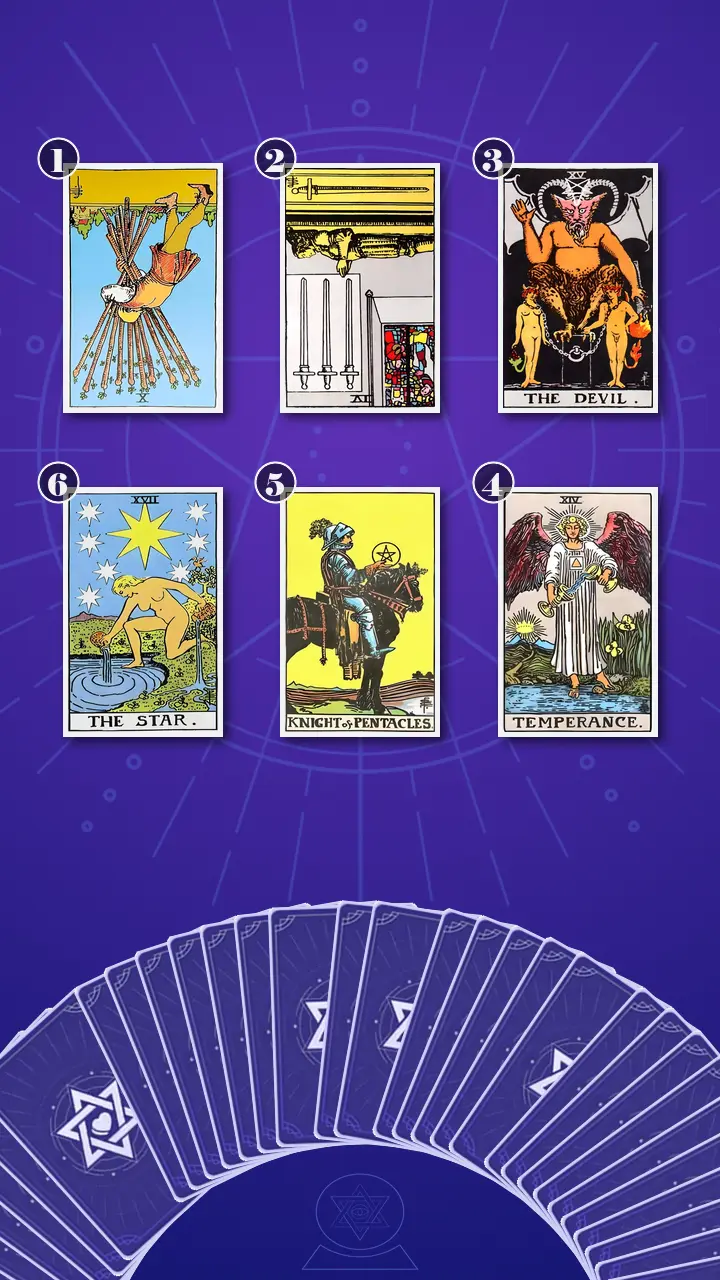
For this consultation, I chose the Transformation Path Grid - Context Edition. I want to explain to you why that matters. This six-position tarot spread follows a recurring month-end pattern from its visible symptom through the blockage, the underlying belief, the catalytic insight, the practical method, and the integrated state. It is a compact diagnostic structure for tracing a feedback loop, not a forecast of what will happen at the next close.
The Celtic Cross would have offered ten broad positions, more information than this question needed. A classic Shadow Spread might have revealed the belief beneath the overwork, but it would not have mapped the operational progression from reopening reports to blocked recovery to a concrete handoff. This grid lets the cards show how one behaviour leads to temporary control, delayed rest, depleted concentration, and then the belief that an even harder push is necessary.
The first card would reveal the visible symptom: where the month-end push crosses its original boundary. The second would identify the mechanism that interrupts recovery. The third would expose the belief underneath the pattern. The fourth would be the turning point, the fifth would translate that insight into a repeatable method, and the sixth would show what competence might feel like when replenishment is allowed to happen during the cycle.
Reading the Load Behind the Deadline
Position 1: The Ten of Wands and the Vanishing Sign-Off
Now I turned over the card representing the visible symptom in the diagnosis: Maya continues carrying month-end work past her planned stopping point until ordinary rest and personal commitments disappear.
It was the Ten of Wands, in reversed position.
At the planned evening sign-off, Maya was already carrying reconciliations, dashboard updates, unanswered messages, and the pressure to appear responsive. Instead of setting down a low-impact item, she added another review, carried the laptop to the sofa, and ate beside it while the pasta cooled. The deadline was close, but the expanding bundle blocked her view of hunger, fatigue, and the stopping point she had chosen earlier.
In energetic terms, reversed Fire is excess turned into contraction. Action is still happening, but momentum has become burden. The card did not say that Maya was incapable of handling close. It showed that she was holding every responsibility at once, including tasks that could have been capped, shared, or left with a clear morning plan. The nearby town on the card became the finish line she could see but never quite reach because each step added another wand to her arms.
I asked her to finish the sentence that seemed to govern the entire cycle: "I only need to carry it until..." She said, "Until the numbers are locked." Then, after a pause, she added, "Until the discrepancy is explained. Until the message is answered. Until nobody can find anything to question." The ending kept moving, which meant the burden did too.
Maya gave a short, bitter laugh. "That is too accurate. Almost rude." Her hand stopped above the card, and she looked toward the laptop bag at her feet as if it had become heavier simply by being named. I did not turn the image into a verdict about her character. I asked her to identify one low-impact close task that could be delegated, deferred, or limited to a single review pass, then observe what actually changed in accuracy and trust.
"Being responsible is not the same as being the sole carrier of everything," I said. Her mouth tightened in recognition, and for the first time she looked away from the imagined finish line.
Position 2: The Four of Swords Reversed and the Pause That Never Lands
Now I turned over the card representing the immediate blockage that prevents movement or relief: rest is interrupted or postponed whenever unfinished work remains mentally active.
The card was the Four of Swords, in reversed position.
I brought us to the scene she had described from 12:18 a.m. Her room was dark except for the cold blue rectangle of her phone and the orange streetlight leaking through the blinds. A streetcar scraped along wet tracks outside. Her limbs were heavy under the duvet, but her breathing stayed shallow. She refreshed Teams, mentally reran a discrepancy she had already documented, and reached for the laptop within minutes.
The resting figure beneath the suspended swords mirrored Maya exactly: her body had stopped moving, but her attention remained on call. In the blockage position, reversed Air showed a pause that never became restorative. The unresolved tasks stayed mentally positioned above her, like swords hanging over a sanctuary she could enter physically but not psychologically.
I described the inner script I heard in the card: "I am resting, but I still need to monitor what might change." This was not simply a lack of free time. It was recovery avoidance maintained by the belief that stillness was unsafe until every task had disappeared. The more she interrupted the pause, the less effective it felt, and that ineffectiveness became another reason to sacrifice rest next time.
Maya pressed her thumb against the edge of her phone. Her breath paused; her eyes lost focus as though she were watching the same blue screen from bed; then her shoulders dropped with a tired exhale. "I am technically resting," she said, "but I am still waiting for something to go wrong."
I asked, "When you imagine waiting ten minutes before checking, what do you predict will happen?" She answered, "I will miss the moment I could have prevented a mistake." I wrote that sentence down. It was not evidence of an actual incident yet. It was a prediction worth testing, and naming it gave her something more useful than another midnight review.
Position 3: The Devil and the Unofficial Service Agreement
Now I turned over the card representing the underlying fear and belief beneath delayed gratification: output must be completed before rest is deserved, because performance has become tied to worth and control.
The card was The Devil, in upright position. I never read this card as a doom sentence, and I did not ask Maya to fear it. In this position, it was an image of a rule that had become so familiar that it felt external, fixed, and non-negotiable.
I asked her to imagine the nearly empty finance area at 8:35 p.m. The HVAC hummed. A cleaning cart rattled past the glass doors. The dashboard refreshed, showing a low-priority variance. Maya knew which check was material, which could wait, and which belonged to someone else, but the green dots beside two colleagues' names made her stomach tighten. She started another review because visible effort felt easier to defend than a personal limit.
I placed two headings between us: What the close actually requires and What I do to prove I care. Under the first, Maya listed material checks, documented variances, escalation rules, and agreed deadlines. Under the second, she listed answering nonurgent messages at night, repeating a completed check, keeping every task open, and staying online because someone else was still online.
"No one explicitly asked, but if I do not respond quickly, they might think I am not committed," she said. The words came out quietly, and then she stopped. The loose chains around the figures on the card mattered to me. They did not mean the workload was imaginary or that workplace pressure was harmless. They suggested that the worth-based rule had room to be examined.
This was where I used my Social Clock Decoupling lens. Green Teams dots, Fishbowl comparisons, LinkedIn posts, and polished #CorporateTok day-in-the-life videos can create an artificial timeline in which staying online looks like ambition and logging off looks like falling behind. I asked Maya to notice the difference between a real operational requirement and a social clock she had absorbed from other people's status signals. The algorithm of overwork had been trained by every guilty extra hour: guilt produced more checking, and more checking taught the system to recommend the same behaviour next month.
"Not every extra check protects the work; some checks protect you from the feeling of stopping," I said. Maya's fingers curled around the pen. She stared at the two headings, first going very still, then blinking as a specific late-night message came back to her. Finally, she wrote one sentence in the second column: "No one required this, but I use it to feel safer."
When Temperance Poured Effort and Rest Into the Same Rhythm
The room grew quiet when I turned to the next card. Outside, a thin wash of Toronto winter light moved across the window, and the radiator gave one small metallic click before settling. The sound seemed to mark a hinge between naming the rule and considering whether Maya still had to obey it.
Position 4: Temperance and the Two Cups That Stay Full
Now I turned over the card representing the catalytic insight that can change the established pattern: the transformation from all-or-nothing pushing to integrating measured recovery inside the month-end process.
It was Temperance, in upright position, the key card and the Antidote in this reading.
The angel's water moved continuously between two cups. One foot stood on land and one in water, and a narrow path led toward distant light. I asked Maya to picture a practical version of that image at 8:20 p.m. during a later close: she saves the workbook, writes "resume with variance 4B at 9:00 a.m." in the tracker, and walks to the building lobby with hot tea held between both palms. The work is not finished, but her recovery has a place inside the workflow.
Temperance does not ask her to care less about accuracy. It asks her to stop treating effort and recovery as two separate phases, with recovery permitted only after total completion. Its energy is measured self-regulation, moderation, and the willingness to let capacity circulate before the workload is fully resolved.
I call this perspective Seasonal Energy Diagnostics. I do not use seasons to excuse a material deadline or pretend organizational pressure is imaginary. I use the seasonal question to notice whether a system is being asked to produce beyond the phase in which it can replenish. Maya had been trying to force a spring harvest during a winter dormancy phase, demanding new output from a body that had already spent its available energy. A recurring close has an intense season, but no natural season is meant to last forever.
I told her that the point was not to empty the cup of work, then collapse beside an empty cup of self. The point was to pour carefully between effort and recovery, keeping both available for the next day.
Maya had learned to treat every open cell as an alarm. She understood the reporting calendar, but guilt made this month's unfinished details feel like a fresh emergency. She was searching for one correct stopping point while believing any pause might expose a flaw in her commitment.
You do not have to drain the cup before you deserve recovery; Temperance asks you to pour effort and rest into the same sustainable rhythm.
I let the sentence settle, then made it operational: "A recurring deadline cannot depend on recovery that is always deferred. Rest is not the reward for emptying the workload; it is part of the operating rhythm that lets you meet it again without emptying yourself."
Maya's fingers froze on the edge of the notebook; her breath stopped halfway in, and the hand holding the pen hovered above the page. Her eyes widened and moved from the water in the illustration to the laptop closed beside us, as though a memory were replaying: the 10:47 p.m. click, the Teams dot, the cooling pasta. When I said the word "deserve," her mouth tightened. "But does this mean I got it wrong before?" she asked, anger arriving before tears. I kept my voice even. "It means the old method protected you from guilt for a few minutes. It does not make your past self foolish, and it does not make real deadlines imaginary." Her shoulders lowered a fraction. She blinked hard, looked at her clenched hand, and slowly opened it. A small, unsteady "Oh" came with the breath she had been holding. The relief was real, but so was the blankness of having no emergency to obey. "Now, use this new view to think back to last week," I asked. "Was there a moment when this insight could have let you feel differently?"
She remembered deleting the words "tomorrow morning" from a handoff message on the TTC because two colleagues were still online. The insight did not erase the pressure, but it changed the question from "How do I prove I am committed?" to "What does this report actually require tonight?" That was the first crossing from compressed deadline urgency, interrupted recovery, and performance-based guilt toward sustainable pacing, cautious relief, and grounded competence without self-abandonment.
The Close Runbook With Room for Tomorrow
Position 5: The Knight of Pentacles and the Written Restart Point
Now I turned over the card representing the practical action or method that puts the catalytic insight into use: defined cutoffs, limited review passes, planned handoffs, and a steady restart point.
The card was the Knight of Pentacles, in upright position.
The Knight was not charging. The black horse stood still while the figure held one pentacle carefully at eye level, with cultivated fields arranged behind him. I connected that stillness to Maya's actual work: required tasks separated from morning tasks, one low-impact check capped at one review pass, one factual handoff, and a known place to resume at 9:00 a.m. Reliability could become a procedure instead of a display of strain.
In energetic terms, this was stable Earth. Temperance had shown the exchange; the Knight showed how to repeat it when the dashboard was busy and the old reflex returned. Sustainable competence would be measured by accuracy, continuity, and repeatability, not by how visibly exhausted the person running the close became.
I said, "Reliable does not have to mean continuously available; today it can mean a clear definition of done, one review limit, one escalation rule, and a written restart point." I underlined the last phrase. "A written restart point can hold the task while your body stops holding it."
Maya looked at her calendar. "I cannot always find even ten minutes in the last hour. What if a variance lands while I am away?" I welcomed the obstacle because it made the advice more honest. We defined the exception first: a genuine material incident, a documented escalation, or a deadline that could not safely wait. Everything else could be placed in the restart note and met at the stated return time.
"If twenty minutes feels impossible, test ten," I said. "If ten feels impossible, test two. The point is not to perform calm. The point is to see what happens when you interrupt the old sequence without abandoning an essential requirement." She set a 9:00 p.m. reminder and typed a provisional handoff. Her thumb hovered over the save button, then pressed it.
A Wider Dashboard of Success
Position 6: The Star and the Ordinary Evening
Now I turned over the card representing the integrated state that sustained practice is intended to support: Maya can experience competence and replenishment together instead of using post-deadline collapse as her only form of recovery.
The card was The Star, in upright position.
The figure beneath the open night sky poured water onto the land and into the pool. I read that as energy returning to more than one part of life at once. In Maya's modern translation, a close could end with enough capacity for an ordinary dinner away from the laptop, a friend's message, and a consistent bedtime. The work would not become magically easy, and one protected pause would not solve every structural pressure. It would simply stop requiring the weekend to function as emergency repair.
The Star's energy was replenishing water, open and visible rather than hidden until collapse. I asked Maya to widen her dashboard of success. Could it include work quality, sleep, remaining capacity, and the ability to keep one ordinary promise to herself? The card did not promise a perfect month. It offered a different measure of a good one.
She looked at the open posture in the image, then rubbed the tired place beneath her eyes. Her shoulders softened, though her mouth remained cautious. "I would like to have enough energy for a Tuesday dinner," she said. I heard the hope in that small, practical sentence, along with the uncertainty that still accompanied it. She did not need to believe in a completely effortless close. She only needed to let an ordinary evening count as evidence.
The elemental movement of the grid was clear to me: overloaded Fire in the reversed Ten of Wands, unsettled Air in the reversed Four of Swords, a binding rule named by The Devil, balanced exchange through Temperance, grounded procedure through the Knight of Pentacles, and replenishment through The Star. The cards had not changed Maya's job. They had made the route from urgency to recovery visible.
A One-Page Close That Leaves a Morning
I laid the six cards in their mirrored grid and told Maya the story they formed. Real month-end work began the cycle, but the Ten of Wands showed her carrying every detail beyond its useful point. The reversed Four of Swords showed why a technically available break never restored her: her attention remained logged in. The Devil exposed the deeper bargain that stopping before perfection might reveal inadequate commitment. Temperance offered the turning point, the Knight of Pentacles made it procedural, and The Star showed the capacity that could return if recovery happened during the cycle rather than only after depletion.
The core metaphor was simple: Maya had been holding one long breath until the reporting cycle was over. Each unfinished detail became a reason to delay exhaling, and the effort of maintaining control consumed the energy she needed for the next cycle. The spread did not ask her to deny the workload. It showed that she had never been given, or had never permitted herself, a reliable way to distribute commitment across time, people, and bodily capacity.
The cognitive blind spot was not that Maya failed to value rest. It was that she treated postponing rest as proof of responsibility and treated the discomfort of stopping as evidence that stopping was wrong. The transformation direction was from waiting for every task to be finished toward scheduling protected recovery checkpoints inside the month-end workflow. This is how tarot works as a grounded cognitive tool: the images give a difficult pattern an external shape, and the querent decides what the shape means against real evidence, workplace requirements, and lived experience.
I offered Maya three small experiments. I called them experiments because she remained the decision-maker. A card could suggest a useful question, but it could not override a material deadline, an unsafe workplace situation, or her own judgment.
- The Protected-Pause CloseOn one close day this week, put a 20-minute phone-free break in the Outlook calendar before the planned sign-off and label it "Close recovery checkpoint." Before stepping away from the laptop, write three lines in the workbook or task tracker: what is complete, what remains, and the exact first action for returning. Take the pause in the lobby, a quiet meeting room, or around the block, with food, water, or stillness rather than Teams.Define the genuine urgent conditions before the timer starts. If 20 minutes is unrealistic, use 10. Treat the thought that this is the worst possible time as data, not as an automatic command.
- The One-Pass Confidence TestIn the existing close tool, whether Excel, OneNote, Notion, or the team tracker, separate "required before sign-off" from "can resume tomorrow." Choose one low-impact task and cap it at one review pass after the primary check. Set one cutoff, such as 9:00 p.m., then send the relevant teammate a factual handoff: the material checks are complete, item 4B is documented for 9:00 a.m., and no action is needed tonight unless the agreed escalation condition occurs.Use only one cutoff, one capped task, and one handoff in the first trial. Do not turn pacing into another perfection project. Judge the test by accuracy, trust, and response time, not by the guilt you feel while the item remains open.
- The Winter Dormancy RitualFor five minutes this week, make two columns: "actual close requirement" and "proof that I am committed." Circle one bounded, nonurgent after-hours action, such as replying to a message that can wait, and consciously do nothing regarding that action for one week beyond the documented working process. Ask a manager or trusted teammate one narrow question about what genuinely needs resolution tonight and what can wait until morning.This ritual does not override a material incident or hide essential work. If asking feels unsafe or politically costly, use written policy, prior close records, or a trusted peer as evidence. The smallest version is one sentence: "No one required this, but I use it to feel safer."
Maya read the list twice. I saw the old urge to redesign the entire month-end process begin to rise, so I brought her back to the smallest version. One protected pause. One review limit. One handoff. One nonurgent action allowed to remain dormant. We did not need to solve her entire career to create a testable next step.
"This is actionable advice with room for reality," I said. "You can stop an experiment if it creates unacceptable operational risk. The purpose is to collect evidence that a bounded pause can coexist with competent work, not to force yourself through discomfort for the sake of a rule."

The Small Proof of a Different Season
A week later, I received a message from Maya during a later close: "I used the 9:00 p.m. cutoff, left variance 4B with a restart note, and took twenty minutes in the lobby. The report was fine at 9:00 a.m." It was not a dramatic transformation. It was one piece of evidence gathered inside the real workflow.
She had slept a full night, but her first morning thought was still, "What if I missed something?" This time she smiled, read the restart note, and made coffee before opening Teams. The doubt remained; it no longer held the only key.
I told Maya that the cards had not rescued her from the close, and they had not guaranteed that every boundary would be easy for everyone around her. She had used them to see the difference between carrying the work and carrying a verdict about her worth. She had chosen the cutoff, tested the pause, and decided what evidence counted. The authority had stayed with her.
That was the Journey to Clarity: not a perfect answer at the end of a difficult month, but a gradual movement from compressed deadline urgency and interrupted recovery toward sustainable pacing, cautious relief, and grounded competence without self-abandonment. Competence does not have to leave you unusable afterward.
When your limbs are heavy but your hand still reaches for the laptop, the hardest part is not simply the unfinished work; it is the fear that putting it down might also mean putting your competence into question.
If one small recovery checkpoint could belong inside your next close rather than after it, where might you be willing to imagine placing it?