Moving Promotion Goalposts: Three Questions Tested the Terms

The Moving-Goalpost Overwork Loop at 9:47 p.m.
If your Slack stays green after everyone else signs off because response speed feels like promotion evidence, you may already know the moving-goalpost overwork loop on an undefined and repeatedly delayed promotion path.
I met Maya over video at 9:47 on a Tuesday night. She was sitting at a small kitchen table in her Toronto condo, adding another impact metric to a promotion document while a container of takeout cooled beside her laptop. Blue screen light flattened the color from the room. I could hear the dry click of her keyboard against the fridge’s low hum, followed by the soft knock of a Slack notification. Her phone looked warm in her hand. Her shoulders were lifted, her jaw held tight, and her eyes had the gritty shine of someone who had been staring at the same problem for too many hours.
“My review got moved to next cycle again,” she told me. “They said I need more evidence of leadership, so I’m finishing a reporting issue, updating my promotion case, and covering part of a senior analyst’s workload. I know it sounds ridiculous, but if I stop now, I’m scared they’ll decide I was never ready.”
Every time her company said “next cycle,” Maya answered with another late evening, another visible assignment, and another revision of the document meant to make the decision impossible to postpone. She was trying to earn a promotion by working harder while the promotion target kept receding far enough that “enough” could never be defined. What she called exhaustion seemed to sit on her body like a wet concrete coat: too heavy to move freely in, yet frightening to take off because she had started to mistake its weight for proof of commitment.
“I’m doing the senior job without the senior title,” she said. “Toronto rent isn’t exactly making it easier to be chill about the salary. But I’m also quietly furious. My friends have started calling me out for checking work messages under the table.”
I told her I was not there to judge her ambition or coldly diagnose her work ethic. Ambition was not the problem. I also would not use tarot to predict whether her manager would finally approve the promotion. I wanted us to examine the arrangement she was already living inside: what was observable, what had only been implied, and where her choices had become difficult to see.
“Let’s make a map of the fog,” I said. “Not so the cards can choose your career for you, but so you can see what your effort is buying, what it is costing, and which part of the next act still belongs to you.”

Choosing the Compass: A Six-Card Transformation Path Grid
I invited Maya to put both feet on the floor, loosen her jaw if that felt comfortable, and take one slower breath. I shuffled while she held one question in mind: “Why do I keep overworking for a promotion that keeps moving away?” The pause was not a mystical performance. It was a psychological threshold between reacting to the latest Slack message and observing the larger pattern.
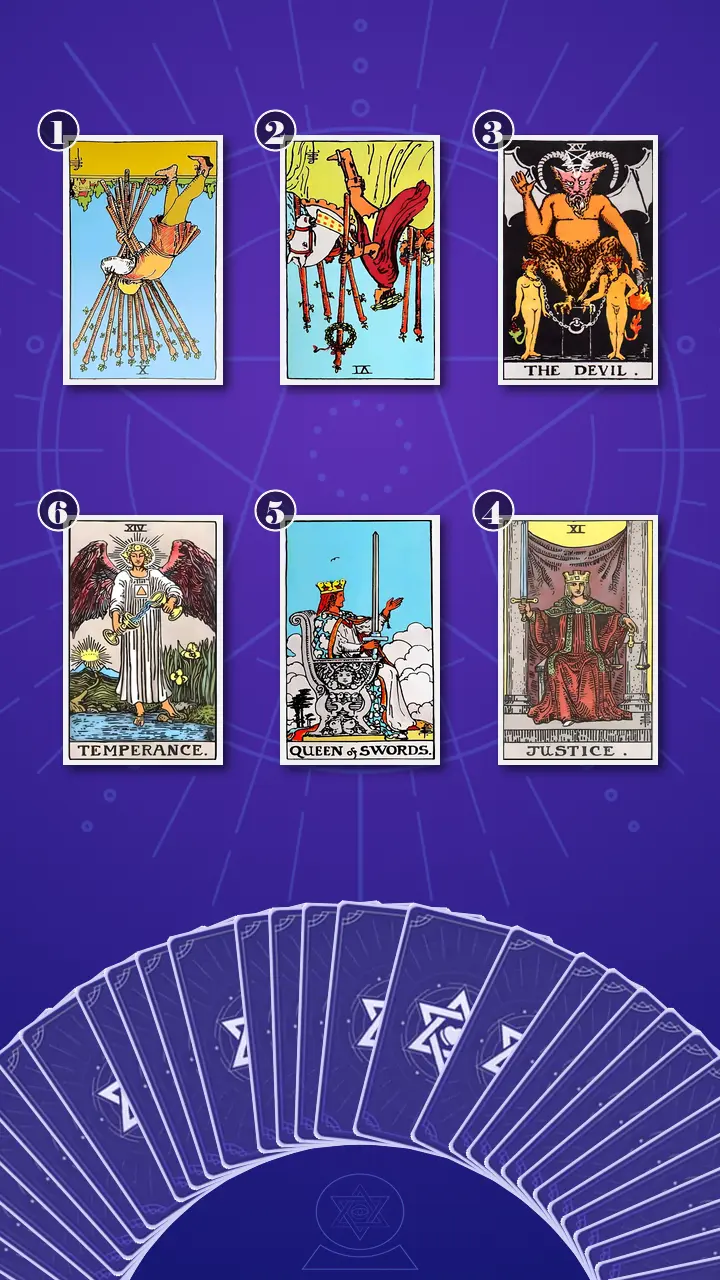
I chose the Transformation Path Grid · Context Edition, a six-card career promotion tarot spread designed to trace a feedback loop rather than predict a fixed outcome. For this question, a simple past-present-future line would have been too narrow. Maya was not choosing between two clearly defined offers. She was caught in a system where vague advancement feedback triggered more work, more work benefited the company without clarifying advancement, and the next delay then felt like proof that she needed to produce even more.
This is one way I explain how tarot works as a clarity tool: the spread gives separate positions to experiences that decision fatigue has compressed into one painful thought. Instead of “I’m not doing enough,” we can inspect present behavior, the external blockage, the hidden belief sustaining it, the leverage point, the practical response, and the integrated way forward. Card meanings in context become prompts for evidence, not verdicts about fate.
The first card would show how Maya responded when the promotion moved away. The second would identify what kept progress blocked. The third would expose the fear that made the current exchange feel compulsory. The fourth, our leverage point, would show where meaningful change could begin even before the organization gave her the answer she wanted. The final two cards would translate that insight into a conversation and a sustainable pace.
I arranged the cards in two rows. The upper row moved from burden to blockage to root. The path then dropped to the lower right and returned across action and integration, like a film sequence reaching a wall, changing direction, and coming back on firmer ground.
The Bundle and the Missing Applause
Position 1: The Load That Keeps Proving Itself
I turned over the card representing the observable present-state behavior in which every promotion delay was answered with longer hours, additional responsibility, and postponed recovery. It was the Ten of Wands, reversed.
I pointed to the worker bent beneath ten tightly bundled wands. His view of the road was blocked by the load, although the town remained visible in the distance. Reversed, the image did not tell me that Maya lacked endurance. It showed Fire in excess and direction in blockage: enormous effort was being generated, but the burden had become unsustainable and was no longer producing clearer movement.
At 9:47 p.m., Maya was carrying her own product operations work, senior analyst responsibilities, and someone else’s urgent overflow toward a title that remained visible in conversation but never became concretely closer. She knew the load was too much, yet she treated silent completion of the entire bundle as the price of arrival. Her internal rule sounded like this: “I know this is too much, but if I put one thing down, they might decide I was never ready.”
“This is not a generic time-management problem,” I said. “The overload is part of the promotion loop. Each delay makes you add another wand because carrying more briefly restores your sense of control.”
Maya gave a small, bitter laugh. “That is so accurate it’s almost rude.” Her shoulders dropped half an inch, then lifted again as she glanced at Slack. “After the last delay, I volunteered to fix a dashboard nobody had assigned to me. I didn’t even think about it as a choice.”
I asked her which task she had added, which evening she had extended, and which recovery plan she had cancelled after the most recent postponement. I did not ask so she could build another case against herself. I asked because naming the bundle is the first way to discover that its pieces can be negotiated separately.
Position 2: Praise Without Promotion Terms
I turned over the card representing the external and psychological blockage created by praise without defined criteria, reciprocal commitment, or a reliable decision point. It was the Six of Wands, reversed.
The upright card usually carries the visible symbols of recognition: a laurel-crowned rider, a wreath raised above a crowd, and public acknowledgment of success. Reversed, recognition had become unstable. Maya was seen, applauded, and relied upon, but those signals did not convert into a title, salary, written proof standard, named approver, or review date. Fire was still present, but its reward function was blocked.
I asked her to remember the all-hands meeting where leadership praised her for rescuing a cross-functional launch. Then I asked what happened in the next one-to-one. She repeated her manager’s words: “You’re doing amazing work. People really rely on you. Keep showing broader leadership.” The call ended. No follow-up email arrived. No one defined “broader.” No date appeared on the calendar.
Maya told me she had refreshed her inbox, opened LinkedIn, seen a former colleague announce a promotion, and started sketching another high-visibility project before the frustration in her face had even cooled. The pattern resembled a project dashboard where every completed milestone automatically generated a new one while the launch date stayed blank.
“They keep saying I’m valuable,” she said, “so why does none of that value become a decision?”
“Because visibility and certainty are not the same thing,” I replied. “Praise is feedback. It is not a promotion contract. Compliments may be sincere, but sincerity does not give you inspectable terms.”
Her fingers stopped rubbing the rim of her mug. She stared at the reversed wreath with a mix of recognition and restrained anger. I could almost see a catalogue of praise-filled meetings passing behind her eyes, each one emotionally bright and structurally empty.
“If the criteria change whenever you meet them,” I asked, “is the missing ingredient really another perfect quarter?”
The Contract Hidden Beneath the Green Dot
Position 3: The Devil and the Auto-Renewing Bargain
I turned over the card representing the underlying fear that a failed promotion would invalidate Maya’s sacrifice and worth, together with the overwork strategy she used to keep that fear at a distance. It was The Devil, upright.
I watched her jaw tighten before I spoke. The card showed two figures held by visible chains beneath a dominating presence. I treated those chains carefully. The Devil did not mean that Maya was trapped by fate, morally compromised, or wrong to want advancement. It represented attachment and perceived bondage: a bargain whose cost had become difficult to question because the hoped-for reward carried too much emotional meaning.
Maya described dinner with friends on Ossington, where she kept Slack open under the table while someone across from her was halfway through a story. The restaurant was loud, condensation slicked the glass in her hand, and every vibration pulled her attention back toward work. In that moment, the title was being asked to validate far more than a job level. It had become proof that her capability, endurance, and sacrificed evenings were real.
I compared the pattern to an auto-renewing subscription paid in hours rather than money, with the cancellation terms buried from view. Each late-night green dot renewed the bargain: “If I stop paying with evenings now, what if that proves the whole sacrifice meant nothing?” Like the split at the heart of Severance, the flawless work self kept performing while the personal life quietly absorbed the cost. Maya’s workplace was not the show’s extreme world, but the behavioral split felt recognizably close.
This was concentrated attachment rather than balanced ambition. The company’s ambiguity did not create Maya’s worth, but it had learned something like an algorithm: uncertainty reliably produced more output from her. Whenever the promotion conversation became vague, she volunteered for another deliverable. Productivity gave her temporary relief, so the cycle renewed before she had to ask whether the promotion track was concrete.
“You cannot outwork an undefined finish line,” I said. “The chain loosens when you make the exchange visible. What promise keeps you consenting to more scope without reciprocal commitment?”
Maya went still. Her gaze dropped from the card to the cold food beside her. “The promise that if I become essential enough, they won’t be able to say no,” she said quietly. “And if they still say no, I don’t know what that says about me.”
“It may say something about the process,” I replied. “It does not get to deliver a final verdict on you.”
When Justice Put the Promotion on the Scales
Position 4: The Sentence That Changed the Question
The room seemed to become quieter as I turned over the card representing the leverage point: replacing hoped-for recognition with evidence, written standards, proportional exchange, and accountability. It was Justice, upright, the key card in the spread.
I asked Maya to stay with the scene she had shown me: at 9:47 p.m., dinner cold beside the laptop, she was adding one more impact metric to a promotion document nobody had tied to a firm decision date because stopping felt more dangerous than continuing.
Justice held level scales in one hand and an upright sword in the other. The scales asked whether Maya’s senior-level contribution and her employer’s commitment were proportionate. The sword cut through phrases such as “next cycle,” “more visibility,” and “broader leadership” by asking for operational definitions. Justice brought balanced Air into the overheated spread: evidence, language, discernment, and accountable structure.
In everyday terms, I saw Maya bringing a dated record of work already delivered into her one-to-one and asking four factual questions before accepting another expansion of scope: What criteria remain? What proof standard applies to each one? Who makes the final decision? On what date will that decision be reviewed? None of those questions guaranteed a promotion. They tested whether the path could support reciprocity without demanding self-exhaustion as an entry fee.
I also used a lens I call Workplace Typecasting Analysis. Maya’s office ecosystem had gradually cast her as the dependable fixer: the supporting character who made messy projects run, absorbed overflow without revealing the cost, and kept every scene moving for everyone else. Her competence was real, but the role created a paradox. Each silent rescue strengthened the organization’s reason to leave her in the same under-titled position.
Justice gave me the bridge into Leadership Narrative Construction. The new professional script was not “I can absorb anything you give me.” It was “I can assess scope, name the evidence, require decision ownership, and make trade-offs visible.” That shift did not manufacture authority through performance. It allowed Maya to exercise the authority she already had over her labor, her language, and the meaning she assigned to the response.
You do not have to earn clarity by exhausting yourself; ask for balanced terms and let Justice's scales compare your contribution with the commitment you are actually receiving.
Maya’s breath stopped first. Her thumb remained suspended above the edge of her phone, and for a moment even the Slack light seemed to lose its pull. Then her eyes moved past the cards, unfocused, as if she were replaying every “keep doing what you’re doing” meeting against a second column containing no dates and no decision owner. Her pupils widened. Color rose into her cheeks. “But doesn’t that mean I’ve been wrong for two years?” she asked, sharper than before. She pushed her chair back, then caught herself and pressed both feet into the floor. I told her no: overworking had been an understandable attempt to create control with the information and power available to her. The new evidence did not turn her past self into a fool; it made the cost visible now. Her eyes reddened slightly. Her fist loosened, finger by finger, and her shoulders finally sank. Relief arrived with a tremor of anger and the disorienting responsibility of having choices again. I let the silence hold before I asked, “Now, with this new perspective, think back: was there a moment last week when this insight could have made you feel different?”
“Sunday, in the grocery store,” she said after a long exhale. “Someone asked for a Monday report while I was standing in the freezer aisle. I cancelled my evening before I even checked whether Monday morning was real. I could have asked what it was for. I could have asked what should move.”
I placed Justice’s scales beside two headings on my notepad: senior-level contribution already delivered and employer commitment actually received. Under the first, Maya had launches, reporting systems, cross-functional cleanup, and stakeholder praise. Under the second, she had verbal encouragement and an undefined “next cycle.” The imbalance was information about the exchange, not proof of personal inadequacy.
“Your performance can be evaluated without putting your worth on trial,” I said. “What do you actually know, and what have you been filling in with hope?”
I named the shift I had just witnessed: from exhausted urgency and promotion-dependent self-worth toward evidence-based self-trust and sustainable ambition. It was not yet a solved career problem. It was the first credible movement from trying to prove readiness at any cost to testing whether the promotion process itself was accountable.
A Sword for the Sentence, Two Cups for the Pace
Position 5: The Queen’s Visible Trade-Off
I turned over the card representing the practical response: a direct criteria conversation, explicit workload trade-offs, and no automatic expansion of scope. It was the Queen of Swords, upright.
The Queen held her sword vertically while extending her other hand toward the horizon. I read those gestures as one communication posture: state the truth clearly, then remain open to a concrete answer. Her Air was balanced rather than aggressive. She did not ask Maya to issue an impulsive ultimatum or reveal private emotional details. She asked Maya to stop hiding the cost of the arrangement.
I brought the card into Maya’s next likely workplace scene. A leader would ask her to own another cross-functional initiative. Instead of saying “no problem” and finding the hours later, Maya could say, “I can own this if we move the reporting redesign to Friday or reassign the launch support. Which trade-off should we make?” In the promotion review, she could name the senior responsibilities already in her scope and ask three direct questions about criteria, decision ownership, and timing.
“A new priority needs a visible trade-off,” I said. “That sentence is not a refusal to contribute. It is capacity information. It makes leadership see the whole production schedule instead of assuming the supporting character will keep working after the credits.”
Maya tried the sentence once. Her first version rose at the end like an apology. I asked her to slow down and let the final word land. On the second attempt, her voice remained warm but level. She did not sound combative. She sounded like someone responsible for the integrity of the work rather than someone auditioning for permission to matter.
“I can stay open to their answer,” she said, “without filling every silence with more unpaid effort.”
Position 6: Temperance and Sustainable Ambition
I turned over the final card, representing the integrated stance of retaining ambition while pacing effort according to evidence, reciprocity, recovery, and self-defined worth. It was Temperance, upright.
Water flowed deliberately between two cups. One foot rested on land while the other touched water, and a path continued toward light in the distance. Temperance did not force Maya into a false choice between relentless output and abandoning her career goals. It introduced Water as emotional regulation and ongoing adjustment after Justice and the Queen had brought clarity through Air.
In modern life, the card looked like Maya continuing to pursue career growth while ending automatic late-night availability, reviewing promotion evidence at agreed intervals instead of nightly, and directing recovered energy toward rest, relationships, or work that offered genuine learning and reciprocity. One foot remained in ambition and one in ordinary life. Effort could rise or fall in response to evidence rather than surge every time uncertainty appeared.
I compared Temperance to version control for effort: make one bounded change, observe what happens, and resist rewriting an entire working life overnight. It was also a thermostat, making regular corrections instead of running at maximum heat until the system failed.
“Sustainable ambition still counts as ambition,” I told her. “Rest is not evidence against your readiness. It is part of the capacity from which discernment, leadership, and good work become possible.”
Maya took a fuller breath and looked at her phone without picking it up. “I think I’ve been treating every evening as collateral,” she said. “I don’t want to quit caring. I want to stop paying before anyone tells me what I’m buying.”
I noticed one more structural detail in the spread. No Pentacles card had appeared. The missing Earth mirrored the missing workplace ground: written criteria, secure terms, named ownership, tangible reciprocity, and a date on the calendar. The cards could not supply those terms for her. They could show her where to request them and how to respond to the evidence she received.
The Justice Terms Check and the Missing Earth
I drew the reading together as one coherent story. Past postponements had trained Maya to convert disappointment into output. In the present, the reversed Ten of Wands showed her carrying an unsustainable bundle, while the reversed Six revealed why the labor did not resolve the problem: praise imitated advancement without becoming accountable recognition. The Devil exposed the hidden contract tying availability to worth. Justice made the contract inspectable. The Queen gave Maya language for capacity and conditions, and Temperance protected ambition from becoming permanent self-abandonment.
The central image was not a person who needed to become more motivated. It was someone trying to force a flower open by pulling at its petals while the surrounding conditions for growth remained undefined. More force could damage the flower, but it could not create soil, light, or a season. Maya’s cognitive blind spot had been treating organizational ambiguity as a personal evidence deficit. That kept her asking, “How can I prove more?” when the more useful question was, “What has the organization actually committed to, and what am I willing to contribute under those terms?”
The transformation direction was practical: stop answering every promotion delay with more hours. Request written criteria, reciprocal commitments, a named decision-maker, visible workload trade-offs, and a time-bound review before accepting additional responsibility. The response might be encouraging, disappointing, incomplete, or politically complicated. Clarity did not require Maya to control that response. It required her to stop using her body and evenings as substitutes for missing process.
When I suggested a seven-minute evidence check, Maya frowned. “Honestly, I’m at the point where even seven minutes feels like another task.”
I adjusted the exercise. “Then do the minimum version,” I said. “One criterion, one example you have already delivered, and one unanswered process question in your phone. This is not a new performance project. It is a way to stop the current project from occupying your mind every night.”
Two Small Moves Before the Next Review
- The Seven-Minute Justice Terms CheckBefore the next one-to-one, set a seven-minute timer and open a private note titled “What is actually confirmed?” Add three headings: criteria, decision-maker, and review date. Write only what has been explicitly stated or documented, and label anything inferred from praise as “not yet confirmed.” If capacity allows, turn those facts into a one-page table with the criterion, evidence already delivered, remaining proof requested, and decision owner. Send a short agenda to the manager one working day before the meeting asking to align on those items and a target review date.Stop when the timer ends. The minimum version is one criterion, one delivered example, and one unanswered question. Keep the note factual, share only what feels professionally appropriate, and treat it as an accuracy check rather than a prosecution.
- The Protagonist Reframe DirectiveAt the next cross-departmental meeting or in the same channel where new senior-level work is requested, pause before agreeing. Name the scope already in motion, then use one sentence: “I can take this on if we move X to Friday or reassign Y. Which trade-off works best?” If the promotion comes up, follow with: “I want to make the current scope visible before we add more responsibility.” Practice both lines aloud once beforehand so the delivery can remain calm, level, and brief.This is a micro-behavioral interruption of the dependable supporting-role script, not an ultimatum. If direct discussion feels unsafe because of workplace power dynamics, document capacity privately and seek context from a trusted mentor, HR resource, or employee representative without disclosing more than you choose.
I call the second practice the Protagonist Reframe Directive because it changes one small piece of the professional scene. Maya did not need to dominate the meeting or perform confidence she did not feel. She only needed to stop entering as the person who automatically absorbed the plot complication. By naming scope and requesting a trade-off, she could act as an author of the work rather than an endlessly available supporting resource.
I reminded her that actionable advice is an experiment, not a purity test. One direct question would not guarantee respect, a promotion, or a better workplace. It would produce information. If the company could define the path and reciprocate her effort, Maya would have firmer ground. If it could not, that information would also belong to her as she considered her next steps.

A Week Later: The Quiet Proof
Six days later, I received a message from Maya. She had sent the meeting agenda instead of rebuilding her promotion deck. During the one-to-one, she asked for the remaining criteria, final decision-maker, and review date. Her manager did not produce a complete answer on the spot, but named the VP who owned the decision and agreed to a dated follow-up. When another cross-functional project appeared, Maya used the trade-off sentence. The reporting redesign moved instead of being silently stacked on top.
She also left one non-urgent Slack message unanswered until the next morning. Nothing catastrophic followed. The promotion was still unresolved, and she was still angry about how long she had carried the uncertainty, but the green dot no longer felt like the only leverage available to her.
Her update ended with a bittersweet line I kept: “I slept through the night. My first thought was still, What if setting a boundary costs me the promotion? Then I remembered the blank review date was already costing me.”
I did not consider the reading successful because Justice had predicted an outcome. It had not. I considered it useful because Maya had separated her performance from her worth, translated vague praise into testable questions, and taken one action that changed the information available to her. The six-card Transformation Path Grid had helped externalize the loop, but Maya was the person who sent the agenda, spoke the sentence, and chose where her effort belonged.
That was the real Journey to Clarity: not certainty about the title, but ownership of the terms under which she would continue pursuing it. Her ambition remained intact. It simply no longer had to consume every evening to prove it existed.
If your laptop is still open beside a cold dinner and your jaw will not unclench, I want to name what I saw at Maya’s table: the hardest burden may not be the workload alone. It may be the fear that setting down one wand could reveal that all your effort was never enough to secure your place. Seeing that fear does not make you weak. It places the loose chain where you can finally examine it.
If your ambition did not have to place your worth on Justice’s scales tonight, what one fact would you feel curious enough to name under criteria, decision-maker, or review date?