See the clearance window in context, the Tarot Cards it mirrors, and reading insights from people navigating pending requirements.
Prerequisite Clearance Window
What is this situation?
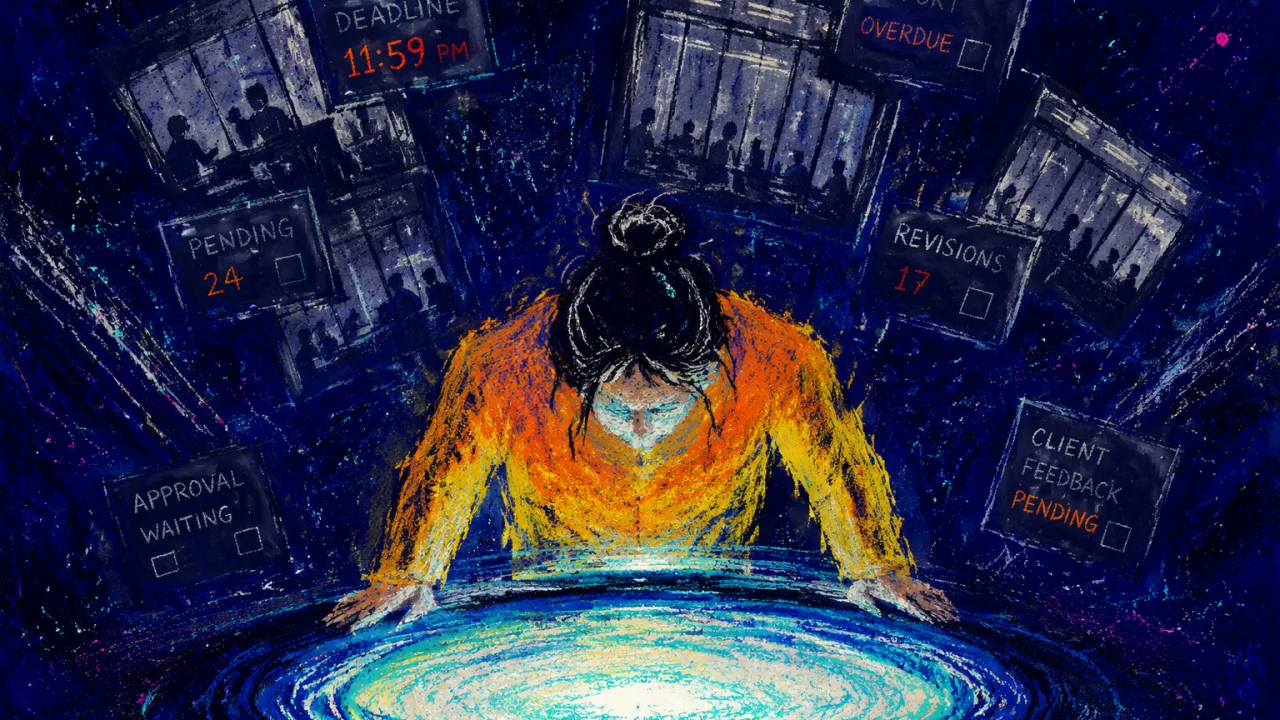
Prerequisite Clearance Window begins when a program, course, or placement tells you that your place is conditional and gives you a date by which every item must be cleared. You log into a portal where one box says received, another says under review, and a third sends you to an office that only answers during a narrow part of the day. A document can be correct yet still unusable because it has not been matched to your file, while a different office says it cannot act until someone else updates their system. You email, call, upload, and refresh between classes or shifts, watching the deadline get closer without being able to move the review yourself; the repeated checking keeps your shoulders held high over the screen. A delayed reply, an unclear status, or one request for the same record again can keep the whole path paused. By the end of the window, the pressure comes from being expected to meet a clock controlled by several separate desks, much like the figure on the Eight of Swords, standing inside a narrow ring of upright swords with the way forward obscured.
Why it's not you?
This is a clearance process built around separate records, review queues, and deadlines that do not share the same clock. When one office waits on another, your status can remain pending even after you have completed what was asked of you.
Prerequisite Clearance Window in Tarot Cards
The Prerequisite Clearance Window is the period when your enrollment or placement remains pending across offices and portals. Repeated portal refreshes can keep your shoulders held high over the screen while the deadline moves closer. This is an environmental, structural dynamic: separate systems and review queues determine the pace. These Tarot Cards reflect the shape of a path paused by requirements outside your control.
A robed institutional authority sits between pillars while two petitioners face him and crossed keys mark the controlled threshold below. The scene directly reflects formal educational membership being mediated by established requirements, delegated offices, and records that must be recognized before access is activated. Upright, the keys indicate that an institutional route exists and is encoded in the organisation's own criteria, even when individual desks apply it unevenly. You are occupying the role of a conditionally admitted learner at a formal gate; the unresolved status measures administrative completion, not your personal legitimacy or capacity to study.
The armoured driver sits between black and white sphinxes without visible reins, facing a road that requires unlike forces to move as one. Reversed, the vehicle's problem is not the absence of a destination; it is the lack of a working mechanism for coordinating the forces expected to carry it there. That is the structure of a course or placement path stalled by offices using separate records and separate clocks. You may have a clear educational direction and a conditional place, yet intention cannot substitute for integrated administration. The reversed chariot locates the stoppage between systems: your long-term route exists, but the institutional vehicle cannot move coherently until its dependencies pull in the same direction.
The red-robed authority sits between stone pillars, holding scales in one hand and a vertical sword in the other. Reversed, those instruments remain present but no longer describe a balanced procedure: a correct document can exist without being matched to your file, while the institution still applies the deadline as though verification were fully within your control. You are being assessed through a formal process whose accountability is unevenly distributed. The reversed scales expose the structural inequity of having to prove timely compliance while the offices with decision-making authority can delay, duplicate, or misroute the evidence without bearing the same immediate cost.
A figure hangs by one ankle from living wood while a bright halo shows that awareness remains active inside physical suspension. Reversed, the pause has stopped functioning as a meaningful interval and become a delay without reciprocal movement: your documents may be complete, but they remain held in a queue that offers neither closure nor a dependable review date. You are still expected to meet the published deadline while the institution controls release from the suspended state. The reversed image exposes the asymmetry of the window: time continues to pass for you, but the office process can remain motionless without surrendering its authority over the outcome.
The central figure steps within an oval wreath while four fixed emblems hold the corners of a scene associated with completed integration. Reversed, the surrounding structure appears almost whole but cannot close, echoing a student file in which most boxes are cleared while one office, record match, or final review prevents enrollment from becoming active. You are not facing evidence that you cannot do the course; you are facing an incomplete administrative cycle attached to course access. The reversed wreath makes the last-mile bottleneck visible, showing how one unresolved prerequisite can hold the entire educational transition in a provisional state.
The figure keeps two pentacles moving through an infinity-shaped band while ships pitch on uneven water behind him. That visible coordination burden mirrors the way portal checks, uploads, office calls, classes, and paid shifts must all be kept in motion even though the institutional conditions continue to change around you. Upright, the loop remains intact: your daily system still contains some usable flexibility, but it is being consumed by administrative triage. The image separates your capacity to sequence tasks from the institution's responsibility to clear them, making visible why competent life management can still feel unstable when every update creates another pass through the loop.
A craftsperson, a robed official, and a third collaborator gather beneath a stone arch around a shared plan. Reversed, the worksite becomes a picture of disconnected expertise: each office holds part of the clearance process, but there is no reliable shared record showing what has been received, verified, or handed forward. You become the unofficial coordinator between teams that possess more system access than you do. The reversed collaboration scene exposes why repeated emails and uploads do not necessarily create progress: effort keeps entering separate desks without being integrated into one authoritative clearance decision.
The gardener leans on his tool and studies seven pentacles already visible on the vine. The labour has been performed and the result exists, but it is not yet available for use. That interval closely mirrors a valid record marked received or under review: your input is present in the system, yet the institutional process has not converted it into clearance. Upright, the visible crop separates pending from absent and waiting from failure. You are confronting a timing mismatch between completed submission and administrative recognition, especially when the review cycle matures more slowly than the deadline attached to your place.
The bound figure stands inside eight upright swords while a distant stronghold remains visible beyond the enclosure. In the study ecosystem, the swords form a clearance perimeter between conditional acceptance and actual participation: your course exists, but unresolved prerequisite statuses keep the entry route narrow and obscure. Upright, the loose cloth and open gaps preserve a limited form of agency without pretending that you control the gate. You can establish which requirements were completed and where the dependency sits, while the institution retains the power to review and release them. The image therefore distinguishes academic readiness from administrative access.
Eight parallel wands cross an open sky in a single visible trajectory toward the ground. Reversed, that apparent line of transit loses practical coherence, matching emails without replies, uploads that do not reach the correct file, and office updates that fail to arrive before the next dependency needs them. With no person directing the movement in the image, the delay belongs to the transmission network rather than to your willingness to act. You experience urgency because the clearance clock remains fixed while messages and records travel unevenly across separate institutional channels.
Ten bundled wands crowd the carrier's body and block his view, while the town he is trying to reach remains visible ahead. The bundle resembles a clearance checklist whose individually manageable items have been transferred onto one person as a single coordination load: upload the record, confirm receipt, identify the reviewing office, and repeat the process when systems fail to connect. Upright, the destination is still present and the load is finite, but the institution has made you carry work that belongs across several desks. You experience the window as daily overload because access to the course depends not only on completing your own requirements but also on transporting proof between offices that do not reliably communicate.
No cards available for this filter.
Prerequisite Clearance Window in Tarot Card Reading Insights
A Prerequisite Clearance Window can leave a course, program, or placement paused while required items move through separate offices. People navigating that waiting period have brought it into readings; explore the Tarot Reading Insights below.