Why Does Checkout Keep Changing?

See how checkout pressure unfolds, which Tarot Cards mirror it, and what related reading insights have surfaced for other shoppers.

Checkout Decision Paralysis
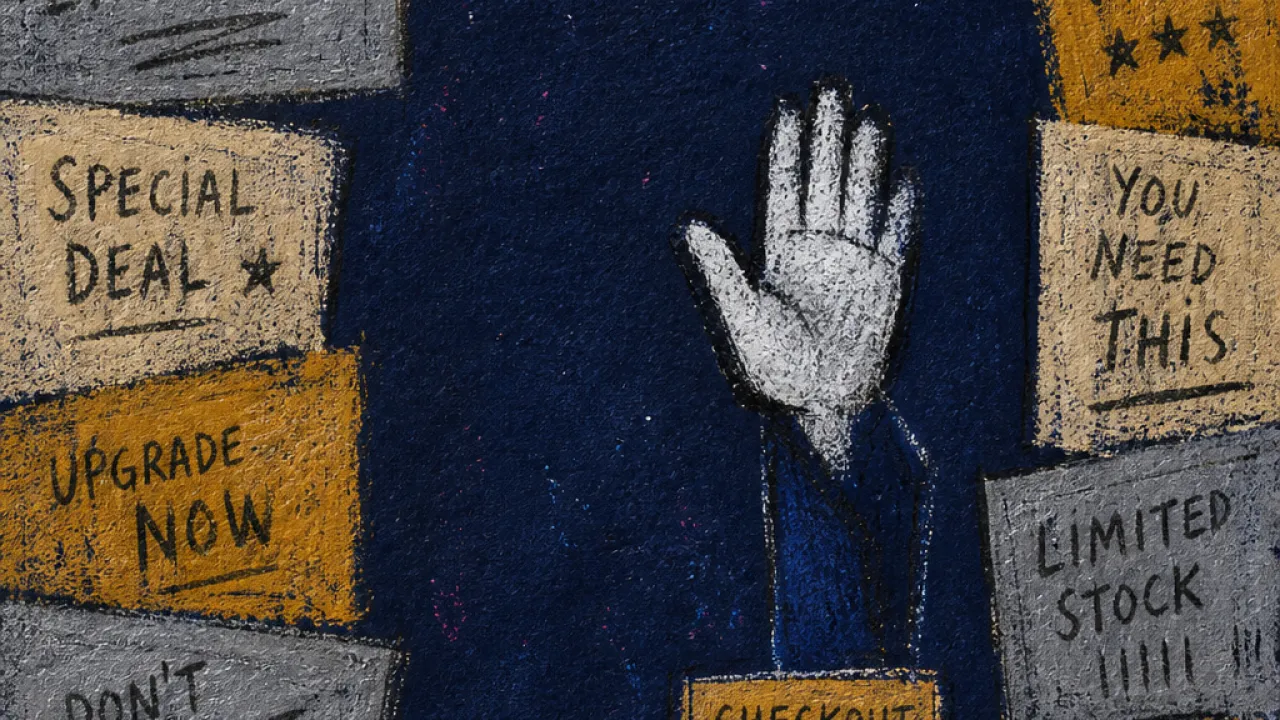
A figure's open palm hovers above a checkout button while stacked offer panels narrow the space from every side.

What is this situation?

Checkout Decision Paralysis: you reach the final screen expecting one last tap, but the purchase suddenly branches into coupon codes, shipping thresholds, protection plans, payment options, and a total that no longer looks final. At 11:40 p.m., sitting on your bed with your phone, the item is still in stock, yet a low-stock banner says to act now, a timer says the offer expires soon, and the coupon box implies a better price may exist elsewhere. You open another tab to compare, then return to find that adding one more item unlocks free shipping while removing it brings the delivery fee back. Reviews disagree about size and quality; the payment-plan panel foregrounds smaller installments; warranty, subscription, and add-on boxes each turn the last step into another choice. The retailer controls when each detail appears and which number gets the largest type, while you are left recalculating the total across screens. A purchase that was meant to take a minute stretches across tabs, screenshots, abandoned carts, and repeat visits. Your palm hovers over Place Order, your shoulders stay lifted, and closing the page does not settle anything because the price or promotion may look different tomorrow. A routine purchase becomes a recurring test whose answer keeps moving, much like the Seven of Cups, where one figure faces a cloud of competing objects, each pulling the gaze in a different direction.

Why it's not you?

This is not a personal failure to make a simple choice. The checkout itself keeps changing the comparison by layering urgency messages, conditional discounts, fees, and add-ons onto the final step; the instability belongs to the setup, not to you.

Checkout Decision Paralysis in Tarot Cards

Checkout Decision Paralysis describes a final purchase step that keeps reopening the choice through fees, offers, warnings, and competing ways to qualify for value. Your palm hovers over Place Order and your shoulders stay lifted as each prompt makes the total look unsettled again. This environmental and structural dynamic is built into how the checkout operates; the Tarot Cards below reflect the outline of options crowding the screen while a clear endpoint stays out of view.

The Magician
Reversed
One hand rises while the other points down toward a table holding a cup, sword, wand, and pentacle, a complete kit of instruments gathered for one act. In a checkout, that table becomes the coupon box, shipping threshold, payment plan, protection offer, review panel, and add-on tray; the same system that appears to give you more control can redirect attention from the actual total. You are navigating an interface whose tools are arranged by someone else, with one figure or number foregrounded while the remaining conditions wait below the fold. Reversed, the Magician shows capability turned into misdirection: the options are real, but their presentation prevents them from functioning as a clear comparison.
Wheel of Fortune
Upright
A large wheel turns between a climbing figure, a descending figure, and four fixed watchers in the corners. The rotating structure matches a checkout whose stock signal, promotional timer, shipping threshold, and displayed total change the decision window while you are trying to decide when to act. You are not responding to a single deadline; you are tracking a commercial cycle that may look different on the next visit. Upright, the Wheel describes timing as an external moving condition, preserving the possibility of a clear moment while showing why the current one keeps being displaced by the next offer state.
Justice
Upright
A seated figure holds a sword upright in one hand and balanced scales in the other, placing measurement and consequence at the center of the frame. The image fits the final checkout when you must compare the real total, delivery terms, return coverage, financing cost, and add-ons rather than the largest number on the screen. You are asked to make a fair assessment while the interface distributes the facts across panels and emphasizes some terms over others. Upright, Justice preserves access to the evidence but exposes the structural friction: the decision remains stalled because the scales cannot settle until every cost is brought into the same view.
The Hanged Man
Upright
A figure hangs by one foot from a living tree, hands behind the back, with a calm halo around an inverted head. The suspension mirrors your palm hovering over Place Order while the timer, stock banner, and tomorrow's possible price make both action and delay carry a cost. You are held at a timing node where waiting is no longer neutral and acting is not fully informed. Upright, the Hanged Man frames the pause as a structural suspension created by competing signals; the inverted view reveals why another tab can change the question without resolving it.
The Devil
Upright
A horned figure presides over two chained people above a dark pedestal, with the chain loose enough to suggest choice but visible enough to keep the attachment in view. That arrangement mirrors a checkout built from scarcity banners, low-stock warnings, installment framing, protection plans, and subscriptions, where each extra promise makes the purchase harder to leave without reconsidering. You can see how the commercial system binds attention to the item and to the fear of missing a better deal. Upright, the card names the material and behavioral pull of the setup without treating your hesitation as a personal defect: the pressure is built through visible incentives and conditional release.
The Moon
Upright
A large moon hangs over a winding path between two towers while a dog, a wolf, and a crayfish respond to different layers of the same scene. The divided landscape resembles a checkout where the headline price, delivery estimate, coupon field, review evidence, and payment-plan total each illuminate a different version of the purchase. You cannot resolve the order by looking at one number because the important conditions appear at different depths. Upright, the Moon keeps the route open but obscured, giving the shifting total and contradictory signals a concrete structure rather than turning uncertainty into a judgment about you.
Seven of Cups
Upright
A single figure faces a cloud carrying seven distinct vessels, each offering a different object while none supplies a stable answer. The scene maps directly onto a checkout where a coupon, free-shipping threshold, protection plan, installment schedule, and add-on all compete to become the decisive detail; the gaze keeps moving because the comparison set itself has become unstable. You are left managing a commercial interface rather than making one bounded purchase decision. Upright, the image keeps every option visibly available, so the path is technically open while attention is repeatedly pulled away from Place Order and into another calculation.
Two of Pentacles
Reversed
Two pentacles are kept in a looping pattern while ships pitch behind the juggler. The repeated motion resembles a checkout where the coupon timer, low-stock signal, shipping threshold, and payment plan each alter the moment at which the order seems worth placing. You are asked to keep pace with a commercial rhythm that changes whenever you adjust the cart or open another panel. Reversed, the juggling loses its workable cadence, so waiting and acting both feel like unstable timing choices rather than distinct moments with clear consequences.
Two of Swords
Upright
A blindfolded figure sits between water and land with two swords crossed tightly over the chest. That physical closure mirrors a final checkout in which the price, delivery fee, coupon, and payment route cannot be weighed from one stable view; each new screen asks you to defend one option before the missing condition is visible. You can still place the order, but the setup withholds the perspective needed to compare it cleanly. Upright, the posture holds the decision in suspension: the obstacle is not a lack of intelligence, but a choice architecture that makes commitment feel premature.
Eight of Swords
Upright
A blindfolded, bound figure stands inside a loose ring of swords, with a castle and open ground visible beyond the enclosure. The scene parallels a checkout that surrounds you with fees, thresholds, reviews, warranties, and payment prompts until the available route is technically present but difficult to identify. You keep opening tabs and returning to the cart because every attempt to escape one constraint exposes another. Upright, the image describes a restricted field of action created by the interface itself, not an inherent inability to choose.
Knight of Swords
Reversed
A mounted knight drives forward with a raised sword under a wind-whipped sky, the horse's motion carrying the scene faster than the terrain can settle. That charge resembles a checkout timer, low-stock banner, or expiring coupon converting a routine purchase into an apparent race while the actual total remains under review. You are being pushed toward a moment of action before the comparison is stable. Reversed, the Knight of Swords shows urgency losing proportion: speed becomes noise, and the deadline signal competes with the information required to know whether the purchase is complete in value.
Ten of Wands
Upright
A figure carries ten wands so densely that the bundle blocks the view ahead, even though the road and destination remain visible. The packed load mirrors a one-minute checkout carrying coupon hunting, review comparison, shipping math, warranty decisions, subscription prompts, and payment-plan tradeoffs all at once. You are still moving through the purchase flow, but the accumulated tasks consume the attention needed for the final choice. Upright, the card shows the burden as an objective property of the transaction: adding one more check can feel responsible while the total workload keeps the decision from closing.

Checkout Decision Paralysis in Tarot Card Reading Insights

When checkout fees, timers, discounts, and add-ons keep reopening a nearly finished decision, other shoppers have brought the same situation into their readings. The articles below gather Tarot Reading Insights from those sessions.
Psychological Contexts Related to Checkout Decision Paralysis