High-Functioning on Paper at 11:47 p.m.
When Mia sat down across from me in the back corner of my café, I told her something I have said to more students than I can count: if the hour after submission makes you feel less relieved than exposed, like now the room, the dishes, the admin, and your own body are all waiting for you, this is the burnout-after-the-deadline loop. She let out one short laugh, the kind that means I had landed too close to the bone.
She described Tuesday night in her shared apartment near campus in Toronto with the kind of precision people use when they are tired of pretending they are fine. It was 11:47 p.m. The Quercus upload confirmation was still open on her laptop. Blue screen light hit a chair buried in clean clothes. The fridge hummed from the kitchen. Her phone warmed in her hand as three overdue texts lit up the screen. She meant to answer one. She opened TikTok instead. Her shoulders went tight, her stomach dropped, and the finished assignment somehow made the rest of her life look louder.
Then she said it plainly. “I can be responsible when it counts, so why am I such a mess the minute no one is checking?” Under that question sat the real contradiction: she wanted the rest of life to feel as manageable as schoolwork, and she was terrified that if laundry, meals, messages, and money tasks still slipped without deadlines, it meant she was failing at adulthood.
What I heard in her voice was not laziness. It was overwhelm with a private undertow of shame, like twenty-four browser tabs opening at once and one of them starting to auto-play audio in the dark. High-functioning on paper can still feel like quietly falling apart off the clock. I wrapped both hands around my espresso cup, looked at her with all the softness I could manage, and said, “We are not here to grade you. We are here to make a map through the fog, and maybe find the kind of clarity that actually helps.”
Choosing the Compass: A Five-Card Cross for Student Burnout
I asked her to take three slow breaths while the last of the milk steam faded behind the counter. Then I shuffled. I have never believed the ritual needs to be theatrical. The point is simpler than that: give the nervous system one small bridge from panic into attention.
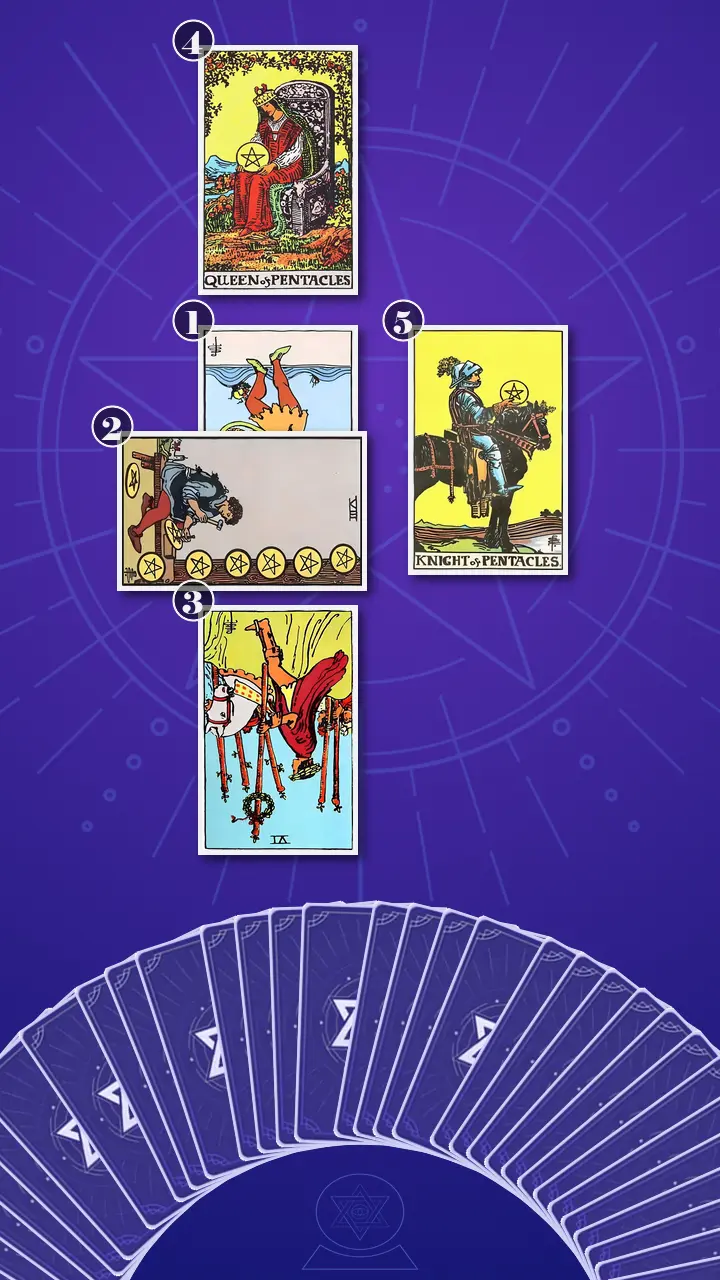
For her, I chose the Five-Card Cross · Context Edition. I use this spread often when someone asks a question that sounds practical on the surface but carries a deeper wound underneath it. It is one of the best tarot spread formats for student burnout and everyday life imbalance because it does not drown the moment in ten different symbols. It gives me a clean chain: what is happening now, what is crossing it, what is underneath it, what can restore alignment, and what kind of rhythm might hold if the insight is actually used.
I told her how tarot works in a situation like this. The center card would show the obvious mismatch between her polished assignments and the scattered state of her real life. The crossing card would reveal the work mode that gets results but eats the bandwidth meant for food, rest, home care, and communication. The lower card would name the root fear. The upper card would carry the medicine. The card to the right would show the next stabilizing arc, not a fantasy transformation, just the next honest direction.
The Cards That Named the Life Admin Crash
The Laundry Chair and the Open Tabs
I turned over the first card, the one representing the observable mismatch between finishing assignments and letting everyday maintenance scatter. It was the Two of Pentacles, reversed.
I did not have to reach far for the translation. This was the exact post-submission hour she had just described: clothes on the chair, low groceries, unread texts, and random admin all demanding attention at once. Nothing in that pile was individually impossible. But her brain could not hold one more moving part, so scrolling or avoidance felt easier than deciding what counted first. The infinity loop around the pentacles became all those never-closed mental tabs. The figure’s raised leg and unstable footing mirrored the way one extra demand could throw off her whole balance.
Reversed, the card showed dysregulated Earth: not a lack of ability, but too many practical needs being held in the head with no rhythm underneath them. It was like carrying a tote bag, a coffee, a phone, and a TTC card through a rushed transfer and knowing something is going to get dropped. I told her, “This card does not say you are bad at life. It says you have been forced to juggle too much of life in real time.”
She looked down at the card and gave me a small, bitter smile. “That’s annoyingly accurate,” she said. Her fingers tapped once against the ceramic cup, then twice, then went still. That reaction matters. It is the moment a person stops arguing with the scene because the scene is already theirs.
The Useful Strength That Turned Into a Tunnel
Then I turned over the card crossing the center, the one revealing the work mode that wins grades but consumes the bandwidth needed for food, rest, home care, and communication. It was the Eight of Pentacles, upright.
This card was Mia in Robarts Library at 3:21 p.m., zoomed to 300% on one paragraph because the rubric was clear, while her water bottle sat empty, her stomach went acidic, and a banking notification about delivery spending and a small late fee got swiped away. The craftsman bent over his bench showed exactly what I needed her to see: competence narrowed to whatever is measurable, gradable, and finishable. In the crossing position, the card did not become bad. It became over-specialized.
Looking at that worker, I had one of those little inner flashes I get from years behind an espresso machine. A good shot can turn bitter if I over-extract it, not because the beans are weak, but because too much is being pulled through too tight a channel. That was her nervous system. Strong attention. Strong effort. Too much pressure through one lane.
I told her, “This is why you can do four clean hours of schoolwork and then feel like groceries, showering, or texting back are somehow impossible. Your best structure is going to the assignment. The rest of life gets mentally cropped out. It’s a little Severance-coded, honestly. Your competent student self is fully online, and your home life barely makes it onto the screen.”
She dragged her thumb along the paper sleeve of her cup and stared past my shoulder for a second. Not disagreement. Recognition with a little grief in it.
The Grade Portal as a Self-Worth Ticker
I turned over the third card below the center, the one naming the fear that competence only counts when it is visible, rewarded, or externally measured. It was the Six of Wands, reversed.
At the root, this card looked exactly like what she had been living: an A- notification can create a clean burst of relief in the chest, but folding one load of laundry feels weirdly flat by comparison. The public victory symbols in this card mattered. Upright, they celebrate witnessed success. Reversed, they show what happens when the mind begins to trust worth only when it comes with proof, a score, or witnesses. Like checking the grade portal the way some people check a stock app, waiting to see if your value is up today.
I leaned back and said it as simply as I could: “If it only counts when it is graded, the rest of life will keep feeling fake.” Then I added the harder part. “That means groceries, sleep, money calm, and one honest reply can all be genuinely important and still fail to emotionally register as success inside your current system.”
Her reaction came in three tiny waves. First her breath caught and held. Then her eyes unfocused, as if she were replaying ten private moments at once: unanswered texts, emergency DoorDash, clean laundry living on a chair. Then she straightened and said, a little sharper than before, “So what, I only know how to care if someone claps?”
I shook my head. “No. I think your brain learned the wrong notification settings. It has been trained to ping for graded tasks and stay silent for private care. That is a measurement problem, not a character flaw.”
That landed. I watched the defensiveness loosen in her jaw by a millimeter. Quiet embarrassment turned into something more useful: understanding.
When the Queen of Pentacles Changed the Standard
The Card Above the Noise
When I reached for the fourth card, even the café seemed to cooperate with the moment. The grinder had gone quiet. The window held only soft streetlight and a blur of passing headlights. By then Mia was back in that 11:47 p.m. room in her head: the paper uploaded, the laptop shut, the fridge humming, the laundry chair in the corner, her own body suddenly loud because the one thing with a grade was finally done.
Your life does not steady by squeezing harder like a machine; it steadies when you hold your needs like the Queen holds her pentacle—close enough to matter before they become a crisis.
I let the sentence sit between us.
Then I brought in one of the lenses I use in both coffee and tarot, what I privately think of as Knowledge Filtration. In coffee, the filter decides the cup before the first sip. It determines what gets through and what gets left behind. Mia had been living with a brutal inner filter: grades, rubrics, and deadlines passed through as real competence, while groceries, clean socks, a filled water bottle, a prescription refill, or one honest text reply were getting trapped on the wrong side as if they were optional residue. The Queen of Pentacles was not asking her to become more impressive. She was asking her to change the filter.
Her reaction unfolded exactly the way deep insight often does. First she went physically still, chin slightly lifted, like her body had forgotten the next instruction. Then her gaze drifted away from me and fixed on nothing, the look people get when old memories start re-captioning themselves. Then her shoulders dropped so suddenly it was almost a collapse. “But if I count that stuff,” she said, and now there was a flash of resistance in it, “doesn’t that mean the bar is embarrassingly low?”
“No,” I told her gently. “It means the old bar only measured performance. Care is not the reward after the real work. Care is part of the real work.”
I watched her eyes redden just slightly. Not tears exactly. More like the dizziness that comes when a burden is lifted and your body has to relearn how to stand without it. She looked at the Queen holding her pentacle close to her body, then at her cooling coffee, then back to the card. I asked, “Think back to last week. Was there a moment when this would have changed how you felt?”
She nodded almost immediately. The night she submitted a paper, opened Uber Eats, ignored Sam’s text for the fourth day, and told herself she would become a better person tomorrow. That was the hinge. So I made the Queen practical. “Tonight,” I said, “choose one make-tomorrow-easier move and do it at 20% effort. Put clothes in the hamper. Leave oats and a bowl on the counter. Fill your water bottle. Send one honest text that says, ‘Late reply, thinking of you.’ Set a five-minute timer and stop when it ends. If your body resists, pause. The goal is contact, not perfection.”
That was the real crossing point of the reading: not from mess to perfection, but from overwhelm and shame after deadlines toward grounded self-trust and steadier everyday care.
The Ordinary Rhythm That Holds
The fifth card went to the right, the one showing the kind of practical rhythm that can make life feel held without relying on panic or deadlines. It was the Knight of Pentacles, upright.
I always love this card because it refuses drama. This was not a 1 a.m. life-reset montage. This was the same grocery slot after Thursday seminar. The same laundry window on Sunday. The same easy breakfast cue. The same tiny reply habit. The still horse told the truth immediately: competence here is pace, not speed. The cultivated field behind the knight said that what steadies a life is repetition, not intensity.
I translated it for her in the plainest language I had. “This card asks one question: can you make support ordinary enough that you still do it on a bad week?” That is the Knight’s whole philosophy. Build the version you can still do on a bad Tuesday.
She gave a slow nod and pulled her phone out, not to disappear this time, but to type. “That,” she said, “sounds way less impossible than getting my whole life together.”
Supportive, Not Impressive: Your Next 48 Hours
Once all five cards were on the table, the story was clean. The visible problem was not that Mia could not handle basic life stuff. The center card showed overload. The crossing card showed task tunnel vision. The root card showed the hidden rule: only what is seen, graded, or praised feels real enough to deserve full energy. That was the hidden hinge. Once that hinge was named, the advice stopped sounding like generic adulting tips and started making psychological sense.
I told her her blind spot was not poor character. It was this: she had been treating ungraded parts of life as optional leftovers and then reading the inevitable crash as evidence against her competence. She kept trying to solve a support problem with performance energy. The reading’s direction was much steadier than that. It asked her to move from performance-based competence to embodied self-stewardship, from panic-driven productivity to supportive-not-impressive routines.
So I gave her a plan small enough to survive finals, part-time shifts, TTC delays, and a tired nervous system. I also gave her one of my café tools, a softened version of my Latte Memory Technique, because a cue that lives next to coffee usually survives a rough morning better than a perfect app.
- Supportive-Not-Impressive Check-InAt about 4 p.m., leaving class, sitting on the TTC, or just before you open a delivery app, ask: What would make tonight materially easier? Choose one answer only: buy two easy groceries, fill your water bottle, clear one desk corner, or send one honest text. Give it five minutes, not an hour.If your brain says this is too basic to count, I would treat that as the pattern speaking, not the truth.
- Two-Anchor WeekFor the next seven days, choose exactly two daily anchors, such as eating within 90 minutes of waking and doing a 10-minute room reset before doomscrolling at night. Track them on one sticky note, in a paper planner, or on a simple phone widget. Do not build a full Notion dashboard for this.If one anchor gets missed, restart at the next one. A routine that shames you is just another deadline in disguise.
- Bad-Tuesday Routine with a Latte Memory CueGive one recurring life task a boring home in your week, like groceries after Thursday seminar or laundry Sunday at 1 p.m. Then tie one tiny care action to the coffee you already make: when the kettle starts, put oats and a bowl on the counter, pack one snack, or move clothes to the hamper. Let the smell of coffee become the cue instead of waiting for motivation.The goal is repeatability on an ordinary Tuesday, not a cinematic reset. If the routine starts feeling punitive, shorten it and keep the cue.
A Week Later, the Quiet Proof
A week later, I got a message from her while I was opening the café. It said, “Did bad-week groceries after seminar. Left oats out before bed. Room still kind of chaotic, but I ate before class and finally texted Sam back.” I smiled into the first espresso of the morning because that is how real change usually arrives: not with a perfect routine reel, but with one less emergency and one more act of self-trust.
She was not transformed into some impossible version of adulthood. She had simply stopped using panic as her only project manager. She slept a full night, woke with the old thought — what if I slip again? — and this time she laughed, made coffee, and put bread in the toaster anyway.
When I think about that session now, I think of what this kind of reading does at its best. A Five-Card Cross tarot spread for student burnout and everyday life imbalance cannot hand someone a new personality. What it can do is show where the shame loop lives, why ungraded tasks start feeling fake, and what kind of next steps create finding clarity without turning care into another performance.
When the assignment is done and the room gets quiet, a lot of us know that jaw-tight, chest-drop moment where laundry, groceries, and unanswered texts suddenly feel like evidence against our whole adulthood.
If one ungraded part of your life got to count as real competence this week, which part would you want to hold like the Queen held her pentacle — close enough to make just 10% easier to care for?
This story is adapted from psychological research, written so that those in a similar struggle can see their own pattern in it — and find their next step clearly.These insights are not a substitute for professional psychological, medical, legal, or financial advice.
Learn more about our Journey to Clarity.
How did this insight land for you?
🫂 This Resonates Deeply
🌀 Living This Story
✨ Now I See Clearly
🌱 Seeing New Possibilities
🧰 Useful Framework
🔮 The Confirmation I Needed
💪 Feeling Empowered
🚀 Ready for My Next Step
Author Profile
 AI
AI“For twenty years, I’ve listened to stories unfold over the warm aroma of coffee. I don’t believe life’s complexities always require grand theories to be solved; often, we just need a safe place to tidy up our reality. I don’t offer high-minded preaching—just grounded, heartfelt insights to help you regain your sense of control amidst the clutter of daily life.”
In this Study Tarot Reading :
Core Expertise
- Syllabus Deconstruction: Stripping the paralyzing dread from massive deadlines by reducing them to mechanical, emotionless daily tasks.
- Study Environment Auditing: Identifying physical clutter and disorganized systems that quietly drain your limited psychological bandwidth.
Service Features
- The Desktop Reset Ritual: A pragmatic 15-minute physical clearing exercise to instantly restore visual order and mental clarity before opening a textbook.
Also specializes in :
Explore Related Patterns:
Achievement FusionThe A- notification giving Mia a clean burst of relief while laundry feels emotionally flat shows that achievement has become her strongest self-worth signal. The grade portal works like an inner ticker: proof arrives, the body relaxes, and competence briefly feels confirmed. Achievement Fusion fits because the self is not just pursuing outcomes; it is using outcomes to decide whether it is allowed to feel real, capable, or okay. You can know intellectually that groceries, sleep, money calm, and one honest reply matter, while your internal reward system stays quiet because none of those acts produce visible proof. That is why the rest of life can feel fake after the assignment is done. Private care is not failing because it is small; it is failing to register because the measurement filter has been trained around external achievement. The useful shift is to treat care as evidence of competence even when no one grades it.
Avoidance CopingAt 11:47 p.m., Mia means to answer one overdue text and opens TikTok instead. That small pivot matters because it shows the behavior function clearly: the app is not the real goal; immediate pressure reduction is. Avoidance Coping fits the repeated sequence of swiping away the banking notification, patching hunger with delivery, delaying Sam's text for a fourth day, and promising to become a better person tomorrow. You are watching the mind move away from tasks that carry shame, ambiguity, or relational exposure, even when those tasks are objectively small. The pattern protects you from the spike of discomfort in the short term, but it also lets the maintenance pile become louder. Once the behavior is named, the intervention can stay small: not a full life reset, but one contact point with the avoided task before the shame loop gets to write the whole story.
Productivity as SafetyMia's line about being responsible when it counts, then falling apart the minute no one is checking, shows a nervous system that has learned to borrow structure from pressure. Deadlines, rubrics, grades, and upload portals do more than organize her workload; they make action feel safe enough to start. Productivity as Safety names the way performance becomes a containment strategy. You may be able to move fast and cleanly when there is a visible standard, because the external frame reduces ambiguity and gives your effort somewhere to go. The problem is that meals, laundry, water, money calm, and honest replies do not arrive with the same external authority. After the assignment is submitted, the safety scaffold disappears. The crash is not proof that you lack discipline; it is evidence that your care system has been outsourcing its stability to urgency. The repair is not more pressure, but a quieter structure that lets ungraded support count before it becomes an emergency.
Shame-Driven DelayMia's question about why she is 'such a mess' the minute no one is checking turns laundry, meals, messages, and money tasks into a verdict on adulthood. The practical task is no longer just a practical task; it becomes evidence in a private trial about whether she is functioning correctly. Shame-Driven Delay fits because shame makes contact with the task feel more threatening than the task itself. You may delay the text, the laundry, the grocery run, or the fee notice not because you do not care, but because touching it would also mean touching the self-judgment attached to it. The promise to become a better person tomorrow keeps the loop alive. It converts a five-minute care action into a moral renovation project, which makes starting feel heavier. The pattern loosens when the task is allowed to be ordinary again: one reply, one water bottle, one small repair, with no character verdict attached.
Tunnel VisionMia zooming to 300% on one paragraph in Robarts while her water bottle sits empty and a banking notification gets swiped away is the cleanest behavioral anchor for this pattern. Her attention is not weak; it is over-specialized around the task with the clearest rubric, the clearest finish line, and the clearest proof of success. Tunnel Vision fits because the assignment becomes the only channel that feels cognitively real. You can complete the graded task with impressive precision while your body, room, money admin, and unread texts are pushed outside the frame until the deadline ends and everything rushes back in. The post-submission crash is the cost of that narrowing. The rest of life has not disappeared; it has been mentally cropped out. Naming the pattern helps shift the question from 'why can't I handle basic life?' to 'what keeps getting excluded when my focus locks onto what can be measured?'
Explore Related Struggles:
Evidence DisconnectionMia has clear proof that she can finish demanding work: the upload confirmation is right there on her laptop. Yet that proof does not calm the scene around her, because the laundry chair, unread texts, low groceries, and ignored admin tell a different story that her current system does not know how to integrate. Evidence Disconnection names the split between visible achievement and lived self-trust. The assignment proves competence in one language, while her apartment and body are asking for competence in another, and those languages are not translating for her. That is why the question hurts so much. You can have evidence that you are capable and still feel privately unconvinced when the evidence only covers the parts of life that someone else measures. The struggle is the broken bridge between what she has demonstrably done and what she can let herself trust.
Panic Productivity TrapMia can produce four clean hours of schoolwork when the assignment is visible, urgent, and measurable. The same person then sits in the post-submission quiet and cannot make laundry, food, texts, or money tasks feel organized enough to begin. Panic Productivity Trap captures that pressure has become her most reliable structure. You see it in the way deadlines switch her competent student self fully online, while the rest of life barely makes it onto the screen until the pressure drops and the backlog rushes in. That creates a harsh bind: the system that proves she can perform is also the system that leaves her dependent on urgency. You are not looking at a lack of capability here; you are looking at capability trained to wake up only when the stakes feel sharp enough.
Performance-Worth FusionMia describes the central wound plainly: she can be responsible when it counts, then reads the slipping laundry, meals, messages, and money tasks as evidence that she is failing adulthood. The story shows why that evidence feels so convincing to her: an A- notification lands as real relief, while folding laundry or replying honestly to Sam feels flat by comparison. Performance-Worth Fusion names the point where visible output starts carrying too much of the self. You can see the fusion in the grade portal functioning like a value ticker and in the way private care loses emotional weight because no one grades it, praises it, or sees it. The inner struggle is that ordinary care has to compete with performance for the right to feel real. You are watching a person whose life support tasks matter materially, but whose internal measurement system keeps treating them as less valid than anything with a rubric attached.
Real-Time Care BindMia’s body and life admin keep appearing after they have already been postponed: an empty water bottle, an acidic stomach, a banking notification swiped away, delivery spending, a late fee, and Sam’s text waiting for the fourth day. These details are small on their own, but together they show care arriving late in the sequence. Real-Time Care Bind captures the trap of only noticing needs once they have become loud enough to interrupt. You can see how the assignment receives attention while it is still manageable, but food, rest, money calm, and communication often wait until they feel like proof that something is wrong. The struggle is about timing, not morality. You are seeing a care system that has been pushed to the end of the line so often that support only appears after depletion, which makes every ordinary need feel heavier than it would have if it had been allowed to matter earlier.
Routine FreefallMia uploads the assignment, sees the confirmation, and immediately meets the chair full of clean clothes, the overdue texts, the low groceries, and the small admin tasks that have been waiting outside the deadline. She means to answer one message, but TikTok becomes the easier path because there is no clear first move and no external structure telling her what matters next. Routine Freefall names the way her life maintenance loses its floor the second the graded task ends. You can see the contradiction in how capable she is when the rubric is clear, then how quickly ordinary care turns into a pile of unsorted demands once no one is checking. The struggle is not that Mia lacks responsibility. The struggle is that her daily rhythm depends on deadlines to hold it upright, so ungraded tasks keep falling through the space between effort and recovery until they return as shame, clutter, late replies, and small emergencies.
Performative StabilityMia looks high-functioning on paper because the finished assignment is real, visible, and submitted on time. At the same moment, the private scene tells another truth: clean clothes are still on the chair, groceries are low, messages are overdue, and the money tasks have been pushed away. Performative Stability names that split between the surface that can be shown and the support system that is quietly fraying underneath it. The story does not present Mia as pretending on purpose; it shows a life where the measurable part stays polished while the unmeasured part absorbs the strain. The struggle becomes painful because the outside proof of stability makes the inside disorder feel harder to explain. You can be functioning where the world knows how to count and still be losing contact with the ordinary structures that make daily life feel held.
Unseen Cost BindThe assignment is done, but the cost of getting it done is sitting around Mia in ordinary forms: low groceries, an empty water bottle, late messages, delivery spending, a small fee, and the laundry chair. None of these details cancels her achievement, but together they reveal what the achievement did not count. Unseen Cost Bind names the hidden exchange between visible output and invisible maintenance. The story keeps showing that schoolwork can be completed while food, rest, money calm, communication, and home care are quietly borrowed from the future. The bind is that the cost only becomes visible after the pressure has lifted. You are watching Mia meet the private invoice for being high-functioning on paper, and the work of clarity is learning to count those costs before they turn into another crash.
Explore Related Emotions:
Capability ShameMia says she can be responsible when it counts, then asks why she becomes such a mess the minute no one is checking. The unfinished laundry, unanswered texts, delivery spending, and skipped care tasks are not just chores in her mind; they start acting like a private verdict on whether she is failing at adulthood. Capability Shame forms when visible competence and hidden disarray sit too close together. You can produce the assignment, meet the rubric, and still feel exposed by the parts of life that have no grade portal. The shame comes from treating the gap between intention and action as evidence about your worth instead of evidence about your current bandwidth. This label belongs here because Mia's pain is not simply that life admin is unfinished. It is that every slipped task seems to whisper that the competent student self is a costume, while the room after midnight is the truth.
Cautious Self-TrustA week later, Mia has not created a perfect routine or a new personality. She has done bad-week groceries after seminar, left oats out before bed, eaten before class, and finally texted Sam back while the room is still kind of chaotic. Cautious Self-Trust grows from proof that is small enough to be believable. You are not asking yourself to become permanently fixed; you are noticing that one practical act can make tomorrow less hostile. The emotional shift is quiet because it does not need to perform itself. This is the forward answer to Mia's question. Keeping life together begins to mean fewer emergencies and more contact with her own needs, not a flawless adulting montage. Trust returns as a series of repeatable moments she can actually survive on a bad week.
Hollow CompletionThe assignment is done, the confirmation is visible, and the expected relief does not arrive in the way it is supposed to. Instead, the finished work exposes the chair buried in clothes, the phone full of overdue texts, the fridge humming from the kitchen, and the body that has been waiting its turn. Hollow Completion is the strange emptiness that can follow a win when the win only resolves the measurable part of life. You finish the thing that counts on paper, but the emotional system does not register safety. It only notices how much remains unheld. For Mia, the completion is hollow because schoolwork gives her a clean endpoint while private care gives her no applause, no score, and no obvious finish line. The assignment closes, but the self behind it still feels unfinished.
Productivity GuiltMia can pour strong attention into the paragraph with the clear rubric, while a water bottle sits empty and a banking notification gets swiped away. Later, one honest text, clean socks, groceries, and a filled water bottle feel too basic to count, even though their absence makes the night harder. Productivity Guilt shows up when care is treated as morally suspicious unless it looks like output. You may know that food, rest, money calm, and communication matter, but they feel less legitimate than the work someone can evaluate. The guilt builds because the body keeps needing support while the inner scoreboard only rewards performance. This is why Mia reads ignored texts and emergency DoorDash as proof that she should become a better person tomorrow. She is not just behind on tasks; she is caught in the feeling that private maintenance has to justify itself before it deserves energy.
Scattered OverwhelmThe upload confirmation is still open when the room starts to feel louder: clean clothes on the chair, overdue texts on the phone, low groceries, money admin, and the hum of a body that has been postponed. None of those demands is huge by itself, but they arrive as one pile the second the graded task is finished. That is the shape of Scattered Overwhelm. Your attention is not empty; it is overfilled with practical fragments that have no obvious order, no deadline, and no clean first move. The mind reaches for TikTok because scrolling offers one single channel when real life is asking for five at once. This emotion connects directly to Mia's question because the problem is not a lack of responsibility. It is the feeling of being flooded by ungraded maintenance the moment external structure disappears, until ordinary life starts to feel less like a set of tasks and more like static pressing against the skin.
Clarity ReliefWhen Mia hears that her brain has learned the wrong notification settings, her jaw loosens. The pile of laundry, delivery spending, and unanswered texts stops being a moral mystery and becomes a map of what her current system has been trained to notice. Clarity Relief is the release that comes when the story finally has a clean shape. You are not excusing the mess, and you are not turning it into a personality flaw. You are seeing the rule underneath it: graded performance has been allowed to count, while private care has been kept outside the frame. That recognition matters because it gives Mia agency without adding another demand. Once the filter is visible, she can start changing what counts as competence instead of fighting herself in the dark.
Deadline Doom SpiralMia can stay locked in for four clean hours of schoolwork, then groceries, showering, and texting back suddenly feel impossible. The assignment gets the structure; the rest of life waits until it becomes loud enough to break through. Deadline Doom Spiral is the emotional drop that happens when urgency becomes the only reliable source of movement. You can function under pressure, but once the pressure releases, everyday care has no engine. The result is a loop of last-minute control followed by a private crash. The story keeps returning to this rhythm: graded tasks pull her into focus, ungraded tasks become background noise, and then the accumulated background noise turns into the next crisis. The dread is not about one missed chore; it is about realizing that panic has been running the calendar.
Explore Related Contexts:
Academic Performance PersonaMia can sit in Robarts Library, zoom in on one paragraph, follow the rubric, submit the assignment, and receive proof that she performed well. The same person then returns to a shared apartment where groceries, showering, messages, and laundry seem to lose their claim on her attention. Academic Performance Persona names the external stage where competence is shaped around what can be submitted, graded, witnessed, and confirmed. The institution gives her a clean role to play: student, producer, deadline-meeter, score-receiver. That role works, but it becomes too narrow to carry the rest of life. The story is not saying that her academic self is fake. It shows a social role that has become over-specialized. You can be highly functional inside a measurable system and still lack scaffolding for the ungraded systems that keep daily life livable.
Adulting Performance PressureMia's question turns laundry, meals, messages, and money tasks into a verdict on adulthood. She does not simply say the apartment is messy; she asks why she becomes a mess the minute no one is checking. Adulting Performance Pressure is the external social script underneath that question. It treats everyday self-management as something a competent adult should be able to perform silently, consistently, and without visible support. For a student whose strongest structure comes from academic deadlines, that script creates a harsh comparison between school success and private maintenance. The pressure is real because the tasks are ordinary but the standard is loaded. You are watching a person measure herself against an imagined adult baseline while living inside a student schedule, a shared apartment, digital obligations, food logistics, and money admin that do not come with rubrics.
External Scorecard PressureThe grade portal functions like a public ticker in Mia's life: an A- can create a clean burst of relief, while one load of laundry or one honest text reply barely registers. Rubrics, upload confirmations, and scores give academic work a visible finish line that private care does not get. External Scorecard Pressure appears when the outside world teaches a person that only measured performance counts as real progress. In Mia's case, school provides a complete feedback economy: deadlines, criteria, submission proof, grades, and recognition. Groceries, sleep, money calm, and communication sit outside that economy. This matters because You cannot keep a whole life together if only the graded parts receive legitimacy. The story shows how a scoring structure can organize attention so strongly that unscored maintenance starts to feel optional, even when it is materially necessary.
Life Admin BacklogThe Quercus upload is complete, but the chair of clean clothes, low groceries, overdue texts, random admin, and the small late fee all become visible at once. Mia has finished the task that counted publicly, yet the private maintenance layer has been waiting in the room the whole time. That is the structure of a life admin backlog: no single item is impossible, but the pile becomes difficult because it has no clear queue, no external checkpoint, and no immediate reward signal. You are not looking at a character flaw in the story; you are looking at a support system that only activates for graded work and leaves everyday logistics to accumulate offstage. The pressure lands hardest after submission because the assignment stops occupying the foreground. Once the academic deadline releases her attention, the unprocessed maintenance work rushes forward as a crowded external scene: laundry, food, money, messages, and body care all asking to be handled without the structure school provides.
Routine CollapseAt 11:47 p.m., the assignment is submitted, but there is no next rhythm to catch Mia. The clothes, fridge, phone, banking notification, food needs, and messages all enter the same field with equal urgency. Routine Collapse names what happens when a person's day is held together by deadline intensity rather than repeatable maintenance. Mia can work intensely when the academic track is active, but the moment that track ends, there is no ordinary sequence for recovery, food, cleaning, communication, or money attention. The collapse is structural because the problem is not one bad night. The story repeats the same pattern across the paper submission, delivery spending, ignored text, empty water bottle, and next-week repair attempt. You can see the missing infrastructure by how quickly small tasks become a crowd.