The Draft Email That Turned Job Uncertainty Into One Fair Question
The 8:47 p.m. Line 1 Reassurance Loop
If a junior project coordinator reads a vague Slack update, types "it is probably fine" into Notes, and returns to email without checking the details, I recognize more than ordinary workplace uncertainty. I recognize the brief, expensive relief of keeping a career crossroads unnamed.
Morgan (name changed for privacy) gave me the timestamp before she gave me the whole story: 8:47 p.m. on a wet Tuesday, northbound on Toronto's Line 1 from Union Station. A delayed Slack notification glowed on the warm phone in her palm while Instagram showed coworkers drinking under rooftop heaters. Fluorescent lights buzzed above her, the carriage smelled faintly of wet coats, and her jaw locked before she opened the message.
The update said the team was "still finalizing next quarter." Morgan pressed the phone against her chest, opened Notes, typed the familiar sentence, and closed the app. "If I call the job unstable, I have to do something about it," she told me. "Maybe I am making a problem out of normal uncertainty."
I watched her thumb rub the edge of the phone as though friction could reveal whether the next paycheque, project, or schedule was solid. She wanted a dependable working life, so she told herself the role was fine, while her body was already bracing for bad news. The feeling was like standing on a subway platform that shifted under her shoes and using the service announcement to convince herself the floor had never moved.
"I am not here to tell you that the job is safe or doomed," I said. "I also will not use tarot to make the stay-or-leave decision for you. I want to help you see the loop clearly enough that you can choose your next move without turning it into a referendum on your worth."
I let that settle before adding, "You are not confused because you lack intelligence; reassurance is simply giving you a few quiet minutes without giving the situation a definition. Let us make a map of what happens during those minutes."

Choosing a Workbench for the Uncertainty
I invited Morgan to take one slow breath and hold a single question in mind: "Why do I keep telling myself this unstable job is probably fine?" I shuffled while she breathed. I treat that small ritual as a transition of attention, not a performance of certainty; it helps separate the question we are actually examining from the dozen feared outcomes gathered around it.
I chose the Transformation Path Grid (6) · Context Edition, an original six-position self-exploration spread. This is how tarot works best for a recurring job-anxiety loop: not as a forecast of what an employer will do, but as a structured way to place behavior, belief, evidence, and choice where they can be examined together.
I had considered a Celtic Cross, but its wider field would have blurred the specific mechanism Morgan wanted to understand. A Past-Present-Future spread would have implied that the problem was mainly chronological. Morgan's pattern was cyclical: an unclear update produced a reassuring phrase, the phrase lowered the pressure, and that relief postponed the fact-finding that could restore agency.
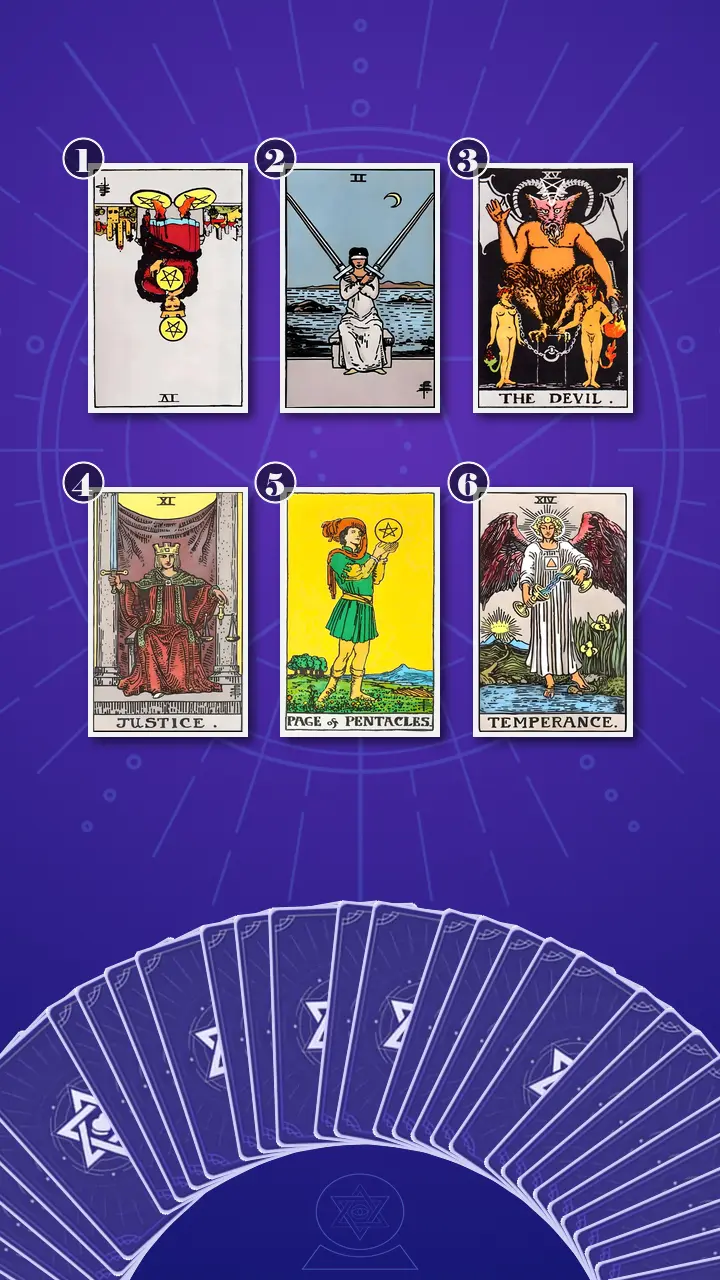
I laid the cards in a two-by-three grid like items on a workbench. The top row would show the current reassurance loop, the blocking response, and the root fear beneath it. The bottom row would reveal a fact-based trigger, one actionable experiment, and a balanced way to integrate uncertainty afterward. The spread would not decide whether Morgan should stay or leave. It would show where her ability to make that decision had become frozen and where movement could begin again.
What the Top Row Was Protecting
Position 1: The Grip That Looked Like Stability
I began, "Now turning over is the card representing your current loop: the repeated reassurance that the unstable job is probably fine, followed by the minimization we can actually observe." The card was the Four of Pentacles, reversed.
I pointed to the figure's strained hold on the coin. Reversed, the card showed earth energy under pressure: an excess of gripping and over-availability combined with a deficiency of direct contact with the material facts. Holding the present income tightly was understandable, but the grip itself could not confirm that the arrangement was stable.
"This is the moment after the vague update," I said, "when you press your phone to your chest, type 'it is probably fine,' and return to email without opening the contract or checking the project details. The phone becomes the coin. The rent, commute, and cost of living become the gray city wall behind it. You are not being careless. You are trying to make a familiar resource feel like proof of safety."
Morgan gave a small laugh that carried no amusement. "That is so accurate it feels a little cruel."
I did not hurry to soften the card into something prettier. "I hear the sting," I said. "But the card is not accusing you. It is distinguishing a tight hold from reliable information. Your need for material safety is valid. We are examining whether this particular coping move is providing the safety it promises."
I asked her what happened between a warning sign and the reassuring sentence. She looked down. "I usually volunteer for something. I answer faster. I try to become too useful to cut." Her index finger pressed into the phone case, then slowly lifted. The reversed Four of Pentacles had made the cost visible: extra availability was being used as emotional proof of security, even while the original question remained unanswered.
Position 2: The Email That Stayed in Drafts
I continued, "Now turning over is the card representing the blocking response: the pause, blind spot, and unexamined evidence that remain when reassurance takes over." It was the Two of Swords, upright.
Here, air energy was blocked. The crossed swords held two interpretations over the chest: "This is normal uncertainty" and "This role may not continue." The blindfold was not a lack of intelligence. It was suspended judgment used to preserve a temporary equilibrium.
I brought Morgan back to 10:32 on a Wednesday morning in her coworking space near King Street West. The coffee beside her had gone cold. A clarification email about whether the project continued past June sat open while the cursor blinked. She deleted the first sentence, answered three low-priority emails, and left the important message in drafts.
"The inner bargain is simple," I said. "If I do not ask, I can keep both stories alive. That gives you relief because no response is required today. The cost is that no useful fact can enter the picture either."
Her breathing paused. Her fingertips went still on the edge of the table. Then her gaze drifted beyond the cards as though she were rereading the draft from memory, and a long breath finally left her chest. "It is still there," she said. "I have edited it six times."
I asked, "What specific answer were you seeking, and what larger decision did you fear that answer would force?"
"I wanted to know whether I have work after June," she said. "But if the answer is 'we do not know,' I feel like I should immediately start applying everywhere. I do not have the bandwidth for that."
"Then we have found an important distinction," I replied. "Asking one question and redesigning your entire career are not the same action. The Two of Swords has been making them feel inseparable."
Position 3: The Price of Looking Responsible
I said, "Now turning over is the card representing the root fear: what admitting instability seems to say about your safety and control over your working life." The card was The Devil, upright.
I am careful with this card because its imagery can be louder than its actual message. I do not read The Devil as a bad omen, an external captor, or a fixed fate. I read it here as excessive attachment and a blockage in perceived choice: a fear-based agreement that has begun to feel like an unavoidable condition.
The loose chains mattered more than the imposing figure. In Morgan's life, those chains looked like checking Slack during dinner, accepting unclear expectations, and treating constant availability as the price of being safe and responsible. Asking for terms felt dangerous because she feared it would make her appear difficult, naive, or ungrateful.
"The polished language around this job sometimes has a Severance quality," I said, "where the official update sounds tidy but leaves the human consequence unresolved. The problem is not that you failed to decode the corporate tone. It is that you have started treating your endurance as evidence that the arrangement must be acceptable."
I also noticed how the LinkedIn algorithm had become an unofficial career clock in her mind. Every classmate's permanent title sped up the fear that she was behind, while every vague Slack message froze her next move. That was not casual comparison; it was a behavioral loop in which somebody else's highlight reel became a standard for how quickly Morgan believed she should achieve certainty.
"When you imagine saying, 'This job may not be reliable,' what do you fear that sentence proves about you?" I asked.
Morgan's shoulders rose before she answered. "That I let this happen. That I am not good at protecting myself. Maybe everyone else knew how to build an adult life, and I somehow missed the instructions."
"The Devil is showing us that belief, not endorsing it," I said. "Calling one part of the job unstable is information, not a verdict on your worth. A difficult condition can be real without becoming evidence that you are incompetent."
Her shoulders did not drop yet, but her hands opened on the table. I could see the first separation forming between the external uncertainty and the identity judgment she had attached to it.
When Justice Balanced the Slack Thread
Position 4: The Fair Witness Raises Her Sword
The rain had softened against the window by the time I reached the bottom row. A streetcar bell sounded once in the distance, clean and singular, and the heater stopped clicking. In the sudden quiet, I said, "Now turning over is the card representing the key trigger: the fair, fact-based moment that interrupts the 'probably fine' story without predicting an external outcome."
The card was Justice, upright, the key card and catalyst of the reading.
Justice brought the spread's blocked air back into motion. Its energy was balanced discernment: neither an excess of catastrophic interpretation nor a deficiency of honest attention. The scales gave each piece of evidence its actual weight; the upright sword represented one clean question capable of cutting through excess analysis.
I asked Morgan to imagine a two-column Google Doc. On the left, she would write the employer's exact words: "We are still finalizing next quarter." On the right, she would write the prediction her mind had supplied: "I may lose all control over my working life, and asking about it will force me to quit." Justice did not demand that she dismiss the prediction. It asked her to stop filing it under "confirmed fact."
This was where I used a diagnostic lens I call Career Cycle Phase Identification. After years of studying cycles, I have learned that a career bottleneck can come from very different sources. Sometimes a person needs a specific skill, clearer performance feedback, or a stronger boundary. At other times, project funding, industry contraction, organizational restructuring, or reduced hours are affecting everyone in the orbit. Those conditions require different responses.
I drew a line down the center of a page. On one side I wrote evidence of a possible personal skill gap: direct feedback, missed outcomes, or clearly stated role expectations. On the other I wrote evidence of a wider contraction: delayed funding decisions, reduced team hours, repeated project postponements, or ambiguity affecting multiple coworkers. Where there was no evidence, I wrote "unknown" instead of allowing self-blame to fill the blank.
"This lens cannot guarantee what the company will do," I told her. "It does something more useful today: it prevents an organizational low tide from automatically becoming a story about your competence. It also prevents comforting language from disguising a material problem. We identify the phase by observing patterns, not by blaming you or predicting the future."
I asked Morgan to return to Sunday night: rent scheduled for Monday, next month's calendar still marked TBD, and her phone bright on the kitchen table. She had been trying to make one reassuring sentence carry the full weight of a floor she could feel moving.
You do not need to prove that the job is fine or decide its entire future today. You need to look at the facts honestly and choose the next question you can answer.
I gave the sentence room before placing the interpretation hook at the center of the reading.
Do not use reassurance to overrule what you observe; weigh the evidence and take one proportionate step, like Justice balancing the scales before raising the sword.
Morgan did not relax immediately. Her breath caught first, and the hand reaching for her water stopped halfway across the table. Her pupils widened; then her gaze lost focus as if the past few months were replaying behind her eyes - the unread contract line, the late Slack replies, the rooftop Stories, the draft email. Her mouth tightened. "But doesn't that mean I was wrong this whole time?" she asked, sudden anger sharpening her voice. "That I wasted months pretending?" The anger held for a beat, then her fingers curled around the glass and gradually loosened. Colour rose beneath her eyes. Her shoulders descended on a trembling exhale, but the release left her looking briefly unsteady, as though putting down the burden had revealed that she would now have to choose what to carry instead. I said, "It means reassurance helped you get through moments you did not yet know how to examine. A coping move can stop being useful without making your past self foolish. We are changing the tool, not prosecuting the person who used it."
"Now, using this new perspective, think back to last week. Was there a moment when this insight could have made you feel different?" I asked.
She returned to the Sunday calendar. "I could have written that the schedule was TBD and that I did not know when it would be confirmed. I could have stopped there. I would not have had to turn it into either 'everything is fine' or 'my life is falling apart.'"
I nodded. "Exactly. The question is not whether you can make the job feel fine. It is what the facts are asking you to notice next."
I showed her the smallest version of the Justice practice: ten minutes, three headings - What I know, What I do not know, and One question I can ask - with only one line under each. If her chest tightened until the exercise started expanding into a complete career plan, she could close the note, schedule a later check, or use a two-minute version. Choosing whether and when to send the question would remain hers.
This was the pivotal movement from contracted anxiety and suspended judgment toward evidence-minded self-trust. Nothing outside Morgan had been resolved yet. The change was smaller and more consequential: she could let uncertainty exist without using denial to erase it or personal shame to enlarge it.
One Pentacle, Then the Evening Back
Position 5: Preparation Without a Dramatic Exit
I said, "Now turning over is the card representing the actionable experiment: a small evidence-gathering step that converts concern into agency without deciding whether you stay or leave." It was the Page of Pentacles, upright.
The Page's earth energy was balanced and deliberately modest. The figure studied one pentacle, not an entire mountain range. I read that focus as available potential: Morgan could learn one material fact and strengthen one option without demanding total certainty first.
"This can be checking one contract term, asking whether the project has a stated end date, updating one resume bullet, or saving one credible posting with its closing date," I said. "The single pentacle is the limit that makes the action manageable. You do not need a five-year plan to ask a one-sentence question."
Morgan looked at the Page rather than away from it. "Updating one bullet does not mean I have decided to leave," she said slowly.
"Right. Preparation is not betrayal, and it is not a prediction. It is a practical skill that increases your range of choices."
Her thumb moved as if she were already opening the abandoned resume document in her mind. The card meaning had become concrete: one verifiable detail could do more for her agency than another hour spent reassuring herself about an undefined situation.
Position 6: A Work Question With an End Time
I finished, "Now turning over is the card representing integration: a balanced way to hold uncertainty, self-worth, and practical planning after the loop has become visible." The final card was Temperance, upright.
Temperance showed balanced water and earth: emotional reality moving between two cups while one foot remained on solid ground. Its gift was not perfect calm. It was proportion - enough contact with the work question to respond, and enough boundary to keep the question from flooding the whole evening.
I translated the image into Morgan's actual routine. She could acknowledge that the job might be unstable, complete one practical check, write the next review time in her calendar, and then mute work notifications when her responsibilities allowed it. She could return to dinner, a shower, or one episode without pretending the uncertainty had vanished.
"A work question can be real without being allowed to occupy the entire evening," I said. "Stopping the review is not the same as losing control. Temperance asks you to contain the process so that discernment remains sustainable."
Morgan glanced at the phone she had kept face down beside her. Her hand moved toward it, paused, and returned to her lap. "I think I have been treating availability like a protective spell," she said. "But it has not made the updates any clearer."
"That is the integration," I replied. "You can care about the outcome, gather information, and still let the day end. The uncertainty is part of your current environment; it does not get to become your entire identity."
Finding Clarity at the Fact-Not-Fear Workbench
Read together, the cards told a coherent story. The reversed Four of Pentacles showed Morgan gripping the present role as proof of material safety. The Two of Swords showed how she preserved that proof by keeping decision-relevant information outside the frame. The Devil revealed the deeper agreement: if she remained useful, quiet, and constantly available, perhaps she could earn protection from uncertainty. Justice interrupted that agreement by separating evidence from prediction. The Page of Pentacles gave the insight one small material task, and Temperance placed a boundary around the task so it would not become a new form of overwork.
The cognitive blind spot was not simply "avoidance." Morgan had been treating three different actions as one: naming an unstable detail, making a practical inquiry, and deciding to leave. Because the third action felt enormous, she postponed the first two. Once those actions were separated, the floor did not have to be declared solid or condemned as unusable. It could become a workbench: a place to examine what was shifting and decide what support she wanted next.
The transformation direction was clear. Morgan did not need stronger reassurance. She needed a weekly evidence check that distinguished what was known, what remained uncertain, and one answerable question. That was the movement from fear-driven reassurance to grounded agency, and from trying to prove safety to building informed choice.
The Micro-Orbit Plan for the Next 30 Days
I adapted my Micro-Orbit Observation strategy into two bounded actions. In astronomy, shifts in light reveal movement that may be too subtle to see in a single glance. In a workplace, I use "blueshifts" for concrete signs of approaching opportunity or increased continuity and "redshifts" for concrete signs of contraction or distance. I told Morgan that these were observations, not omens. A single delayed message would not become a forecast; repeated, sourced patterns could become useful information.
- Run the 15-Minute Weekly Evidence CheckOn Tuesday, open one Google Doc and create three headings: What I know, What I do not know, and One question I can ask. Record one line under each. Mark any observable blueshift, such as confirmed project scope, a funded timeline, or a direct invitation to discuss future work, and any observable redshift, such as repeated postponements, reduced hours, or an unresolved request for unpaid availability. Send one concise clarification message to the relevant manager or project contact using one observable detail and one specific question. Repeat once a week for 30 days, then review the pattern rather than judging any isolated update.Keep the boundary narrow: one topic, one recipient, one question, and 15 minutes. If sending feels too exposed, save the exact question in a draft or ask a trusted person to check its clarity. Choosing not to send it that day remains Morgan's decision.
- Make One-Pentacle Preparation ConcreteBy Friday, choose one material detail to verify: the current project's stated end date, the accessible pay schedule, or one relevant employment term. Spend 10 minutes recording the source. Then spend no more than another 10 minutes updating one resume bullet or saving one relevant job posting with its closing date. Write the next review time in the document and close it.The smallest version counts: verify one sentence, rewrite one bullet, or save one credible link. Preparation does not require an application or a decision to leave. When the time ends, mute Slack for the evening if the role permits and move into an ordinary transition such as tea, a shower, or a show.
I reminded Morgan that actionable advice should increase her freedom, not replace one source of pressure with another. Tarot had made the loop visible, but it had no authority over her manager, her job, or her eventual choice. The observations, boundaries, questions, and decisions belonged to her.

A Week Later, the Quiet Proof
Six days later, I received a message from Morgan with a screenshot of the clarification email in her sent folder. She had written one sentence: "Could you confirm whether the current project and my scheduled hours are approved through the end of June, and when the next continuity update is expected?"
Her manager's reply was incomplete but usable. The present schedule was confirmed through June; the next phase had not yet been approved; another update was expected in two weeks. Morgan entered each statement under the correct heading instead of making any one of them carry the weight of her whole future.
She also updated one resume bullet, scheduled the next evidence check, and closed her laptop. She had not solved her career, secured a permanent contract, or eliminated the thought that the next update might be difficult. She had completed the first movement from frozen judgment to grounded agency.
That night she slept until morning. Her first thought was still, "What if the next update is bad?" She smiled once at the ceiling because the thought no longer felt like a command, and she got up before checking Slack.
I think of that as the honest scale of a Journey to Clarity. The spread did not hand Morgan certainty or decide her future. It helped her distinguish a natural low tide from a personal verdict and gave her a structure for observing what came next. Morgan created the proof herself when she asked the question, recorded the answer, and allowed the evening to end.
If a vague work update makes your chest tighten, remember that calling the Line 1 floor solid may offer a few quiet minutes, but admitting that it moves does not mean you have failed to protect your future. It means your wish for stability and your awareness of instability are finally allowed to be true at the same time.
If one honest fact could sit on Justice's scale beside the uncertainty without deciding your whole future, what one-sentence question are you curious enough to place there this week?