An 82% Score, a Notion Detour, and the 20-Minute Study Return

The 10:12 Score That Triggered a Loss of Study Momentum
I often meet final-year students who fit exam prep between seminars, weekend shifts, and a shared flat that never stays quiet for long. Jordan, a 22-year-old undergraduate in Toronto, came into our session carrying that exact kind of study momentum anxiety. At 10:12 that Wednesday morning, they slid their laptop across the fourth-floor library table and showed me an 82% practice-quiz result. The number still glowed beside a maze of newly opened Notion tabs. Fluorescent lights hummed overhead. Their coffee had gone cold enough to taste metallic, and every few seconds I watched their jaw tighten.
Jordan had wanted evidence that active recall was working. The moment they got it, the score stopped feeling like evidence and started feeling like a standard they could fail. Instead of opening the next question set, they had spent forty minutes retagging modules, color-coding four weeks of Google Calendar blocks, and researching a more advanced study workflow.
"The moment a routine works, it starts feeling like a test I can fail," they said. "Maybe I need a better system before I commit."
I heard the central conflict immediately: Jordan wanted reliable study momentum, but visible progress made them afraid they would have to keep proving they deserved it. Their frustration seemed to sit in their body like a train gathering speed while one hand kept reaching for the emergency brake. The brief relief came only after they postponed the journey.
"I don't think we're looking at a lack of discipline," I told them. "I think we're looking at what success activates. Let's use the cards to map the sequence, then find a next step small enough that it doesn't become another test."
Choosing the Hinge: The Five-Card Shadow Spread
I asked Jordan to take one slow breath and hold a precise question in mind: "What happens inside me when a study method starts working?" I shuffled while they focused. I use this brief ritual as a transition from mental noise to observation, not as a way to summon certainty.
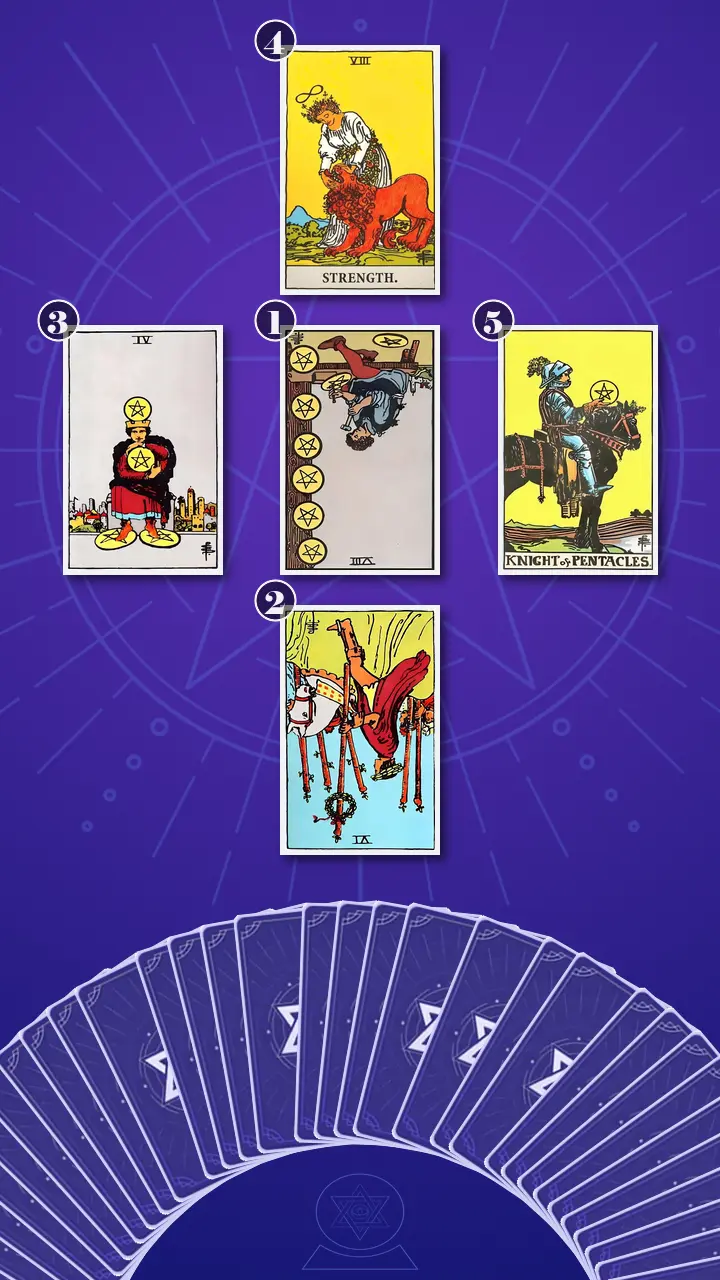
I chose the five-card Shadow Spread. The word shadow does not imply danger or doom. Here, it simply describes a protective pattern whose logic has not yet been examined. For anyone curious about how tarot works as a self-reflection tool, this spread keeps five things separate: the visible behavior, the hidden fear, the protection gained from that behavior, the inner resource that can change it, and the practical next step.
The center card would show Jordan's interrupted study routine. The card beneath it would identify what progress made vulnerable. The card on the left would reveal why postponement brought temporary relief. Above the center, I would look for the integrating resource; on the right, I would look for an observable way forward. It was a symptom-to-root-to-return structure, useful for understanding study self-sabotage without predicting grades or deciding Jordan's future for them.
The Workbench Abandoned After a Good Score
The Visible Pattern: Eight of Pentacles Reversed
I turned the card representing the visible study-momentum pattern: the Eight of Pentacles, reversed.
In the Rider-Waite-Smith image, a craftsperson sits at a workbench beneath a row of completed pentacles. Reversed, that steady earth energy is blocked and misdirected. The tools exist. The skill is developing. The interruption happens because attention moves away from the craft and into perfecting the conditions around it.
I pointed from the card to Jordan's screen. They already had completed practice sets and an 82% result showing that the question bank was useful. Yet the next set remained closed while Notion properties, color labels, calendar blocks, and active-recall videos multiplied. The work had been replaced by productivity theater.
"The thought underneath it sounds responsible," I said. "It says, 'I'm not avoiding the work. I'm making sure I do it properly tomorrow.' But planning can look responsible while still postponing exposure."
Jordan gave a short laugh with a bitter edge. "That's uncomfortably accurate. Kind of brutal, actually." Their fingers stopped moving over the trackpad, then folded under their palms as if they no longer wanted to touch the open planner.
"Accurate doesn't have to mean condemning," I said. "This card is describing a blockage in repetition, not an absence of ability. You don't need to answer it with a stricter timetable. That would turn the same pattern into a more demanding costume."
The Hidden Audience: Six of Wands Reversed
I moved to the card representing the hidden fear activated by progress: the Six of Wands, reversed.
The upright card carries the fire of recognition and confidence. In reversal, that fire turns inward as comparison, imagined scrutiny, and pressure to repeat a victory perfectly. The laurel-crowned rider begins to feel surrounded by an audience, even when no one is actually watching.
I asked Jordan what happened after the first flicker of pride. They admitted that they had checked a class group chat, opened LinkedIn, and scrolled past an internship announcement and a seven-hour study-timer screenshot. Within minutes, their private learning result felt like a public ranking. The inner sentence became, "That was good, but now it has to happen again or it didn't count."
"The problem is not too little motivation," I said. "It is motivation turning into evaluation. A good result is data, not a contract."
Jordan's shoulders rose toward their ears. Their eyes drifted to the face-down phone beside the deck, as if a whole feed were waiting inside it. After a moment, they turned the phone over and said, "A mediocre score disappoints me. A good one makes the next session feel dangerous."
I nodded. The Six of Wands reversed was not telling Jordan to reject recognition or stop tracking useful evidence. It was showing how feedback became unstable when every result was asked to certify their consistency, control, and worth.
The Grip That Buys One Quiet Evening: Four of Pentacles
I turned the card representing the protective function of losing momentum: the Four of Pentacles, upright.
This earth energy was active, but held in excess. The figure presses one coin to the chest while two more pin both feet in place. Nothing is lost, yet nothing can move. In Jordan's life, the image became an unfinished timetable held tightly while the next real attempt remained safely postponed.
"If I wait until the system is perfect," I translated, "the result can't say anything final about me yet." Stopping early preserved the possibility that Jordan could succeed under better conditions. It also lowered the pressure for one evening. The cost arrived later, when restarting felt heavier and the broken continuity seemed to confirm that they could not maintain momentum.
Jordan's breath left in a long, quiet stream. Their hand loosened around the coffee cup. "If I stop now, I don't have to find out whether the progress was real," they said.
"Exactly. That protection makes emotional sense," I replied. "We can respect why it developed without pretending it is still serving you well. The question is not whether you should surrender control. It is whether control has become so tight that it prevents you from gathering honest evidence."
When Strength Met the Lion of Resistance
The Integrating Resource: Strength Upright
The room seemed to quiet before I turned the card above the center. Even the fluorescent hum receded behind the rain beginning to tap the library window. The position represented the key transformation from force and self-surveillance to patient self-regulation. The card was Strength, upright.
The woman in the image does not attack the lion, shame it, or pretend it is absent. Her hands rest steadily at its jaws. This is balanced power: an impulse can be present without being obeyed or turned into an emergency. In Jordan's situation, Strength looked like noticing the tightened jaw, naming the thought "Now I have to keep proving this," leaving the planning app closed, and completing the existing question-bank block without demanding another personal best.
I used an Academic ROI Audit, one of the analytical tools I carried with me from high-stakes commercial work. I do not use return on investment to reduce education to money. I use it to distinguish strategic yield from avoidable friction. Jordan's question bank had produced direct learning evidence. Forty minutes of calendar redesign had produced temporary relief, but no additional practice. The planner was earning emotional distance rather than academic return. That did not make the planning foolish; it made its function visible.
A Wall Street memory flashed through my mind: one strong result could make the next decision feel like a referendum on whether the first one had been deserved. Data became identity, and useful caution hardened into paralysis. I recognized the same distortion here, scaled to a library desk and a practice quiz.
I named the loop we had uncovered: Jordan got the better score, felt a flicker of pride, then opened the calendar instead of the next set. Forty minutes later, the plan looked cleaner and their jaw felt looser, but the method that had worked had been postponed.
I explained that progress was not another demand for proof. Momentum could grow while pressure remained present, as long as Jordan allowed one ordinary study block to be enough.
Momentum is not proof that you must perform perfectly; it grows when you meet the lion of resistance with a steady hand and complete the next small block.
Jordan's breathing stopped for a beat. Their fingers hovered above the edge of the laptop, frozen between the planner tab and the closed question bank. Then their gaze lost focus, and I watched them mentally replay the missed blocks, the rebuilt calendars, and the sudden relief after each postponement. Their mouth tightened before their voice returned.
"But doesn't that mean all that planning was just avoidance? That I was wrong every time?" The question came out sharper than anything they had said so far.
"No," I said. "Planning has helped you in other contexts. Here, it also protected you when progress felt exposing. A strategy can be understandable and still become expensive. Seeing the cost now does not invalidate the person who needed the protection then."
The tension moved through Jordan in stages. Their eyes reddened slightly; their hands opened flat on the table; then their shoulders dropped with an exhale that sounded relieved and unsettled at once. Clarity had removed one burden, but it had also left them facing the responsibility of choosing what to do next.
"Now, with this new perspective, think back to last week," I invited. "Was there a moment when this insight could have made the experience feel different?"
Jordan remembered a Friday afternoon when a mock-exam notification had arrived between seminars. Their thumb had moved toward a study-method video. With Strength's perspective, they could imagine saying, "The urge is here, and I don't have to turn it into an emergency," then doing two questions before deciding anything about the system.
I named the crossing plainly: this was a first movement from success-triggered pressure and disrupted practice to gentle self-regulation and dependable return. It was not certainty. It was the ability to remain present when success made the next ordinary action feel consequential.
The Knight Who Refused the Catch-Up Marathon
The Practical Exit: Knight of Pentacles Upright
Finally, I turned the card representing the grounded implementation of the shift: the Knight of Pentacles, upright.
The Knight sits on a stationary horse and studies one pentacle with full attention. His earth energy is balanced, methodical, and deliberately undramatic. He does not chase novelty or punish himself into speed. His progress is measured by responsible return.
For Jordan, this meant the same library seat when available, the same question bank, and one predefined 20-minute block. They could schedule three realistic windows, prepare the link and notebook in advance, and record only whether the minimum happened. If Wednesday was missed, Friday would not become a two-hour punishment session or a ceremonial restart. It would remain Friday's ordinary block.
"Think of the 'wax on, wax off' rhythm in The Karate Kid," I said. "The repetition looks unimpressive before its accumulated value becomes visible. No upgrade, no catch-up, just today's defined task."
Jordan pulled a sticky note from their bag and wrote, "Momentum is measured by return, not by an unbroken streak." Their handwriting was still tentative, but they did not open a new dashboard to track it.
The Seven-Day No-Upgrade Audit
I gathered the five cards into one causal story. Jordan's history of exciting fresh starts had supplied plenty of tools, but the Eight of Pentacles reversed showed the working method being interrupted. The Six of Wands reversed revealed why: visible improvement became an imagined audience and a new performance contract. The Four of Pentacles showed the protective payoff, because withholding the next attempt preserved potential and lowered pressure. Strength restored movement through calm regulation, and the Knight of Pentacles gave that steadiness a modest daily container.
The cognitive blind spot was not simply "I plan too much." It was the assumption that discomfort after a good result meant the method required optimization. Often, the discomfort was evidence that progress had begun to feel personally exposing. The transformation direction was therefore not harsher discipline. It was protecting repetition from optimization and treating the first sign of progress as a cue to repeat the smallest effective block for seven more days.
I adapted my Research Sunk-Cost Audit into a seven-day decision gate. This framework normally helps a student decide whether a stalled academic project deserves perseverance or a strategic pivot. For Jordan, it would prevent both mindless persistence and pressure-driven method switching. They would keep the already effective method for one week, gather minimal evidence, and review it only after the test period.
- Run the 20-Minute Same-Method Test. Before the next scheduled library session, write: "20 minutes in the existing question bank; no method changes during the block." Use that same rule for seven scheduled days and mark only done or not done. Keep 20 minutes as a maximum, not a target to exceed. On a low-capacity day, choose the five-minute version.
- Use the One-Breath Strength Check. When the planning-app impulse appears, place both feet on the floor, release the jaw once, and say, "A good result is making the next block feel like a test." Close the planner for 10 minutes and complete two questions or one short recall page. This is a pause, not a new journaling system. The pressure does not need to disappear before beginning.
- Make a No-Debt Return. Put three realistic study windows in the phone calendar with the exact task named. If one is missed, return at the next window with the original minimum and write "Returned" instead of restarting the streak. Add no catch-up time. A missed 20-minute block does not create 40 minutes of debt tomorrow.
I reminded Jordan that the experiment was an invitation, not a contract. After seven days, they could assess whether the method produced useful learning evidence, whether the minimum was repeatable, and whether any friction came from the method itself or from the pressure attached to progress. They remained free to change course. The cards had clarified the decision environment; they had not taken the decision away.

Six Days Later: The Quiet Proof
Six days later, Jordan sent me a short message. They had completed two ordinary question-bank blocks, missed the third because their weekend shift ran late, and returned at the next scheduled window without adding catch-up time. "I wanted to rebuild the week," they wrote. "I didn't. I just did Monday's twenty minutes."
In a second message, they told me they had slept through the night. Their first thought on waking was, "What if the next score drops?" This time, they smiled, opened the same question bank, and let the question remain unanswered.
I did not see a life magically solved or a perfect streak beginning. I saw something more credible: the first evidence of grounded trust, created by Jordan's own repeated returns. Tarot had made the pattern visible and given us a shared language for it. Jordan had supplied the choice, the action, and the meaning.
I want to leave the light of that library scene with anyone whose jaw tightens after one good score because progress suddenly feels like a standard that must be defended. Stepping away can feel safer than discovering whether a sincere effort will be enough. Simply recognizing that protection means the old sequence is no longer invisible.
If your next study block did not have to defend the bright number on the screen or prove that your progress was real, what small return would you be willing to let count?