The 8:41 a.m. Ping That Turns Into 45 Minutes
You sit down to finally start, a Slack ping lands, and you tell yourself you’ll “just check it quick”—and suddenly it’s been 45 minutes of tab-switching and you’ve done nothing.
Taylor said it like she was confessing something embarrassing, not describing a completely normal human nervous system trying to survive hybrid work.
We were on a video call, but I could still picture the scene because she described it so precisely: 8:41 a.m. in her downtown Toronto condo, coffee sweating onto a coaster, laptop open to the project doc… and then that sharp little Slack sound cutting through the quiet like a needle skipping on vinyl. The laptop fan kept its low hum. The screen glare was just a bit too bright. Her shoulders did that tiny jump—like her body moved before her thoughts had a chance to vote.
“One ping and my whole brain changes channels,” she said. “I’ll open Slack, then I’m like, okay, now I should check email, and then I’m in Jira, and then I’m reorganizing my to-do list like… that counts as work.”
Her jaw was tight enough that I could hear it in her voice. The kind of tight that makes even breathing feel like a task you forgot to add to the list.
“And I’m not trying to be flaky,” she added quickly. “I’m a project coordinator. If I don’t respond, I’m scared people will think I’m dropping the ball.”
I let that land, because there it was—the real tension underneath the productivity talk: wanting to be reliable, while fearing that not answering instantly would be interpreted as incompetence.
“That makes so much sense,” I told her. “You want to stay responsive and on top of everything… but the moment you try to focus, your brain treats silence like risk. We’re not here to shame that. We’re here to understand it—so we can change it.”
I glanced at her face on my screen: the restless hands, the micro-flinch when her phone lit up off-camera. Overwhelm wasn’t an abstract emotion in this moment. It was a body braced for impact—tight jaw, tense shoulders, that fluttery chest feeling like her attention was trying to sprint in six directions at once.
“Let’s make this practical,” I said. “We’ll use the cards like a map. Not to predict your life—but to show you what’s driving the spiral, where your energy leaks, and what your next step is for finding clarity. Small, doable clarity.”

Choosing the Compass: The Celtic Cross · Context Edition
I asked Taylor to take one slow breath—not as a mystical ritual, but as a clean transition. The kind you’d do before you hit ‘Send’ on a difficult email. Then I shuffled while she held the question in mind: Why do noise/pings/to-dos spiral me into procrastination—and what’s my next step?
“Today I’m going to use the Celtic Cross · Context Edition,” I said. “It’s a classic spread, but we’re framing it ethically: position one is the real-time ping spiral, and position ten is your grounded next step—not a fixed fate.”
For anyone reading along who’s ever Googled how tarot works and found either spooky certainty or fluffy vague affirmations—this is the middle path. The Celtic Cross is powerful because it’s a diagnostic. It shows pattern → root → lever → integration. Which is exactly what Taylor needed: not “be more disciplined,” but “why does this keep happening when I’m smart and capable?”
“Here’s what to watch for,” I told her. “The first card will show your present loop—the exact moment the ping hits. The crossing card will reveal the hook that turns information into a spiral. A root card will show what fear makes it feel high-stakes. And the final card will give us a sustainable rhythm—something you can actually do in a ping-heavy job.”
Reading the Map: The Loop, the Hook, and the Fear Underneath
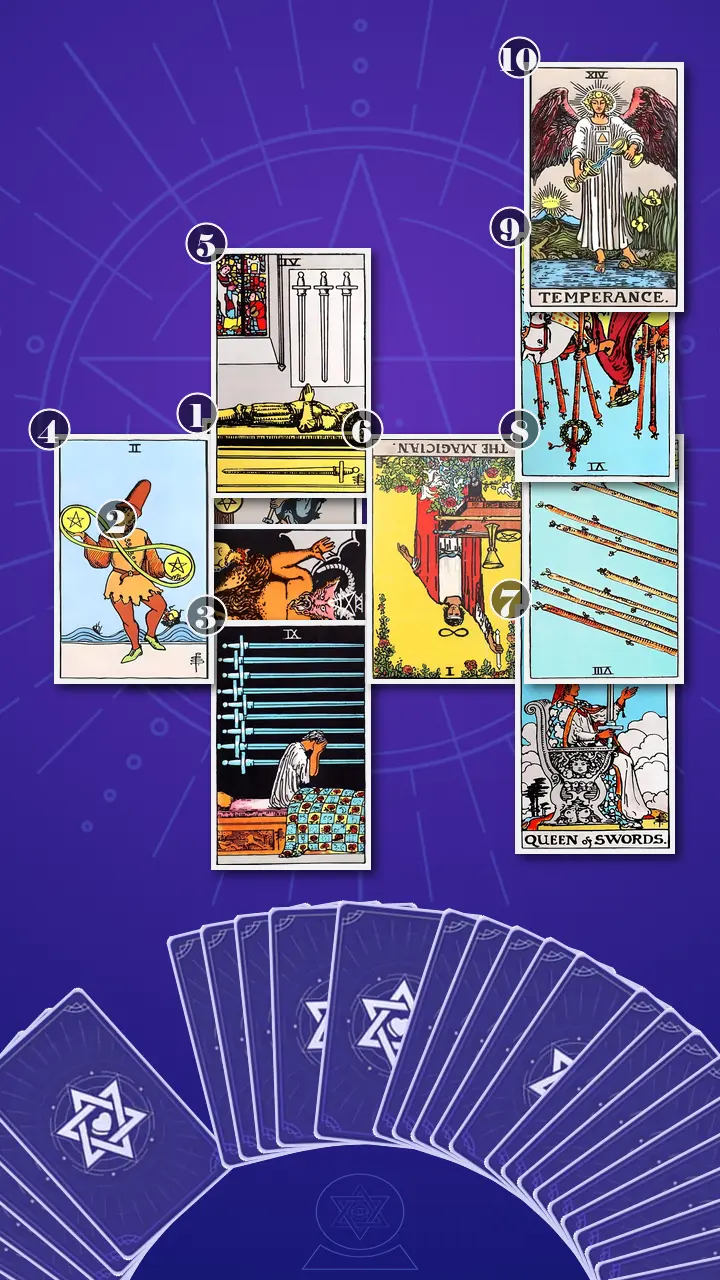
Position 1 — The moment the ping hits (your present procrastination pattern)
“Now what we’re turning over is the card for the present procrastination pattern the moment a ping/to-do hits,” I said, keeping my voice calm on purpose. “The observable behavior and the felt experience.”
Eight of Pentacles, reversed.
“This is like when you open your project doc with good intentions,” I said, “but your ‘progress row’ turns into unread pings and shifting priorities, so you keep resetting instead of completing one small deliverable.”
In an upright Eight of Pentacles, the energy is craft: repetition, focus, building a streak. Reversed, the energy isn’t gone—it’s fragmented. It’s diligence that can’t stay in one lane long enough to produce a finished unit. Not lazy. Not incapable. Just constantly interrupted—externally and internally.
“Organizing can feel like control—until you realize nothing moved,” I added, and Taylor let out a quick laugh that had a little bitterness in it.
“Okay,” she said, laughing again, softer. “That’s… rude. It’s accurate, but rude.”
“I’ll take ‘accurate,’” I said. “And I want you to notice what this does: it makes the pattern measurable. It turns ‘I’m broken’ into ‘I’m doing resets instead of work units.’ That’s changeable.”
Position 2 — The immediate blocker (the hook that turns information into a spiral)
“Now what we’re turning over is the card for the immediate blocker: what hooks your attention and turns information into a spiral,” I said.
The Devil, upright.
I didn’t flinch from it, and I didn’t dramatize it. In modern life, The Devil shows up less as doom and more as compulsion—attachments that masquerade as responsibility.
“This is like when you feel the buzz of a notification and reflexively reach for your phone,” I told her, “even when nothing is truly urgent, because checking itself temporarily quiets discomfort.”
Here’s the crucial reframe: a ping is information. Your reflex is the part that turns it into a command.
The Devil’s energy, in this context, is a zero-friction escape hatch. The moment a focused task starts to feel heavy—like you might do it imperfectly or get judged—the mind finds a door labeled “just check.” The relief is immediate. The cost is delayed. And that’s exactly why it’s addictive.
Taylor made the sound the resonance blueprint promised she would: a tight little laugh, then a sharp inhale, like she’d been caught mid-scroll. Then a quiet nod—almost embarrassed. “Yeah,” she said. “That’s the loop. I’m like, I’m just checking… I’m being responsible… and then I feel worse.”
“Exactly,” I said gently. “Relief-now versus progress-later.”
In Jungian terms—the part of me that can’t help being a Jungian psychologist even when I’m reading cards—The Devil is the Shadow wearing a blazer. It’s the protective part that says, “If we stay hyper-alert, we can’t be surprised. If we respond instantly, we can’t be judged.” It’s trying to keep you safe. It just uses a strategy that drains you.
Position 3 — The root engine (the fear/belief that makes pings feel high-stakes)
“Now what we’re turning over is the card for the root engine underneath the spiral,” I said. “The deeper fear or belief.”
Nine of Swords, upright.
“This is like when you can’t start because your brain is already running the ‘what if I miss something’ scenario,” I said, “and the notification sound becomes the soundtrack to that fear.”
Nine of Swords energy isn’t just worry. It’s overforecasting: the mind rehearsing consequences until starting feels like walking into court without a lawyer.
“I want to offer you a metaphor,” I said. “Your to-do list has become a courtroom docket. The backlog is ‘evidence.’ And your mind is the prosecutor.”
There was a pause on her side of the screen. The kind of pause where you can tell someone’s eyes are unfocusing—not zoning out, but replaying something. Like late-night blue light. Like refreshing. Like the quiet dread of waking up behind again.
She exhaled long and slow. “It does feel like… proof,” she admitted. “Like if I’m not on top of messages, it proves I’m not capable.”
“That’s the root,” I said. “Not laziness. Not a character flaw. Fear of judgment.”
Position 4 — The recent pattern (what trained the reactivity)
“Now what we’re turning over is the card for the recent pattern that trained this reactivity,” I said.
Two of Pentacles, upright.
“This is like when your day is structured around keeping many plates spinning,” I told her, “so a ping feels like another plate to catch—even if it’s not actually urgent.”
The energy here is real juggling. Adaptation. Multiple demands. And it matters because it tells Taylor something important: her nervous system didn’t invent this out of nowhere. It learned it. In a role where “quick asks” and “high-impact deep work” live in the same Slack workspace, the brain starts treating everything as the same kind of incoming threat.
“Your attention has been trained to bounce,” I said. “So now, stillness feels suspicious.”
Position 5 — The conscious aim (what you think you “should” do)
“Now what we’re turning over is the card for what you think you should do to fix it,” I said. “Your conscious strategy or desired state.”
Four of Swords, upright.
“This is like when you keep saying you need a ‘reset day,’” I told her, “but the real reset is shorter and repeatable: a protected 15–30 minutes where you’re not processing anyone else’s requests.”
Four of Swords energy is strategic silence. Not quitting. Not disappearing. A pause that restores your ability to choose.
“Your system is craving quiet,” I said. “But right now, you’re trying to think your way out of overwhelm. This card says: recovery is a productivity skill.”
Position 6 — The near-future pull (how the pattern will express next)
“Now what we’re turning over is the card for the near-future pull,” I said. “The likely next way this expresses unless redirected.”
The Magician, reversed.
“This is like when you have Slack, email filters, task apps, and calendars—yet you can’t translate them into one grounded next step,” I said, “so the tools themselves become another loop.”
Reversed Magician energy is power-without-channel. Tools-without-direction. The modern version is brutal: Notion vs Todoist vs Apple Notes wars, switching systems midweek, consuming Huberman Lab focus content as a substitute for actually doing the work.
“If there’s a shadow move here,” I told her, “it’s optimizing your system to avoid the discomfort of starting.”
Taylor winced, like she’d been personally attacked by her own browser history. “I literally watched a ‘perfect morning routine’ video this morning,” she said. “While not doing my morning.”
“Exactly,” I said. “The Magician isn’t judging you. He’s just saying: pick one tool. Pick one outcome. Remove everything else from the table.”
Position 7 — The inner lever (the self-capacity that interrupts the loop)
“Now what we’re turning over is the card for the inner lever,” I said. “The part of you that can interrupt the loop.”
Queen of Swords, upright.
“This is like when you stop explaining yourself to every request and simply set message windows,” I said, “turning responsiveness from reflex into choice.”
Queen of Swords energy is clean edges. Discernment. The courage to disappoint minor demands to protect major goals. It’s not harshness—it’s self-trust in sentence form.
“I want you to try a boundary script,” I said. “Not a dramatic speech. Just one line you can say out loud: ‘I check messages at X and Y; if it’s urgent, call me.’”
Taylor’s posture shifted. It was subtle, but real—shoulders coming down a fraction, chin lifting. Permission can look like that: a body realizing it’s allowed to choose.
Position 8 — The external conditions (the environment amplifying the noise)
“Now what we’re turning over is the card for the external conditions,” I said. “The communication and work environment.”
Eight of Wands, reversed.
“This is like when your Slack channels light up at once,” I told her, “so your attention goes airborne—fast, scattered, and unable to land long enough to finish.”
Reversed Eight of Wands energy is speed without landing. Bursts. Bad timing. It’s not that communication is bad; it’s that it’s uncontained.
“This is the card that says, very plainly,” I added, “urgent isn’t the same as loud. Your workplace has loud channels.”
Position 9 — Hopes and fears (the reputation pressure keeping the loop alive)
“Now what we’re turning over is the card for your hopes and fears,” I said. “The reputation pressure, the worth-story.”
Six of Wands, reversed.
“This is like when you equate fast replies with being valued,” I told her, “so you keep checking for acknowledgment instead of letting completed work speak for itself.”
Reversed Six of Wands energy is visibility anxiety. The fear of being seen as behind, not impressive enough, not ‘on it.’ In a modern workplace, it can turn responsiveness into a performance—replying fast for optics while the actual deliverable stays untouched.
“Whose approval are you trying to earn with instant responsiveness?” I asked softly. “And what would ‘good enough’ look like today?”
She swallowed. “Honestly? Everyone’s,” she said. Then, quieter: “My manager’s. My team’s. My own.”
When Temperance Spoke: Pouring Attention Like a Venetian Canal Current
Position 10 — Integration and next step (the sustainable way forward)
The room—my little Venice-side studio, her Toronto condo—felt like it got quieter at the same time. Like the moment right after a ferry passes and the water settles. I could feel we were turning over the card that would decide whether this reading became actionable advice or just another fascinating mirror.
“Now what we’re turning over is the card for integration and next step,” I said. “The most sustainable way to relate to pings and to-dos going forward.”
Temperance, upright.
“This is like when you stop chasing the perfect ‘no distractions’ day,” I told her, “and instead create a reliable cadence—focus blocks plus message windows—so your nervous system learns what to expect.”
In my own framework—my Energy State Diagnosis—Temperance is where I check for energy leaks in three dimensions: environment, relationships, self.
“Your environment leak is the bursty message stream,” I said. “Your relationship leak is the unspoken expectation that you’re always available. And your self-leak is the belief that instant response equals competence. Temperance doesn’t fight any of that with willpower. It regulates flow. Like Venice: the city survives because the currents are managed, not because the water is eliminated.”
For a moment, Taylor looked exactly like the setup I’ve seen a thousand times: coffee in hand, laptop open, about to start—then a Slack ping hits, her hand moves before her brain votes, and suddenly she’s triaging tabs like it’s an emergency.
Stop treating every ping like a command, start pouring your attention in measured doses like Temperance, and let your day be defined by pacing rather than panic.
She froze first—breath caught, eyes slightly wider, hands hovering like they’d been interrupted mid-reach. Then her gaze slid off-camera as if her mind was replaying last week: the tab carousel, the jaw clench, the tiny dread spike at every sound. And then, slowly, her shoulders dropped. Not dramatically. Just enough to change the geometry of her face. “Oh,” she said, almost to herself. The word didn’t sound hyped. It sounded relieved—like finding the light switch in a hallway you’ve been walking through by touch.
“Let’s make this real right now,” I continued, using what I used to teach crew members on transoceanic voyages: instant adjustments you can do during a coffee break. “Set a 10-minute Temperance Test: (1) Pick one task that can be finished in 10–20 minutes. Write the next physical step in one line. (2) Turn on Do Not Disturb for 10 minutes. (3) Put your phone face-down or in a drawer. (4) If you feel the urge to check, label it once—‘this is the relief-urge’—and return to the one step. If it spikes your stress, stop early and shorten it to 3 minutes. The win is practicing the choice, not forcing hero focus.”
I watched her take a deeper breath, the kind that comes from the diaphragm rather than the chest. “Okay,” she said, voice a little shaky but steadier. “That… feels doable.”
“Now,” I asked her, “with this new lens, can you remember a moment last week when a ping hit and you obeyed it automatically—where this idea could’ve changed how you felt?”
She nodded slowly. “Yesterday. I was mid-sentence in a doc and Teams pinged. I didn’t even think. I just… left.” She paused. “If I’d had a container… I could’ve stayed.”
That was the shift happening in real time: from reactive overwhelm toward cautious clarity—one concept becoming a behavior she could practice.
From Insight to Action: Practical Next Steps for Notification-Triggered Procrastination
I leaned back and gave her the whole story the spread was telling, in plain language.
“Here’s why this is happening,” I said. “You’ve been juggling a real workload (Two of Pentacles). Your craft gets interrupted, so you keep resetting (Eight of Pentacles reversed). The external environment delivers bursts that scramble you (Eight of Wands reversed). And every time a ping hits, it hooks you because it offers instant relief from the fear that being ‘not immediately responsive’ means being judged as unreliable (The Devil + Nine of Swords).”
“Your conscious mind thinks the answer is: ‘I should rest more and then I’ll be productive’ (Four of Swords),” I continued. “But the near-future risk is: you’ll try a new system, a new app, a new set of rules (Magician reversed), and it becomes another task.”
“The cognitive blind spot I want you to see clearly,” I said, “is this: you’re treating responsiveness like the same thing as reliability. They overlap—but they’re not identical. Reliability is finishing what matters and communicating clearly. Responsiveness is typing quickly. Your worth has gotten tangled in the second one.”
“The transformation direction is simple but not easy,” I added. “Shift from reacting to every cue to choosing one clearly defined next action—and add intentional friction between you and interruptions. Temperance says: your next step is a rhythm, not a reinvention.”
Then I gave her a plan that matched the cards: containers (Queen of Swords), pacing (Temperance), and one-tab craft (Eight of Pentacles). Small steps, not a new personality.
- Boundary-First Comms WindowsPut two “Comms Batch” windows on your calendar this week (e.g., 11:30 a.m. and 4:30 p.m.). During focus blocks, set Slack/Teams status: “In focus time until 11:30—call/text if urgent.”Expect the thought “This won’t work in my job.” Treat it as a 7-day experiment. If you have truly urgent channels, whitelist them (direct calls from your manager) while muting everything else.
- One-Tab Craft Blocks (20 + 3)Choose your top task and define one finishable work unit (verb + object): “draft the first paragraph,” “fill slide 1–2,” “send the calendar hold.” Work for 20 minutes with one tab. Then do a 3-minute message check—timer on—then return.Sticky-note cheat code: “ONE TAB / ONE STEP / TIMER / THEN CHECK.” If 20 feels impossible, do the 10-minute Temperance Test version.
- The Relief-Urge Interrupt + Urgent-vs-Loud FilterWhen a ping hits, pause for one breath and name it: “relief-urge.” Ask: “Is this urgent, or just loud?” If it’s loud, park it in one capture place (one list) and return to the task.If labeling feels cheesy, do it silently. If it spikes anxiety, shorten the pause to 10 seconds. You’re teaching your brain that discomfort doesn’t require obedience.
“And one extra, very modern cleansing move,” I added, because Taylor’s Magician reversed had ‘too many tools’ written all over it. “Pick one capture tool for the week. One list. No switching midweek. If you need a tiny digital detox, do it through something gentle—like organizing your photo album for ten minutes instead of scrolling productivity clips. It gives your mind the sensation of completion without feeding the checking loop.”

A Week Later: Quiet Proof, Not Perfect Peace
Six days later, Taylor sent me a message that wasn’t dramatic. It didn’t say, “My life is fixed.” It said: “I did two 20-minute blocks before checking Slack. I finished the first draft. I still wanted to check, but I didn’t spiral.”
She added, almost as an afterthought: “Also, I set the status. No one died.”
I could see the scene when she described it—bittersweet in a way that felt real. She’d finished her deliverable and then sat alone in a café for an hour, not celebrating loudly, just letting her shoulders stop bracing. The next morning, her first thought was still, “What if I’m wrong?”—but this time she noticed it, breathed, and started anyway.
That’s the Journey to Clarity in its honest form: not certainty, but ownership. Not silence, but containers. Not “never get distracted,” but “I can notice a ping without obeying it.”
When you’re trying to be reliable, every ping can feel like a tiny test—so you keep grabbing for immediate replies, even as your real work sits there untouched and your body stays braced for the next alert.
If you didn’t have to treat every notification like a command, what’s one small, finishable next step you’d choose to define your next hour—just for you?
This story is adapted from psychological research, written so that those in a similar struggle can see their own pattern in it — and find their next step clearly.These insights are not a substitute for professional psychological, medical, legal, or financial advice.
Learn more about our Journey to Clarity.
How did this insight land for you?
🫂 This Resonates Deeply
🌀 Living This Story
✨ Now I See Clearly
🌱 Seeing New Possibilities
🧰 Useful Framework
🔮 The Confirmation I Needed
💪 Feeling Empowered
🚀 Ready for My Next Step
Author Profile
 AI
AI“Having traveled across cultures... I've learned that what we often lack isn't a simple answer, but a moment of being truly understood. I use a Jungian psychological lens to help you deconstruct your subconscious patterns—not to prove anything, but to be the gentle companion who helps you unravel your knots, free of judgment, so you can reconnect with your inner wisdom.”
In this Personal Growth Tarot Reading :
Core Expertise
- Limiting Belief Deconstruction: Auditing the subconscious self-sabotage mechanisms that trigger when you are on the verge of leveling up.
- Imposter Syndrome Decoding: Separating your authentic potential from the fear of being 'found out' or unworthy of your success.
Service Features
- The Cognitive Reframing Protocol: A structured psychological journaling exercise to translate a vague fear of failure into actionable, logical risk-management data.
Also specializes in :
Explore Related Patterns:
Boundary DiscernmentTaylor's posture shifts when she hears the boundary script: I check messages at X and Y; if it is urgent, call me. You can see the pattern change from reflexive availability into chosen availability. Boundary Discernment fits because the next step is not withdrawal, silence, or pretending messages do not matter. It is the ability to distinguish focus time from response time, urgent from loud, and someone else's request from your immediate obligation. This pattern gives the spiral a practical container. Once message windows, status lines, and urgent-call exceptions exist, responsiveness becomes part of a rhythm instead of a threat response, and the project doc finally gets protected space to move.
Urgency BiasThe story keeps returning to one precise distortion: a ping is information, but Taylor's reflex turns it into a command. You can see it when Slack channels light up, when Teams interrupts a half-written sentence, and when every new cue feels like another plate that must be caught immediately. Urgency Bias is the mechanism that lets loudness outrank importance. The notification sound carries sensory force, social pressure, and the possibility of judgment, so the brain treats it as higher priority than the quieter project doc. That is why the work that matters most can feel less compelling than the cue that interrupts it. The urgent-vs-loud filter directly targets this bias. It does not deny that some messages matter; it teaches your attention to sort signals before reacting, so your day is paced by actual priority rather than whatever arrives with the sharpest sound.
Approval SeekingTaylor says she is scared people will think she is dropping the ball if she does not respond. Later, when asked whose approval she is trying to earn with instant responsiveness, she names her manager, her team, and herself. Approval Seeking is the social engine under the checking loop. Fast replies become a way to secure the feeling of being valued, reliable, and on top of things, even when the actual deliverable is being delayed. The behavior is trying to solve a reputation fear through constant availability. The distinction between responsiveness and reliability is the key repair. Reliability can include clear communication, finished work, and agreed response windows; it does not have to mean proving your worth through immediate replies every time a channel lights up.
Compulsive CheckingThe 8:41 a.m. Slack ping, the tiny shoulder jump, and the 45 minutes of tab-switching show how a neutral cue becomes a command before you have time to choose. Taylor does not open Slack because the message is proven urgent; she opens it because checking offers immediate relief from the discomfort of not knowing. That relief is the hook. Slack leads to email, email leads to Jira, and Jira leads to rearranging the to-do list, so the brain receives a short burst of control while the real project stays untouched. The mechanism is not laziness; it is a checking loop that turns uncertainty into action fast enough to feel responsible. Compulsive Checking fits because the behavior repeats around the same trigger: a ping, a body-level threat response, a quick check, and then a loss of focus. The next step is not to shame the reflex, but to add friction between the cue and the response so you can notice the urge before obeying it.
HypervigilanceTaylor's shoulders jump at the ping, her jaw tightens, and her phone lighting up off-camera creates a micro-flinch. You can see that the spiral starts in the body before it becomes a productivity problem. Hypervigilance fits because her attention has been trained to scan for incoming demands. In a work environment where quick asks and deep work live in the same Slack space, stillness starts to feel suspicious, as if quiet focus might make her miss the thing that proves she is reliable. The next step is not simply to concentrate harder. Her system needs predictable containers, such as focus blocks and message windows, so the body learns that not checking for ten minutes is not the same as being unsafe, irresponsible, or unavailable forever.
Productive ProcrastinationTaylor's project doc is open, but the visible activity shifts into Slack, email, Jira, list-cleaning, tool decisions, and even productivity content. You can see the defense clearly: the mind chooses tasks that look responsible because they are easier to enter than the exposed act of finishing one deliverable. Productive Procrastination works by disguising avoidance as preparation. Reorganizing the system gives a brief sense of control, but the real unit of work remains untouched, which then feeds more pressure and more resetting. The loop is especially convincing because it contains real work signals: tabs, tickets, lists, and tools. The pattern becomes changeable when the question moves from, did I do something, to, did I finish one defined unit. Taylor's one-tab craft block interrupts the loop because it replaces vague motion with a concrete next physical step.
Threshold ToleranceTaylor's 10-minute Temperance Test gives the urge a small container: one task, Do Not Disturb, phone facedown, and a single label when the pull to check appears. You can see the intervention working because the goal is not perfect calm; it is staying with the urge long enough to choose. Threshold Tolerance is the capacity underneath the next step. Instead of treating discomfort as an instruction, Taylor practices recognizing it as a sensation that can rise, be named, and pass without hijacking the work block. The week-later update gives the pattern real evidence: she still wanted to check, but she finished two 20-minute blocks before opening Slack. That is the shift from panic-paced responsiveness to owned attention, one tolerable interval at a time.
Competence TheaterTaylor keeps checking for acknowledgment instead of letting completed work speak for itself. The story names the modern workplace trap directly: replying fast for optics while the actual deliverable stays untouched. Competence Theater fits because the performance of being on it starts to replace the quieter evidence of competence. Slack replies, reorganized lists, and visible responsiveness create the appearance of control, but they also pull attention away from the work that would actually build trust. The repair is not to become less responsible; it is to make responsibility more concrete. A finished draft, a clear status, and a defined message window offer stronger proof than constant availability, because they move competence from performance into delivery.
CatastrophizingTaylor says that if she is not on top of messages, it feels like proof that she is not capable. The to-do list becomes a courtroom docket, the backlog becomes evidence, and the mind starts prosecuting before the work has even begun. Catastrophizing fits because the nervous system is not only reacting to pings; it is rehearsing the consequences of missing one. A delayed reply becomes a possible reputation failure, and a normal backlog becomes a story about incompetence. That future forecast makes starting feel loaded, as if one imperfect response could expose something larger. The practical shift is to separate evidence from prediction. A message waiting in Slack is not proof that you are failing; it is an item to process inside a container. Naming that distinction lowers the stakes enough for action to return.
Explore Related Struggles:
Approval-Safety FusionTaylor says the quiet part directly: if she does not respond, people may think she is dropping the ball. That line turns the ping from neutral information into a social risk signal, and the whole workday begins to feel like it is being watched by an invisible evaluator. You can feel the fusion forming between approval and safety. Fast replies are not just communication; they become proof that she is competent, available, and still in good standing. The backlog then starts functioning like evidence against her, so even ordinary tasks can feel loaded with reputation pressure. Approval-Safety Fusion is central because Taylor's procrastination spiral is powered by more than noise. The noise hooks into the fear of being misread. When approval feels like the condition for safety, silence becomes hard to tolerate, even when silence is exactly what focused work requires.
Read Receipt Worth LockTaylor keeps checking because the message interface has become more than a communication tool. Fast replies start carrying the weight of being seen as valuable, and the story names that pressure through her fear of everyone’s approval: her manager’s, her team’s, and her own. You can see how the lock tightens. Completed work is slower, quieter proof; read receipts and quick responses are immediate proof. So the body reaches for the fast signal, even when the deeper part of the workday needs patience, privacy, and a stretch of uninterrupted effort. Read Receipt Worth Lock captures the specific modern bind in this story: worth gets measured through visible availability instead of meaningful output. The escape is not to ignore people; it is to stop letting every notification become a referendum on whether you still count as capable.
Self-Erasure ReliabilityTaylor is trying to be reliable, so every ping gets treated like a small test of whether she is still on top of things. The cost is hidden in plain sight: her own focus block has no equal claim, and the work that would prove reliability keeps getting displaced by the performance of being reachable. You are not seeing simple distraction here. You are seeing self-interruption turned into a work identity. Taylor protects other people's access to her attention before she protects the task she already chose, so responsiveness becomes the visible substitute for steadier delivery. Self-Erasure Reliability fits because the story shows reliability being purchased through the repeated shrinking of her own working space. The next step is not to become less responsible; it is to stop making responsibility depend on abandoning herself every time the workplace makes noise.
Vigilance-Execution SplitTaylor opens the project doc with a real intention to begin, but the Slack ping instantly redirects her body and attention into scanning. The story makes that split visible in the smallest motions: the shoulder jump, the phone-lit micro-flinch, the hand moving before thought has time to choose. You are watching execution lose its channel to vigilance. The problem is not that Taylor lacks work ethic; the focused part of her is already at the document. The stuck point is that monitoring the environment has become so closely tied to staying safe at work that every incoming cue gets first claim on her attention. Vigilance-Execution Split captures the exact mechanics of the spiral: one system is trying to finish something concrete, while another system keeps scanning for what might need immediate response. Until those two systems are separated with containers, every ping can feel like a command and every attempt to focus can turn into another reset.
Short-Term Maintenance TrapTaylor reaches for Slack, email, Jira, or a list because checking gives her a quick hit of relief. It makes the moment feel managed, even as the unfinished work continues sitting there and the pressure quietly grows. You can see the trap in the timing. The relief arrives immediately, while the cost shows up later as lost minutes, reset fatigue, and another round of proof that she is behind. That delayed cost is why the loop can feel reasonable while it is happening and punishing once it is over. Short-Term Maintenance Trap names the structure that keeps the spiral alive: the action that soothes the immediate threat also preserves the longer problem. Taylor’s next step has to create a small pause between cue and obedience, because without that pause, the fastest relief will keep outranking the work that would actually free her attention.
Strategy-Execution SplitTaylor keeps trying to regain control through the nearest available system: Slack, email, Jira, filters, calendars, task apps, lists, even focus content. Each tool promises order, but the story keeps returning to the same physical fact: the deliverable stays open while the system around it gets rearranged. You can see the friction between planning and doing. Strategy is being used to reduce the discomfort of starting, while execution waits for a clean enough runway that never quite arrives. The more Taylor tries to optimize the setup, the more the setup becomes another place for her attention to circulate. Strategy-Execution Split names the trap where preparation starts impersonating progress. It is a core struggle here because the next step cannot be another better app or stricter workflow; the real shift is learning to choose one finishable work unit before the tool layer absorbs the day again.
Urgency-Compass FusionA Slack ping lands while Taylor is mid-start, and the day instantly reorganizes around the sound. The story keeps separating two things that her body has started treating as one: what is loud and what is actually urgent. You are watching her compass get hijacked by arrival speed. The chosen task has already been selected, but the newest signal feels more authoritative because it interrupts with force. That makes attention reactive instead of directional, so the next action is chosen by pressure rather than priority. Urgency-Compass Fusion belongs here because the central question asks why pings and to-dos spiral her into procrastination. The spiral begins when external urgency takes over the role of inner guidance. The next step is a filter, not a personality overhaul: separating real urgency from loudness before the day hands its steering wheel to the latest cue.
Explore Related Emotions:
Approval AnxietyTaylor says she is not trying to be flaky, then immediately explains that if she does not respond, people may think she is dropping the ball. Later, she admits the approval she is chasing belongs to her manager, her team, and herself. Approval Anxiety is the emotional charge that turns responsiveness into a worth signal. You are not just choosing between a doc and Slack; you are trying to manage how reliable, capable, and on-it you appear to everyone in the room, including yourself.
Contained OverwhelmThe 10-minute test gives the ping-heavy day a small container: one task, one physical step, Do Not Disturb, the phone face-down, then a return to the same step. Six days later, Taylor completes two 20-minute blocks before checking Slack and does not spiral. Contained Overwhelm is not a fantasy of never being interrupted. It is the feeling of pressure becoming holdable because the day now has edges, windows, and a way back when the urge to check rises.
Grounded AgencyWhen Taylor repeats that if she had a container, she could have stayed, the story shifts from being controlled by the ping to practicing a choice around it. The status line, the urgent-vs-loud filter, and the one-step task all turn the next hour into something she can steer. Grounded Agency fits because the next step is not a personality overhaul. You get a clearer sense of authorship: pings can still exist, but they no longer automatically define what your hand does next.
Hypervigilant AnxietyHer phone lights up off-camera and she micro-flinches; her jaw is tight enough that breathing seems like another item on the list. You are watching a body scan for the next incoming request as if quiet itself needs to be monitored. Hypervigilant Anxiety names the alertness beneath the procrastination. The ping is not received as neutral information; it registers as a possible test of competence, so the body braces before the thinking mind has a chance to sort urgent from merely loud.
Message DreadThe Slack sound is described like a needle cutting through quiet, and a Teams ping can pull Taylor out of a sentence before she has thought about it. The channel is not just a tool in the story; it becomes the tiny door through which the whole day gets hijacked. Message Dread fits because each alert carries more weight than its content. You can feel the body preparing for consequence before the message is even opened, as though every notification might contain a demand she is already late to meet.
Scattered OverwhelmAt 8:41 a.m., the project doc is open, coffee is on the coaster, and then Slack cuts through the quiet before Taylor has time to choose. You see focus turn into a tab carousel: Slack, email, Jira, the to-do list, and 45 minutes gone. Scattered Overwhelm fits because the story keeps showing attention split into too many live channels at once. The issue is not a lack of effort; it is the feeling of being pulled across pings, priorities, glare, and internal urgency until no single task can hold the center.
Performance FreezeThe project doc is open and the intention is real, but progress keeps converting into resets: reorganizing lists, checking systems, restarting the same beginning. The work does not disappear; it sits there untouched while the mind builds a courtroom around it. Performance Freeze names the moment when starting feels like exposing yourself to judgment. You are close enough to the task to feel its importance, but the imagined verdict around doing it imperfectly makes checking and organizing feel safer than producing one visible unit.
Clarity ReliefTaylor's shoulders drop after the pattern is named, and later her message is modest: she finished the first draft, still wanted to check, but did not spiral. The relief is quiet because the proof is quiet. Clarity Relief names the moment when the problem becomes specific enough to handle. You are no longer trapped in the global story of being broken; you can see the smaller mechanism, and that gives the body a little more room to breathe.
Productivity GuiltTaylor laughs bitterly when organizing the to-do list is named as something that feels like control until nothing moves. She keeps explaining that she is not flaky, which shows how quickly the spiral becomes a character audit instead of a workflow issue. Productivity Guilt fits the aftertaste of the loop: the relief of checking fades, and what remains is the feeling that the untouched work says something bad about you. The story keeps separating effort from output, and that gap becomes emotionally expensive.
Explore Related Contexts:
Always On AvailabilityTaylor says the core fear plainly: as a project coordinator, if she does not respond, people may think she is dropping the ball. That turns availability into a performance metric, even when nobody has written it into the job description. For you, the pressure comes from a workplace norm where reliability is measured through visible responsiveness instead of finished outcomes and clear updates. Silence starts to feel risky because the social system has not distinguished focus time from neglect. A workable move is to make availability explicit rather than endless through status windows, call-if-urgent rules, and agreed response rhythms. The goal is not to disappear; it is to stop letting constant reachability define whether you are competent.
Notification GuiltTaylor's body moves before her thoughts can vote: the phone lights up, her shoulders jump, and the message feels like a tiny test. The ping is only information, but the workplace reputation layer turns it into a demand for immediate proof. For you, this is the external logic of notification guilt. The cue carries a social penalty that may or may not actually be there, and the spiral starts because the message is tied to being seen as capable, reliable, and on top of everything. The useful distinction is urgent versus loud. Once that filter exists, a notification can be parked, batched, or escalated through a real channel instead of becoming a reflexive verdict on your work ethic.
Slack Scope CreepTaylor's high-impact project doc and quick asks live inside the same Slack-shaped day. A channel ping, a Teams message, a Jira check, and an email scan all compete as if they belong to the same priority class. For you, the structural issue is that the communication platform has expanded beyond messaging into task triage, reputation management, urgency sorting, and self-monitoring. When one workspace carries all those jobs, a single alert can pull the whole role out of alignment. The next step is to shrink the platform back to a lane. Slack can receive and route information, but it does not get to decide the order of your work unless the message passes a real urgency test.
Work Chat FirehoseTaylor opens the project doc at 8:41 a.m., and one Slack sound sends her through Slack, email, Jira, and a 45-minute tab carousel. The workplace channel is acting less like a neutral messenger and more like a live queue that keeps dropping new claims onto her attention before a work unit can close. For you, the relevant external pattern is not a lack of discipline; it is an uncontained communication stream where loudness keeps borrowing the authority of urgency. When every channel can light up at once, focus has to compete with the social risk of missing something, so procrastination forms as a response to a noisy work system rather than a simple personal failure. The next step becomes structural. Separate true escalation from ordinary noise, give messages scheduled landing zones, and let one deliverable hold the center of the hour. That restores a choice point between a ping arriving and your attention obeying it.
Work Life Integration TrialSix days later, Taylor has tested two 20-minute blocks before checking Slack, finished the first draft, and set a status without the team collapsing around her. The plan works because it does not ask for a perfect no-distraction day; it builds a repeatable rhythm inside a ping-heavy job. For you, the next step is an integration trial rather than a personality overhaul. Focus blocks, comms batching, a single capture list, and an urgent-call rule create a system where reliability is shown through delivery and clear expectations. The value of the trial is that it produces evidence in the real environment. Each block teaches your workday that a ping can wait, a task can finish, and responsiveness can be paced without abandoning responsibility.
Productivity TheaterTaylor does not do nothing; she does a lot of near-work. She opens Slack, checks email, enters Jira, reorganizes the to-do list, compares tools, and even watches focus content while the actual deliverable waits. For you, the trap is that motion starts impersonating progress. The work environment offers endless productive-looking surfaces, so the discomfort of starting can be converted into planning, sorting, optimizing, and resetting. The procrastination is not empty avoidance; it is staged as responsible activity. A stronger next step is to define one finishable work unit before opening the tool stack, then let the completed unit, not the amount of system management, prove that the hour moved.