When Every Opinion Becomes Another Task

Explore Feedback Overload through its daily pressure, the Tarot Cards that mirror it, and Tarot Card Reading Insights from related sessions.

Feedback Overload
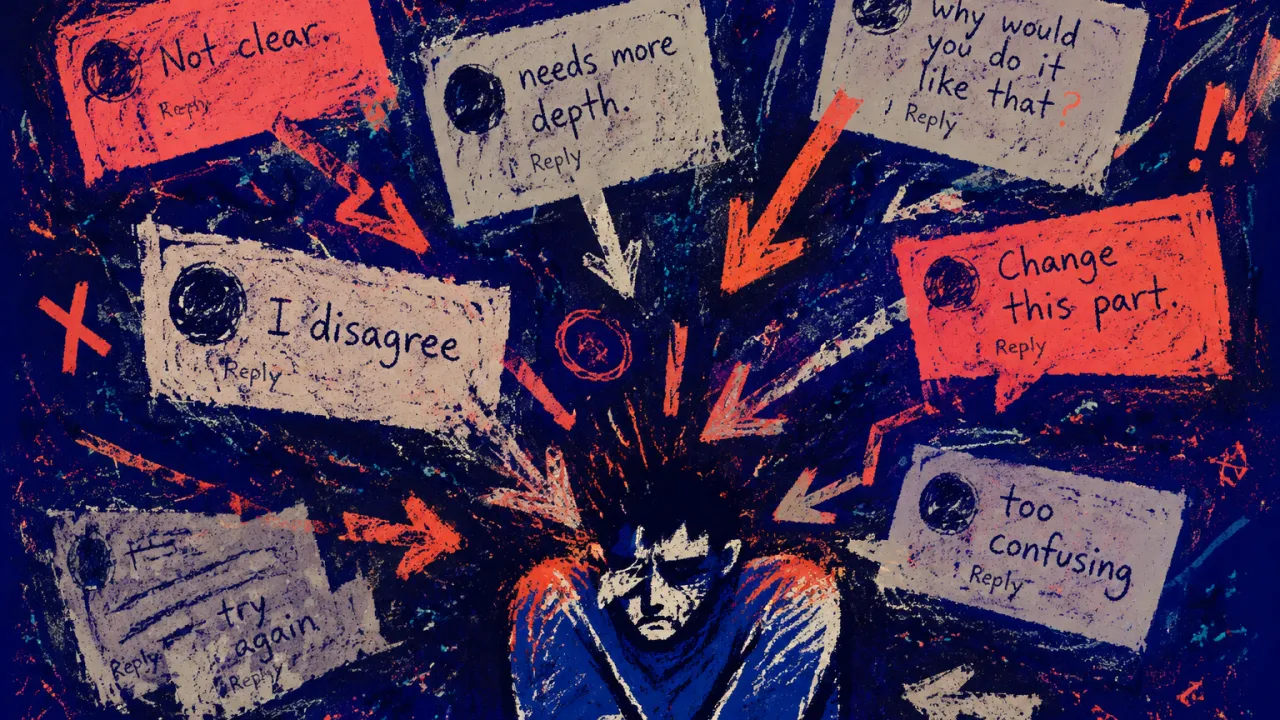
Solitary figure with shoulders drawn inward as overlapping comment windows encroach, coral and grey arrows converging.

What is this situation?

Feedback Overload — you open the shared document expecting one last round of notes, but overnight the comment thread has filled with requests from your manager, a client, and two teammates. One asks you to make the copy warmer; another says it should be shorter and more direct; a third wants the earlier version restored, while the client adds a new priority halfway through the day. You make each change, tag people for a decision, and watch new notifications appear before anyone answers the old question. In meetings, the person with the most authority changes the target, while everyone else adds preferences in Slack, email, and tracked comments, leaving you to reconcile instructions that were never agreed on together. By lunch, you are switching between drafts, rereading the same lines, and carrying your laptop from one room to another because the work is always described as nearly finished but never allowed to close. Your shoulders stay raised, your eyes burn from comparing versions, and the evening disappears into another round of edits, not because one task is unusually large, but because the surrounding voices keep moving the point of completion, much like the Two of Swords: a blindfolded figure seated between crossed blades, holding two opposing directions in place while the water behind remains still.

Why it's not you?

This is not a failure to handle feedback; the situation is overloaded by competing requests and no agreed decision-maker. Moving standards, repeated revisions, and instructions arriving through several channels belong to the environment itself, not to your ability to do the work.

Feedback Overload in Tarot Cards

Feedback Overload is the situation where your shoulders stay raised while managers, clients, and teammates keep sending competing revisions through the same day. It is an environmental and structural dynamic: the target keeps moving because the voices around the work are not aligned. The cards below reflect that outline without deciding what you should do. Here are the Tarot Cards for this situation.

Justice
Reversed
The seated figure holds a sword beside a pair of scales, creating the promise that work will be judged by one visible standard. Reversed, that promise tilts: warmer, shorter, restored, and newly prioritized are treated as simultaneous criteria, while authority changes the weight of each one without publishing a final rule. You are asked to produce a fair result from an evaluation system that has not agreed what fairness looks like. The contradiction lives in the review structure, so each revision can be defensible in isolation while the overall project remains trapped in inconsistent judgment.
Seven of Cups
Upright
Seven cups float before a silhouetted figure, each holding a different possible object and each competing for attention. The spread turns feedback into a menu of plausible versions: warmer, shorter, more direct, restored, and newly reprioritized, with no visible rule for deciding which cup represents the actual brief. You are pushed to choose among options that were generated by different stakeholders rather than by one shared decision process. The abundance looks like flexibility, but it creates choice pressure because selecting one version leaves the others available to return as objections.
Two of Pentacles
Upright
The figure juggles two pentacles inside an endless loop while ships rise and fall on rough water behind him. The physical rhythm matches a workday spent switching between versions, channels, and priorities, where keeping everything moving matters more than any one edit reaching a settled endpoint. You can make each adjustment, but the balance is temporary because a new instruction enters before an old one is resolved. The loop turns responsiveness into a hidden career workload: your value is measured by how much contradiction you can carry, while the brief itself remains unstable.
Three of Pentacles
Reversed
The cathedral plan, the apprentice on the bench, and the two observing figures form a scene built around shared work and visible standards. Reversed, the same arrangement becomes a broken handoff: the people around the draft can see different parts of the assignment, but their criteria are not being integrated into one build. You are left to stitch together comments that were never negotiated in the same room, carrying both production and coordination responsibility. The document keeps returning to the workbench because collaboration is present as a crowd of reviewers, yet absent as a coherent process for approval.
Two of Swords
Upright
The blindfolded figure sits between two crossed swords, with the still water behind her and no visible path forward. That physical arrangement mirrors a review queue where warmer, shorter, restored, and newly prioritized versions are held in suspension rather than ranked by one accountable voice. You are left to translate incompatible comments into a single draft while authority keeps shifting. The work looks nearly complete, yet the absence of a shared decision rule turns every edit into another exposed choice, so the backlog grows around a decision no one has formally made.
Five of Wands
Upright
The five figures raise their wands into a tangled cluster, with no central conductor and no single line of movement. That crowded field mirrors a workplace review in which manager, client, and teammates each enter with a valid-looking preference, turning the shared draft into a contest of directions. You become the person who absorbs the collision and translates it into revisions, while the group can keep adding pressure without agreeing on a winner. The visible activity creates the impression of progress, but the unresolved coordination leaves the deliverable exposed to the next round.
Eight of Wands
Upright
The eight wands streak across the open sky in one rush, with no figure visible to catch or sequence them. The image gives the review cycle its timing problem: comments, notifications, and a new priority land faster than the earlier decision can be closed, so the supposed final round becomes another moving window. You are not waiting for work to exist; you are trying to find a stable moment in which the work can stop changing. The speed of incoming signals becomes the pressure, and the lack of an agreed pause keeps the finish line receding even when your edits are complete.
Ten of Wands
Upright
The lone worker's face is hidden beneath a bundle of ten wands, leaving the path ahead partly obscured. The image fits a career role in which you carry not only the draft but also the stakeholders' unresolved prioritization, so a modest edit becomes a stack of invisible coordination tasks. You keep moving because the deliverable is described as nearly done, yet the bundle grows whenever another voice adds a condition. The work is exhausting in a structural sense: responsibility for closure has been loaded onto the person without equivalent authority to close the review.

Feedback Overload in Tarot Card Reading Insights

People dealing with Feedback Overload have brought the flood of competing revisions, shifting targets, and unanswered decision requests into readings. Below are Tarot Reading Insights from sessions shaped by this kind of review cycle.
Psychological Contexts Related to Feedback Overload