Perfectionism-Driven Academic Procrastination: Choosing a Rough Start

The Perfectionism-Procrastination-Shortcut Loop at 8:47 p.m.
'If you can build a perfect Notion dashboard after a cafe shift but cannot type one messy sentence before the Sunday Scaries hit, this may feel familiar,' I said. Jordan (name changed for privacy), a 21-year-old third-year student in Toronto, gave me a tired half-smile and sat down at my table.
At 8:47 p.m. on Sunday, they had been at the shared apartment kitchen table with the course portal open beside a cooling mug of tea. The microwave hummed over the smell of reheated noodles while a red assignment reminder glowed on the screen; Jordan refreshed the portal, opened a new Notion template, and left the actual brief untouched. Their shoulders rose toward their ears before they had written a word.
'I spend more time preparing to work than actually working,' Jordan told me. They wanted to complete the assignment honestly, but they kept delaying meaningful engagement until the deadline made summaries, answer banks, or paste-ready wording feel like the only workable options. The question underneath was direct: why did the first honest attempt feel harder to face than the shortcut that appeared after time had nearly run out?
I could see the anticipatory dread in the tight jaw, the restless thumb reaching for the phone, and the heavy drop that followed every minute without a draft. It looked to me like a stalled TTC turnstile inside the chest: the exit was visible, but every attempt to move forward met the same invisible stop.
'I am not going to treat this as a character flaw,' I told Jordan. 'There is a pattern protecting you from the discomfort of being seen trying, and then that protection creates the emergency you later have to survive. We can look at the pattern without shaming it. Our job today is to give the fog a map, so you can choose the next move before panic chooses it for you.'

Choosing the Staircase Through the Fog
I asked Jordan to place their phone face down and take one slow breath while I shuffled. The small ritual was a transition into focused attention, not a supernatural test: it gave the question a clear beginning and moved us from reacting to the deadline into observing the system around it.
For this reading, I chose the Four-Layer Insight Ladder. For anyone trying to understand how tarot works in a question about academic procrastination, this spread is useful because it separates four things that often blur together: the behavior that is visible, the belief beneath it, the inner quality that can change the pattern, and the practical action that makes the change real. It is a compact inner-excavation spread, so it fits a question about why the same loop keeps returning.
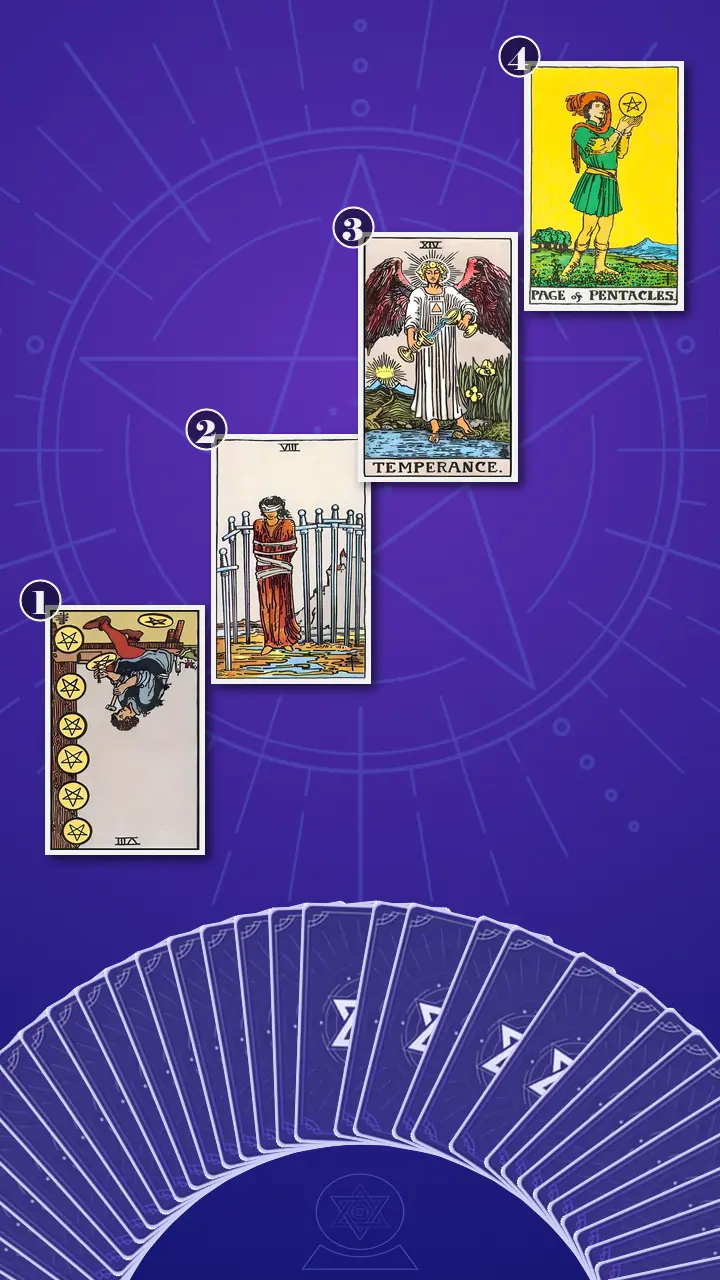
I arranged the cards as an ascending diagonal staircase. The first position would show the presenting layer, the formatting, planning, and digital distraction that replaced substantive work. The second would identify the underlying layer, the restrictive readiness rule and fear that made an imperfect beginning feel unsafe. The third would reveal the transformation layer, and the fourth would ground that insight in one focused academic action. I told Jordan that the cards would not make a decision for them; they would give us a sequence clear enough to examine and revise.
The Workbench, the Blindfold, and the First Honest Sentence
I read the cards in context rather than treating isolated card meanings as fixed verdicts. The staircase began with scattered earth, moved into constricted air, found a steady flow, and returned to grounded earth. That progression already suggested that the issue was not a lack of intelligence or effort, but where effort was being allowed to land.
Position 1: The Workbench That Never Gets Used
'The first position is the presenting layer,' I said, 'the observable delay pattern that is asking for attention now.' I turned over the Eight of Pentacles, reversed.
In the Rider-Waite-Smith image, the craftsman is seated at a workbench with repeated pentacles in front of him. Reversed, the earth energy is blocked and the repetition has lost its useful direction. Jordan had the document, the rubric, the citation guide, and twelve research tabs ready, but the one activity that would build competence, producing and revising original material, never reached the bench. The desk looked busy while the learning remained untouched.
I connected the card to the Tuesday-night pattern Jordan described: renaming headings, sorting browser tabs, comparing productivity systems, collecting sources they did not read, and then opening short-form videos when the first paragraph still felt exposed. Planning can feel like work while keeping the work unseen. Here, preparation was not empty; it was simply producing relief faster than it produced a claim, a rough paragraph, or a source note. That was the excess of low-risk activity and the deficiency of sustained practice.
Jordan gave a short, bitter laugh. 'That is too accurate. It is almost rude.'
'I hear the accuracy, but I do not hear laziness in it,' I replied. 'I hear a person using real organizational skill to avoid the one moment when the quality of their own thinking becomes visible. The risk is that lost practice later tempts you into an all-night rescue, banning every break and trying to force the whole assignment through one exhausted burst.'
Jordan looked down at their hands and rubbed a faint ink mark from one finger. The laugh had loosened something, but it had not made the pattern comfortable. I let that discomfort remain specific: one missing sentence, one hour spent arranging the tools, one deadline made narrower than it needed to be.
Position 2: The Rule Behind the Blindfold
'The second position is the underlying layer,' I said. 'This is the belief or protective fear that makes the visible pattern so persistent.' I turned over the Eight of Swords, upright.
The Eight of Swords carries concentrated air: an active mind that has become a mental enclosure. The blindfold and loose bindings suggest a real experience of restriction, but not every boundary around the figure is locked. For Jordan, an unclear rubric had become a rule that said the entire argument had to be understood before a first draft was permitted. The problem was not that uncertainty existed; it was that uncertainty had been interpreted as proof that no safe first move existed.
I brought Jordan back to the Thursday evening TTC ride home from a cafe shift. Rain had streaked the dark window while the brakes squealed between stops, and they had reread the rubric on their phone until every requirement seemed to demand an immediate final answer. They had told me the sequence exactly as it appeared in their head: 'I need to know the whole argument. I need the right source. I need the opening to be good.'
'Before panic narrows the choices,' I said, 'there is a provisional claim, a bracketed uncertainty, or one focused question for office hours. The options are present, but the rule makes them hard to see. A blank document cannot be revised, but it can keep the verdict away.'
Jordan went very still. Their breathing shortened, their eyes moved from the card to the table as if replaying several assignments at once, and then their fingers pressed into the edge of the chair. 'I do make rules like that before I even begin,' they said. I did not ask them to argue with the rule immediately. I asked them to notice that it was an assumption trying to sound like a fact.
When Temperance Turned Panic into a Measured Pour
Position 3: The Bridge Between Two Cups
The room became quieter when I reached the third card. Outside, a streetcar hissed along the wet road, then faded, leaving the small click of the timer on my desk. 'The third position is the transformation layer,' I said. 'It shows the quality that can change the relationship to the root pattern.' I turned over Temperance, upright.
Temperance does not ask Jordan to choose between doing nothing and finishing everything. The water passing between two cups gives a different rhythm: create a small piece now, then review a small piece later. One foot on land and one foot in water holds practical requirements and uncomfortable feelings at the same time. This is balanced, regulated energy, a middle pace that lets rough drafting, feedback, reading, and revision move toward one another instead of waiting for deadline combustion.
I brought in my signature lens, Academic ROI Auditing. I use it to evaluate whether a degree choice, major pivot, research direction, or specific work unit is producing strategic yield, not to turn a person's worth into a spreadsheet. Applied here, one rough bullet has more academic yield than another hour spent making the dashboard beautiful because the bullet creates material that can be tested, revised, and discussed. The timer, not the panic, becomes the measure of the next useful investment.
For a second, I was back at a Wall Street desk, watching people mistake a dramatic price swing for a reliable signal. Uncertainty had been loud, but volume was not value. I returned to Jordan with the same distinction in mind: deadline pressure was a constraint, not evidence of talent, and a crisis was not the only source of momentum.
At 10:40 p.m., the headings were polished, the tabs neatly grouped, and the cursor still blinked above an empty paragraph. Jordan's tea had gone cold, and their jaw was tight. Another minute of setup promised relief without requiring a rough idea to become visible.
Pressure is not proof that you work best; choose a measured rhythm, and let Temperance's steady pour turn small rough drafts into honest progress.
Jordan's breath stopped, and their fingers hovered above the notebook. First came the freeze: their eyes stayed on Temperance, unfocused, as if the two cups had interrupted a familiar replay of late nights. Then the sentence reached them. Their eyebrows lifted; their mouth opened slightly; the hand gripping their sleeve loosened one finger at a time. A slow breath moved from the bottom of their chest, not dramatic, but audible. Their shoulders lowered, and their eyes shone with a recognition that was almost relief and almost grief for the hours already surrendered to panic. They looked at the timer on my desk, then back at the card. 'So I have been calling the fire alarm motivation,' they said. Their voice was quieter now, with a new vulnerability in it: a measured pace would not guarantee a perfect result, only give them room to meet the work honestly. I let the silence hold both truths. 'Now,' I said, 'use this new view to remember last week. Was there a moment when one small transfer, instead of a full rescue, could have made the next choice feel different?'
That was the first meaningful crossing in the emotional transformation, from anticipatory dread and crisis-driven shortcut pressure toward paced engagement, academic integrity, and grounded self-trust. It did not promise that Jordan would always feel ready. It offered something more useful: a way to let discomfort remain present without handing it control of the schedule.
Position 4: The One-Pentacle Study Block
'The fourth position is the integration layer,' I said. 'This is where the transformation becomes a repeatable academic posture.' I turned over the Page of Pentacles, upright.
The Page is attentive, practical, and willing to learn without pretending to have mastered the whole landscape. I connected the card to one concrete first session: Jordan places the phone in another room, chooses one provisional thesis, one source note, or three imperfect bullets, and gives that object twenty minutes of undivided attention. The wider assignment can remain visible in the background without demanding that the entire mountain be crossed at once.
'I do not have to prove I can finish,' I said. 'I am practising the next piece.' One rough paragraph is a study skill, not a personality test. The upright earth of the Page restores the apprenticeship that the reversed Eight had interrupted: one visible unit, one clear next question, and enough time for legitimate revision.
Jordan nodded, but not with the bright certainty of a productivity video. They moved their phone farther across the table and wrote three words on a clean page: one thing only. Their shoulders were still slightly raised, yet their gaze stayed with the card instead of escaping toward the nearest tab.
A 72-Hour Route to Finding Clarity
I read the four cards as one short story. The reversed craftsman showed tools, preparation, and genuine effort circulating around the work instead of becoming practice. The Eight of Swords revealed why: an imperfect first attempt had been treated as a verdict on capability, so formatting, planning, and scrolling offered temporary protection from self-evaluation. That relief compressed the deadline, and the compressed deadline made shortcuts feel necessary. Temperance introduced the missing bridge, a controlled transfer between making and reviewing, while the Page of Pentacles returned the whole reading to one tangible learning unit.
The cognitive blind spot was not simply poor time management. Jordan was confusing the action that reduced discomfort fastest with the action that created academic progress. They were also reading urgency as proof that they worked best under pressure, when urgency was actually removing the time needed for honest choice, revision, and appropriate help.
The transformation direction was clear: replace waiting for crisis activation with one imperfect work unit completed at least 72 hours before the deadline, then schedule a separate review and support decision. The assignment could become a sequence of practice rounds rather than a single judgment on worth. Tarot had not taken control of the outcome. It had helped Jordan see where their own control had been getting spent.
The Research Sunk-Cost Audit Before Another Tab
I also gave Jordan a version of my Research Sunk-Cost Audit, the decision framework I use when an academic project has accumulated time without producing a workable direction. Before opening another source, I asked them to record three things: what usable material actually existed, which next action would create the highest learning yield, and whether the project needed a narrower claim, a strategic pivot, or steady continuation. Time already spent sorting tabs was information, not a reason to spend more time sorting tabs.
I paired that with Institutional Resource Leverage. A writing-centre appointment, tutor, instructor, office hour, or course discussion board was not a last-minute rescue or a substitute for thinking. It was a university resource Jordan could manage proactively by bringing one named question while the work was still rough. Asking for feedback on whether a claim was arguable was a much better use of that network than waiting until the deadline made every question feel like an emergency.
- The 72-Hour Rough StartI asked Jordan to choose one assignment due at least 72 hours away and place a 20-minute calendar block titled 'rough only' on the first available evening. At the start, they would type three rough content bullets: a possible claim, one relevant course idea, and one unanswered question. Before the timer ended, they would add 'Next time, I will...' and schedule a separate 15-minute review block.If twenty minutes feels too exposed, five minutes and one deliberately provisional bullet still count. No formatting, citation polishing, or source hunting comes before the content exists. The block is an experiment, not a promise to finish the whole assignment.
- The One-Pentacle Study BlockFor one first-session block this week, Jordan would put the phone in another room or inside a bag across the room, choose one tangible object, and write its name at the top of the document: one thesis, one paragraph, or one source note. For the first 20 minutes, they would not open new tabs. Any uncertainty would become a bracketed note such as '[check lecture 4 definition]' rather than a search for ready-made wording.The wider essay is allowed to stay unfinished. A bullet list, dictated rough note, or printed assignment brief can lower the difficulty while keeping the work visible. The goal is one object receiving steady attention, not instant mastery.
- The Legitimate-Support CheckpointAfter the rough start, Jordan would make two columns, 'I can do next' and 'legitimate support to ask for,' with no more than one item in each. For a source-heavy or stalled project, they would run the Research Sunk-Cost Audit in ten minutes, then bring one specific question to office hours, a tutor, a writing centre, or the course discussion board before the deadline fell below 24 hours.Institutional Resource Leverage works best when the request is small and named. Jordan could ask whether a provisional claim is arguable or which course concept fits the evidence; they would not ask another person to produce the assignment. A two-sentence email draft is enough to begin.
Jordan looked at the calendar and swallowed. 'But I cannot even find five minutes sometimes because my cafe shifts move around, my roommates are home, and by the time I get back I have already used up all my attention.'
I did not argue with the obstacle. 'Then make the five-minute version the real version,' I said. 'Use one bus stop, the first five minutes before a shift, or the moment you sit down at the kitchen table. Write one bullet and stop if that is all the system can hold. The point is not to perform discipline. It is to give your future self one piece of material and a choice that panic has not yet taken away.'
Jordan wrote the first review block beside the rough-only block. The two appointments were small enough to look almost unimpressive, which was exactly why they felt possible.
Integrity needs time, and time begins with an imperfect start.

A Quiet Proof, Not a Perfect Ending
Four days later, I received a message from Jordan while I was making coffee. 'I did the rough-only block,' they wrote. 'Three bad bullets, one question, and a review slot. It was not a miracle, but I had something real to revise before the panic started.' I read the message twice because the modesty of it mattered. The assignment was not magically easy; the process had simply become visible early enough for Jordan to work with it.
They slept through the night, but the next morning's first thought was still, What if I am wrong? This time, they smiled, opened the document, and wrote one bullet before checking the course portal.
That was the first evidence of the new rhythm: not a finished life, not permanent certainty, but a small act of ownership. I did not give Jordan a destiny, and the cards did not create their discipline. I helped them name the loop, test a different pace, and recognize that the person who chooses the next honest unit is the person directing the story.
When the blank document is glowing at 10:40 p.m. and your jaw is tight, it can feel safer to postpone than to let one imperfect paragraph test the version of you who is trying for real. I know that protective pause, and I also know that noticing it is already a form of finding clarity.
If you gave one small part of the assignment your full attention before it became urgent, what might you be curious to make rough first?