Submission-Order Paralysis: Use One Criterion to Send the Next Draft

The 8:47 p.m. Queue: Finding Clarity at the Send Button
If you work an early-career content job in Toronto, you may know the 9:12 a.m. ritual: open the task board, drag three ready drafts into a new order, then freeze when a Slack deadline reminder lands.
Jordan (name changed for privacy) brought that ritual into my consultation room. She described 8:47 p.m. on a Tuesday at her small apartment kitchen table, dragging two Google Docs across an Asana board for the fourth time instead of submitting either one. The refrigerator hummed, the laptop fan warmed the quiet room, and her jaw tightened whenever the cursor reached the Send button.
She looked down at her hands. 'Why do I keep stalling when I cannot choose what to submit first?' she asked. 'I can finish any of these once I know which one matters most. If I send the wrong thing first, people will notice what that says about my judgment.'
I recognized the central contradiction immediately: she wanted to move one submission forward, but the inability to settle the order had turned every available draft into a test of competence. The physical shape of her indecision was a train stopped between stations, its doors open, every possible route displayed, and nobody willing to take the next stop. Her breath stayed high in her chest, her fingers kept searching for another fact, and rest seemed to wait on the other side of a decision that could never feel fully protected.
I told her that this was decision paralysis at work, not a character defect and not proof that she lacked judgment. 'You are not stuck because there is nothing you can do,' I said. 'You are stuck because the next action has started carrying the meaning of a verdict. Let us use the cards as a map of that pressure, then find one small, reversible way through it. Our Journey to Clarity begins by making the hidden rule visible.'

Choosing the Compass: The Decision Cross Tarot Spread
I invited Jordan to place both feet on the floor, take one unhurried breath, and name the question without trying to solve it while she spoke. I shuffled slowly, treating the movement as a practical transition from the workday's noise into focused observation, not as a supernatural test.
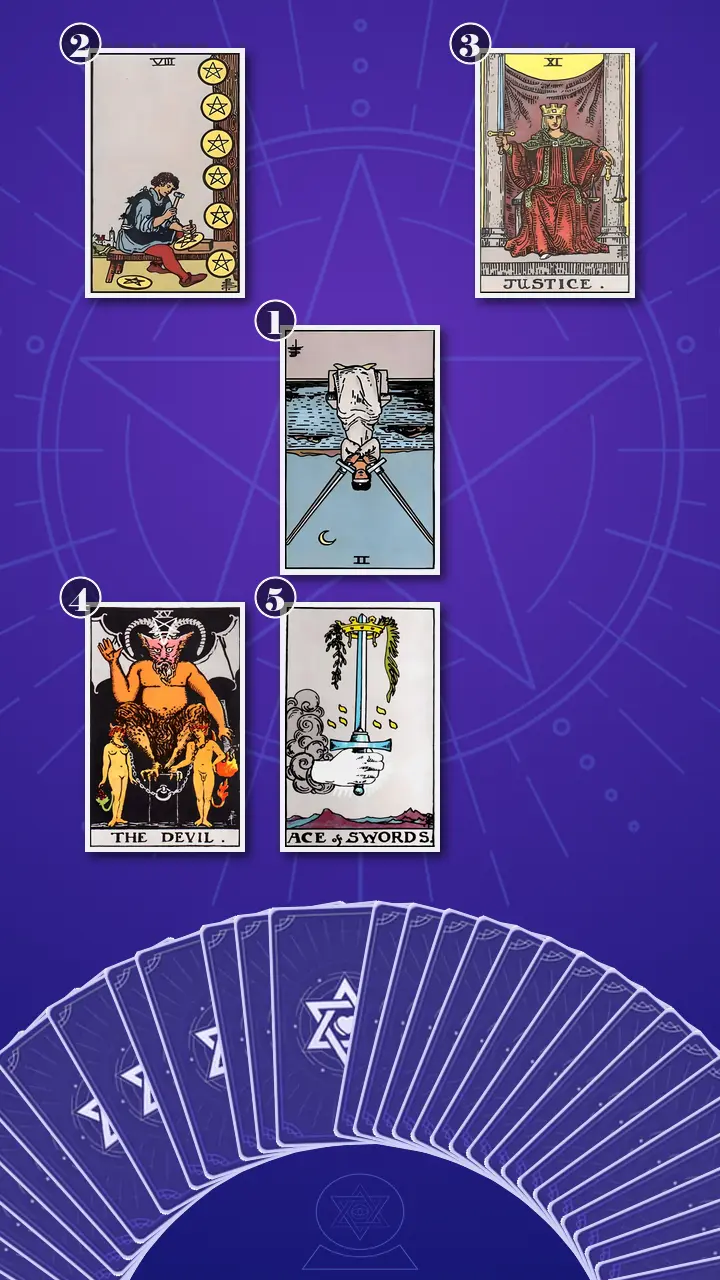
For this reading, I chose the Decision Cross · Context Edition. A broad life forecast would add more material to a problem already crowded with competing information. This five-card Decision Cross tarot spread is smaller and more useful here: it examines the present tension, two contrasting prioritization paths, the hidden attachment underneath the stall, and one integrating action.
For readers wondering how tarot works in a work-prioritization question, the cards are serving as visual prompts and an objective structure for reflection. They do not decide Jordan's correct submission order or predict how colleagues will react. They give us separate images for facts, habits, fears, and possible actions so that a blurred internal experience can be examined one layer at a time.
The center card would show the observable present dilemma: repeated comparison, reordering, and delayed submission. The two cards above it would compare readiness with explicit criteria. The lower card would reveal the hidden fear that makes order feel like proof of control, and the final card would translate the insight into a small, reversible next step.
Reading the Map Beneath the Queue
The Center: A Blindfolded Work Queue
Now I turned over the card representing the observable present dilemma: repeated comparison, reordering, and delayed submission when Jordan could not settle what to send first.
It was the Two of Swords, in reversed position.
In the Rider-Waite-Smith image, the blindfold and crossed swords show a mind holding two possibilities in suspension. Reversed, the Air energy has turned inward and begun circling itself. At 9:12 a.m., Jordan opens two ready Google Docs and the project board in separate tabs. She drags the task cards into three different orders, checks the same deadline thread again, and changes a low-impact heading. The queue stays full because the decision feels unsafe to settle, even though the actual options and some usable facts are already visible.
This is a blockage, not an absence of choice. The calm water behind the seated figure matters: information is present, but the blindfold keeps Jordan focused on the swords she is holding across her chest. She is treating comparison as protection. Reopening the task list gives her a brief reduction in exposure to regret, while the untouched submissions quietly gather more pressure. Researching the order can feel productive while keeping the queue exactly where it is.
I asked her, 'What fact is already available before you ask for one more opinion? Is there a real deadline, dependency, approval boundary, or missing section that could guide one provisional move?'
Her fingers froze over the trackpad. Her eyes went unfocused, as if the 8:47 p.m. kitchen table had appeared again in the room. Then she gave one short, humourless laugh and released a thin breath.
'Damn, this is exactly what I do,' she said. 'I call it being thorough, but I am moving the queue, editing the safest draft, and waiting for certainty before I let anyone see my judgment.'
I nodded. 'That recognition is already evidence. We do not have to shame the strategy in order to stop letting it run the schedule. The question is not whether you can think carefully. It is whether thinking is still changing the decision or only postponing the moment of being seen choosing.'
The Upper-Left Path: Readiness at the Workbench
Now I turned over the card representing what becomes possible when Jordan prioritizes the submission that is most ready for a focused completion pass, without treating readiness as a final verdict.
It was the Eight of Pentacles, in upright position.
The craftsman at the bench offers a different kind of intelligence from the crossed swords. He is not ranking every future object in the workshop before touching the next one. He is completing one piece through defined, repeated attention. In Jordan's workday, this looks like choosing the draft with the smallest remaining gap, closing the other tabs, and giving it a ten-minute final review for facts, required sections, recipient details, and the attachment. Check one paragraph, fix one link, attach the file, press Send.
This is grounded Earth energy, balanced through a bounded task. Readiness is a route into action, not a final ranking of everything else. The visible row of pentacles becomes visible progress: one item leaving the queue, one work block completed, one piece of evidence that she can act without solving the entire system first.
I asked, 'Which submission could receive a defined final pass today? Not which one deserves to dominate your whole week, only which one can become complete enough for its actual purpose?'
Jordan slid her phone face down and looked at the two imagined drafts. Her shoulders remained high, but one hand stopped tapping the table. She did not yet choose. She only stopped adding more candidates to the question.
The Upper-Right Path: Scales Against Shifting Fear
Now I turned over the card representing what changes when Jordan uses one explicit importance or consequence criterion to prioritize, revealing how visible standards can replace repeated comparison.
It was Justice, in upright position.
The scales and upright sword translated cleanly into a familiar work moment. Before comparing drafts, Jordan could write two questions in a note: 'What has the clearest real consequence if delayed?' and 'Who is waiting on this?' She could apply those questions once, choose the submission with the strongest present evidence, and leave the note beside the sent item. The order would be fair and reviewable without pretending it could guarantee everyone's agreement.
Justice brings balanced Air back into the reading. The criterion is not an oracle and not a complex scoring model. It is a boundary against allowing fear to change the standard every few minutes. Criteria make a decision visible; they do not make the future certain. That distinction matters because Jordan has been asking certainty to do a job that evidence can do adequately.
I placed my finger beside the scales and asked, 'What evidence would make this order defensible to you one hour from now?'
Her thumb moved toward the Notes app before she seemed to notice it. She opened a blank page, typed the two questions, and stared at them. The pressure did not disappear, but it became something that could be written down rather than something that had to be obeyed.
The Lower Layer: The Loose Chain of Control
Now I turned over the card representing the core fear and perfectionistic attachment that made submission order feel like proof of control or judgment.
It was The Devil, in upright position.
I explained that this was not a warning of external danger, a prediction of failure, or a fate waiting to trap her. In a reflective reading, The Devil names an attachment that has become stronger through repetition. The loose chains around the figures in the Rider-Waite-Smith image are important because they are not locked tight; the binding is maintained by a rule that feels absolute because it has been rehearsed so often.
For Jordan, the modern version was painfully ordinary. She was not only deciding between submissions; she was trying to make the first send protect her reputation. Reopening the queue lowered regret for a minute, like silencing a notification, but the message returned because nothing had actually moved. The hidden rule sounded like this: 'If I choose the less important thing first, people will remember what that says about my judgment.'
I used one of my signature lenses, Research Bottleneck Analysis. On an archaeological dig, a blocked trench does not automatically mean the excavation has failed. It may mean that a denser layer is underneath and needs a different tool. In Jordan's case, the bottleneck was not a shortage of information. It was the belief that a reversible work sequence had the authority to define her competence.
I asked her to complete the sentence, 'I know this is only a work order, but my body is acting like...'
Her jaw tightened before she answered. Her shoulders rose, then held there; her eyes moved from the Devil's loose chains to the task board on her phone as if she were watching the same loop replay. Finally, her hand closed around the pen, and she said, '...like the decision cannot be undone.'
I let the silence remain kind and ordinary. 'That is the hidden trade-off,' I said. 'Delay protects you from the instant of regret, but it leaves the queue intact and teaches your nervous system that choosing is dangerous. We can name the rule without treating it as truth. The first send is not a referendum on your judgment.'
When One Blade Cut Through the Crossroads
The Integrating Edge: A Provisional Way Forward
Now I turned over the card representing the transformation into a small, reversible action that moves one submission forward and gives Jordan new evidence about self-trust.
The room seemed to narrow around the card. Outside my window, a streetcar bell sounded once and faded, while the radiator clicked into silence.
It was the Ace of Swords, in upright position.
The hand emerging from the cloud held one upright blade, crowned but not omniscient. The mountains behind it had not vanished. The sword simply created a clear direction through a complex landscape. Jordan could write, 'For the next send, I will choose the item with the clearest real consequence if delayed,' apply the rule once, complete one final check, and send. The remaining submissions would stay available. The result would become information about the workflow and the criterion, not a final verdict on whether she was capable of prioritizing.
My hallmark perspective, Academic Stratigraphy, gave me a precise way to make that distinction visible. I separated the top layer of actual deadlines, dependencies, and approval boundaries from the middle layer of draft readiness and required content, then exposed the buried layer of competence fear. The Ace of Swords did not tell Jordan which document was cosmically first. It let one clear rule reach the surface without pretending the entire excavation had been mapped.
I asked her to picture 8:47 p.m. on a Tuesday: two drafts open, the task board reordered again, a phone warm beside cold coffee, and her jaw tight as she changed a heading instead of sending anything. The scene held the old belief that certainty had to arrive before movement.
Stop treating the first submission as a verdict on your competence; choose one clear criterion and cut through the queue with the Ace of Swords' single blade.
I let the sentence rest between us. Then I added, The first submission is a work decision, not a verdict on your competence. One explicit criterion can be enough to move the queue without pretending you know the perfect order.
For a second, Jordan did not blink. Her pupils widened, then her gaze dropped to the Ace as if the card had put a name on a sentence she had been carrying in her body. Her fingers, curled around the edge of her notebook, tightened until the paper bent. I heard her inhale and stop halfway. Then her jaw loosened by a fraction; her shoulders lowered, not dramatically, but enough for the room to change. She looked at the two earlier cards, then at the empty space where a submission could actually leave the queue. Her eyes shone. A small, irritated crease appeared between her brows.
'But what if I really do choose wrong?' she asked, the question sharper than the relief.
I told her that was the honest part: a provisional rule could still produce an imperfect order, and no card could guarantee another person's reaction. Her fist opened. She let out a shaky breath that became almost a laugh, then looked less like someone awaiting a verdict and more like someone holding a tool. The old fear had not vanished; it had become visible, which made it workable.
'Now, use this new perspective to think back to last week,' I said. 'Was there a moment when this insight could have made you feel differently?'
This was the first crossing from stalled comparison, held-breath perfectionism, and fear of exposing poor judgment toward provisional discernment, focused completion, and steadier self-trust built through evidence. The cards had not removed uncertainty. They had changed its status. It no longer had to be permission before action; it could become information after action.
A Criterion, Not a Verdict
When I gathered the five cards into one story, the pattern was clear. The reversed Two of Swords showed a present queue where comparison had replaced judgment. The Eight of Pentacles offered a readiness path through one defined final pass. Justice provided a fair, visible standard instead of a shifting emotional ranking. The Devil revealed why the queue felt so heavy: a reversible order had been tied to control, reputation, and worth. The Ace of Swords supplied the resource that could reconnect them, one explicit criterion followed by one bounded action.
Jordan's blind spot was not that she had failed to prioritize. It was that she had assumed more comparison would eventually produce perfect certainty, when comparison was actually protecting her from the discomfort of being visible and provisional. The direction of change was therefore specific: treat submission order as a reversible working decision, name one criterion, choose one item, and let what happens next add evidence to the process.
I also gave her my Thesis Stratigraphy Framework so the action would not turn into another elaborate productivity system. For each draft, she would separate the foundation, meaning the core request or argument; the load-bearing layers, meaning verified facts, required sections, recipient details, and approval boundaries; and the surface dust, meaning a heading, filename, comma, or formatting preference. The first send needed a sound foundation and load-bearing layers. It did not need every grain of surface dust removed.
- The One-Criterion SendBefore the next submission block, write one sentence in a note: 'For the next send, I will choose the item with the clearest real consequence if delayed.' Apply it once to the live queue, set a 7-minute timer, complete one final review relevant to that criterion, and send the chosen draft. If another person's approval is required, draft the exact approval message or identify the person whose decision is needed.Use one observable rule, such as earliest real deadline, clearest consequence, or smallest remaining gap. Do not reopen the full ranking after the rule selects one item. A genuine approval or workplace risk is a boundary, not a failure of the method.
- The Ready-Enough Work BlockMark the submission closest to a defined finish, close or minimise the other drafts, and set a 10-minute timer. Use the Thesis Stratigraphy Framework to check the foundation, the load-bearing facts and requirements, and the recipient or approval details. When the timer ends, submit the item if it meets the agreed standard, or write down the one specific missing step instead of reopening the whole queue.Define readiness narrowly: required sections are present, the main facts are checked, and only a short final pass remains. If ten minutes feels too demanding, begin with five. Readiness is a route into action, not a permanent ranking of everything else.
I reminded Jordan that a clear criterion should never override a real deadline dependency, an approval boundary, or a material risk. The purpose was not to force a submission at any cost. It was to replace invisible pressure with a visible, reviewable choice and to make room for self-trust to grow after the send rather than demanding that it arrive fully formed beforehand.

One Item Leaving the Queue
Three mornings later, Jordan sent the draft with the clearest consequence if delayed and kept the evidence note beside her keyboard. She sat alone with her coffee while the next draft remained open, and her first thought was, 'What if I chose wrong?' This time, she lowered her shoulders and recorded what had actually happened before touching the task board.
She wrote to me, 'I still do not know the perfect order. But one thing left the queue, and I did not have to make the next choice at the same time.'
That was the proof I wanted her to have: not a solved career, a flawless workflow, or a promise that uncertainty would never return. Just one item moving, one criterion made visible, and one ordinary decision no longer carrying the weight of an entire reputation.
I have spent a lifetime at Cambridge and on archaeological digs, where the most useful discoveries rarely arrive as intact monuments. More often, they appear as a fragment placed carefully beside another fragment until the older structure begins to make sense. Jordan's Journey to Clarity worked the same way. The cards offered images; she supplied the evidence, made the decision, and remained the author of what happened next.
When two ready submissions sit open and your jaw locks, the choice can feel less like sequencing work and more like risking proof that you cannot control how your judgment will be read. But the first send can remain a provisional layer of evidence, not a verdict.
If the first submission could stay provisional rather than define you, what small criterion would you feel curious enough to try for the next ten minutes?