Old Praise Closed the Career Exit Plan; A Calendar Invite Reopened It

When a Successful Career Starts Feeling Like a Contract
If you can explain why staying is sensible but cannot tell whether you still choose it, every old portfolio win can start functioning like a contract you never knowingly signed. When Maya joined my video call from Toronto, I recognized sunk-cost guilt and recognition-dependent self-trust making a successful career feel impossible to leave responsibly.
It was 11:40 p.m. in her high-rise condo near Yonge and Eglinton. A document titled Next Direction glowed beside a polished product-design portfolio. Through her microphone, I could hear the refrigerator humming. She lifted a mug, tasted the cold tea, and grimaced as if it had left a bitter coating on the whole evening.
She had written one possible experiment in the document: contact someone working in an adjacent field. Then she had reopened an old Slack thread full of praise, added strong reputation to the stay column, and returned to polishing a case study that was already finished. The blue-white light caught the hard line of her jaw.
“Every win makes the exit harder to justify,” she said. “I worked too hard to earn this momentum just to walk away. Why do past wins make quitting this path feel irresponsible?”
Her guilt-laced ambivalence seemed to sit in her rib cage like two hands pulling in opposite directions: one reaching for the door, the other tightening each time she moved toward it. The more evidence she had that the path worked, the harder it became to ask whether it still worked for her. Underneath the calculation, I could hear grief for a successful identity she was no longer certain she wanted to inhabit.
“A successful path can stop fitting without becoming a mistake,” I told her. “I am not here to predict whether you should quit. I want us to see why the comparison keeps becoming unfair, then build a way for you to gather current evidence. Let us make a map for the fog without pretending the map owns your destination.”

Choosing the Compass at a Career Crossroads
I asked Maya to take one slow breath and hold her question without forcing an answer. I shuffled deliberately beneath the overhead camera. The brief ritual was a transition from reacting to observing, not an attempt to make the decision mystical.
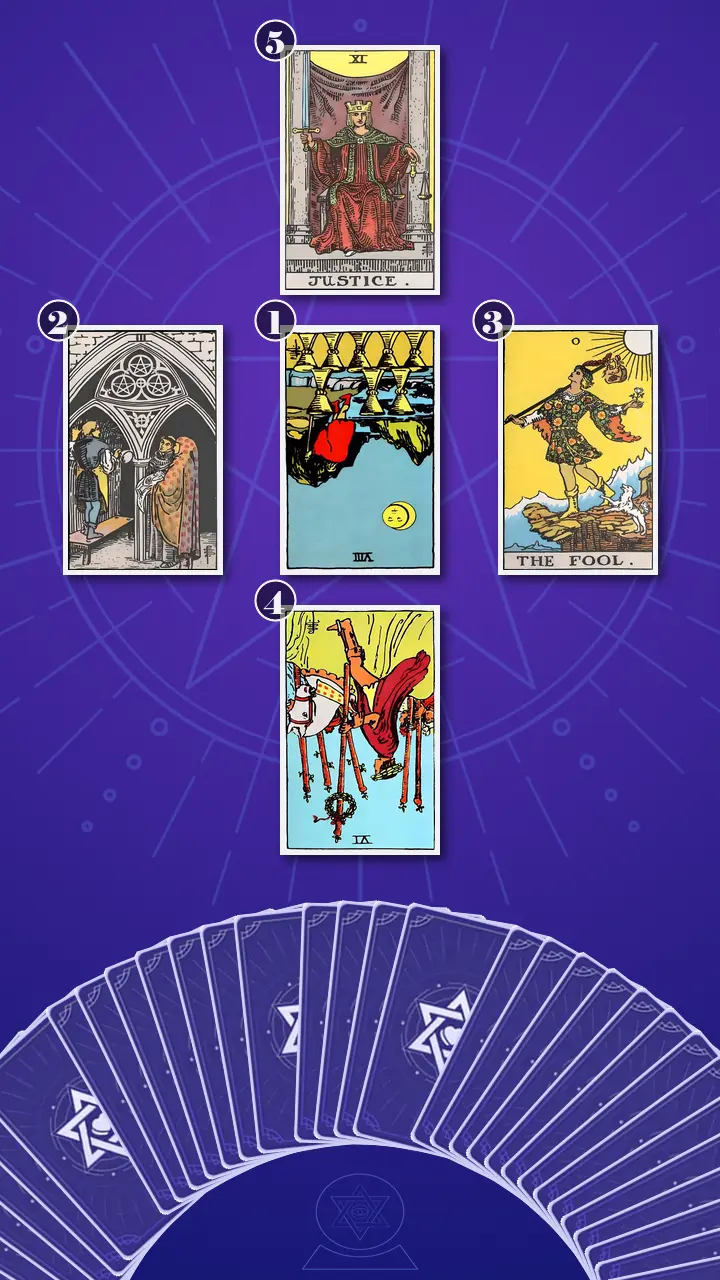
I chose the five-card Decision Cross tarot spread for career change and sunk-cost guilt. For readers wondering how tarot works in a career decision, I use the cards as structured prompts: they separate factors that hyper-analysis tends to blend together. This focused five-card spread was sufficient because Maya did not need a prediction or a sprawling life forecast. She needed the stalled departure, the legitimate value of staying, the possibility of changing, the hidden recognition pressure, and the standard capable of weighing them fairly.
The centre would show the present knot. The cards to the left and right would hold the valid cases for continuing and exploring. The lower card would uncover the influence distorting the comparison, while the upper card would provide an integrating criterion. Laid out as a cross, the spread resembled a compass rose at the exact point where Maya kept turning back.
Reading the Loop That Looked Like Research
Position 1: The Departure Repeatedly Reversed
The card I turned over now represented the present knot: Maya approaching departure, reviewing past wins, and postponing exploration. It was the Eight of Cups, reversed.
The reversed card showed blocked Water, emotional information that could be felt but could not yet become movement. Its life translation was already open on Maya’s screen: write an exploratory action, reopen the praise messages, edit the stay column, close the document. Returning to familiar work reduced her guilt for a few minutes, but it prevented her from learning whether another path might fit.
“You are holding two sentences at once,” I said. “I want to know what else fits. And: I need one more reason before I am allowed to look. What exact action were you about to take before you backed away tonight?”
“Send the message,” she answered. Then she gave a short, bitter laugh. “That is painfully accurate. Almost rude.” Her jaw released for a second, but her shoulders stayed close to her ears. She could now see that another round of work was not neutral productivity. It had been relief from the exposure of a real experiment.
Position 2: The Craft That Remains Real
The card I turned over next represented what genuinely supported continuing: the present benefits, developed skills, and value that remained valid without sunk-cost guilt. It was the Three of Pentacles, upright.
This was balanced Earth: research synthesis, stakeholder facilitation, visual communication, and collaboration under pressure. I asked Maya to review a successful launch as a project retrospective, separating the title from the behaviours that produced the result. Those abilities could be reasons to stay if ordinary product-design work still developed them. They were also portable.
“Your wins are evidence of skill, not a lifetime contract,” I said. “A strong portfolio is a toolbox, not a lease on one building.”
Maya looked away from the cards and slowly rubbed her thumb across the rim of her mug. “I can respect what I built without making the building my permanent address,” she said. Her exhale was quiet, but it was the first one that reached the bottom of her lungs.
Position 3: The Experiment Smaller Than a Resignation
The card I turned over now represented what genuinely supported leaving or changing: the possibilities and forms of exploration her current path might not contain. It was The Fool, upright.
The Fool brought balanced beginner energy, not an instruction to make a reckless exit. In Maya’s life, it looked like placing one 20-minute informational conversation on her calendar beside ordinary meetings. She could carry her existing skills like the figure’s small bundle, listen to practical caution like the alert dog, and ask beginner questions without demanding a career verdict.
“Treat it like a product prototype,” I said. “Small enough to test, real enough to produce information, and nowhere near a full launch. It does not have to prove that you should leave. It only has to show you something another browser tab cannot.”
Her fingers hovered over her trackpad, then settled. I watched the word resignation lose its grip as she replaced it with conversation.
When LinkedIn Became a Private Scoreboard
Position 4: The Laurel That Had to Be Defended
The card I turned over beneath the centre represented the hidden influence: Maya’s fear that leaving after visible success would invalidate her past wins, weaken her self-trust, or look irresponsible. It was the Six of Wands, reversed.
Here, Fire was trapped in recognition maintenance. Maya described standing on a packed Line 1 train while the brakes shrieked into Bloor-Yonge, damp coats and burnt coffee crowding the air. A former colleague’s promotion filled LinkedIn while an alternative-career course waited in another tab. Her phone felt hot in her hand. She immediately imagined a smaller title and beginner-level work, then pictured everyone revising their opinion of her.
The pattern resembled an algorithm trained only on her highest-performing professional posts. It kept recommending more of the same while ignoring what she no longer wanted to create. LinkedIn had become a live scoreboard for a private decision it could never fairly evaluate.
“If I become a beginner,” Maya said, her voice lower, “people might decide the old praise was mistaken.”
I did not dismiss that fear as vanity. Losing a legible identity can carry real grief, especially when colleagues know you as the person with the clear trajectory. But visibility was no longer merely feedback; it had become a condition Maya believed she had to satisfy before trusting herself. Sometimes the next win does not answer the question. It only postpones it more convincingly.
When Justice Changed the Rules of the Spreadsheet
Position 5: Today’s Evidence, Weighed Equally
The refrigerator motor clicked off, and the sudden quiet seemed to widen the small kitchen behind Maya. I told her we were turning over the reading’s integrating card. It represented how both paths could be evaluated through present evidence and accountable experimentation rather than historical obligation.
The card was Justice, upright.
Justice was balanced discernment: scales holding competing evidence and an upright sword removing criteria based only on guilt, image, or old investment. In practical terms, Maya would evaluate staying and changing through the same present-day measures: energy after an ordinary workday, learning, financial feasibility, values fit, and the consequences of delay. Unknowns would remain unknown instead of being automatically scored as dangers.
Seeing the card, I remembered deal-review sheets from my Wall Street years. One side could not book every upside while forcing the other side to absorb every uncertainty. Fairness was not a mood; it was a structure.
I brought in my Transferable Asset Pricing lens. Instead of valuing Maya’s five years as non-refundable shares in product design, I audited the assets underneath the title: synthesis, facilitation, systems thinking, visual communication, and steadiness under pressure. Those assets belonged to her. Staying could use them, but leaving could not erase them. The audit stripped prestige and workplace messaging out of the valuation long enough for Maya to see that her competence was portable.
Until that moment, she had been treating proof that she was good at product design as proof that she must continue doing it. The spreadsheet looked analytical, but its hidden purpose was to preserve yesterday’s verdict and protect her from the vulnerability of judging again.
You do not owe permanent loyalty to yesterday's proof; choose by today's evidence, and let Justice's scales weigh what continuing and leaving actually cost.
I let the sentence remain in the quiet. Then I translated it once more: Responsibility is not permanent loyalty to a decision that once worked. It is the willingness to judge both paths by the evidence, values, and consequences that exist now.
Maya’s breath stopped first. Her fingers froze above the keyboard, and her eyes lost focus as if she were replaying every praise message that had sent her back to work. Her eyebrows drew together; the recognition arrived with an edge rather than immediate relief. “But doesn’t that mean I was wrong before?” she asked, suddenly angry. “That I built five years on the wrong call?”
“No,” I said. “It means the earlier decision can have been sound for the evidence and person you were then. Updating a decision is not a confession. It is what accountable people do when the information changes.”
Her fist loosened one finger at a time. Her shoulders lowered, her eyes reddened, and a trembling exhale escaped before she could turn it into another argument. Relief came first, followed by the brief, exposed stillness of realizing that clearer standards would return responsibility to her rather than remove it. “Oh,” she said. “So I do not need to put my old self on trial.”
I asked, “Now, using this new perspective, think back: was there a moment last week when this insight could have made you feel differently?”
She named Thursday’s praise message and the prestigious assignment she had accepted before checking her capacity. I invited her to run the smallest Justice exercise: set a 10-minute timer and write one present-tense reason to stay, one historical reason to stay, one current cost of staying, and one unknown about changing. She could stop early. It was evidence gathering, not a commitment.
What Justice offered was evaluating staying and changing against equal present-day criteria while using transferable skills and reversible career experiments as current evidence. That marked the first crossing from guilt-driven loyalty to past success to grounded self-trust based on present evidence. The card did not make Maya certain. It helped her become fair.
The One-Page Justice Check
When I read the spread as one story, the mechanism became clear. The Eight of Cups showed Maya repeatedly retreating from a threshold. The Three of Pentacles confirmed that the current path held real craft and benefits. The Fool made room for a reversible test. The Six of Wands revealed why even a small test felt reputationally dangerous. Justice corrected the scoring rules.
The loop was sunk-cost guilt and recognition-dependent self-trust making a successful career feel impossible to leave responsibly. Maya’s blind spot was not a failure to collect enough information. It was that she counted the risks of changing in detail while allowing past achievements to give staying unlimited points. Every trophy had become another lock on the same door.
The direction of change was equally specific: stop asking whether past success obligated another five years and start testing whether the path still met current criteria. The five-card Decision Cross tarot spread for career change and sunk-cost guilt had clarified the pattern, but it could not and should not choose her career. Maya retained that authority.
I adapted my Leverage Mapping Protocol for her next week. In a salary negotiation, I use it to identify bargaining chips before a conversation begins. Here, its job was to separate what Maya genuinely possessed from what she merely feared losing. I gave her three bounded actions.
- The Ten-Minute Threshold CheckOn Tuesday evening, Maya would open Next Direction and create two headings: Present reasons to stay and Historical reasons to stay. She would place each reason under only one heading and stop when a 10-minute timer ended.If she felt pulled toward her portfolio, she would write one sentence only. The minimum version still counted.
- The Equal-Weight Leverage MapOn one page, she would define four current criteria: ordinary-day energy, learning, financial feasibility, and values fit. She would score staying and one alternative from 1 to 5 using evidence from the previous eight weeks, including Toronto rent and benefits without giving old prestige a bonus point.Unknowns would be labelled unknown, not risk. If four criteria felt heavy, she would compare one.
- The One-Conversation ThresholdBefore Friday, Maya would message one person in an adjacent field and request a 20-minute conversation about their ordinary workweek. Afterwards, she would record three observations under energising, neutral, and costly.The conversation was a Responsible Explorer experiment, not a disguised resignation. She did not need an exit verdict to run an honest test.
Evaluating staying and changing against equal present-day criteria while using transferable skills and reversible career experiments as current evidence would not guarantee a comfortable answer. It would give both options the same hearing, which was the clarity Maya had been trying to manufacture through more work.

Six Days Later, a Calendar Invite
Six days later, Maya sent me a screenshot. The Next Direction document was still open, but the old praise thread was not. A 20-minute conversation with a service-design researcher sat on her calendar between a product critique and a dentist appointment. Nothing about it looked dramatic, which was precisely why it mattered.
She had also completed the one-page check. Staying still scored well on salary, collaboration, and skills. It scored lower on ordinary-day energy and curiosity. The alternative contained genuine financial unknowns, but no longer carried an automatic penalty for making her look inconsistent.
She had not resigned, announced a pivot, or solved the next decade. She told me she slept through the night, although her first thought in the morning was still, “What if I am wrong?” This time, she smiled at the thought and got up anyway.
I saw that as the quiet proof of our Journey to Clarity. Tarot had not selected a path for Maya. It had helped her expose an unequal decision system, reclaim the value of her own skills, and make one accountable move. The agency had always been hers.
When your chest tightens over an exit tab while old praise glows on the next screen, it can feel as though wanting something different puts both your judgment and the successful person you became on trial. I would ask you to remember what Maya discovered: your wins can remain true without being allowed to decide every future choice.
If your past wins could travel with you as the Fool’s light bundle instead of sitting on Justice’s scales for you, what is one small possibility you might let yourself examine this week?