When a Missed Academic Window Became a Verdict: Letting Today Count

The 2:14 p.m. Loop: Academic Procrastination After a Missed Opportunity
If your Sunday Scaries look like a learning portal, a half-built Notion timetable, and the promise “I can start properly next term,” I know the loop. I recognized it within minutes of meeting Alex, a 22-year-old Toronto undergraduate trying to recover from a missed academic opening.
At 2:14 on a grey Sunday afternoon, I watched her glance between our video call and the overdue task glowing red on her laptop. A mug of cold coffee stood beside the trackpad; the laptop fan rose into a dry mechanical whine; her phone, warm from scrolling classmates' updates, kept returning to her hand. She clicked away from the task and opened next-term course dates.
“I can start properly next term,” Alex said. “If I begin now, I have to admit how much time I lost.” I could see the contradiction tightening through her body: she wanted to re-enter university life, but she only trusted a doorway without fingerprints, missed dates, or evidence that anyone else had entered first. Regret sat behind her sternum like a cold metal tray, pulling her shoulders down whenever the portal loaded.
“You are not doing nothing,” I told her. “You are planning a future reset because contact with the present task feels as though it might reveal something painful about your control, ability, or worth. That makes sense as a protection strategy, even if it is no longer helping.”
Her hand stopped halfway to the phone. “That is exactly my loop. I call it planning, but I am really waiting until beginning cannot show me how behind I feel.”
I told her I would not use the cards to predict an academic outcome or pressure her into staying on a particular path. My role was to help her separate facts from the verdicts attached to them. “Let us give this fog a map,” I said. “We are looking for clarity about what remains possible, not a command about what you should do.”

Choosing the Compass: A Six-Card Transformation Path Grid
I invited Alex to put both feet on the floor and take one unforced breath while holding the question in mind: “Why do I keep waiting for a fresh academic start after missing one?” I shuffled slowly, using the brief pause as a transition from reacting to observing. Nothing supernatural was required.
I work with tarot through a Jungian psychological lens. For me, this is how tarot works at its most useful: the images externalize an inner rule, allowing both of us to examine it without treating the rule as Alex's identity. Card meanings in context become prompts for reality-testing, not declarations of fate.
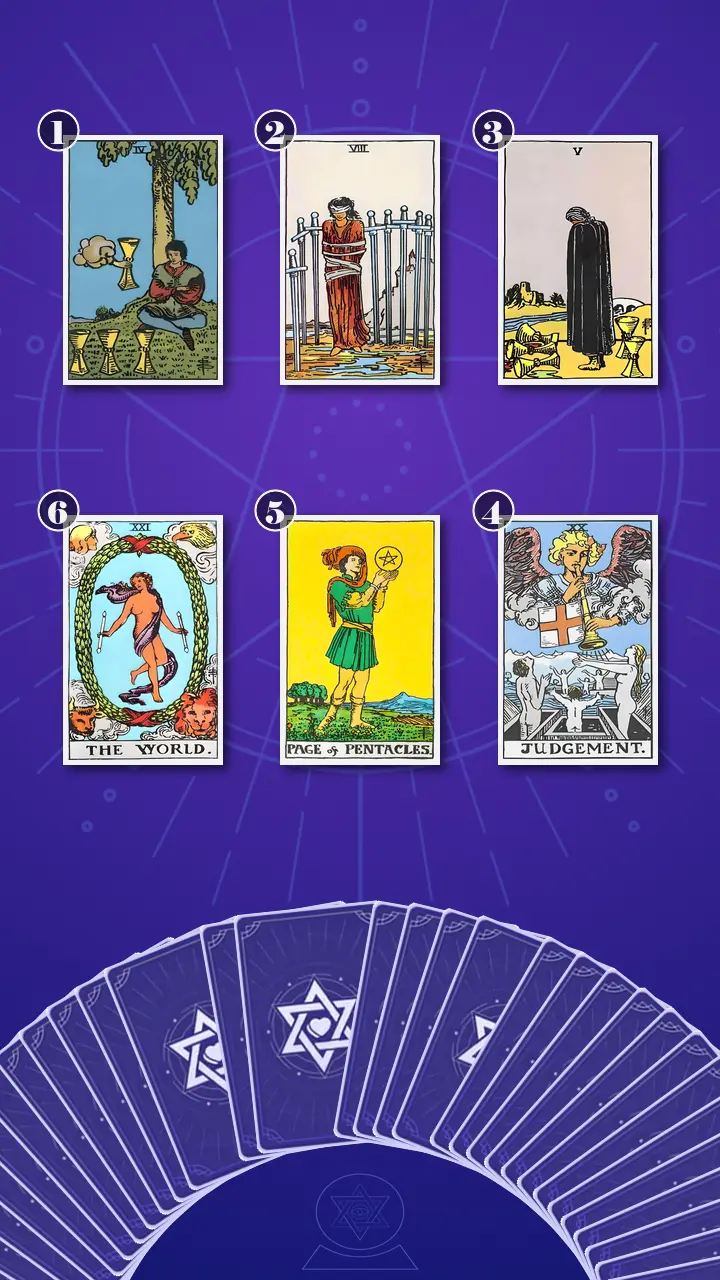
I chose the Transformation Path Grid (6) · Context Edition, a six-card tarot spread designed to trace a repeating pattern from symptom to integration. Alex was not choosing between two live academic offers, so a decision spread would have forced the wrong question. She was asking why missed-window fixation kept recreating academic procrastination after falling behind. This grid could show the entire loop without pretending to decide her future.
I arranged the cards in a two-by-three grid under the camera. Positions 1 through 3 would move across the past-facing loop: the visible behavior, the belief maintaining it, and the emotional root. Position 4 would turn downward as the transformative bridge. Positions 5 and 6 would lead back through a practical re-entry and an integrated perspective. The layout resembled a six-square floor plan, with a route out of the loop rather than a jump into a different life.
Reading the Past-Facing Loop
Position 1: The Fourth Cup Behind the Open Tab
Now I turned over the card representing the presenting situation: the specific behavior of waiting for the next academic start while leaving current study or support-seeking undone. It was the Four of Cups, in the upright position.
I angled the card so Alex could see the seated figure beneath the tree, arms crossed and gaze lowered. Three cups rested nearby, while a fourth cup was being offered from a cloud. I connected the image to the Sunday scene still open on her screen: the overdue task, unfinished notes, and current support options were present, but her inner posture kept them at a distance. She had assigned nearly all emotional meaning to next-term dates because the current option could not deliver the clean academic identity she wanted.
I read the cup energy here as Blockage. The card did not say Alex lacked options. It showed disappointment blocking her capacity to receive an option that arrived in the wrong form or at the wrong time. The available action looked emotionally insufficient, so scrolling future courses felt more meaningful than opening two current pages.
“When the portal shows you the overdue task, what happens next?” I asked. “Do you open it, rebuild the schedule, check future dates, or reach for your phone?”
Alex gave a short laugh, but it was not the sound of easy agreement. Her mouth tightened at one corner. “That is so accurate it feels a little brutal.”
“Then let us slow it down,” I said. “The card is describing a posture, not condemning you for having it. Crossed arms can be protection. The useful question is whether they still need to stay crossed when the fourth cup is only a reading, a question, or a request for information.”
Position 2: The Thought-Prison Built from Open Tabs
Now I turned over the card representing the maintaining blockage: the belief that the current academic period is spoiled and that any action taken inside it is invalid. It was the Eight of Swords, in the upright position.
I pointed to the blindfold, the loose bindings, and the swords forming a narrow enclosure without fully sealing the landscape. On Alex's desk, those swords had modern equivalents: a learning portal full of alerts, several course-calendar tabs, and a support email left in draft. Missing the preferred window had become a total barrier in her interpretation, so opening one reading or asking one question felt as if it would expose the entire distance she had fallen.
I read the sword energy as Excess in interpretation and Blockage in movement. Her mind had built an inner operating system with one punishing permission rule: “If I cannot do this properly, it will prove I have lost control, so maybe I should wait.” Under that rule, a limited route was rejected because it did not restore the original timeline.
This was where I used what I call Draft Paralysis Deconstruction. I explained that perfectionism can operate as a subconscious defense against academic criticism. If Alex never sent the advisor email, no advisor could respond to her imperfect explanation. If she never opened the task, she did not have to encounter what she did not understand. The protection reduced pressure for a few minutes, but it also kept her from receiving new information.
“What exact thought makes the email or reading feel pointless before you try it?” I asked.
Her breathing paused first. Then her gaze drifted toward a Gmail tab as if she were replaying each deleted opening sentence. Finally, she pressed her palms flat on the desk and said, “If the help is limited, I think asking will only confirm that I messed up too badly for it to matter.”
“That is the blindfold speaking as though it were the full landscape,” I said. “Limited help and no help are different facts. We do not have to pretend the enclosure is imaginary. We only need to notice that it is not completely sealed.”
Position 3: Three Spilled Deadlines and Two Upright Cups
Now I turned over the card representing the emotional root: the regret and selective attention beneath missed-window fixation, including the fear that one lost opportunity defines the whole academic path. It was the Five of Cups, in the upright position.
I showed Alex the cloaked figure facing three spilled cups. Two upright cups stood behind the figure, and a bridge led toward a distant building. I read the three spills as the dates and requirements Alex kept reopening, including the deadline she had searched so often that the page appeared first in her browser history. The two standing cups were less dramatic: a current reading, a specific question, an instructor's office hour, or someone who could clarify what remained.
The emotional energy was in Excess around the loss and Deficiency in peripheral awareness. Regret had become a cropping tool. Like a comparison feed showing only classmates' finished milestones, it removed unfinished processes, private setbacks, and remaining routes from the frame. The card did not ask Alex to be grateful or stop caring about what she had lost. It asked whether loss had become the only evidence allowed into the case.
“If those two upright cups were practical rather than inspirational, what might they be?” I asked.
Alex rubbed her thumb along the edge of her mug. “The reading is still there. And I could ask the TA which section matters most before I try to understand everything.”
I nodded. “Exactly. The bridge is not a promise that the old timeline can be repaired. It is a route for finding out what is possible now. Mourning the missed opening and using the bridge can happen at the same time.”
When Judgement Sounded Like a Current Notification
Position 4: The Verdict That Was Never Final
The room seemed to narrow around the next card. Even the laptop fan softened for a moment. Now I turned over the card representing the transformative bridge: the inner shift that would let Alex acknowledge the missed window without waiting for a future reset to authorize action. It was Judgement, in the upright position, the key card of the reading.
I centered the angel's trumpet and the figures rising with open arms. I told Alex I did not see the angel as a dean issuing a new sentence. I saw the trumpet as the notification already on her screen: a current call that could be answered or left unanswered. Judgement's energy was Balance, combining honest reckoning with renewal. It neither erased the deadline nor turned it into a life sentence.
As I spoke, a streetcar bell sounded through the wet traffic below Alex's apartment. The clean metallic note crossed the room and vanished. For one second, the city seemed to collaborate with the card: a call did not have to continue forever to be heard.
I remembered conversations I had held across different countries, languages, and grading systems. The institutional rules changed, but I often saw the psyche perform the same transformation: an external evaluation became an inner myth about who was allowed to continue. Through a Jungian lens, Judgement interrupts that myth. The authority in the image can be reclaimed as the conscious part of the self willing to meet reality.
I used my Performance Anxiety Decoupling framework to separate three things Alex had fused together. The first was an academic fact: a window had passed. The second was performance information: some work remained unfinished, and current options needed checking. The third was her core worth and capacity to learn. The first two deserved an honest response. Neither was qualified to evaluate the third. A portal status, classmate comparison, or mentor reply could provide data without becoming a definition of Alex.
I brought her back to the Sunday loop: her shoulders dropping at the overdue task, her hand switching tabs, and the busy future-term screen providing temporary relief. She had been asking the calendar for permission to become a student again because granting that permission herself felt both exposing and strangely unauthorized.
I spoke slowly: “You do not need a fresh academic start to begin again. The beginning becomes real when you name what was missed and answer with one present-tense action.”
Stop treating the missed window as proof that the current academic moment cannot count; answer Judgement's trumpet by making one honest, present-tense commitment.
I let the sentence rest. For one beat, Alex's breathing stopped; her right index finger hovered above the trackpad, and the muscles along her jaw went still. Then her eyes shifted away from me and fixed on the red portal label, as if she were replaying every Sunday she had converted into a future-term plan. Her brows pulled together. “But doesn't that mean I've been wrong this whole time?” she said, sharper than before. The anger arrived before the relief. I watched her hands close, then loosen. Her eyes brightened, her shoulders dropped by perhaps an inch, and she released a breath that shook at the end. The opening did not make her triumphant. It left her briefly unsteady, because the closed-door story had protected her from the smaller responsibility of choosing what to do today. Her face held both grief for the lost time and a cautious recognition that the next move was hers.
“No,” I said. “It means future planning protected you from shame and evaluation when you needed distance. We can respect why that protection appeared without asking it to run the whole semester. You were not wrong as a person. You were using a strategy whose short-term relief had begun to cost you participation.”
“Now, with this new perspective, think back: was there a moment last week when this insight could have made you feel different?” I asked.
Alex looked toward the unfinished email. “Wednesday in the library. I wrote, 'Hi, I missed the deadline and wanted to ask,' then deleted it. If I had treated the deadline as a fact instead of a verdict, I might have saved the draft. I still might not have sent it, but I could have let the question exist.”
“That distinction is the crossing,” I said. “Not from failure to instant success, but from regret-driven future planning and self-imposed academic paralysis toward grounded present-tense participation and rebuilding self-trust. Judgement does not guarantee an academic turnaround. It restores your right to respond.”
Finding Clarity in One Open Browser Tab
Position 5: The Page's Twenty-Five-Minute Beginning
Now I turned over the card representing practical re-entry: one small, observable academic action available during the current transition. It was the Page of Pentacles, in the upright position.
I drew Alex's attention to the Page studying a single pentacle, the cultivated field, and the path leading toward distant mountains. The Page was not performing an academic-comeback montage. The Page was making patient contact with one tangible object. In Alex's life, that could be one twenty-five-minute block, one assigned reading, three plain-language notes, or one precise question.
I read the earth energy as a current Deficiency with clear potential for Balance. Alex had plenty of conceptual planning but little physical contact with the material. The card redirected attention from constructing a future identity to producing one modest piece of present evidence: a browser tab opened, two pages read, or a draft preserved.
“What could you finish in ten to twenty-five minutes without turning it into an all-day rescue mission?” I asked.
Alex looked down, counted silently on her fingers, and then lifted her eyes. “Two pages from the reading and three rough notes. Not good notes. Just notes I can see.”
“That is Page of Pentacles work,” I said. “Your first step does not have to repair the whole timeline. It only has to put you in contact with what is here.”
Position 6: The World Inside One Completed Loop
Now I turned over the card representing the integrated perspective: experiencing a fresh start through participation in the present cycle, with small completed loops rebuilding self-trust. It was The World, in the upright position.
I traced the laurel wreath around the central dancer and indicated the four steady figures in the corners. I read the wreath as a frame wide enough to hold the missed opening, the current task, and the next step without deleting any of them. In practical terms, The World was Alex recording what she read, what remained unclear, and what she would revisit. One completion would not be a consolation prize before the “real” restart. It would belong to her actual education.
The energy here was Balance through integration. The Four of Cups had looked away from an imperfect offer; The World could include imperfection without losing coherence. Alex did not need an immaculate academic timeline to feel whole. She needed a way to close small loops and allow each one to count.
“After those two pages and three notes, what could you record so the task becomes evidence rather than another disappearing effort?” I asked.
“I could put the date at the top and write the next question underneath,” she said. Her hand moved toward the notebook rather than the phone. “Then I would know where to return.”
I watched the last of the grey afternoon light widen across her desk. The spread had moved from withdrawn water and restrictive air, through the water of regret, into the practical earth of the Page. The World did not brighten the room into a different season. It simply widened the frame enough for Alex to see that she was already inside the cycle she had been waiting to enter.
Start Where the Calendar Left You
I gathered the six cards into one coherent account. Alex had missed an opening and kept revisiting it. The Four of Cups showed how the imperfect present then felt emotionally unworthy of attention. The Eight of Swords revealed the rule maintaining the pause: if an action could not restore the original timeline, it could not count. The Five of Cups showed why that rule felt convincing, because regret kept the spilled opportunities in the foreground. Judgement separated fact from permanent verdict. The Page translated permission into contact with one task, and The World showed how repeated contact could become a more integrated relationship with learning.
I named the cognitive blind spot directly: Alex had assumed that confidence, control, and the right plan had to arrive before action. The spread suggested the reverse sequence. A small action could create evidence of participation, and that evidence could gradually rebuild grounded self-trust. Planning was not the enemy. It became avoidance only when it repeatedly replaced contact with the work or information available now.
I returned to the doorway metaphor that had shaped our conversation. Alex was not necessarily locked outside her academic life. She was standing inside a building, treating one closed door as proof that every room was unavailable. Present-term re-entry meant checking the doors that still existed and retaining the freedom to decide whether entering any of them supported her goals and well-being.
I turned the reading into two pieces of actionable advice. Both were experiments, not obligations:
- Run the ten-minute missed-window reality check.Before Friday, sit at your desk, in a campus study space, or at a Toronto library and set a ten-minute timer. Begin my Inner-Critic Mute Protocol by writing: “Fact: the deadline passed. Critic's verdict: this proves I cannot participate. Present permission: I only need accurate information about what remains.” Then make two columns titled “What I cannot change” and “What is still available this term.” Choose one item from the second column and take only its first physical step, such as opening the reading or locating one requirement.Use neutral language, keep the page private, and reduce the timer to two minutes if ten feels too exposing. Stop when it rings. Completion is optional, and choosing no further action that day remains valid.
- Complete one Page of Pentacles loop.Book one twenty-five-minute block this week at home, on campus, or in a library. Put the phone out of reach and choose the visible finish before starting: read two pages and write three plain-language notes, or review one lecture section and mark one unclear point. Add the date and one next question, then stop when the timer ends.Do not let the block expand into an all-day catch-up attempt. The goal is contact with the material, not proof that you have become a different person overnight.
Alex studied the list. “Two pages still feels almost insultingly small compared with everything I missed.”
“It is small,” I said. “That is why it can test the belief. We are not pretending two pages solve the term. We are finding out whether one imperfect action is allowed to count. Consistency can begin as one completed loop.”
I also reminded her that tarot had not instructed her to continue a course, send an email, or sacrifice her well-being for an institution. She retained full authority over those choices. The cards had helped us distinguish an old protection strategy from the range of options still available. What she did with that clarity belonged to her.

Four Days Later: The Quiet Proof
Four days later, I received a short message from Alex. “I did the ten-minute page. Under 'still available,' I wrote the current reading and one question for the TA. Then I read two pages, made three ugly notes, and stopped when the timer went off. I did not rebuild the semester.”
She added, “I slept through the night. This morning my first thought was, What if I am still too late? I smiled, opened the notes, and read the next page anyway.”
I did not read that message as proof that everything was fixed. I read it as the first observable movement from regret-driven planning into present-tense participation. The six-card Transformation Path Grid had supplied a map for academic re-entry, but Alex had made the movement. Tarot did not authorize her return; she did.
When the learning portal opens and your shoulders lock around a missed deadline, waiting for a clean restart can feel safer than beginning now and risking a clear view of how far behind you are. If you can notice the difference between the academic fact and the permanent verdict your inner critic adds, you have already created a little room around the old loop.
If the next term did not have to authorize your return, what is the smallest present-tense academic loop you might quietly let count today?