When Office Hours Feel Like a Test: Bringing One Unfinished Question

The 2:45 Alert and the Productivity Costume
If you keep preparing for office hours until office hours are over, I do not think the problem is necessarily your question. Sometimes the real problem is the rule that says you must already look competent before you are allowed to ask it.
Alex was twenty-one and studying at a large university in Toronto when they brought me a question that sounded simple: "Why do I keep skipping office hours when I know I need help?" I asked them to take me through the most recent Tuesday minute by minute, because avoidance patterns often become easier to understand when I slow them down to their actual sequence.
At 2:45 p.m., Alex had been sitting beneath the fluorescent lights of the campus library. The ventilation hummed above the keyboard clicks, and a paper cup beside their laptop smelled faintly of burnt coffee. Their instructor's office-hours page was open next to Quercus, while a nearly usable question waited in Notes: "I understand the first step, but I lose the thread when the second follows."
Then the fifteen-minute calendar alert appeared. Alex's fingers tightened around their warm phone. Instead of leaving, they checked the lecture slides for the lecturer's exact terminology, opened another tutorial, and replaced "I lose the thread" with wording that sounded more technical. By 3:42, rain was tapping against the library window, four tutorial tabs were open, and there was just enough travel time left to make going feel unreasonable.
"Missing the session feels easier for ten minutes and worse for the rest of the week," Alex told me. "I somehow turn one question into a whole preparation project. I want help, but I feel like I should know enough before I ask for it."
I could hear the central contradiction clearly: Alex wanted direct clarification, yet the moment clarification became available, they prepared harder so they would not have to be seen mid-confusion. The feeling sat beneath their ribs like a bass speaker turned one notch too high. When the support window finally closed, the pressure briefly cut out, only to return as a heavy drop in the stomach when the same unfinished assignment came back into view.
"I am not going to treat this as laziness or tell you to just be more confident," I said. "Your preparation is doing a protective job. Let us find out what it is protecting, what it is costing, and where you still have room to choose. We are not asking the cards to decide your future. We are using them to draw a map through this particular fog."
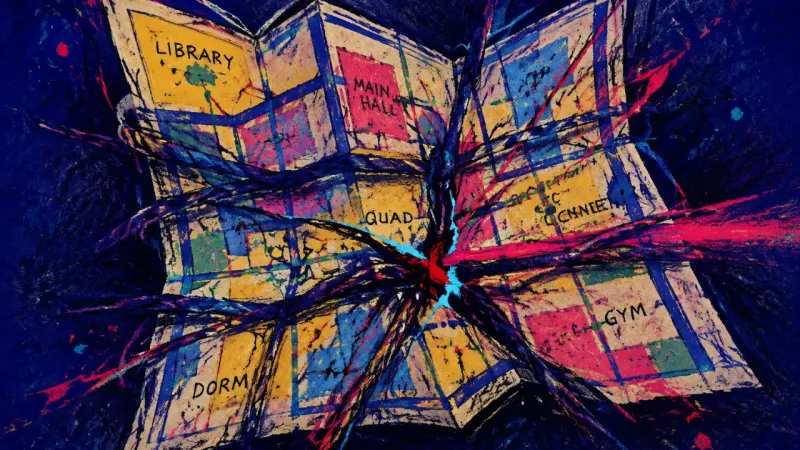
Drawing a Switchback Through the Fog
I invited Alex to put both feet on the floor, take one unforced breath, and hold the question in mind while I shuffled. I use this pause as a transition for attention, not as a test of belief. It gives a crowded problem a clear boundary long enough for us to examine it.
I chose the six-card Transformation Path Grid: Context Edition, a tarot spread for office-hours anxiety and help-seeking procrastination. I arranged the cards in two rows of three. The eye would move across the top row from visible behavior to immediate blockage to the belief beneath it, then drop at the far side and return through leverage, practical action, and integration.
I chose this spread because Alex was not dealing with one isolated missed appointment. They were caught in a feedback loop: need help, anticipate exposure, prepare instead of attending, feel temporary relief, carry the confusion forward, and feel even less qualified to ask the following week. A three-card past-present-future reading would not separate those mechanisms. A Celtic Cross could hold them, but it would be broader than this focused question required. This six-card grid was the smallest map that could show both the loop and the point where it might change.
This is how tarot works in my practice: the cards externalize a pattern so that card meanings in context can be compared with observable behavior. The first position would show how Alex disengaged from available help. The central blockage would expose why an open door or meeting link felt inaccessible. The hinge card would identify the leverage point, and the lower row would translate that insight into next steps. Alex would remain the decision-maker throughout.
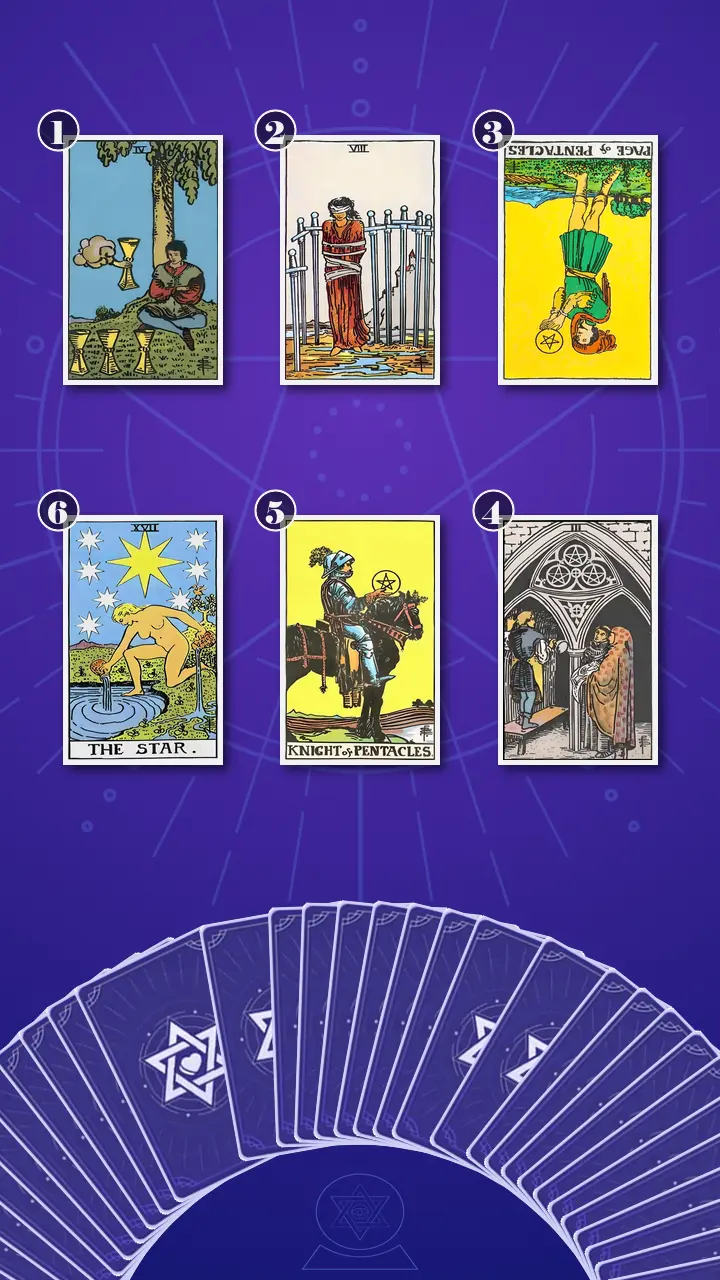
Across the Top Row, the Loop Became Visible
Position 1: The Offered Cup Beside the Open Tab
I turned over the card representing the diagnosis-level behavior of noticing available office hours while disengaging until the opportunity passed. It was the Four of Cups, upright.
In the image, a seated figure folds their arms while three cups remain fixed on the ground. A fourth cup is being offered from a cloud, visible and available, but not engaged. I translated the offered cup as the live office-hours invitation. The three cups on the ground became the familiar notes, slides, and tutorials Alex kept returning to while the time-sensitive offer waited beside them.
"At 2:45, you had the page open and a question that could have started a conversation," I said. "When the alert appeared, you crossed your arms over the discomfort by checking three familiar resources again. Nothing hid the offer. Focusing on what still felt incomplete made it possible to let the offer pass without actively refusing it."
The Cups energy was present but stagnant. Alex genuinely wanted relief and connection, but withdrawal had blocked the normal movement toward support. Researching alone provided a brief emotional shelter, which maintained the loop precisely because it worked in the short term.
"What appeared in the first minute after you decided you might go, before the practical explanations arrived?" I asked.
Alex gave a short laugh, but there was no amusement in it. "That is so accurate it is almost cruel. I tell myself, 'I am not refusing help. I am just making sure I can explain this properly.'" Their thumb rubbed the edge of their phone case, faster than before.
I let the laugh settle. "The card is not accusing you of indifference," I said. "It is showing how strongly you want the help and how effectively a responsible-looking task protects you from the exposed moment of receiving it. That distinction matters. It means there is a function we can change, not a character flaw we need to shame."
Position 2: The Door That Became an Oral Exam
I turned over the card representing the immediate thought-based paralysis that made attending with an unfinished question feel inaccessible. It was the Eight of Swords, upright.
The figure on the card is blindfolded and loosely bound inside a ring of swords that looks complete from within, although a gap remains visible. I saw Alex at 2:56 p.m., either standing near an office door with the room number glowing on their phone or hovering over a Zoom link while mentally rehearsing every question the instructor might ask in return.
"You technically could enter, email, or read one sentence," I said. "But your mind adds a permission rule: 'Not until I can answer what they might ask me.' The physical route remains open while the psychological route gets marked 'not yet.'"
The Air energy of the Eight of Swords had moved into excess. Thinking was no longer helping Alex define the question; it was generating an increasingly elaborate simulation of negative evaluation. It reminded me of Chidi in The Good Place, turning one manageable choice into an exhaustive inquiry into every possible consequence. Alex's internal algorithm had been trained on imagined embarrassment, so every new scenario arrived as further evidence that staying away was prudent.
I was careful not to call the restriction imaginary in a dismissive sense. Limited office-hour windows, commuting time, accessibility needs, and an instructor's actual behavior can all create real barriers. The card asked us to separate those external constraints from the anticipated judgment that had turned every visible contact route into a test.
"When you picture asking the question exactly as it is now, what verdict do you expect?" I asked.
Alex inhaled, held the breath high in their chest, and looked past the cards. "That I did not listen. That I am wasting their time. Maybe that I should not be in the course."
"That is a very large verdict attached to a very small conversation," I said. "The useful gap in this card is not 'feel completely safe.' It is one physical action that remains available before your mind finishes the trial: enter the room, click Join, or send the first sentence."
Position 3: The Apprentice Who Kept Editing the Admission Ticket
I turned over the card representing the root learner belief and procrastination mechanism that equated needing preparation with deserving help. It was the Page of Pentacles, reversed.
Upright, the Page studies a single pentacle with devoted attention. Reversed, that concentration can lose contact with practical follow-through. The learner remains absorbed in preparation while the larger learning path waits beyond the frame.
I asked Alex to show me the latest question draft. It had begun with a direct knowledge gap. Then it had acquired definitions, citations, examples, and increasingly technical wording until the sentence where their reasoning actually stopped was difficult to locate. The draft looked conscientious, but its purpose had changed. Alex was no longer only trying to understand the material; they were trying to conceal the fact that understanding was still in progress.
Here, Earth energy was blocked. Study intention was real, but it was not reaching a grounded action or another person. The reversed Page showed preparation without participation: a Notion board for one question expanding into twelve subtasks, none of which moved the question into the room where it could be answered.
"Preparation becomes avoidance when it must be complete before contact," I said. "The care you put into learning is not the problem. The problem begins when being visibly unfinished feels incompatible with being a capable student."
Alex's fingers stopped moving. Their eyes returned to the draft as if they were watching its edit history replay. After a long pause, they said, "If I can make the question smart enough, no one will notice what I missed."
Their shoulders lowered by a fraction, but their face tightened. I could see both recognition and grief in the change. The strategy had protected something tender, and naming its cost did not make that protection instantly unnecessary.
When the Three of Pentacles Put the Question on the Table
Position 4: The Workshop Hidden Inside Office Hours
The room grew unusually still as I moved to the hinge of the spread. Rain traced the window behind Alex, and the heating pipe clicked once, then again, like a metronome settling into a slower tempo.
I turned over the card representing the leverage point that could reframe office hours from a competence test into collaborative learning. It was the Three of Pentacles, upright, the key card of the reading.
A craftsperson stands on a workbench while two collaborators hold architectural plans. No one in the image waits for the structure to be finished before discussing it. Competence is being built through visible work, shared attention, and constructive input. I translated the scene into Alex placing one incomplete problem between themself and an instructor, TA, or tutor so that both people could look at the exact place where the reasoning broke.
The Earth energy had shifted into balance. The reversed Page had held the question close as private proof; the Three placed it on a shared table as working material. The card did not require Alex to surrender control or accept every authority figure as safe. It showed a collaborative structure in which the work, rather than Alex's worth, could become the object under examination.
To make that shift concrete, I used my Focus Disruption Audit. I asked Alex to replay the fifteen minutes before office hours as if we were isolating tracks in a recording. The calendar alert was the external cue. The imagined judgment was the dissonant internal chord. The sudden slide-checking, rewriting, and tutorial-opening were not random distractions; they were the fragmented rhythm produced when that chord entered.
After ten years of studying sound and energetic rhythm, I often think of a mixing desk at moments like this. A track can be crowded with technically correct notes and still lose its pulse because one channel keeps clipping. Alex did not need more intellectual volume. They needed a cleaner transition: when the alert sounded, the research track would close, and the unfinished question would move into a shared workspace.
I asked Alex to hold the familiar 2:45 scene in mind: the office-hours tab open, the draft nearly usable, the alert landing, one slide becoming one tutorial, and the live window narrowing. Until then, their mind had treated that sequence as evidence that they were still not ready.
Needing help is not evidence that you failed. The unfinished question is not your admission ticket; it is the material you bring into the shared workspace.
I let the sentence remain in the room before I continued.
You do not need to arrive as the finished expert; enter as the working craftsperson, and let the Three of Pentacles turn one unfinished question into shared progress.
For one beat, Alex stopped breathing. Their thumb froze against the phone case, their eyes widened, and a flush rose across their face. Relief did not arrive first. "But does that mean I have been doing learning wrong this whole time?" they asked, their voice sharper than it had been. "Did I create all of this myself?"
I kept my tone level. "No. It means you developed a strategy that protected you from being evaluated while confused. It probably made sense somewhere along the way. We are not putting you on trial for using it. We are noticing that the strategy now blocks the support it was trying to make safer."
Alex's gaze lost focus as if an old memory had started playing behind their eyes. Their hand loosened, then their shoulders dropped on a long, unsteady exhale. Their eyes shone, but they smiled with a slight, almost startled disbelief. The release carried a second feeling beneath it: if the question was already usable, then the next move belonged to them. Clarity had removed one excuse without removing the fear.
"Now, using this new perspective, think back to last week," I said. "Was there one moment when treating the question as workshop material might have changed how the situation felt?"
Alex looked down at the two-line draft. "When I changed 'I do not understand why' into a paragraph of terminology. I could have stopped there. That sentence was the actual work."
I named the crossing plainly. This was not a sudden cure. It was the first movement from anticipatory shame and solitary overpreparation toward collaborative courage and practical self-trust. Alex was beginning to separate being in the act of learning from being judged as unworthy of learning.
The Lower Row: Participate, Repeat, Restore
Position 5: One Question, One Appointment, Ten Minutes
I turned over the card representing the bounded behavior that could carry the intervention into daily life: one scheduled session, one question, and an initial ten-minute commitment. It was the Knight of Pentacles, upright.
The Knight's horse stands still. He holds one pentacle steadily at eye level, while carefully worked fields stretch behind him. I did not read this as a demand for dramatic bravery. The card's balanced Earth energy favored a modest commitment completed reliably over a burst of confidence that might never arrive.
I translated the image into one recurring calendar event with one two-sentence question attached. Alex could choose an appropriate office hour, TA session, tutorial, course forum, or email route. They would commit only to the first ten minutes. Success would be marked when the handoff happened, even if their voice shook, the conversation remained partial, or they decided the support person was not a good fit.
"There is no Wands card in this spread," I explained. "That means I am not going to tell you to wait for a rush of courage or inspiration. The activation has to be deliberately small. I do not need a confidence surge; I need one appointment small enough to complete."
Alex reached for their phone and opened the calendar without my prompting. Their jaw was still set, but their tapping had slowed. I watched them locate the next support window and sit with it rather than immediately building a research checklist around it.
"Make showing up the task, not sounding impressive," I said. "The Knight is asking for follow-through, not a personality transplant."
Position 6: The Two-Way Flow of The Star
I turned over the card representing how repeated help-seeking could become an ordinary, restorative part of learning without becoming a verdict on worth. It was The Star, upright.
The figure kneels with one foot at the pool and one knee on the earth, pouring water in two directions. I read the pitchers as a practical two-way flow: guidance comes in through contact, and independent application carries it back into Alex's own work. Neither stream cancels the other.
I pictured Alex receiving one clarification, applying it to a paragraph, equation, citation, or practice problem, and recording what changed. The next question could arise from that application rather than from shame about needing help. Water, stagnant in the Four of Cups, was moving again. This was balanced openness, not dependence.
"You can take in guidance without handing over your agency," I said. "Help can be part of the workflow without becoming a verdict on your worth. The useful measure is not whether you ever feel awkward again. It is whether you can receive one piece of information, test it in your own work, and decide what support or next step is appropriate."
Alex's shoulders lowered again. "That sounds much more normal than the version in my head," they said. "In my version, going once means admitting something huge. This just sounds like using a resource and then doing the work."
I nodded. I could not promise that every instructor would respond well or that one conversation would dissolve the tightness in Alex's chest. The Star offered a way to relate to support, not a guaranteed outcome: receive, apply, assess, and retain the freedom to choose another route.
What the Switchback Had Been Saying
I drew the six cards together into one coherent story. The Four of Cups showed the visible withdrawal: Alex noticed help and turned toward familiar solo tasks. The Eight of Swords revealed the immediate enclosure of anticipated judgment. The reversed Page of Pentacles exposed the root rule that a learner must look finished before deserving guidance. The Three of Pentacles changed the object of attention from Alex's identity to the unfinished work. The Knight supplied a repeatable handoff, and The Star returned clarification to an ordinary cycle of receiving and applying support.
The blind spot was subtle because it wore a productivity costume. Alex believed more preparation would make contact safer and more respectful, but the requirement for complete preparation had become the entrance requirement. Each extra resource reduced discomfort for a few minutes while preserving the knowledge gap, enlarging the backlog, and making the next office hour feel more exposing.
The transformation direction was therefore not "stop caring what anyone thinks" or "become fearless." It was a smaller, more credible shift: move from waiting to feel fully prepared toward bringing one precommitted question into the first ten minutes of a bounded collaborative conversation. Office hours could become a working session rather than an oral exam.
Two Beats Before the Window Closes
For the actionable advice, I adapted my Syncopated Study Session. Alex's old study rhythm packed every beat with preparation, leaving no opening for contact. I gave the new rhythm two intentional beats: prepare only the entry point, then complete one handoff. The gap between those beats was important. It prevented another research task from slipping in and taking over the measure.
Alex immediately raised a practical concern. "Thursday's session is across campus, and I have a class right before it. I can already see myself deciding that arriving late is rude."
"Then the routine should reflect your actual week," I said. "A plan that ignores travel time is not a fair test. Add the travel block now, or choose the online TA session. Keep an email version ready as the backup. Collaboration is an available structure, not an obligation to force yourself into one inaccessible route."
- Beat One: Precommit the unfinished question. Before the next support window, open Notes and write exactly two lines: "I understand..." and "I lose the thread when..." Stop after two sentences, attach them to one calendar event, and include the travel time or direct meeting link. The whole setup should take no more than five minutes. Keep any extra context in a separate note. When the urge to add a paragraph appears, treat it as the cue that preparation may be turning into avoidance. The minimum version is saving one honest sentence.
- Beat Two: Complete the handoff and capture one echo. During the first ten minutes, place the assignment, slide, or problem beside the two lines and say, "Could we look at where my reasoning stops?" Alex may leave after ten minutes. Within five minutes afterward, they will record one clarified point and one next step, then apply that point to one small part of the assignment. If the session is cancelled, inaccessible, dismissive, or disrespectful, send the same two sentences to a TA, tutor, course forum, or instructor by email before the original window ends. Changing routes is an exercise of agency, not a failed attempt.
I asked Alex to judge the experiment only by observable actions: Was one question attached? Did one form of contact happen? Was one clarified point applied? The goal was not to manufacture a harmonious feeling on command. It was to create a rhythm sturdy enough to carry them through ten uncomfortable minutes without making discomfort the decision-maker.

A Week Later, the Quiet Proof
Six days later, I received a message from Alex. At 2:58 p.m., they had opened the online TA session with the two-line note visible beside the Join button. They read the second sentence almost exactly as written: "I understand how to set up the first part, but I lose the thread when the variable changes here."
The conversation lasted eleven minutes. The TA pointed out one assumption Alex had carried over from the previous example, and Alex used the clarification to correct a single paragraph that evening. Their message did not claim that office-hours anxiety had vanished. It ended with: "My voice sounded weird, and I still did it before I could open another tab."
Alex told me they slept through that night. In the morning, their first thought was still, "What if I sounded ridiculous?" This time, the thought did not reopen six tutorial tabs.
That was the change I trusted: not a solved life, but one interrupted loop. The Transformation Path Grid had made the pattern visible, but the cards did not click Join, ask the unfinished question, or apply the answer. Alex did. Tarot had served as a cognitive map; Alex remained the person choosing the route.
When the office-hours alert appears and your chest tightens, it can feel safer to perfect the question alone than to risk letting one confused sentence stand in for your whole worth. If you can hear the moment that protective rhythm slips out of sync, you are already listening from somewhere beyond the starting point.
If your unfinished question were allowed to become workshop material instead of a verdict, what would you write after "I understand..." and "I lose the thread when..." before the first ten minutes begin?