Study Streaks and Blank Answers: Letting Recall Redefine Progress

When the Dashboard Says Done
I recognized the sentence before Jordan had finished saying it: a Toronto university student balancing lectures with a customer-service shift, opening the shortest lesson just to keep the app alive, then calling it progress when the next quiz felt too risky. The search-sized question underneath it was simple: study streak but can't remember.
At 8:47 p.m. on the TTC Line 1 home from work, Jordan scrolled through her study app and watched the streak number tick upward. The phone felt warm in her palm; the train brakes squealed against the rails; her shoulders stayed lifted as if she were bracing for impact. Beside the new badge, an unopened practice quiz waited like a small white door she did not want to touch.
She looked at me and said, “The app says I showed up, so why do I still feel unprepared? I keep telling myself I will test my memory after one more chapter, but then I just start another tutorial.”
I could see the contradiction in the restless movement of her thumb: she wanted a visible study streak to prove she was consistently progressing, while fearing that an honest recall attempt would expose how little of the material was actually available without notes. Her frustration was not an abstract mood. It moved through her like a treadmill whose display kept flashing distance while the belt carried her nowhere near the destination.
“I do not hear laziness in this,” I told her. “I hear a study habit protecting you from a painful moment. We can look at the pattern without turning it into a judgment of your character. Today, we will draw a map of the loop and find one small place where you can choose a different next move.”

Choosing a Map for the Study Loop
I asked Jordan to put her phone face down, take one unforced breath, and name the question she wanted the cards to examine. I shuffled slowly while she focused on the difference between finishing a task and being able to use what the task was meant to teach. The preparation was a psychological transition, a way to gather attention, not a supernatural test she could fail.
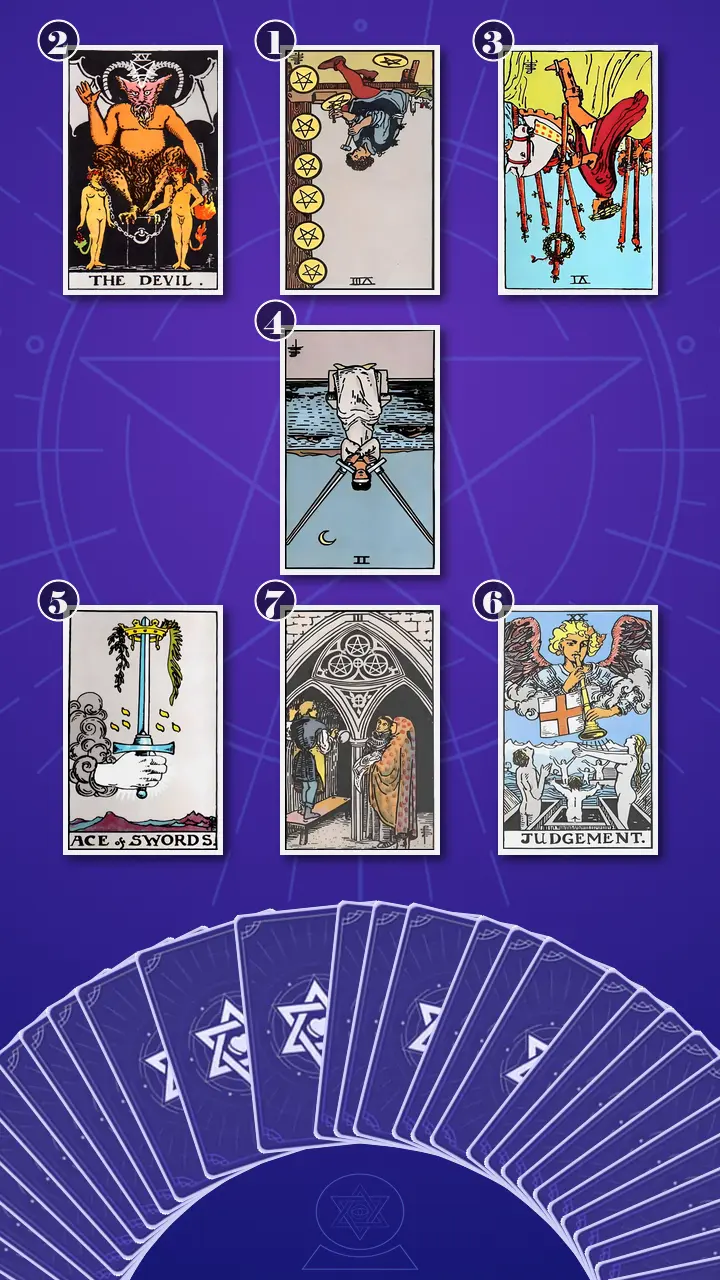
For this reading, I chose the Energy Diagnostic Map (7) · Context Edition. For anyone wondering how tarot works in a study-habit question, I use the cards as an objective reflection and reasoning tool: each position isolates one part of a self-reinforcing feedback loop so that a vague sense of being stuck can meet observable behaviour.
A broader Celtic Cross could have shown a general present state, obstacle, root, and advice, but its ten-card structure would have spread this particular problem too thin. This seven-card diagnostic spread keeps the relationship visible: surface behaviour, inner attachment, external pressure, the core blockage, an available resource, the pivotal transformation, and the next practical integration.
The first card would show the observable streak-chasing ritual and its stagnant emotional payoff. The central card would identify the precise moment Jordan avoids closed-book recall. The final cards would offer a clear testing tool, show how honest assessment can interrupt the loop, and translate that insight into repeatable skill-building.
The Workshop, the Scoreboard, and the Closed Tab
Position 1: The Workshop That Only Counts Attendance
Now I turn the card for the surface energy: the observable streak-chasing behaviour, the repeated study action, and the stagnant emotional payoff identified in the presenting problem.
The card is the Eight of Pentacles, in reversed position. In the Rider-Waite-Smith image, a craftsperson works carefully while finished pentacles line the wall. Reversed, that craftsmanship has become mechanical repetition without a reliable inspection of the result.
This appears in Jordan's life as finishing the shortest lesson after her customer-service shift, watching the progress ring fill, and highlighting another page before attempting recall. Like a craftsperson repeating a motion without checking the workmanship, she has plenty of visible effort but little feedback about whether familiarity is becoming usable skill.
The energy here is excessive repetition with deficient feedback. When the session feels uncertain, Jordan adds volume: another module, a longer timer, another highlighted chapter. That overcorrection makes retrieval even less likely because the ritual leaves no room for the uncomfortable but informative question, What can I explain with the notes closed?
This is where I use my signature lens, Cognitive Tempo Calibration. After work and lectures, Jordan's natural neurological rhythm is already carrying the friction of customer conversations, commuting, and decisions. A low-friction app lesson matches that depleted tempo; an open-ended recall task demands a sharper, more exposed rhythm. The mismatch does not excuse the pattern, but it explains why the easiest task keeps winning. The solution is not automatically a longer session. It is a better match between the task, the available energy, and the evidence she needs.
Jordan did not nod. She gave a short, bitter laugh and rubbed the edge of her phone. “That is almost too accurate. I finish the timer and still feel like I have not actually made anything.”
“That reaction is useful information,” I said. “We do not need to shame the part of you that found a finishable way to keep going. We only need to stop asking a completion ring to answer a recall question.”
Position 2: The Chains That Feel Like Motivation
Now I turn the card for the inner pull: the relief-seeking attachment to app rewards that maintains the illusion of competence beneath the visible behaviour.
The card is The Devil, in upright position. The loose chains around the two figures matter here. Jordan can technically stop the app loop, but the badge, reminder, and completed lesson make the chain feel voluntary, even while the reward keeps pulling her back to the same low-feedback task.
The Devil is not a prediction of failure, and it is not a moral label. It shows an attachment structure. When a practice question makes Jordan's forehead tighten, she opens the app, finishes a ten-minute module, and receives an immediate signal that she is back on track. The metric becomes the authority in the room before she has checked whether the knowledge can travel outside the app.
The energy is an excess of immediate relief and a blockage of deliberate choice. A badge briefly settles the fear of drawing a blank, so rereading and highlighting begin to feel like proof of ability. Then weak recall returns, and the mind concludes that it needs an even longer streak. I asked Jordan, “What does the badge let you postpone for another ten minutes?”
Her thumb moved toward the imaginary app icon, then stopped. She looked down at the cards instead. I could see that she was beginning to separate the behaviour from the person using it.
Position 3: The Victory Lap with an Invisible Audience
Now I turn the card for the external pressure: the comparison, badges, dashboards, and perceived study habits of peers shaping Jordan's standard for success.
The card is the Six of Wands, in reversed position. Upright, this card carries public recognition and the confidence of being seen to succeed. Reversed, the recognition becomes unstable. It looks like a victory display that cannot settle the private question underneath it.
I saw the card in the Instagram Story Jordan had described: a classmate's polished exam calendar, colour-coded blocks, and seven-day study badge. Jordan refreshed her own dashboard and added another study block, even though she was already tired. The public-looking win gave her a quick lift, but it could not answer what she could explain without notes.
The energy here is excessive social scanning and insufficient private evidence. StudyTok desk videos, group chats, leaderboard positions, and progress bars make attendance easy to display. They do not show the blank answer behind the carefully framed laptop. I told Jordan that comparison was not a character flaw; it was an external volume knob that had become too loud for the learning process.
She tucked one strand of hair behind her ear and turned her phone farther away. “I think I am trying to look on track before I actually know whether I am,” she said.
Position 4: The Blindfold with Three Tabs Open
Now I turn the card for the core blockage: the exact moment Jordan avoids closed-book recall and the suspended assessment that keeps fulfilment stasis in place.
The card is the Two of Swords, in reversed position. The blindfold and crossed swords show a mind holding a stalemate in place by refusing a clear assessment. Reversed, the stillness has become restless movement: lecture slides, a highlighted PDF, and a YouTube tutorial all remain open for the same topic, but none requires Jordan to produce an explanation herself.
This is the scene I asked her to remember: after work, her laptop fan humming while a highlighter cap taps against the desk, her fingers switching between resources whenever a question feels difficult. Her inner sentence is convincing because it sounds responsible: “I am not avoiding the question; I am getting ready to answer it.” But getting ready becomes indefinite when certainty is required before testing.
The energy is blocked discernment. Familiar words surround her, but the blank page remains untouched. Her hands become restless, her forehead tightens, and her attention flickers toward the next explanation before the current one has been examined. I asked, “What if the test is not asking you to prove that you know the whole topic? What if it is only offering one usable gap?”
Her index finger stopped above a tab. First, her breath paused and her hand froze. Then her eyes went slightly unfocused, as if replaying the last quiz and the instant she had reached for another tutorial. Finally, she let out a low breath and said, “I do this exact thing when I am afraid the answer will not be there.” The shame had become an observable sequence, not an identity.
The Sword That Made One Question Enough
Position 5: A Clear Instrument, Already in Reach
Now I turn the card for the available resource: the clearest mental tool Jordan can use to distinguish familiarity from retrievable understanding.
The card is the Ace of Swords, in upright position. The hand emerging from the cloud offers one direct instrument. It does not promise that the mountains ahead will disappear; it offers a clean way to see the next section of the path.
In modern life, this is Jordan closing the laptop tabs, writing one exam-style question in a blank Google Doc or phone note, and answering it from memory for two minutes. The result might expose a gap, but that gap would be precise enough to guide the next ten minutes. The energy is balanced clarity: a small amount of honest evidence, applied without turning the result into a verdict on her intelligence.
I wrote the sentence where she could see it: “I do not need to know everything right now; I need one clean piece of information about what I can retrieve.” Then I gave the distinction its simplest name: Familiar is not the same as retrievable.
Jordan closed one imagined browser tab with her hand. Her shoulders did not collapse into certainty; they lowered by a fraction, which was more honest and more useful. I watched a little mental noise leave the room. One precise question had begun to look less like an exam and more like a compass.
When Judgement's Trumpet Cut Through the Streak
Position 6: The Call That Was Not a Verdict
The room grew quiet as I turned the card for the key transformation: the recognition that can interrupt the gamified learning trap and loosen the illusion of competence without turning a recall gap into a judgment of self-worth.
The card is Judgement, in upright position. In the Rider-Waite-Smith image, an angel's trumpet calls figures out of grey coffins. For Jordan, the trumpet is not an ominous warning. It is the recall result that cannot be replaced by another badge, inviting passive material to become available for conscious review.
I brought her back to the Sunday evening scene: one more chapter open, a blank practice page beside it, and the old bargain forming in her mind. Review until certainty arrives, then test yourself. The problem was that certainty never arrived, so the streak kept standing in for evidence.
My Focus Disruption Auditing gave me a precise way to name the pattern. I listened for the dissonant chords shattering Jordan's deep-work flow: the badge's instant reward, the comparison ping from someone else's polished routine, and the fear attached to a blank. I did not ask her to silence every sound. I asked which sound had been allowed to set the tempo.
A streak can prove that you showed up. Only retrieval can show what actually came with you. A blank answer is feedback about the method, not a verdict on your ability to learn.
Do not let an unbroken streak certify your ability; answer Judgement's trumpet by testing what you can retrieve and letting the result shape the next piece of practice.
For a second, Jordan froze. Her inhale stopped halfway, and her fingers hovered over the phone as if they could still manufacture another easy win. Then her gaze slipped past me; I could see her replaying the badge, the unopened quiz, and the promise of one more chapter. Her jaw tightened when the old interpretation surfaced: a blank means something is wrong with me. The room offered a different rhythm. Her shoulders dropped, her fist slowly opened, and her eyes grew wet without spilling over. When she finally spoke, her voice was low and slightly unsteady. “So the answer can tell me what to practise next, instead of telling me what I am?” A streetcar bell sounded faintly beyond the window, bright and singular in the quiet. She breathed out a small, disbelieving “Ah,” followed by a moment of lightheaded blankness. The path was clearer, and that meant she would now have to choose what to do with it.
I asked her, “Now, use this new perspective to remember whether there was a moment last week when this insight might have made things feel different.” She returned to the Sunday desk, but this time she imagined writing down the missing concept instead of opening another tutorial.
This was the first visible crossing in the emotional transformation from metric-driven frustration and fear of blanking to evidence-based self-trust and grounded confidence. Nothing had been permanently solved. Jordan had simply stopped treating unfinished understanding as a character verdict long enough to receive information from it.
The Workbench Beneath the Scoreboard
Position 7: Building Something She Can Use
Now I turn the card for the next-step integration: the practical way to embody the transformation through retrieval, feedback, and tangible skill-building.
The card is the Three of Pentacles, in upright position. The craftsman, architectural plans, and observing figures show work that can be inspected, compared with a clear standard, and improved. This is not public approval. It is constructive feedback attached to one real piece of work.
The modern scene is simple: Jordan writes three points from memory, checks them against her notes or a study partner's explanation, and turns only the two missed points into the next short practice block. The energy has returned to Earth, but it is no longer mechanical. It is deliberate, visible, and capable of revision.
I offered her my Syncopated Study Session, a rhythm protocol for overwhelming academic tasks. The first micro-beat is retrieval, the second is comparison, and the third is revision: two minutes to produce what is there, three minutes to mark two gaps, and five minutes to rebuild one of them. The point is not to force her brain into someone else's Pomodoro fantasy. It is to make the honest task frictionless enough to begin.
Jordan ran her fingertips over the edge of the blank page. “I am not collecting completed sessions,” she said slowly. “I am building something I can actually use.” I nodded, because that sentence belonged to her.
From Progress Bar to Workbench: Finding Clarity in the Next Ten Minutes
The Story the Cards Made Visible
I could now thread the reading into one coherent story. The reversed Eight of Pentacles showed effort repeating without inspection. The Devil explained why the app reward felt safer than a recall test, and the reversed Six of Wands added the pressure of classmates, badges, and imagined observers. All three pressures narrowed into the reversed Two of Swords, where switching tabs protected familiarity from evidence.
The Ace of Swords supplied the clean question. Judgement changed the meaning of the answer. The Three of Pentacles showed how to repeat that change through specific work and useful feedback. Jordan's problem was not a lack of commitment. It was a feedback loop that kept rewarding attendance before asking whether learning had become retrievable.
The cognitive blind spot was subtle: she had been treating proof that she began as proof that the method worked, then treating weak recall as proof that she needed more of the same. The key shift was clear now. Keep the streak as the cue to begin; let closed-book retrieval, feedback, and targeted revision become the evidence of progress.
I gave her three small pieces of actionable advice. None required deleting the app, abandoning every familiar study tool, or promising herself a flawless new identity. Each was designed as a low-pressure experiment that could tell her what to do next.
- Use the streak as a starting cueOn one evening this week, after a customer-service shift or class, let the app reminder open the session, close every note and tab, set a two- to five-minute timer, and write three points from one lecture in a private Google Doc or notebook.At low energy, use the two-minute version and stop after recording the result; the aim is private recall evidence, not a perfect score.
- Lower the volume of comparisonFor seven days, mute the leaderboard and social study notifications while keeping the basic calendar reminder if it genuinely helps you begin. After one session, replace one dashboard check with a note titled What I Could Retrieve and list one correct point and one gap.Hide only the comparison feature that creates pressure. A private result can remain private, and accountability is optional rather than a performance.
- Run the Syncopated Study SessionChoose one missed concept from a recent quiz at your desk. Spend two minutes writing what you remember, three minutes comparing it with the source or a study partner's specific feedback, and five minutes revising only the two missing details.If ten minutes feels too exposing, answer one familiar prompt or record a thirty-second private voice memo. Retrieve, compare, revise, then decide whether to continue.
I reminded Jordan that a blank answer might still sting. The goal was not to call every difficult result a hidden win. The goal was to let one result be accurately sized: information about the next practice block, not a global review of the learner.

A Week Later, the Quiet Proof
Four days later, I received a message from Jordan after her shift: “I kept the streak, but I used it to start a two-minute recall check. I got one point wrong, and instead of opening another video, I wrote the missing idea beside the date. It was more useful than the badge.”
She had not transformed her entire course load or suddenly become fearless. She had made one private record that contained evidence of what was available, rather than only evidence of attendance. The next evening, she used the same record to choose a single question instead of opening three resources at once.
The change was clear but fragile: she slept a full night, woke with the familiar thought, What if I am wrong, and reached toward the dashboard. This time she wrote one question on a sticky note first, then carried the uncertainty with her to breakfast.
I saw the first proof of grounded confidence there: not certainty, but a greater willingness to stay present while the evidence arrived. The cards had not decided whether Jordan would ace an exam. They had helped me hold up a precise mirror, and Jordan had chosen what to do with what she saw. She remained the author of the method, the pace, and the next piece of her learning.
That is what this Journey to Clarity offered: a quieter relationship with effort, where the streak can invite the beginning and retrieval can show what came with her. When a blank page makes your forehead tighten and your hands reach for another tutorial, it can feel safer to keep performing progress than to risk discovering that the streak has been carrying your self-worth instead of your learning.
If you let one small recall result be information rather than a verdict, what would you be quietly curious to notice in your next study session: the first point that arrives, or the one gap that tells you where to place your next ten minutes?