She Protected a 143-Day Streak, Then Put Her Learning to Work

The 10:47 p.m. Study Streak That Still Felt Lost
I met Maya, a 24-year-old operations assistant in Toronto, over video at 10:47 on a weeknight. She was the after-work learner who could keep a 143-day study streak alive while everyone else seemed to be announcing a new qualification, portfolio, or career move. She tilted her phone toward the camera just as the warning appeared above her pillow: “Streak expires in 1h 13m.” I heard the reminder chime cut through the dry hiss of her radiator. Blue light sharpened the tired skin beneath her eyes, and the warm phone kept shifting between her restless hands.
I watched Maya open the shortest familiar review. She answered five questions, waited for the completion animation, and let the counter advance. When the app offered an original-response prompt, her thumb closed it almost automatically. She had completed the lesson, protected the number, and still could not tell me what had changed in her understanding.
“I am consistent, so why do I still feel like I am going nowhere?” she asked. “Breaking the streak would make all that effort feel fake. But I keep finishing lessons, and I cannot say what I am building.”
What sat in Maya's body was not a vague cloud of uncertainty. It felt, as she described it, like stepping off a treadmill after running hard and discovering that the room had not moved with her: her legs carried the evidence of effort, but there was still no destination outside the window. The animation gave her a quick lift. Then her shoulders sank, her chest became heavy, and her hand reached back toward the dashboard as if another number might tell her where she was.
She also told me about an 8:12 a.m. Line 1 commute. A former classmate's polished LinkedIn portfolio post had appeared between Bloor-Yonge and St George. As wet coats crowded the carriage and the wheels shrieked around a bend, Maya had opened her own course dashboard and checked her streak, badges, and completion percentage. The numbers looked reassuring. Her jaw still tightened.
I said, “You can be consistent and still need a direction. I am not going to tell you that the streak is fake, and I am not going to turn one uncomfortable question into a prediction about your future. Let us use the cards to map what the routine is measuring, what it is protecting, and what kind of evidence might help you steer it.”
I have spent enough time among broken walls and incomplete records to know that a fracture is not a permanent fate. A confusing layer can hide an intact foundation. My role was not to choose Maya's destination. It was to sit with her in the uncertainty long enough for her own enduring values to become visible.
Choosing the Compass: The Transformation Path Grid
I asked Maya to place both feet on the floor, silence the app for the length of the reading, and take one unforced breath. I shuffled slowly while she held one question in mind: “What is my study streak helping me do, and what is it helping me avoid?” I treat this pause as a change of attention, not as a performance of mystery.
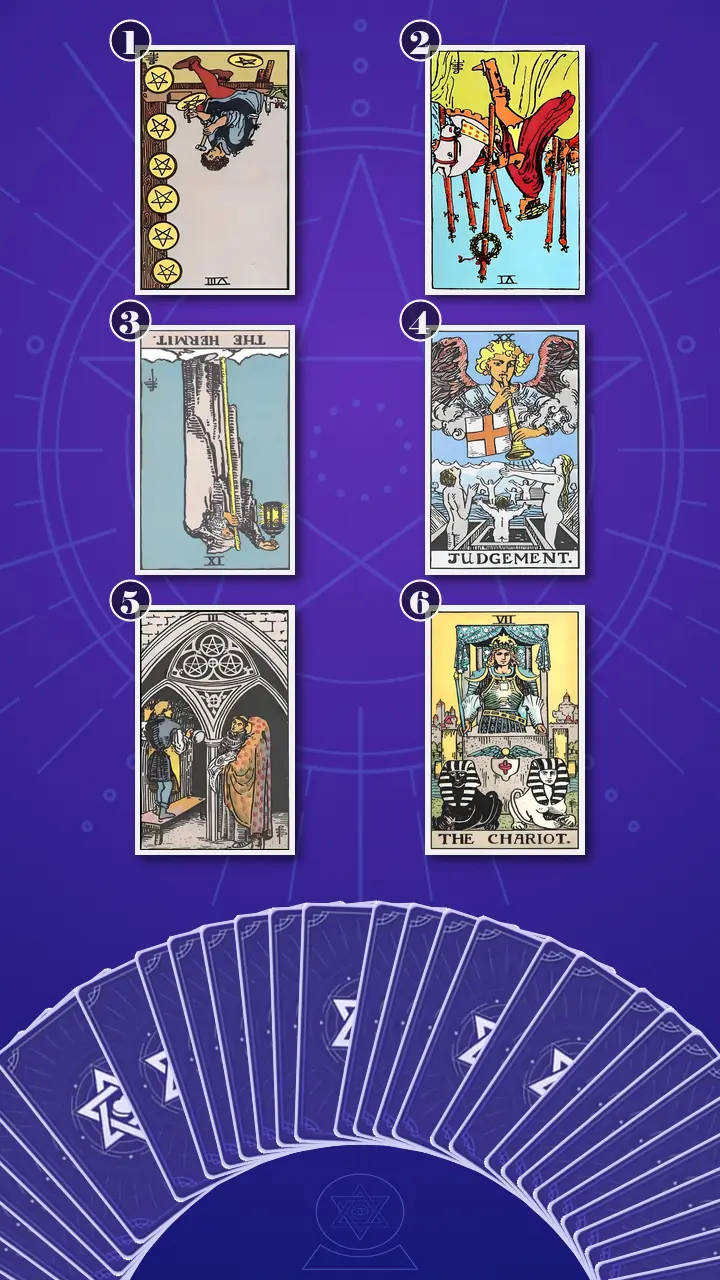
I chose the six-card Transformation Path Grid, Context Edition. The way this tarot spread works is practical: it follows a pattern from symptom to blockage, root, transformation, action, and integration. Maya's problem was not simply about the past, present, and future, nor was it a single yes-or-no decision. It was a feedback loop. A reminder prompted an easy lesson; the lesson produced a badge; the badge brought relief; the relief postponed an independent test; the next reminder then became even more important.
I could have used a Celtic Cross, but ten positions would have produced more material than this focused loop required. A timeline spread would also have implied that time itself was the organizing issue. The six-card grid was the smallest map that could keep the reward system, the avoided question of purpose, the competence test, and the practical next steps distinct. That distinction matters when reading card meanings in context.
I placed two cards across the upper row for the visible symptom and its immediate blockage. The middle row would expose the deeper root and the transformation hinge. The lower row would translate the insight into a reviewable action and show the integrated form of learning that might become available through practice. The arrangement resembled stepping stones, alternating between what Maya needed to notice and how she could respond.
I reminded her that the spread would not certify a career path or pronounce a verdict on her intelligence. Tarot could give us an objective structure for examining the pattern. Maya would decide what counted as useful evidence and what she wanted her learning to serve.
Reading the Closed Reward Loop
Position 1: Eight of Pentacles Reversed and the Row of Completed Lessons
I turned the card in the position representing the observable symptom: completing repetitive lessons and preserving the streak without independently applying the material. It was the Eight of Pentacles, reversed.
I pointed to the craftsman's lowered gaze and the row of nearly identical pentacles. Upright, this card often depicts focused practice becoming craftsmanship. Reversed here, its Earth energy was abundant in quantity but blocked in function. Maya did not have a shortage of effort. She had an excess of countable repetition and a deficiency of contact with the practical world represented by the distant town behind the workbench.
I brought the image back to 10:47 p.m. Maya had completed the easiest familiar review, watched another unit appear as finished, and closed the app before it asked for an original explanation. The dashboard filled, but independent use remained untested. It was the same shape as a task board where tickets kept moving to Done even though none could be traced to the outcome the project was meant to deliver.
“The question in this position is very specific,” I said. “The last time you protected the streak, which exercise did you choose, which harder prompt did you skip, and what could you still explain once the app was closed?”
Maya gave a short laugh, but no warmth reached it. She pressed her thumbnail into the side of her phone and said, “That is so accurate it feels a little cruel. I did the work, so why can I not use it?”
I answered, “The card is not calling your effort worthless. It is showing us that the feedback available to you is too narrow. Repetition becomes craftsmanship when it meets recall, context, and revision. Your consistency is a resource. We are looking for a more honest job for it.”
Position 2: Six of Wands Reversed Beneath the LinkedIn Applause
I turned the card representing the immediate blockage: the gamified reward system making external recognition feel like sufficient evidence of progress. It was the Six of Wands, reversed.
The two visible wreaths and the surrounding crowd translated almost too cleanly into badges, streak celebrations, leaderboards, certificates, and reactions beneath an “excited to announce” LinkedIn post. The reversal showed Fire caught in a reward loop. The desire to feel momentum was real, but its energy had become dependent on being externally confirmed. Each celebration produced a brief spark, followed by the need to check again.
I returned to the Line 1 scene. Maya had seen someone else's reviewable work, felt her stomach drop, and responded by checking numbers that could reassure her without answering what she could do. Her learning algorithm had become optimized for returning to the platform, not for transferring knowledge beyond it. The app said she was winning, which made the private question more uncomfortable: why did she need the app to say it again?
“A streak records attendance; it cannot certify understanding,” I said. “That does not make attendance meaningless. It means the streak is answering a smaller question than the one you are asking.”
Her fingers stopped moving. Her eyes remained on the wreath in the card while her grip on the phone loosened. “I check the badge before I check whether I remember anything,” she said. “I think I am looking for reassurance before evidence.”
I nodded. “That is a useful observation, not a confession. The blockage is not that you enjoy recognition. It is that recognition has been getting the final word before understanding gets a chance to speak.”
Position 3: The Hermit Reversed at the Blank Google Doc
I turned the card representing the deeper root: disconnection from personal guidance and the use of structured study to postpone asking what matters. It was The Hermit, reversed.
Maya had already described the card's modern scene without knowing it. At 6:35 p.m. in the Toronto Reference Library, she had opened a document titled “What is this learning for?” The air-conditioning hummed above the keyboard clicks, and the laminate edge pressed cold against her wrists. She watched the cursor blink, opened the course catalogue, and saved three recommended modules instead of writing one imperfect sentence.
The Hermit's lantern does not illuminate an entire mountain. It gives enough light for a limited next step. Reversed, that modest inner signal was being covered by a brighter supplied route. Maya was doing the learning equivalent of opening another precise Google Maps route before deciding where she wanted to go. The directions were excellent. Precision still could not provide the destination.
This was where I used what I call Research Bottleneck Analysis. On an archaeological dig, a stalled interpretation does not automatically mean that the researcher is inadequate or that the site contains nothing. It often means the current question is too broad, the available evidence has been sorted under the wrong categories, or a deeper layer needs careful excavation. I applied the same lens to Maya's blank page. Her block was not proof that she lacked purpose. It was a signal that she had been demanding a permanent career identity before allowing herself a provisional experiment.
“You do not need a forever plan to choose a thirty-day purpose,” I told her. “The lantern only needs to show what you want to test next. What happens in the first five minutes after a blank page asks what your learning is for?”
Maya inhaled, held the breath near the top of her chest, and then released it slowly. “I search for another syllabus,” she said. “The app always knows my next step better than I do.”
“It knows a next step,” I replied. “It cannot know which problem you find worth solving. That authority remains with you.”
When Judgement's Trumpet Answered the Notification
Position 4: Judgement Upright and the Honest Baseline
The radiator behind Maya clicked off as I reached for the card at the visual hinge of the grid. For a moment, the room on her side of the screen became unusually quiet. I turned the position representing the key transformation from app-defined proof to honest self-evaluation, purpose, and testable understanding. The card was Judgement, upright.
I centered the angel's trumpet. Its call mirrored the app's reminder sound, but the authority had changed. Maya was no longer being summoned to preserve a counter. She was being invited to pause the automatic next lesson, close the app, review what she could retrieve, and choose one small thirty-day outcome before selecting more content. Judgement brought balanced, available energy: discernment without self-punishment, accountability without shame, and permission to make a conscious but revisable choice.
At that point, Maya still had the warm phone in her hand. The streak had advanced and the original-response prompt was closed. Relief had arrived on cue, but the heavy question had returned: what could she now do without the app?
I thought of a trench section from one of my early digs, where the newest layer initially looked like the whole story because it was the easiest to see. I used my Academic Stratigraphy framework to separate Maya's evidence into layers. At the surface sat the streak and completion total. Beneath it sat memory without hints. Beneath that sat application in a new context. At the load-bearing level sat purpose: the reason any of the other layers mattered. The surface record was real, but it could not speak for the whole site.
An unbroken streak is not proof that you are moving forward; answer Judgement's trumpet by testing what you know and naming the direction your learning is meant to serve.
I let the sentence remain between us. Then I added, “Consistency proves that you returned; competence becomes visible when you can retrieve, apply, and revise toward a purpose you chose.”
For one beat, Maya's breath stopped. Her thumb stayed suspended above the darkened screen, and her pupils widened before her gaze drifted past me, as if she were replaying months of completion animations in silence. Her shoulders rose toward her ears. Then her mouth tightened and the recognition came out as anger rather than relief. “But doesn't that mean I did all of this wrong?” she asked, her voice suddenly sharper. I kept my tone level. “No. It means the upper layer cannot answer every question about the site. Your effort happened. Some knowledge is there. We are changing how you examine it.” Her jaw released first. Her fist opened next, one finger at a time. Finally, a quiet “Oh” left her on a trembling exhale. Her shoulders lowered, but she looked briefly unsteady, almost lightheaded with the responsibility of having a choice where an algorithm had previously supplied one.
I said, “Now, using this new perspective, think back to last week. Was there a moment when this insight might have made you feel different?”
Maya recalled a rainy Sunday at a Queen West café. A friend had asked what she hoped to make with the material she was studying. Milk had hissed behind the counter, rain had distorted the streetlights, and Maya had gripped a hot ceramic cup while answering with the length of her streak. “I could have said I did not know yet,” she told me. “Then I could have named one thing I wanted to try instead of using 143 days as my whole answer.”
“Exactly,” I said. “A gap found with the app closed is information, not an indictment. Take ten minutes after your next lesson. Close every course tab, set a timer, and write three things you remember, one thing you could use, and one thing you need to check. Do not score the page or share it unless you choose to. If the discomfort becomes too sharp, stop, shorten it to two minutes, or record a private voice note instead.”
I could see the change taking shape, but I did not mistake it for instant certainty. This was the first crossing from brief metric-based satisfaction and private disorientation toward grounded confidence in self-directed, evidence-based learning. Maya did not suddenly know her life's direction. She had begun to trust that honest evidence could guide a provisional one.
A Draft Enters the Real World
Position 5: Three of Pentacles and the Reviewable Draft
I turned the card representing the practical action that would give the transformation concrete form: producing one small piece of work and inviting specific feedback. It was the Three of Pentacles, upright.
I pointed to the artisan on the workbench, the two figures consulting a plan, and the pentacles embedded in the architecture. Earth energy had returned in balance. The Eight of Pentacles reversed had shown repeated private units; the Three of Pentacles showed skill entering a usable structure where standards could be seen and the work could be improved.
For Maya, the scene became deliberately small. She could turn one course concept into a one-page workflow analysis, label it Draft 0.1, and send it to one trusted colleague with a single question: “Which part is clear, and where did you need more explanation?” Competence would become a bounded artefact exposed to specific feedback, not a feeling supplied by a progress bar.
“I do not want this to become another portfolio performance,” I said. “No public post is required. No polished personal brand is required. The aim is to let one idea meet one real reader.”
Maya leaned closer to the card. She named an operations handoff at work that often produced duplicated data entry and said she could map the current workflow using a sample dataset with no confidential information. Her voice became quicker, then caught. “I could make that. But what if my colleague points out something obvious that I missed?”
“Then the feedback will have done what a badge cannot,” I replied. “It will have identified the next useful lesson. Feedback is route information, not a public ranking of your worth.”
Position 6: The Chariot and the Route Maya Could Revise
I turned the final card in the position representing the integrated mode of learning available when discipline follows a chosen direction instead of replacing one. It was The Chariot, upright.
The black and white sphinxes gave form to Maya's competing pulls. One voice said, “Protect the streak.” The other said, “Build something real.” The charioteer did not destroy either force. His steady stance coordinated them around a chosen course. The card's energy was balanced self-command, not harsher discipline and not reckless acceleration.
I translated the image through Maya's Toronto commute. Her daily study window could remain the vehicle. A self-chosen thirty-day project would become the destination. Closed-app recall and specific feedback would provide route information. When the evidence changed, she could revise the route without pretending that every earlier mile was wasted.
“Keep the routine if it helps; change what gets to define success,” I said. “A supplied route can start a journey, but it cannot steer forever on your behalf. You do not need a forever plan to choose a thirty-day purpose.”
Maya looked from The Chariot back to the dark phone in her palm. She did not delete the app or promise never to care about a streak again. Instead, she moved its widget off her home screen and scheduled a twenty-minute block for Saturday afternoon titled “Thirty-Day Direction.” The action was almost ordinary, which was exactly why I trusted it.
Changing What Gets to Define Success
I read the full spread back to Maya as one connected story. A short daily routine had originally solved a real problem: after a full workday, app-guided lessons were accessible, convenient, and easy to begin. Over time, the Eight of Pentacles reversed showed that useful structure narrowing into repeated completion. The Six of Wands reversed explained why the loop remained compelling: each visible reward supplied quick reassurance. The Hermit reversed exposed the deeper avoidance beneath it, where another syllabus covered the harder question of personal direction. Judgement restored honest evaluation. The Three of Pentacles turned learning into reviewable work. The Chariot placed Maya's genuine discipline behind a course she could choose and revise.
The spread's central metaphor was no longer that Maya had been standing still. She had been running on a treadmill and using the distance display as proof of travel. The display measured real exertion. It simply could not tell her where the building was, which door she wanted, or whether the running prepared her to enter it.
I named the cognitive blind spot plainly: Maya had allowed attendance to stand in for competence and an app-supplied sequence to stand in for a destination. The transformation was not from discipline to rebellion, or from online learning to rejecting every platform. It was a shift from preserving an unbroken streak to defining one provisional purpose and measuring progress through recall, application, and feedback.
To make that shift workable, I adapted my Thesis Stratigraphy Framework. I normally use it to rebuild an argument so its central claim can pierce through intellectual clutter. For Maya, the “thesis” became her thirty-day purpose. Recall provided the first evidence layer. A Draft 0.1 tested whether the idea held together outside the course. Feedback showed which layer needed strengthening next. I gave her two bounded experiments rather than a total lifestyle overhaul.
- The Ten-Minute Closed-App Evidence Check.After one normal lesson at home this week, Maya will close the app before viewing the badge screen, set a ten-minute timer, and write what she remembers in a blank Notes or Google Docs page. She will finish with two lines: “I can explain...” and “I still need to check...” The evidence page, not the animation, will become the session record.If ten minutes feels exposing after work, she can use three minutes, list three remembered points, or record a one-minute private voice note. An incomplete page still counts because the gaps are usable information.
- The Thirty-Day Lantern and Draft 0.1.During a twenty-minute app-free window at the library or a café this weekend, Maya will complete the sentence, “For the next thirty days, I am studying this so I can...” She will choose one small outcome, cap the first draft at forty-five minutes, and send it to one trusted colleague with the question, “Which part is clear, and where did you need more explanation?” She will record the response under three headings: Worked, Unclear, and Next Lesson.The purpose lasts thirty days and does not define her identity or career. She can use a sample dataset, keep the draft private, and change direction after receiving evidence. The minimum version is one paragraph or one screenshot sent to one safe person.
I told Maya that neither experiment was an exam on whether the previous 143 days had counted. They were instruments for choosing what happened on day 144. Tarot had helped us expose the measurement system and arrange the evidence. It could not perform the recall, select the purpose, or send the draft. Those choices belonged to her.

A Week Later: A Draft Instead of a Badge
Six days later, I opened a message from Maya. She had completed the closed-app check and remembered less terminology than she expected, but she had correctly described the central process in her own words. Beneath it she had written, “I still need to check how the handoff fails when two teams edit the same field.” Instead of opening another broad certificate, she had used that gap to choose one targeted lesson.
Her second attachment was a one-page workflow analysis labelled Draft 0.1. A trusted colleague had marked one section clear and asked for an example in another. Maya told me she had felt heat rise into her face before opening the comment. Then she had added the example.
She had not solved her career in a week. That night she slept through without answering a streak reminder, but her first thought in the morning was still, “What if I picked the wrong project?” She said she smiled, opened her thirty-day note, and kept the question provisional.
I saw the quiet proof of our Journey to Clarity there. The important change was not a perfect recall score, a dramatic career pivot, or a message from the cards guaranteeing success. It was Maya's movement from badge-based reassurance toward honest curiosity. Her routine had become a tool she could steer, and the gaps in her knowledge had become directions for excavation rather than evidence against her.
The six-card Transformation Path Grid did not hand Maya a destination. It helped her distinguish the bright surface layer from the deeper structure and return authorship to the person holding the phone. She kept what was useful, revised what was misleading, and made one small piece of evidence that could answer back.
If the streak animation fades while the warm phone is still in your hand, and that familiar weight drops through your chest, I hope you remember this: wanting your consistent days to mean something does not make you foolish, and discovering a gap does not erase the effort beneath it. Noticing that tension already gives you more choice than the dashboard can display.
If your consistency could serve one provisional purpose for the next thirty days, what small piece of evidence would you place under the Hermit's lantern first: three recalled points, a one-page Draft 0.1, or something only you can name?