No Live Class: Lecture Four Stayed at 00:00 Until One Block Felt Real

The Open Morning That Never Found Its Starting Gun
If you are a university student in an asynchronous or hybrid program who can make every live seminar but keeps moving your own study blocks, you may know the specific frustration of unstructured-study procrastination.
At 10:07 on a Tuesday morning, Maya (name changed for privacy), a 22-year-old undergraduate in Toronto, joined our video consultation from the kitchen table of her shared apartment. I could hear the refrigerator humming behind her. A mug of yesterday's coffee sat beside a laptop that felt warm under her wrists, and a recorded lecture waited on-screen at 00:00 while her thumb moved between the course portal, a colour-coded task list, and a video about the “perfect study system.”
“I know what to study,” she told me. “I just can't make myself start when the day is open. A deadline gives me a starting gun, and my own calendar doesn't.”
I watched her press her palms against the table as she described the usual sequence. She knew what to do, but because no one had said when, she first reorganised the week, then moved the study block, and by evening promised that tomorrow would be different. She wanted the freedom to direct her own learning, yet her own schedule never felt as real as somebody else's.
Her frustration seemed to travel through her body like a bass note played too low for the room: not dramatic enough to interrupt the day, but strong enough to make her limbs feel heavy and every small movement vibrate with self-doubt. The phone, the planning tabs, and the paused lecture were not signs that she did not care. They were the visible parts of a rhythm that kept losing its first beat.
“I'm not going to use tarot to judge your discipline or predict your grades,” I said. “I want us to see what happens between opening the course portal and pressing play. Let's draw a map of that gap, then find one place where your own choice can carry more weight.”

Choosing a Map for the Unscheduled Day
I invited Maya to place both feet on the floor and take one ordinary breath while holding a single question in mind: “Why do I keep stalling when no one sets my study schedule?” I shuffled slowly, using the movement as a transition from self-criticism into observation rather than as a performance of mystery.
I chose the Transformation Path Grid · Context Edition, a six-card, 2-by-3 tarot spread for deadline-dependent study procrastination. This is how tarot works in my practice: the cards do not announce an unavoidable outcome. They provide an external structure for examining patterns that are difficult to see while living inside them.
For anyone reading along, this spread fits because Maya's problem is a feedback loop, not a single bad habit. An absent external schedule leads to prolonged negotiation; postponement provides brief relief; unfinished work creates urgency; urgency produces a compressed deadline sprint; and that sprint appears to prove that outside pressure is the only thing that works. A simpler problem-and-solution spread would miss either the mechanism or the process of building a sustainable replacement.
I arranged three cards across the upper row and three directly beneath them. The first would show the observable form of the stagnation lock. The second would identify the immediate mechanism keeping every start negotiable. The third would reveal why self-created structure lacked the authority of an instructor's timetable. Beneath them, the fourth card would locate the catalyst, the fifth would turn it into a practical experiment, and the sixth would show how to preserve continuity when real life disrupted the plan.
“Think of it as a study-desk blueprint,” I told her. “The upper row shows what is malfunctioning. The lower row pairs each problem with a capacity you can test. Nothing here is a verdict about who you are.”
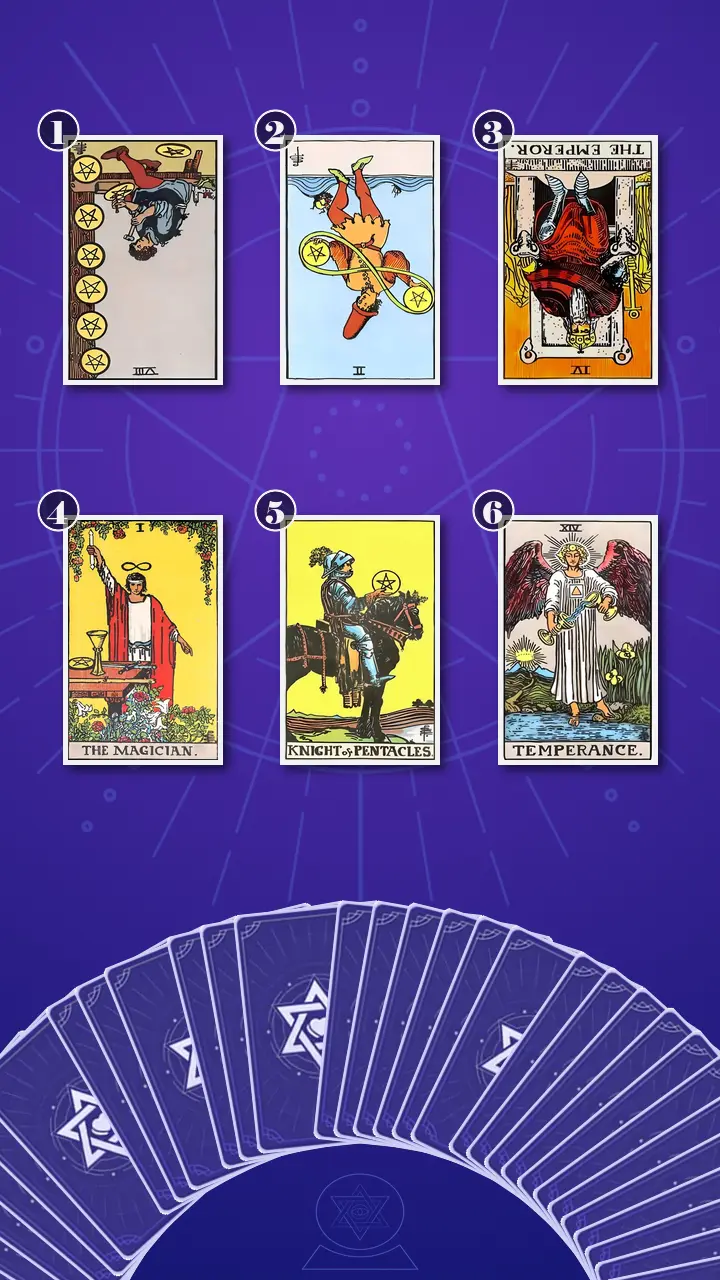
The Upper Row of Productive-Looking Delay
Position One: The Bench Where Nothing Reaches Done
I turned the card representing the observable form of Maya's stagnation lock: replacing a defined study task with preparation, reorganisation, and incomplete practice. It was the Eight of Pentacles, reversed.
On the upright card, a craftsperson sits at a dedicated bench beside a visible sequence of completed pentacles. Reversed, I read that rhythm as interrupted. The workbench was easy to recognise in Maya's life: a kitchen table covered with a laptop, highlighters, a Notion dashboard, a carefully chosen lo-fi playlist, and a recorded lecture still paused at 00:00.
I described the inner sequence I heard beneath it: “I'm getting organised first. This will make the session easier. Somehow, I still have nothing finished.” Planning can look like progress while keeping the lesson at 00:00.
The reversed energy showed a blockage and misdirection of effort, not an absence of effort. Maya was spending time around the craft, but the next lecture segment, practice set, or page range was not joining the row of completed units. I also warned against the obvious overcorrection. Turning the card upright did not mean forcing an exhausting six-hour catch-up session. It meant defining one finishable unit and letting completion, rather than proximity to the work, become the evidence.
Maya gave one short laugh, but there was no humour in the way it left her chest. Her eyes flicked towards the planning tabs, and her fingers curled around the cool handle of her mug. “That's so accurate it's almost cruel,” she said.
I paused instead of trying to make the card sound nicer. “I can see why it lands sharply. But the card isn't calling you lazy. It is separating useful setup from setup that keeps delaying practice. That distinction gives us something specific to change.”
Position Two: The Calendar Block That Kept Sailing Away
I turned the card representing the immediate mechanism maintaining the procrastination: every priority and possible start time remained negotiable. It was the Two of Pentacles, reversed.
The infinity loop around the pentacles looked like one Google Calendar event dragged from 10:00 a.m. to 2:00 p.m. and then to 7:30 p.m. Behind the figure, ships rose and fell on rough water. I mapped those waves to messages, laundry, food, a roommate entering the kitchen, an easier assignment, and the thought that a cleaner start would be available later.
“Morning isn't ideal. After lunch will be cleaner. Tonight I'll have more focus,” I said, laying out the bargaining rhythm. Each move offered a second of relief, but no time became committed time. The reversed Two contained an excess of adjustment and a deficiency of containment. Flexibility had become endless negotiability.
I used a lens I call Focus Disruption Auditing to separate the dissonant chords. Some were external: notifications, chores, shared-space interruptions. Others were internal: comparing equally urgent tasks, waiting for the right mood, or treating discomfort as evidence that the time was wrong. The loudest disruption was not the phone itself. It was the standing permission to reopen the decision every few minutes.
I asked which self-set block she had moved most recently. Maya's breath caught before she answered. Her gaze went unfocused as if she were watching the event travel across the previous day, and then her jaw tightened. “Lecture Four. I moved it three times yesterday and deleted it after dinner.”
I told her the card was not demanding a minute-by-minute schedule. It was asking for one primary slot and one named backup, so adaptation could happen once without becoming an infinite loop.
Position Three: The Authority Gap in Her Own Calendar
I turned the card representing the deeper root beneath the scheduling problem: self-created structure did not yet carry the authority or credibility of a timetable supplied by someone else. It was The Emperor, reversed.
I placed two calendar events side by side in our conversation. Maya protected an instructor's 11:00 a.m. seminar without requiring herself to feel ready. Yet she could slide her own 1:00 p.m. study appointment into tomorrow because no professor, supervisor, or classmate would notice. The inner contrast was blunt: “Their time counts immediately. My time can always be renegotiated.”
The Emperor's reversed energy showed both deficiency and excess. There was too little fair internal authority on an ordinary day, followed by too much punitive control after a missed one. Maya would draft a six-hour Monday reset with no space for commuting, food, lower energy, work, or interruption. One disruption then toppled the whole structure like an unstable throne.
Her hand became still on the mug. She looked away from the cards and towards the instructor-set events on her screen. “I keep saying I need discipline,” she said quietly, “when what I actually use is urgency.”
“That is the authority gap,” I replied. “It isn't proof that you lack control. Urgency is a cue you have practised, not proof that you cannot direct yourself. Your self-set appointment is not unreal; it is still building credibility.”
I could see the precision of that distinction soften something in her face. The problem was no longer an accusation about character. It was a learned sequence: external pressure supplied a credible cue, while an open day required her to invent the entire timetable and begin the work at the same time.
When The Magician Gave the Morning a Downbeat
Position Four: The Catalyst Already on the Table
As I reached for the first card in the lower row, the refrigerator compressor behind Maya clicked off. The kitchen, loud with its low mechanical hum all morning, became suddenly still. I turned the card representing the key trigger for change: using available tools to convert one intention into one bounded, observable start. It was The Magician, upright.
The Magician stood before a stable table holding the four suit emblems, one hand raised and the other directing energy towards the ground. In Maya's modern study scene, those tools were already present: a calendar cue, a timer, the exact course page, and a notebook. The upright energy was practical agency in balance. It did not ask her to collect another tool. It asked her to direct the tools she already had.
I named the familiar setup: the lecture paused at 00:00, the cleaner task list, the block moved later, and her shoulders sinking as an open morning became an unfinished day. I could see how tightly she had fused self-direction with the demand to design a flawless semester before beginning one segment.
This was where I used Cognitive Tempo Calibration, the diagnostic lens I have developed through a decade of studying rhythm and sound. I explained that deadline pressure gave her attention a loud, unmistakable downbeat. An open morning gave her no equivalent cue, then demanded that she compose the entire arrangement while already trying to play it. The mismatch was severe: too many scheduling decisions before the first meaningful action. The answer was not a harsher metronome. It was one audible first beat.
For a second, I pictured the layered audio timelines from my research, where a track can sound chaotic until one wandering signal is aligned with the pulse. The Magician offered that pulse in physical form: place the tools on the table, narrow the frame, set the timer, and press play.
You are not waiting for discipline to appear; choose one visible action and use The Magician's table of tools to turn intention into practice.
I let the sentence settle before making its edges explicit. You do not need a complete schedule to prove you can direct yourself. Make one block real by giving it three edges: one cue, one task, and one finish line.
For a beat, Maya stopped breathing. Her fingers hovered above the trackpad without landing, and her pupils widened slightly as her gaze slipped past the screen, as though she were replaying every open morning that had dissolved into planning. Her lower eyelids reddened. Then her shoulders descended a fraction, her curled hand opened against the tabletop, and a long breath left her with a faint tremor. The release did not look entirely comfortable. It carried the brief dizziness of seeing that a smaller path had been available, along with the responsibility of being able to choose it now. “But doesn't that mean I've been doing it wrong this whole time?” she asked, with a flash of anger beneath the hurt. I told her no: the planning had been a way to reduce the discomfort of choosing, not evidence of failure. Then I asked, “Now, using this new perspective, think back to last week. Was there a moment when this insight could have made you feel different?”
She returned to Sunday at 8:56 p.m., when two untouched modules and a classmate's completed-assignment post had pushed her towards building another ambitious Monday reset. “I could have watched ten minutes instead of trying to rescue the whole week,” she said. “That would have left something finished.”
I told her that this recognition was the first movement from frustrated, deadline-dependent inertia towards cautious self-trust through small completed study units and flexible, self-authored structure. It was not certainty, and it did not settle the semester. It was a transfer of authority: from waiting for pressure to choosing one visible act.
The Quiet Strength of an Ordinary Study Block
Position Five: The Knight Who Did Not Need to Sprint
I turned the card representing the practical experiment that could carry Maya's agency into daily life: repeating one modest study anchor and one preselected task instead of waiting for deadline pressure. It was the Knight of Pentacles, upright.
The knight sat on a motionless dark horse and held one pentacle at eye level. I read the stillness as disciplined attention rather than inactivity. In Maya's life, this looked like returning to the same anchor time twice in one week, opening the lesson selected the night before, and completing one bounded unit at a measured pace. The session did not need to feel urgent, cinematic, or worthy of a #StudyTok reset.
The Knight's Earth energy was balanced and grounded. It answered the reversed Two's constant juggling by reducing the field to one responsibility. It also warned against the deadline sprint that borrowed sleep and capacity from the following day. The useful question was not, “Did this routine feel motivating?” It was, “Was this promise modest enough to repeat after an imperfect day?”
“It can be boring and still count,” Maya said, testing the sentence aloud. I watched the corners of her mouth lift while her shoulders stayed low. The relief was cautious, but it was no longer theoretical. She could picture one ordinary block leaving one visible unit behind.
Position Six: Temperance and the Right to Adjust Once
I turned the final card, representing cognitive integration through flexible self-scaffolding: maintaining continuity while adapting the size or timing of a session without treating the change as failure. It was Temperance, upright.
The angel moved water steadily between two cups, with one foot on land and one in water. I translated those cups into one primary study slot and one named backup. If a delayed TTC commute made the original block unrealistic, Maya could use the backup and shorten the lesson from 25 minutes to 10. She could preserve the cue-task-finish-line container, record the smaller completed unit, and return at the next anchor without assigning herself a punishing catch-up day.
Temperance held balanced, adaptive energy. It answered the reversed Emperor by replacing the swing between optional structure and rigid control with a fair boundary. “Flexibility means preserving a return, not renegotiating forever,” I said. “It can move once and still remain real.”
Maya inhaled, glanced at the block she had deleted the previous day, and slowly recreated it. Her finger paused over the time field, her eyes narrowed while she considered the actual shape of Thursday, and then her forehead smoothed as she added one backup slot instead of redesigning the entire week.
I reminded her that Temperance was not promising perfect consistency. It was showing a quality she could practise: keeping one part stable while adjusting one part deliberately. The cards had moved from blocked Earth in the upper row to chosen action, repeatable practice, and responsive flow in the lower row. The outcome would depend on how Maya used those capacities, not on the spread deciding for her.
A Study Rhythm with Three Edges
I drew the six cards into one connected story. Earlier live courses had trained Maya to respond reliably to visible timetables and frequent checkpoints. When those structures disappeared, she knew the material mattered but treated every self-set start as provisional. Preparation replaced practice, endless adjustment kept priorities airborne, and urgency eventually became the only cue loud enough to make the work feel real.
The image that held the whole reading together was a train idling because no timetable had been posted. Maya had been trying to design the entire rail network before authorising one departure. The Magician did not build the whole network. The card placed four tools on a stable table and asked for one conversion of intention into action. The Knight repeated that departure. Temperance kept a second route available when the first one was blocked.
I named Maya's cognitive blind spot directly: she believed a self-authored commitment had to feel credible before she followed it. The spread suggested the reverse. Credibility would grow after she honoured a small, fair commitment often enough to leave evidence. Her transformation direction was therefore not from “undisciplined” to “perfectly scheduled.” It was from urgency-driven starts to one light rhythm she could author, complete, and adjust without abandoning.
The Syncopated Study Session
To turn the reading into actionable advice, I offered Maya my Syncopated Study Session. In music, syncopation does not destroy the beat. It lets movement shift around a beat that remains recognisable. I gave her the same structure: the cue was the downbeat, the specific task was the phrase, and the finish line was the rest that kept one session from swallowing the day.
- Make one block real within 48 hours.Choose the next workable study window and create one 25-minute calendar event titled with a verb and a visible finish line, such as “Watch Lecture 4 from 00:00 to 18:00 and write three bullet notes.” Paste the exact course link into the event. Before the block, leave only the timer, course material, and one note-taking tool on the table. When the timer ends, record the segment, questions, or pages completed.Tip: If 25 minutes feels unrealistic, use a 10-minute minimum. Stop at the timer unless you freely choose another block after a break. Do not use the experiment to override sleep, meals, paid work, access needs, or genuine rest.
- Test one anchor and one backup for seven days.Choose a cue that already exists, such as 30 minutes after breakfast or immediately after arriving at the library. Select the first task the night before and name one backup slot within 24 hours. Move the block no more than once. After each session, mark only “completed,” “used minimum version,” or “used backup.” Leave the wider planning system unchanged until the seven-day test ends.Tip: A missed block creates no debt and requires no catch-up marathon. Write the next cue and next unit, then resume. Review completed units and successful returns, not total hours or perfect adherence.
I asked Maya to treat both actions as experiments rather than tests of character. Tarot had helped us make the pattern visible, but it could not press play for her. The authority to begin, shorten, stop, return, or seek supportive scaffolding remained hers.

A Week Later, the Lecture Had Moved Past 18:00
A week later, I received a message from Maya at 1:03 p.m. She had completed Tuesday's 25-minute block and used Thursday's 10-minute backup after a delayed commute. “I still wanted to move it,” she wrote, “but I changed the size instead. Lecture Four is finally past 18:00.”
She also told me that Friday's first thought had been, “What if this falls apart next week?” Then she smiled, opened the calendar event, and pressed play. I counted that as clarity in motion, not a promise of perfection.
I did not see the week's result as proof that The Magician had granted Maya discipline. I saw it as evidence that Maya had used the card as an objective mirror, recognised her rehearsed dependence on urgency, and chosen a different cue. Her self-trust was not arriving as a grand feeling. It was accumulating quietly in completed units.
When an open study day leaves your limbs heavy and your hand hovering over yet another calendar edit, the hardest part may not be knowing that the material matters. It may be fearing that, without someone else's timetable, your own intention will never carry enough weight. Noticing that fear already places your hand on the tools.
If your next study block only had to feel real rather than perfect, what one cue, one task, and one finish line would you place on your own Magician's table?