One Name Moved Down a Launch Caption—Then Credit Split from Support
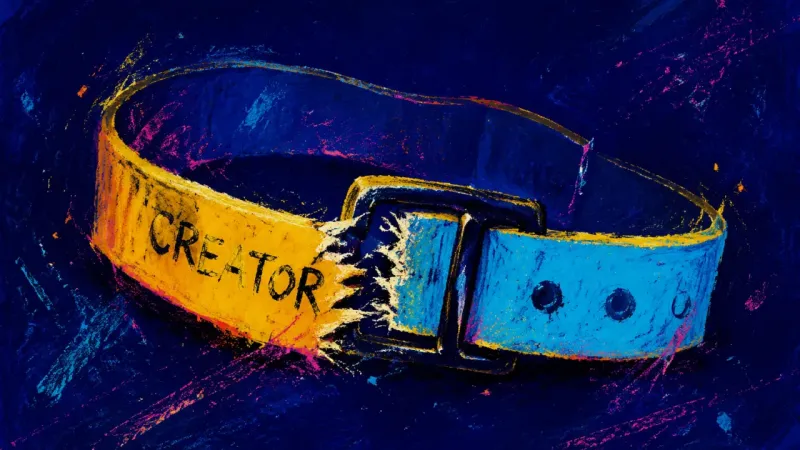
The 12:40 a.m. Caption Where “I” Went Missing
If you are a Toronto freelance graphic designer at the exact moment a launch caption asks whether to write “I created this” or “we made this,” fear of claiming authorship can suddenly sound like a relationship problem. That was where I met Jordan (name changed for privacy), a twenty-seven-year-old non-binary designer and independent digital creator. At 12:40 a.m., they sat at a small kitchen table on my video screen. Their phone had gone warm in their hand, the fridge hummed through the laptop mic, and blue light sharpened the tired planes of their face as they dragged their own name below two friends. They replaced “a project I developed” with “a project we built.” No one had asked them to. This was creative authorship anxiety.
“I don’t want it to look like I’m claiming too much,” Jordan said. Their thumb stayed pressed against the edge of the phone. “They gave feedback. They’ve hyped me up. We’re all in the same group chat. If I put my name first, it feels like I’m saying they don’t matter.”
Then they looked at the draft again. “But I did develop the idea. I designed almost everything. And now I’m already annoyed at a caption that hasn’t even gone live. How am I invisible in a project I started?”
I could see the longing in their posture. It was not a soft, floating feeling. It was like breath clouding the inside of a sealed glass bottle: warmth searching for somewhere to go while the stopper stayed firmly in place. Their throat tightened whenever they read the word “I,” their chest braced before every edit, and one restless knee kept knocking the underside of the table.
“It feels less awkward to call it ours than to ask them to show up for me,” Jordan admitted. “Why do I trade credit for closeness when I launch creative work?”
“I don’t think your wish for closeness is the problem,” I told them. “I think one sentence is being asked to do two incompatible jobs: document who made the work and guarantee that you will still belong. We’re not here to decide whether you are generous or selfish. We’re here to give each need its own language and make a map of the fog.”

Choosing a Map for Credit and Closeness
I invited Jordan to place both feet on the floor, let their hands rest away from the caption, and take three slower breaths. I shuffled while they held one precise question in mind. I use this kind of brief ritual as a transition from rapid social calculation into focused observation, not as theatre and not as a promise that the cards will predict anyone’s reaction.
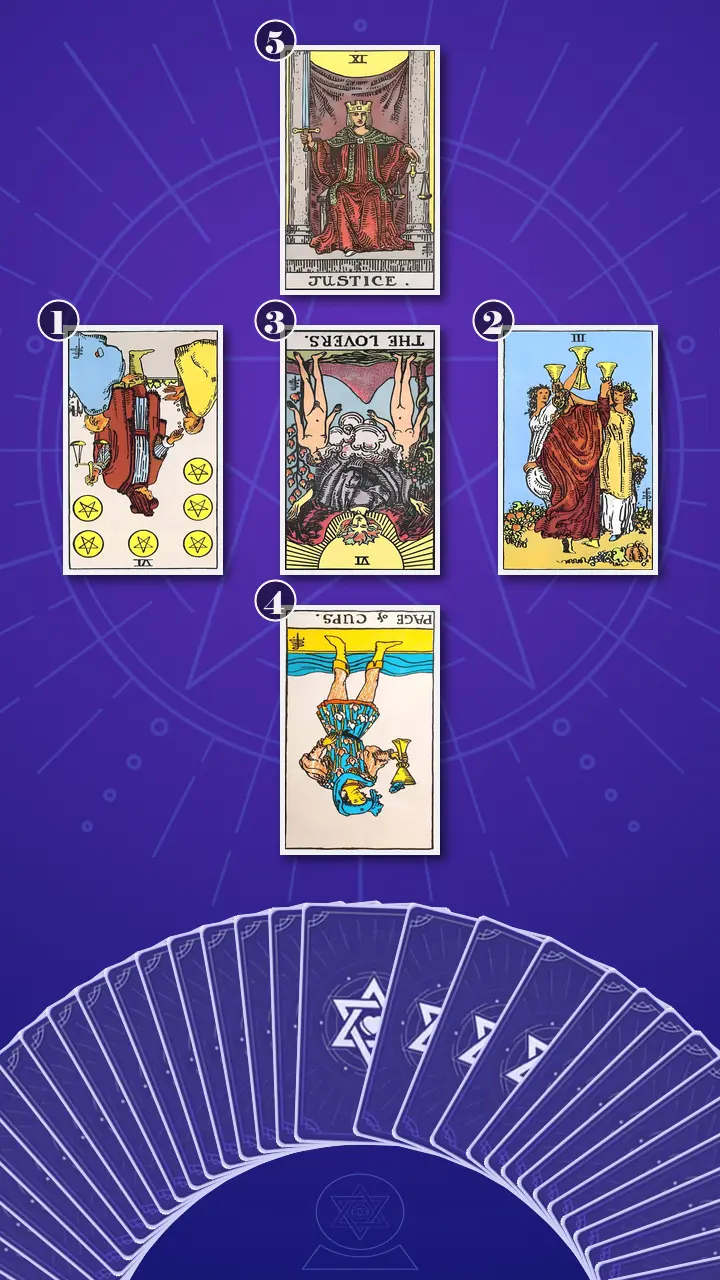
For this reading, I chose a five-position Relationship Spread. I chose it because Jordan was not comparing five career options or asking me to reveal what their friends secretly thought. The issue was a recurring exchange inside an overlapping friendship and creative network: Jordan’s behavior, the connection they wanted, the unspoken bargain linking those two things, the vulnerable request underneath it, and the boundary that could make the relationship more workable.
I laid the cards in a cross shaped like a bridge. The left position would show Jordan’s observable role in the credit imbalance. The right would clarify what they hoped to receive from the creative social field. The center would reveal the contract silently operating between authorship and belonging. Beneath it, I would look for the concealed emotional challenge. Above it, the final card would act as the keystone: an integrating principle for accurate credit and continued connection.
This is how tarot works at its most useful for me. The spread does not issue a verdict. It separates a fused experience into visible parts, much as a clean creative brief separates concept, production, review, and promotion. Jordan would remain the person deciding what to publish, what to ask for, and which relationships had earned a deeper conversation.
Reading the Bridge Between Ownership and Belonging
Position One: When Credit Becomes Currency
I turned over the card representing Jordan’s observable role in the pattern: over-distributing credit and softening authorship language during a public creative launch. It was the Six of Pentacles, reversed.
I pointed to the scales in the standing figure’s hand and the coins moving downward toward the kneeling figures. Upright, the image can describe conscious generosity and proportionate exchange. Reversed here, the allocation had become distorted. Jordan was distributing a concrete professional asset, byline space, in the hope of receiving a less measurable social resource in return.
In practical terms, I saw Jordan back at the kitchen table treating the caption like a limited launch budget. A friend who had commented on drafts became a co-creator. A useful introduction expanded into producer credit. Jordan’s own name moved lower. The heart reactions in the group chat offered a moment of relief, but the eventual portfolio case study would no longer show who originated the concept and built the visual system.
I described the energy as an excess of Earth-level giving combined with a deficiency of proportion. The problem was not generosity itself. The blockage appeared when generosity stopped documenting contribution and started functioning as advance payment for reassurance.
“Your byline is not an entrance fee,” I said. “So I want to ask the scales’ question: is this credit line recording the work, or is it trying to purchase a feeling of social safety?”
Jordan did not nod. First, their thumb froze above the trackpad. Then their gaze shifted from the card to the caption screenshot, as though the version history were running silently behind their eyes. Finally, they gave a short laugh with a bitter edge. “That’s so accurate it’s almost brutal.”
“Brutal would be using the card to shame you,” I replied. “I’m using it to make the exchange visible. Once it is visible, you can choose differently. And choosing differently does not mean swinging to the opposite extreme and claiming work that genuine collaborators performed. Justice later in the spread will ask for proportion, not isolation.”
Position Two: The Celebration Jordan Actually Wanted
I turned over the card representing what Jordan experienced and sought in the creative social field: celebration, inclusion, and visible support without any claim that I could know their friends’ private intentions. It was the Three of Cups, upright.
The three figures raised their cups in a linked, celebratory formation, with fruit gathered at their feet. I read this as balanced Water: feeling moving openly through friendship, mutual encouragement, and a shared moment of arrival. Nothing about the card measured who had authored the central idea.
I described the Toronto launch Jordan had pictured while making the work: friends arriving at the small gallery, tagged Instagram Stories appearing in real time, photos beside the projector, voice notes landing in the group chat, and someone saying, without being prompted, “You worked so hard on this. I’m glad I’m here.” The warmth was real. Wanting it did not make Jordan needy, unprofessional, or less independent.
“The Three of Cups validates the celebration,” I said. “It just refuses to turn attendance into authorship. A friend can repost, take photos, bring people, or stand beside you at the launch without becoming the person who originated the concept.”
I asked, “If you already knew the room would feel warm, what would the credit line say?”
Jordan’s knee stopped knocking the table. They looked down and answered without much delay. “Concept and design by Jordan. Feedback from Maya and Theo.”
“Then the factual language is available,” I said. “The fear is not that you do not know what happened. The fear is what accurate wording might appear to mean about the relationship.”
Position Three: The Agreement Nobody Said Out Loud
I turned over the center card, representing the unspoken contract created when Jordan treated shared ownership as the price of relational closeness. It was The Lovers, reversed.
I drew Jordan’s attention to the two exposed figures standing separately beneath a larger witnessing presence, with a mountain rising between them. Reversed, the card did not tell me that a friendship was doomed. It showed a blockage of congruent choice: the public wording presented harmony, while Jordan’s private standard of fairness registered a split.
I brought the image into the final Instagram caption field. One option said, “our project.” The other said, “a project I created with support from…” Jordan knew the second sentence was more accurate, but the first felt relationally safer. The caption had become a checkbox forcing a false choice between truthful authorship and a warm creative community.
“An accurate ‘I’ is not an attack on a genuine ‘we,’” I told them. “The Lovers reversed asks which sentence remains consistent with your values even if someone experiences a brief flicker of disappointment.”
Jordan pressed their lips together. “I keep imagining that precise credit will sound like I used everyone for help and then made the launch about myself.”
“That is a prediction, not a contribution record,” I said. “It may deserve compassion, but it does not get to write the metadata. And waiting until every friend approves every word would only place authorship back in the group’s hands. You can invite factual corrections without requesting permission to own the idea you developed.”
Position Four: The Message Hiding Inside the Title
I turned over the card representing the emotional challenge beneath the credit trade: difficulty asking directly for care, attendance, encouragement, or celebration. It was the Page of Cups, reversed.
I pointed to the fish emerging unexpectedly from the Page’s cup. The image looked almost absurd, which was exactly why it worked. A tender message had surfaced in the middle of what was supposed to be a professional conversation, and the messenger did not know how to receive it plainly.
I asked Jordan to show me the draft they had deleted before offering one friend a larger title. The cursor had once blinked beside: “Would you come to the launch? It would mean a lot to me.” Jordan had erased that sentence and replaced it with a suggestion that the friend be named as a creative producer.
“I can offer professional value more easily than I can name an emotional want,” I said, giving the pattern its inner voice. “The title feels safer because you can pretend it is a fair exchange. The direct message admits that you care, that the answer is voluntary, and that you cannot control it.”
I described the Page’s energy as blocked Water. The need for warmth was not excessive or immature; it simply could not move through direct language. So it changed form and reappeared as an Earth-level concession of credit. That made the Page the blockage and the catalyst. Once Jordan could separate “You helped me test this” from “I want you there,” the whole spread could begin to move.
“Do not ask a title to say what a direct request could say,” I told them. “What is the smallest honest sentence you would rather send?”
Jordan’s fingers tightened around the phone, held, and then loosened. Their eyes drifted toward the unsent draft before returning to me. “Your support matters to me. Would you come if you can?”
“That is enough,” I said. “One trusted person, one observable role, one request, and no ownership swap. If they cannot come, their actual contribution remains the same. If they can come, their presence does not need to be converted into authorship. You also do not have to respond by launching alone or cutting everyone out. A boundary can preserve contact instead of ending it.”
When Justice Cleared the Air
Position Five: The Scales, the Sword, and the Accurate Sentence
I turned over the final card, representing the integrating path that could protect Jordan’s idea ownership while leaving room for direct relational support. It was Justice, upright: the key card and antidote of the reading.
The fridge compressor clicked off on Jordan’s side of the call just as I placed Justice above the center of the spread. The sudden quiet sharpened the image. Justice held level scales openly in one hand and an upright sword in the other. I saw the return of the scales from the reversed Six of Pentacles, but now the allocation was visible, proportionate, and supported by precise language.
I brought us back to 12:40 a.m.: the warm phone, the humming fridge, the tightening throat, and the name dragged below two friends. Jordan had changed “a project I developed” to “a project we built” because the softer sentence seemed able to keep the group close.
I gave the split its plainest language: “If I name the work precisely, they may hear rejection; if I blur it, I reject my own record.”
After fifteen years at a perfume bench, I have learned that a boundary is what allows each material in a composition to remain legible. If every note permeates every layer at full strength, even beautiful ingredients collapse into saturation. Space does not make the fragrance cold. Space lets an accord breathe.
I call the corresponding reading tool my Aura Permeability Diagnosis. It is not a clinical label and it is not a verdict that the people around Jordan were toxic. I use it to ask where the atmosphere of one environment has become so permeable that it seeps into a decision belonging to another. Jordan’s group chat was both a friendship room and an informal studio. Warmth, fear of exclusion, feedback, invitations, promotion, and professional credit all shared the same air. Justice showed me where the factual byline needed a clearer membrane.
You do not have to make your authorship smaller to keep people near; name each contribution accurately, as Justice keeps the scales level and the sword clear.
I let the sentence sit in the new quiet.
Jordan’s breath stopped before anything else moved. Their index finger hovered above the trackpad, then curled slowly into their palm. For two beats, they stared past my screen, eyes unfocused, as if the caption, the TTC repost, and the gallery photo were replaying at once. Their pupils widened; the muscles beside their mouth tightened; a thin red line appeared at the lower lids. Then their shoulders dropped, not dramatically, but by the first honest inch I had seen all night. Their closed hand opened against the table. A breath came out with a small tremor and an almost-laugh, followed by a blank, weightless look. Relief had arrived, but so had the unnerving responsibility of no longer pretending the choice was unavailable. “Oh,” they said quietly. “That makes it simpler. Not easy. Simpler.”
Then their brow tightened again. “But doesn’t that mean I’ve been wrong this whole time?”
“It means you used a strategy that reduced discomfort quickly,” I answered. “It protected you from having to ask for care without knowing the answer. That strategy also became expensive. Recognizing the cost does not invalidate the need it was trying to meet. It gives you the option to meet that need more directly now.”
I leaned closer to the screen. “Now, with this new perspective, think back: was there a moment last week when this insight might have made you feel different?”
Jordan remembered the TTC ride when a collaborator reposted the project as “our new visual story.” They had typed a correction while the streetcar rattled, watched the blue screen glare back from the window, and deleted the message because it felt petty.
“If I had seen credit and support as separate,” they said, “I could have corrected the record without making the correction mean I didn’t appreciate them. It still would have been uncomfortable, but maybe I wouldn’t have sat there rereading it for forty minutes.”
“That is the crossing,” I said. “Not perfect confidence, and not certainty that every conversation will go smoothly. It is one step from socially vigilant self-erasure and private resentment toward accurate authorship, direct support-seeking, and grounded relational trust.”
I set a ten-minute timer. On one page, I asked Jordan to make two short lists. The first held observable contributions: concept, design, production, editing, feedback, and promotion. The second held one form of support they genuinely wanted: attendance, a repost, or a message after the launch. From those lists, they drafted one factual credit line and one separate support request.
“You do not have to send either tonight,” I reminded them. “If this feels too exposing, stop. Reduce it to one role and one request, or return later. The credit line can tell the truth about the work while the relationship carries the request for warmth. Accurate authorship is not a threat to real closeness; it is a boundary that lets both exist in public.”
Jordan read what they had written: “Concept and design by Jordan. Visual feedback from Maya. Launch support from Theo.” Then, separately: “Your support matters to me. Would you be up for coming to the launch? No pressure either way.”
I looked again at the spread. The cups could hold celebration. The scales could measure contribution. The sword could give each one a clear sentence. Neither container had to impersonate the other.
The Separate Containers Credit Check
I gathered the five cards into one coherent account. Across earlier launch drafts, Jordan had learned to lower immediate social tension by over-distributing a professional asset. The reversed Six of Pentacles exposed that unequal exchange. The Three of Cups protected the valid wish beneath it: Jordan wanted friends to celebrate, attend, repost, and witness the work. The Lovers reversed showed the hidden contract joining those needs through a values-misaligned choice. The reversed Page of Cups revealed why the contract persisted: a direct request for care felt more exposing than a generous title. Justice supplied the missing structure, allowing accurate attribution and emotional openness to coexist.
The cognitive blind spot was subtle. Jordan’s broad credits were generous, but generosity was not the whole mechanism. The byline had also become a tool for regulating uncertainty about belonging. That was why a vague caption produced temporary relief and later resentment. It solved the social discomfort for one evening by weakening the professional record for months.
I also noted that no Wands appeared in the spread. Jordan’s creative fire was not missing; the finished project proved otherwise. What had been underused was decisive action around that fire: the willingness to protect its origin through a clear sentence. The transformation was therefore not from selfishness to generosity, or from community to independence. It was from an inaccurate “we” toward an honest “I” that could still invite a genuine “we” into celebration.
Before we chose the next steps, I adapted my Scent Bubble Protocol for the launch workflow. I asked Jordan to picture a scent associated with clean, breathable space, not a fragrance chosen for anyone else’s approval. For sixty seconds, they would press thumb and forefinger together, inhale gently, lengthen the exhale, and imagine that scent forming a clear perimeter at arm’s length.
I explained that the bubble was not armor against friends and not proof that the group was dangerous. It was a temporary somatic boundary around one task. Inside it, Figma history, Google Docs comments, and observable roles could write the credit line. Group-chat warmth could wait just outside until Jordan was ready to write the invitation. For one minute, the social atmosphere would not be allowed to edit the evidence.
- Build the Observable-Role BylineThis week, open the current launch folder in Notion, Figma, or Google Docs and set a ten-minute timer. Create four headings: concept, production, review, and promotion. Place each person’s name only beside work they visibly performed, including Jordan’s name beside the central idea and design execution. Turn the record into one credit line, then send it with: “Please flag anything factually inaccurate.”Keep the minimum viable version to three roles and one sentence of evidence for each. Ask for factual corrections, not permission to take lead credit. If someone identifies a real contribution, include it proportionately; pause before agreeing to wording that remains unclear.
- Make the Support Ask Without an Ownership SwapAfter using the sixty-second Scent Bubble Protocol, choose one trusted friend from the launch group chat and take five minutes to send: “Your support matters to me. Would you be up for attending the launch or sharing the post? No pressure either way.” Keep that person’s credit tied to their actual role whether they accept, decline, or need time to answer.Expect this sentence to feel more vulnerable than giving away a title. A voice note or in-person request is valid, and postponing is allowed. Keep the request voluntary and do not attach extra credit as a reward.
I called these actionable next steps experiments, not tests of Jordan’s courage or their friends’ loyalty. A factual byline could reveal where a conversation was needed, but it could not guarantee an ideal response. Jordan retained the right to revise, pause, correct a future asset instead of a rapidly circulating post, and decide how much contact felt sustainable.

A Week Later: The Quiet Proof
A week later, Jordan published the accurate credit and sent the separate ask. One friend could not attend but offered a repost and a call. Jordan slept through the night; their first thought at dawn was, “What if I was too much?” This time, they smiled before making coffee.
Jordan also sent me a screenshot of the final caption. Their name was not inflated, and nobody else’s contribution had been erased. The wording simply matched the work: concept and design, feedback, production help, and promotion each occupied the right line. Under the screenshot, Jordan had typed, “I still checked it six times. But I didn’t change ‘I’ to ‘we.’”
I did not credit the cards with writing that sentence. Jordan wrote it. Tarot gave us an objective arrangement in which the exchange, the longing, the unspoken contract, the blocked message, and the fair boundary could be examined separately. Jordan supplied the honesty, tolerated the discomfort, and made the decision.
That was the real Journey to Clarity. Clarity did not arrive as a guarantee that accurate authorship would keep every room warm. It arrived as the ability to stop using authorship to control the temperature. Jordan could let the credit line document the work, let the relationship carry the warmth, and learn through experience which connections could respect both.
If your throat tightens over the word “I,” I hope you remember what I watched Jordan discover: handing away pieces of a byline may make the room feel warmer for one night, but silence is not the same as closeness. Noticing that exchange means you are already beyond its starting point.
If Justice’s scales held the factual credit at your next launch while the cups held connection, what one small kind of support would you quietly ask for, without paying for it with your byline?