A Proposal Left in Drafts: From Insider Approval to Peer-Level Work

The 8:47 Train and the Door Marked “Promising”
“Being called promising is starting to feel like a polite way of keeping me junior,” were the first words Alex said to me.
She described the moment she could not stop replaying. At 8:47 p.m., on the Central line home from a client meeting, she had scrolled through Instagram Stories from a panel and launch she had been close enough to hear about but not invited to attend. The carriage lights buzzed above her, her phone felt warm in her palm, and a peer-level collaboration proposal remained in drafts while her shoulders climbed towards her ears.
Earlier that day, a senior contact had introduced a less experienced insider to the client conversation while describing Alex, who had developed much of the positioning work, as “talented and promising.” She had smiled, accepted an executional follow-up, and told herself that staying useful would preserve access. By the time she reached her stop, she had reopened her portfolio for the fifth time.
“Why do I keep waiting for insiders to treat me like a peer?” she asked. “I know I can do the work, but I don't know how to stop asking the room to certify that.”
I heard the contradiction immediately: she wanted equal professional participation, yet she kept making insider approval the condition that had to arrive before she participated as an equal. She could do the work, but when the room's status signals went quiet, she treated their approval as the missing evidence.
What she called frustration had become a physical holding pattern, like standing against a Tube door that never opened while every muscle stayed braced for the station announcement. Her jaw locked before direct messages. Her stomach dropped at a typing indicator that disappeared. Every delayed reply seemed to add another invisible line to a verdict nobody had actually written.
“I don't want to tell you that the gatekeeping is imaginary,” I said. “Some of it is structural and unfair. I also don't want these cards to predict whether a particular insider will change. What we can do is map where their power ends, where your protective strategy begins, and what information you could gather without surrendering your worth to the response.”
I placed the deck between us. “Let's give this fog a structure. The goal is not to make the cards the authority in the room. The goal is to help you hear your own judgment without all the status noise around it.”

Choosing the Workbench Map
I invited Alex to put both feet on the floor, loosen her hands, and state the question once without improving the wording. I shuffled slowly while she breathed. The pause was not a mystical test; it was a deliberate transition from compulsive analysis into focused observation.
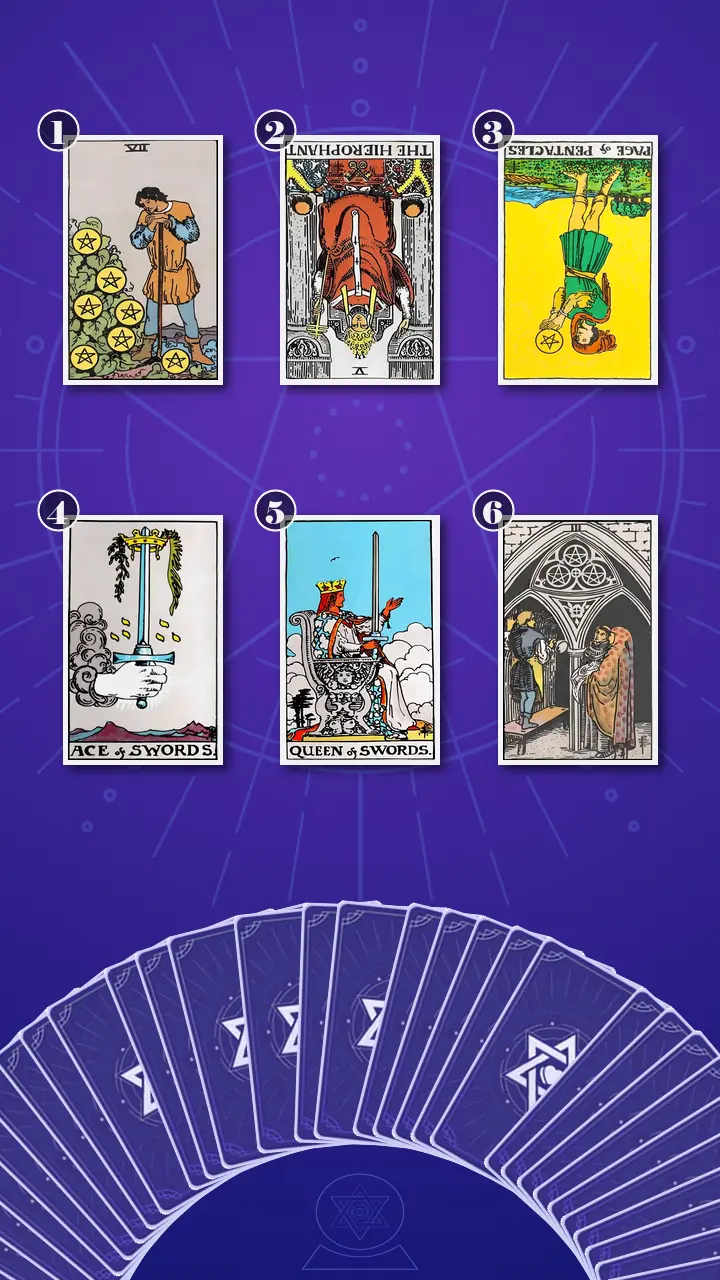
I chose the Transformation Path Grid (6) · Context Edition, a two-row, six-card tarot spread designed to examine a pattern as a connected system. This was more useful than a general career spread because Alex was not choosing between two job offers. She wanted to understand why professional gatekeeping, over-preparation, and her fear of making a peer-level claim kept reinforcing one another.
The top row would diagnose the loop: the visible waiting behaviour, the systemic gate, and the internalised not-yet-ready script. The lower row would trace an exit through a clarity trigger, a reciprocal action, and an integrated form of collaboration. Position 1 would show what Alex was visibly doing while she waited. Position 2 would identify the inherited network rules maintaining the pattern. Position 5, the practical bridge of the spread, would show the boundary or proposal she could make without asking an insider to define her professional identity.
This is how tarot works in my practice. The cards do not issue a forecast or decide whether someone belongs. They provide a stable set of images and questions, allowing me to separate observable facts from interpretations, internal resources from external timing, and genuine skill development from preparation used as emotional cover.
Where Patience Became Permission
Position 1: The Finished Work Still Sitting in Staging
The first card I turned represented the surface loop: what Alex was visibly doing while waiting for insiders to treat her like a peer. It was the Seven of Pentacles, upright.
I pointed to the worker leaning on the hoe, studying the pentacles growing on the plant. The labour was real. So was the pause before harvesting. In Alex's modern working life, this was a completed brand strategy case study sitting open in Google Drive while she checked whether an established contact had liked or shared it, changed another sentence, and postponed the direct proposal that would let someone evaluate her as a potential collaborator.
Upright patience can represent balanced investment, but here it was operating in Excess. Continued refinement no longer produced a materially better case study. It produced temporary relief from the possibility of dismissal. Her portfolio had become a product left in staging: polished, privately impressive, and protected from the real-world feedback that publication would create.
“What evidence are you gathering with the next edit?” I asked. “And what small peer-level action would let you learn from reality instead?”
Alex gave a short, bitter laugh. Her fingers tightened around the edge of her sleeve before she looked away from the card. “That's so accurate it's almost cruel. This is the exact moment I start editing instead of sending.”
“Then let's not use the accuracy against you,” I replied. “This card is not accusing you of laziness or weakness. It confirms that you have invested. It asks whether waiting is still serving the investment, or whether it has quietly become the price you pay to avoid a verdict.”
Position 2: The Keys Owned by the Network
The next card represented the systemic gate: where legacy professional conventions restricted access, recognition, or equal participation. I turned over The Hierophant, reversed.
The seated authority, the two kneeling acolytes, and the crossed keys formed an uncomfortably precise picture. Alex had watched London creative opportunities move through a small circle of alumni ties, old agency relationships, family names, referrals, and private Slack introductions. She had begun treating those pathways not merely as common routes, but as the only legitimate keys to the room.
The reversal showed Blockage inside the institution's authority. Some professional standards organise useful learning, but inherited rituals can also turn “people usually enter this way” into “you are not allowed to enter any other way.” I was careful not to reduce real network inequality to a confidence issue. The closed circles existed. The card's question was whether Alex had allowed their preferred ceremony to become the final authority over every route she might try.
“Think of the last panel or client introduction that travelled through an alumni or referral circle,” I said. “Which part was a genuine barrier, and which conclusion did you add about what you were allowed to propose?”
Her gaze settled on the crossed keys. Her breathing paused, then became shallower. I watched her replay something before she spoke.
“I saw the same four names moving between the launch, the panel, and the next brief,” she said. “I remember thinking there was no point emailing unless one of them introduced me.”
I wrote a sentence beside the card: I am not asking whether this rule is fair; I am acting as if it is the only rule.
“Questioning that sentence doesn't require you to reject every mentor or established community,” I said. “It only means an introduction can be useful without becoming a permission slip for speaking as an equal.”
Position 3: The Apprentice Script with No Graduation Date
The third card represented the internalised script: how delayed gratification and professional infantilisation had shaped the belief that more preparation must come before peer participation. I turned the Page of Pentacles, reversed.
The Page held one pentacle at eye level while a cultivated field stretched behind him. Reversed, that attentive student energy had become a permanent condition of not-yet-readiness. In Alex's life, it looked like signing up for another certification, rewriting her portfolio bio, or adjusting a case study introduction while the proposal she could send today remained untouched in a draft folder.
This was a Blockage of practical initiation and a Deficiency of bounded experimentation. Learning itself was not the problem. The problem was using the identity of “still learning” to postpone any exchange that might reveal how others responded to her current competence.
“Name one skill you genuinely need to strengthen,” I said. “Now name the approval question you have been hiding inside the same phrase, 'I'm not ready yet.'”
She named a specific research method she wanted to practise. Then I asked whether that gap prevented her from leading the positioning phase described in her draft.
“No,” she said quietly. “It doesn't. I think I wanted the next course to make asking feel less exposed.”
Her fingers went still. Her eyes lost focus for a moment as though she were scrolling backwards through every saved course page and unfinished pitch. Then she exhaled from low in her chest and let her palms open on the table. I could see the distinction landing: a real skill gap could be scheduled and practised; an approval delay could expand forever because nobody had defined what would finally count as enough.
When the Blade Made the Question Answerable
Position 4: One Sentence Through the Status Noise
The fourth card represented the peer-claim trigger: the truth or direct conversation capable of turning an unspoken status question into a concrete exchange. I turned the Ace of Swords, upright.
The hand emerged from a cloud holding one clean vertical blade. After three cards dense with pentacles, credentials, institutions, and accumulated effort, the arrival of air changed the visual logic of the spread. The Ace did not ask Alex to feel more impressive. It asked her to become more precise.
I invited her to open the proposal on her phone. The existing version took three paragraphs to thank the recipient, summarise her agency background, explain why she might be useful, and reassure them that she was happy to support. Her actual proposition did not appear until the final line.
I read back the Ace of Swords version: “I can lead the positioning work for this project, and I would like to discuss a defined fee, decision-making role, and credit before we proceed.”
The upright Ace brought Balance through clarity. It did not guarantee acceptance. It cut vague status anxiety into an exchange another person could answer. A clear professional message was a testable invitation, not a referendum on Alex's entire career.
“A clear ask is a way to gather information, not a demand for approval,” I said. “You do not have to decode the room if you can ask it a clear question.”
Alex read the shorter sentence again. I watched the hinge of her jaw release. She took a fuller breath and said, “I don't have to decode the room if I can ask a clear question. That feels obvious when you say it, but I've been trying to reverse-engineer their LinkedIn activity like it's an answer.”
Position 5: When the Queen Refused to Write an Apology Paragraph
The heater clicked off, and the room became unexpectedly still. Rain traced a narrow line down the window, echoing the clean edge of the sword as I turned the most strategically important card in the spread.
This card represented reciprocal action: the boundary, proposal, or communication style Alex could practise without asking insiders to define her professional identity. It was the Queen of Swords, upright.
Her sword stood vertical while her free hand remained open. I read that pairing as the complete gesture: a clear boundary and a genuine invitation. In Alex's working life, it sounded like, “I can lead this part of the project, and I would need decision-making credit and a clear fee to take it on.” Then it stopped. No apology. No second page of proof. No performance of superiority, either.
The Queen's energy was in Balance. Too little sword would soften the terms until nobody had to answer them. Too much could turn understandable anger at gatekeeping into a blanket rejection of collaboration. Balanced discernment stated the exchange plainly and left both people free to respond.
At that point, I brought Alex back to 8:47 p.m. on the train: the fluorescent hum, the warm phone, the reopened portfolio, and the unsent proposal. She had been trapped between sounding acceptable enough to be invited and risking one direct statement that could disappoint her.
Stop treating insider approval as the precondition for peer participation; let the Queen of Swords' clear blade mark a boundary and a direct invitation, so Delayed Gratification becomes a deliberate choice about investment rather than a reason to remain professionally junior.
I let the sentence remain between us before making the core message even plainer.
You do not need an insider's permission to test peer-level participation. Name what you contribute, make one reciprocal ask, and let the response tell you about the relationship rather than decide what you are worth.
Alex's breath stopped. Her fingertips hovered above her phone, and her pupils widened before her gaze slipped past me towards the rain-dark window. I watched recognition move across her face as she replayed the Tuesday kickoff where her strategy had been introduced as someone else's lead and her own role had been reduced to support. Her eyes reddened slightly. Then her clenched hand loosened, one finger at a time, and both shoulders dropped with a long, uneven exhale.
“But doesn't that mean I've been doing this wrong for years?” she asked. The first edge in her voice sounded almost angry. A second later it thinned into something more vulnerable. “And if I know this now, I can't pretend I'm just waiting anymore.”
“It means your strategy protected the access you had when dismissal felt too costly,” I said. “It also means the strategy now has costs you can see. The gatekeeping was real. Your response to it was adaptive. Neither fact requires you to keep renewing the same arrangement.”
For a few seconds, the release left her looking almost unsteady, as though setting down the old burden had revealed the responsibility underneath it. Then I asked, “Now, using this new perspective, can you think of a moment last week when this insight might have made the experience feel different?”
She returned to the kickoff. “I could have said, 'Just to clarify, I led the positioning system, and I'd like to present that section.' They might still have brushed it aside. But then I would have known something real about the relationship.”
The Resource Readiness Assessment
I turned a blank sheet sideways and used one of the diagnostic tools I carried from my years in high-stakes finance: a Resource Readiness Assessment. On the left, I listed internal assets. Alex had a completed case study, years of agency experience, evidence that her strategy affected client decisions, a defined offer, and enough capacity to lead a bounded workstream. On the right, I listed external timing: uncertain budgets, entrenched referral networks, access to relevant decision-makers, and one live opportunity that required a reply.
The assessment mattered because self-assertion is not a substitute for preparation. If her internal assets had been materially below the demands of the work, strategic holding would have protected her reputation and improved the eventual proposal. If the market offered no relevant opening, waiting could conserve effort. But neither condition applied here. Her resources were not perfect; they were sufficient for a small, answerable test.
Looking at the Queen's upright sword, I flashed back to a trading desk where every delayed decision had to justify its carrying cost. Delay was never neutral. It either bought useful information and stronger positioning, or it quietly accumulated risk. Alex's additional portfolio edits were no longer buying readiness. They were buying temporary relief while increasing the cost of remaining peripheral.
I used Strike Timing Calibration to identify the smallest decisive node. It was not a dramatic resignation, a public callout, or a claim that every insider owed her access. The optimal move was one three-sentence proposal with a named contribution, a reciprocal term, and a deadline. The downside was bounded. The information value was high. That made action strategically sound even while discomfort remained.
I named the transition I could see taking shape: from waiting for insider approval and over-preparing towards a clear peer-level contribution, evidence-based boundaries, and reciprocal collaboration. This was not instant confidence. It was the first move from asking, “How do I sound acceptable enough to be invited?” towards asking, “What reciprocal arrangement am I willing to enter?”
The Open Worktable Beyond the Door
Position 6: Three People, One Visible Plan
The final card represented the integrated stance: how Alex could recognise peerhood through visible contribution, mutual credit, and reciprocal collaboration instead of waiting for permission. I turned the Three of Pentacles, upright.
A craftsperson worked beneath an arch while two others reviewed the plan. Unlike the solitary figures examining pentacles in the earlier cards, these people were making competence legible through shared work. In Alex's life, this looked like joining a project as a named contributor, discussing the plan as an equal, and having strategy ownership reflected in the decisions, credit, and final structure.
The Three of Pentacles showed Balance in earth energy. The work remained practical. Standards still mattered. Feedback still mattered. The difference was that skill now entered a visible exchange rather than waiting in a private portfolio for a gatekeeper's ceremonial nod.
“Peerhood is not a badge handed down by the room,” I said. “It is a practice of clear contribution and mutual terms. You can observe it in who shapes the work, who receives credit, who owns decisions, and whether the exchange remains reciprocal when you stop being endlessly available.”
I asked her to think of one recent collaboration where she had actually been heard, credited, and included in the making. She named a former colleague who had invited her into a small strategy sprint and openly attributed her work in the client review. As she described it, she leaned towards the spread rather than away from it.
“It wasn't prestigious,” she said, studying the shared plan in the card. “But I never had to wonder whether I was allowed to have an opinion.”
“That is evidence,” I replied. “The network's aura may have been smaller, but the reciprocity was larger.”
From a Verdict to Verifiable Terms
Read as one story, the spread showed how the pattern had formed. Years of capable work had taught Alex to invest patiently, while unstable freelance income made preserving access feel sensible. Legacy networks then supplied a real external hierarchy, and the reversed Page turned that hierarchy into an internal apprentice script: one more credential, one more edit, one warmer introduction. The resulting blind spot was subtle. She assumed she had to establish readiness before making a peer-level request, when a bounded request was one of the few honest ways to gather evidence about readiness, fit, and reciprocity.
The cards did not ask her to deny structural gatekeeping or manufacture certainty. They redirected her from the closed doorway to the open worktable. Her existing competence was the material resource. Clear language was the leverage. Boundaries protected the downside. Shared work would provide evidence that status monitoring never could.
I introduced my Strategic Holding Pattern so that waiting, when she deliberately chose it, would stop meaning indefinite suspension. Under this framework, every pause had to purchase one measurable asset: a specific skill repetition, one relevant market fact, a clarified term, or a fixed decision point. If the pause purchased none of those, it was avoidance wearing the clothes of professionalism.
- Run the 10-Minute Peer-Level Signal Test. Before Friday, choose one relevant collaborator in London or in an existing professional network. Set a 10-minute timer and draft three sentences: what you can lead, what project or conversation you propose, and what reciprocal role, fee, credit, or next step you are asking for. Remove one paragraph of credentials, apologies, or unnecessary justification. Set a specific time to send it or consciously decide not to send it. Tip: The first direct version may feel too blunt because deference has felt safer. Discomfort is not proof that the wording is wrong. Keep the proposal answerable, and remember that drafting it does not remove your choice about whether, when, or to whom it is sent.
- Use the Boundary-First Proposal and Response-as-Information Log. For the next vague request to “jump in and help,” spend five minutes writing four headings: scope, credit, fee, and decision-making authority. Reply with, “I can take responsibility for ___, and I would need ___ confirmed for this to work.” After the response, record three columns: what they actually said, what they did not answer, and what the exchange tells you about the working relationship. Tip: Ask one clarifying follow-up if a key term remains vague, then wait before adding unpaid or undefined work. A no, a counteroffer, or silence provides information. None of them requires you to persuade the other person or convert their response into a judgment of your worth.
“You remain in charge of the move,” I told her. “The cards do not require you to send a message, accept a project, or confront anyone. Their value is that you can now distinguish a strategic pause from a protective delay. You decide which relationships are worth testing and which terms are worth protecting.”

A Week Later, One Clean Sentence
Six days later, Alex messaged me from a café near Old Street. She had sent the three-sentence proposal. No reply yet. She slept through the night, then woke thinking, What if I got it wrong? She told me she smiled and opened the evidence log.
I did not read her calmer night as proof that uncertainty had disappeared. I read it as a small, concrete change in her relationship to uncertainty. She had allowed one clear contribution to exist before approval arrived, and she had kept the meaning of the response within its proper boundary.
That was the quiet proof of our Journey to Clarity. The six-card Transformation Path Grid had not opened a guarded professional room by magic. It had helped Alex see the difference between the network's gate, her inherited apprentice script, and the choices still available at her own worktable. The agency belonged to her, not to the spread.
I know that when a delayed reply makes your jaw lock and your shoulders rise, it can feel safer to keep proving yourself than to risk a peer-level claim that might be dismissed. If you are caught between wanting equal footing and waiting for someone else to certify it, noticing the holding pattern already means you are no longer fully inside it.
If you placed one finished contribution on your own open worktable without asking it to prove your belonging, what small reciprocal exchange would you be curious enough to invite?