The 11:42 p.m. Verb That Outran the Work
I met Jordan, a 28-year-old junior creative strategist in Toronto with a real point of view, a seven-minute pitch slot, and a deck that had become harder to defend every time creative pitch anxiety made them replace a precise verb with a senior-sounding one.
At 11:42 p.m., our video call opened onto their small apartment near Bloor. The radiator clicked behind them, the laptop fan hummed under an overworked Google Slides file, and cold coffee had left what Jordan described as a bitter film on their tongue. A banking notification showing the rent withdrawal was still lit on their phone.
I watched them change “contributed to the strategy” to “led the strategy.” Their hand stayed on Command-Z, but they did not press it. Their face was hot, their throat looked tight when they swallowed, and their fingertips kept tapping the trackpad as if the right wording might unlock the door to a more senior version of them.
“I want them to treat me like a real creative professional,” Jordan said. “But if I say I supported the work, I think they’ll hear that I wasn’t important. The part I call confidence is sometimes just panic with better vocabulary.”
The contradiction was painfully clean: Jordan wanted to be taken seriously through a confident pitch, yet the truth about what they had done felt dangerously junior. Their insecurity reminded me of trying to breathe inside an oversized professional costume, with every impressive new layer pulling tighter around the throat.
“I’m not here to put your ambition on trial,” I told them. “We’re going to examine what the pitch is asking language to hide. Tarot can give us an objective map of the pattern, but you will decide what to rewrite, what to keep, and what belongs to you.”
I pointed to the sentence still glowing on their screen. “Which line becomes difficult the moment someone asks, ‘What did you personally do?’”
Jordan looked at “led the strategy” and slowly moved the cursor away. “That one,” they said.
Choosing a Map for the Credibility Fog
I asked Jordan to place both feet on the floor and take one unforced breath while holding the pitch question in mind: “What am I overclaiming to be taken seriously?” I shuffled slowly. The pause was not a mystical performance; it was a way to interrupt the cycle of editing, comparing, and rehearsing long enough for us to observe it.
I chose The Shadow Spread · Context Edition, a four-position RWS tarot reflection. This is how tarot works in my practice: the cards do not predict whether a pitch will succeed, expose a hidden destiny, or make career decisions on someone’s behalf. They provide symbolic distance, allowing a person to examine a charged pattern without being swallowed by it.
The spread suited Jordan’s question because there were no external options to compare. We needed a narrow, honest audit. The first position would show the visible pitch performance: inflated ownership, senior-sounding language, and repeated editing. The second would reveal the hidden status wound beneath that performance. The third would identify truthful authority, and the fourth would turn that authority into a grounded pitch practice.
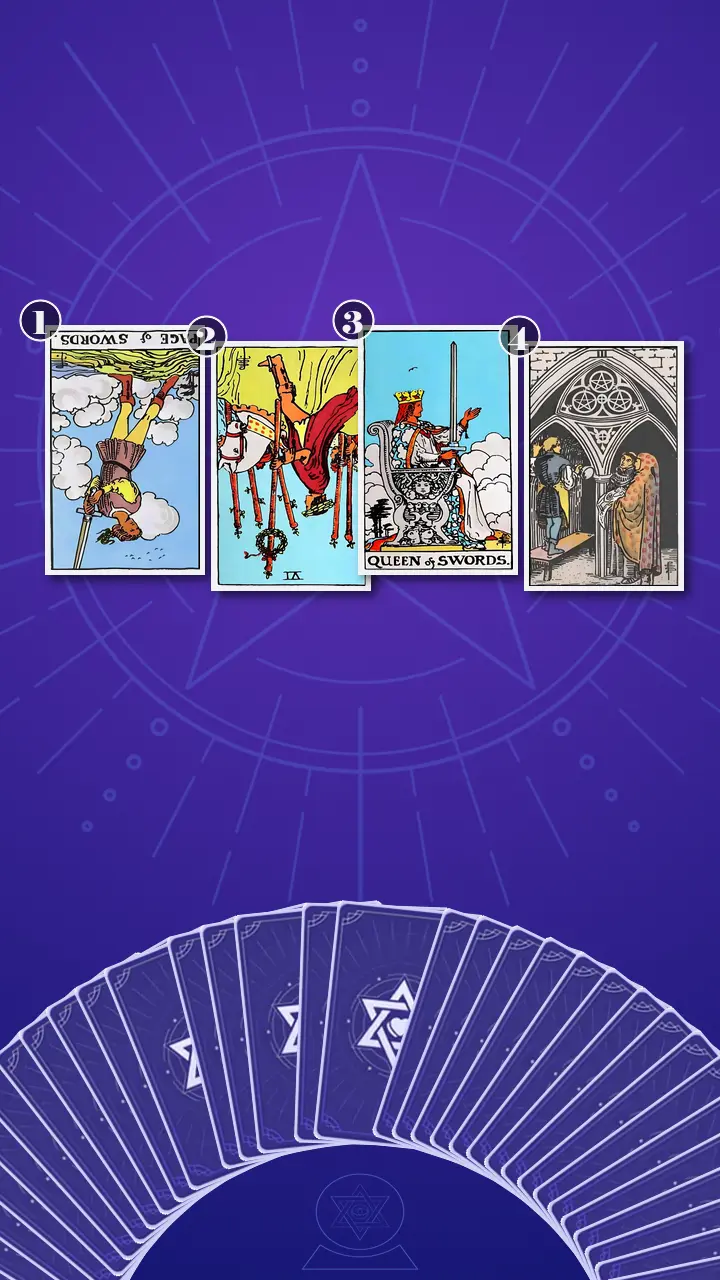
I placed the four cards in a straight line. From left to right, the layout resembled a short bridge from a noisy microphone to a solid worktable: surface language, approval pressure, precise discernment, and inspectable craft.
Reading the Noisy End of the Bridge
Position 1: The Sentence That Could Not Survive a Follow-Up
I turned over the card representing the visible pitch performance, the observable place where ownership, certainty, and repeated editing had expanded under the pressure of a short creative pitch window.
It was the Page of Swords, reversed.
In the RWS image, the Page raises a sword while wind drives the clouds across an uneven hill. Upright, that alert Air energy can bring curiosity, verbal agility, and intelligent investigation. Reversed here, I read it as both Excess and Blockage: language was moving quickly, but it had lost secure contact with the evidence beneath it.
“This is not a card calling you dishonest,” I said. “It is showing verbal skill pushed into self-protection. Your mind is so busy preventing the room from hearing ‘junior’ that it is answering questions no one has asked and making claims your actual work does not need.”
The card replayed the scene already open in front of us. At 11:42 p.m., Jordan had changed “I contributed audience insights and wrote the first concept territories” to “I led the brand strategy.” The new sentence sounded sharper for thirty seconds. Then they opened Voice Memos and rehearsed imaginary objections because the claim no longer mapped cleanly to the messages, drafts, and decisions they could show.
I heard the protective inner script beneath the edit: If I say exactly what I did, they will hear less than what I mean. If I upgrade the verb, maybe they will hear my potential.
That was the Page’s reversed problem. The pitch had started behaving like autocomplete, finishing Jordan’s professional story in the most senior-sounding language before checking whether the source material supported it. Sounding senior had replaced being answerable for the claim.
“A bigger verb cannot repair a smaller evidence base,” I said. “Which does not mean your contribution was small. It means the verb is currently hiding the part that was genuinely yours.”
Jordan gave one short laugh, but there was no amusement in it. Their hand closed around the coffee mug and then loosened. “That’s too accurate. A little brutal, actually.”
“Precision can sting when the larger wording has been acting like protective clothing,” I replied. “We’re not going to strip away authority. We’re going to find the authority the sentence skipped over.”
Position 2: The Imaginary Awards Jury
I turned over the card representing the hidden status wound, the fear that honest limits would confirm that senior people were right to treat Jordan as professionally junior.
It was the Six of Wands, reversed.
The upright Six of Wands carries visible recognition: a wreath, a raised wand, and a watching crowd. Reversed in this position, its Fire energy had become Blocked and then overheated. Recognition no longer registered as welcome feedback; it had become an entry requirement for professional belonging.
I asked Jordan to return to the LinkedIn case study they had viewed before our call. A more established creative had posted an award badge, a polished carousel, and the familiar “thrilled to announce” caption. Jordan had immediately reopened the deck, enlarged an outcome they had not independently measured, and considered deleting the strategist whose input had shaped the final route.
“That edit was not only communicating the work,” I said. “It was presenting to an imaginary awards jury. The thought underneath it was: If their work looks award-ready and mine looks collaborative, the room will rank me before it hears me.”
The reversal did not forecast failed recognition. It exposed the cost of making recognition conditional. When accurate collaboration felt like a status deficit, Jordan tried to create visible importance through sole-credit language. That brought a quick flash of relief, followed by a much heavier task: defending a role that no longer matched the project’s evidence trail.
“Which part of this deck is trying to win applause rather than communicate a useful truth?” I asked.
Jordan’s chest rose and stayed there for a moment. Their eyes drifted from the cards to the LinkedIn tab, as though they were replaying the exact second comparison had entered the pitch. Then they shut the tab.
“The outcome slide,” they said quietly. “I can explain the idea, but I keep trying to make my experience sound like proof that the idea will work. I need to sound established before anyone will let me become established.”
I let that sentence sit without correcting it. Ambition was not the problem. Jordan wanted more responsibility and had real strategic judgment to offer. The blockage was the belief that development had to be invisible before authority could become visible.
When the Queen Put a Border Around the Truth
Position 3: Truthful Authority Without the Costume
The radiator in Jordan’s apartment clicked once and went quiet. On their screen, the vertical text cursor continued to blink beside the word “led,” a thin upright line echoing the card I was about to reveal.
I turned over the card representing truthful authority, the inner quality capable of separating demonstrated ability, collaborative contribution, and future potential.
It was the Queen of Swords, upright, the key card and antidote in the spread.
Her sword stood vertically beside a steady stone throne. Her other hand remained open, receptive to context without surrendering judgment. I read her energy as Balance: disciplined Air, direct language, clear ownership boundaries, and enough self-respect to let a learning edge remain visible.
I asked Jordan whether their studio ecosystem usually brought them into projects as the person who sharpened other people’s ideas, filled gaps, prepared language, and kept collaborative work moving.
“Constantly,” they said. “People trust me to make the thinking clearer, but then someone more senior presents the final version.”
I recognized a pattern I call Workplace Typecasting Analysis. When an office repeatedly sees someone as the capable helper, the fast fixer, or the junior pair of hands, that person can become trapped in an undervalued supporting role even while exercising real judgment. Jordan’s overclaiming was an attempted escape from that typecast. They were trying to leap from “supporting role” to “sole lead” because they had not yet built language for the authority already present in their specific decisions.
The Queen did not ask Jordan to accept marginalization or become smaller. She asked them to stop auditioning for the opposite extreme. In the film of their working life, changing the billing did not rewrite the scene. Naming the decisions, effects, and boundaries of their contribution did.
I returned us to the precise setup: at 11:42 p.m., rent had just left Jordan’s account, a creative director’s polished case study was still open, and their throat had tightened as “contributed to” became “led.” The supposed confidence was still a status alarm.
Stop using borrowed certainty to outrun the fear of being treated as junior; use the Queen of Swords' upright blade to separate demonstrated skill from aspiration and state both with precision.
I paused long enough for the words to remain in the room without explanation.
Credibility is not sounding finished. It is making the border between proof, collaboration, and possibility easy to see.
I watched the insight land in three stages. First, Jordan’s breathing stopped. Their index finger hovered above Undo, frozen between preserving the larger claim and returning to the accurate one. Then their gaze lost focus, as if they were replaying the Zoom rehearsal where a peer had asked what remained untested and they had answered for ninety seconds without naming the open question. Their mouth tightened before their voice came out sharper than it had all evening. “But doesn’t that mean I’ve been doing this wrong? Doesn’t it mean I’ve been faking being ready?” I did not cover the discomfort with reassurance. “It means your wording has been protecting you from a real status fear,” I said. “A protective response can be revised without becoming your identity.” Jordan’s eyes reddened. Their shoulders lowered, their fist opened against the desk, and a long breath left their chest. “That feels cleaner,” they said, their voice unsteady. “Also terrifying. Now I have to trust the actual work.”
“Now, with this new perspective, think back to last week,” I said. “Was there a moment when this insight could have changed how the situation felt?”
Jordan returned to the rehearsal. “When my peer asked what was untested, I could have said the audience response was still a hypothesis. Then I could have shown how I built the concept from the audience tension. I didn’t need to turn the hypothesis into a result.”
“Exactly,” I said. “Accuracy is not making yourself smaller; it is making your contribution legible.”
I described the Queen’s modern-life expression: Jordan could duplicate the deck and mark each major claim as DEMONSTRATED, SHARED, or TESTING. One slide might then read: “I developed the first three concept territories from the audience tension; the design team translated the selected route into a visual system; this pitch proposes testing which message earns the strongest response.” Nothing in that sentence apologized. Nothing erased the team. Each clause knew what it owned.
This was the first visible move from status-driven overclaiming and frantic self-editing to evidence-based self-trust and grounded professional confidence. It was not certainty, and that was why it could become trustworthy.
When the Work Became the Proof
Position 4: An Artifact the Room Could Inspect
I turned over the final card, representing grounded pitch expression: a small, observable practice that would allow evidence and craft to carry credibility without requiring a larger-than-true claim.
It was the Three of Pentacles, upright.
The card shows a craftsperson working while two other people review the plan beneath a visible structure. I read its Earth energy as Balance: individual skill becoming legible inside collaboration, feedback, and a piece of work that can actually be examined.
For a moment, the artist in me saw a film set’s call sheet rather than a cathedral arch. A production does not become more serious because one person claims every department. Authority becomes visible through decisions, roles, revisions, and the trace each person leaves on the finished frame.
“Credit is not a pie,” I told Jordan, “but credibility does need receipts.”
I pictured the practical scene this card proposed: an annotated prototype placed directly after the concept slide. One callout would identify the audience observation. Another would mark the line Jordan wrote. A third would name the collaborator feedback that changed the execution. The final note would state what still needed testing.
When a reviewer asked about ownership, Jordan would no longer need to perform a title. They could point to a decision. The inner script could change from They must believe I had the bigger role to They do not have to believe a bigger title if they can inspect the work.
That was the Three of Pentacles in context: demonstrating craft instead of performing expertise, naming collaboration instead of treating credit as a zero-sum contest, and replacing a sweeping outcome with one observable artifact.
“What could you show the room?” I asked. “Not your whole professional identity. Just one piece of work that makes one claim verifiable.”
Jordan opened a prototype slide they had nearly removed because it looked unfinished. “This,” they said. “I wrote the three concept lines. The designer’s comment changed which one we developed. I can annotate the decision trail without showing confidential material.”
Their pulse had not magically settled; I could still see their thumb moving against the side of the trackpad. But the restless motion now had somewhere practical to go.
The Eight-Minute Claim-Evidence Triage
I read the full sequence back to Jordan as one coherent story. The reversed Page showed language rushing ahead of proof. The reversed Six revealed why: every senior title, award post, rent notification, and follow-up question had begun to feel like a public vote on whether Jordan belonged. The Queen restored a boundary between evidence and aspiration. The Three of Pentacles moved that boundary into visible craft.
The spread’s elemental movement made the path especially clear. Scattered Air had fed status-heated Fire; disciplined Air then redirected the energy into Earth. In plain language, Jordan needed to move from frantic wording, through the fear of being ranked, into an exact sentence and an inspectable piece of work.
The cognitive blind spot was not a lack of talent. It was the assumption that accuracy and authority were opposites, and that visible collaboration automatically reduced individual value. That belief had pushed Jordan to escape a supporting-role typecast by making the role sound larger, instead of constructing a leadership narrative around the decisions they had genuinely made.
“Your next act is not a confession,” I said. “You do not owe the room every limitation, and you should not undersell work you truly owned. The shift is from using senior-sounding certainty to secure legitimacy toward naming evidence, contribution, and a relevant learning edge with exact language.”
Jordan frowned at the proposed eight-minute audit. “I know what I’m like. Eight minutes will turn into two hours and a full redesign.”
“Then the minimum version is two minutes and one sentence,” I replied. “Stopping when the timer rings is part of the exercise. We are building an evidence boundary, not another perfection project.”
Three Small Moves Before the Pitch
- Run the private claim audit.Before the next Google Slides edit, set an eight-minute phone timer and label five claims in speaker notes as PROVEN, SHARED, or TESTING. Rewrite one as: “I contributed [specific action], which produced [observable artifact or decision], and I am now testing [open question].”If eight minutes invites over-editing, use two minutes and label one sentence. Keep the note private and exclude confidential client details.
- Add one inspectable artifact.This week, place one permitted prototype, concept line, audience framework, test note, or contribution map directly after the claim it supports. Add three labels: MY DECISION, TEAM INPUT, and WHAT CHANGED. Ask one trusted collaborator by Slack or email whether the wording describes your role accurately.The artifact does not need case-study polish. A redacted, three-bullet process note is enough when client material cannot be shown.
- Use the Protagonist Reframe Directive.In the next cross-departmental meeting, pause for two seconds after an ownership question, then say: “I was responsible for... The team made... possible. The next thing I would test is...” This micro-script interrupts the old supporting-role performance by making Jordan’s judgment visible without erasing anyone else.Record one Voice Memo rehearsal and stop. Answer only what was asked; precision does not require a speech or unrestricted vulnerability.
I called the underlying method Leadership Narrative Construction. Jordan did not need a grander character description. They needed a professional story with clear authorship: the decision they made, the context that informed it, the people who strengthened it, and the question they were ready to investigate next.
“Let the work carry the weight the title has been carrying,” I said.

A Week Later, the Sentence Held
Six days later, I received a message from Jordan. They had changed “I led the brand strategy” to “I developed the first three concept territories from the audience tension and facilitated the review that selected the route.” The next sentence credited the design team, and an annotated prototype showed exactly what Jordan’s decision had changed.
During the pitch, a senior strategy lead asked, “Which part did you own?” Jordan told me their pulse still jumped and their throat still tightened. They let the two-second pause happen anyway. Then they used the three-line answer and pointed to the artifact. The conversation moved from the size of their title to the reasoning behind the concept.
Jordan did not yet know whether the pitch would be approved. That night, they slept without reopening the deck. Their first morning thought was still, What if exact sounds small? They smiled, left the revised verb alone, and made coffee.
I did not see that as tarot proving a future. The cards had offered a reflective structure; Jordan supplied the evidence, made the edits, credited the collaboration, and chose to tolerate the brief exposure of being precise. That was their Journey to Clarity: ownership rather than certainty.
When the room feels senior and the opportunity feels wired to rent, I know how easily a tight throat can make an oversized claim feel safer than letting anyone see a capable professional who is still learning. Noticing that borrowed certainty does not put you back at the opening scene. It puts the pen in your hand.
I leave you with the question I left on Jordan’s final slide: if one real, inspectable piece of work could carry the weight instead of a bigger title, what small truth about your contribution might you let it show?
This story is adapted from psychological research, written so that those in a similar struggle can see their own pattern in it — and find their next step clearly.These insights are not a substitute for professional psychological, medical, legal, or financial advice.
Learn more about our Journey to Clarity.
How did this insight land for you?
🫂 This Resonates Deeply
🌀 Living This Story
✨ Now I See Clearly
🌱 Seeing New Possibilities
🧰 Useful Framework
🔮 The Confirmation I Needed
💪 Feeling Empowered
🚀 Ready for My Next Step
Author Profile
 AI
AI“I’ve always felt our lives are films currently in production. As an artist, I know that when you feel stuck, it’s often because you’ve bravely stayed in a painful scene for just a little too long. I’m not here to coldly analyze you. I want to sit closely with you, look at those difficult moments with profound empathy, and gently hand you the pen so you have the courage to write your next beautiful act.”
In this Career Tarot Reading :
Core Expertise
- Workplace Typecasting Analysis: Identifying how your office ecosystem has boxed you into a marginalized or undervalued 'supporting role'.
- Leadership Narrative Construction: Rewriting the script of your professional identity to command authority and visibility.
Service Features
- The Protagonist Reframe Directive: A micro-behavioral script for your next cross-departmental meeting to instantly disrupt your established subordinate persona.
Also specializes in :
Explore Related Patterns:
Approval SeekingJordan sees an established creative's award post, reopens the deck, enlarges an outcome, and starts pitching to an imaginary awards jury. Recognition is no longer functioning as useful feedback on the work; it has become the condition Jordan believes must be met before the room will treat them as a real professional. When you make approval responsible for confirming that you belong, accurate collaboration and visible learning can begin to feel like disqualifying evidence. The pitch then shifts from communicating a useful truth to managing how important you appear. That makes applause briefly regulating but never conclusive, because the next senior person, title, or question can reactivate the same legitimacy test.
Boundary DiscernmentJordan marks claims as DEMONSTRATED, SHARED, or TESTING, then rewrites the pitch so concept development, design input, and the unresolved audience response occupy separate clauses. The final sentence neither absorbs the team's work nor abandons Jordan's own judgment. When you distinguish proof, collaboration, and possibility, professional boundaries become a source of authority rather than a limit on it. You no longer have to choose between underselling yourself and claiming the entire project. The border around each contribution makes your work more legible, allowing confidence to come from accurate ownership instead of from a title the sentence is trying to perform.
Competence TheaterJordan's change from "contributed to the strategy" to "led the strategy" enlarges the role at the exact moment accurate authorship begins to feel dangerously junior. The same performance reaches the outcome slide and the distribution of credit, showing that the pitch is trying to display a senior identity rather than make Jordan's actual decisions easier to inspect. When you use a bigger role to secure credibility, the wording can provide a brief sense of protection while quietly increasing exposure. Every follow-up question then has to be managed because the claim is carrying more status than the evidence can support. The pattern is not ambition itself; it is the attempt to perform completed authority instead of letting specific judgment demonstrate emerging authority.
Zero-Sum ThinkingJordan considers deleting the strategist whose input shaped the final route and interprets collaborative wording as a sign that the room will rank them below a sole lead. Credit is treated as a fixed amount, so making another person's contribution visible appears to reduce Jordan's own professional value. When you experience collaboration as a subtraction from authority, the available roles collapse into helper or sole owner. That false binary obscures the more credible middle ground where your decisions can be named without erasing the conditions and people that shaped the work. The overclaim attempts to escape an undervalued supporting role, but it also hides the strategic judgment that could establish your contribution on its own terms.
Borrowed Certainty LoopJordan's hand remains near Undo after "contributed" becomes "led," and an untested audience response is presented as though it were an established outcome. The language borrows the certainty associated with a more senior professional identity before checking whether the work can carry that certainty. When you use certainty to outrun status anxiety, the initial relief rarely lasts. The larger claim creates imaginary objections, extra rehearsal, and another search for wording strong enough to defend the previous wording. Jordan's phrase "panic with better vocabulary" identifies the loop precisely: certainty is being used as protective clothing, but the need to keep protecting it becomes its own source of pressure.
Defensive OverexplainingJordan opens Voice Memos to rehearse imaginary objections after writing a claim that no longer fits the available messages, drafts, and decisions. In an earlier rehearsal, a direct question about what remained untested produced a ninety-second answer that still did not name the open question. When you sense that a claim may not survive inspection, extra explanation can become a defensive structure around it. The goal quietly changes from answering what was asked to preventing the listener from noticing uncertainty or junior status. More words then create less clarity, because they protect the oversized claim instead of locating the precise action, evidence, and limit that would make a shorter answer credible.
Reality TestingJordan identifies "led the strategy" as the sentence that becomes unstable when someone asks what they personally did. The claim audit, annotated prototype, and decision trail then give each statement an external reference point beyond how senior the wording sounds. When you test a claim against what another person can inspect, imagined ranking loses some control over the narrative. Messages, drafts, decisions, and artifacts can confirm the part you owned while also exposing what remains shared or untested. This does not reduce ambition; it prevents status anxiety from becoming the standard of evidence and lets the room evaluate the reasoning that actually belongs to you.
Uncertainty ToleranceJordan names the audience response as a hypothesis, pauses after the senior lead asks what they owned, and states what should be tested next. Six days later, the pitch outcome is still unknown, yet Jordan leaves the accurate verb unchanged and does not reopen the deck overnight. When you can let an open question remain open, certainty no longer has to perform your competence. You can show what the current evidence supports, identify the learning edge, and still speak with authority about the reasoning you contributed. The exposure does not disappear, but it becomes tolerable enough that you do not need to convert possibility into proof before the room has asked for it.
Upward Social ComparisonJordan's exposure to an award badge, polished carousel, and established creative immediately changes how their own deck is edited. Instead of using the post as limited information about someone else's public presentation, Jordan turns it into a ranking system and then alters outcome and credit claims to close the perceived gap. When you compare unfinished or collaborative work with another person's polished status display, attention can narrow around what appears missing from your own profile. Your real decisions, contextual judgment, and contribution trail become harder to see because the comparison rewards visible seniority above inspectable substance. The resulting overclaim is an attempt to escape the lower position created by the comparison, not a reliable measure of what your work needs.
Explore Related Struggles:
Status-Belonging FusionAfter Jordan sees an established creative's award badge and polished LinkedIn case study, they reopen the deck, enlarge an unmeasured outcome, and consider deleting the strategist whose input shaped the final route. The comparison does not remain outside the pitch. It changes what Jordan believes must be claimed in order to enter the room as a "real creative professional." Recognition has become more than welcome feedback in this structure. It functions as an admission requirement, so accurate collaboration feels like evidence of lower rank and a follow-up question feels like a public vote on whether Jordan belongs. Sole-credit language offers temporary access to the imagined senior circle while making the actual contribution harder to defend. When professional belonging appears conditional on visible status, you may feel pushed to manufacture the rank you think the room requires before your work can be heard. Status-Belonging Fusion identifies the deeper bind beneath the inflated verb. Seeing that condition clearly gives you room to let demonstrated judgment establish your place without asking one title, award, or pitch sentence to certify your entire professional worth.
Clarity-Exposure SplitJordan leaves a hand resting over Undo after changing "contributed" to "led." In an earlier rehearsal, they answer for ninety seconds rather than state that audience response remains a hypothesis. Even after the final pitch holds, the next morning still begins with the question, "What if exact sounds small?" Clarity carries visible exposure here. A precise sentence would show what Jordan decided, what the team contributed, and what remains untested, but those same boundaries would reveal that their development is still in progress. The truthful line and the fear of being reduced to "junior" remain active at the same moment, turning a simple edit into a test of whether unfinished expertise can still be respected. When you know the accurate wording yet hesitate because it makes your learning edge inspectable, you are carrying a Clarity-Exposure Split. The struggle is not a lack of truth or ambition. It is the live tension between making your work easy to verify and tolerating the fact that verification includes limits. Naming that tension allows precision to become an act of authorship rather than a retreat from authority.
Competence-Narrative SplitPeople at Jordan's studio repeatedly trust them to sharpen ideas, fill gaps, prepare language, and keep collaborative work moving. Jordan also developed the first concept territories and facilitated the review that selected the route. Yet the pitch initially offers only two inadequate accounts of that work. "Supported" makes the judgment disappear, while "led" claims a level of ownership the project record cannot sustain. The real competence has no stable sentence to inhabit. Jordan's contribution is more substantial than generic assistance and more bounded than sole leadership, leaving their professional narrative split between minimization and inflation. Every edit attempts to close that gap without first naming the decisions through which their ability is already visible. When your skill is real but your available professional story either shrinks it or overstates it, you can feel forced to choose between invisibility and overclaiming. Competence-Narrative Split names that missing middle. You regain narrative ownership by making the judgment itself legible, including what you noticed, what you changed, how collaboration shaped the result, and what evidence still needs to be gathered.
Responsibility-Authority SplitJordan is repeatedly brought into projects to sharpen other people's ideas, fill gaps, prepare language, and keep the work moving, while someone more senior presents the final version. The studio can rely on Jordan's judgment without giving that judgment the same visible authorship, leaving meaningful responsibility on one side of the working relationship and recognized authority on the other. Overclaiming becomes an attempted escape from that arrangement. Because the supporting role does not fully communicate what Jordan contributes, "sole lead" starts to look like the only alternative to being seen as a junior pair of hands. The leap does not resolve the original gap. It replaces under-recognized responsibility with an ownership claim that erases the collaboration through which the work was actually made. When you carry decisions without receiving matching visibility, it can become difficult to describe your contribution without either accepting a diminished role or claiming the entire result. Responsibility-Authority Split locates that pressure in the uneven distribution of work, credit, and presentation power. Once the split is visible, you can build authority around the decisions you truly carried rather than borrowing the role label that remained out of reach.
Explore Related Emotions:
Approval AnxietyAfter you reopened the deck to enlarge an outcome you had not independently measured, you noticed that the outcome slide was trying to win applause rather than communicate a useful truth. The imaginary awards jury turned recognition into an entry requirement, making the room's response feel like a verdict on your professional legitimacy. Approval Anxiety names the unsettled need for the audience to ratify you before your accurate, collaborative contribution can feel important. The pressure is not a simple wish for feedback. It is the fear that honest wording will be overlooked unless the room first sees a more impressive version of you.
Authorship AnxietyWhen the question about what you personally did made led the strategy difficult to defend, the wording crossed the border between your documented decisions and the role you wanted next. You had audience insights and wrote the first concept territories, yet the larger claim demanded a sole-lead story that the messages, drafts, and decisions could not support. Authorship Anxiety names the exposed feeling around claiming your real contribution. You were trying to avoid being heard as only a helper, but sole-credit language made you answerable for work that included other people and for outcomes still being tested. The precise task is to make your authorship legible, not to make it total.
Capability ShameAfter you said that calling the work supported might make you sound unimportant, your throat tightened as the word changed, and later you asked whether you had been faking being ready. The accurate contribution became entangled with a verdict about your capability, so a precise sentence felt like evidence against you rather than a clear account of what you had done. Capability Shame captures the inward sting beneath the inflated claim. It is the moment when a junior label feels larger than the actual work, and when trusting your audience insight, concept territories, and decision trail requires exposing a learning edge you were trying to keep invisible.
Status AnxietyAt 11:42 p.m., with the rent withdrawal still lit on your phone, you changed contributed to the strategy to led the strategy after seeing a polished award post from a more established creative. The pitch was no longer only describing your work. It was carrying a public ranking of whether you belonged among more senior people, so a larger verb felt like protection against being placed below the room's standard. Status Anxiety names the tight, vigilant pressure to sound established enough to earn professional regard, even when the actual question is simply which decisions you made. The status concern is what the larger verb is carrying for you, not proof that your contribution was insignificant.
Evidence AnxietyDuring rehearsal, you answered a peer's question about what remained untested for ninety seconds without naming the open question, and the upgraded verb stopped mapping cleanly to the messages, drafts, and decisions you could show. Later, you recognized that you had been turning a hypothesis into a result so the work would look more proven than it was. Evidence Anxiety names the unease that rises when credibility depends on a claim surviving inspection. It does not say the work lacks substance. It shows how much pressure you placed on wording to carry proof that an annotated artifact and an exact decision trail could have carried more honestly.
Exposure ShameYour index finger hovered over Undo when the precise verb returned, and your answer stretched for ninety seconds when a peer asked what remained untested. Once the open question and the learning edge became visible, being seen as a capable professional who was still developing felt more exposed than keeping the larger claim in place. Exposure Shame describes the sting of being accurately visible before you feel fully established. Precision brings your actual work into the room, but it also removes the cover that made potential look like completed proof. The discomfort belongs to the exposure, not to a verdict that your work has no value.
Grounded ConfidenceYou opened the prototype you had nearly removed and showed the audience observation, your concept lines, the collaborator feedback, and what changed. That artifact allowed the room to see your judgment without requiring you to claim every department or guarantee an outcome. Grounded Confidence is the outward steadiness built from legible work. Your voice can sound serious because each sentence has a clear owner, a visible basis, or an explicitly named test, turning professional presence into something the room can inspect rather than something you must perform.
Grounded Self-TrustOn the revised slide, you named the three concept territories you developed, the review you facilitated, the design team's role, and the question still needing a test. In the pitch, you paused for two seconds and let that decision trail answer the ownership question instead of reaching for a bigger title. Grounded Self-Trust grows here through inspectable authorship. You are not asking yourself to feel invulnerable. You are giving yourself something concrete to stand on, so the fact that you are still learning can sit beside the fact that you made a meaningful decision.
Truth ReliefSix days later, you left the revised verb alone, credited the design team, and pointed to an annotated prototype when a senior strategy lead asked which part you owned. The conversation moved from the size of your title to the reasoning behind the concept, and you slept without reopening the deck. Truth Relief is the release that comes when a sentence no longer has to defend an identity larger than the evidence. The work remains collaborative and unfinished in places, but its exact boundaries let you stop arguing with the room before the room has even asked for more.
Explore Related Contexts:
Collaboration Credit ImbalanceJordan's contribution sits inside a chain of shared work: another strategist shapes the final route, Jordan develops concept territories and language, the design team creates the visual system, and a more senior colleague commonly presents the result. Under pitch pressure, Jordan changes that distributed authorship into "I led the brand strategy" and considers deleting a collaborator whose input would complicate the sole-lead version. The structural conflict concerns how collaborative value is converted into individual credibility. When visible recognition flows toward senior presenters, you may have substantial influence without receiving an equally visible authorship position. Treating credit as a scarce resource can then reproduce the same imbalance: the person whose contribution has been compressed tries to secure space by compressing someone else's contribution. Naming the imbalance keeps both parts of the evidence in view. You can refuse an undervalued supporting position while still showing where another person's input changed the work. That makes your real authority more defensible because the claim explains the decision trail instead of competing with it.
Creative Career Legitimacy ScrutinyAt 11:42 p.m., Jordan replaces "I contributed audience insights and wrote the first concept territories" with "I led the brand strategy." The larger verb has to carry more than a description of work: it is being used to close the visible distance between a junior title, genuine strategic ability, and the senior standing Jordan wants the room to recognize. That distance creates a concrete legitimacy test. When your wording signals a level of authority that the project record cannot fully verify, an ordinary follow-up such as "Which part did you own?" becomes a challenge to the whole professional identity presented by the pitch. The external issue is not that junior contributors lack authority; it is that status-sensitive creative environments often make precise developmental language appear less valuable than finished, senior-coded certainty. Identifying the scrutiny allows you to stop asking one oversized claim to prove that you belong in the profession. You can make demonstrated judgment, collaborative authorship, and next-level potential separately visible, giving reviewers a credible basis for taking your work seriously without requiring you to sound professionally finished.
Creative Ownership NegotiationSix days later, Jordan says, "I developed the first three concept territories from the audience tension and facilitated the review that selected the route." The next sentence credits the design team, and an annotated prototype shows which decision Jordan made, what team input changed, and what still requires testing. That revision turns ownership from a title claim into an inspectable professional boundary. When you can distinguish your decision from shared execution and an open hypothesis, collaboration no longer automatically reduces your authority. The reviewer can assess the reasoning, the artifact, and the limits of the claim without having to accept a larger role description on trust. The pitch result remains unknown, so the professional position is still being negotiated rather than treated as secured. You now have a workable basis for that negotiation: name the action you owned, show its trace in the work, credit the contribution that changed it, and state the next question without converting it into a result.
Workplace Helper Role Lock-InJordan reports that the studio constantly brings them in to sharpen other people's ideas, fill gaps, prepare language, and keep collaborative work moving, while someone more senior presents the final version. Their judgment is useful enough to support the work repeatedly, but the visible role attached to that judgment remains the capable helper rather than the recognized strategic lead. When an organization repeatedly relies on you as the fixer without making your decision-making authority equally legible, the supporting position can become self-reinforcing. More work proves that you are reliable in the existing role, while presentation access and senior recognition remain elsewhere. Claiming to have led the whole strategy then becomes an attempted leap over a blocked progression route rather than an accurate description of what happened. Seeing the role lock-in clarifies what the inflated verb is trying to escape. You can challenge the typecast by documenting the decisions you made, the reviews you facilitated, and the effects your contribution produced, building a progression case around real authority instead of borrowing the title of the person who presented last.