Second-Guessing After Sharing: From Reopened Files to One Fair Test

The 10:42 p.m. Spiral: Visibility-Triggered Second-Guessing
You liked the choice until the link left your laptop.
That was the pattern I heard when Casey, a 28-year-old product designer in Toronto, joined my late appointment from their shared apartment's kitchen table. At 10:42 p.m. on a Tuesday, they had sent a finished portfolio case study to a group chat. The fridge hummed behind them, the laptop fan pushed warm air over their wrists, and two read receipts appeared without replies. Their fingers were already reopening three discarded Figma layouts.
Ten minutes earlier, the selected layout had felt settled. Once other people could see it, silence became evidence against it. Casey looked at the rows of duplicated frames and said, "I had reasons for choosing this. But if they're quiet, maybe I missed something obvious. Why do I keep second-guessing my choice once other people see it?"
I watched their shoulders pull inward as one hand reached for the trackpad and the other checked the group chat again. Their self-doubt had the physical logic of an elevator dropping half a floor: the chest braced, the stomach lagged behind, and the hands searched for something to fix before the mind had identified an actual problem.
"I keep calling it research," Casey said, "but I think I'm asking for permission. I want feedback without handing over the steering wheel."
"Then that is where we'll begin," I said. "Your discomfort is real, but it is not automatically a quality signal. Visibility is not evidence. I want us to map the exact point where useful feedback becomes an imagined verdict, then find a way for you to keep the information without surrendering authorship. That will be our Journey to Clarity."
Choosing the Mirror Map: The Four-Card Shadow Spread
I asked Casey to place both feet on the floor, take one slower breath, and hold the consultation question in a single sentence. I shuffled while they closed the three alternative layouts. I treat that small ritual as a transition of attention, not as a performance of certainty.
I chose a four-card Shadow Spread tarot reading because Casey did not need ten predictions about competing futures. They needed the smallest useful structure for examining an observable reflex, the fear underneath it, the capacity hidden by that fear, and one practical way to test a different response. This is how tarot works in my practice: the cards provide an external map for patterns that are difficult to examine while we are trapped inside them. They do not take the decision away from the person making it.
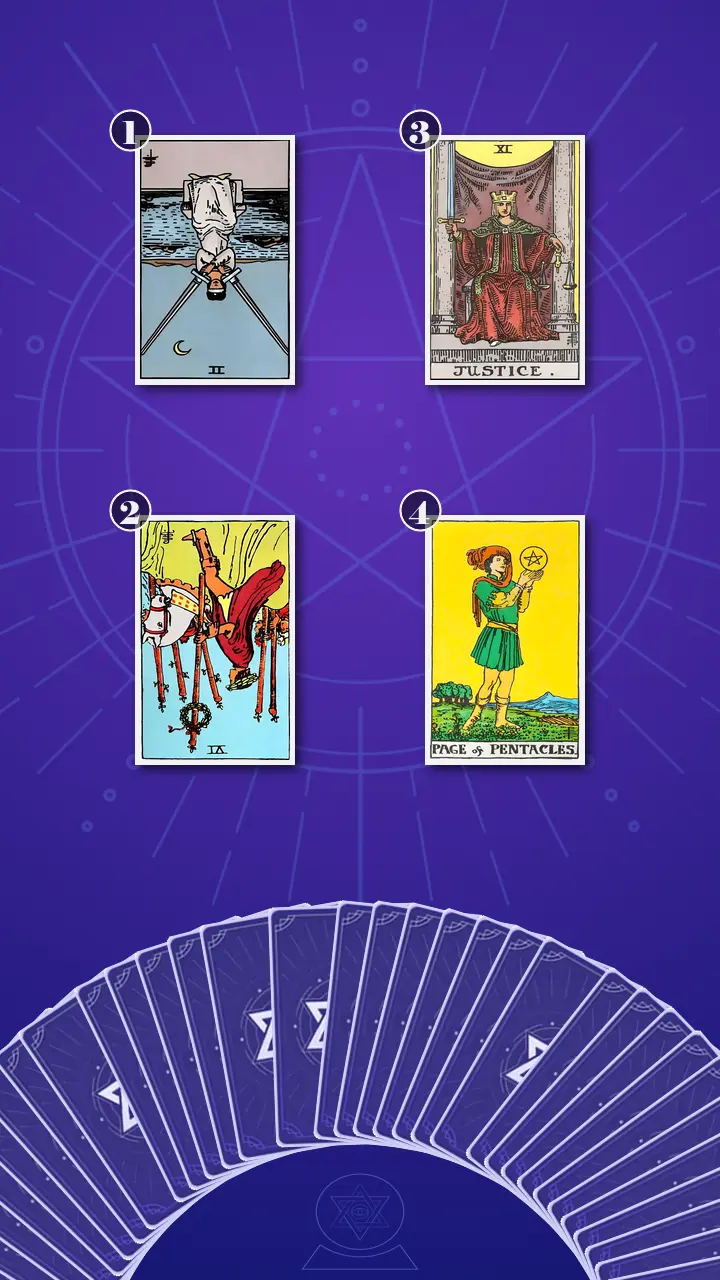
I arranged the cards as two facing columns. In the shadow column, the first position would show the conscious symptom and the second would reveal the hidden root. Across the diagonal, the third position would recover Casey's inner resource. Beneath it, the fourth would turn that resource into a bounded public experiment. The left side would show how visibility distorted the choice; the right side would return evaluation to Casey.
Where the Closed Tabs Reopened
Position One: The Blindfold Behind Three Open Files
I turned over the card representing the conscious symptom: the observable pattern of reopening a settled choice once other people can see and evaluate it. It was the Two of Swords, reversed.
I pointed to the blindfolded figure and the two blades crossed defensively over the chest. Upright, the image can hold a guarded pause. Reversed here, blocked Air had tipped into excess: too many interpretations, too many reopened alternatives, and too much effort spent monitoring an audience that had not yet provided meaningful information. The blindfold did not mean Casey lacked intelligence. It showed how their attention left the reasons in front of them and scattered toward every possible reaction.
The card reproduced the Tuesday-night scene almost literally. Casey had sent a finished portfolio case study, watched two read receipts appear, and reopened three layouts that had been rejected for clear design reasons. A short delay became a search for hidden criticism. The warm laptop, the restless trackpad, and the row of resurrected Figma frames turned a completed choice back into an active debate. The inner sentence was, "I had reasons for choosing this, but if they're quiet, maybe I missed something obvious."
I explained that wanting useful feedback was not the problem. The overcorrection began when every reaction, including silence, became an instruction to reopen the decision. Like a browser configured to restore every comparison tab whenever a notification arrived, Casey's decision process could not preserve closure long enough to learn whether the selected version worked.
Casey gave a short, bitter laugh. "That's so accurate it feels a little brutal." Their fingers tightened around the edge of the laptop and then released it.
"I hear the sting in it," I said. "But I am not reading this as a character flaw or calling you incapable of deciding. I am identifying a sequence. Your chest tightens, your hand reaches for the trackpad, and the choice becomes provisional. A sequence can be interrupted without shaming the part of you that wanted protection."
Position Two: The Wreath Became a Dashboard
Next, I turned over the card representing the hidden root: the fear that disagreement or muted approval reveals defective judgment and reduces personal worth. It was the Six of Wands, reversed.
I showed Casey the rider wearing a laurel wreath, the second wreath displayed on the raised wand, and the surrounding crowd. Reversed Fire was blocked at its source and excessive in its monitoring. Instead of visibility expressing confidence, visibility demanded recognition before confidence could survive. Internal acknowledgement was deficient, while the audience's response had been given disproportionate weight.
I connected that reversal to Casey's workday. They could present a researched recommendation that met the agreed usability constraints, hear one colleague suggest another direction, and immediately feel the ten reasons behind the original choice become lighter than that one confident sentence. Later, Slack reactions, portfolio views, and a former classmate's polished LinkedIn launch would be read like a live legitimacy score. It was like using an engagement algorithm as a quality-assurance dashboard even though the algorithm measured a messy mix of timing, attention, office dynamics, taste, and reach.
"If they look impressed, I feel certain," Casey said quietly. "If they're mixed or slow, I assume I chose badly." Their gaze moved away from the cards, their throat worked once, and their thumb pressed into the side of their mug.
"That distinction matters," I said. "There is nothing weak about caring how your work lands. Design is collaborative, and relevant critique can make the work better. But the Six of Wands reversed shows approval monitoring disguised as feedback. A reaction is data, not a verdict. The shame comes from treating insufficient applause as proof that both the choice and its maker have lost legitimacy."
I asked, "If ten stated reasons supported your choice and one raised eyebrow undid it, were you evaluating the choice, or monitoring whether you were still acceptable to the room?"
Casey did not answer immediately. I watched their jaw set, then soften. "Monitoring whether I was acceptable," they said. "I hate that answer, but yes."
When Justice Lowered the Crowd's Volume
Position Three: One Sword, Three Written Criteria
As I moved diagonally from the shadow column to the agency column, the refrigerator compressor clicked off through Casey's microphone. The kitchen suddenly became quiet. For the first time that evening, the silence had no read receipts attached to it.
I turned over the card representing the reclaimed resource: Casey's capacity to evaluate feedback through fair, self-authored criteria rather than popularity. It was Justice, upright, the key card and catalyst of the reading.
I drew Casey's attention to Justice's unobstructed gaze, evenly suspended scales, and single upright sword. The visual contrast was precise. The Two of Swords had covered eyes and two blades held in defensive opposition. Justice looked directly at the matter, weighed it proportionately, and reached one accountable conclusion. This was not a command to keep the original choice at all costs. Justice could revise. The difference was that a revision needed a relevant reason.
I translated the card into a design-critique practice: before sharing, Casey could write three criteria in a Notion decision note, naming the purpose, the constraints, and the evidence that would justify a change. When comments arrived, even a confident colleague's opinion would receive only the weight its substance earned. An accessibility issue might justify revision. A personal preference about the header might not. Feedback could inform the choice without inheriting the steering wheel.
Seeing Justice, I flashed back to an investment committee during my Wall Street years. I remembered how quickly a room could confuse emotional commitment with forward value when money, status, and prior effort were already exposed. The cleanest decisions began when we stopped asking how much had been invested and asked what each option justified from that moment onward.
I call that lens Sunk Cost Neutralization. Applied here, the hours Casey had spent on three discarded layouts did not buy those layouts a vote in the next decision. Nor did the embarrassment of changing direction obligate Casey to defend the current version. Justice removed both distortions. Past time, money, and emotion became context rather than command; purpose, evidence, constraints, and future opportunity cost returned to the scales.
At 10:42 p.m., the portfolio link had already entered the group chat. Read receipts had appeared, nobody had answered, and Casey's hand was back on the trackpad opening three layouts they had deliberately closed. The mind's demand was simple and impossible: make the exposed choice immune to disagreement.
You do not need unanimous approval to make a sound choice; weigh feedback against your own criteria, and let Justice's balanced scales keep opinion from becoming a verdict.
For a full beat, Casey's breathing stopped. Their fingers stayed suspended above the keyboard, as if the next click had been interrupted mid-command. Then their eyes lost focus. I could see them replaying old critique rooms, delayed messages, and the duplicated files named variations of final-final-v7. Their mouth tightened before the recognition became relief. "But doesn't that mean I've been doing this wrong for years?" they asked, with a brief flash of anger. I told them it meant the strategy had once offered fast relief from feeling exposed, not that every past decision was a failure. The anger loosened first. Their fist opened against the table, their shoulders dropped, and a long breath left their chest with a slight tremor. Their eyes shone, but they smiled without looking triumphant. "Oh," they said. "I can hear an opinion without making it the rule." The release carried a moment of dizziness too, because a fair standard returned both freedom and responsibility to them.
I asked, "Now, using this new perspective, can you think of a moment last week when this insight might have made the experience feel different?"
Casey recalled a critique containing two comments. One identified an accessibility issue; the other came from someone who simply preferred a different visual style. "I put both on the same revision list," they said. "With this filter, I could have acted on the accessibility issue and parked the style preference without pretending I hadn't heard it."
I named the movement I had just witnessed: from approval-dependent self-doubt and public-evaluation anxiety to grounded confidence through self-authored, evidence-aware discernment. It was not total certainty, and it did not need to be. It was the first willingness to remain uncomfortable while asking a better question: does this feedback address the purpose, evidence, or constraints I actually named?
"The goal is not to become criticism-proof," I said. "It is to know what would justify a revision."
The Page Studied the Work, Not the Applause
Position Four: A Version With a Learning Window
Finally, I turned over the card representing the integration practice: one small public experiment that turns a considered choice into tangible action without making approval the success condition. It was the Page of Pentacles, upright.
I saw balanced Earth in the Page's concentrated attention. The Page held one pentacle at eye level and studied the object itself. There was no crowd to impress and no demand for instant mastery. The cultivated field suggested patient development, while the mountain in the distance left room for future skill. Casey did not need to prove permanent confidence. They needed one version stable enough to produce observable evidence.
I asked them to picture publishing one contained portfolio case study with a narrow learning question: can a hiring manager understand the design problem and Casey's contribution after reading the first two sections? They could close the alternative files, leave the selected version unchanged for three days, and record what readers actually understood before looking at likes, views, or praise. The release would not be a permanent declaration of worth. It would be a bounded experiment.
"This version does not need to prove who I am," Casey said, testing the sentence aloud. "It needs enough time in the world to teach me something."
I nodded. "Exactly. A first version needs a learning window, not a live approval score."
Casey leaned closer to the screen. Their posture was not suddenly fearless, but it was no longer folded around the laptop. "One case study. One question. Three days," they said. For the first time in the reading, the next step sounded smaller than the fear surrounding it.
The Decision Log and the Learning Window
Looking across the four cards, I did not see a prediction about whether Casey's portfolio would be praised. I saw a coherent feedback loop. Reopening options after exposure briefly relieved the pressure of carrying one visible position, so the relief trained the behavior to repeat. The Two of Swords reversed showed the conscious churn. The Six of Wands reversed revealed the hidden root: public recognition had become the quality score. Casey's central conflict was not collaboration versus stubbornness; it was the desire for useful feedback colliding with the fear that disagreement would expose unreliable judgment.
Justice restored the resource that pressure had obscured: Casey already knew how to evaluate purpose, evidence, scope, and constraints. The Page of Pentacles then moved that discernment out of the mind and into a tangible release. Until then, Casey had been signing every choice in pencil and handing the eraser to the audience. The cards did not replace the audience with blind self-belief. They returned the eraser to Casey and added a written rule for when using it would make sense.
The cognitive blind spot was simple but consequential: Casey had been weighting discomfort, response time, confidence, popularity, evidence, and personal taste as though they were equivalent inputs. The transformation direction was equally clear. Before making a choice visible, Casey would name three personal criteria. After sharing, they would wait before revising, then weigh each response against those criteria. The choice could change, but Casey would be able to name why.
Two Small Tests for the Next Visible Choice
- The Justice Criteria Gate Ten minutes before the next design critique or Figma preview, open Notion, Apple Notes, or a sheet of paper. Write three lines: "Purpose," "Constraints," and "Evidence that would justify a change." Add one focused request when sharing, such as, "Can you tell me where the case-study logic becomes hard to follow?" Set a reminder for 24 hours later. Until it appears, collect comments without editing. At review time, sort them into "Relevant to stated criteria" and "Personal preference / outside scope." Tip: The criteria do not need to guarantee a perfect result. If three lines feel like too much, write one sentence naming what the choice is trying to accomplish. If 24 hours feels too exposing, begin with 30 minutes or one evening.
- The 3rd-Option Leverage Test Spend 12 minutes mapping the apparent dead ends. Option A is keeping the work private until it feels criticism-proof. Option B is publishing it and letting every reaction dictate the next edit. Then define Option C: share one contained section at a visibility level you choose, attach one learning question, archive the rejected alternatives, and leave the selected version unchanged for 72 hours. At the end of that window, record three observations about the work before checking approval metrics. This third path preserves openness without making the audience responsible for the decision. Tip: An unlisted link shared with one trusted peer counts. The test is reversible, and stopping after defining Option C also counts as useful information about your current capacity.
I told Casey that these were experiments, not commandments. They could revise, reduce the visibility, choose a private decision, or decide that a particular piece of feedback deserved immediate weight. Justice was a relevance filter, not a rigid delay tactic. The final scope and the final decision remained theirs.
Six Days Later: The Version Stayed Live
Six days later, I received a voice note from Casey. They had published one contained portfolio case study, closed the alternative Figma files, and left the selected version unchanged for the full 72-hour window. One reader could not tell which part of the project Casey had owned; another reader preferred a different header. Casey revised the explanation of their contribution because it matched the stated learning question. They left the header alone because the comment was personal taste, not relevant evidence.
They slept through the night. Their first thought in the morning was, "What if it is wrong?" They laughed once, checked the criteria note instead of the analytics, and made coffee. Clarity had not erased vulnerability; it had stopped vulnerability from issuing commands.
I took that as the first modest proof of the shift, not a claim that Casey had solved self-doubt forever. They still cared about how the work landed. They had simply created enough space to distinguish a useful signal from the old dropping sensation in the stomach.
I did not credit the cards with making the decision. The Shadow Spread had made the pattern visible, but Casey wrote the criteria, tolerated the open tab, weighed the evidence, and chose what to revise. Tarot offered the map; Casey retained authorship of the route. That was the real Journey to Clarity: not certainty granted by an outside authority, but a decision process they could explain and still call their own.
If your chest tightens when a choice leaves your screen and enters someone else's view, I hope you remember that the tightening may mark visibility, not a defect in your judgment. Noticing that distinction means the audience is no longer holding the eraser automatically.
If your next visible choice only had to meet the three criteria you can honestly name today, what small part could you leave on Justice's scales, and in the world, long enough to teach you something?