A Late-Night Yes, a Notes Draft, and a Boundary Finally Said Aloud

The 11:40 p.m. Yes: People-Pleasing Under Commitment Pressure
If you are the easygoing city dater who can facilitate a tense work meeting but hears yourself say yes before you know whether you mean it, Jordan’s story may feel uncomfortably familiar.
Jordan, a 28-year-old UX researcher in Toronto, described the moment to me with the precision of someone who had replayed it too many times. At 11:40 p.m. on a Tuesday, the iMessage typing dots pulsed after a conversation about exclusivity. The radiator clicked in their condo, a streetcar bell carried up from the wet road, and the phone felt warm against their palm.
Then the question arrived. Their throat tightened. Pressure spread across their chest as if an invisible zipper had been pulled from their sternum to their jaw. Their stomach seemed to drop half a floor while the rest of them stayed perfectly still.
Within seconds, Jordan typed, “Yes, I want that too.”
At 12:07 a.m., after the typing dots had vanished and the immediate tension had lifted, they opened Notes and began drafting three versions of a different answer: “I do want this, but I might need to slow down.”
“I can hear myself saying yes before I know whether I mean it,” Jordan told me. “I keep thinking I can agree now and work out how I feel later. Then I wake up wanting to pull away.”
I heard the conflict beneath the sequence. Jordan wanted closeness, affection, and the possibility of commitment. They simply did not want closeness at a speed that made them disappear. But in the moment, asking for time felt harsher than agreeing and attempting to repair the promise later.
This was people-pleasing during accelerated intimacy: a request for certainty triggered an automatic yes, the yes temporarily protected the connection, and the honest response arrived only after Jordan was alone. Anxiety came first, sharpened by guilt. Resentment followed quietly behind it.
“I am not going to use tarot to decide whether you should commit,” I said. “I want us to understand why your voice goes offline when an immediate answer is expected. Let’s draw a map of the pressure, the fear beneath it, and the place where your real choice can return.”

Choosing the Bridge: A Relationship Tarot Spread for Commitment Pace and Boundaries
I invited Jordan to put both feet on the floor and take one ordinary breath. I asked them to hold the question without forcing an answer: “Why do I keep saying yes when commitment gets pushed too fast?” I shuffled slowly, using the movement as a transition from reacting to observing, not as a performance of mystery.
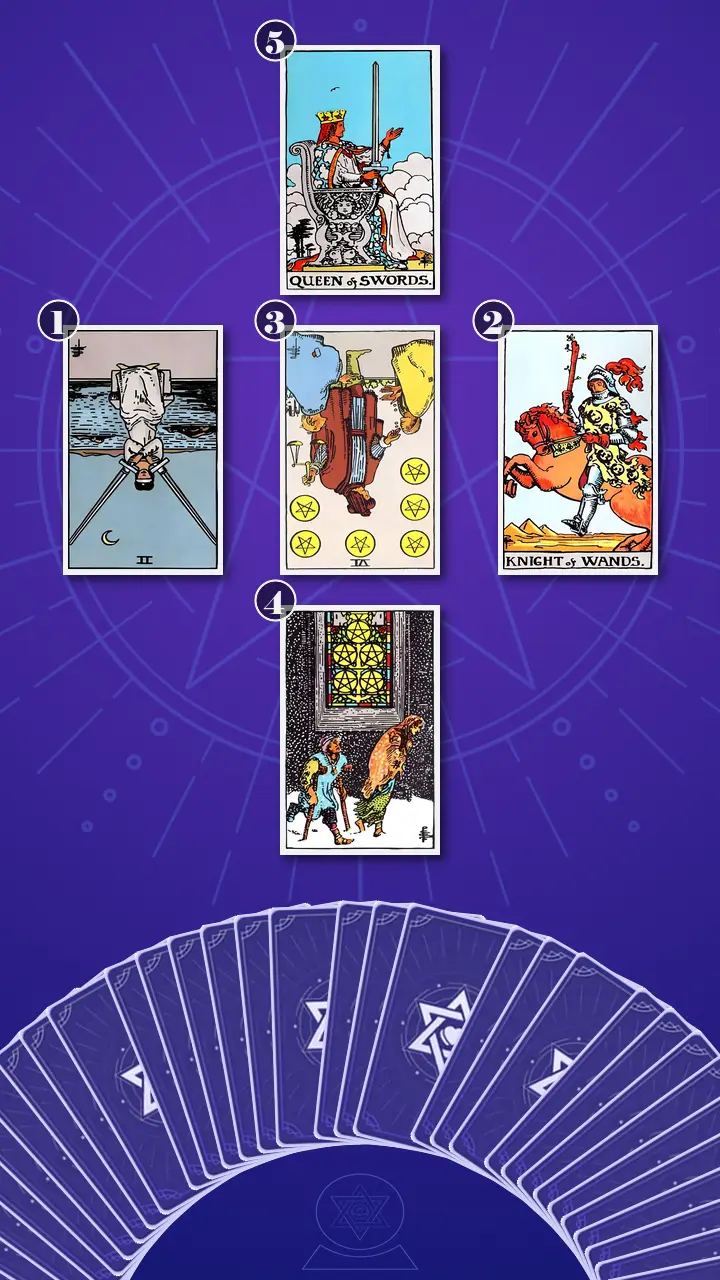
I chose the five-card Relationship Spread · Context Edition. This is how tarot works best in my practice: not as a verdict about the future and not as a way to guess another person’s private motives, but as a structured reflection tool. The five-card relationship reading would let me examine Jordan’s immediate response, the pace they experienced, the exchange that followed, the fear supporting that exchange, and the boundary practice that could interrupt it.
I laid the cards in a cross. The first card sat to the left, representing Jordan’s observable auto-yes response. The second sat to the right, representing the speed and intensity Jordan directly experienced from the other side of the conversation. I placed the third card between them to show the repeating relationship dynamic.
The fourth card went underneath the centre as the hidden psychological foundation: the fear that made pausing feel dangerous. The fifth went above it as a clear signpost, translating insight into conscious action. The spread resembled a bridge, with an unseen anchor below and a direction marker above.
I explained one ethical distinction before turning anything over. “The card on the other side will not tell us what your date secretly thinks. It will show us the pace you are being asked to meet. Your experience is enough data for this reading.”
Jordan nodded, but their shoulders remained high. Their thumb kept moving along the seam of the phone case beside them, as if part of their body still expected another message to appear.
Reading the Yes-Then-Pull-Away Cycle
Position 1: The Answer That Arrives Before the Research
“The card I am turning now represents the observable symptom,” I said. “It shows you agreeing before checking your capacity, then recognising your actual preference only after the conversation.”
I turned over the Two of Swords, reversed.
The blindfolded figure held two swords across the chest while uneasy water moved behind them. Reversed, the card showed blocked Air becoming overloaded: the suspended choice did not resolve into clarity; it collapsed into the fastest available answer.
I returned to the 11:40 p.m. scene. The typing dots pulsed. Jordan’s throat tightened. Silence began to feel more dangerous than commitment, so “Yes, I want that too” left the phone before their own answer had arrived. Minutes later, Notes opened, and the real consultation with themselves began.
“You are not lacking an answer,” I said. “You are losing access to it while trying to protect the relationship from immediate tension. The answer that ends tonight’s pressure is not necessarily the answer that fits tomorrow morning’s capacity.”
I compared the pattern to clicking “Accept all” on relationship terms because the pop-up blocks the screen, then reading the permissions after access has already been granted. Jordan’s collaborative job rewarded quick, smooth responses. Under relational pressure, that useful professional reflex became a form of self-interruption.
“I can hear myself saying yes before I know whether I mean it,” I repeated, giving Jordan’s own sentence back to them. “What would you choose if no response were required tonight?”
Jordan gave a brief laugh, but there was no amusement in it. “That is so accurate it feels a little brutal.” Their fingers stopped moving along the phone case. For a moment, they looked at the crossed swords rather than at me.
“Accuracy can sting without becoming an accusation,” I said. “The card is describing a protective response. It is not calling you indecisive or defective.”
Position 2: The Express Train With Closing Doors
“The card I am turning now represents the speed, intensity, and pressure you experience from the other side of the interaction,” I said. “It does not claim to define the other person’s motives.”
I turned over the Knight of Wands, upright.
The horse was already rearing forward. The Knight’s wand was raised, fresh leaves sprouting from it, and everything in the image suggested enthusiasm, appetite, and motion. Fire itself was not the problem. In this position, however, its speed exceeded the time Jordan needed for reflection.
I described the modern scene back to them: a warm date becomes an energetic conversation about labels, an upcoming trip, and seeing each other more often. The other person sounds certain. The possibilities arrive quickly. Jordan feels as though they have stepped onto an express train because the doors are closing, while still trying to check whether it is going to their stop.
“They sound so sure; if I slow this down, I will ruin the moment,” I said, naming the logic Jordan had described. “But intensity can create momentum without creating readiness.”
I watched Jordan’s jaw loosen slightly. They had been treating another person’s confidence as a standard they were required to match, rather than as one piece of information in a shared negotiation.
“Excitement and readiness can coexist,” I said. “They can also arrive at different times. A conversation moving quickly does not remove your right to stop and assess its direction.”
Jordan looked toward the rain-bright window. “I think I have been calling the momentum chemistry,” they said. “And then assuming I am doing something wrong when my body cannot keep up.”
Position 3: The Connection Tax Hidden in the Calendar
“The card I am turning now represents the central relationship loop,” I said. “It shows how immediate agreement creates temporary harmony while producing an unequal and unsustainable exchange.”
I turned over the Six of Pentacles, reversed.
The scales in the card tilted over figures receiving coins from someone positioned above them. Reversed, the Earth energy was imbalanced. Time, access, reassurance, and availability were being given before Jordan had confirmed that the offering was voluntary or sustainable.
I asked Jordan to open their calendar. They showed me the week after the exclusivity conversation: a research debrief had moved, a gym booking had disappeared, and dinner with a friend had been pushed to the following week to create space for a third date. I could almost hear the squeal of the Line 1 brakes from the scene they described and feel the overheated carriage pressing around an already contracted body.
The affectionate invitation had felt good. The rearranged week had not. Jordan had offered more time and certainty because warmth in the moment seemed contingent on giving an immediate yes.
“If I give them certainty now, maybe I can keep the connection safe,” I said. “That is the exchange at the centre of the spread.”
I used one of my core diagnostic tools, Hidden Cost Deconstruction. Together, we named the emotional bills that had not appeared in the original agreement: two lost recovery evenings, one displaced friendship plan, repeated reassurance messages, a private Notes spiral, and the resentment of living inside a schedule Jordan had not consciously chosen.
Across cultures, I have noticed how often being “easygoing” is praised without anyone asking who quietly pays for the ease. The scales on the card brought that question into view. Generosity was not the problem. The hidden cost of generosity performed under pressure was.
“Certainty is not the admission price for closeness,” I said. “When you provide access in exchange for reassurance that the connection will continue, you lose equal footing even if nobody explicitly names the transaction.”
Jordan’s breath paused. Their eyes moved across the calendar again, as though they were watching the week rearrange itself in reverse. Then they put the phone face down and released a low, tired “Oh.” Their shoulders dropped, but their mouth tightened with a trace of resentment.
“I thought I was being flexible,” they said. “I did not realise I was making the other person’s comfort the priority signal and treating my exhaustion like background noise.”
Position 4: The Door That Had Not Actually Closed
“The card I am turning now represents the underlying obstacle,” I said. “It shows the fear that requesting time will lead to exclusion, withdrawal, or the loss of belonging.”
I turned over the Five of Pentacles, upright.
Two figures moved through falling snow beneath a warm stained-glass window. I made the boundary of the interpretation explicit: this card did not predict rejection. It showed how vividly Jordan’s mind anticipated it.
I returned to the moment after a partner’s tone changed or a reply slowed. The apartment seemed colder. The typing indicator vanished. Before any ending had occurred, Jordan’s mind supplied one: “Their disappointment means I am already being left.” One delayed reply became an algorithm that had supposedly classified the entire relationship as doomed from a single data point.
Through a Jungian lens, I did not see a hidden wish to sabotage closeness. I saw a shadowed part of Jordan that expected belonging to be conditional. That part had learned to stand outside the lit building in imagination before anyone had closed the door in reality.
I introduced my Fear-Driven Logic Decoupling method. I drew two columns on a page. In the first, I wrote the observed evidence: a commitment request was made; Jordan hesitated; the other person’s tone changed; the typing indicator disappeared. In the second, I wrote the fear-driven forecast: they will leave; they will choose someone easier; my need for time proves that I am incapable of commitment.
“Your fear is taking incomplete information and presenting its forecast as a confirmed research finding,” I said. “It is trying to protect you, but it is crossing the line between evidence and prediction.”
Jordan exhaled and stared at the warm window in the card. Their gaze lost focus for several seconds, as if they were replaying old conversations. Then their fingers, which had curled against their palm, slowly opened.
“I keep confusing their disappointment with proof that I have done something wrong,” they said.
“Disappointment is a feeling, not a verdict on your worth,” I replied. “You can witness it without automatically reversing your boundary. A connection may or may not tolerate honest pacing, but you cannot learn that by supplying compliance before the question is tested.”
When the Queen of Swords Made Room for “Not Yet”
Position 5: The Boundary With an Open Hand
The room became very quiet before I turned the final card. Rain moved against the window in fine diagonal lines, but the radiator had stopped clicking. The last position represented the practical transformation: pausing, identifying a sustainable pace, and communicating a clear answer without over-explaining.
I turned over the Queen of Swords, upright.
Her sword stood vertical and unobscured. Her other hand remained open toward what approached. I saw balanced Air returning to the spread: not the blocked, crossed Air of the reversed Two of Swords, but discernment placed into calm language. The boundary was precise without becoming cold. Receptivity remained present without requiring immediate agreement.
At 11:40 p.m., the typing dots return, Jordan’s chest contracts, and “Yes, I want that too” is ready to leave the phone before their own answer has arrived. The Queen does not demand instant certainty. She interrupts the private Notes conversation before it has to become a repair attempt.
You do not need immediate agreement to prove care; choose a pace you can name and sustain, holding the Queen of Swords' upright blade between truth and pressure.
I let the sentence remain between us for a moment.
A pause is not rejection; it is the space where commitment becomes honest.
Jordan’s breath stopped halfway in. Their thumb froze over the dark screen of their phone. Their pupils widened slightly, then their gaze drifted beyond the cards as though the last week were replaying against the far wall: the late-night question, the quick yes, the moved calendar blocks, the Notes drafts. Their brow tightened first, and I saw resistance arrive before relief.
“But doesn’t that mean I have been doing it wrong this whole time?” they asked. The words came out sharper than anything they had said earlier. “That all those yeses were not real?”
“No,” I said. “It means those yeses were protective. They were real attempts to lower pressure and preserve belonging. We can respect what they were trying to do without asking them to keep running your relationships.”
Jordan’s eyes reddened. Their shoulders descended slowly, but the release left them looking briefly unsteady, as though putting down a heavy bag had made them notice how long they had been carrying it. Their hand opened on their knee. A trembling breath left their chest, followed by a quieter one.
I placed Fear-Driven Logic Decoupling beside the Queen’s image. The sword represented one line separating observed evidence from predicted abandonment. The open hand represented sincere interest that did not have to become self-erasure. Jordan did not have to choose between warmth and accuracy.
“Try the sentence,” I said.
Jordan looked at the card and spoke slowly. “I am interested, and I am not ready to decide tonight. I will answer tomorrow.”
The first attempt sounded formal. On the second, their voice became warmer. On the third, they shortened it: “I care about this, and I need until tomorrow evening to answer.”
“Now, with that new perspective, can you think of a moment last week when this insight might have made you feel different?” I asked.
Jordan returned to the exclusivity conversation. “I would still have been scared,” they said. “But maybe I would not have treated the fear as the answer.”
That was the breakthrough. It was not a leap from anxiety to perfect confidence. It was the first movement from anxiety-driven auto-agreement and delayed withdrawal to honest, self-paced commitment and steadier closeness. Jordan was beginning to treat pace as compatibility information rather than evidence that their interest was insufficient.
A warm boundary was still a boundary. A pause was still an answer.
The 24-Hour Honest Yes
I gathered the cards into one coherent sequence. The reversed Two of Swords showed Jordan losing access to internal information under pressure. The Knight of Wands showed intensity outrunning reflection. The reversed Six of Pentacles revealed the practical cost: Jordan purchased short-term reassurance with extra certainty, time, and access. The Five of Pentacles exposed the foundation beneath that exchange, the fear of being left outside if they hesitated. The Queen of Swords restored the missing capacity: a calm sentence that held care and discernment together.
The spread’s elemental movement also mattered. Blocked Air was overtaken by urgent Fire, and urgency hardened immediately into practical promises through two Pentacles cards. Water was absent. Jordan’s felt response had been bypassed before it could inform the decision. The correction was simple, though not necessarily easy: feel first, name the truth second, and commit only after both had been considered.
I named the cognitive blind spot directly. Jordan had assumed that asking for time created more relational harm than giving an answer they could not sustain. The immediate harmony of a quick yes was visible; the later resentment, withdrawal, cancelled plans, and unclear consent were hidden bills. Their task was not to become certain faster. It was to replace the immediate yes with a standard pause: name the request, check personal capacity, and return with an answer after a specific amount of time.
I did not ask Jordan to make a decision about exclusivity during the reading. I gave them three small practices for finding clarity without turning reflection into another endless analysis loop.
- Save the Name-Check-Return Pause. Before the next date, save this phone shortcut: “I care about what you are asking. I want to check what I can genuinely sustain, and I will answer by tomorrow evening.” When a label, trip, exclusivity request, or major availability change appears, name the request in plain language and use the shortcut before discussing the answer. Keep one warm sentence, one limit, and one return time. The minimum version is: “I need until tomorrow to answer.” A return time is a promise to revisit the question, not a promise to say yes.
- Run the 90-Second Missing-Water Check. Set a 90-second timer before answering. Notice only the throat, chest, and stomach, then label the overall signal “open,” “neutral,” or “contracted” in Notes. Ask: “If no answer were required tonight, what feeling would I notice first?” Write one sentence and stop. The body signal is information, not an automatic verdict. If body-focused attention feels uncomfortable, skip it and check practical capacity instead: open your calendar and identify what the commitment would displace.
- Try the 48-Hour Shadow Choice Experiment. On paper only, intentionally choose the option that feels most frightening: “I will ask for time instead of agreeing tonight.” For 48 hours, record every defence your mind produces, including predicted rejection, urges to over-explain, and imagined evidence that you are difficult. Add three lines: “What am I offering? What do I need in return? Does this still feel voluntary?” This is not a test of the other person, and nothing has to be sent. The experiment reveals the fear attached to the pause so that fear can be examined separately from your actual preference. Ten minutes is enough.
I asked Jordan to read the saved sentence aloud once and notice whether anything changed in their throat, chest, or stomach. Their throat remained tight, but the pressure across their chest softened.
“It still feels risky,” they said.
“That makes sense,” I replied. “The goal is not to make the risk sensation vanish before you speak. The goal is to stop treating that sensation as an instruction to abandon your pace.”
I reminded them that a boundary script could not guarantee a perfect response. Another person might feel disappointed, ask questions, or decide that they wanted a different pace. Tarot could not remove those possibilities. What the reading restored was Jordan’s ability to meet reality with their own voice intact.

A Week Later: The Quiet Proof
Six days later, I received a short message from Jordan. Another future-focused conversation had started late in the evening, and they had felt the familiar constriction rise from stomach to throat. This time, they named the request and used the shorter line: “I care about this, and I need until tomorrow evening to answer.”
The response was not perfectly reassuring. There was a long pause, followed by, “I wish you already knew.” Jordan felt the old drop in their stomach, but they did not rush to reverse the boundary or send a five-paragraph explanation. They returned the next evening as promised.
Their honest answer was not yet on exclusivity, paired with a clear yes to continuing the relationship at a pace they could sustain. They offered one weeknight and one weekend plan rather than rearranging the entire calendar. The conversation remained complicated, but it became real.
Jordan slept through the night, then woke with the thought, “What if I ruined it?” This time, they smiled faintly, opened the saved sentence, and let the question exist without treating it as a command.
I did not see that as a solved life or a flawless boundary. I saw it as proof of growing self-trust. The cards had not created Jordan’s clarity, and I had not handed them the correct relationship decision. The reading had helped Jordan see the pattern clearly enough to reclaim the pause in which their own wisdom could speak.
When someone asks for certainty before your body has caught up, your throat may tighten and the yes may come out anyway, because losing your pace still feels less frightening than losing your place with them. I want you to remember that noticing this sequence already changes your position inside it: the lit door, the open hand, and the calendar hold for your own decision time are still available.
If a pause were allowed to belong inside closeness, what answer would you give yourself permission not to rush tonight?