Editing Out a Bold Sentence on Line 1, Then Restoring It to Learn

Finding Clarity on the 8:47 Line 1
I recognized the pattern as soon as Casey told me about her portfolio full of almost-finished case studies. Each time a former classmate announced a promotion, creative collaboration, or career pivot, she polished the safest version of her own work. I thought of it as Comparison Fatigue disguised as professional judgment.
At 8:47 on a Tuesday evening, Casey had been riding Line 1 home through Toronto. As she described the scene, I could almost hear the brake squeal and the fluorescent lights buzzing above her. Her phone felt warm in her palm as Instagram Stories moved past rooftop drinks, launch announcements, and smiling former classmates beneath captions about being “so excited for this next chapter.”
She reopened her portfolio draft before the train reached the next station. The boldest sentence in the case study suddenly looked embarrassing. Her jaw tightened. Her breathing moved high into her chest. By the time the doors opened, she had replaced the sentence with language that sounded polished, familiar, and almost impossible to criticize.
“I know which choice would stretch me,” she said when we sat down together, “but I also know which choice will make sense to everyone else.”
Her phone remained face down beside her, although the screen kept lighting against the tabletop. She rubbed the hinge of her jaw with two fingers. The feeling in her body seemed less like ordinary indecision and more like standing beneath cold office lighting while an invisible review panel inspected every unfinished edge of her work.
Casey was caught between the growth she wanted and the public approval she feared losing. At work, she chose production tasks that made her look competent now instead of ambiguous discovery work that would make her more capable later. In her portfolio, she edited away originality until the result looked professionally defensible but no longer felt recognizably hers. With friends, she turned supportive conversations into approval panels and felt even less certain when their advice conflicted.
“Maybe I don't want it badly enough,” she said. “Or maybe I just need one more opinion.”
I let the silence remain for a moment. Then I said, “I don't think the goal is to stop caring what people think. Feedback matters, especially in design. What we need to examine is the moment feedback stops being useful information and starts acting like permission.”
I told her I would not lecture her into becoming fearless. I would help her separate actual professional constraints from the judgments she was rehearsing in advance. Our Journey to Clarity would not produce a guaranteed outcome. It would give us a map of why choosing public approval over personal growth felt safer, and identify one move she could still make while uncertainty remained.

Choosing the Ladder: The Shadow Spread
I invited Casey to take one slower breath and hold her question in plain language: “Why do I keep choosing public approval over the growth I want?” I shuffled while she focused on that sentence. The brief ritual was simply a transition from looping thoughts to deliberate attention; it did not require her to believe that the cards controlled what happened next.
I chose a four-card layout called The Shadow Spread. For anyone wondering how tarot works in a question like this, I use the cards as a structured cognitive mirror. Their symbols help us externalize a pattern, compare its moving parts, and ask better questions. They do not diagnose a person, predict an unavoidable fate, or make the decision on the querent's behalf.
The Shadow Spread suited Casey's question because she was not asking me to compare two jobs or forecast public success. She wanted to understand why the same approval-seeking loop kept returning. A larger spread would have added external detail without necessarily clarifying the internal mechanism.
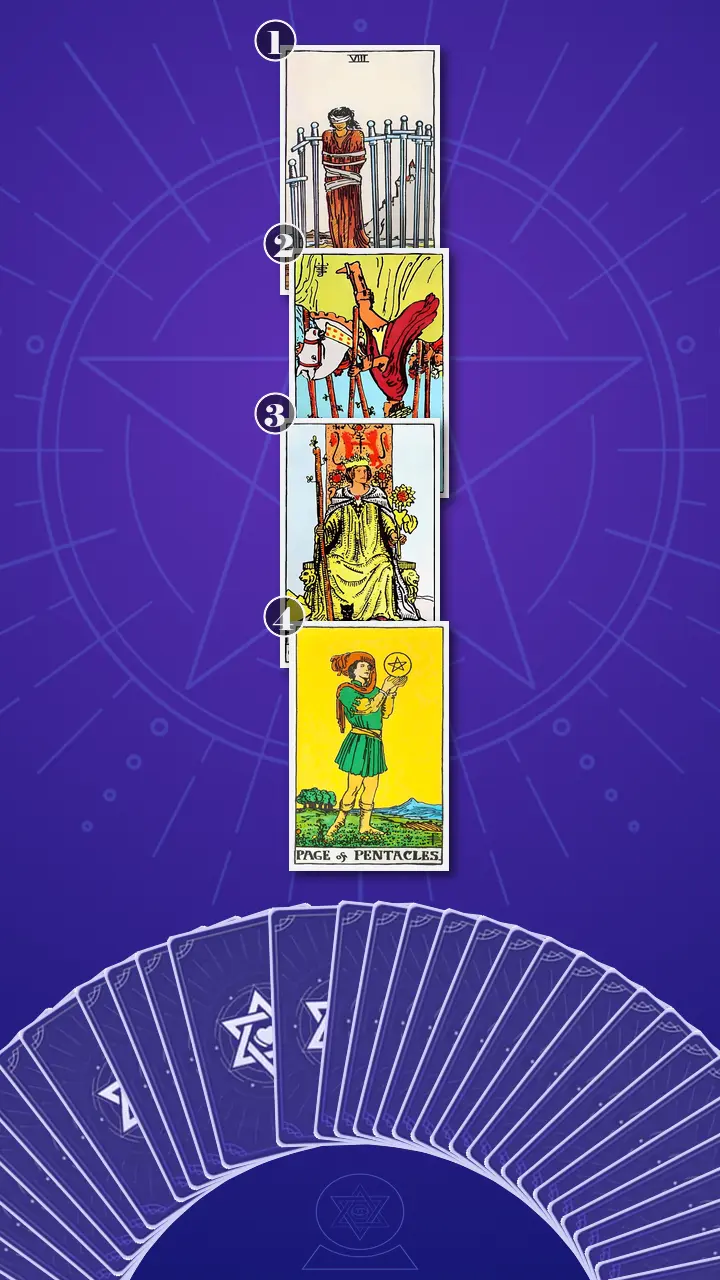
I arranged four cards as a vertical ladder. The first position would show the visible shadow pattern: what Casey was doing in daily life. The second would uncover the hidden fear giving that behavior its authority. The third, the reading's central bridge, would identify a self-authored quality capable of interrupting the loop. The fourth would ground that insight in a small, observable experiment.
I explained that we would move from symptom to root, from root to reframe, and from reframe to practice. The final card would not promise an outcome. It would offer a place to put her foot.
The Figma File with Invisible Permissions
Position 1: The Visible Shadow Pattern
Now I turned over the card representing the visible shadow pattern: the way Casey delayed or reshaped a desired growth choice until it looked publicly acceptable.
It was the Eight of Swords, upright.
I pointed to the blindfold, the loose bindings, and the ring of swords around the figure. “This card often describes restriction, but the image asks us to distinguish a locked door from a boundary the mind has learned to rehearse. The figure's movement is limited, yet not every limit is as fixed as it first appears.”
I brought the symbolism directly into Casey's workday. At 6:12 p.m., she could open an ambiguous discovery board in Figma and find no clear acceptance criteria. Instead of writing one focused research question, she would switch to a polished production ticket, check how other designers presented similar work, and edit her portfolio toward the safest available language. The enclosing swords became imagined reviews. The blindfold became the conviction that only an already approved choice was professionally acceptable.
“It is like a Figma file with invisible permission settings,” I said. “Nothing technical is stopping you from editing, but you keep waiting for an owner to approve your access.”
The Air energy of the Eight of Swords was contracted into a blockage. Casey did not lack intelligence or options. Her intelligence was working overtime to simulate every possible criticism, and the simulation was narrowing what she could see. Hyper-analysis made an imagined audience feel physically present before anyone had offered an opinion.
I asked, “Think of the last time you changed the meaningful part of a proposal because you imagined a manager or peer disapproving. What restriction was actually present, and which one were you rehearsing?”
Casey gave one short laugh, but there was no amusement in it. Her fingers tightened around the cuff of her sleeve before loosening again. “That is so accurate it's almost a little brutal,” she said. “I call it being thoughtful. But half the time nobody has even said no.”
I nodded. “Then we don't use the card to shame you for thinking carefully. We use it to separate care from captivity. Your caution may contain useful information, but the imagined verdict does not get to impersonate a real constraint.”
Position 2: The Crowd Inside the Notification Tab
Now I turned over the card representing the hidden driver: the fear that public judgment could disprove Casey's ability, worth, or place in the room.
It was the Six of Wands, reversed.
Upright, the card displays recognition openly: an elevated rider, a laurel wreath, raised wands, and a watching crowd. Reversed, that public victory can become an unstable internal scoreboard. The problem is not wanting appreciation. The problem begins when visible recognition becomes the condition that tells someone whether private effort counts.
I described a familiar sequence. Casey posts a design thought on LinkedIn, refreshes the notifications page, and watches the first few reactions. A quiet hour begins to feel like a public referendum. Before any useful feedback arrives, she replaces the unusual example with one that is easier to praise.
I said, “The inner monologue sounds something like this: If nobody responds, maybe it wasn't good. If they respond warmly, maybe I'm allowed to trust it.”
The card's Fire was not absent. Casey's ambition was real. But in the reversed position, that Fire had been redirected into excessive monitoring while self-validation remained underfed. Energy that could have gone into experimentation was being spent reading LinkedIn reactions, portfolio compliments, and a silent group chat like market indicators for personal worth.
Her hand stopped halfway to the water glass. First her breathing paused. Then her eyes moved away from the card and lost focus, as though she were replaying a row of quiet posts and unanswered messages. Finally, she exhaled through her nose and lowered her shoulders by a fraction.
“When nobody reacts, I start wondering whether the work mattered at all,” she said. “And if someone doesn't like it, I don't just think they disliked the idea. I think they can see that I'm not as capable as they thought.”
I answered carefully. “That is why one more opinion rarely settles this. You are not waiting for better evidence; you are waiting for permission to trust your own direction. The relief from reassurance is real, but it expires, so the scoreboard asks to be checked again.”
I also warned her against swinging to the opposite extreme. “This card is not telling you to reject feedback, stop collaborating, or pretend criticism cannot hurt. That would be the same fear wearing the costume of independence. Useful feedback addresses the work. Permission decides whether you are allowed to continue. Those are different jobs.”
I tapped the reversed laurel wreath lightly. “A quiet reaction is information about a moment, not a verdict on your worth.”
Outside the consultation room, a streetcar bell sounded once and faded into the wet Toronto traffic. The noise was brief, clear, and then gone. I noticed how neatly it contradicted the imagined crowd in the card: not every signal had to become a lasting judgment.
When the Queen Kept Hold of the Pen
Position 3: The Transformative Reframe
The room grew still as I reached for the central card. Now I turned over the card representing the transformative reframe: the self-authored quality that could interrupt the pattern and let Casey receive feedback without surrendering her direction.
It was the Queen of Wands, upright.
I showed Casey the sunflower held beside the Queen, the budding wand in her other hand, and the black cat settled at her feet. The Queen's confidence was not a loud performance of certainty. Her posture conveyed a warmer and more disciplined authority: she could face the world while remaining connected to a private center.
In Casey's life, I translated the card into a specific design-review morning. At 9:03 a.m., before the meeting began, she would leave one distinctive choice in a rough product direction and write down the question she actually wanted answered. She could watch the room's response without rebuilding the idea around the first facial expression. The sunflower represented the value she meant to bring. The budding wand allowed the experiment to remain unfinished. The black cat represented the quiet judgment that still belonged to her.
The Queen's Fire was in balance. It neither hid from visibility nor consumed itself performing for the crowd. It created a third option between secrecy and self-erasure: Casey could let the work be seen while she was still learning.
By then, I could see the thought that had trapped her. On Line 1, she had treated the bold sentence as though it needed public certification before she could leave it in the draft. The real question was not whether she cared about quality. It was who had the authority to let her risk becoming more original.
I thought of the years I had spent at Cambridge and on archaeological digs, where a collapsed wall rarely meant that an entire culture had contained nothing worth preserving. A fracture could reveal the governing assumptions beneath the structure. Some foundations remained sound. Others had reached the end of their usefulness.
I call this Cognitive Paradigm Excavation. I asked Casey to treat her growth bottleneck as the collapse of an obsolete intellectual era rather than proof that she lacked discipline. The old governing law was simple: only work that other people could immediately understand and approve deserved visible commitment. That law had once protected her professional identity, but it could no longer support the more capable and original designer she wanted to become.
Do not wait for the crowd's applause to prove that your direction is valid; choose one visible act of growth from your own values, like the Queen of Wands holding her sunflower while her black cat stays at her feet.
I stopped speaking and let the sentence occupy the room.
Casey's breath froze first. Her fingertip remained suspended above the black cat on the card, and her pupils widened slightly. Then her gaze shifted toward her own hands, as if she could see them deleting the sentence on the train all over again. Colour rose along her cheekbones. Her jaw set rather than softened.
“But doesn't that mean I've been doing it wrong this whole time?” she asked. The words arrived sharply, then broke at the end. “I've spent years trying to look like I deserved to be in the room.”
Her shoulders dropped, but relief did not arrive alone. Her fingers opened slowly against the table. Her eyes became bright, and she gave a small, unsteady exhale that sounded like both recognition and grief. For a few seconds she looked almost disoriented, as though setting down the audience's verdict had removed a weight but also left her responsible for choosing what came next.
I said, “I would not call your earlier choices wrong. They helped you build craft, credibility, and sensitivity to other people. We carry those foundations forward. What we leave in the past is the equation that says approval equals worth. Clarity can sting because it returns authorship to you, and authorship includes the possibility of making an imperfect choice.”
I leaned back slightly and asked, “Now, using this new perspective, can you think of a moment last week when this insight might have made you feel different?”
Casey mentioned a review in which she had removed an unusual research framing before anyone saw it. “I could have said, 'This is the direction I'm testing,'” she told me. “I could have asked whether the framing helped them see the user problem. Instead, I asked whether the whole thing seemed good.”
“That is the shift,” I said. “Tell me this is valid before I move becomes I can choose this direction, then learn from what happens. You can be visible without handing the audience the pen.”
I invited her to open her notes app. Within ten minutes, she wrote one direction she would still practise if nobody could praise it. Then she made a two-minute, reversible move: she restored the distinctive sentence to her portfolio draft and labelled it “testing this framing.” She did not publish the case study or promise to keep the sentence forever. The point was to preserve one live possibility long enough to learn from it.
I asked her to record what the move had already shown her before checking anyone's reaction. She wrote, “The specific version feels more vulnerable, but it explains what I actually noticed.”
That sentence marked the reading's central emotional transformation: a first movement from shame-laced tension and outsourced authority toward self-authored visibility. She had not become permanently confident. She had simply allowed commitment to begin before public certification.
Where the Fire Became a Dated File
Position 4: The Grounded Experiment
Now I turned over the card representing the grounded experiment: one small, observable practice through which Casey could build self-trust by learning rather than by collecting social proof.
It was the Page of Pentacles, upright.
The Page held a single coin in both hands. Behind the figure lay a green field and distant mountains. Nothing in the image suggested instant mastery, a dramatic launch, or an applauding audience. The card gave full attention to one tangible beginning.
I translated it into Casey's Saturday morning. She would set a thirty-minute timer, open a fresh Figma file, and practise one unfamiliar research-synthesis method. At the end, she would keep the rough artifact, save it with the date, and write three lines: what I tried, what confused me, and what I would test next.
The Pentacles energy was grounded and balanced. The Page redirected Casey from performing readiness to accumulating evidence through repetition. The dated file would be a small material record that she had returned to the work, even if no manager, follower, or friend ever saw it.
“So the Page is basically a beginner's notebook instead of a launch announcement,” Casey said.
“Exactly. Let the first proof of growth be a dated practice, not an applauded performance.”
She frowned at the card. “Thirty minutes sounds easy when we're sitting here, but my weekends fill up. Then I make the exercise bigger because it needs to feel worthwhile, and I avoid it.”
I adjusted the recommendation immediately. “Then begin with ten minutes, one file, and one learning target. The Page is not impressed by the size of the plan. It cares whether you can touch the work without turning the practice into another public identity test.”
Casey nodded, looked down at the restored sentence in her portfolio, and closed the notifications panel before saving the file.
Excavating the Law Beneath the Loop
I laid the four cards back into their ladder. The Eight of Swords showed the visible restriction: Casey delayed the uncertain work and edited herself toward what looked safe. The reversed Six of Wands revealed why the restriction had such force: public recognition had become the authority that decided whether an effort counted. The Queen of Wands reclaimed that authority without dismissing collaboration. The Page of Pentacles gave the reclaimed authority somewhere ordinary to live.
The elemental movement made the story especially clear. Contracted Air had kept Casey thinking about judgment. Distorted Fire had kept her monitoring applause. Balanced Fire returned her to desire and creative authorship. Earth turned that authorship into a dated practice. Cups were absent, which reminded me that the spread would not supply emotional permission automatically. Casey still had to allow embarrassment, disappointment, longing, and mixed feedback to exist without converting them into a verdict about belonging.
Her cognitive blind spot was subtle because it looked so professional. She treated repeated polling as objectivity and social defensibility as evidence of correctness. Yet every extra opinion moved the decision farther from the question she actually needed to test. She was not merely gathering information; she was outsourcing the authority to begin.
I used my second archaeological lens, Core Philosophy Stratigraphy, to separate the beliefs layer by layer. Casey did not need to abandon care, collaboration, ambition, or high standards. Those were sound foundations. She did need to leave behind three obsolete equations: unfamiliar means irresponsible, mixed feedback means inadequate, and public silence means the work had no value.
The transformation direction was therefore precise: use public reaction as information rather than a verdict, and take one visible growth action before seeking consensus. Approval could remain welcome. It simply could not be the gatekeeper of commitment.
The Paradigm Shift Manifesto
I introduced Casey to my Paradigm Shift Manifesto, a rigorous exercise for naming the governing laws of a new life chapter. I do not use a manifesto as an inspirational promise. I use it as a field document: short, testable, and clear enough to consult at the exact moment an old pattern becomes persuasive.
Casey's first draft contained three laws: “I may choose a reversible direction before polling the room. Feedback may shape the work without owning the decision. Practice counts before applause.”
We translated those laws into three next steps small enough to begin without performing a personality transformation.
- Take the five-minute no-poll pause. Before opening LinkedIn, Slack, or a group chat about a career or creative decision, Casey will open her notes app and write: “The direction I want to test is...” and “I want to learn whether....” She will make one reversible move before requesting an opinion. Tip: If five minutes feels loaded, write one sentence and limit the experiment to a private draft.
- Keep one distinctive portfolio choice. In her current case study, Casey will retain one specific sentence or design decision that she would normally make generic. She will send a private link to one trusted design peer with one focused question, such as “Does this framing make the user problem clearer?” After receiving the response, she will wait ten minutes before revising and label each comment as information, preference, or prediction. Tip: One informed reviewer is enough. She may withdraw the draft or end the experiment if the emotional cost becomes too high.
- Create a dated beginner artifact. On Saturday morning, Casey will set a ten-to-thirty-minute timer, practise one unfamiliar product-design skill in a single Figma file, and save the rough version with the date. Before checking reactions, she will record what she tried, what confused her, and what she would test next. Tip: The file does not need to be shared. The smallest valid version is ten minutes of practice and one sentence about what changed.
I reminded Casey that these were experiments, not tests of courage. She could revise, stop, keep the work private, or decide that a direction was genuinely unsuitable. Agency included the right to change course. The purpose was not to force a brave performance; it was to collect cleaner evidence before the approval loop edited the question out of existence.

A Week Later, the Rough File Still Existed
A week later, I received a message from Casey with a screenshot of a dated Figma file. She had completed twenty-three minutes of research-synthesis practice. The artifact was uneven and visually plain, but underneath it she had written three lines about what she learned. No engagement metrics appeared anywhere in the frame.
She had also kept the distinctive sentence in her portfolio and sent one focused question to a trusted colleague. The colleague liked the insight but suggested that Casey add evidence. Instead of reading that response as a rejection, she labelled it “information,” waited ten minutes, and revised the supporting material without deleting the original idea.
Her final line was quieter: “I slept properly, but my first thought this morning was still, What if this is embarrassing? I laughed a little, opened the dated file, and kept going.”
I did not read that message as proof that uncertainty had disappeared. I read it as the first grounded evidence that uncertainty no longer held exclusive authority. The cards had not given Casey confidence by magic. They had helped her see the old structure clearly enough to choose one different action, and she had done the choosing.
I know that when your jaw tightens over an unfinished idea and you start editing yourself into someone nobody can criticize, the hardest part is not wanting approval. It is fearing that one imperfect attempt could make you unworthy of belonging. Merely noticing that fear as an old governing law means you are no longer standing entirely inside it. Your work can be unfinished and still belong to you.
So I leave you with the question beside Casey's restored sentence, the Queen's sunflower, and the Page's dated file: if other people's reactions could be information rather than a verdict, what small piece of work might you let remain recognizably yours while you keep learning?