The Rain-Check Text That Turned Into Pajamas and Doomscrolling
When Jordan (name changed for privacy) appeared on my screen from Toronto, I found myself saying something I have learned to say very plainly: if you work hybrid, spend all week online, and then lose half your Sunday to TikTok, headlines, and unread group chats because getting dressed at noon feels weirdly high-stakes, you are not imagining that doomscrolling loop.
She was calling me at 11:38 a.m., still under a grey blanket in an oversized T-shirt, with cold coffee on the nightstand and a phone warm in her hand. I could hear the radiator humming through her laptop mic, and once, sharp and metallic, a streetcar screeched outside. Sunlight had hit one wall of her apartment, but the blinds were still half-closed, as if the room itself had not decided whether the day had started.
'My brunch got canceled,' she said. 'And then I just... stayed like this. I wanted it to become rest, but once I'm still in pajamas at noon, it feels embarrassing to start over.' What she described was the exact contradiction sitting at the center of her reading: an empty pause had opened in the day, but instead of becoming a place to breathe, it had become a place to hide. The disappointment was sitting in her body like wet laundry draped over her arms, while her head buzzed like a phone trapped under a pillow.
I nodded. 'That isn't laziness,' I told her. 'It's a loop. And loops can be mapped. Let's make this hour a little clearer.'

Choosing the Compass: A Tarot Spread for a Free-Day Shutdown
I asked Jordan to put the phone face down for one breath and keep the canceled-plan feeling in mind while I shuffled. I am never interested in ritual for its own sake; I use it the way I use a pause under a planetarium dome before the stars come up. It helps the nervous system notice that we are shifting from reaction to observation.
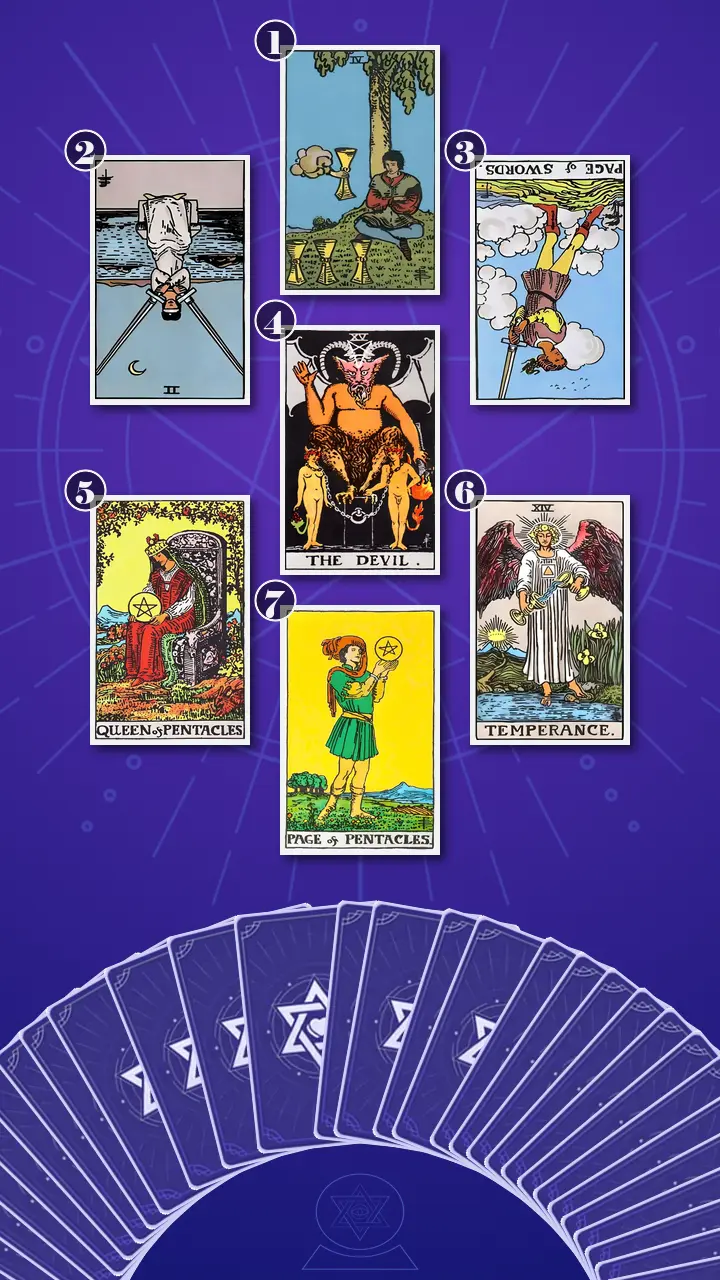
For this reading, I chose my Energy Diagnostic Map · Context Edition. When people ask me how tarot works for something as modern as doomscrolling after canceled plans, my answer is simple: I do not use the cards to moralize the habit. I use them to separate the visible symptom from the inner split, the outside amplifier, the core bind, the available resource, the turning point, and the grounded next step.
At the Tokyo planetarium, I never explain an eclipse with one still frame. A loop has to be shown in motion, or it stays mysterious. That was why a simple Past-Present-Future spread would have flattened Jordan's situation. This was not one mood passing through a day. This was a feedback system: the slump, the indecision, the comparison-heavy input, the shame knot in the middle, then the body-based way out.
I told her what I especially wanted to see. The first card would show the surface state she could already recognize. The center card would name the binding pattern that kept feeding the low-energy self-isolation loop. The fifth and sixth cards would matter most for finding clarity, because one would show what support was already in reach, and the other would reveal the exact rebalancing that could get her back into her own life.
Reading the Storm Eye
Position 1: The Blanket Stayed On
Now the card representing Jordan's visible surface state turned over: Four of Cups, upright.
I told her this was the classic image of a day going emotionally flat after disappointment. In real life, it looked exactly like what she had just shown me: lying in bed after the cancellation, phone in hand, while perfectly okay alternatives still existed nearby — a shower, a walk, a solo coffee, opening the blinds — and yet none of them felt emotionally reachable because the day still felt organized around what did not happen. The energy here was blocked Water: feeling without flow, mood without movement, withdrawal disguised as downtime.
'This card doesn't say there is nothing available,' I said. 'It says you cannot receive what is available once the original plan disappears.' Then I added, because she needed the sentence right there, 'A canceled plan can disappoint you without defining the whole day.'
Jordan gave a short laugh with a bitter edge to it. 'Wow,' she said. 'That is accurate enough to feel rude.' Her thumb, which had kept ghost-moving against the side of the phone even after she set it down, finally stopped.
Position 2: Twelve Tabs for the Next Hour
The next card was for the inner tension beneath the slump: Two of Swords, reversed.
I told her this card showed the part nobody else sees. It was not only that she felt disappointed. It was that she kept every option technically open — rest, reschedule, go out alone, reset the apartment — until the pressure of choosing any one of them started to feel too exposing. That is the reversed Two of Swords in modern clothes: weather in one tab, a cafe map in another, a half-typed group-chat reply, and forty more minutes gone because the whole next hour had become one over-negotiated question. The energy was excess Air leaking through a blocked choice. Her mind was busy, but not deciding.
'Rest feels different when it is chosen,' I told her, 'not when it is covering an unmade decision.' I asked her which moment felt most loaded — getting dressed, texting back, or leaving the apartment. She looked down immediately.
'Getting dressed,' she said. 'Because then I have to admit the day got weird.' Her jaw tightened when she said it, then loosened, as if naming that out loud had taken some of the performance out of it.
Position 3: Push-Notification Mode
The third card showed the outside amplifier: Page of Swords, reversed.
I smiled, not because it was funny, but because it was brutally on-theme. This card is what happens when attention mistakes vigilance for care. I described the exact modern life scenario it mirrored: one news alert pulls you into headlines, then a TikTok about burnout, then Instagram stories of rooftop brunches and airport gates, then back to the group chat, then back to the news, until your nervous system is basically living on a For You Page that keeps serving 'just one more thing.' The body stays in the same dent in the bed or couch, while the mind goes into push-notification mode. That is Air in excess — scattered, reactive, overfed.
'Your phone can keep the room from feeling quiet,' I said, 'but it cannot make the day feel held.' The sentence landed hard. Jordan's eyes moved offscreen toward the kitchen counter, where I suspect another screen was waiting, just out of view.
Position 4: The Loop That Calls Itself Comfort
Then I turned the center card, the one naming the binding pattern itself: The Devil, upright.
I felt the reading click into place. Even over video, I could hear the faint buzz of her fridge from the next room, the kind of apartment noise that gets louder when you are trying not to hear your own thoughts. I told her The Devil here was not about being dramatic or self-destructive. It was about low-friction relief turning into captivity. In modern terms, it was the 4:21 p.m. version of her day: still in pajamas, phone warm in her hand, eyes dry, stomach a little off from random snacking, thinking, 'I could get up anytime, just not yet,' while every extra hour made re-entry feel more expensive. Like Netflix autoplay for a coping system, the next episode starts before you decide whether you even want it.
I kept her focused on the loose chains in the card. 'That matters,' I said. 'Because the habit feels absolute, but it is not absolute. The chain is made of tiny repeated permissions: stay horizontal, check one more thing, answer later, shower later, decide later.' This was distorted Earth — heavy, binding, falsely stabilizing. I asked her, gently, 'If you are brutally honest, what discomfort is the scroll protecting you from for five quiet minutes?'
She winced before she answered. Then she nodded once. 'Feeling like maybe nobody was that bothered to see me today,' she said. The truth of it did not make her dramatic. It made her quieter.
Position 5: The Room Becomes Livable Again
The fifth card showed the stabilizing resource already within reach: Queen of Pentacles, upright.
I felt the whole spread exhale. I told Jordan this was the corrective the top half of the reading had been begging for. The mind was overfed; the body was under-supported. The Queen of Pentacles does not ask for a better attitude first. She asks for clean fabric, warmth, light, water, actual food, a made surface, a room that feels inhabited instead of hidden in. In her modern translation, this was changing out of the sleep T-shirt, opening the blinds, sitting upright with soup or tea, washing her face, maybe walking once around the block. Balanced Earth. Tangible care.
'You do not need a new personality,' I told her. 'You need to become physically here again.' I watched her shoulders drop a fraction. She glanced toward the window, then back to me, and I could see the thought crossing her face: okay, maybe one of those things is possible.
When Temperance Poured Between Two Cups
Position 6: Rest and Motion in the Same Day
When I turned the sixth card, the call seemed to go quieter on both ends. The late light on the wall behind Jordan had gone from hard white to something softer, and for one suspended beat even the city noise outside her apartment fell back. This was the key transformation card, the antidote to the whole loop: Temperance, upright.
I told her that this card matters so much in readings about burnout, bed rot after a rain check, and free-day shutdown because it refuses the fake choice between a total comeback and a total collapse. One foot on land, one in water. Disappointed, and still moving. Resting, and still in contact with life.
This is where I brought in one of the tools I use most often, something I call Pulsar Breathing. Years of explaining pulsars under the dome taught me that order does not begin by silencing the whole sky; it begins by finding one reliable pulse inside the noise. When someone's nervous system is trapped in app-hopping static, I use a simple rhythm — slower inhale, longer exhale, repeated while moving from one small caring act into one small physical act. Temperance is that exact principle in card form. Not force. Rhythm. Not reinvention. Rebalancing.
Jordan was still caught in the thought, very common and very painful, that if she could not turn the day around properly, she might as well write it off. The canceled plan had made the coffee go cold, the blanket stay over her legs, and her thumb do laps between stories, headlines, and unread messages until the whole day started to feel personal instead of merely unplanned.
The day is not ruined, so stop drowning the empty space in endless input; pour one small act of care into one small act of movement, like Temperance passing water between cups until life starts flowing again.
I let the sentence sit there.
Jordan reacted in three waves. First, there was the physical freeze: her breath caught, and even her fingers went still around the mug she had finally lifted from the nightstand. Then came the cognitive seep — her eyes lost focus for a second, not glazed over, but tracking backward through memory, as if she were replaying last Sunday frame by frame: the rain-check text, the cold coffee, the jeans she picked up and put down, the moment the phone became easier than deciding. Then the emotion arrived, and it was not relief at first. It was resistance. 'But doesn't that mean I've been doing this wrong?' she asked, and there was a little anger in it, the honest kind that appears right before a pattern breaks.
'No,' I said. 'It means disappointment has been disguising itself as a productivity problem. Different thing.' That was the pivot. Her shoulders lowered. She pressed one hand against the center of her chest like she was checking whether there was more room there now. Then came the longer exhale, shaky at the front and softer at the end. Relief was there, but so was a strange lightheadedness — the vulnerable feeling that comes when the exit has been visible all along and now you are responsible for taking it. I asked her, 'With this angle, can you think of a moment last week when this would have changed how the day felt?' She nodded slowly. 'If I had just made tea and walked downstairs,' she said, 'I probably wouldn't have disappeared for four hours.'
That was the real turning point of the reading: not from chaos to perfection, but from deflated, shame-tinged numbness toward steadier self-trust and intentional rest. Or, more simply, from trying to save the whole day to learning how to re-enter it.
Position 7: One Tangible Finish
The final card showed the smallest actionable experiment: Page of Pentacles, upright.
I loved the precision of it. After the reversed Page of Swords had shown attention scattered across endless inputs, this card brought attention back to one real thing. In daily life, it looked like choosing a task under fifteen minutes with a visible finish: wash the mug and one plate, start laundry, take out recycling, buy one grocery item, answer one low-stakes message after washing your face. This was grounded Earth in beginner form — not glamorous, not self-improvement theatre, just one finishable act the body could believe.
'One finished, physical thing can interrupt an entire spiral,' I said. Jordan sat up straighter when I said that. Not transformed. Just a little more vertical, which, in readings like this, counts as evidence.
From Insight to Action: The Gentle Re-entry Sequence
Once all seven cards were on the table, the story was clean. A canceled plan was not ruining Jordan's whole day by itself. What was ruining it was the chain reaction: disappointment landed, the body withdrew, the mind started negotiating instead of choosing, digital noise rushed in to keep the room from feeling fully quiet, and then shame glued her to the very comforts that were flattening her out. The central knot was never laziness. It was unresolved hurt plus overstimulated attention plus a habit loop that had become too easy to enter.
The blind spot was this: Jordan kept treating the problem like a discipline failure, when it was really a belonging wound getting activated inside an unstructured hour. And because she thought she needed to rescue the whole day at once, she kept avoiding the only thing that would actually help — giving the empty hour one deliberate shape. That was the transformation direction the spread made unmistakable: body first, then gentle re-entry, then one finishable physical task.
I told her that if she started arguing with the whole day again, I wanted her to narrow the next hour instead of solving Sunday. Then I gave her three concrete moves.
The Three Moves I Asked Her to Try
- Clean-Clothes CueAfter a rain-check text, in your apartment, change out of the sleep T-shirt into any clean top and socks, open the blinds or crack a window, and move your drink from the bed to a table or counter. Give it three minutes.If your brain says that is too small to matter, do the minimum version: socks and blinds only. The point is livability, not proving anything.
- The Two-Cup Temperance SequenceBefore reopening social apps, put your phone on charge across the room, tap the flashlight on for one second as a tiny Supernova focus cue, then do three rounds of Pulsar Breathing, make tea or another warm drink, and walk to the end of the block and back — or stand by the window until the mug cools if leaving feels like too much. Ten minutes total.If ten minutes feels impossible, shrink it to two minutes of care and two minutes of movement. The goal is not to rescue the day. The goal is to re-enter it.
- 15-Minute Tangible WinChoose one physical task with a visible finish before checking your phone again: wash the mug and one plate, start laundry, take out recycling, buy one grocery item, or send one low-stakes reply after a shower or face wash. Cap it at twelve to fifteen minutes.Pick something your eyes can register immediately. If the room feels too quiet, let the washing machine or kettle become the background instead of the feed.
A Week Later, the Quiet Proof
Four days later, Jordan sent me a voice note. Another plan had shifted. This time, she said, she changed her top, put on socks, moved her coffee to the kitchen table, set her phone across the room, made tea, and walked to the end of the block before opening anything. When she got back upstairs, she washed the mug, started laundry, and answered the friend who had texted, 'you around later this week?'
Afterward, she sat alone in a cafe for twenty minutes — not ecstatic, not fixed, just dressed, upright, and inside her own life again. She told me the day still felt tender, but it did not feel cursed.
That is why I trust this spread for behavioral loops like this one. The Energy Diagnostic Map · Context Edition does not ask for a makeover. It helps me show the shift from passive numbness to self-trust in terms a body can actually use: clean socks, a warm mug, one short walk, one visible finish.
When a canceled plan leaves you in pajamas with a buzzing head and a hollow chest, it can feel less like free time and more like evidence that nobody was really coming for you. If you recognize that feeling tonight, I want you to know that the moment you notice the loop, you are already a little less trapped.
If that next empty hour did not have to prove anything about your belonging, what tiny two-cup shape would you want to give it first — tea and a walk, socks and sunlight, one mug and one message?

Every reading at AceTarot is a journey to connect with inner wisdom and empower the path ahead. This reading shared here is a psychological mirror, not a private record—crafted to reflect universal emotional loops and help restore personal clarity. Please note that these insights do not replace professional psychological, medical, legal, or financial advice, and should not serve as the sole basis for major life decisions.
Learn more about our Journey to Clarity.
How did this insight land for you?
🫂 This Resonates Deeply
🌀 Living This Story
✨ Now I See Clearly
🌱 Seeing New Possibilities
🧰 Useful Framework
🔮 The Confirmation I Needed
💪 Feeling Empowered
🚀 Ready for My Next Step
Author Profile
AI Laila Hoshino
829 readings | 533 reviews
“After a decade of guiding people through the stars, I’ve come to see life much like the orbits of planets: everything has its inevitable cycles. When you feel lost, please don't blame yourself; you might just be in a natural low tide. I’m here to sit under the night sky with you, offering a gentle cosmic perspective to distinguish temporary pain from the beautiful breakthroughs just around the corner.”
In this Personal Growth Tarot Reading :
Core Expertise
- Cognitive Spiral Mapping: Validating that feeling 'stuck' is often just a necessary orbital slingshot phase before a major intellectual breakthrough.
- Gravity Well Identification: Diagnosing the obsolete habits or environments exerting a downward pull on your personal evolution.
Service Features
- The Orbit Expansion Strategy: A macro-perspective exercise to map the precise trajectory and momentum needed to escape your current cognitive gravity well.
Also specializes in :
Explore Related Patterns:
Analysis ParalysisJordan's next hour turns into weather in one tab, a cafe map in another, a half-typed group-chat reply, and forty more minutes gone. The issue is not that she has no options. The issue is that every option stays open long enough for choosing one to feel like a public admission that the day has gone weird. Analysis Paralysis shows up when thinking creates the sensation of movement without producing a decision. You are not resting, because rest has not been chosen; you are not going out, because leaving would close the negotiation; you are not replying, because replying would make the day socially real again. This is why the canceled plan and pajamas feed the scrolling loop. The mind keeps searching for the least exposing next move, while the body stays parked in the same place. The more the hour is analyzed, the less available any simple action feels.
Avoidance CopingJordan's canceled brunch leaves her under the blanket with cold coffee nearby, a warm phone in her hand, and several ordinary alternatives still available: a shower, a walk, solo coffee, opening the blinds. The striking detail is that none of those options are physically impossible, but they feel emotionally unreachable once the day is organized around what did not happen. That is the logic of Avoidance Coping. The bed, pajamas, feed, and delayed shower become a low-friction shield against the more vulnerable feeling underneath the cancellation. You can see the defense in the tiny permissions that keep accumulating: stay horizontal, check one more thing, answer later, shower later, decide later. The pattern feeds itself because avoidance offers immediate relief while raising the cost of re-entry. Each extra hour makes getting dressed feel more exposing, so the comfort that was supposed to soften disappointment becomes the thing that keeps disappointment in place.
Compulsive ConsumptionJordan's phone does not stay on one thing. A news alert becomes headlines, then a TikTok about burnout, then Instagram stories of rooftop brunches and airport gates, then group chats, then back to the news. Her body remains in the same dent in the bed or couch while her attention keeps getting pulled into another input stream. Compulsive Consumption is not simply liking content too much. In this story, the feed becomes an attention-based coping system: it keeps the room from feeling quiet, keeps the canceled plan from being fully felt, and keeps the next decision just far enough away. The loop is self-reinforcing because endless input feels like stimulation, but it does not create emotional holding. You get more signals, more comparison, more urgency, and more noise, while the original empty hour remains unshaped.
Rejection SensitivityJordan names the protected discomfort very clearly: maybe nobody was that bothered to see her today. The brunch cancellation becomes more than a scheduling change. It starts to feel like a signal about whether she mattered in the first place. Rejection Sensitivity is the cognitive-emotional filter that turns ambiguous social data into a verdict about belonging. You are not just dealing with an empty Sunday; you are tracking whether the empty space proves something painful about your place in other people's minds. That filter makes the doomscrolling loop more powerful. The phone offers social noise without the vulnerability of direct contact, while the pajamas and blanket reduce exposure. The result is a private withdrawal that looks like rest from the outside but is actually organized around a relational alarm.
Shame-Driven DelayJordan says that once she is still in pajamas at noon, it feels embarrassing to start over. That sentence is the hinge: the problem is no longer only the canceled brunch, but the visibility of having stalled. Getting dressed starts to feel like admitting the day got weird. Shame-Driven Delay works by making the repair action feel more exposing than the original problem. You delay the shower because starting over now feels awkward; then the delay itself becomes another reason to avoid starting. Every extra hour makes re-entry feel more expensive. This is why the pajamas matter psychologically. They become evidence in the internal case against the day: cold coffee, jeans picked up and put down, phone easier than deciding. The longer the loop runs, the more shame binds you to the same comforts that are flattening you out.
Self-SoothingFour days later, when another plan shifts, Jordan changes her top, puts on socks, moves her coffee to the kitchen table, sets her phone across the room, makes tea, and walks to the end of the block. None of these acts is dramatic, but each one gives the empty hour a physical shape. Self-Soothing here is practical regulation, not forced positivity. The body receives clean fabric, warmth, light, water, food, movement, and one visible finish before the mind is asked to solve the entire day. You are giving the nervous system evidence that the room is livable and the hour is survivable. This adaptive pattern matters because it interrupts the loop at the level where the loop is actually running. Instead of arguing with shame or trying to rescue Sunday, Jordan uses one caring act and one movement act to re-enter her life in a way her body can believe.
Explore Related Struggles:
Comfort EntrapmentThe blanket stays on, the phone stays warm, and every tiny postponement gives Jordan a few more minutes of low-friction relief. You can see the bind in the repeated permissions: stay horizontal, check one more thing, answer later, shower later, decide later. Comfort Entrapment fits because the soothing object stops acting like rest and starts acting like a soft enclosure. The cancelled brunch creates the first drop in energy, but the scroll keeps feeding it by making re-entry feel more expensive with every hour. The struggle is not that comfort is wrong; it is that comfort becomes the thing holding the door shut after the body has already asked for a way back into the day.
Productivity Shame BindJordan keeps reading the stuck day as a discipline problem: still in pajamas at noon, embarrassed to start over, worried that naming the pattern means she has been doing it wrong. You can see shame become a second lock on top of the cancelled plan. Productivity Shame Bind fits because the day becomes judged by whether it can be turned around properly. When the only acceptable outcome is a full reset, a tiny re-entry can feel too small to count, so the scroll becomes a place to hide from the verdict. The release point in the story comes when disappointment is separated from failure, letting care and movement matter without needing to rescue the whole Sunday.
Rest-Permission SplitJordan wants the empty pause to become rest, but staying in pajamas at noon starts to feel embarrassing instead of restorative. You can see the split when rest remains technically available while her body cannot receive it as chosen care. Rest-Permission Split names the friction between needing downtime and feeling unable to claim it without a clean reason, a plan, or a proper restart. The day does not simply become restful after brunch is cancelled; it becomes suspended, as if rest needs permission and action needs a performance. That is why the pajamas and the scroll feed each other: unchosen rest creates shame, and shame makes chosen movement harder.
Availability-Worth FusionJordan names the quiet sting underneath the scroll when she says it feels like maybe nobody was that bothered to see her today. You can see how a changed plan stops being just a schedule change and starts pressing on the question of whether she was wanted. Availability-Worth Fusion is the bind where someone else's availability becomes too closely tied to your sense of being chosen. The phone keeps offering signals from other lives, group chats, and unread messages, but none of them settle the original hurt. The loop feeds itself because the more the empty hour feels like evidence about belonging, the harder it becomes to step back into the day on your own terms.
Mental Bandwidth DepletionJordan's mind keeps moving while her body stays in the same dent in the bed: weather tab, cafe map, half-typed reply, headlines, burnout TikTok, Instagram stories, group chat, then news again. You can see attention working hard without producing a decision. Mental Bandwidth Depletion fits because the system is overfed with inputs and under-supported by embodied action. The scroll promises information, distraction, and contact, but it keeps slicing the hour into smaller pieces until choosing feels even more expensive. The struggle is not simple screen time; it is a depleted attention field trying to solve an emotional and physical transition with more data.
Routine FreefallOnce the brunch falls through, the room itself looks half-started: cold coffee, half-closed blinds, a grey blanket, and a body that has not crossed into the day. You can feel the routine drop out before any big crisis appears. Routine Freefall fits because the cancelled plan removes the external rail that was going to carry the day forward. Without a replacement shape, every option stays floating, and the easiest input rushes in to organize the hour. The struggle is the loss of a usable transition, not a lack of character; one small physical cue later works because it gives the day a new track.
Explore Related Emotions:
Belonging ShameThe rain-check text lands in your body as more than a schedule change when it becomes the thought that maybe nobody was that bothered to see you. The empty hour starts to feel personal, as if the canceled brunch is quietly voting on your place in other people's lives. Belonging Shame is the sting under the pajamas and the phone loop. The day is unstructured, but the deeper pain is the way unstructured time starts asking whether you were wanted in the first place; naming that separates the schedule shift from your worth.
Shame SpiralBeing in pajamas at noon becomes the first visible mark of the loop: not just a clothing choice, but a threshold that now feels embarrassing to cross. Getting dressed would mean admitting the day got weird, so the reset starts to feel more exposing than the shutdown. Shame Spiral is the inner tightening that makes every delayed move look like evidence against you. The longer you wait to shower, reply, open the blinds, or leave the apartment, the more each ordinary action seems to carry the whole story of what went wrong.
Comfort NumbnessA canceled brunch leaves you under a grey blanket at 11:38 a.m., cold coffee on the nightstand and a warm phone in your hand. The blinds are half-closed even after sunlight hits the wall, and the day never fully crosses from bed-mode into life-mode. Comfort Numbness names the point where low-friction relief stops restoring you and starts flattening the hour. The blanket and the scroll are not the problem by themselves; they become the container for every postponed transition, until staying still feels easier than choosing rest on purpose.
Doomscrolling AnxietyOne alert pulls you into headlines, then a TikTok about burnout, then Instagram stories of rooftop brunches and airport gates, then unread chats, then back to the news. Your body remains in the same dent while your attention keeps sprinting through other people's weather. Doomscrolling Anxiety shows up when input starts imitating containment. The phone keeps the room from feeling quiet, but the stream also feeds the sense that the day is slipping away without you, so the scroll becomes both the sedative and the source of the buzz.
Guilt-Free RestRest changes texture when it becomes chosen: phone across the room, tea in hand, one walk to the end of the block, one visible task before reopening the apps. The pause receives a shape instead of becoming a hiding place. Guilt-Free Rest is not a perfect Sunday or a productivity makeover. It is the felt permission to stop treating rest as something you must earn after rescuing the whole day; you can be disappointed, move gently, and still let the hour count as care.
Choice Paralysis OverwhelmWeather in one tab, a cafe map in another, a half-typed group-chat reply, rest still possible, a shower still possible, a solo coffee still possible. Nothing is fully closed, which makes the next hour feel like one over-negotiated decision instead of a livable stretch of time. Choice Paralysis Overwhelm names the pressure of having options without a body-ready yes. You are not blocked because there is no path; you are flooded by small paths that each require you to admit the day changed and choose a shape anyway.
Cautious Self-TrustFour days later, another plan shifts, and you do not begin by arguing with the whole day. You change your top, put on socks, move the coffee to the kitchen table, set the phone across the room, make tea, walk downstairs, and answer one friend after you return. Cautious Self-Trust is the vulnerable feeling that the exit was small enough to use. It does not erase the tenderness of the day; it lets you believe that a shifted plan does not have to take you out of your own life for hours.
Quiet Apartment AnxietyThe apartment is not silent; it hums with the radiator, the fridge, the streetcar, and the phone. Still, the room feels unheld, with blinds half-closed and coffee going cold while the canceled plan takes up more space than the furniture. Quiet Apartment Anxiety appears when the empty room becomes too reflective. The feed rushes in to pad the silence, but it cannot answer the relational question underneath it, so the quiet keeps pressing against you until scrolling feels like the only background noise strong enough to stay there.
Explore Related Contexts:
Doomscrolling LoopOne news alert pulls Jordan into headlines, then TikTok, then Instagram stories, then the group chat, then back to the news. You can track the loop by its movement pattern: the body barely changes location, but attention keeps being transferred from one high-stimulation input stream to another. Doomscrolling Loop fits because the phone is not only filling time; it is replacing the missing structure of the canceled plan with an endless sequence of prompts. Each swipe gives the next few seconds a direction, while the actual day remains untouched. That is why the scrolling feeds the pajamas, and the pajamas feed the scrolling: the less the body re-enters the day, the more the feed becomes the only thing still moving.
Canceled Plans FalloutJordan's brunch is canceled, and the empty slot immediately changes the social architecture of her Sunday: she is no longer expected somewhere, yet she has not actively chosen solitude either. You can see the external trigger clearly because the plan had been carrying the day's timing, clothing, movement, and social proof all at once. Once that anchor disappears, the free time is not neutral. It becomes an exposed gap where every alternative has to be chosen from scratch, which is why the later shifted plan matters: the same social disruption returns, but this time Jordan has a sequence for re-entry. Canceled Plans Fallout names the way a small calendar change can create a much larger rupture when the day was leaning on that plan for structure and belonging cues.
Premature Reentry PressureGetting dressed is the exact moment Jordan identifies as most loaded, because clean clothes would make the changed day visible. You are not looking at a simple pajama problem; the clothing threshold has become a public-facing decision about whether the day can still be entered after it has gone off-script. Premature Reentry Pressure names the all-or-nothing demand that forms around a small transition. Jordan does not only need to put on jeans or leave the apartment; she feels as if she must justify the weirdness of the day, recover the lost plan, and restart properly. That pressure makes staying under the blanket feel cheaper than attempting a full comeback, even though a smaller re-entry would be enough.
Routine CollapseSunlight has already hit one wall of Jordan's apartment, but the blinds are half-closed, the coffee is cold, and the room still has not committed to the day starting. You are watching a routine lose its sequence in real time: shower, clothes, food, a walk, and one message are all available, but none of them has enough priority to become the next step. Routine Collapse fits because the problem is not the absence of options. The problem is that the canceled brunch removed the outside order that would have made those options feel automatic, so every small action now requires a fresh decision. The longer the routine stays unstarted, the more the day organizes itself around the missing plan instead of the life still available around it.
Bed Rot SpiralJordan is under a grey blanket in an oversized T-shirt at 11:38 a.m., with cold coffee beside her and the phone already warm in her hand. By late afternoon, the same setup has hardened into a physical loop: pajamas still on, eyes dry, food improvised, and the body staying in the same dent while the mind keeps moving through apps. Bed Rot Spiral is the right frame because the room, clothing, posture, and phone are working together as an environment, not as separate habits. You can see how the body gets parked while attention keeps being fed, and every hour of staying horizontal raises the social cost of standing up, getting dressed, and becoming reachable again.