Sending One Preference: From 'Whatever Works' to Equal Space

The 6:18 Delete: Friendship Self-Erasure in a Group Chat
If your hybrid workday ends with you asking everyone else about their week, turning your own update into a joke, and then riding the TTC home wondering why nobody knows what is happening in your life, you may recognize the quiet pressure behind the low-maintenance friend role.
At 6:18 p.m. on a Thursday, Jordan joined my video call from the kitchen of her Toronto condo. A Notion board from her junior content job was still open on the laptop behind her. The fridge hummed beneath the silence, and the blue light from her phone sharpened the tired shadows under her eyes.
A message had just arrived in the group chat. Her friend had suggested a bar near Queen West for Friday. Jordan showed me the restaurant recommendation she had already typed: Korean food near Christie, somewhere she had saved on Google Maps and genuinely wanted to try. I watched her reread the sentence, add, “But honestly I’m good with anything,” delete the whole message, and send a thumbs-up instead.
Her shoulders dropped as soon as the reply went through. The relief was immediate, but so was the cost. I could see self-doubt moving through her like shrink-wrap tightening around her ribs whenever her own preference became visible.
“I’m not jealous of them,” she told me. “I’m happy when they’re having a good time. I’m just tired of disappearing next to them. They pick the place, tell the big stories, know everyone. I make the night work. Then I take Line 2 home and realize I barely said anything real.”
I heard the contradiction clearly. Jordan wanted to be an equal, visible participant, but the moment equality required her to risk an opinion, a story, or an inconvenient preference, she moved back into orbit around the friend with the strongest main-character energy.
“You can be genuinely happy for your friend and still be tired of disappearing beside them,” I said. “Those feelings do not cancel each other out, and neither one makes you a bad friend.”
I also told her what I would not do. I would not use tarot to label her friend a narcissist, predict the friendship’s future, or manufacture a villain from a few painful evenings. I wanted to help Jordan distinguish observable patterns from guesses about intent. “Let’s give this fog a map,” I said. “The cards can show us the script you have both become used to, but you will decide whether and how you want to rewrite your part.”

Choosing a Wider Frame for the Friendship
I asked Jordan to place both feet on the kitchen floor and take one unforced breath. I shuffled while she held the question in mind: “Why do I keep playing sidekick to my main-character friend?” The pause was not a mystical performance. It was simply a transition from replaying the latest chat to observing the relationship with more precision.
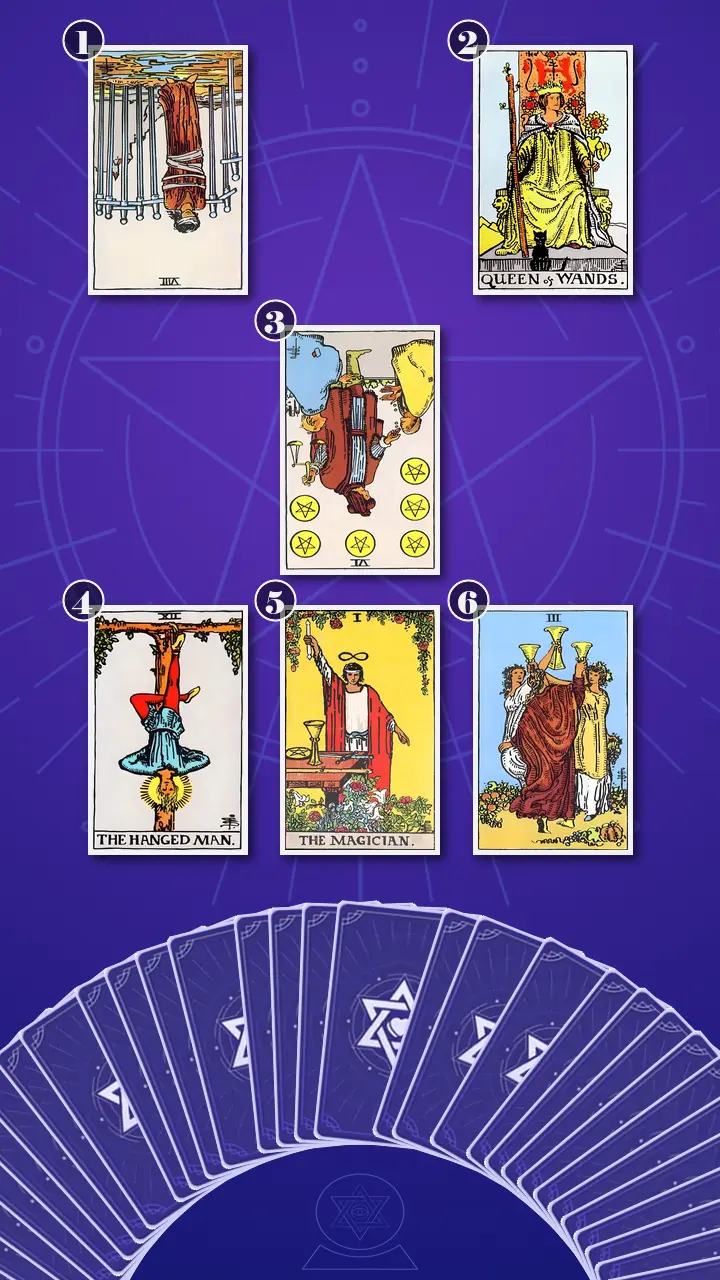
I chose the Relationship Spread · Context Edition, a contextualized six-card relationship tarot spread. This is how tarot works best for me: not as a machine that announces what another person secretly thinks, but as a structured set of perspectives that makes habits, assumptions, exchanges, and available choices easier to examine.
A broader spread would have added noise to a focused friendship question. These six positions were enough. The first would show Jordan’s observable sidekick stance. The second would describe the friend’s presence as Jordan perceived it, without pretending to read the friend’s private motives. The central card would examine how attention, flexibility, and emotional labor actually moved between them.
The lower path would then reveal the belonging fear beneath Jordan’s accommodation, identify a resource for reclaiming agency, and end with a small reciprocal experiment rather than a fixed prediction. The layout looked like two people standing on either side of a narrow bridge, with the path widening as it descended toward shared participation.
I told Jordan that card meanings in context matter more than dramatic keywords. A reversed card was not bad news, and an upright card was not a guarantee. I would read each one as an energy in excess, deficiency, blockage, release, or balance, then compare that pattern with what she had actually lived.
The Script Hidden Inside “Whatever Works”
Position 1: The Reversed Eight of Swords and the Deleted Draft
The card I turned for the position representing Jordan’s observable sidekick behaviors and contracted emotional stance was the Eight of Swords, reversed.
In the Rider-Waite-Smith image, a blindfolded figure stands bound inside a ring of swords. In Jordan’s modern-life version, the blindfold was imagined judgment, the binding was a deleted draft, and the surrounding blades were all the reactions she simulated before anyone had actually responded.
I brought us back to the message I had just watched disappear. Jordan had not been prevented from suggesting Korean food. Her brain had conducted a full legal review of one restaurant preference, found her guilty of being potentially inconvenient, and withdrawn the evidence before the group could see it.
Because the card was reversed, I read the energy as an internal blockage that had begun to loosen. Jordan was becoming aware that she was withholding herself in advance. That awareness created an opening, but it also carried an overcorrection risk: she could mistake freedom for interrupting everyone, rejecting every compromise, or turning each preference into a contest. The card was not asking her to become dominant. It was asking her to notice the difference between flexibility and self-censorship.
“Being low-maintenance is not the same as being easy to know,” I said. “When you type ‘whatever works,’ what were you actually about to ask for?”
Jordan gave a short laugh, but there was no amusement in it. “That’s so accurate it feels a little brutal.” Her thumb hovered over the edge of her phone, her eyes shifted toward the deleted chat, and then her jaw softened by a fraction. “I’m not prevented from speaking. I’m predicting the reaction and withholding myself first.”
I let that recognition stand without turning it into blame. The Eight of Swords showed a protective strategy, not a character defect. Jordan had learned that being useful felt safer than being visible because usefulness produced quick evidence of belonging. The problem was that the same strategy kept her included while making her increasingly difficult to know.
Position 2: The Queen of Wands and the Myth of One Microphone
The card I turned for the position representing the friend’s perceived main-character presence was the Queen of Wands, upright.
I described the Queen’s upright wand, sunflower, forward-facing posture, and alert black cat. Her energy was warm, socially fluent, and comfortable with initiative. I could picture the scene Jordan had described outside a Queen Street bar: the friend telling an animated story with both hands, welcoming someone new, and choosing the next venue without apologizing for having an idea.
I read this Queen as balanced visible fire, not evidence of bad intent. The distortion appeared in Jordan’s interpretation of that fire. When three people turned toward the friend, Jordan’s chest tightened and she silently concluded that the friendship had one microphone. She admired the friend’s confidence and simultaneously treated it as a limit on her own.
“Your friend’s main-character energy is not proof that you were cast as the sidekick,” I said. “Their comfort with attention does not establish ownership of it.”
Jordan looked down at the Queen’s sunflower. “I think I decide there can only be one socially confident person before I even try.”
“That is the distinction this position gives us,” I replied. “I can observe that your friend initiates plans and holds attention. I cannot responsibly claim that they want you smaller. The card asks what their visibility makes you assume about your own right to speak, choose, and be noticed.”
Her fingers tightened once around her mug and then released. I could see admiration and loneliness occupying her face at the same time. That complexity mattered. Jordan did not need to diminish the Queen of Wands to recover her own fire.
Position 3: The Reversed Six of Pentacles and the One-Way Calendar Sync
The card I turned for the position representing the actual exchange of attention, emotional labor, flexibility, and conversational space was the Six of Pentacles, reversed.
The traditional image shows one figure distributing coins while holding scales above two kneeling recipients. In Jordan’s friendship, the coins looked like check-in texts, birthday reminders, restaurant bookings, schedule changes, reassurance after bad meetings, and six follow-up questions about someone else’s week.
I asked Jordan to describe the last group dinner using only observable actions. She remembered checking that everyone got home safely, changing the booking time for her friend, and asking about a difficult work situation the friend had mentioned days earlier. Jordan had shared one piece of news from a chaotic content shoot, softened it with a joke about being “the least important person on set,” and returned the conversation to the friend before anyone had a clear chance to respond.
The reversal showed an excess of outward giving paired with a deficiency of receiving. Attention kept flowing downward instead of circulating. I did not interpret that as proof that the friend consciously exploited Jordan. I interpreted it as a relational system whose terms had gone largely unexamined.
This was where I used a lens I call Clique Power Dynamics. I track the small behaviors through which a group creates an implicit hierarchy: who names the venue first, whose story survives an interruption, who is expected to remember the logistics, whose discomfort changes the plan, and whose contribution gets converted into a joke. I also look for jealousy and micro-aggressions, but I do not invent them when the evidence is not there.
In Jordan’s examples, I saw no reliable proof of a secret campaign against her. I saw a faster, more confident friend, a group accustomed to following that momentum, and Jordan repeatedly lowering her own bid for space. The hierarchy was real in its effects even if nobody had formally designed it.
“You keep paying the conversational bill while hoping someone notices you never ordered,” I said. “But you also clear your own plate before anyone can ask what you wanted.”
Jordan’s breath caught. Her gaze went unfocused as if she were replaying the dinner, and then she pressed a palm against the center of her chest. “I know a lot about their life,” she said more quietly. “I’m not sure they know mine.”
I reminded her that reciprocity was not a mathematical scorecard. The card did not ask her to stop caring, keep a ledger, or punish the friend with sudden withdrawal. It asked whether Jordan allowed attention a fair chance to return before she gave it away again.
The TTC Platform Where Listening Became Waiting
Position 4: The Hanged Man and the Belonging Fear Beneath the Pause
The card I turned for the hidden belief that made the sidekick role feel safer than equal visibility was The Hanged Man, upright.
I described the figure suspended by one foot, the calm expression, and the halo that signals a changed perspective. The card’s pause can be conscious and illuminating. In Jordan’s pattern, however, the energy had remained suspended for so long that observation had started replacing participation.
I asked about her last ride home after a group dinner. Jordan told me she had stood on a Line 2 platform at 10:05 p.m. while the fluorescent lights buzzed and a station announcement blurred overhead. Her jaw had been tight. She remembered having an opinion about a possible group trip but never saying it. She had told herself, “I was just listening,” while mentally replaying every opening she had declined.
“What does the pause protect?” I asked. “And what does it postpone?”
Jordan did not answer immediately. The refrigerator behind her clicked off, leaving the kitchen suddenly still. She rubbed the pad of her thumb over the mug’s rim and said, “It protects me from finding out whether they actually want that much of me. If I’m useful and easy, I know where I fit. If I suddenly take up more space, would it still feel like us?”
I read The Hanged Man as a blockage created by the overuse of a genuine strength. Jordan was skilled at reading a room. She could pause, listen, and notice what other people needed. Those abilities became restrictive only when every pause was treated as evidence that silence was morally safer.
“I can see the pattern now, but seeing it does not mean I have to punish myself for having used it,” I said, giving her the sentence slowly. “This strategy protected belonging when you did not trust that your unedited presence would be welcome. We can respect why it formed without leaving you hanging there forever.”
Jordan inhaled through her nose, held the breath for a moment, and released it with a sound that seemed to come from lower in her chest. The defense did not vanish. It changed shape. She was no longer calling permanent self-suspension a personality trait; she was becoming curious about the second before she deferred.
When The Magician Opened the Table
Position 5: The Bridge from Permission to Participation
The card I turned for the key shift Jordan could practice to reclaim agency was The Magician, upright. As I placed it below the center of the spread, the room seemed to narrow around its open table.
I showed Jordan the raised wand, the lowered hand, the infinity symbol, and the four suit objects waiting in full view. I translated them into resources she already possessed: the cup was emotional awareness, the sword was clear language, the pentacle was a practical choice, and the wand was initiative. The energy here was balanced and integrated. Nothing essential was missing. The blocked move was using one tool before permission arrived.
As I gave the card’s basic meaning, I could see Jordan still caught inside the demand to make the “right” social move. She was imagining that a visible contribution had to be impressive, perfectly timed, and guaranteed not to inconvenience anyone before it could count as safe.
I thought of a film set, where a performer can hit the same background mark for so many takes that the blocking begins to look like identity. As an artist, I know the mark is still a production choice. It can be changed in the next setup.
I call this pattern my Sidekick Syndrome Diagnosis. It is not a diagnosis of Jordan as a person. It is a production note on a recurring social role. Jordan had become the organizer, audience, emotional translator, and punchline provider. The group had learned to expect those contributions, while Jordan had learned that delivering them reduced the risk of rejection. Each successful performance made the role feel more permanent.
The Magician interrupted that loop. Jordan did not need a personality transplant or a competing spotlight. She needed to create new relational data: one complete preference, one story allowed to keep its original ending, or one plan initiated before she checked whether the friend would have chosen it.
The role you keep performing is not your permanent identity. You can support your friend and still author a sentence, a preference, or a plan of your own; equal space does not require outshining anyone.
I left a beat of silence between us, then placed my finger beside the four tools on the card.
You do not have to earn belonging by staying in the background; use the tools already in your hands, your voice, preferences, and initiative, to write one part of the friendship yourself, like The Magician arranging the cup, sword, pentacle, and wand on the table.
Jordan’s breath stopped first. Her index finger froze against the mug, and her pupils widened as if the open table had exposed something she had been keeping just outside the frame. Then her eyes lost focus. I watched her replay the deleted restaurant message, the shortened work story, and the group photos she had volunteered to take. Her brows drew together, and color rose along her cheeks.
“But doesn’t that mean I’ve been doing this to myself?” she said, the first edge in her voice sharper than anything I had heard from her. “Doesn’t it mean I was wrong all this time?”
“It means you used a strategy that once felt protective,” I answered. “Responsibility is not the same as fault. Your friend still has responsibility for how they respond when you become more visible. Your responsibility is to stop rejecting your contribution on everyone else’s behalf.”
Her fist loosened. Her shoulders sank, and a long, trembling breath left her, followed by a small look of disorientation. The relief had made room for a new vulnerability: if the role could change, she would have to risk finding out what the friendship could hold.
“Now, with this new perspective, think back to last week,” I said. “Was there a moment when this insight could have made you feel different?”
Jordan looked at the phone beside her. “Thursday. I could have sent the restaurant. I didn’t need proof that I belonged before I made one contribution. The contribution was how I participated.”
“Exactly,” I said. “You do not need to become louder than your friend; you need to stop deleting yourself before anyone can respond.”
I named the emotional crossing for her: this was one step from contracted, permission-seeking self-erasure toward grounded self-trust and equal participation. It was not confidence as a permanent mood. It was the willingness to act while a little uncertainty remained.
Position 6: The Three of Cups and a Circle with More Than One Center
The card I turned for the small, non-predictive reciprocal experiment was the Three of Cups, upright.
I pointed to the three women raising their cups in a circle and the abundance gathered at their feet. The image did not organize friendship around one spotlight. It showed shared water in balance: several people bringing news, initiating plans, responding to one another, and remaining visible at the same time.
In Jordan’s life, this could look like bringing a story from her workweek into the group and allowing it to remain there instead of dismissing it before anyone responded. It could also look like choosing the restaurant, sending the invitation, and noticing whether the group could receive her initiative without making the result a referendum on her worth.
“Bring one cup to the table before asking who else is thirsty,” I told her. “Then observe what happens. The card does not promise that your friend will respond perfectly. It gives you a way to test mutuality without competing for the main-character role.”
Jordan smiled, but the smile held both hope and caution. “So I’m not trying to become the new center.”
“No,” I said. “You’re discovering whether the friendship can become a circle.”
The Role Resignation Act: Two Small Ways Back into the Frame
I gathered the six cards into one storyline. Jordan’s long-standing strategy had been to secure belonging through usefulness: scan the friend’s mood, support the friend’s story, adapt the plan, and make her own presence easy to accommodate. The reversed Eight of Swords showed how she censored herself before anyone could react. The Queen of Wands showed that she mistook another person’s visible fire for a limit on her own. The reversed Six of Pentacles revealed the resulting imbalance, while The Hanged Man exposed the fear that equal visibility might destabilize belonging.
The Magician provided the bridge. Jordan already had feeling, language, practical options, and initiative. The Three of Cups gave those tools a relational purpose: mutual participation rather than a takeover. In the film of this friendship, Jordan had kept holding the camera and then wondering why she was missing from every frame. The cards did not demand a dramatic rewrite. They suggested changing the blocking in one scene.
I named her cognitive blind spot directly: she had been treating the friend’s visibility as the cause of her invisibility. That story hid the moment when Jordan surrendered space before anyone requested it. It also risked making silence look like proof that she had less to offer. The transformation direction was more precise: replace automatic deference with one visible contribution, then evaluate the friendship by whether there is room for mutual attention.
Jordan frowned at the action implied by that. “But if I suddenly start doing this, they’ll know I’m making it a whole thing. And what if my friend jokes about the restaurant or changes the subject?”
“Then we do not make it a whole thing,” I said. “We make it one sentence. You are collecting information, not staging a confrontation. Their response matters, but it stays separate from the fear you experienced before they responded.”
I introduced my Role Resignation Act, a conversational pivot for declining the assigned sidekick character without attacking the cast. It works by noticing the familiar cue, refusing the automatic line, and replacing it with one clear contribution. No speech about how everyone has failed. No forced confidence. Just a small revision delivered in Jordan’s natural voice.
- The One-Preference Role Resignation Within the next 48 hours, when the group chat asks about plans, send one complete preference before asking what the friend wants: “I’d love Korean food near Christie this Friday.” Leave out “but whatever works,” extra apologies, and three backup options. The whole exercise should take under five minutes. Tip: Draft the sentence once in Notes and read it aloud. A preference is information, not a demand. Sending it remains your choice, and you can mute the chat afterward instead of rereading every reaction.
- The Two-Breath Reciprocity Pause In one low-stakes, one-to-one conversation this week, share a personal update in two or three sentences without a self-deprecating punchline. Pause for two slow breaths before asking the next question. Notice whether your friend follows up, gives a brief response, or redirects the topic, and record only what happened. Tip: Prepare one ordinary update in advance. Two breaths are enough; you do not need to hold the floor indefinitely. If the exchange becomes dismissive or disrespectful, you can stop and decide later what boundary fits.
I asked Jordan to measure success by the action she controlled, not by whether the group instantly reorganized around her. Sending a clear preference would be a successful experiment even if the restaurant changed. Sharing an unedited update would be successful even if the response revealed an uncomfortable imbalance. Actionable advice should increase information and agency, not force a happy ending.
That distinction seemed to steady her. She took a screenshot of the two practices, then opened Notes and typed: “I’d love Korean food near Christie this Friday.” She read it once. Her chest lifted with a shallow breath, her shoulders tried to fold, and then she left the sentence intact.

A Week Later, One Sentence Stayed Sent
Five days later, a message from Jordan appeared on my phone. She had sent the restaurant suggestion without a disclaimer. Her friend had replied, “Wait, yes, that sounds great,” and another person had asked for the Google Maps link. Jordan wrote that the response felt almost comically ordinary after the courtroom her mind had built around it.
The more important change happened at dinner. Jordan told the story about her team’s chaotic content shoot in three sentences and did not turn herself into the punchline. She took two breaths. Her friend asked what happened next. Jordan answered instead of saying, “It was nothing.”
She told me she slept through the night, then woke with the first thought, “What if I made it awkward?” This time, she smiled at the thought, left the message sent, and made coffee.
I did not read that week as proof that the friendship had been permanently repaired. I read it as quieter, more useful evidence: Jordan had moved from self-editing toward visible presence, and she had done it without becoming louder than her friend or withdrawing her care. The cards had provided the map. Jordan had pressed send.
When you leave another hangout with your shoulders lowered and your own story still sitting behind your teeth, it can hurt to realize that staying useful kept you included while staying visible felt like a risk. If that is where you are tonight, noticing the role already means you are no longer performing it unconsciously.
If you did not have to outshine anyone to step into the frame, which one thing would you place on The Magician’s open table this week: a preference, an unedited story, or an invitation you send before permission arrives?