The 11:43 PM Spiral in a Bedroom Lit by Instagram
“If you’ve ever said ‘I know it’s just clothes, but it doesn’t feel like just clothes,’ and then stayed up doing comparison-checking like it’s your second job—welcome to the identity anxiety spiral.”
I said it the way I always do—half invitation, half truth serum—because I could already see it in Taylor’s face. Taylor sat across from me with her hoodie sleeves pulled over her hands, like she was trying to make herself smaller without admitting she was doing it.
She described the exact slice of time that had been looping in her head: 11:43 PM on a Wednesday in her small NYC bedroom. Streetlight stripes across the wall. The radiator clicking like it had opinions. She was in a robe, phone warm in her palm, Instagram brightness turned down. She saw her friend’s Story—the same silhouette she’d planned for Friday—and her body reacted before her brain could argue. Stomach drop. Chest tight. A sudden, restless urge to fix it.
“I know it’s petty,” she said, voice flat like she’d already tried to scold herself out of it. “But my thumb just… starts. I’m tapping between her post, my camera roll, and shopping tabs like I’m building a case.”
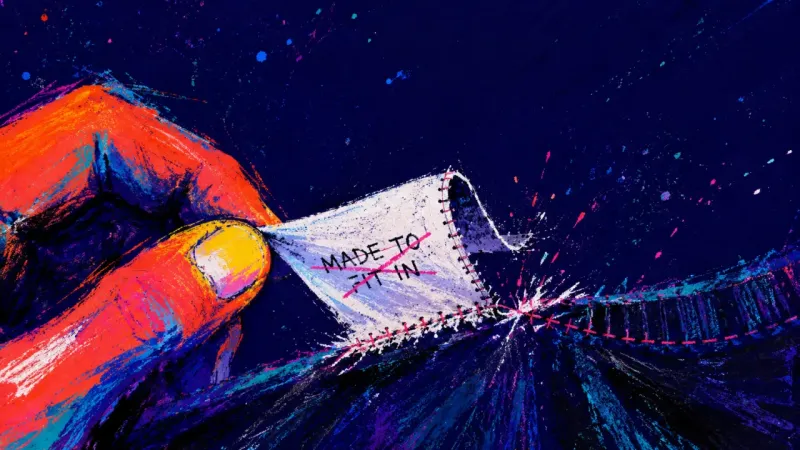
It wasn’t “just clothes.” Not the way she was carrying it. It felt like her style was a receipt for her identity—proof she was real, original, worth noticing. And the moment someone else wore a similar look, that proof felt flimsy, like paper in rain.
Her insecurity wasn’t an abstract thought; it was a physical compression—like she was trying to breathe through a too-tight sports bra. And beneath the embarrassment sat irritation and a sharp little jealousy she hated admitting.
“Okay,” I told her, gentle and direct. “We’re not here to judge you for caring. We’re here to understand why this hits so hard—and to find clarity, so your style can go back to being yours instead of a battlefield.”

Choosing a Map for a Very Modern Problem
I invited Taylor to put her phone face-down for a moment and take one slow breath—not as a ritual for luck, but as a clean transition. A way to get out of the feed and into her own body. While she did, I shuffled, listening for the tone beneath her story: the parts she said out loud, and the parts she didn’t.
“Today,” I said, “I want to use a spread I built for exactly this kind of situation: the Four-Layer Insight Ladder · Context Edition.”
For anyone reading along: this isn’t a predictive spread. It’s a structure for the mechanism—especially when you’re asking, ‘Why do I spiral when someone copies my style?’ The Ladder works because it separates what’s happening on the surface (the spiral) from what triggered it (the story your mind attaches), then drops down into the root belief, the protective strategy, and finally the turning point and next steps. It’s the minimum number of positions you need to move from “why this hits” to “what do I do differently” without getting lost in endless analysis.
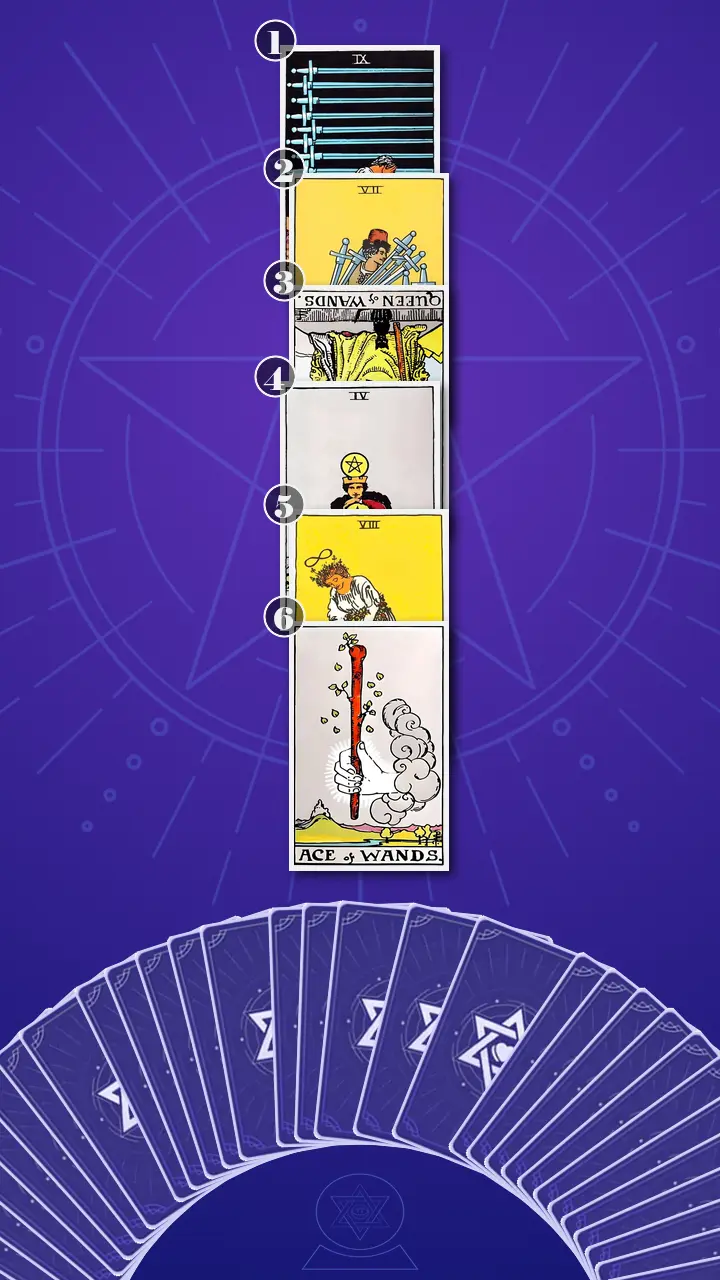
“We’ll read it like stairs,” I told Taylor. “Card 1 is the presenting symptom. Card 3 is the root fear. Card 5 is the medicine—the key transformation. And Card 6 is one grounded thing you can actually do this week.”
She nodded, but I saw the tell: her shoulders were still up by her ears, like her nervous system didn’t fully believe relief was allowed yet.
Reading the Evidence: When Thoughts Turn into a Courtroom
Position 1 — The presenting symptom: the spiral you can’t stop
“Now I’m turning over the card that represents the presenting symptom—the specific mental and behavioral spiral after the outfit copying,” I said.
Nine of Swords, upright.
I didn’t have to dramatize it. This card always looks like a person waking up into their own mind like it’s an emergency alarm.
“It’s 1:00 AM in your NYC apartment and you’re wide awake, phone glow in a dark room, replaying one outfit photo like it’s a courtroom exhibit,” I said, using the scene the card was already holding. “You toggle between her Story, your camera roll, and old pics to prove you had the vibe first—then you open a shopping cart to ‘fix’ the feeling. Your body is tense, your chest tight, and your inner voice is harsh: ‘If I can be copied, I’m not special.’”
This is Air energy in overload—thoughts stacked like evidence, not insight. Not clarity. Accusations. The mind trying to regain safety by building an airtight argument.
Taylor let out a small laugh that didn’t reach her eyes. “That’s… too accurate,” she said, and then, quieter: “It’s kind of mean.”
“It’s not mean,” I replied. “It’s precise. And precision is how we stop confusing the symptom for the truth.”
I watched her fingers worry the edge of her sleeve—restless, like her body wanted to keep moving so the feeling wouldn’t catch up.
Position 2 — The trigger story: what the situation is made to mean
“Now I’m turning over the card that represents the trigger story—what this situation is ‘made to mean,’ and why it hooks you,” I said.
Seven of Swords, upright.
“You see the similar outfit and instantly slip into detective mode,” I told her. “You zoom in on details, check the timestamp, reread her caption, and scroll back to see if this is a pattern. It’s less about the actual clothes and more about the feeling of something personal being used without consent—like your taste was treated as public property while you’re left guessing what the move was.”
Seven of Swords isn’t always a villain. Sometimes it’s simply the sensation of ‘something here isn’t being said out loud’—and your mind tries to create certainty with surveillance.
I leaned in a little. “Let me ask you the Ladder question for this spot: what clues have you been collecting—caption tone, timing, tags, repeated brands—and what boundary need might be hiding underneath that detective work?”
Her eyes flicked down and left, the way they do when someone is replaying receipts. “I keep thinking… was it intentional?” she admitted. “And then I feel stupid for thinking that.”
“A boundary said out loud is kinder than a grudge maintained in silence,” I said, not as a push to confront, but as a north star. “We’ll get there. But first—we have to separate two things: a copied item versus a copied identity. Your brain keeps treating them as the same.”
Her jaw worked once, like she was chewing on that distinction.
When Style Becomes a Scoreboard
Position 3 — The root belief: what copying threatens in your self-worth
“Now I’m turning over the card that represents the root belief and underlying fear—what the copying threatens in your self-concept,” I said.
Queen of Wands, reversed.
“Your confidence works—until it starts depending on being the most distinct person in the room,” I said, letting the card be blunt but not cruel. “When your friend mirrors your look, your style stops being play and turns into a scoreboard. You feel heat in your face, draft a snarky text you never send, and suddenly you’re planning something ‘louder’ just so you can feel like you’re the original again.”
Reversed, the Queen’s fire isn’t gone—it’s pointed inward. It becomes comparison. Possessiveness. That quiet panic of ‘If I’m not distinct, I disappear.’
As a perfumer, I’ve spent years watching how people confuse signal with self. In brand meetings, I’ve seen teams treat a fragrance brief like a moral identity: as if the wrong note would make the entire house “basic.” But a brand isn’t a locked PDF. It’s lived, updated, embodied.
“If the fear had to finish the sentence,” I asked, “would it be: ‘If I’m not distinct, then ____’?”
She swallowed. “Then I’m… replaceable,” she said. “Like I’m not actually a person with a vibe. I’m just… a look.”
That was the root. Not her friend’s blazer.
Position 4 — The shadow strategy: the grip that backfires
“Now I’m turning over the card that represents the shadow strategy—what you do to regain control, and how it costs you,” I said.
Four of Pentacles, upright.
“After being triggered, you start treating your style like a password,” I said, and I saw her flinch in recognition before she even fully processed the words. “You stop sending outfit links, you dodge ‘where’d you get that?’ questions, and you keep your favorite stores to yourself. You think it’s protecting your vibe, but it actually keeps you tense—like you’re always bracing for someone to ‘take’ what makes you you.”
Earth energy here is control architecture. A closed fist. A coin pressed to the chest. It’s protection that turns into isolation.
I mirrored back what I’d heard in her week: the Notion “capsule wardrobe” list that became a rulebook. The tabs: Revolve, SSENSE, Zara, Aritzia. The Notes app titled “signature pieces” that read like security protocols. The last-minute hallway mirror outfit swap that felt less like self-expression and more like a performance review.
“When style becomes a scoreboard, getting dressed stops being fun,” I said, letting the phrase land without shame. “And Four of Pentacles is the part of you that tries to win by tightening the rules.”
She exhaled through her nose—half laugh, half grief. “I hate that I’m like this,” she said.
“You’re not ‘like this,’” I corrected gently. “You’re in a loop. And loops can be interrupted.”
When Strength Quieted the Feed
Position 5 — The turning point: the medicine that restores self-trust
I slowed down before turning the next card. Even the air in the room felt more still—like the story was ready for its hinge.
“Now I’m turning over the card that represents the key transformation—the inner shift that loosens the fear and restores self-trust and clean boundaries,” I said.
Strength, upright.
Setup. I watched Taylor’s eyes move between the card and her own hands. She knew that moment too well: you see the photo—same vibe, same piece—and your stomach drops before your brain starts building a whole case about what it means. The urge is immediate: thumb hovering over Instagram, hunting for certainty like it’s oxygen.
Delivery.
Stop gripping your ‘signature look’ as proof of worth, and start softening the inner lion with steady self-trust—then let your spark grow from the inside out.
I let the sentence sit between us, the way a good base note lingers in the air after the initial shock of citrus fades.
Reinforcement. Taylor’s reaction came in a chain. First: a tiny freeze—her breath paused, and her fingers stopped fidgeting mid-motion. Second: her gaze went distant, like she was replaying the L train screenshot zoom-in, the timestamps, the “proof of originality” audit. Third: her shoulders dropped on a long exhale she didn’t seem to plan. Her jaw unclenched as if she’d just realized it had been clenched for days.
Then the unexpected part: her face tightened with a flash of anger. “But if I stop gripping,” she said, voice sharper, “doesn’t that mean she just… gets to take it?”
I nodded. “That’s the lion,” I said softly. “Hot. Fast. Protective. And it’s trying to keep you safe.”
This is where my work—Social Pattern Analysis—matters. “Let’s diagnose the hidden interaction barrier,” I continued. “Right now, your nervous system is interpreting overlap as replacement. But in groups—especially ones with unspoken aesthetic competition—mirroring can mean a lot of things: admiration, closeness, trend convergence, or yes, boundary-testing. The problem isn’t that you notice patterns. It’s that the only tool you’ve been using is surveillance. That tool always keeps you in a clenched posture.”
I guided her into the practice embedded in Strength—the move from feed to body. “Try this now,” I said. “Phone stays face-down. Put one hand on your chest as a closed fist. Notice what changes in your breath and jaw. Then slowly open it.”
She did. Her breathing shifted—less shallow. Less frantic. The open palm looked almost unfamiliar on her own body, like she’d been living in ‘defend mode’ for so long that softness felt suspicious.
“Now ask,” I said, “What do I want to feel in my body tonight—bold, calm, sharp, soft?”
“Calm,” she said, surprised by her own answer. “I want calm.”
“Good,” I replied. “That’s self-definition. That’s the shift—from guarding proof of uniqueness to practicing your identity as something lived.”
Then I asked the question that seals the insight into real life: “Now, with this new lens—can you think of a moment last week when this would’ve changed how you acted? A moment when the urge to check her feed took over?”
She nodded slowly. “Thursday,” she said. “I was literally on the edge of my bed. I could’ve… not opened her profile. I could’ve just—picked an outfit for how I wanted to feel.”
“Exactly,” I said. “Your vibe isn’t a scarce resource—it’s a lived signal.”
And that’s the emotional transformation I want you to hear clearly: this wasn’t about catching your friend’s intent. It was a step from identity anxiety and comparison-driven vigilance toward embodied self-trust—toward charisma without competition.
Position 6 — The next step: a spark you can actually live this week
“Now I’m turning over the card that represents the next step—a concrete, doable way to embody identity from the inside out,” I said.
Ace of Wands, upright.
“Instead of reactive reinvention, you start a tiny self-led style experiment,” I told her. “You pick one intention for the week—bold-and-relaxed, soft-and-sharp—build a simple outfit formula from what you own, and wear it without checking her posts. It’s not about being uncopyable—it’s about being in motion from your own desire.”
Ace of Wands is Fire that belongs to you again. Not a flare you set off in response to someone else. A sprout—alive, personal, renewable.
Taylor’s mouth softened, like she could feel the difference between “prove it” energy and “create it” energy.
From Insight to Action: The One-Word Outfit and a Cleaner Boundary
I summarized the Ladder the way I’d want someone to summarize it for me: simple, coherent, usable. “Here’s the story the cards tell,” I said. “The Nine of Swords is the late-night courtroom—rumination and comparison-checking. The Seven of Swords turns it into a motive mystery—‘was it intentional?’ Underneath, Queen of Wands reversed shows the root: confidence that became contingent on being the most distinct. Four of Pentacles shows the protection strategy: hoarding, gatekeeping, clinging. Strength is the medicine—soft power, self-trust, clean boundaries. And Ace of Wands is your next step: self-led expression, not reaction.”
“Your cognitive blind spot,” I continued, “is thinking the solution is to become uncopyable. That keeps you in scarcity. The transformation direction is the opposite: choose who you are from the inside—how you want to feel—and let the details stay flexible. That’s how you stop feeling replaceable.”
Then I gave her actionable advice—small enough to start, specific enough to matter.
- One-Word Style IntentionIn your Notes app, write one line before your next hangout: “Tonight I want to feel: calm / grounded / playful / sharp.” Choose your outfit to serve that word—not to be uncopyable.If your brain says “this is cringe,” do the 10-second version: pick the word and stop there. It’s an experiment, not a test you have to pass.
- 24-Hour No-Check WindowDo a 24-hour ‘no checking their posts’ window before and after the event you’re dressing for. If you slip, restart with zero punishment.Treat it like reducing a trigger—not making a moral statement. If it helps, mute their Stories for one week instead of spiraling.
- Sillage Control: A Boundary You Can FeelPick one “signature formula” you can repeat for a week (e.g., black jeans + white tee + one statement accessory). Pair it with a grounding, woody-leaning scent you already own (cedar, vetiver, sandalwood) as your personal presence anchor.Keep the scent close—soft sillage. This is first impression calibration for you, not a performance for the room. Consistency builds self-trust faster than novelty does.
I added one optional tool from my own practice for the hardest moments—the moments right before the thumb goes back to Instagram. “If you need a nervous-system reset,” I said, “use a quick cleansing citrus spray—something bright like bergamot or grapefruit on a tissue. One inhale. Then phone face-down. It’s not magic. It’s a cue: ‘I’m back in my body.’”
Taylor looked relieved, and then practical resistance showed up, right on schedule. “But what if we’re in the group chat and someone texts, ‘what are we wearing?’” she asked. “That’s usually when I start spinning.”
“Then you answer with the feeling,” I said. “Not the item. ‘I’m going for calm and sharp.’ That’s Personal Brand Management in a healthy form—consistent internal direction, not external proving.”

A Week Later: The Quiet Proof
A week later, Taylor texted me on a Sunday afternoon. Not a paragraph. Just a screenshot of her Notes app.
Tonight I want to feel: grounded.
Under it: “Didn’t check her Stories for 24 hours. Wore my black jeans/white tee formula. Put on the woody perfume I forgot I had. Felt weirdly… solid. Still had a tiny ‘what if’ in the morning, but it didn’t hijack my whole day.”
That’s what I mean when I say a Journey to Clarity doesn’t always look like a dramatic confrontation or a perfect transformation. Sometimes it looks like an open hand. A softer jaw. A night where getting dressed doesn’t feel like you’re auditioning for your own life.
When your style has been carrying the job of proving you’re uniquely worth noticing, one copied outfit can feel like your whole self got quietly replaced—even if you hate how much it hits.
If you let “being you” be something you practice in your body (not something you protect in your closet), what’s one feeling you’d dress for this week—just to see what changes?
This story is adapted from psychological research, written so that those in a similar struggle can see their own pattern in it — and find their next step clearly.These insights are not a substitute for professional psychological, medical, legal, or financial advice.
Learn more about our Journey to Clarity.
How did this insight land for you?
🫂 This Resonates Deeply
🌀 Living This Story
✨ Now I See Clearly
🌱 Seeing New Possibilities
🧰 Useful Framework
🔮 The Confirmation I Needed
💪 Feeling Empowered
🚀 Ready for My Next Step
Author Profile
 AI
AI“As a perfumer for fifteen years, I’ve learned to perceive human boundaries through the delicate metaphor of scent. Relationships need the right amount of space to breathe, and I've seen too many kind souls exhaust themselves trying to please everyone. I’m here with warmth and understanding—not to teach you to be guarded, but to help you gently clear the air and rediscover the comforting, safe boundaries that are rightfully yours.”
In this Friendship Tarot Reading :
Core Expertise
- Boundary Permeability Diagnosis: Identifying friends whose lack of limits is metaphorically 'bleeding into your space' and causing emotional suffocation.
- Vibe Contamination Auditing: Recognizing when a highly sensitive or negative friend is unconsciously polluting your personal psychological atmosphere.
Service Features
- The Space Calibration Ritual: A behavioral directive to implement specific 'digital and physical blank spaces', preventing enmeshment and restoring breathable boundaries.
Also specializes in :
Explore Related Patterns:
Aesthetic Identity FusionTaylor's style is described as a receipt for her identity, proof that she is real, original, and worth noticing. When her friend wears the same silhouette, the threat does not stay at the level of fabric or trend; it lands in the belief that if the look can be copied, the self behind it can be replaced. That is the fusion point: an external aesthetic signal starts carrying the weight of self-worth. You are not just reacting to someone borrowing a visual idea; you are watching a personal proof system fail under social overlap, which is why the spike feels disproportionate and hard to talk yourself out of. The pattern becomes especially clear when Taylor says that if she is not distinct, she is replaceable. Aesthetic Identity Fusion names the moment when style stops being expression and becomes identity infrastructure, making any similarity feel like a direct challenge to being seen as a whole person.
Comparison TrapTaylor's confidence works until it depends on being the most distinct person in the room. Once her friend mirrors the outfit, style stops feeling like play and becomes a scoreboard where originality has to be defended. Comparison Trap applies because the story shows self-evaluation being routed through another person's visible choices. You are not just asking whether you like your own look; you are measuring whether your look still counts if someone else can approximate it. That comparison becomes sticky because the social field is familiar and close. A stranger wearing the same silhouette might register as trend overlap, but a friend wearing it makes the mind search for rank, motive, and replacement, which turns self-expression into a quiet competition for visibility.
Zero-Sum ThinkingTaylor's nervous system interprets overlap as replacement. When her friend wears a similar look, the meaning is not "we both liked the same aesthetic"; it becomes "if she has it too, there is less of me." Zero-Sum Thinking captures the scarcity logic underneath the spike. You are treating distinctiveness like a limited resource, so another person's visibility appears to reduce your own rather than existing alongside it. That is why the urge to plan something louder feels temporarily protective. It tries to restore a sense of ownership, but it also keeps the whole system trapped in competition, where identity has to win space instead of simply inhabit it.
Anxiety SpiralThe 11:43 PM scene starts with a body reaction before Taylor has a coherent argument: stomach drop, chest tightness, and the restless urge to fix something. Then the phone loop takes over, moving between her friend's Story, her own camera roll, old pictures, and shopping tabs as if enough evidence could make the feeling stop. Anxiety Spiral fits because the story shows a closed feedback loop between physical arousal, threat interpretation, and compulsive mental review. You are not simply having one insecure thought; your body, attention, and inner critic begin reinforcing each other until one outfit photo becomes an identity emergency. The phrase "If I can be copied, I'm not special" gives the spiral its fuel. The anxiety keeps escalating because the mind is no longer solving a clothing problem; it is trying to protect a threatened sense of uniqueness through comparison, accusation, and urgent self-repair.
Certainty SeekingTaylor does not stop at noticing the similar outfit; she zooms in on details, checks the timestamp, rereads the caption, and scrolls back to see if this has happened before. The core question becomes "was it intentional?" and the feed turns into a place where she tries to extract a clean answer from messy social signals. Certainty Seeking names the defensive logic behind that detective mode. You are trying to reduce ambiguity because ambiguity feels unsafe, especially when the situation is made to mean that something personal was taken without consent. The problem is that surveillance gives the nervous system more material to process without giving it real safety. Every clue opens another possible interpretation, so the search for certainty keeps Taylor attached to the trigger rather than helping her decide what she actually needs or wants to say.
Control CopingAfter the copied outfit, Taylor starts treating her style like a password. She stops sending outfit links, dodges "where'd you get that?" questions, keeps favorite stores to herself, and turns her capsule wardrobe notes into something closer to security protocol than self-expression. Control Coping fits because the strategy is protective before it is punitive. You tighten access, rules, and information because control feels like the fastest way to stop the identity threat from happening again. But the cost is that the boundary stays indirect. Instead of clarifying what feels uncomfortable, Taylor has to stay guarded, braced, and suspicious, which means the protective system keeps her psychologically attached to the very threat it is trying to prevent.
Authentic Self-ExpressionTaylor's shift begins when the phone goes face-down and the question changes from "how do I prove I am original?" to "what do I want to feel in my body tonight?" That small change moves her attention away from the friend's post and back toward her own internal signal. Authentic Self-Expression fits because the new behavior is not about becoming uncopyable. You are choosing from desire, mood, and embodied self-trust rather than reacting to someone else's aesthetic move. The week-later screenshot makes the pattern concrete: "Tonight I want to feel: grounded." The outfit formula stays simple, the checking window holds, and style becomes something lived again instead of a courtroom where identity has to defend itself.
Explore Related Struggles:
Aesthetic Self-Management TrapTaylor's wardrobe stops being a place of play once the copied look appears. The Notion capsule list, the Notes app of signature pieces, the secret stores, and the hallway mirror outfit swap all show style turning into an identity management system with rules, audits, and emergency revisions. You get caught when self-expression has to constantly prove that it is still yours. Instead of dressing from desire, the aesthetic becomes a performance review where every overlap has to be corrected. The trap is not caring about style; it is making style carry the whole job of proving that your selfhood cannot be diluted.
Identity Verdict LockTaylor sees her friend's Story at 11:43 PM, and the same silhouette she had planned for Friday stops feeling like overlap; it becomes evidence in a private trial about whether she is original enough to count. Her phone moves between the Story, her camera roll, and shopping tabs because one outfit has been given the authority to decide whether her selfhood is solid or flimsy. That is why the spike feels disproportionate to clothes. You are not reacting to fabric alone; you are watching a visible signal get treated as a verdict on being replaceable. The lock forms when distinctiveness becomes the only proof that you are real, so any shared look can feel like an identity audit instead of a minor social coincidence.
Scarcity Compass LockTaylor hears the sentence underneath the spiral clearly: if she is not distinct, she is replaceable. From that point, the solution seems to be becoming harder to copy, louder, more original, more guarded, and always one step ahead. That compass points every choice toward scarcity. You start reading style overlap as a limited-resource problem, as if only one person can hold the vibe and anyone else's similarity subtracts from your presence. The lock loosens when identity becomes something lived through the body in real time, not a scarce aesthetic asset that has to be defended from the room.
Boundary RigidityAfter the copied outfit, Taylor starts treating her style like a password. She stops sending links, dodges source questions, keeps favorite stores private, and turns a capsule wardrobe into something closer to a security protocol. The boundary need underneath this is legitimate: you want your taste, effort, and sense of personal territory to be respected. The rigidity begins when protection can only take the form of closing the fist. At that point, even ordinary sharing feels risky, and the very strategy meant to protect your vibe starts cutting you off from ease, friendship, and creative movement.
Monitoring-Safety FusionTaylor zooms in on the Story, checks timestamps, rereads the caption, scrolls backward, then compares it all against her own camera roll. The behavior has the shape of investigation, but the real aim is not fashion research; it is trying to make the body feel safe after a social signal lands as a threat. You are not simply looking for information in that loop. You are trying to turn monitoring into certainty, and certainty into relief. The problem is that the feed can always produce one more clue, so the checking posture keeps your attention locked outside yourself while your body stays braced for the next piece of evidence.
Explore Related Emotions:
Mirrored Self-DoubtThe same silhouette on her friend's Story makes Taylor's identity proof feel flimsy, like paper in rain. What should be a shared trend or a similar taste starts acting like a mirror that gives back a distorted question: if someone else can wear the signal, was it ever really mine? Mirrored Self-Doubt captures that destabilizing reflection. You are seeing yourself through someone else's styling choices, and the image comes back blurred. The self-doubt is not about whether the outfit looks good; it is about whether your taste can remain yours when another person appears inside the same aesthetic language.
Replaceability DreadTaylor finishes the fear sentence with 'Then I'm replaceable,' and that line explains why a similar outfit lands with such force. The blazer or silhouette is only the visible trigger; the deeper hit is the sense that her style has been carrying proof that she is real, original, and worth noticing. Replaceability Dread names the moment when overlap feels like erasure. You are not reacting as if a friend borrowed a garment; you are reacting as if a piece of social identity has been made interchangeable. That dread spikes because the mind has confused distinctiveness with personhood, so being mirrored starts to feel like being quietly swapped out.
Self-Audit AnxietyAt 1:00 AM, Taylor is awake in the phone glow, toggling between her friend's Story, her camera roll, old photos, timestamps, and shopping tabs. The scene has the structure of a courtroom, not a closet: every image becomes evidence, every caption becomes a clue, and every tab promises a way to repair the feeling. Self-Audit Anxiety fits because the distress is being processed through an internal trial. You are not simply comparing outfits; you are trying to prove that your identity still belongs to you. The more proof your mind collects, the less settled your body becomes, because the question underneath is not 'Who wore it first?' but 'Do I still count as myself if someone else can resemble me?'
Cautious Self-TrustTaylor puts the phone face-down, places a closed fist on her chest, and slowly opens it. Her breath becomes less shallow, her jaw loosens, and softness feels unfamiliar because her body has been living in defend mode for so long. Cautious Self-Trust is the steadiness that arrives without pretending the trigger has vanished. You still may have a small 'what if' in the morning, but it no longer has to hijack the whole day. The trust is cautious because it is being rebuilt through repeated contact with your own body, not through a guarantee that no one will mirror you again.
Clarity ReliefThe conversation separates two things Taylor's brain had fused together: a copied item and a copied identity. Once that distinction is on the table, the whole situation becomes more workable; there is the outfit, the story attached to it, the possible boundary need, and the self-worth fear underneath. Clarity Relief comes from seeing the mechanism without having to shame yourself for it. You do not need to prove that the friend meant harm before you are allowed to understand why it hurt. The relief is clean because it gives the feeling a shape, and once it has a shape, you can choose a next move instead of staying trapped in the late-night case file.
Grounded AgencyA week later, Taylor sends a screenshot that says, 'Tonight I want to feel: grounded.' She wears the black jeans and white tee formula, uses the perfume she had forgotten, and keeps the no-check window even though a tiny 'what if' still appears the next morning. Grounded Agency fits because the shift is not just insight; it becomes an action that belongs to her. You choose a feeling, build from what you already own, and stop using the friend's feed as the starting point. The agency is grounded because it works through small, physical choices rather than a performance of being unbothered.
Scarcity AnxietyTaylor starts treating her style like a password: she stops sending outfit links, dodges 'where did you get that' questions, and keeps favorite stores to herself. The closet becomes less like a place of expression and more like a vault where the right pieces have to be protected from other people's access. Scarcity Anxiety shows up because uniqueness has started to feel limited. You act as if there is only so much vibe to go around, so another person's similar look seems to reduce what is available for you. The fear narrows the whole style system until sharing, influence, and overlap all feel like depletion.
Comparative JealousyTaylor names the part she hates admitting: underneath the embarrassment sits irritation and a sharp little jealousy. The friend's outfit turns the room into a scoreboard, where being distinct starts to feel like winning and being mirrored starts to feel like losing ground. Comparative Jealousy fits because the emotion is relational, social, and ranking-based. You are not only wishing the friend had chosen something else; you are measuring your own solidity against her visibility. The jealousy hurts because it exposes how much reassurance has been outsourced to being the most distinctive person in the room.
Shame SpiralTaylor says 'I know it's petty' in a flat voice, as if she has already tried to scold herself out of caring. Later, when the loop is named, she says 'I hate that I'm like this,' turning the original outfit trigger into a second problem: the reaction itself becomes something to attack. Shame Spiral fits because the pain doubles back on itself. You feel the spike, then judge the spike, then use that judgment as more evidence that something is wrong with you. The result is not clarity; it is a closed loop where self-criticism keeps the same feeling in circulation.
Protective AngerTaylor's face tightens when she asks, 'But if I stop gripping, doesn't that mean she just gets to take it?' Earlier, she had drafted a snarky text she never sent. The anger is quick, hot, and closely tied to the sense that something personal has been used without clear permission. Protective Anger belongs here because the heat is not random hostility; it is a boundary alarm looking for language. You are trying to protect a part of yourself that feels exposed, but without a clean boundary, the anger has nowhere useful to go. It stays in the body as bracing, private arguments, and imagined comebacks.
Explore Related Contexts:
Algorithmic Comparison LoopTaylor is in a small NYC bedroom with Instagram dimmed, moving between her friend's Story, her own camera roll, old photos, and shopping tabs. The phone does not just show her the copied outfit; it gives her an endless comparison machine with timestamps, captions, tags, and archives that can be rechecked at any hour. The loop spikes because the platform keeps offering more evidence without offering resolution. You can keep scrolling toward certainty, but the structure of the feed rewards the checking itself, turning one outfit overlap into a recurring identity audit that follows you into a private space where you should be able to reset.
Personal Brand PerformanceTaylor's style is described as a receipt for identity, proof that she is real, original, and worth noticing. Once the friend wears a similar silhouette, the outfit stops being a choice and starts functioning like a public brand asset that has to defend her uniqueness. That pressure turns getting dressed into performance infrastructure. You are not only deciding what to wear; you are managing visibility, originality, and social distinctiveness in a peer environment where a look can be treated as a personal signature. The identity spike comes from making style carry the weight of proof that no outfit can permanently hold.
Zero-Sum Friendship ConflictTaylor's style stops being play and turns into a scoreboard where she has to be the original again. When the friend mirrors the look, Taylor starts planning something louder, not because the first outfit failed, but because the social field has started to feel like only one person can own that signal. A zero-sum friendship conflict makes another person's similarity feel like a subtraction from your presence. You begin treating links, stores, formulas, and aesthetics as scarce resources because the friendship environment has turned overlap into rivalry. The identity spike is sharpened by that social math: if she has the look too, you fear there is less room for you.
Receipts CultureTaylor's thumb starts building a case between the friend's post, her camera roll, old photos, captions, and timestamps. The copied outfit becomes something to prosecute, as if the right sequence of digital proof could settle whether the friend crossed a line. Receipts culture makes ambiguity feel solvable through documentation, but it also keeps you inside the case file. Instead of clarifying what boundary you need or what you want to wear, the external structure pulls attention toward proof, motive, and chronology. The spike intensifies because the question shifts from how you want to show up to whether you can prove you had the vibe first.