The 11:40 p.m. Plan That Felt Borrowed
If your manager calls you reliable on the same day you postpone the workshop, application, or creative idea you keep returning to, the praise can feel both validating and strangely disconnected.
That was the knot Alex, a 27-year-old non-binary project coordinator in Toronto, brought into our session. They could build a flawless promotion roadmap, explain every respectable milestone, and still freeze when anyone asked, “But what do you actually want?”
Alex opened by describing the previous Tuesday night. At 11:40 p.m., they had been sitting at the kitchen table in their shared apartment with a promotion-planning spreadsheet in front of a community design workshop registration page. The radiator hissed, their tea had gone cold, and the laptop felt warm beneath their wrists. They adjusted the same five-year-plan cell for the third time, closed the workshop tab, and felt their jaw lock.
“I can explain why every sensible option makes sense,” they told me, pressing two fingers against the hinge of their jaw. “I just can't tell you which one I want. Maybe I do want the promotion, but I can't tell whether I learned to want it. Why do I keep following someone else's life script instead of mine?”
I heard no lack of intelligence or ambition in that question. I heard a private signal trapped beneath a life that kept receiving public approval. Alex described the pressure in their chest like a phone vibrating on silent under the breastbone: insistent, easy to conceal during meetings, and impossible to answer without interrupting the performance.
“I don't think the recognised path is automatically wrong,” I said. “The problem is that recognisability has become the only evidence your mind will admit. A life can look coherent and still feel borrowed. Let's give this fog a map without asking the cards to make your decision for you.”

Choosing the Crossroads Map
I invited Alex to take one ordinary breath and hold the question in plain language while I shuffled. I use that pause as a psychological threshold, not a mystical performance: it helps the nervous system stop drafting its defence brief long enough for the real question to remain in the room.
I chose a five-card layout called The Shadow Spread. In Jungian terms, I do not treat the shadow as something sinister. I use it to examine the needs, fears, and capacities that have been pushed outside a person's preferred self-image, especially when a reliable, high-functioning identity is concealing an authenticity gap.
I chose this spread because Alex had asked why the pattern kept repeating, not whether a predicted event would occur. A ten-card Celtic Cross would have introduced more future and environmental material than we needed. This compact cross follows one precise chain: the visible borrowed-script behaviour, the hidden belief beneath it, the protective function that keeps it in place, the capacity Alex can reclaim, and the practical integration step.
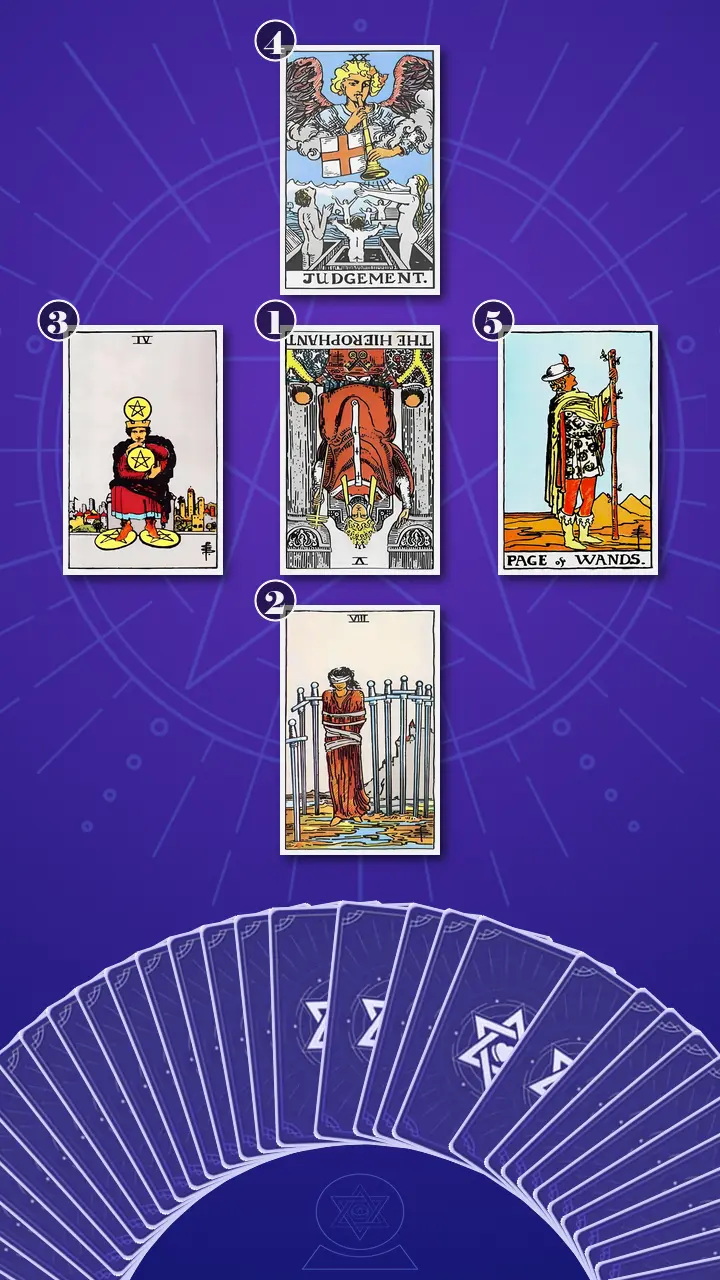
I placed the first card at the centre for the life script Alex was visibly performing. The second went below it for the belief underneath. The third sat to the left for what the pattern protected. The fourth rose above the centre for the suppressed capacity available to reclaim. The fifth waited on the right for one low-risk experiment. The layout looked like a person standing at an internal crossroads.
This is how tarot works in my practice: not as an authority issuing a verdict, but as an objective pattern-recognition tool. The images slow down a familiar mental loop and place its moving parts where both of us can inspect them. Alex would remain the person deciding what was true, what was incomplete, and what happened next.
Reading the Borrowed Scorecard
Position 1: The Rule That Still Organised Monday
The first card I turned represented the observable life-script behaviour: privately questioning expected milestones while continuing to organise choices around them. It was The Hierophant, reversed.
I pointed to the seated authority, the two kneeling acolytes, and the crossed keys at the figure's feet. Upright, the Hierophant can represent established teaching, recognised paths, and the structures through which a community transmits knowledge. Reversed here, its energy was blocked between intellectual dissent and embodied choice. Alex had begun questioning who should hold the keys, but their calendar still behaved as though external authority controlled access.
I connected the image directly to the Tuesday-night scene. At 11:40 p.m., Alex could privately write that the promotion path felt empty and then keep refining the promotion spreadsheet because a manager, family member, or LinkedIn network would immediately recognise that choice. The reversal was not proof that every conventional milestone was false. It showed the split between no longer believing the borrowed rule completely and still waiting for its permission.
The pattern had some of the emotional architecture of Severance: the polished professional self kept performing a legible role while the person outside that role became harder to hear. I asked, “Which rule do you privately question but still obey through one specific weekly behaviour?”
Alex gave a brief laugh with a bitter edge. “That's so accurate it feels a little brutal.” Their fingers stopped circling the rim of the cold mug, then tightened around it. “I don't believe the promotion is inevitable. But I spend Tuesday evenings preparing for it as if somebody already decided.”
“We can let the card be accurate without turning it into an indictment,” I said. “A promotion can be a genuine choice. The question is whether you are choosing it now or continuing it because breaking the sequence without a perfect replacement feels irresponsible.”
Looking at the crossed keys, I remembered a lesson that years of travelling across cultures had made impossible for me to forget: what one room calls obvious, another may reveal as only one possible arrangement. A social rule can be useful, even generous, without becoming a private truth for every person who inherits it.
Position 2: Fifteen Tabs and No Open Door
The next card represented the hidden belief sustaining the gap between Alex's private truth and visible behaviour: the assumption that uncertainty meant no personally chosen movement was realistically available. It was the Eight of Swords, upright.
The figure was blindfolded and bound, but the fence of swords was uneven. I read the energy as an excess of air, thought turning over thought, combined with a blockage of movement. The image did not claim that Alex's practical limits were imaginary. It asked whether those limits had been fused with assumptions until a restricted route felt like no route at all.
I brought in the Line 1 commute Alex had mentioned. They had stood between wet coats and a fogged window, searching “career change without pay cut” while opening tabs for certificates, portfolio requirements, salary calculations, Reddit threads, and resume optics. Toronto rent was real. Uncertain outcomes were real. But the browser full of risk had created the sensation that every exit had been inspected, even though Alex had not booked one beginner session or asked for one exploratory conversation.
“Every personal preference becomes a research project when recognisability is the hidden entry fee,” I said. “The mind says, 'Rent is real and uncertainty is real, therefore any movement is impossible.' Caution and paralysis get compressed into the same conclusion.”
I asked Alex to sort the enclosure into three categories: fixed limits, assumed limits, and movement still available. They named rent, paid work, and essential rest as fixed. They placed imagined peer judgement and the fear of looking unfocused under assumed. Under available movement, after a long pause, they wrote: “One email. One workshop. Thirty minutes.”
Their breathing caught while they looked at the final column. Their gaze drifted away from the card as though replaying the train journey, then returned to the small opening between the swords. Their shoulders did not fully lower, but one hand opened on the table.
Position 3: The Calendar Guarding the Door
The third card represented the protective payoff of following the borrowed script: preserving stability, approval, and a controllable identity. It was the Four of Pentacles, upright.
I mapped the pentacle at the figure's crown to career optics, the coin pressed against the chest to Alex's dependable identity, and the coins pinned underfoot to salary and routine. Earth energy was operating in excess. Useful conservation had hardened into total resource control, restricting where Alex could place time, money, attention, and beginner-level effort.
Alex's salary covered their share of Toronto rent, and their professional credibility provided meaningful security. I did not minimise either fact. The blockage appeared when every evening was allocated to work, networking, exercise, or recognised development while a CAD 25 workshop or thirty-minute personal project was cross-examined as though it could destabilise the entire structure.
I described the Wednesday evening Alex had already shown me on their colour-coded calendar. A networking coffee, spin class, and optional industry webinar occupied Saturday. One place remained in the design workshop, but the workshop had no recognised status attached to it. Alex had left it unscheduled while telling themselves, “I can't risk becoming less reliable for something I may not even be good at.”
This was where I used my Hidden Cost Deconstruction lens. The recognised path had visible benefits: salary, routine, credibility, and approval. The personal experiment had visible costs: perhaps thirty minutes, CAD 25, and the discomfort of being inexperienced. But the spreadsheet omitted the emotional bills attached to never testing it: another Saturday surrendered, another flash of resentment after praise, and another month in which Alex could only speculate about their own interest.
“I'm not asking you to spend recklessly or dismantle the systems that keep you housed,” I said. “I'm asking why business-as-usual receives one hundred percent of the project budget while exploration is told it lacks evidence. Security becomes a cage only when nothing meaningful is allowed a key.”
Alex's mouth opened, then closed. They released a breath from low in their chest and looked at the overfilled calendar beside the card. “I thought filling my time proved I was responsible,” they said quietly. “I didn't realise it also made sure I never had to be a beginner in front of myself.”
When Judgement Sounded Above the Spreadsheet
Position 4: The Review That Wasn't a Verdict
The radiator clicked off as I reached for the card above the centre. Through Alex's open window, a distant streetcar bell sounded once, then the apartment settled into an unusual quiet. I turned the card representing the capacity needed to loosen the inner conflict: honest self-evaluation that separates inherited standards from current conviction.
The card was Judgement, upright.
I traced the angel's trumpet and the figures rising from grey coffins with open arms. I read this upright energy as a return to balance: a signal being consciously evaluated and answered. Judgement was not commanding Alex to quit, rebel, or expose a private desire to public scrutiny. It reclaimed their ability to review the scorecard without automatically obeying it or rejecting it.
In ordinary life, I translated the card into a private scene. Alex closes LinkedIn, removes praise and guaranteed outcomes from the evaluation, and asks what interest has kept returning anyway. Community design remains. Instead of producing another strategy document, they give that signal one reversible response within seven days.
I call the next distinction Fear-Driven Logic Decoupling. I drew a line down the centre of a page. On the left, I wrote the authentic desire data: “Community design has returned for eighteen months. I want direct contact with it.” On the right, I wrote the fear forecast: “People may think I'm unserious. One workshop might expose that I have no coherent plan.” Rent and work hours stayed on the page as real boundaries. Fear of losing approval was no longer permitted to impersonate financial evidence.
I watched Alex return to the same 11:40 p.m. logic: the spreadsheet looked organised, the workshop tab looked dangerous, and their jaw tightened around the demand to make the correct permanent choice. They were still waiting for private desire to win a public trial.
Stop treating the borrowed scorecard as a verdict; answer Judgement's trumpet as a prompt for honest self-review, then rise into one small action of your own.
For one beat, Alex did not move. Their breath stopped halfway in, and their fingers hovered above the keyboard as though an invisible warning had frozen them there. Then their pupils widened and their gaze lost focus. I could see the promotion meeting replaying behind their expression: the manager's praise, the automatic respectable answer, the workshop disappearing from the conversation. Colour rose along their cheeks. Their eyes brightened, but their first release was not relief.
“But doesn't that mean I've been wrong this whole time?” they asked, sharper than before. Their shoulders drew up again, and one hand closed into a fist. A second later, the anger thinned into a tremor in their voice. “I've worked so hard to make this life make sense.”
I let the objection remain in the room without correcting it too quickly. Then I said, “No. The old choices protected income, connection, and a version of you that knew how to succeed. We don't have to insult that protection in order to update it. Judgement is a review, not a prosecution.”
Their fist loosened finger by finger. Their jaw released first, then their shoulders dropped with a long, uneven exhale. The softening left a moment of exposed stillness, almost like the slight dizziness that comes after setting down something heavy and realising the carrying itself had become an identity.
“Now, with this new perspective, think back to last week,” I said. “Was there a moment when this insight could have made the situation feel different?”
Alex looked toward the closed workshop tab. “Wednesday. I treated pressing Register as if I were resigning from my job in the same click.”
I reduced the insight to one practical sentence: “Your own script does not begin when every doubt disappears; it begins when one honest preference gets a real place on your calendar.”
I asked Alex to open the private note where they kept workshops, alternative roles, and creative ideas. Without polling the group chat or converting the interest into a career-development objective, they circled the item that had survived repeated postponement. I invited them to give it one ten-minute action within seven days. The test would protect rent, work obligations, privacy, and their right to stop.
I saw that moment as the real bridge in the reading: a step from contracted frustration and approval-based self-doubt toward grounded self-trust built through direct personal evidence. It did not resolve every doubt. It changed which kind of evidence Alex was willing to collect.
A Sprouting Wand Gets a Calendar Invite
Position 5: The Beginner Who Needed No Rebrand
The final card represented the practical integration step: translating Alex's own script into one low-risk, scheduled experiment that could produce direct evidence without demanding a permanent decision. It was the Page of Wands, upright.
The Page was not displaying a finished achievement. The figure was studying a wand with fresh leaves, attentive to something alive but undeveloped. I read the fire energy as balanced curiosity: enough heat to make contact, not so much that Alex needed to burn down a stable life or announce an identity-level reinvention.
I offered three equally valid translations of the image: book one beginner workshop, make one rough prototype, or request one exploratory conversation. Alex could call the calendar block “Private pilot,” set a time and cost cap, keep it private, and define success as completing the test. The Page did not require them to become a designer, abandon professional services, or produce anything impressive.
“This card protects your right to be new at something,” I said. “You are allowed to gather evidence without announcing a new identity.”
Alex opened their calendar. Their fingers paused over Saturday, but this pause felt different from the earlier freeze. They checked the workshop date, cancellation policy, and price. Then they created a thirty-minute block for the following evening and attached the registration link.
“I'm not choosing a new identity,” they said, reading the event back to me. “I'm collecting one piece of lived evidence.”
The spread's elemental movement became visible in that small action. The Eight of Swords had shown air narrowing the field through thought. The Four of Pentacles had shown earth fixing that narrowed field into routine. No Cups appeared, mirroring how Alex repeatedly removed feeling from an authenticity question. Judgement interrupted the lock, and the Page introduced a measured amount of fire. The missing emotional data did not need to become a command; it only needed enough room to meet behavioural data.
The One-Date Script Shift
I gathered the five cards into one coherent account. Alex had inherited a scorecard that linked recognisable milestones with approval, stability, and belonging. The Hierophant reversed showed that its authority was already weakening internally. The Eight of Swords showed how real limits and imagined social consequences had been compressed into “no movement is possible.” The Four of Pentacles explained why the loop persisted: it protected money, competence, and connection by withholding all resources from unfamiliar evidence. Judgement restored honest private review, and the Page of Wands converted that review into one bounded contact with experience.
The core blind spot was not simply overthinking. It was the assumption that a choice became legitimate only after it was publicly defensible. That approval-based filter produced its own misleading algorithm: because only recognised choices received clicks, dates, and completed actions, the internal recommendation system kept serving more of the same. Untested preferences produced no behavioural data, so the borrowed path appeared to be the only realistic one.
The transformation direction was therefore precise. Alex did not need to replace conformity with reflexive rebellion. They needed to distinguish an inherited rule from a current value, preserve genuine boundaries, and schedule one low-risk experiment before asking anyone else to reshape the preference. Tarot had made the mechanism visible, but it could not take ownership of the decision. That remained with Alex.
I gave them three next steps, deliberately small enough to begin without quitting a job, risking rent, or making a public declaration.
- The Borrowed Scorecard Review On Sunday, before opening LinkedIn, spend ten minutes in a phone note titled “Recognisable rule / Current preference.” Write one inherited sentence in the first column and one unedited preference in the second. Do not explain either entry or ask for feedback yet.Tip: Stop after one row. The exercise is a private review, not another comprehensive life audit.
- The 48-Hour Shadow Choice Experiment On paper only, temporarily act as though you have chosen the most feared low-risk option, such as attending one beginner workshop rather than quitting your job. For 48 hours, record each defence that appears: cost, time, approval, competence, identity, or something else. At the end, separate fixed constraints from fear forecasts. No real-world commitment is required.Tip: Keep the imagined choice bounded. The purpose is to reveal what your subconscious is protecting, not to force yourself into the option.
- The Seven-Day Private Pilot By Wednesday, spend fifteen minutes checking the next reversible step for one returning interest. Set a cap of thirty minutes, CAD 0 to 25, and no disclosure unless you choose it. Place one dated block within seven days. Afterward, log energy before, energy after, and whether you want one more contact with the activity.Tip: Success means completing the experiment, not proving a new career or identity. If thirty minutes feels exposing, use two minutes and record only what you noticed.
I reminded Alex that stopping after one test would still count as information. A boundary-first experiment can preserve security while releasing a measured amount of time and attention from total control. The aim was not to force enthusiasm. It was to create more personal evidence than zero.

A Week Later, the Quiet Proof
Six days later, I received a message from Alex: “Booked it. Slept all night. Woke up thinking, What if this is stupid? Then I laughed and made tea. The workshop is still on my calendar.”
They had not solved their career, rejected the promotion, or uncovered one permanent calling. The respectable path remained available. What had changed was smaller and more consequential: the desired path had finally received one observable action instead of another round of research.
I understood that as the first proof of grounded self-trust. Clarity had not arrived as certainty; it had arrived as Alex's willingness to gather evidence from a choice they had made themselves. The Shadow Spread offered a mirror and a map, but Alex supplied the date, the boundary, and the movement.
When your chest tightens around a preference you cannot yet defend, I know it can feel safer to keep performing the life that protects your place with other people than to risk discovering what is actually yours. Even noticing that your borrowed scorecard is making the decision turns its verdict back into information.
If one returning item in your own “Maybe Later” note could become a private seven-day experiment rather than a verdict on your whole future, what tiny contact would you give it before the next Sunday-night scroll?
This story is adapted from psychological research, written so that those in a similar struggle can see their own pattern in it — and find their next step clearly.These insights are not a substitute for professional psychological, medical, legal, or financial advice.
Learn more about our Journey to Clarity.
How did this insight land for you?
🫂 This Resonates Deeply
🌀 Living This Story
✨ Now I See Clearly
🌱 Seeing New Possibilities
🧰 Useful Framework
🔮 The Confirmation I Needed
💪 Feeling Empowered
🚀 Ready for My Next Step
Author Profile
 AI
AI“Having traveled across cultures... I've learned that what we often lack isn't a simple answer, but a moment of being truly understood. I use a Jungian psychological lens to help you deconstruct your subconscious patterns—not to prove anything, but to be the gentle companion who helps you unravel your knots, free of judgment, so you can reconnect with your inner wisdom.”
In this Choice Tarot Reading :
Core Expertise
- Fear-Driven Logic Decoupling: Separating authentic desire from the subconscious fear of failure in your decision matrix.
- Hidden Cost Deconstruction: Identifying and quantifying the unstated psychological 'emotional bills' attached to each option.
Service Features
- The Shadow Choice Experiment: A 48-hour paper exercise to intentionally 'choose' the most feared option, forcing your subconscious to reveal its true defense mechanisms and breaking the paralysis.
Also specializes in :
Explore Related Patterns:
Approval-Driven Decision ParalysisAlex freezes when asked what they want, closes the workshop tab, and keeps refining the promotion spreadsheet because the promotion can be explained to a manager, family member, or professional network. Imagined peer judgement is listed beside real rent and work constraints until every route outside the recognised path feels unavailable. When approval becomes the hidden entry fee for action, private preference cannot authorise even a reversible test. Your mind first tries to predict whether other people will regard the choice as sensible, coherent, and serious. Because those social forecasts cannot be fully controlled, the decision stalls and passive continuation begins to look like the responsible option. Approval-Driven Decision Paralysis explains why more thought does not resolve Alex's question. The missing ingredient is not a perfect argument but permission to collect evidence before the choice is publicly defensible. Scheduling one private, bounded experiment interrupts the paralysis by allowing personal experience to enter the decision alongside social feedback.
Self-AbandonmentAlex repeatedly gives evenings, calendar blocks, and planning energy to the recognised career path while community design remains in a private note or a closed tab. Even a CAD 25 workshop is cross-examined as a threat, although work, networking, and recognised development receive the default share of discretionary resources. The recurring preference is heard internally but denied an actionable place. When you protect approval, competence, and continuity by repeatedly excluding your own signals, self-abandonment can look indistinguishable from responsibility. There is no dramatic rejection of the self; there is a sequence of small allocations in which other people's imagined standards receive decision-making weight and your preference is asked to wait until it can justify itself perfectly. The resulting lack of personal evidence then makes the external script appear even more realistic. Alex begins reversing this cycle by giving one returning interest a date, a cost cap, privacy, and the right to stop. That boundary-first action does not elevate desire above rent or work obligations. It restores the preference as one legitimate source of information, allowing self-trust to be built through observable choices rather than demanded as a feeling in advance.
Social Clock ComplianceAlex privately questions the promotion while continuing to reserve Tuesday evenings for it because a manager, family member, or LinkedIn network would immediately recognise the choice. The workshop has returned for eighteen months, but its lack of recognised status means it receives less time, less money, and less behavioural commitment than the conventional milestone. When you organise your life around a social timetable, recognisability can start functioning as the only acceptable evidence of legitimacy. The inherited sequence offers approval, stability, and belonging, so following it reduces the relational risk of appearing unfocused. The cost is that your calendar may continue obeying a rule your private judgment has already begun to revise. Social Clock Compliance does not mean the promotion is false or that convention must be rejected. It identifies the mechanism that gives a publicly legible option automatic authority. Alex begins reclaiming authorship when the conventional path and the returning personal interest are both treated as choices to evaluate, rather than one being presumed valid before the evaluation begins.
Authenticity PerfectionismAlex describes pressing Register as though they would be resigning from their job in the same click. One beginner workshop is made responsible for proving whether community design is a real calling, whether the promotion is false, and whether the entire existing life has been wrong. A small experiment cannot carry that identity-level burden, so the action freezes. When you require an authentic choice to arrive as certainty, curiosity is disqualified for being incomplete. You may wait to know exactly what you want before acting, even though direct action is one of the main ways preferences become clearer. The search for a perfectly coherent personal script then reproduces the same paralysis as the borrowed script, because both demand obedience to a complete answer before experience is allowed. Authenticity Perfectionism loosens when a preference is permitted to be provisional. Alex's workshop can remain one bounded contact rather than a verdict on career or identity. That distinction protects practical stability while letting authenticity develop through evidence instead of being forced to pass an impossible advance test.
Identity ForeclosureAlex can build a flawless promotion roadmap and perform the reliable project coordinator role, yet they freeze when asked what they actually want. Community design has returned for eighteen months without receiving enough direct exploration to become more than a private possibility. The established professional identity therefore has years of evidence behind it, while the alternative is kept too undeveloped to compete. When you commit to a socially coherent identity before testing other meaningful possibilities, the commitment can begin to look like discovery rather than selection. The dependable role supplies income, competence, approval, and a ready-made explanation of who you are. The untested interest appears vague by comparison, but that vagueness is partly produced by repeatedly withholding experience from it. Identity Foreclosure names this premature closing of exploration, not a permanent mistake. Alex's workshop does not require a new identity announcement. It reopens the evidence-gathering process so that future commitments can include information generated by Alex's own contact with the activity.
IntellectualizationAt 11:40 p.m., Alex edits the five-year promotion plan again, closes the workshop tab, and later turns the same returning interest into a browser full of certificates, salary calculations, Reddit threads, and resume optics. These are not signs that thought itself is the problem. They show thought being used to move an emotionally ambiguous choice into a domain where Alex can stay informed, articulate, and professionally competent. When you can explain every sensible option but cannot identify which one you want, analysis may be functioning as emotional insulation. The mind keeps producing reasons because reasons are publicly defensible, while preference is private, unfinished, and unable to guarantee an outcome. Intellectualization preserves control, but it can also make the absence of direct experience look like proof that no personal answer exists. The useful audit is to notice when research is clarifying a real constraint and when it is replacing contact with the choice. Alex's bounded workshop experiment does not reject careful reasoning; it gives reasoning a new source of data by allowing one preference to become lived evidence.
Productivity as SafetyAlex spends Tuesday evenings refining a promotion path they no longer consider inevitable, then fills Saturday with networking, exercise, and an optional industry webinar while leaving the design workshop unscheduled. The calendar does more than organise responsibilities. It continually produces visible proof that Alex is reliable, serious, and in control. When you use recognised productivity to regulate uncertainty, an open hour can feel less like freedom and more like exposure. Keeping every block useful protects you from encountering an interest at the beginner stage, where there is no status, competence, or guaranteed return to display. Productivity becomes a safety behaviour because the full schedule prevents the unfamiliar preference from generating evidence that could complicate the established identity. Alex's private pilot changes the function of one calendar block without dismantling the stable structure. The important shift is not from productivity to irresponsibility; it is from using productivity as total protection to using structure in service of both security and exploration.
Sunk Cost Identity AttachmentWhen Alex is invited to review the inherited scorecard, their first response is to ask whether they have been wrong the whole time. They immediately connect a possible update with the amount of work already invested in making the current life coherent. Continuing the promotion sequence protects more than prior effort; it protects the meaning attached to that effort. When your investment in a path becomes fused with identity, changing direction can feel like declaring the earlier self foolish or fraudulent. The mind therefore keeps funding the established sequence because continuation appears to preserve the value of everything already spent. This is how sunk cost moves beyond a practical calculation and becomes an attachment to the person you had to be in order to make the path work. Alex's review becomes possible once previous choices are recognised as protective and contextually useful rather than prosecuted as mistakes. You can honour the income, connection, and competence those choices created without requiring them to determine every future allocation. Updating the path does not erase the earlier investment; it stops that investment from holding exclusive authority over what happens next.
Explore Related Struggles:
Approval-Safety FusionThe manager's praise confirms Alex as reliable on the same day that another personally meaningful idea is postponed. Promotion, credibility, income, and social recognition therefore arrive as one coherent package, while a private workshop appears to carry the possibility of seeming unfocused or irresponsible. When approval has become part of how you verify safety, an unrecognised preference can feel dangerous before any practical risk is measured. You are not simply choosing between two activities; you are trying to move toward something personally meaningful without disturbing the belonging and stability attached to the approved role. Separating concrete limits from anticipated judgement makes that hidden bargain available for review.
Borrowed Purpose LockAt 11:40 p.m., Alex edits the promotion plan for the third time and closes the workshop tab that represents an interest they have been returning to for eighteen months. Their private questioning has changed, but their weekly behaviour still follows the sequence that a manager, family member, or professional network would immediately recognise. When your calendar keeps carrying out a rule you no longer fully endorse, self-direction cannot emerge through insight alone. The lock sits between recognising that the script was inherited and granting your own preference enough authority to alter one real decision. Seeing that division lets you review the borrowed sequence without declaring every earlier choice a mistake or allowing it to keep deciding by default.
Metric-Compass FusionAlex can defend every respectable milestone and build a flawless promotion roadmap, yet the question of what they want produces a freeze. Salary calculations, résumé optics, praise, and recognised development all count as admissible evidence, while an interest that has returned for eighteen months remains unofficial because it has never been tested. When external metrics take over the work of an inner compass, the approved path keeps generating proof of itself. You click, schedule, and complete what is already legible, then encounter the absence of evidence for your own preference as if that absence proved the preference was unrealistic. Allowing a bounded personal action to count as evidence interrupts that closed measurement system without requiring certainty first.
Competence-Desire SplitAlex is publicly recognised as reliable and can produce a flawless promotion roadmap, while the workshop offers no status and requires entering as a beginner. Their filled calendar maintains the competent role so completely that an undeveloped interest has no place to exist without first proving its professional value. When competence becomes the condition for granting desire any resources, wanting something new exposes you to evidence that you are not already good at it. The conflict is not a lack of ambition; it is the pressure to preserve a finished, dependable identity while curiosity asks for unfinished contact. A private pilot lets competence remain intact without forcing desire to arrive as another performance.
Identity Verdict LockPressing Register feels to Alex as though they are resigning from their job in the same click. One beginner workshop is no longer allowed to be a workshop; it becomes a public trial of whether their career is coherent, whether their past effort was wrong, and whether they must adopt an entirely new identity. When every exploratory action is treated as a verdict about who you are, the borrowed path gains an automatic advantage because it asks for no new self-definition. You remain caught between permanent identities instead of collecting limited evidence from a temporary experience. Restoring the difference between an experiment and a declaration gives you permission to learn without turning the result into a sentence on your whole life.
Resource Control BindAlex's calendar gives time to work, networking, exercise, and recognised development while leaving the community design workshop unscheduled. Reworking the promotion plan is accepted as responsible resource use, but thirty minutes and CAD 25 for exploration are cross-examined as though they could destabilise the entire system. When control protects every existing obligation by withholding all resources from unfamiliar experience, the current path keeps winning through allocation rather than conscious consent. You cannot discover whether an interest belongs in your life when it is denied the minimum time needed to produce evidence. A capped calendar block loosens that bind by protecting material limits and personal exploration at the same time.
Security-Choice SplitAlex looks at a CAD 25 workshop and experiences pressing Register as though resignation would happen in the same click. Toronto rent, paid work, and essential rest remain real constraints, but the scale of the proposed action is lost when it is evaluated as a threat to the entire structure supporting their life. When security and personal choice are positioned as mutually exclusive, even reversible movement carries the weight of destabilisation. You can respect the boundaries that keep you housed and employed while examining why a thirty-minute experiment is being charged with consequences it cannot produce by itself. That distinction creates room for choice inside security rather than requiring security to be abandoned.
Explore Related Emotions:
Approval AnxietyWhen your manager calls you reliable while you postpone the workshop, the praise lands as validation and as a reminder of the role you know how to perform. The fear is not simply that other people may disagree; it is that a less recognisable choice could cost you credibility, belonging, or the image of being responsible. Your calendar then treats anticipated judgement as if it were evidence about what is financially or personally safe. Naming that pressure gives you room to keep real boundaries such as rent and work while refusing to let approval make the decision on your behalf.
False Alignment UneaseAt 11:40 p.m., you can revise the promotion spreadsheet for the third time while the community design workshop sits in a closed tab, and praise for being reliable still feels strangely disconnected. The outside structure looks coherent, but the preference that keeps returning has no lived place inside it, leaving you with the unease of inhabiting a life that earns recognition without fully registering as yours. When recognisability becomes the only evidence your mind accepts, a polished plan can hide the gap between public approval and private conviction. You do not need to label the promotion false; the useful question is which part is chosen now and which part is being maintained because it remains legible to other people.
Authorship AnxietyAsked what you actually want, you can explain every respectable milestone yet cannot tell whether the promotion is something you chose or something you learned to want. That split leaves your own preference feeling like a draft written in someone else's voice. Because the recognised path already has a script, you keep refining it while waiting for your private desire to win a public trial. A small choice made without polling the group chat can begin returning authorship to your lived evidence, without requiring a permanent identity claim.
Numbed DesireCommunity design has returned for eighteen months, yet the workshop tab keeps closing and the promotion spreadsheet keeps receiving edits. The repeated postponement does not prove that the interest is your answer; it shows how little room the feeling behind it has been given to become observable. When the question of desire is converted into salary calculations, peer judgement, and resume optics, the signal becomes hard to hear. A ten-minute or thirty-minute contact can let you collect information from direct experience rather than asking the muted preference to produce certainty on command.
Preference Exposure DreadYour fingers hover over Register as if one click were a resignation, and the fear of looking unfocused turns a CAD 25 workshop into a public statement about your entire future. The private interest is not only being evaluated; it is being exposed to a verdict before it has had a chance to be lived. That pressure makes beginnerhood feel risky in front of yourself and other people. A private, bounded experiment keeps the preference yours while allowing it to produce evidence, so exposure is no longer the price of having an interest.
White-Knuckle SecurityYour salary covers your share of Toronto rent, and your full calendar protects routine, credibility, and the identity of being dependable. The grip is understandable because those structures matter, but each evening assigned to recognised development leaves the unfamiliar option with no time, money, or beginner-level effort. Security becomes emotionally constricting when business-as-usual receives the entire project budget and exploration is required to prove its worth before it starts. Keeping the base intact while reserving CAD 0 to 25 and thirty minutes lets protection remain protection rather than the only permitted form of care.
Cautious AutonomyAfter separating rent and work hours from imagined peer judgement, you create a thirty-minute private pilot and keep the right to stop. The choice is small enough to respect your actual constraints while still coming from your own calendar rather than an inherited scorecard. That bounded movement gives autonomy a practical shape. You do not have to reject every conventional milestone to make one decision yours; you only need to reserve a space where your preference can be tested before other people's approval enters the room.
Cognitive OverwhelmOn the Line 1 commute, you open tabs for certificates, portfolio requirements, salary calculations, Reddit threads, and resume optics, but no beginner session or exploratory conversation gets booked. Thought keeps adding conditions until the number of apparent exits shrinks to one recognised route. Real rent and uncertain outcomes deserve a place in the calculation, yet they do not need to carry imagined peer judgement in the same column. Separating fixed limits from forecasts can turn the crowded mental field into one small question you can actually test.
Grounded Self-TrustSix days later, you booked the workshop, slept all night, laughed at the thought that it might be stupid, and kept the event on your calendar. Nothing about that action settles your career, but it gives your own choice a date, a boundary, and one piece of lived evidence. That is how trust in your judgement becomes concrete here, not through certainty or a dramatic rebrand, but through noticing what happens when you act on a preference without asking it to be publicly defensible first. You remain free to continue, revise, or stop after the experiment.
Explore Related Contexts:
External Scorecard PressureAlex can explain every respectable milestone and still freeze when asked what they actually want, even as a manager praises the reliability that keeps the promotion track moving. You are watching an external scorecard become the main test for whether a choice is allowed to count. Manager approval, LinkedIn recognition, salary, and resume optics are concrete social signals, but they are not the same thing as a current personal conviction. When only publicly defensible options receive clicks, dates, and completed actions, the approved path keeps generating evidence while your untested interests remain silent. You continue following the scorecard because recognition has been made the hidden entry fee for movement.
Rigid Life Script Lock-InAt 11:40 p.m., Alex adjusts the same five-year-plan cell for the third time, closes the community design workshop tab, and then continues preparing for promotion on Tuesday evenings. You can see the lock-in in the gap between privately questioning the sequence and continuing to organize your week around it. The promotion route remains socially legible because a manager can call you reliable and other people can recognize the milestones, while the workshop has no equivalent stamp of legitimacy. You keep inheriting the next step because breaking a visible sequence appears irresponsible before an alternative has earned public proof. The issue is not that a conventional milestone must be wrong; it is that the established sequence has been given authority over your calendar before your current preference has been allowed to operate as evidence.
Values Alignment CrossroadsAlex says they may want the promotion but cannot tell whether they learned to want it, while community design has kept returning for eighteen months. You are standing at a crossroads between a role that already receives public recognition and an interest that has personal persistence but no established status. The choice is not a contest between sensible work and reckless escape. Rent, paid work, and essential rest remain real boundaries, while the workshop can be tested within a small time and cost limit. Your task is to separate a current value from an inherited rule while both are still occupying the same calendar, so the next decision can be based on direct evidence rather than on the prestige of one route.
Career Stability Lock-InAlex's salary covers their share of Toronto rent, their professional credibility provides security, and the calendar is filled with work, networking, exercise, and recognized development. These are real protections, so you do not need to pretend that stability is an imaginary obstacle in order to examine what it is costing. The promotion path keeps receiving the full project budget because it produces measurable returns in money, routine, competence, and connection. A CAD 25 workshop is then reviewed as if it could destabilize the whole structure, while another Saturday surrendered to postponement remains invisible. You keep choosing the stable route because the surrounding system rewards it immediately and gives unfamiliar interests no comparable place to prove their value.
Career Transition FogOn Line 1, Alex searches for a career change without a pay cut and opens tabs for certificates, portfolio requirements, salary calculations, Reddit threads, and resume optics, yet does not book a first session or exploratory conversation. You can see the alternative direction surrounded by requirements before it has received direct contact with the work itself. Rent and paid work are genuine boundaries, but they become fused with the demand to know the outcome, protect a coherent resume, and avoid looking unfocused. The established promotion route therefore feels actionable because its sequence is already visible, while the personally interesting route stays in research mode. You keep returning to the inherited script because the alternative has been required to provide certainty before it is permitted to provide information.