The 10:45 p.m. Habit Stacking Overload
After a late hybrid workday in Toronto, one unchecked habit can send you from a warm phone and tight shoulders straight into a new productivity video. At 10:45 p.m., that exact spiral was glowing in the hands of Alex, a 28-year-old junior UX designer who had joined my video call from their apartment.
The dishwasher hummed through their microphone. Blue light washed over a cold takeout container while their thumb hovered above a habit app showing twelve evening boxes: stretch, journal, read, prep lunch, tidy, meditate, track water, shut down screens. One box remained blank. Their shoulders rose toward their ears as if bracing for impact.
"I know how ridiculous this sounds," Alex said. "I want to sleep, but I also want to rebuild tomorrow morning. If I can find the right system, I'll finally become consistent. Why do I pile on new habits until my whole routine collapses?"
I could hear the contradiction underneath the question. Alex kept adding habits to build a better life, yet every addition made that life harder to inhabit. Their frustration had the physical logic of an overstuffed carry-on: every item seemed useful, but the zip was cutting into the fabric and the bag itself had become the journey.
"It doesn't sound ridiculous," I said. "The routine has become the task. You do not need another plan if the plan has already become the thing you are carrying."
The muscles around Alex's jaw loosened slightly. I told them I was not going to use tarot to predict whether they would become disciplined. I wanted to help them separate a temporary low tide from an obsolete pattern, then find a form of consistency that belonged to their real week. "Let's draw a map of the fog," I said, "and make sure the next move remains yours."

Choosing a Map for the Overload-Reset Loop
I invited Alex to put both feet on the floor and take one slow breath before I shuffled. The pause was not a mystical test. It was simply a transition from compulsive fixing to careful observation.
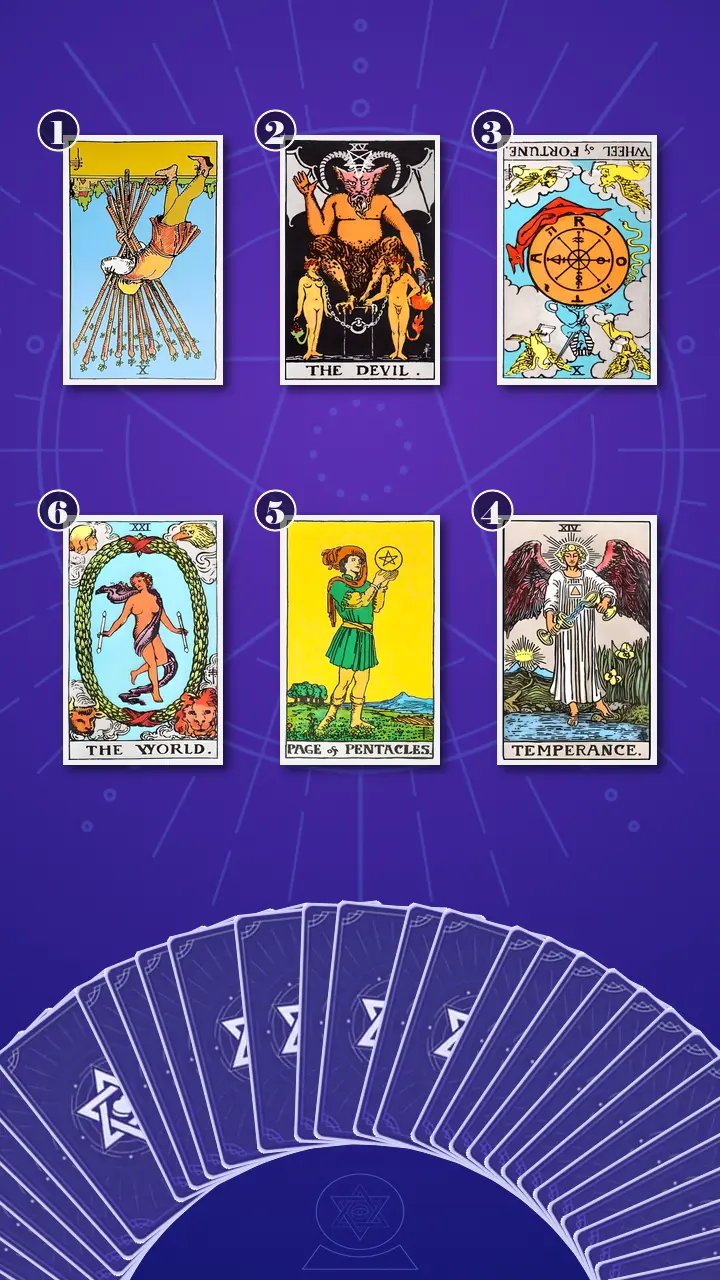
I chose the Transformation Path Grid (6) - Context Edition, a six-card tarot spread designed to follow a self-reinforcing pattern from symptom to integration. For anyone wondering how tarot works in a practical consultation, I treat the cards as a structured visual interface. Card meanings become useful only in context, when their symbols help us examine a real behaviour without turning it into a verdict or prophecy.
This spread fit because Alex's problem was not a single decision or a simple timeline. It was a loop: add habits, feel briefly in control, become overloaded, miss one step, abandon everything, and start again from day one. A broad snapshot would not have exposed the mechanism with enough precision.
The upper row would show the visible overload, the hidden attachment, and the automatic reset script. The lower row would reveal the influence capable of interrupting the cycle, a one-week experiment, and a more integrated definition of a complete routine. The cards would move like a checklist unfolding into a walkable path.
The Bundle, the Chain, and the Turning Wheel
The Visible Load: Ten of Wands Reversed
I turned over the card representing the visible condition: the exact moment new habits accumulate until one missed task appears to cancel the whole routine. It was the Ten of Wands, reversed.
In the Rider-Waite-Smith image, a figure bends under ten staffs, their face hidden and their path almost impossible to see. I asked Alex to imagine each staff as one useful suggestion promoted to a requirement: wake earlier, stretch, journal, read, prep meals, track water, tidy, meditate, review the day, and put the phone away. None of those habits was inherently bad. Gathered into one bundle, however, they blocked the purpose of the routine from view.
The reversed energy showed excess action alongside a blocked attempt to release it. Alex did not merely carry too much; when the load became unbearable, they dropped every staff at once. That was why pure spontaneity would not solve the problem either. They needed to release excess while preserving one helpful anchor.
"Which single habit could you remove this week before adding anything else?" I asked.
Alex gave a short laugh with a bitter edge. "That's so accurate it's almost rude. I keep thinking every nice-to-have is a core feature."
As a UX designer, they recognised the pattern immediately: their daily backlog had no priority levels. Every feature was marked critical, so the interface of their life could no longer display the page they had originally opened.
The Rule Behind the App: The Devil Upright
I turned the card representing the hidden attachment: what the overloaded routine was being asked to prove and why the burden kept being chosen. It was The Devil, upright.
I explained that I did not read The Devil as an outside force waiting to punish Alex. I focused on the loose chains around the two figures. The habit app had begun as chosen support, but it now behaved like a performance review. A blank box was no longer just an incomplete action. It seemed to say something about whether Alex was disciplined, worthwhile, or capable of following through.
"If I leave this out, I'm settling," Alex said quietly, recognising their own internal script. "And if I miss it, the whole plan is broken."
This was a blockage created by attachment, not by a lack of ability. Adding another habit delivered a brief hit of control while tightening the rule underneath. The app was not the enemy, and Alex was not trapped by fate. The loose chain mattered because its governing assumption could be questioned.
I used what I call Gravity Well Identification: locating the old rule or environment exerting such a strong downward pull that every attempt at change curves back toward it. Alex's gravity well was not "having routines." It was the belief that a complete checklist could certify a complete person.
Their thumb stopped moving over the screen. Their shoulders remained high for a moment, then one dropped. I watched their gaze shift away from the app as if they were seeing the chain rather than only feeling its weight.
The Reset That Looks Like Progress: Wheel of Fortune Reversed
I turned the card representing the repeating script: the trigger, the adding-and-restarting response, and the cost of leaving the operating rule untouched. It was the Wheel of Fortune, reversed.
I traced the circular motion in the image. Alex misses a planned habit, resets the tracker to day one, downloads a cleaner template, and launches the same demanding schedule under a new name. Notion becomes Todoist; Todoist becomes a streak app; Monday becomes the next Monday. The interface changes, but the overloaded expectation survives every relaunch.
The Wheel's movement was blocked into repetition. Activity created the sensation of change without changing the mechanism. The new plan briefly relieved the heavy feeling in Alex's chest, which made restarting emotionally persuasive even when it produced the same outcome.
"Starting over feels clean," I said. "Adjusting is where the experiment begins. A missed checkbox is information, not a character reference."
Alex inhaled, held the breath, and stared past the screen. I could almost see the last several Sunday resets replaying behind their eyes. When they exhaled, they said, "I've been changing the icon without fixing the bug."
When Temperance Changed the Measure
The Antidote: Temperance Upright
The room on Alex's side of the call became unusually still. Even the dishwasher had reached the quiet part of its cycle. I turned the card representing the influence that could interrupt the pattern and test the fear that a smaller routine meant personal failure.
It was Temperance, upright.
I showed Alex the angel pouring carefully between two cups, with one foot on land and one in water. This was balanced energy rather than excessive or deficient effort. In Alex's life, the cups became one reliable cue and one possible addition. The divided footing became a routine able to hold both structure and an unpredictable workday.
At 10:45 p.m., Alex had been caught between a tired body and the promise of a brand-new morning routine. The promise was control, but the body had already supplied the data. They were still asking, "What should I add to become consistent?" Temperance asked a different question: "What proportion could actually survive Tuesday?"
A collapsed routine is not proof that you need more rules; blend only what you can carry, like Temperance's two cups, and let a measured experiment replace the urge to start over.
I let the sentence remain in the quiet.
Alex's breath stopped first. Their fingers stayed suspended above the phone, neither closing the app nor opening another video. Then their gaze lost focus, as though they were replaying every late meeting followed by every midnight redesign. Their lips pressed together; their eyes brightened. One shoulder lowered, then the other, and their hand slowly unclenched around the phone.
The release did not arrive neatly. Alex frowned and leaned back. "But doesn't that mean I've been doing all of this wrong?" Their voice sharpened before it softened. Under the anger, I heard grief for the hours spent maintaining systems that were supposed to create more life.
"No," I said. "It means a strategy that once gave you hope has outlived its useful scale. We do not need to shame the part of you that wanted control. We need to give that part a smaller job."
I asked, "Now, using this new perspective, think back to last week. Was there a moment when this insight could have made the day feel different?"
Alex remembered a Wednesday dinner invitation. They had spent fifteen minutes trying to fit a friend around movement, meal prep, reading, and digital shutdown, then declined because the routine would not survive the change. "If one anchor had counted," they said, "I could have gone."
This was where I applied my Cognitive Spiral Mapping. A return to the same coordinate can look like proof that someone is stuck, but in orbital mechanics, a close pass can also supply the momentum for a new trajectory. The recurring missed box was not the failure point. It was the slingshot point, the moment when Alex could either add more rules or change their relationship with the load.
For a moment, I pictured the planetary cycles I had studied for years: repetition does not always mean going nowhere. Sometimes the cycle returns so that one governing condition can finally be altered. Temperance changed that condition from accumulation to proportion.
"This is not giving up," I told Alex. "It is testing the right amount. Smaller is not settling when the goal is staying."
That was the first clear step from shame-driven expansion toward proportionate experimentation, flexible consistency, and patient self-trust. The new vulnerability was real: without the dramatic high of starting over, Alex would have to tolerate an ordinary, unfinished-looking week. Clarity had returned their agency, but it had also returned responsibility for choosing what was enough.
One Pentacle and a Living Whole
The Practical Experiment: Page of Pentacles Upright
I turned the card representing the next available action: one anchor, no more than one addition, and an observation-based review instead of another total restart. It was the Page of Pentacles, upright.
The Page holds one pentacle with both hands. I read that concentrated attention as the grounded earth energy missing from Alex's fire-heavy pattern. Instead of collecting habits, Alex could study one concrete behaviour under real workweek conditions.
The modern version was deliberately unglamorous: choose a five-minute habit, place it after an existing cue, and observe whether it fits after an actual day of Figma reviews, Slack follow-ups, and meetings that run late. The goal was not to perform an impressive lifestyle. It was to learn what could be repeated without self-judgment.
"So I don't need to know whether this is my forever routine?" Alex asked.
"Exactly. The Page is a student, not a final exam. One week of data is enough for the next decision."
Their expression softened, but I also noticed hesitation. "I can already feel myself wanting to add journaling and reading once the stretch starts working."
"Then the experiment includes that urge," I said. "You can record the idea without promoting it into the active routine."
Completion Without Perfection: The World Upright
I turned the final card, representing integration rather than a predicted outcome: a routine complete enough to support daily life and flexible enough to survive a missed step. It was The World, upright.
I focused on the laurel wreath surrounding a figure who is enclosed but still moving. The boundary creates wholeness; it does not freeze life inside a perfect pose. Alex could complete one anchor, leave another task blank, and still recognise the routine as a living whole.
This was balanced integration. The World did not ask Alex to include every possible habit. It asked whether the existing parts could coexist with a late meeting, low energy, an unplanned dinner, or a day when the body simply needed less.
"Could a routine be complete if it included one blank checkbox?" I asked.
Alex looked at the wreath, then at the twelve-box app. "It would have to be," they said. "Otherwise it isn't designed for my actual life."
I nodded. "Your routine is a container, not a character reference. Its quality is measured by how well it holds your life, not by how much of your life it consumes."
The Orbit Expansion Strategy for an Ordinary Week
I gathered the six cards into one story. The reversed Ten of Wands showed a routine carrying too many commitments. The Devil exposed the identity rule that made releasing one commitment feel dangerous. The reversed Wheel revealed why changing apps and start dates kept producing motion without change. Temperance replaced accumulation with proportion; the Page grounded that principle in one experiment; The World offered a bounded routine with room to move.
The cognitive blind spot was simple but costly: Alex had assumed that collapse meant the system was not comprehensive enough. The spread showed the opposite. Collapse was information about load. The transformation was not from having routines to abandoning them, but from using routine as proof of worth to using it as adjustable support.
For the actionable advice, I drew three small rings on paper and used my Orbit Expansion Strategy. The centre ring held what already carried Alex through an ordinary day. The second held one testable addition. Everything else remained outside the active orbit until the current trajectory proved stable. Escaping the old gravity well would require less cargo and a precise change in momentum, not a larger launch vehicle.
- Run a One-Anchor Week. During the next Sunday planning session, spend no more than ten minutes choosing one existing cue, such as making the first coffee or opening the work laptop. Write it on a sticky note and hide the optional habit boxes for seven days. Make the pause reversible. Archive the boxes instead of deleting them, and test two days first if seven feels too loaded.
- Use a One-Addition Field Test. Place one five-minute action after the anchor, such as a two-minute journal note or brief stretch. Keep the same wording, app, and start date for one week. Put every other idea in a note titled "Later, not now." The anchor is the success measure. The addition is data, so missing it does not invalidate the day.
- Complete a No-Restart Review. After a miss, take under two minutes to record what interrupted the habit, which part was too large, and the smallest version you could try at the next ordinary cue. Leave the blank visible and continue without waiting for Monday. Stop after one sentence if the review starts becoming another checklist. Adjustment, not analysis volume, is the practice.
I asked Alex to open their tracker during the call. They circled "make first coffee," hid one optional evening box, and typed "the anchor counts as complete" at the top. The exercise took less than ten minutes. It was reversible, intentionally small, and entirely their choice.
The cards had not ordered Alex to become a different person. They had made the overload-collapse-restart loop visible enough for Alex to choose a different response. That is the value I want tarot to offer: not authority over a life, but a clear enough perspective for its owner to reclaim the controls.

A Week Later: One Blank Box, No Restart
A week later, Alex sent me a photo of a sticky note beside their mug: "coffee, then two-minute stretch." Wednesday was blank. The tracker remained intact. Their first morning thought was, "What if smaller means I'm lazy?" They smiled, made coffee, and continued.
They had not solved every question about discipline, work, or self-worth. They had done something more credible: they had allowed one imperfect week to remain a week instead of turning it into evidence for the prosecution.
I thought again of Temperance and the careful space between two cups. Alex's Journey to Clarity was not a sudden arrival at certainty. It was the first measured movement from shame-driven resets toward flexible consistency, with enough open space for a real life to keep happening.
When one missed checkbox lifts your shoulders and leaves your chest heavy, rebuilding everything can feel safer than letting a small, imperfect effort sit beside the fear that you are not disciplined, or worthwhile, enough. I would rather name that fear gently than let a tracker disguise it as a technical problem.
If, for one ordinary week, a smaller routine did not have to prove anything about your worth, which one anchor would you leave in Temperance's first cup and allow to be enough?
This story is adapted from psychological research, written so that those in a similar struggle can see their own pattern in it — and find their next step clearly.These insights are not a substitute for professional psychological, medical, legal, or financial advice.
Learn more about our Journey to Clarity.
How did this insight land for you?
🫂 This Resonates Deeply
🌀 Living This Story
✨ Now I See Clearly
🌱 Seeing New Possibilities
🧰 Useful Framework
🔮 The Confirmation I Needed
💪 Feeling Empowered
🚀 Ready for My Next Step
Author Profile
 AI
AI“After a decade of guiding people through the stars, I’ve come to see life much like the orbits of planets: everything has its inevitable cycles. When you feel lost, please don't blame yourself; you might just be in a natural low tide. I’m here to sit under the night sky with you, offering a gentle cosmic perspective to distinguish temporary pain from the beautiful breakthroughs just around the corner.”
In this Personal Growth Tarot Reading :
Core Expertise
- Cognitive Spiral Mapping: Validating that feeling 'stuck' is often just a necessary orbital slingshot phase before a major intellectual breakthrough.
- Gravity Well Identification: Diagnosing the obsolete habits or environments exerting a downward pull on your personal evolution.
Service Features
- The Orbit Expansion Strategy: A macro-perspective exercise to map the precise trajectory and momentum needed to escape your current cognitive gravity well.
Also specializes in :
Explore Related Patterns:
Black-and-White ThinkingAlex explicitly says that if one habit is missed, the whole plan is broken, and they recognize that every nice-to-have has been marked as a core feature. Once the load becomes unbearable, they do not reduce it by one or two items; they drop the entire routine and prepare to rebuild it from day one. Black-and-White Thinking compresses a varied week into two verdicts: complete or failed. When you cannot count partial completion as real progress, a single blank box gains the power to cancel every action that came before it. The routine then collapses not only because it contains too much, but because its internal scoring system provides no stable middle ground between perfect adherence and total restart.
Compulsive Self-ImprovementAt 10:45 p.m., Alex is already tired and looking at twelve evening habit boxes, yet one unchecked item sends them toward another productivity video and another system redesign. Every useful suggestion has been promoted into a requirement, so improvement is no longer a selective response to a real need; it has become an accumulating workload of its own. When you use adding as the default answer to inconsistency, each new habit can produce a brief sense of momentum while increasing the pressure that caused the previous collapse. Compulsive Self-Improvement names this repeating mechanism: the self is treated as an endless upgrade project, and the possibility of becoming better repeatedly displaces the harder decision about what is already enough.
Productivity as SafetyAlex's productivity app began as chosen support but now behaves like a performance review, and opening another video or rebuilding the routine briefly loosens the heavy feeling created by a missed box. The planning activity therefore does more than organize behavior: it converts uncertainty, fatigue, and self-doubt into a structure that appears controllable. When productivity becomes a source of psychological safety, reducing the system can feel more threatening than carrying it, even after it has stopped working. You may keep adding because the plan promises protection from an unfinished-looking day, while an ordinary adjustment leaves you exposed to the fear that you are falling behind or losing control. The problem is not a lack of planning skill; it is the emotional job the plan has been assigned.
Achievement-Based Self-WorthAlex says that leaving a habit out would mean settling, and the blank checkbox appears to comment on whether they are disciplined, worthwhile, or capable of following through. A small unfinished action has therefore acquired identity-level meaning: the tracker is measuring behavior on the surface while Alex experiences it as measuring the person underneath. When your worth is routed through achievement, reducing the workload can feel like lowering your value rather than correcting an overloaded design. That is why piling on habits may remain compelling even when the routine repeatedly fails. Achievement-Based Self-Worth turns completion into personal evidence, so a smaller routine cannot feel sufficient until performance and identity are separated again.
Cognitive FlexibilityDuring the call, Alex hides an optional habit box, chooses one anchor, and records other ideas without immediately adding them to the active routine. A week later, Wednesday remains blank but the tracker remains intact. The missing action is allowed to provide information without erasing the rest of the week. Cognitive Flexibility appears when you can revise one part of a system without condemning the whole system or the self who designed it. In this story, flexibility does not mean abandoning structure; it means letting structure respond to late meetings, lower energy, social plans, and imperfect follow-through. That shift interrupts collapse because adjustment becomes a valid form of consistency rather than evidence of failure.
Explore Related Struggles:
Metric-Compass FusionAlex's tired body, late meetings, and heavy chest all report that the evening load is too large, yet the habit app's twelve boxes carry the deciding vote. A Wednesday dinner is declined because preserving the tracker matters more than testing whether the routine can hold real life. You lose clarity when the measure designed to inform you becomes the authority that overrides your own data. The problem is not tracking itself; it is the point at which a completed grid replaces bodily limits, actual circumstances, and chosen priorities as the definition of what counts.
Capacity MisalignmentAt 10:45 p.m., Alex is facing twelve evening boxes after a late hybrid workday while their shoulders, jaw, and need for sleep already show how little room remains. Each habit makes sense by itself, but the bundle is calibrated for a day with more time, energy, and predictability than the one Alex actually has. You become trapped when consistency is measured against an ideal operating capacity instead of your real week. The collapse is not random evidence that you need a better system; it is the point where the routine's demands exceed the life available to carry them, making reduction necessary even as your standard keeps asking for expansion.
Self-Optimization MartyrdomThe routine was built to create more life, but it becomes the task Alex carries through the evening, into the next morning, and around a friend's invitation. Rest, flexibility, and connection are sacrificed so the self-improvement system can remain intact. You become responsible for serving the optimization project that was supposed to serve you. The deeper cost appears when building a better life consumes the ordinary life being improved, making every reduction look like giving up even when reduction is what would return time, movement, and choice.
Explore Related Emotions:
Cautious Self-TrustA week later, Wednesday is blank, the tracker is still intact, and Alex continues after noticing the thought that smaller might mean lazy. The old urge to add more has not disappeared, but it no longer has to become an immediate instruction. Cautious Self-Trust grows through that small gap between an urge and a decision. You learn that you can notice the pressure to expand, keep a boundary anyway, and return at the next ordinary cue without requiring a dramatic restart.
Chronic OverwhelmThe twelve-box checklist sits beside cold takeout while Alex's shoulders rise, their jaw tightens, and sleep competes with another productivity video. The load is no longer contained within a planning tool; it has entered the body, the evening, and the decisions about whether there is room for anything unplanned. Chronic Overwhelm emerges when every item remains individually defensible but the bundle becomes impossible to inhabit. You may then drop everything at once because the system has left no smaller release valve, making collapse feel like the only available form of rest.
Completion AnxietyOne blank box raises Alex's shoulders and makes the whole plan appear broken. When an incomplete action is treated as a verdict rather than a detail, you can begin to experience partial completion as exposure, as though the unfinished list is revealing something unfinished about you. Completion Anxiety grows in the gap between what the day could realistically hold and what the checklist demands before it will count. Seeing that gap clearly allows you to ask whether completion is serving your life or being used as proof that you are acceptable.
Grounded AcceptanceWednesday remains blank, yet Alex leaves the tracker intact and lets the week continue. The missing action becomes one visible fact among many rather than evidence that the whole routine, or the person following it, has failed. Grounded Acceptance is not pretending the miss does not matter. You allow it to remain part of the record, learn from what interrupted the routine, and preserve everything that still worked without demanding a cleaner story.
Not-Enough PanicAlex says that leaving a habit out would mean settling, then later notices the thought that choosing something smaller might mean being lazy. When reducing the list feels like reducing your standards for yourself, each new habit can offer a brief defence against the fear that you are not trying hard enough. Not-Enough Panic makes accumulation feel protective even while it destabilises the routine. The deeper shift is not proving that you can carry more; it is recognising that the pressure to prove enoughness has been disguising itself as planning.
Scope Creep AnxietyAt 10:45 p.m., twelve evening boxes are competing with sleep, and every new suggestion has been promoted from a useful option to a critical requirement. You are not only managing tasks; you are living inside a list whose edges keep moving, so limiting it can feel as risky as falling behind. That moving edge creates Scope Creep Anxiety, the sense that enoughness will always sit one item beyond the current routine. Naming this pressure helps you separate the urge to enlarge the system from the actual needs of your week, giving you a clearer place to choose a limit.
Self-Improvement ShameAlex calls the problem ridiculous, wonders whether they have been doing everything wrong, and hears the thought that a smaller routine might reveal laziness. Once the tracker starts functioning as a character reference, you no longer experience a missed habit as information; you experience it as exposure. Self-Improvement Shame turns an adjustable tool into a measure of personal adequacy. Separating the person from the system restores the possibility that a routine can be badly sized without making you deficient, unserious, or incapable of change.
Optimization FatigueNotion becomes Todoist, Todoist becomes a streak app, and each cleaner interface relaunches the same oversized expectation. You remain active, but the activity is increasingly devoted to maintaining the improvement system rather than receiving the life that system was supposed to support. Optimization Fatigue is the weariness of repeatedly engineering a fresh start without changing the emotional rule underneath it. Recognising that exhaustion makes it possible to stop asking which tool is best and examine why another redesign still feels safer than an ordinary adjustment.
Agency ReliefDuring the call, Alex circles one anchor, hides an optional box, and writes that the anchor counts as complete. The app stops acting as the authority on whether the day was valid because Alex begins deciding what the system is for and what it is allowed to demand. Agency Relief is the easing that follows when the next move becomes yours again. You can archive rather than erase, test rather than swear permanence, and revise from evidence rather than waiting for a tracker to issue a verdict.
Bittersweet ReleaseAlex's shoulders lower and their hand unclenches, but their voice sharpens when they ask whether all the previous effort was wrong. The release opens space for the cost to become visible, including the hours spent maintaining systems that were meant to create more life. Bittersweet Release allows you to loosen an outdated strategy without humiliating the part of you that once relied on it. Something can have offered genuine hope and still have grown beyond a useful scale; recognising both truths makes change more honest and less punitive.
Clarity ReliefAlex's thumb stops moving, one shoulder lowers, and they describe the cycle as changing the icon without fixing the bug. The physical shift arrives when the problem becomes specific: the routine is overloaded, and the overload has been mistaken for evidence about the person using it. Clarity Relief is the easing that comes when a vague personal indictment becomes an observable mechanism. You do not need to declare yourself disciplined or undisciplined; you can inspect the rule, test its scale, and decide whether it deserves to keep governing your week.
Flexible CalmAlex puts both feet on the floor, takes one slow breath, and eventually loosens their grip on the phone. The routine then narrows to one anchor, one possible addition, and a next cue that does not depend on a flawless sequence. Flexible Calm comes from having enough structure to orient you and enough open space to respond to the actual day. The week can contain a late meeting, low energy, or a dinner invitation without forcing you to choose between rigid completion and total collapse.
Explore Related Contexts:
Zero-Sum Self-Improvement CultureAlex repeatedly marks every nice-to-have as a core feature, treats one blank checkbox as evidence that the plan is broken, and questions whether a smaller routine would amount to laziness or settling. The governing standard recognizes only comprehensive completion or total failure, with no credible status for a partial but functional week. You are navigating zero-sum self-improvement culture when each useful practice becomes compulsory and reduction is framed as personal decline. Naming that structure exposes why adding habits can seem more legitimate than selecting among them, while also opening a practical alternative in which partial completion, proportional effort, and an intentionally bounded routine are allowed to count.
Bounded Commitment TrialAlex hides the optional habit boxes, keeps one existing coffee cue, and admits only one five-minute addition for a seven-day test. The experiment gives the routine an enforceable boundary: new ideas can be recorded, but they cannot automatically become active obligations. When you separate possible improvements from current commitments, consistency no longer depends on carrying every useful idea at once. The trial creates room to observe what your real week can support while preserving your authority to expand, reduce, or maintain the routine after evidence has accumulated.
External Scorecard PressureAlex describes the habit app as if it were issuing a performance review: a blank box no longer records one incomplete action but appears to evaluate discipline, capability, and whether the whole plan deserves to continue. The visible scorecard has acquired authority far beyond its original support function. When you face external scorecard pressure, the measurement tool starts setting the terms under which your day is allowed to count. Separating the recorded result from the authority to define completion makes the tracker editable again and returns decisions about scale, priority, and adequacy to you.
Rigid Planning Lock-InAlex spends fifteen minutes trying to fit a Wednesday dinner around movement, meal preparation, reading, and digital shutdown, then declines because the routine cannot survive the change. Late meetings, reduced energy, and one missed checkbox produce the same structural problem: the schedule contains no legitimate variation. You become locked into rigid planning when a routine can function only on an ideal day and any deviation demands abandonment or reconstruction. The constraint is not a lack of possible plans; it is a planning architecture with no slack, no priority hierarchy, and no smaller version available when real life changes the available capacity.
Routine Reset TrialAfter a missed action, Alex is instructed to leave the blank visible, record one brief observation, and continue at the next ordinary cue without waiting for Monday. A week later, Wednesday remains blank while the tracker and the routine both remain intact. You gain a different kind of reset when revision does not require erasing the week. Keeping the miss inside the record preserves useful information, limits the scale of the response, and lets you adjust one component without turning every disruption into another full-system launch.
Self-Defined Weekly RhythmAlex places a two-minute stretch after the first coffee and allows the routine to remain complete even when Wednesday is blank. Late meetings, low energy, and an unplanned dinner are treated as normal features of the week rather than exceptional events that invalidate the design. You establish a self-defined rhythm when the routine is measured by how well it holds your life, not by how completely it occupies it. That structure protects room for work variation, rest, and relationships while keeping one reliable coordinate available for the next ordinary day.
Algorithmic Self-Help SpiralOne unchecked box sends Alex directly from a warm phone into another productivity video. Notion becomes Todoist, Todoist becomes a streak app, and a cleaner template supplies the next promise of a fresh start while the same demanding checklist survives each migration. You can remain highly active inside this digital self-help environment without changing the condition that causes collapse. The platforms keep replacement systems readily available, so redesign feels like movement; recognizing that supply loop lets you distinguish genuinely useful support from another interface carrying the same unedited rules.