From Four Open Tabs to One Value: A Fourteen-Day Practice Trial

When Every Self-Help Plan Feels Wrong at 10:40 p.m.
I have learned that a person can build a beautiful system for changing her life, then distrust it before the first ordinary week is over.
Maya was twenty-seven, a junior UX designer in Toronto, and very good at researching alternatives. At 10:40 on a Sunday night, she angled her laptop camera towards the small table in her shared apartment. A Notion habit tracker filled the foreground of her screen. Four review tabs waited behind it, and a productivity video sat paused beneath a title promising the only planning system she would ever need.
The laptop fan hummed. Her peppermint tea had gone cold beside the trackpad. Blue-white light caught three half-used notebooks on a shelf while streetcar wheels scraped faintly beyond the window. When she replayed a section of the video and heard the presenter mention a different method, her fingers immediately began moving fields around in tomorrow's tracker. I watched her shoulders climb towards her ears.
“Every plan makes sense until it becomes my plan,” she said. “I chose a ten-minute evening walk because I want to feel less scrambled after work. Then I saw a morning-routine video, and suddenly the walk felt too basic. I spend more time designing change than living it.”
I could see self-doubt moving through her like a recommendation algorithm trained on uncertainty: each tight breath seemed to produce another tab, and each tab made the next breath shallower. She wanted a self-help plan that felt meaningfully right, but commitment made every chosen plan look limited while the excluded plans regained their untouched glow.
“I don't hear a lack of discipline,” I told her. “I hear self-help choice paralysis with post-choice doubt. The question isn't only whether you picked the wrong plan. It is whether every plan has been hired to provide an impossible level of certainty.”
I lifted my coffee, felt the warmth of the cup against my palms, and let the room settle around that distinction. “I won't ask the cards to predict which app, book, or routine will fix your life. Let's use them to tidy the loop into something we can examine. Our journey today is about finding clarity without taking your authority away from you.”

Choosing a Ladder Instead of Another Life Plan
I invited Maya to close the review tabs, place both feet on the floor, and take three unforced breaths while holding one question: “Why does every plan feel wrong once I choose it?” I shuffled slowly, using the repetition as a transition from scrolling to focused attention rather than as a performance of mystery.
I chose the Four-Layer Insight Ladder · Context Edition, a four-card tarot spread arranged like an ascending staircase. I use this spread when a problem is not a one-time choice between two options but a recursive system: idealise, choose, doubt, compare, redesign, and return to the beginning.
This is how tarot works in my practice. I read card meanings in context as a structured mirror, not a fixed verdict. The first position would reveal the observable routine-switching symptom. The second would expose the values conflict keeping it alive. The third would introduce the key transformation from outsourced certainty to personal discernment. The fourth would turn that insight into a bounded experiment. There was no predictive position because Maya did not need a promised future. She needed to see where her present agency had become tangled.
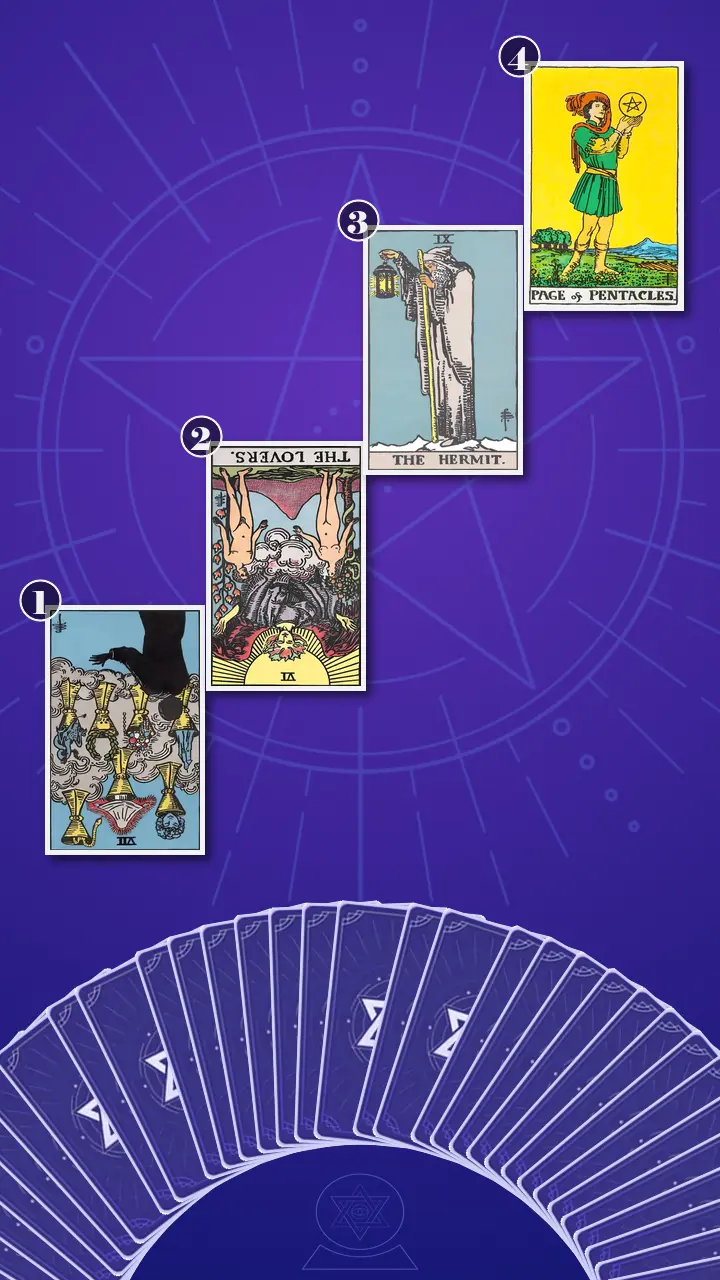
The Open Tabs Beneath the Cards
Position One: Seven Cups Behind One Chosen Tab
“The card now opening represents the visible symptom: choosing a self-help plan, reopening comparisons, and abandoning the practice when its initial meaning fades,” I said. I turned over the Seven of Cups, reversed.
Seven objects hovered inside cloud-borne cups while a dark figure faced the whole display. Reversed, the card showed an attempted narrowing that had not produced grounded clarity. Its energy was blocked and unstable: Maya had selected one cup, but she was still emotionally negotiating with the other six.
I brought the image directly back to 10:40 p.m. Maya had copied one routine into Notion but left four polished comparison tabs open. When a video introduced another method, she redesigned tomorrow before completing tonight's five-minute action. Her chosen plan had to contend with fatigue, repetition, a crowded commute, and a cramped Tuesday evening. The alternatives only had to look compelling in preview.
“The inner monologue sounds like this,” I said. “I chose this, but what if that one would be easier, deeper, or more me?”
Then I gave her the fairest summary I knew: “The unchosen plan keeps its marketing; the chosen plan meets Tuesday.”
Maya let out a short laugh, but there was no amusement in it. Her mouth tightened at one corner. “That's so accurate it's almost mean.”
“Accurate should not become cruel,” I replied. “This card is describing an unfair comparison process, not blaming you for having one. Your research ability is real. The problem begins when research is used after a decision to protect every imaginary future from being temporarily closed.”
I asked which action had remained undone during her most recent redesign. She glanced at the cold tea. “The walk. I spent forty minutes researching whether walking was enough, and then it was too late to go.”
Position Two: The Impossible UX Brief
“The card now opening represents the root of the pattern: the inner conflict and the demand that one routine reconcile every value while eliminating uncertainty,” I said. I revealed The Lovers, reversed.
The two figures stood apart with a mountain between them. The angel remained above, visible but unable to choose on their behalf. Reversed, the card's aligning energy was blocked by divided standards. Maya's preference was on one side; persuasive expert rules stood on the other.
I translated the card into the language of her work. “This is an impossible UX brief. One feature must maximise speed, depth, ease, originality, certainty, and retention, with no trade-offs allowed. Your routine must make you ambitious without costing rest, disciplined without feeling restrictive, authentic while matching expert advice, and certain without closing any alternatives. When it cannot do all of that, the routine gets blamed for the contradiction.”
I remembered how often, over twenty years of readings and cups of coffee, I had watched intelligent people hand one ordinary decision a job no decision could perform. The details changed; the impossible brief did not.
“A routine cannot settle an argument between five versions of you,” I said.
Maya's breathing stopped for a beat. Her index finger hovered above the trackpad. Then her gaze slipped away from the cards as if she were replaying a rainy morning when she had wanted more sleep but heard a podcast insist that disciplined mornings were non-negotiable. Finally, her fingers lowered and opened flat against the table.
“I want rest,” she said quietly, “but I want to be taken seriously. Whenever an expert recommends the harder option, my own preference feels unserious.”
“That is the split,” I said. “Not laziness versus discipline. Your lived preference is competing with a borrowed standard of credibility. The card does not tell you which value must win forever. It asks you to choose which value this specific experiment will serve.”
When the Hermit's Lantern Replaced the Whole Map
Position Three: Enough Light for One Testable Step
The room became noticeably quieter before I turned the third card. Maya had closed the video and the remaining tabs, leaving only our call and one blank notebook page. Her desk lamp made a small amber pool in the blue darkness.
“The card now opening represents the key transformation from outsourced certainty to personally defined discernment,” I said. I revealed The Hermit, upright.
I named the scene already operating behind her doubt: it was 10:40 p.m.; four review tabs had glowed beside a fresh habit tracker. One new method entered the paused video, and her hand moved to redesign tomorrow before she had tried tonight's five-minute practice.
The Hermit held a lantern that illuminated only a limited patch of the mountain. Upright, its energy was balanced and available: quiet discernment, tolerance for incomplete clarity, and guidance built from examined experience. The lantern did not reveal every route. It made the next piece of ground visible enough to test.
This was where I used my Analysis Paralysis Deconstruction. I stripped the choice of its abstract counterfactuals and separated them from the immediate facts. “A better method might exist” was a what-if. “The walk fits your evening schedule, costs nothing, and was chosen to create a calmer transition from work” was grounded reality. “This must become my permanent system” was a projection. “I can observe its effect for fourteen days” was a present constraint with an answerable question.
I followed with Complexity Reduction, but I was careful not to reduce Maya herself. I reduced only the experiment's assignment: does this small action serve one chosen value within her actual limits, or does it not? Everything else could wait for its own decision.
“A plan feels wrong when it is asked to prove who you are. Give it one value to serve, one small job to do, and enough ordinary days to produce evidence.”
I paused, then placed the reading's central sentence between us.
“You do not need a plan that stays dazzling enough to silence every inner conflict; choose the next value-aligned step, and let the Hermit's lantern illuminate only the ground you can test now.”
Maya froze with her pen touching the paper but making no mark. Her eyes widened, then lost focus as the sentence travelled past immediate recognition and into memory. Colour rose along her cheeks. Her shoulders dropped by an inch, but her jaw remained set.
“But doesn't that mean I've been doing this wrong for years?” she asked, sharper than before.
I let the question remain whole. “It means a strategy that once gave you relief has been keeping you from the evidence you need. That can hurt to recognise. It does not make the years empty, and it does not make you defective.”
Her fist tightened once around the pen, loosened, and settled flat. Her eyes shone. She released a long, unsteady breath, then gave a smaller one that sounded almost like a laugh. The relief was real, but so was the brief vertigo of having no perfect framework left to chase.
“Now, with this new perspective, think back to last week,” I said. “Was there a moment when this insight might have made you feel different?”
She remembered standing on Line 1 while a creator's morning routine made her evening walk look inadequate. “I could have asked whether the walk helped me come home more settled,” she said, “instead of asking whether it proved I was disciplined.”
I watched urgency become curiosity. It was not total certainty. It was the first movement from restless comparison-driven self-doubt to evidence-based self-trust and grounded flexibility.
Position Four: The Apprentice Holds One Thing Still
“The card now opening represents the grounded action: one small practice, one personal criterion, and one review point,” I said. I turned over the Page of Pentacles, upright.
The Page held one pentacle steadily at eye level while the wider landscape remained present but secondary. Upright, the card offered balanced earth energy: beginner's attention, practical study, and meaning developed through contact rather than demanded in advance.
For Maya, this looked like a junior designer testing one feature with one success criterion instead of relaunching the entire product. She could take a ten-minute walk after closing her work laptop, record one factual observation, and review the trial on day fourteen. A missed day would become information, not a character assessment.
“For fourteen days, your job is to do the small version and record what happened,” I told her. “It is not to decide what kind of person the routine makes you. Review at the date you chose, not at the moment doubt gets loud.”
Maya nodded once, opened her calendar, and created the review event before another comparison could enter the room.
The Coffee Bean Filter and Fourteen Ordinary Days
I gathered the four cards into one coherent story. Maya's professional strength in research and refinement had taught her that more comparison could improve a system. In her personal life, that strength had become a defence against practising something imperfectly. The Seven of Cups showed the visible comparison loop. The Lovers exposed the impossible values brief beneath it. The Hermit returned the criterion to her hand. The Page made that criterion observable in daily life.
The blind spot was an evidence mismatch: Maya had been comparing one plan tested under real conditions with alternatives that still existed as polished possibilities. Doubt-triggered redesign created evidence starvation, and the absence of evidence appeared to confirm that she could not trust her choice.
The transformation was therefore not “find the perfect routine” or “force yourself never to quit.” It was a shift from judging whether a plan continued to feel completely right to testing one small practice for fourteen days against one personally chosen criterion. A tool could be temporary, partial, and still useful. Revision after evidence could become discernment rather than failure.
For actionable advice, I adapted my Coffee Bean Filter Protocol. A coffee filter does not pretend the grounds are simple; it separates what belongs in this cup from what does not need to pass through right now. Maya's next steps would do the same with the crowded variables around her choice.
- Run the 24-Hour Coffee Bean Filter At the kitchen table, set a seven-minute timer and write each decision variable on a separate scrap of paper. Physically sort them into “Absolute Must-Haves” and “Emotional Noise.” Must-haves can include safety, affordability, accessibility, a five-to-ten-minute fit, and service to one chosen value. Noise includes claims that the practice must feel inspiring forever, reproduce a creator's outcome, or prove an identity. Leave the piles overnight and use only the must-haves when deciding the next evening. Tip: “Emotional Noise” does not mean feelings are invalid; it means those particular pressures are not useful criteria for this trial. The minimum version is one sentence: “This matters to me because ___.”
- Create a “Later, Not Lost” Note For seven days, place every new routine, app, book, TikTok, Reddit thread, or newsletter in one phone note. When the urge to compare appears, complete five minutes of the current practice before deciding whether to open the link. Tip: Delaying is not deleting. The recommendations remain available for the scheduled review, and muting accounts is optional rather than a dramatic digital detox.
- Begin the Fourteen-Day Apprentice Trial Choose one five-to-ten-minute practice and connect it to an existing cue, such as taking a short walk after closing the work laptop. After each attempt, record what happened, how long it took, and one neutral observation tied to the chosen value. Put “Review evidence, not identity” in the calendar for day fourteen. Tip: Record missed days without moral language and continue. Reduce the practice to two minutes when capacity is low. Stop or adapt it immediately if it becomes unsafe, harmful, financially unsuitable, or incompatible with a health need or personal boundary.

A Week Later, the Quiet Proof
Eight days later, I received a message from Maya. She had taken the walk five times, left six recommendations unopened in “Later, Not Lost,” and noticed that the first twenty minutes at home felt less jagged after walking. She had not become a different person. She had produced one piece of evidence that belonged to her.
She also admitted that her first thought that morning had been, “What if another method is better?” The difference was small but important: she had smiled at the familiar question, logged it, and kept the review date where it was.
I did not regard the cards as the source of that change. They had provided an objective cognitive map, but Maya had chosen the value, taken the walks, respected her limits, and gathered the observations. The Journey to Clarity had not ended in certainty. It had begun in ownership.
I know that when a plan becomes yours, your fingers may start reopening tabs and your chest may tighten. One ordinary routine has suddenly been asked to preserve every possibility, prove who you are, and guarantee that your growth remains under control. Merely noticing that impossible assignment means the old loop is no longer completely invisible.
If your next choice only had to carry the Hermit's lantern and light one small stretch of road, what would you be curious to notice before the review date you chose?