Going Out to Escape, Making Room to Face One Real Thing This Week

The 6:40 p.m. WhatsApp Escape
At 6:40 p.m. on a Thursday, Chloe (name changed for privacy) sat on the edge of her bed in a shared Hackney flat. An untouched takeaway had gone cold beside her, and a budgeting spreadsheet cast a pale blue light across unopened post on the floor. The radiator clicked. Garlic lingered in the warm air. Then her WhatsApp group began moving from “one drink?” to Shoreditch plans before she had checked her energy, her bank balance, or the work still open on her laptop.
She closed the spreadsheet and reached for her mascara. “Tomorrow me will be able to look at this properly,” she said. Then she looked at me and asked the question that had brought her to the reading: “Why do I keep going out when I’m too drained to face my life? I know I need a quiet weekend, but staying in makes everything feel too real.”
I noticed the stiffness in her neck and the way her fingers kept waking her phone. Her exhaustion seemed to coat her limbs like a damp winter coat she could not take off, while every unanswered task pressed against her ribs from the inside. She was not choosing between fun and discipline. She was choosing between immediate noise and the depleted quiet she needed in order to face one real thing.
“You are not lazy,” I told her. “You are using noise to postpone a question that feels too big when the room goes quiet. That strategy makes sense as short-term relief, but it is now consuming the energy you need to change what hurts. I’m not here to tell you to stop seeing your friends. I want us to map the loop clearly enough that your next invitation becomes a choice again.”

Choosing the Compass Before the Group Chat Chooses
I invited Chloe to place both feet on the floor, take one unforced breath, and hold the question in mind while I shuffled. I treat this pause as a transition for attention, not a mystical test. Nothing depended on whether she breathed perfectly, cut the deck at the right place, or believed the cards could predict her future.
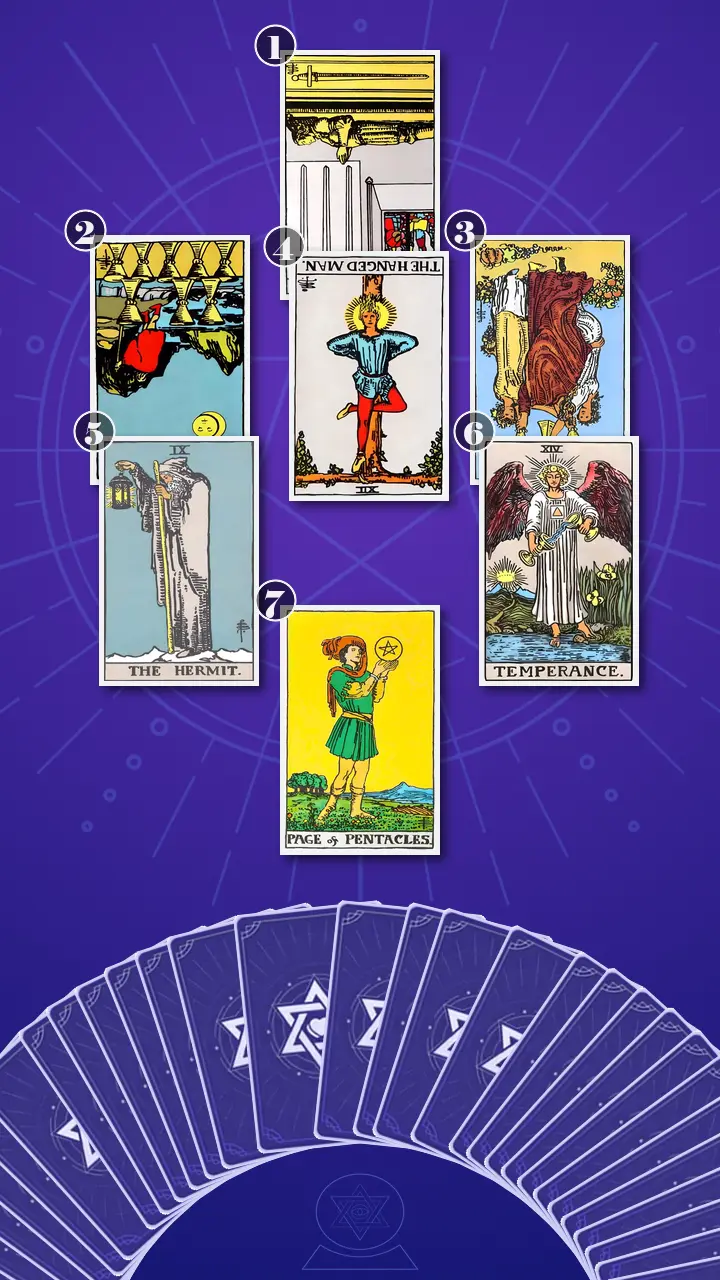
I chose the Energy Diagnostic Map · Context Edition, a seven-position tarot spread designed to trace a pattern through its whole system. I use tarot here as a reflective framework: the images create enough distance for a person to examine familiar behaviour without immediately defending it or condemning themselves.
For anyone wondering how this tarot spread works for burnout and avoidance, its sequence matters. A simple past-present-future reading could make Chloe’s problem look chronological, while a decision spread could reduce it to the false choice of going out or staying home. This map follows a cycle instead: the visible symptom, the internal pull, the external pressure, the central blockage, the resource already available, the key transformation, and the first practical test.
I placed the first card at the top. Beneath it, I set the cards for Chloe’s private dissatisfaction and the social atmosphere reinforcing the pattern. Their lines converged on the central blockage. The final three positions narrowed from intentional solitude to sustainable moderation and then to one grounded action. The layout looked like several currents entering a compass and resolving into a single foothold.
Reading the Loop Behind Nightlife Burnout
Position 1: The Sunday That Never Became Rest
Now, I turned over the card representing the observable symptom: going out while depleted and then failing to obtain restorative rest. It was the Four of Swords, reversed.
I pointed to the resting figure beneath the three suspended swords. “The body is horizontal, but the mental load is still hanging overhead. In your week, this is Sunday on the sofa: your phone in your hand, drifting between short naps, Deliveroo, event photos, work messages, and the banking app you keep closing. Your body has stopped, but your attention is still scanning everything you think you should have fixed already.”
In energy terms, I read the reversal as a blockage. Rest is present in form but not in function. The phone is warm in Chloe’s palm, the room is too warm, the show is playing, and every open digital tab continues to make a small demand. When the evening arrives, she does not feel restored enough to act, so another invitation can seem easier than choosing either genuine recovery or one contained responsibility.
My work as a perfumer has trained me to notice loads that become invisible through familiarity, so I gave Chloe a brief Sensory Overload Audit. I asked her to name what remained active on a typical recovery day: bright screen light, notifications, background television, stale bar scents on clothing, takeaway cartons, unread Slack messages, and the visual pressure of laundry and post. None was catastrophic by itself. Together, they kept her nervous system in a room that never quite stopped speaking.
“Scrolling in bed is not always rest,” I said. “Sometimes it is just exhaustion with Wi-Fi. When you woke after your last night out, what did your body need first, and what did you give it instead?”
Chloe gave a short laugh with a bitter edge. Her thumb stopped circling the rim of her water glass. “That is painfully accurate. I needed food, a shower, and no phone. I gave myself Instagram and a Sunday reset video.”
Position 2: The Gap in a Full Calendar
Now, I turned over the card representing the internal pull beneath the behaviour: Chloe could sense that her current life was unsatisfying, but she resisted staying with that recognition long enough to choose a direction. It was the Eight of Cups, reversed.
The gap in the stacked cups held my attention. I connected it to the moment Chloe opened saved LinkedIn roles, a course page, or a blank note called What am I actually doing? Her calendar might be full and her friendships real, yet something important still felt unfilled. As soon as the uncertain path became visible, the familiar group chat offered a route back to movement without requiring a decision.
I read the reversed water as another blockage: emotional awareness was circulating but not progressing. Chloe was not oblivious to her dissatisfaction. She repeatedly approached it, felt the first pinch in her chest, and turned back before it could become a smaller question. The problem was not that she lacked insight. The insight had no protected time in which to develop.
“I’m not going to ask what you should do with your whole life,” I said. “I want to ask something narrower. When you last closed a job listing or your bank app, what feeling made the familiar plan seem easier?”
Her gaze moved from the card to the dark laptop screen beside us. “Embarrassment,” she said after a pause. “I thought I should already know what I wanted. Going to the pub meant I could be a person who had plans instead of a person who had no plan.”
I let that distinction settle. A night out was not merely entertainment in that moment. It offered a temporary identity that required less uncertainty than the unfinished one waiting at home.
Position 3: When Belonging Becomes Attendance
Now, I turned over the card representing the external pressure: the party scene, group-chat momentum, FOMO, and informal agency culture that made another outing feel easier than stepping back. It was the Three of Cups, reversed.
I was careful here because friendship was not the villain in Chloe’s story. The upright card can hold mutual joy, celebration, and genuine support. Reversed, I read its energy as excess: the raised cups had exceeded her actual capacity, and belonging had quietly become measured by attendance.
“This is the Overground to Shoreditch when your legs already feel heavy,” I said. “The carriage smells of damp coats and canned lager. Friends are posting the first round under neon lights, and you type ‘On my way xx’ because being absent from the photo dump feels more consequential than it really is. Then you stay for the second venue while checking Citymapper and counting the minutes until you can leave.”
Chloe pressed her lips together and nodded once. I asked which invitations were hardest to decline. She named agency drinks first. At her workplace, after-hours socialising could feel like recreation, friendship, and informal networking all at once. A fast-moving weekend chat came next, especially when nobody named an end time.
“The card is not asking you to become guarded or disappear,” I said. “It is asking when shared joy stops feeling mutual because your quieter no cannot be heard inside everyone else’s yes. The useful measure is not how sociable the plan looks. It is how present you feel during it and what kind of energy remains the next morning.”
Her shoulders moved down by a fraction. “I keep calling it fun even when I’m counting the minutes until I can go home,” she said. Hearing her own sentence aloud seemed to separate genuine connection from the pressure to remain visible.
Position 4: The Polished Form of Waiting
Now, I turned over the card representing the central procrastination mechanism: delaying action until clarity, motivation, and energy all arrived together. It was The Hanged Man, reversed.
The figure’s illuminated head and immobilised body gave us the exact contradiction. Chloe could understand the pattern, build systems for it, and explain why she felt stuck. Physical follow-through remained suspended. The reversal showed blocked perspective: exhaustion had already forced a pause, but she resisted using that imperfect pause unless it could produce a complete answer.
I described the agency kitchen on Monday evening: fluorescent light aching against tired eyes, the microwave humming, and a Notion board called Get My Life Together filling with six colour-coded categories. Career. Money. Fitness. Flat. Food. Social life. Chloe could rearrange each task while her jaw tightened, then leave without selecting the first one.
“The inner script sounds like this,” I said. “I will start when I have slept properly. I will start when I know what I want. I will start when the flat is clean, the CV is rewritten, and I have a free weekend. But the same pattern that delays the task also delays the sleep, time, and confidence you are waiting for.”
I leaned slightly closer to the card. “Perfect motivation is not a starting line. It is often the reason the starting line keeps moving. Planning a life and touching one part of it for fifteen minutes are different actions.”
Chloe’s breathing paused. Her fingers hovered above her phone without picking it up. Her eyes lost focus as if she were replaying a row of abandoned dashboards, and then a breath came from deep in her chest. “I have spent more time designing the reset than doing any part of it,” she said, with a rueful half-smile. “I thought the planning proved I was trying.”
“It did prove you were trying,” I replied. “It also shows us where the effort is getting absorbed. We do not need to shame the planning. We need to redirect a small amount of it into contact with the actual task.”
Position 5: The Hermit’s Light at Normal Volume
Now, I turned over the card representing an existing resource: intentional, bounded solitude that could help Chloe hear what she needed without turning a quiet night into punishment or total withdrawal. It was The Hermit, upright.
I read this upright energy as balance: solitude used deliberately and in proportion. The Hermit’s lantern illuminates only a short stretch of road. It does not reveal a finished identity, a flawless five-year plan, or proof that every choice will work. It offers sufficient light for the next honest question.
I returned to the Thursday bedroom scene but changed its atmosphere. I asked Chloe to imagine the phone in another room, the group chat silent for ten minutes, and no productivity video playing. She could make tea, let the shower run, or walk one familiar block without headphones. Her only inner line needed to be: “I do not have to decide my whole life tonight. I only need enough quiet to notice what hurts.”
“A quiet night is not a social failure,” I said. “It can be a place to hear yourself at normal volume. The distinction is intention. Isolation removes contact and often removes support. Bounded solitude protects a small amount of private attention so that contact can become chosen again.”
I asked what question might arise first in a phone-light room. Chloe’s eyes settled on the Hermit’s lantern. “Whether I actually want to stay at the agency,” she said. She immediately added, “I don’t want to answer that tonight.”
“You do not have to,” I said. “Naming the question is already different from making the group chat drown it out.” Her hands loosened around the glass. The room felt quieter, but the quiet no longer seemed to be closing in on her.
When Temperance Put Both Lives in the Same Week
Position 6: Water Moving Between Two Cups
The rain against the window softened just as I reached the spread’s central bridge. I turned over the card representing the decisive shift from all-or-nothing resets and overstimulation toward a measured social rhythm that preserved energy for ordinary life. It was Temperance, upright.
The angel stood with one foot on land and one in water, pouring steadily between two cups. I read the card as balanced integration: connection and solitude, pleasure and responsibility, uncertainty and action could remain in communication. Chloe did not need to treat one side as the enemy of the other.
In modern terms, Temperance looked like one social night with a leaving time, one protected recovery evening, and one fifteen-minute practical commitment. It replaced the familiar sequence of an open-ended late night, a lost recovery day, and an impossible Monday reset. The point was not to make Chloe’s life smaller. It was to give her more than two settings: maximum stimulation or total withdrawal.
This was where I used what I call Spatial Boundary Scenting. After fifteen years in perfumery, I instinctively notice when two atmospheres overlap until neither can perform its proper function. A bright top note can be beautiful, but if it saturates every layer, the quieter base never has room to develop.
I could see that Chloe’s agency atmosphere followed her onto the train, the pub atmosphere followed her into the bedroom, and the group chat entered every attempted recovery space. Work, nightlife, scrolling, and private decision-making had no clean air between them. Her flat could not become restorative because every environment was bleeding into the next. Temperance was not asking for a wall around her life. It was asking for enough breathable space that each part could recover its proper proportion.
I watched her look from one cup to the other. She had framed the problem as a demand to choose the correct identity: fun Chloe who always showed up, or disciplined Chloe who disappeared until every neglected area was fixed. Both identities required a performance her depleted body could not sustain.
I lowered my voice. You do not need to solve your whole life before you change one evening. A steadier rhythm starts when relief stops costing you the energy to face what matters.
You are not trapped between nonstop nights out and total isolation; choose a measured rhythm, like Temperance's water passing steadily between two cups, that leaves energy for one honest next step.
For one beat, Chloe did not breathe. Her fingertips stopped against the glass, and her eyes lost focus as though she were replaying every Friday that had swallowed a Saturday. When the meaning reached her, her mouth tightened rather than softened. “But doesn’t that mean I’ve been doing all of this wrong?” she asked, her voice suddenly sharper.
I let the anger have room. “It means the strategy gave you quick relief and now costs more than it gives. That is information, not a verdict on you or your friendships.” Her pupils widened; the line between her brows released; her hand opened flat beside the card. A breath left her with a slight shake, followed by a small, almost disoriented laugh. Her shoulders dropped, but she looked briefly unmoored, as though putting down a heavy bag had revealed that she would now have to choose where to walk.
I asked, “Now, using this new perspective, can you remember a moment last week when this insight could have made the evening feel different?”
Chloe thought of Thursday. She had wanted to see her friends, but she had not wanted the second venue, the last-train calculation, or the missing Friday morning. “I could have checked five transactions, met them for one drink, and left when I first wanted to,” she said. “Connection and responsibility could have stayed in the same week.”
That sentence marked the key emotional shift for me. Chloe had moved from depleted social escape and a fantasy of total reinvention toward the first fragile form of grounded self-trust: the belief that she could regulate the pace before certainty arrived. The relief was real, but so was the new responsibility. Once the false binary softened, she could no longer wait for either the group or an ideal future self to make every decision.
Position 7: One Ordinary Thing Held Steady
Now, I turned over the final card, representing the immediate and realistic next step through which Chloe could test the reading. It was the Page of Pentacles, upright.
I shifted our attention away from the bright phone, crowded bar, and abstract career crisis toward the weight of one ordinary object. The Page held a single pentacle at eye level while distant mountains remained in the background. I read this upright earth energy as grounded potential: not mastery, but a practical beginning small enough to survive an imperfect week.
For Chloe, the card could be five Monzo transactions, the first three lines of a job application, one cleared table, one opened stack of post, or ten minutes researching a course. The task was intentionally too small to solve her life. Its purpose was to produce visible evidence that she could face one part of life without waiting for a complete reset.
“This will not fix my whole life, but it is the thing I can touch today,” I said, translating the Page’s posture. “The mountains can stay distant. Your attention only has to hold the pentacle in front of you.”
I asked her which task had a clear enough edge for a fifteen-minute appointment. Chloe chose her budget. She would review five recent transactions, write one sentence about the next smallest step, and stop when the timer ended. Her jaw tightened briefly at the word budget, then eased when I repeated that completion meant meeting the task, not fixing her finances.
“You do not need a new life by Monday,” I told her. “You need one honest thing that survives the weekend.”
The One-Real-Thing Method for Finding Clarity
I looked at the full spread and traced its logic aloud. The Four of Swords reversed showed a body lying down without recovering. The Eight of Cups reversed revealed a known dissatisfaction that Chloe kept circling. The Three of Cups reversed showed how genuine belonging had tipped into compulsory attendance. The Hanged Man reversed held everything in limbo by making perfect clarity the admission requirement for action.
Then the posture of the reading changed. The Hermit stood alone by choice, Temperance regulated the flow between competing needs, and the Page of Pentacles held one concrete object with sustained attention. The first four reversed cards closed the loop; the final three upright cards reopened choice. I also noted the absence of Wands. I did not read that as a demand for Chloe to manufacture more excitement. She already had bursts of stimulation. What she needed was protected attention, proportion, and enough earth to make one decision visible.
The cognitive blind spot was simple but consequential: Chloe believed clarity, motivation, and rest had to arrive before she could act. In practice, one contained action was part of how clarity and self-trust would begin to form. She also treated quiet as if it had to become either an existential reckoning or a perfect recovery routine. The cards offered a smaller transformation: protect one pocket of quiet, face one real thing, and then decide what kind of connection actually fits.
I framed the pattern through the metaphor that had followed us from the opening scene. Chloe had been keeping the music loud so an unanswered question could not be heard, but the noise was taking away the energy required to answer it. The goal was not silence forever. It was control of the volume.
I gave Chloe two experiments rather than a dramatic lifestyle reset:
- Within 72 Hours: The Physical Boundary ProtocolChoose one evening before a high-pressure group-chat night and calendar it as “offline until 8:30.” At the chosen time, close the laptop and place it out of sight, put the phone on Do Not Disturb in another room, switch off the overhead light, and make mint tea. Use that same light-and-scent combination only as the signal that high-output mode has ended. Spend ten phone-free minutes in the quieter atmosphere, then sit somewhere other than bed and review exactly five bank transactions for fifteen minutes. Stop when the timer ends. Only then decide whether to stay home, make a call, take a walk, or join a contained plan.If ten quiet minutes feels too exposed, begin with five. The laptop and phone stay outside the recovery space for the block, and a simple “Taking a quiet one tonight, catch you soon” is enough explanation.
- Calendar Calibration Before the Next YesBefore accepting one weekend invitation, write three lines in Notes: “energy now,” “money I am comfortable spending,” and “time I want to leave.” Choose a plan with a defined container, such as dinner, coffee, or one drink after work. Set an alarm twenty minutes before the leaving time and order the ride or start the journey home when it rings. Pair the plan with one recovery evening that has no obligation to become a full reset.Treat the leaving time as information about capacity, not a verdict on the friendship. Chloe could stay longer when she genuinely had the energy; the boundary simply prevented FOMO from becoming the default decision-maker.
I reminded Chloe that these were experiments, not commandments issued by the cards. She could shorten them, change the task, choose a different sensory cue, or decide that a plan genuinely nourished her. Tarot had made the loop visible and supplied language for the leverage points. Chloe retained authorship of every boundary, every friendship, and every next step.

A Week Later: The Saturday Morning She Kept
A week later, I received a message from Chloe: “I left dinner at 10:40, slept properly, and checked five transactions on Saturday. My first thought was still, ‘What if I’m becoming boring?’ Then I laughed, made coffee, and opened the sixth.”
I did not read that message as proof that her career question, budget, flat, and social boundaries had been solved. I read it as a small piece of evidence. She had enjoyed connection without using it to disappear from herself. She had woken with doubt and still retained enough energy to meet one ordinary part of her life.
That was Chloe’s Journey to Clarity: not a perfect answer descending from the cards, but a shift from automatic escape toward regulated connection, intentional solitude, and cautious self-trust. The cards did not give her control. They helped her see where she could begin exercising the control that was already hers.
I think of anyone whose flat finally goes quiet and whose chest tightens at the unopened post, the tired body, and the life decisions waiting on a screen. Another night out can feel safer than discovering that no complete map has arrived. But noticing the moment when noise becomes escape already creates a small interval in which another choice can breathe.
If you gave tonight one Temperance-sized space between the group chat and your reply, then let one Page-of-Pentacles task hold your attention for fifteen minutes, what might become a little easier to hear in yourself?