Four Self-Help Tabs, One Criterion, and a Seven-Day Direction Test

Finding Clarity in the 10:45 p.m. Scroll
I often meet twenty-something hybrid workers who can deliver a clean campaign brief by Friday afternoon, then reach Sunday night unable to write a personal brief for the life waiting outside work. Alex, a 27-year-old marketing coordinator in Toronto, arrived in that exact split state.
At 10:45 p.m., my video call opened onto their condo kitchen. They were moving colour-coded blocks around a Notion calendar while a values quiz, a career-change video, a habit app, and a new planning template glowed across two screens. I could hear the laptop fan humming beneath the dry click of the radiator. Blue light sharpened the tired lines around their eyes. They lifted their tea, winced, and told me it had gone cold and slightly metallic.
One hand kept drifting toward the phone. Their jaw tightened each time another notification appeared. I watched them minimize a video called How to Find Your Purpose, only to open the planning dashboard underneath it.
“I have a system for finding direction,” Alex said, with a small, embarrassed laugh, “but I still don’t know what I want. Starting a new plan feels easier than admitting the last one changed nothing.”
Their confusion did not look like an empty road. It looked like trying to read a compass inside a snow globe while thirty-four possible futures struck the glass. This was self-help choice overload in its most recognizable form: plenty of effort, plenty of options, and almost no lived evidence about which direction felt personally meaningful.
“I don’t think you’re short on motivation,” I said. “You may be short on a criterion you chose and evidence you actually lived. We’re not going to ask the cards to announce your purpose or make a career decision for you. We’re going to use them to draw a map of the loop, then find one place where your own choice can interrupt it.”

Choosing the Switchback Map
I asked Alex to place both feet on the floor, let their hands rest away from the phone, and take one unforced breath. I shuffled slowly while they held the question: Why do I keep chasing self-help plans without finding my direction? The pause was not a mystical performance. It was a deliberate transition from consuming answers to observing a pattern.
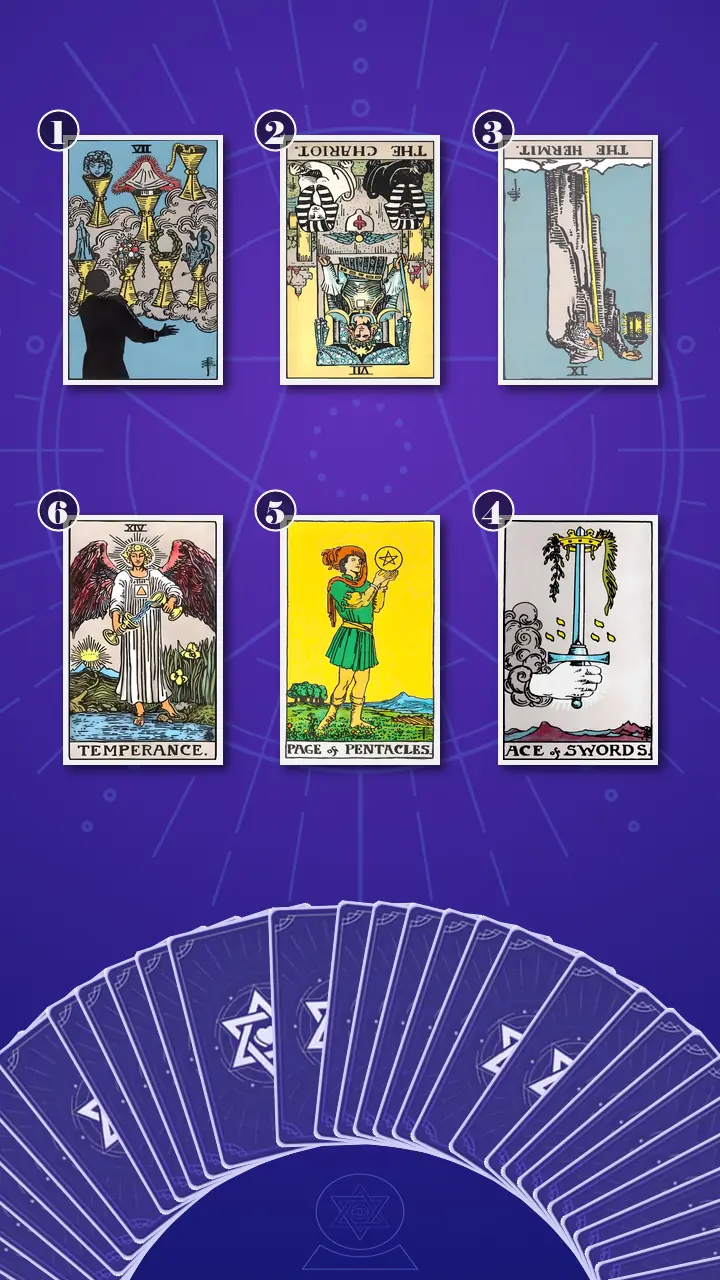
I chose the six-card Transformation Path Grid: Context Edition. I have learned on archaeological digs that surface debris can tell us what happened only when we understand the layers beneath it. This spread works similarly. It is the smallest map that can show the visible behaviour, the blockage, the root belief, the leverage point, a practical action, and a way to integrate the evidence without turning the reading into another overwhelming system.
I arranged the cards as a switchback path. The upper row would show Alex’s present condition, the divided will blocking movement, and the fear beneath the constant search for guidance. From there, the reading would turn downward to the key transformational trigger, then travel through one bounded action and a balanced review practice.
This is how tarot works in my practice. Card meanings in context are not verdicts handed down by an outside authority. They are structured prompts that make a pattern visible enough to question. Alex would remain the author of every value, experiment, boundary, and next step.
More Options Can Feel Like Movement
Position 1: The Possible Lives on the Screen
I turned the card in the position showing the observable self-help collecting behaviour, chaotic emotional energy, and choice overload currently substituting for personal direction. It was the Seven of Cups, upright.
The card showed a silhouetted figure standing before seven cups suspended in a cloud. Each cup offered a different object, promise, danger, or ideal. The figure could view every possible life, but could not participate in any of them from where they stood.
I pointed from the card to Alex’s screens. “At 10:45 on a Sunday night, this is the purpose course, the habit challenge, the career quiz, the creator video, and the new Notion template. Each one offers a compelling version of a better life. Saving and comparing them creates a real burst of possibility. By midnight, though, the week has been redesigned without one personally meaningful behaviour being tested.”
I described the card’s energy as Excess: too much imaginative Water without a personal filter. Possibility itself was not the problem. The problem was that every open tab preserved a possible future self, so closing any tab felt like losing that identity before Alex had even met it.
“It’s also an algorithm trained on aspiration,” I said. “Every productivity video you save teaches the feed to bring you more possible selves. The algorithm gains data about what attracts your attention, while you gain almost no evidence about what fits your actual life. More options can feel like movement while keeping you in the audience.”
Alex gave one short laugh, but there was bitterness in it. Their fingers froze above the trackpad. Their eyes moved across the open windows as if replaying every recent Sunday reset, and then their shoulders dropped a fraction.
“That’s painfully specific,” they said. “Almost rude, honestly.”
“Accurate recognition can sting,” I replied. “But the card is not calling you flaky or incapable. It is showing that your attention has been asked to compare options without a criterion for sorting them. That is a design problem, not a character defect.”
I asked, “Which of those tabs feels hardest to close because it represents a version of you that you’re afraid to lose?”
Alex looked toward the paused career-change video. “The creative one. I don’t even know if I want that life. I just don’t want to rule it out.”
Position 2: A Calendar Receiving Conflicting Briefs
I turned the card in the position identifying the divided will that converts competing improvement goals into stalled movement and repeated restarts. It was The Chariot, reversed.
In the Rider-Waite-Smith image, black and white sphinxes sit before a charioteer who holds no visible reins. Reversed, the image did not suggest laziness. It showed available drive divided among destinations that had never been coordinated.
I described the Monday-night version of the card: a creator’s fitness challenge, a career acceleration plan, a slow-living routine, and a daily mindfulness streak all dragged into the same calendar. A late client meeting breaks one part of the schedule. The remaining demands collide. Alex assumes the problem is insufficient willpower, tightens the timetable, and replaces the entire structure by Wednesday.
“It’s like receiving incompatible briefs from four managers and blaming the coordinator when every deadline lands on the same hour,” I said. “A strict calendar cannot reconcile goals you never chose.”
The reversed Chariot showed Blockage through overcontrol. Alex had plenty of Fire, especially during the first days of a new routine, but that Fire was being directed toward borrowed definitions of success. Slow living asked for spaciousness. Career acceleration demanded greater output. Creative independence needed room for uncertain beginner work. The perfect wellness routine left no tolerance for a late meeting. More discipline could only make those contradictions collide faster.
Alex pressed their tongue against the inside of their cheek. “So I’m not failing because I can’t keep up with all of it?”
“No,” I said. “The schedule is reporting a conflict. It is not issuing a moral judgment. The useful question is not, ‘How can I force all of this to fit?’ It is, ‘Which two aims belong to me strongly enough to guide this week?’”
Alex looked down at the black and white sphinxes. Their hand tightened around the mug, then loosened. “Visible learning matters to me,” they said slowly. “And making something, not just coordinating other people’s ideas. I’m less sure the five a.m. routine matters at all.”
Position 3: The Lantern Lost Beneath Autoplay
I turned the card in the position revealing the underlying fear of lacking control and the habit of replacing sustained inner observation with external guidance. It was The Hermit, reversed.
The Hermit’s lantern illuminates only the next few steps. It does not flood the entire mountain with certainty. Reversed, the problem was not that Alex lacked an inner guide. The energy showed a Deficiency of uninterrupted inner consultation, created by an excess of outside input.
I asked about their most recent quiet walk. Alex told me that at 11:32 on Saturday, near the Toronto waterfront, a purpose podcast had ended. Cold lake wind pressed against their face and tyres hissed across wet pavement. Before the silence had lasted ten seconds, their hand reached for another episode.
“My stomach dropped,” they said. “I thought, ‘What if there’s nothing underneath all this advice?’ Then I pressed play.”
I nodded toward the reversed lantern. “That is this card in modern life. Advice fills the commute, the walk, lunch, and the unstructured evening. Useful guidance is not the enemy. But when advice fills every silence, your own evidence never gets a turn.”
I watched their thumb stop rubbing the edge of the phone case. Their gaze slipped away from the screen and held somewhere beyond the kitchen wall. After several seconds, they released a low breath that seemed to come from much deeper than the conversation.
“If I stop listening,” they said, “I’m worried I’ll just spiral.”
“Then we do not romanticize isolation,” I replied. “The Hermit is not asking you to delete every app, refuse support, or spend a weekend alone trying to manufacture an epiphany. Fifteen minutes without input can be enough. The point is to notice one direct reaction before another expert interprets it for you.”
I could see the protective logic now. Research offered temporary control because it postponed the more vulnerable act of naming a preference that might remain incomplete. Alex did not fear choosing only because a choice could be wrong. They feared choosing one direction, still feeling uncertain, and losing the comforting belief that a perfect system could guarantee control.
When the Ace of Swords Cleared the Cloud
Position 4: One Truth Strong Enough to Test
The room seemed to become quieter before I turned the card in the position identifying the leverage point that could interrupt plan collecting through one self-defined criterion. It was the Ace of Swords, upright, the key card of the reading.
A single sword rose vertically from a cloud, crowned but not sheltered from the jagged mountains below. I read its energy as Balance through clarifying Air. The card did not promise an effortless path or permanent certainty. It restored the missing capacity to distinguish, name, and select.
I invited Alex to imagine closing the comparison tabs and leaving one plain note on the screen: A direction is worth testing when it includes visible learning and direct creative contribution. That sentence would not decide their career. It would give the next small experiment an acceptance criterion written in their own language.
At this point, I used the archaeological lens I call Cognitive Stratigraphy. A sudden trigger is often only the surface artifact. I drew three lines on a sheet. On the surface sat the urge to open a career quiz after seeing a friend’s promotion. Beneath it sat the obsolete rule, The right system will reveal who I should become. At the foundation sat the fear, If I choose and still feel lost, I will have proof that I am not in control.
That excavation mattered because the surface action was easy to misread as curiosity. The deeper layers showed why the search carried so much pressure. Once separated, the friend’s milestone could remain a present-day event rather than becoming evidence about Alex’s worth, timing, or future.
I brought us back to 10:45 on Sunday night: four tabs promising four better versions of Alex, cold tea beside a tight jaw, and the belief that rebuilding next week was safer than closing the laptop without a complete answer. The Ace offered precision in place of comprehensiveness.
Stop treating more options as more clarity; state one truth you can test, like the Ace of Swords rising above the cloud of borrowed advice.
I let the sentence stand without explaining it away.
For one beat, Alex stopped breathing. Their fingers remained suspended over the table, slightly curled, while their pupils widened at the sword above the cloud. Then their focus drifted, and I could almost see the recent memories moving behind their eyes: the promotion post, the quiz opened before a campaign task was finished, the Wednesday schedule deleted after one late meeting. Their brows drew together. A flash of anger crossed their face before the sadness arrived.
“But doesn’t that mean I’ve been doing all of this wrong?” they asked. “I’ve spent years looking for the plan.”
“It means the plans were asked to perform a job they could never reliably perform,” I said. “They could offer methods. They could not author your criteria. You were trying to create safety, not wasting your life.”
Their fist loosened one finger at a time. Their shoulders sank, followed by a long, uneven exhale. Relief appeared, but it was not simple relief. I saw the slight dizziness that can follow the removal of an old explanation. If no plan could make the choice for them, then the next move was smaller, kinder, and unmistakably theirs.
“Now, using this new view, think back to last week,” I said. “Was there a moment when this insight could have made you feel different?”
Alex swallowed and looked at the blank space beside the card. “When I saw my friend’s promotion. I treated their milestone like an emergency instruction for me. If I’d had my own criterion, I could have asked whether their path involved the kind of learning or creative contribution I want. I wouldn’t have needed to turn their life into my deadline.”
“Exactly,” I said. “Direction is not hiding inside a better total-life plan; it begins with one criterion you chose and one experience that can answer back.”
I named the crossing I had just witnessed: from restless comparison, borrowed direction, and repeated routine resets to values-led experimentation, grounded curiosity, and steadier self-trust. It was not a completed transformation. It was the first credible movement from demanding certainty to trusting a provisional choice.
Position 5: The Seven-Day Piece of Work
I turned the card in the position converting clarity into one bounded seven-day action that could produce personal evidence without demanding a permanent commitment. It was the Page of Pentacles, upright.
The Page held one pentacle at eye level. Where the Seven of Cups had presented a cloud full of possible identities, the Page studied one tangible object on workable ground.
I translated the card into Alex’s actual week. They could choose one seven-day project, schedule three 20-minute sessions, and decide in advance what evidence to collect: attention held, energy afterward, and desire to repeat. One possible test was drafting a one-page creative concept for a neighbourhood arts event, something close enough to their marketing skills to be accessible and different enough to test direct creative contribution.
“You would not be announcing a new identity,” I said. “You would not be deciding whether to leave marketing, become a designer, or monetize anything. You would be gathering data about fit.”
The Page’s Earth energy showed Balance through grounded curiosity. The experiment was small enough to exit, specific enough to produce evidence, and real enough to challenge an assumption. Treat direction as a hypothesis, not a lifetime contract.
Alex’s eyes returned to the calendar, but this time they did not reach for a new template. “Three sessions sounds almost suspiciously small,” they said.
“Small is part of the method,” I replied. “If enthusiasm is allowed to turn this into a thirty-day challenge, a new personal brand, and a shopping list, the old loop will simply put on the Page’s clothes.”
A smile reached their face for the first time. “Right. No launch announcement.”
Position 6: Pouring the Week Instead of Deleting It
I turned the final card in the position describing the non-predictive integration practice of reviewing evidence, retaining what fit, and adjusting without rebuilding the entire self-help system. It was Temperance, upright.
Water moved steadily between two cups. One foot rested on stone and the other in water, holding practical limits and emotional information at the same time. I read this as Balance through proportion, not as a prediction that Alex would become perfectly consistent.
In Alex’s week, Temperance looked like a fifteen-minute Sunday review with three lines: keep, change, release. Keep the task that held attention. Shorten the session that created friction. Release the part copied from someone else’s routine. One adjustment would replace the usual total reset.
My mind went briefly to a restoration trench where a collapsed wall had once looked like undifferentiated rubble. The work had not been to rebuild the entire settlement according to an imagined perfect plan. It had been to identify which stones still carried weight, which belonged somewhere else, and which gaps needed to remain visible.
That is what I call Ruins Restoration Thinking. A fragmented routine or exhausted identity does not always mean the whole structure is defective. Sometimes it marks a transition in which inherited plans have stopped holding, while a self-authored structure is still being assembled. Restoration begins by preserving what is sound, not by pretending nothing fell.
Temperance also brought to mind the wider movement of The Wizard of Oz. The hoped-for authority does not simply hand over a complete identity. What matters becomes visible through capacities practiced and observed along the way. Alex’s direction would emerge similarly, through contact with experience rather than a pronouncement from me or the cards.
Alex traced the space between the two cups without touching the card. “So even if I only complete two sessions, the week can still tell me something?”
“Yes,” I said. “Completion is one fact, not the only evidence. Attention, energy, friction, practical limits, and the desire to repeat are also facts. Temperance asks what the experience taught, not whether the experience certified your worth.”
Restoring a Compass, Not Rebuilding a Life
I gathered the six cards into one story. The Seven of Cups showed Alex watching possible lives instead of inhabiting one. The Chariot reversed revealed that their effort was being pulled by incompatible borrowed goals. The Hermit reversed showed why the loop felt safer than silence: continuous advice protected them from the fear that no choice could guarantee control. The Ace of Swords introduced a self-authored criterion. The Page of Pentacles brought that criterion into one bounded experiment, and Temperance protected the evidence from another all-or-nothing reset.
The pattern was like replacing a compass every time its needle wobbled. No compass could settle long enough for Alex to compare its direction with the terrain. Their cognitive blind spot was the assumption that the right plan should reveal who they ought to become, followed by the assumption that perfect adherence was the only valid way to judge whether it fit.
The transformational direction was precise: shift from collecting comprehensive systems to testing one seven-day action selected by two self-defined values. Tarot had not uncovered a predetermined purpose. It had provided an objective symbolic structure through which Alex could see the feedback loop, choose a filter, and collect their own evidence. The authority belonged to Alex.
The Trigger Excavation and Seven-Day Direction Test
When I laid out the next steps, Alex frowned at the empty note on their screen. “But I could turn this into another giant Notion project,” they said. “I know exactly how I am.”
“Then we design for that,” I replied. “No dashboard, no new app, and no requirement to complete the full version. We’ll use my Trigger Excavation Exercise to separate the old rule from the present choice, then keep the test deliberately plain.”
- Excavate the trigger, then write the criterion. On Tuesday after work, sit at the kitchen table and use a plain note. For two minutes, write three short lines: the surface trigger, the old rule it activated, and one present-day fact. Then set an eight-minute phone timer, place the phone face down, and finish: A direction is worth testing when it lets me... Circle only two value words, such as learning and creative contribution. Keep the language ordinary. Do not open a values quiz. If the exercise becomes tense or self-punishing, stop after the sentence fragment and two words; that is a complete minimum version.
- Run one Seven-Day Direction Test. Choose one action serving both values, such as drafting a one-page concept for a neighbourhood arts event. Define what done means, then place three 20-minute sessions in the existing calendar. After each session, record three scores from 1 to 5: attention held, energy afterward, and desire to repeat. Put any tempting new course, app, or creator plan on a dated advice parking list until the test ends. Use tools already available and do not add make-up sessions. One 10-minute attempt and one line of evidence still count. The test can be paused if it conflicts with health, safety, money, workload, or personal boundaries.
- Review the evidence without resetting the system. On the seventh day, set a 15-minute timer and write three lines: keep, change, release. Keep one element worth repeating, change one practical detail, and release one borrowed expectation. Finish with a neutral sentence beginning, This week suggests that... Then choose only one next step: repeat the test, modify it once, or close it. Review the behaviour, not your character. Avoid always, never, success, and failure. If fifteen minutes feels heavy, answer only the keep line and leave the rest for another day.

A Week Later: The Quiet Proof
Seven days later, I received a message from Alex. They had completed two of the three creative sessions. A client request had swallowed the third, but they had not deleted the remaining calendar or searched for a replacement system. Their scores were simple: attention 4, energy 4, desire to repeat 5.
“I kept the one-page concept,” they wrote. “I changed the session length to fifteen minutes. I released the idea that it has to become a career move before it counts. I still don’t know my direction, but I know I want to try this again.”
That night they slept straight through. In the morning, their first thought was, “What if this tells me nothing?” They told me they smiled anyway. The question was still there; it no longer had the whole room.
I did not regard the message as proof that six cards had solved a life. I regarded it as the first piece of lived evidence in Alex’s Journey to Clarity: less restless comparison, one personally chosen filter, and enough grounded curiosity to remain with an experience after its initial excitement faded.
I know the Sunday-night moment when a jaw tightens over a beautifully rebuilt plan because borrowing one more direction feels safer than choosing our own and discovering that certainty was never guaranteed. If that is your screen tonight, noticing the loop already means you are no longer standing at its beginning.
If direction were allowed to be a seven-day question rather than a lifetime verdict, which two words would you choose as your one-criterion compass, and what small action could let your own experience answer back?