When 'Refinement' Was Actually Delay: Leaving One Piece Visible
The 11:40 p.m. Curtain Call
I knew I was meeting creator visibility paralysis when Jamie, a 27-year-old illustrator and junior brand designer in Toronto, said, I can handle client feedback all day. The second my own finished work becomes a public post, I freeze.
It was 11:40 p.m. on a Tuesday. On my screen, I could see Jamie at a compact desk in their shared apartment, blue laptop light catching the edge of a drawing tablet. The radiator clicked behind them, their coffee had gone cold, and their phone had grown warm in one restless hand.
A finished illustration sat beside an Instagram caption draft. After checking three established illustrators, Jamie changed the caption twice, opened Insights from an older post, and dragged the image back into a private folder labelled Final_v7.
Their shoulders dropped as soon as the file disappeared, but the relief looked thin and temporary.
I want an audience until I remember that an audience can react,
Jamie said. Being unseen hurts, but being seen feels harder to control.
Their ambivalence felt like pulling open a theatre curtain with one hand while the other hand yanked it shut, their rib cage caught in the rope between longing and retreat.
You want an audience until an audience can react; then you call the retreat refinement,
I said gently. I am not here to predict whether people will praise this piece or tell you to expose more than you choose. I want us to map what happens between the work is finished and the work must disappear. That is where we may find your next available choice.
Choosing a Map for the Hide-and-Withdraw Loop
I asked Jamie to put both feet on the floor, let one breath travel below the tightness in their chest, and hold a precise question: Why do I keep hiding my work when I want it to be seen?
I shuffled slowly. I use this pause as a change of focus, not as a performance of mystery; it gives the mind a moment to stop drafting answers before the symbols arrive.
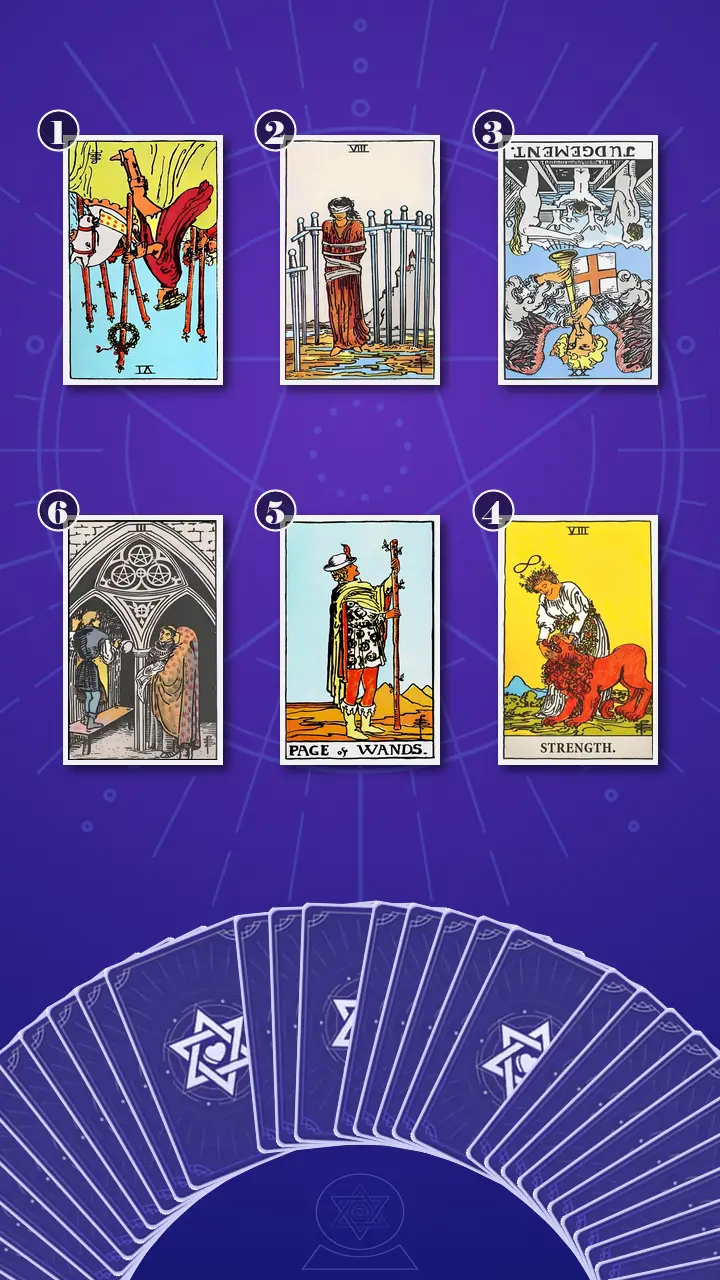
I chose the Transformation Path Grid · Context Edition, a six-card tarot spread for creative visibility and fear of being seen. I want readers to understand how tarot works in a consultation like this: the cards do not hand down a supernatural verdict. They provide a structured set of images through which I can test a pattern against observable behaviour, bodily reactions, beliefs, and available choices.
I laid the first three cards from left to right across the top. They would show the visible symptom, the immediate blockage, and the deeper belief keeping the cycle alive. Beneath them, the fourth card would reveal the leverage point, the fifth would turn that leverage into a practical experiment, and the sixth would show how the experiment could become sustainable creative practice.
I chose this spread because Jamie did not need ten different predictions about their career. They needed the smallest map capable of showing the complete loop: finished work approaches visibility, imagined evaluation raises the stakes, withdrawal provides relief, and the lack of real contact reinforces the next withdrawal. The switchback path of the cards let us see exactly where that loop might be redirected into learning.
The Rider Who Stepped Down Before the Crowd Responded
Position 1: The Observable Visibility Paralysis
I turned over the card representing the current state, the place where completed work approaches public recognition and is then withheld, archived, or removed. It was the Six of Wands, reversed.
I pointed to the laurel-crowned rider, traditionally elevated where the surrounding crowd can see him. In reverse, I read the card as Fire in blockage: the desire for recognition is present, but its outward movement collapses when recognition becomes an encounter that cannot be controlled. Jamie was not lacking ambition. They were trying to accept visibility only in a form guaranteed to be affirming.
The card replayed the scene still open on Jamie's laptop. At 11:40 p.m., the illustration was finished, the caption worked, and the scheduler waited for one click. Then a peer's successful launch made the post feel like a public scorecard. Jamie inspected old metrics, revised language that had already been clear, and stepped down from the visible position before any actual audience had time to respond.
I gave the conflict its internal line: I want people to find this, but I need to know what they will think before I let them see it.
Wanting attention was not shallow. The impossible part was asking recognition to arrive without uncertainty, delay, mixed taste, or another person's independent interpretation.
Think about the last finished piece you withheld,
I said. What happened in the five minutes between deciding it was finished and deciding it should not remain public?
Jamie did not nod. They gave a short, bitter laugh and looked away from the screen. That is so accurate it feels a little cruel.
Then we will slow it down,
I replied. The card is describing a protective sequence, not accusing you of dishonesty. The part that wants recognition and the part that withdraws are arriving at the same threshold. Both are real.
Their fingers stopped tapping the phone case, although their thumb remained pressed against its edge.
Eight Rules Around One Publish Button
Position 2: The Mechanism That Makes Sharing Feel Impossible
I turned over the card representing the immediate mechanism that converts Jamie's wish to be seen into over-editing, binary thinking, and non-publication. It was the Eight of Swords, upright.
The blindfolded figure stood inside an uneven ring of swords. I read the card as Air in excess becoming restriction: thought is trying so hard to eliminate risk that it narrows the field until only two options remain, a flawless public release or total privacy. The figure is constrained, but the image does not show a sealed prison. A smaller route still exists.
Around Jamie's caption box, I named the eight invisible conditions the card had exposed: flawless craft, perfect wording, ideal timing, coherent branding, career relevance, positive engagement, no embarrassment, and complete emotional certainty. None was an actual Instagram or portfolio requirement. Together, however, they had acquired the force of platform permissions Jamie believed they could not override.
I technically could post, but not until the feed looks coherent, the caption cannot be misunderstood, the timing is right, and I know I will not regret it,
I said, giving the mental enclosure its voice. It is like a Notion launch board where every task depends on eight other tasks, so nothing can ever move to Done.
Jamie inhaled through their nose, held the breath for a beat, and stared at the blank caption field as if the list had appeared around it. Then they said, The criteria change after I look at someone else's account. A piece can be ready at ten and embarrassing by ten-fifteen.
That distinction matters,
I said. If the craft standard changes only after comparison begins, we may not be looking at new information about the piece. We may be looking at your tolerance for being witnessed. Which publication rule is a fact, and which one is a protective assumption that has never been allowed to meet reality?
When a Portfolio Request Became a Verdict
Position 3: The Internal Tribunal Beneath Portfolio Perfectionism
I turned over the card representing the root belief that gives the blockage its continuing power: the fear that public response will rule on Jamie's legitimacy and personal worth rather than provide limited information about one piece. It was Judgement, reversed.
In the traditional image, a trumpet calls people to rise into a new stage. Reversed, I saw that awakening energy turned inward and obstructed by self-evaluation. The invitation to participate had become a courtroom summons. Before any real viewer arrived, Jamie's own imagined jury had already assembled.
I asked them to remember the creative director who had requested recent personal work in the agency kitchen. The espresso machine had hissed behind them while they opened a sparse public portfolio and thought of six completed illustrations sitting privately on their laptop. The request had not sounded like Show me some examples.
It had sounded like Prove, once and for all, that you deserve to call yourself an illustrator.
One portfolio update had been assigned the impossible job of certifying an entire creative identity. It was close to the rating system in Black Mirror's Nosedive, except the most decisive score was being assigned internally before anybody encountered the work. In that state, even silence could be made to say anything.
As an artist, I flashed to the editing timeline of a film still in production. No responsible director would demand that one unfinished scene prove the value of the entire movie, yet Jamie was treating every post as both premiere and final review. The work was being asked to carry a plot too large for it.
A post can carry a piece of work without carrying your entire worth.
Jamie's breath paused. Their gaze moved away from me and lost focus for several seconds, as if they were replaying the agency kitchen, the portfolio tab, and the quick promise to update it later. Their fingers tightened around the phone and then slowly released. If this goes nowhere, I think I will finally know I was overestimating myself,
they said, their voice lower than before.
That is the tribunal,
I replied. It turns feedback on one encounter into Judgement on the whole person. But a quiet response can reflect reach, timing, fragmented attention, platform distribution, or taste. Even thoughtful criticism can only address what is actually in front of the viewer. It cannot responsibly calculate your total potential or decide whether you belong.
I could now see the classic Refusal of the Call taking shape, one of the patterns I track through my Hero's Journey Alignment. Jamie had heard the call repeatedly through portfolio requests, completed pieces, open captions, and collaboration opportunities. The refusal was not proof that they lacked a creative calling. It was the scene in which the call had been mistaken for a final trial of legitimacy.
When Strength Held the Lion at the Threshold
Position 4: The Bridge Between Hiding and Participation
The radiator behind Jamie stopped clicking. For a moment, only the laptop fan and a distant car moving through wet Toronto streets remained audible. I turned over the card representing the leverage point that could interrupt the familiar hide-after-finishing sequence. It was Strength, upright, the key card and bridge of the reading.
I drew Jamie's attention to the woman's calm hands at the lion's jaws. She does not run from instinct, humiliate it, or attempt to crush it. I read this as balanced energy: compassionate courage, emotional tolerance, and self-directed persistence. The impulse to hide could remain present without receiving automatic authority over the publication decision.
In modern terms, Strength looked like Jamie defining two personal readiness criteria and a twenty-four-hour visibility window before publishing. When their chest tightened and the urge to archive arrived, they could name the protective reaction, mute notifications, and put the phone in another room. Privacy and safety exits would remain available. The experiment would never require them to tolerate harassment or unwanted exposure. What changed was the assumption that discomfort itself must mean the work was not ready.
I placed Strength beside Judgement reversed. The pattern was now plain: at 11:40 p.m., the art was done and the caption open; then three creator accounts, two rewrites, and one warm phone later, the file returned to private while Jamie's chest finally loosened. The immediate relief had been training the same retreat to happen again.
You do not have to overpower the part that hides; choose one bounded act of visibility and meet that protective impulse as Strength meets the lion, with steadiness rather than force.
I let the sentence remain in the room. Jamie's inhale stopped halfway, and their raised hand stayed suspended over the trackpad. Their eyes widened, then shifted out of focus as though the archive sequence were replaying frame by frame. Their fingertips curled into the sleeve of their sweatshirt before slowly opening. A faint redness reached their eyes; their jaw loosened, their shoulders dropped, and a long breath left their chest with a slight tremor.
Then the release caught on something sharper. But doesn't that mean I have been doing this wrong for years?
Jamie asked. The words came quickly, with more heat than their voice had carried all evening. I've missed actual opportunities.
It means the protection worked fast enough to spare you uncertainty,
I said. It also carried a cost. We can acknowledge both without putting your past self on trial. Seeing the interruptible moment now gives your present self a responsibility, but responsibility is not the same thing as blame.
Jamie looked back at the card, visibly lighter and not entirely comfortable, like someone standing after a heavy bag has been removed and discovering they must relearn their balance.
I asked, Now, using this new perspective, think back to last week. Was there a moment when this insight could have made you feel different?
Jamie remembered the post they had archived twelve minutes after sharing it from a Queen West coffee shop. The grinder had roared, the table had vibrated, and two early likes had made heat climb into their face. I thought the urge to delete was evidence,
they said. I never considered that it was just the first wave of being exposed.
I used my Hero's Journey Alignment to reposition that memory. Reversed Judgement was the Refusal of the Call, but Strength was not a sudden confidence makeover or a triumphant montage. It was the threshold scene: the protagonist hears the fear, keeps one hand on the chosen boundary, and crosses at a scale they can actually sustain.
I also used Vision Actualization to challenge the limiting screenplay underneath the pattern. The old direction read, Jamie is not ready for the next stage until visibility feels safe and the audience response is known. We rewrote it as, Jamie can enter the next stage by choosing the terms of one share and remaining present while the outcome is still unknown.
The urge to disappear does not have to vanish before you become visible. Self-trust can look like choosing a boundary for the share, then refusing to let one wave of discomfort rewrite that choice.
I named the emotional crossing carefully. This was not a leap from fear to fearlessness. It was the first movement from contracted ambivalence and fear-driven withdrawal toward compassionate courage and bounded participation. Grounded confidence would come later, built through repeated evidence that Jamie could make a choice, feel discomfort, keep a chosen boundary, and continue creating.
The Beta Release, Not the Final Identity
Position 5: One Piece, One Platform, One Question
I turned over the card representing the practical action through which Strength could enter Jamie's ordinary behaviour. It was the Page of Wands, upright.
The Page studies a sprouting wand with interest. He is not displaying a polished trophy or claiming to have mastered the landscape. I read the card as creative Fire moving outward again in a balanced, beginner-scale form. Curiosity gives the energy somewhere to go before certainty is complete.
For Jamie, this meant choosing one already-finished piece, one platform, and one narrow learning question: Does the colour contrast direct attention where I intended?
The caption could identify the piece and name one process detail without explaining Jamie's whole career. Publication would become a small field experiment rather than a permanent statement of identity.
Think of it as a beta release with one test question, not a global launch expected to prove the company,
I said. This post does not need to explain your whole career. It can show one thing you made and help you learn what conversation it starts.
Jamie's eyes moved toward the private folder still open on their screen. Their mouth lifted slightly at one corner, not quite a smile but the beginning of interest. I can already think of the piece,
they said. Then their forehead tightened again. But I can turn one post into a full brand project. After work, I genuinely do not have the capacity for that.
Then the experiment needs a production limit,
I replied. Preparation ends after fifteen minutes. No profile redesign, no Notion content calendar, and no algorithm research. If a public post is too exposed, the minimum version is one trusted creative peer receiving the image and confirming contact. The Page asks for a beginning, not maximum exposure.
Turning the Audience Into a Workshop
Position 6: The Sustainable Creative Practice
I turned over the final card, representing cognitive integration as a repeatable cycle of making, sharing, receiving specific feedback, and continuing without equating response with worth. It was the Three of Pentacles, upright.
The craftsperson stands on a bench while two other people consult a plan. The work is visible, but the scene is not organised around applause. I read the card as Earth in balance: outward creative energy gains a practical container through contribution, collaboration, and information that can be used in the next piece.
I translated the image into a fifteen-minute critique. After leaving one illustration visible, Jamie could ask one or two trusted peers, Where did your eye go first, and was that clear?
Jamie could keep one useful observation, label the rest optional, and begin the next sketch. Other people would participate in the craft without becoming a jury for Jamie's legitimacy.
I can take one useful note, leave the rest, and make the next piece,
I said, giving the integrated state its inner voice. Visibility becomes sustainable when the audience stops being a jury and becomes part of the workshop.
Jamie leaned back for the first time during the reading. Their hand was no longer wrapped around the phone. A workshop has a brief,
they said. A jury just gives a score.
Exactly,
I replied. Raw engagement asks you to interpret a vague number. A craft question asks for information you can accept, decline, or use. Your audience becomes smaller, more human, and less powerful than the imagined tribunal.
I looked across the full spread. Reversed Wands had shown creative Fire turned back on itself. The Eight of Swords showed Air enclosing that Fire in impossible rules. Strength changed Jamie's relationship to the pressure, the Page released Fire through a limited experiment, and the Three of Pentacles grounded it in Earth. No Cups appeared. I did not take that to mean feelings were absent; I took it as a warning that emotional certainty would not be delivered in advance. Feelings would need a tolerable place inside the action.
The Character Bible for One Visible Scene
I gathered the cards into one continuous story. Recent repetitions had taught Jamie that a finished piece led to exposure, exposure led to imagined Judgement, and withdrawal led to immediate physical relief. The Six of Wands showed the public symptom. The Eight of Swords revealed the publication rules that made retreat look rational. Judgement reversed exposed the root: one response had been asked to decide whether Jamie deserved a creative identity at all.
Strength supplied the unclaimed resource. Jamie did not need to destroy the protective impulse; they could meet it with a boundary chosen during a calmer moment. The Page of Wands reduced visibility from a career-defining premiere to one exploratory scene. The Three of Pentacles replaced the faceless audience with a workshop organised around specific craft information.
The cognitive blind spot was now clear: Jamie had been treating discomfort about exposure as evidence about craft readiness. Refining captions, redesigning profiles, researching timing, and checking peer accounts felt like technical work, but none could pre-edit every possible audience reaction. The transformation direction was equally clear: stop waiting for visibility to feel emotionally risk-free, complete one bounded and intentionally imperfect share, and evaluate the act of participation before evaluating the response.
I opened a blank note and introduced my Character Bible Directive. In film production, a character bible records how a person thinks, chooses, speaks, and behaves consistently across scenes. I asked Jamie to describe their future visible self without making that person fearless, endlessly productive, or dependent on applause. The useful specification was behavioural: what does this version of Jamie do when the cursor hovers over Publish and their chest tightens?
I can already feel myself turning this into homework,
Jamie said, rubbing one temple. I barely have eight minutes after work without opening Slack again.
Then eight minutes is the full version,
I said. We are not building a new identity tonight. We are writing the direction for one scene.
- Write the Eight-Minute Character BibleTonight at the apartment desk, open one finished illustration without editing it. Set an eight-minute timer and write two future-self specifications:
This version of me lets one piece represent one moment, not my whole worth
andWhen the urge to hide arrives, this version follows the boundary chosen in advance.
Add two readiness criteria that belong to the craft, such as clear intended mood and no known technical errors.Stop when the timer ends. Do not open social media, rebuild the portfolio, ask several friends for approval, or add a third readiness criterion after comparison begins. - Run the One-Piece Visibility ContainerWithin the next seven days, select the most recently completed piece that meets both criteria. Share it on one chosen platform with a caption of no more than three sentences and one craft question. Put a twenty-four-hour no-delete window and a two-hour no-metrics block in the calendar. After forty-eight hours, ask one trusted illustrator or designer where their eye went first, record one useful observation, and begin a ten-minute sketch.Cap posting preparation at fifteen minutes and move the phone out of reach after publishing. The minimum version is a direct share to one trusted peer or a five-person Close Friends list. Comments may be limited, and privacy, safety, or harassment always remains a valid reason to change or end the experiment.
I asked Jamie to judge the experiment first by what remained within their control: Did the piece meet their readiness criteria? Did they use the chosen platform and context? Did they honour the visibility window? Did they return to the craft? Audience response could then be observed as partial information, not used as a retrospective ruling on whether the share should ever have happened.
Leave the work visible long enough for reality to answer the assumption,
I said. The answer may be mixed, delayed, quiet, or useful in a way no metric records. Your power is not control over reception. It is authorship over the share, the boundary, the question, and the meaning you carry into the next piece.

Six Days Later: The Quiet Proof
Six days later, Jamie sent me a screenshot: the illustration had stayed up for twenty-four hours. The response was quiet. They had slept anyway; on waking, their first thought was What if I was wrong? Then they smiled, kept the post visible, and opened a new sketch.
One designer had answered the craft question with a specific note about the colour contrast. Jamie placed that note in the next project's file and ignored a vague suggestion that did not fit their intention. They had not solved their whole relationship with visibility. They had completed one cycle of making, sharing, choosing, and continuing.
I saw that as the honest proof of our Journey to Clarity. The Six-card Transformation Path Grid had not predicted praise or granted Jamie permission to become an illustrator. It had made the hide-and-withdraw loop visible, identified the threshold where another response was possible, and returned the pen to Jamie. The deck showed a map; Jamie authored the next scene.
When the cursor hovers over Publish and your chest tightens, I know it can feel as if you are choosing between the ache of staying invisible and the risk that one quiet response will confirm you never deserved to be seen. If that is where you find yourself tonight, remember that noticing the curtain being pulled in both directions already means you are no longer moving through the scene unconsciously.
If your next share only had to place one scene from your unfinished film on the Three of Pentacles workshop table, rather than prove the entire plot, what piece might you let remain visible for the boundary you choose?