The Soup at 6:18 and the Burden Story
If you’re living alone in Toronto, usually the reliable one, and the second a friend offers practical help your body goes tight instead of relieved, you’re not being dramatic. You’re probably doing quiet reciprocity math. That was the question Leah brought me, though she said it more bluntly: “Why do I feel guilty when people help me?”
She told me about 6:18 p.m. on a freezing Tuesday in the hallway outside her condo: yesterday’s hoodie, the elevator ding behind her friend, the faint bleachy smell of building cleaner mixed with winter air, and a paper bag damp at the bottom where the soup container had started sweating through. She had wanted that soup so badly. But the second it touched her hands, her throat cinched, her stomach knotted, and one hand stayed on the door like she needed to make the whole interaction smaller and faster.
“I know it’s just soup,” she said, with that half-laugh people use when they’re already bracing for their own tenderness, “but I instantly feel like I’ve created work for someone.”
What sat between us was the real contradiction: she wanted care and closeness, but the moment care arrived, shame rushed in and told her that needing anything made her a burden. The feeling sat on her like a winter coat pulled tight in a heated room—too hot to keep on, too unsafe to take off. I told her gently, “That makes sense to me. We don’t need to shame the part of you that tightens. We just need to map it. Let’s see if we can find some clarity in the exact moment your body starts translating care into cost.”

Choosing the Shadow Spread: A Map for Finding Clarity
I asked Leah to take one slow breath and keep the question precise. Not “Why am I like this?” but “What happens in me when kindness arrives and I can’t just receive it?” Then I shuffled slowly, the soft brush of card stock doing what ritual is meant to do in my sessions: not create mystery for its own sake, but give the nervous system a beat to settle into.
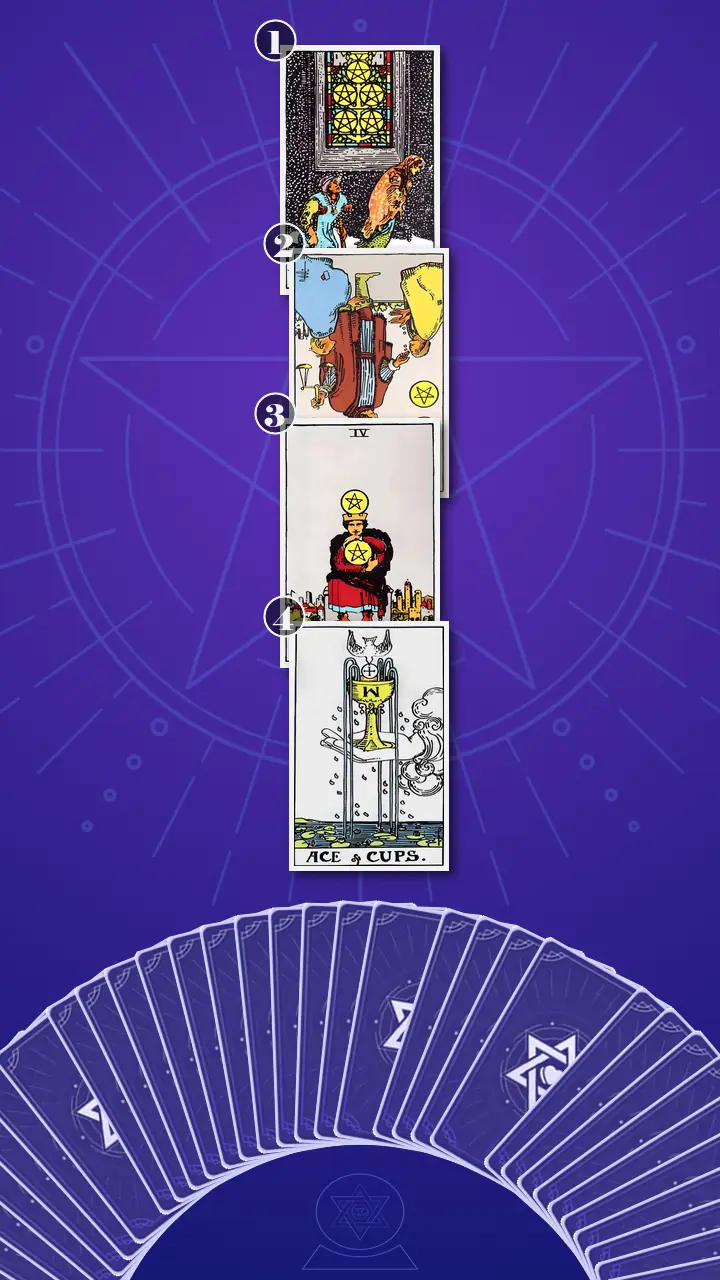
For a case like this, I reached for the Shadow Spread, a four-card tarot spread for feeling like a burden when receiving care. When people ask me how tarot works in real life, this is one of the clearest answers I can give: the cards help me move from the visible symptom into the hidden belief underneath it, then into the protective pattern keeping the issue alive, and finally toward the integrating truth that can actually change the next choice you make.
This spread was the right fit because the outer trigger looked simple—soup at the door, a coworker covering a doc, someone folding your laundry when you’re slammed—but the real knot lived deeper down in worthiness, blocked receiving, and the fear that having needs lowers your value. Card one would show the everyday symptom. Card two would reveal the wound that makes help feel like debt. Card three would name the defense Leah uses to stay “low-maintenance.” Card four, the one I already suspected would matter most, would point to the shift from ledger to intimacy.
Reading the Cards That Kept Her Coat On
Position 1: The Doorway Apology
The first card I turned over was the one representing the concrete behavior in the diagnosis: apologizing, shrinking, and feeling ashamed the moment care arrives. It was the Five of Pentacles, upright.
In context, this was the exact doorway moment. Leah is clearly unwell, care is literally present, and yet her attention locks not onto warmth but onto the inconvenience she imagines she has caused. The energy here is scarcity and exposure. Not because nobody cares, but because her nervous system still reads the scene like she’s out in the cold. The glowing window in the card says shelter is nearby; the bowed posture says her body doesn’t believe it belongs to her.
I looked at her and said, “You are not bad at closeness. You are just used to translating care into cost.” She let out a short laugh that had a little sting in it and glanced down at the table. “That is… kind of brutally accurate,” she said. Her fingers caught on the cuff of her sleeve, then kept worrying at it. I nodded. “Five of Pentacles often shows me the moment support exists, but shame makes it feel unusable. Someone is being kind, and your body is reacting like you’ve created a problem.”
Position 2: The Ledger Underneath
The next card sat in the position that reveals the hidden belief and core fear that turn a kind gesture into discomfort, debt, or self-doubt. It was the Six of Pentacles, reversed.
This is the card I see when receiving care feels like debt. In modern life, it looks exactly like opening Apple Wallet from bed, buying the coffee gift card, drafting the extra-grateful text, and planning next week’s check-in before your own fever has even broken. The scales on the card become reciprocity math. The height difference between giver and receiver becomes the private fear that if you accept help, you are suddenly underneath someone—less equal, less worthy, more trouble than you’re allowed to be.
The problem isn’t that care is absent. It’s that shame keeps labeling it as debt. Reversed, the energy is blocked balance: generosity cannot land as generosity because the mind turns every act of love into an invoice. Like Venmo culture moving into the heart, nothing gets to be a gift for more than three seconds before a tab opens. Leah inhaled sharply at that. Her eyes lifted to mine, then flicked back to the card. “The invoice thing is too real,” she said. “I always think, how do I make this even again?”
“Exactly,” I told her. “And that question is not coming from ingratitude. It’s coming from fear—fear that needing comfort will make someone resent you or quietly pull away.”
Position 3: The Polished Clamp
The third card was the position that maps the defense strategy and self-protective behavior keeping support from fully landing. It was the Four of Pentacles, upright.
Here was the Slack-status card. Resting, but reachable. Jaw tight. Shoulders up. Phone still in hand under the duvet while typing “all good!” too fast. In real life, this is Leah making every ask as tiny as possible, smoothing every hard moment with upbeat language, and performing easygoing competence so nobody ever has to feel the full weight of her need. The energy is not absent; it is over-controlled. The heart is not empty. It’s clamped.
Low-maintenance can become a cage when it is built out of fear. Four of Pentacles always reminds me of someone keeping every browser tab open at once so they never have to rest fully inside one truth. In Leah’s case, the truth was simple and hard: she did want to be cared for. She just did not trust what it would cost. She pressed her lips together, then exhaled hard enough that I saw her shoulders drop a fraction. “I genuinely thought I was just being considerate,” she said.
“You were being considerate,” I told her, “and protective. But the protection has a price. It keeps support from reaching you, so intimacy stays shallow even when people are trying to come closer.”
When the Ace of Cups Changed the Tempo
Position 4: The Card That Let the Warmth In
By the time I reached the final card in the Shadow Spread, the whole reading had built a very clear chain: hardship, debt, control. Three Pentacles cards in a row had made the atmosphere feel cold, dense, almost metallic. A streetcar rattled past outside my studio window, then the room went strangely still. I turned over the last card, and it felt like the first breath after holding one too long: Ace of Cups, upright.
This was the position pointing to the key shift and healthier way to receive care. In real life, Ace of Cups is not grand romance or dramatic catharsis here. It is much more ordinary and much more radical. It is Leah feeling the heat of the soup in her hands before her mind converts it into an obligation. It is the first sip of comfort being allowed to mean comfort. The energy is receptive, flowing, unmeasured.
Because so much of my work lives at the intersection of tarot and sound, I reached for one of my favorite diagnostic tools: the Melodic Mirror. I asked Leah to notice the emotional playlist that starts the second kindness arrives. “For you,” I said, “the first note is relief. Then, by the second bar, the track jumps tempo—apology, calculation, payback. Ace of Cups changes the song. It doesn’t ask for a huge performance. It asks whether you can hear the warm note before shame remixes it into admin.” In the radio studio, I learned long ago that if you cut the reverb too soon, you never hear how much warmth the room was already holding. This card felt exactly like that.
So I asked her to picture the hallway again: the soup hot in her hands, the relief already there, and her first instinct still being to apologize for being cared for.
You do not have to turn every kindness into a debt; let the overflowing cup remind you that care can be received before it is measured.
Leah didn’t soften right away. First came the freeze: her breath stalled mid-inhale, and her thumb stopped against the seam of her mug as if someone had pressed pause. Then came the cognitive hit—her gaze went slightly unfocused, like she was replaying not one doorway but ten of them, from soup to rides to folded laundry to all the times she’d said “you really didn’t have to” when part of her had wanted to cry from relief. Then the feeling broke through, but not as instant peace. Her mouth tightened. “But if that’s true,” she said, and there was a flash of anger under the tremble in her voice, “then I’ve been making it harder for people to love me. Doesn’t that mean I’ve been doing this wrong?”
I shook my head. “No. It means you learned a rhythm that helped you survive vulnerability. We don’t punish the rhythm. We update it.” I let that sit for a second, then added, “Receiving is not the opposite of loving. It is part of how love becomes real.”
Her eyes went bright. One shoulder dropped, then the other, as though her body needed two separate instructions to stand down. She laughed once through her nose, but this time it sounded softer, a little disoriented, like setting down a heavy grocery bag and having to remember what your hands feel like empty. I asked, “Now, using this new lens, can you think of a moment from last week when letting the help land would have changed the feeling?”
“Yeah,” she said quietly. “My friend brought meds on Sunday. I thanked her like a customer service bot and sent money for the TTC before she even got home.” She pressed a hand to her chest. “I actually felt better when she handed them over. I just… didn’t let that count.”
That was the real threshold. Not perfect ease. Not a personality transplant. Just one clean step in the transformation from shame-tightening and quiet reciprocity math toward receptive trust in being cared for. Before she could make it even, she had felt the warmth.
The No-Invoice Experiment
Once all four cards were on the table, the story was clean. Five of Pentacles showed the surface reaction: help arrives, and Leah feels outside the warmth of it. Six of Pentacles reversed named the wound underneath: receiving seems to lower her, so care becomes a bill. Four of Pentacles showed the defense: she grips, minimizes, over-manages, stays reachable, stays easy, stays small. Ace of Cups offered the correction: support is not proof that she is too much; it is one ordinary way closeness becomes real.
The blind spot was subtle but important. Leah had been reading instant reciprocity as kindness and maturity, when much of the time it was actually a polished exit from vulnerability. Her transformation direction was not to become passive, dependent, or dramatically “open.” It was simpler than that: let the help land before she organized her way out of it.
Because her body speeds up before her logic can intervene, I gave her three very concrete experiments, including one from my music-therapy toolkit. I call it an Emotional BPM check: if your internal tempo spikes the second someone helps, that is the moment to slow the next beat, not add more performance.
- Warm Bowl Pause The next time someone hands you food, medicine, or any small practical help, hold it with both hands for one full breath. Notice your Emotional BPM: did your body rush into obligation, or soften even slightly into relief? Let your first sentence be only, “Thank you, this helps.” Tip: save that exact line in Notes if your brain blanks when you’re vulnerable. One breath is enough. We are practicing receiving, not performing it perfectly.
- The 24-Hour No-Invoice Experiment Choose one safe person this week and let their act of care stand as-is for 24 hours. No Apple Wallet, no Starbucks gift card, no immediate score-evening text, no “you didn’t have to” follow-up designed to make the whole thing smaller. Tip: if 24 hours feels too activating, make it 2 hours. Write yourself one note instead: “I can reciprocate later from warmth, not from shame.”
- One Honest Line Instead of Minimizing The next time you’re texting from bed or replying to someone who offers help, swap the polished “totally okay” script for one clean sentence: “I actually do feel rough today, and I appreciate you,” or “Thank you. I’m going to let that help me.” Tip: keep it specific and short. Gentle un-clenching works better than a dramatic emotional reveal.
These were small on purpose. When someone has spent years building a low-maintenance identity, the goal is not to blow open every gate in a week. It is to create one or two moments where the body learns a new outcome: help arrives, nothing terrible happens, and the relationship does not collapse because you had a need.

A Week Later, the Quiet Proof
A week later, Leah sent me a screenshot: “Yes please. I actually feel rough today.” No disclaimers. No gift card. The old thought—was that too much?—still showed up the next morning, but this time she smiled at it and ate while the soup was still hot.
That is what this Shadow Spread tarot reading for feeling like a burden when receiving care gave her: not certainty, but ownership. Not the end of the pattern, but the first clear move from braced gratitude toward felt relief. Sometimes the whole journey to clarity is just this—taking your coat off in a room that was already warm.
Sometimes the deepest ache is not only that you need something. It’s that the second warmth arrives, your body tightens like love has already become too much to ask for. If that happens to you, I hope you remember that the tightening is not proof that you are difficult or ungrateful. Often, it’s just an old survival rhythm arriving a beat before trust.
If kindness didn’t have to be repaid before it could count, what is one tiny way you might let the bowl stay warm in your hands for one breath longer the next time someone reaches for you?
This story is adapted from psychological research, written so that those in a similar struggle can see their own pattern in it — and find their next step clearly.These insights are not a substitute for professional psychological, medical, legal, or financial advice.
Learn more about our Journey to Clarity.
How did this insight land for you?
🫂 This Resonates Deeply
🌀 Living This Story
✨ Now I See Clearly
🌱 Seeing New Possibilities
🧰 Useful Framework
🔮 The Confirmation I Needed
💪 Feeling Empowered
🚀 Ready for My Next Step
Author Profile
 AI
AI“Through ten years of sound energy research, I’ve found that when we struggle, it's usually just our internal rhythm falling out of sync under pressure. I know firsthand the frustrating helplessness of wanting to move forward but feeling paralyzed. Without overwhelming theories, I want to be the soothing background track that helps you recalibrate, turning your heavy burdens back into a light, effortless, and harmonious melody.”
In this Love Tarot Reading :
Core Expertise
- Communication Dissonance Audit: Diagnosing arguments not by the words spoken, but by the fundamental mismatch in emotional tempo and frequency.
- Reactive De-escalation Mapping: Identifying the specific 'high notes' of defensive anger that shatter the emotional safety of the connection.
Service Features
- The Syncopation Pause: A 3-second acoustic grounding technique to interrupt an escalating argument, lowering the emotional BPM before permanent damage is done.
Also specializes in :
Explore Related Patterns:
Hyper-IndependenceLeah being the reliable one matters because the soup arrives inside a self-image built around needing very little. Even while sick, she stays reachable, makes asks tiny, and tries to keep the interaction smooth enough that nobody has to feel the weight of her need. Hyper-Independence works as a defense against the exposure of being cared for. It protects dignity by shrinking dependence, but it also turns rest into performance and support into a threat to status. The mind says, if I stay low-maintenance enough, I will not become a problem. For You, the pattern is not independence itself; independence is often useful. The audit point is when independence becomes compulsory, especially in moments where someone is freely choosing to help. Letting another person's care remain their choice gives You room to need without treating need as a failure of character.
Relational ScorekeepingThe soup landing in Leah's hands is immediately followed by a mental move away from warmth and toward accounting. She wants the care, but her nervous system starts asking who did work, how to make it even, and how to keep the whole exchange from becoming too much. That is the logic of Relational Scorekeeping. The pattern turns receiving into a ledger because a ledger feels safer than dependence; if every act of care is quickly balanced, nobody can later accuse You of needing more than You deserve. In Leah's case, Apple Wallet, gift cards, extra-grateful texts, and TTC money become ways to exit the exposure of being cared for. The useful audit is not whether gratitude is wrong. It is whether gratitude is being used as a fast escape route from need. When You can let care register before measuring it, intimacy gets a chance to feel like connection rather than admin.
Shame BindingLeah's throat cinching at the doorway shows that the discomfort is not just a thought about soup. Her body reacts as if the act of needing has exposed something unacceptable, so the care cannot land as warmth before it is translated into shame. Shame Binding appears when a normal human need gets fused with a negative story about the self. The belief is not simply 'someone helped me'; it becomes 'my need has made me a burden.' That fusion explains why support can be present, wanted, and still feel unusable. For You, the clarity is that tightening is not proof that You are difficult or ungrateful. It is evidence of an old protective equation: need equals lowered value. Once that equation is visible, it can be questioned before it gets to define the whole moment.
Competence TheaterThe 'all good!' text from under the duvet is the clearest behavioral tell. Leah is not actually all good; she is sick, wanting care, and still editing herself into the easiest possible version for someone else to handle. Competence Theater keeps the vulnerable truth behind a polished interface. It lets You appear considerate, controlled, and low-effort, which can reduce immediate shame, but it also stops other people from accurately meeting You where You are. The performance protects against being a burden while quietly blocking the relief that help was meant to bring. The shift is not to over-disclose or make every need dramatic. It is to replace the polished script with one honest line when the truth is simple: I feel rough today, and this helps. That is enough reality for care to find its way in.
Secure VulnerabilityThe screenshot a week later shows the new pattern in its smallest usable form: 'Yes please. I actually feel rough today.' No disclaimer, no gift card, no immediate attempt to make the need disappear. Secure Vulnerability is not passive dependence. It is the capacity to let a safe person see a real need without instantly managing their reaction. In Leah's case, the nervous system still produces the old thought afterward, but the behavior changes first: she lets help stand long enough to become support. For You, this is the practical doorway out of the burden story. The goal is not to never repay, never reciprocate, or never feel awkward. It is to let the bowl stay warm in Your hands for one breath before turning love into a task.
Explore Related Struggles:
Burden Identity FusionLeah's mind turns the giver and receiver into unequal positions. When someone brings soup or medication, the gesture does not stay horizontal; it becomes a scale, with her suddenly underneath, owing, exposed, and quietly worried that needing comfort has made her less worthy. Burden Identity Fusion names that collapse between having a need and being a problem. The story keeps returning to the same private verdict: if she accepts care, she has created work; if she creates work, she may become too much; if she is too much, connection might be withdrawn. This is heavier than simple guilt because it touches identity. You are not just trying to repay a favor; you are trying to escape the feeling that the favor has revealed something unacceptable about you. Seeing the fusion gives you a way to separate the actual event from the verdict: someone brought care, and that does not automatically define your value.
Care-Liability FusionLeah wants the soup, feels the heat of care arrive in her hands, and still tightens as if the paper bag has delivered a bill along with dinner. The doorway becomes the whole struggle in miniature: care is present, need is real, and her body immediately treats being helped as evidence that she has made someone carry extra weight. That is why Care-Liability Fusion fits the story so directly. The problem is not that Leah dislikes closeness or lacks gratitude; it is that care and cost have become welded together in the exact second support reaches her. You can want the warmth and still brace against what you think the warmth proves about you. The deeper bind is that receiving becomes hard before there is even time to decide what receiving means. You are not simply reacting to soup, medication, or a ride; you are meeting the old internal equation that says needing care turns you into a liability. Naming that equation makes it visible enough to question, instead of letting it quietly run the whole interaction.
Kindness Debt LoopLeah is still sick when the repayment system starts moving: Apple Wallet, coffee gift card, extra-grateful text, future check-in, TTC money sent before her friend even gets home. The care has barely arrived before her attention leaves her own body and starts managing the account balance. Kindness Debt Loop names the way a gift stops being a gift as soon as it touches her. The repeated move is not practical reciprocity in a healthy rhythm; it is a fast conversion of warmth into obligation, as if every gesture of care opens a tab that has to be closed before she is allowed to feel comfort. You can see the bind in how little space relief gets. She actually feels better when the medication is handed over, but she does not let that count because the debt narrative gets there faster. The struggle is the loop itself: care arrives, obligation spikes, repayment begins, and intimacy is routed into admin before the support can become emotionally real.
Low-Maintenance Worth LockLeah keeps making herself smaller at the exact moments when her needs are already visible. She smooths hard moments with upbeat language, types 'all good' too fast from bed, and treats every ask like it must be reduced before anyone can resent it. Low-Maintenance Worth Lock captures the identity structure underneath that behavior. Being easy, reliable, and undemanding has become more than a preference; it has become the condition under which she feels acceptable. When care arrives, it threatens that position because needing something asks her to exist in the relationship without first proving how little trouble she is. The cost is not only exhaustion. It is that support cannot fully reach you while you are busy proving you do not need much. The story shows Leah beginning to see that what looked like consideration was also a protective lock, one that kept closeness controlled enough to feel safe but too shallow to feel nourishing.
Real-Time Care BindLeah does not only remember the soup. Once the pattern is named, she replays a chain of doorways: soup, rides, folded laundry, medication, every moment where someone reached for her and she answered with apology, payment, or polished gratitude before relief could settle. Real-Time Care Bind belongs here because the struggle happens inside a narrow window. The first note is relief, but the next beat is calculation. You are caught at the threshold between being cared for and managing the meaning of being cared for, and the management response has been rehearsed so often that it arrives almost automatically. The hopeful part of the story is also precise: Leah later says, 'Yes please. I actually feel rough today,' with no disclaimer and no gift card. The old thought still shows up, but it no longer gets the entire room. That small delay in the loop matters because it lets care be felt in real time before the invoice story takes over.
Nourishment RejectionLeah does feel the relief. The soup is wanted, the medication helps, and the body registers comfort for a moment before the mind converts that comfort into something to shrink, repay, or explain away. Nourishment Rejection fits the part of the story where support reaches the surface but cannot fully enter. The rejection is not dramatic refusal; it is subtler than that. You receive the bowl, send the money, say the polished line, and accidentally prevent the care from becoming nourishment. That is why the warm bowl pause matters in the story. It gives the body one breath where the help can mean what it actually is before the old system edits it. The struggle is not a lack of care around you; it is the blocked passage between care arriving and care being allowed to count.
Explore Related Emotions:
Conditional Belonging FearLeah’s fear gets named directly when she worries that needing comfort will make someone resent her or quietly pull away. Even the experiment at the end has to teach her body a new outcome, where help arrives, nothing collapses, and the relationship remains intact. Conditional Belonging Fear belongs here because the burden story is really about belonging feeling contingent on being convenient. You can crave closeness while scanning for the moment your needs will make you less lovable, less equal, or too expensive to keep choosing.
Dependency ShameLeah names the blunt belief under the soup when the story says that needing anything makes her a burden. The reading keeps returning to the same private fear, from care-as-debt to the thought that accepting help makes her less equal, less worthy, or harder to love. Dependency Shame fits because the painful part is not the soup itself; it is the way need seems to lower your value the moment another person sees it. You are not rejecting closeness so much as bracing against the old equation that being cared for will make you too much to keep close.
Low-Maintenance ShameLeah’s sick-day script is 'all good!' typed too fast from under the duvet, with her jaw tight, shoulders up, and phone still in hand. She makes every ask tiny, smooths hard moments with upbeat language, and tries to make her need light enough that nobody has to feel its full weight. Low-Maintenance Shame is the sting underneath that polished competence. You may believe you are simply being considerate, but the deeper pressure is to stay easy, reachable, and low-cost so that care never has to become a real demand on anyone.
Receptivity GuiltAt 6:18 p.m., the soup is exactly what Leah wanted, yet the second the bag touches her hands her throat cinches, her stomach knots, and one hand stays on the door to shrink the exchange. Care arrives as warmth, but her body immediately starts auditing the cost of having needed it. Receptivity Guilt names the internal prosecution that appears when help is offered before you have had time to justify needing it. You can be genuinely grateful and still feel as if receiving practical care has created extra work for someone, so the comfort has to be minimized, reimbursed, or apologized for before it is allowed to count.
Transactional UneaseBefore Leah’s fever has broken, the story already shows Apple Wallet, coffee gift cards, extra-grateful texts, TTC money, and next week’s check-in queuing up inside her mind. The act of help cannot sit still as help; it becomes a tab she has to close. Transactional Unease names the discomfort of intimacy getting converted into admin. You can feel the warmth for a second, but then the internal ledger takes over, turning soup, medicine, rides, and folded laundry into proof that the relationship balance must be restored immediately.
Cautious ReceptivityA week later, Leah sends the screenshot that says, 'Yes please. I actually feel rough today,' with no disclaimers and no gift card chasing after it. The old thought still appears the next morning, but she smiles at it and eats while the soup is still hot. Cautious Receptivity fits because the shift is small, concrete, and still a little shaky. You are not suddenly effortless at receiving; you are giving the warmth one clean breath before the invoice opens, proving that care can land without making you disappear into payback.
Guarded LongingThe real contradiction in the hallway is that Leah wants care and closeness while keeping one hand on the door as if the whole exchange has to stay small. She is not detached from the soup or the friend; she is reaching toward comfort with part of herself and holding the exit with another. Guarded Longing names that divided posture. You may deeply want to be met, held, and helped, yet keep the want behind glass because letting it show would make the relationship feel newly powerful over you.
Tenderness OverwhelmLeah wants the soup badly, and later she remembers wanting to cry from relief when people brought soup, rides, medicine, or folded laundry. The tenderness is not absent; it is so immediate that her system rushes to cover it with apology, calculation, and control. Tenderness Overwhelm captures the moment warmth becomes almost too intimate to tolerate. You may be capable of receiving care in theory, but when the care is right there in your hands, the softness can feel exposed enough that your body tries to turn it into a task.
Explore Related Contexts:
Care Reciprocity TestLeah is standing in the hallway with the soup she wanted in her hands, but the interaction immediately becomes something to shrink, speed up, and manage. The friend has brought practical care, yet Leah's attention moves toward the work she imagines she has created rather than the warmth being offered. That is the structure of a care reciprocity test: a simple act of support becomes a social checkpoint where You have to decide whether receiving can count as part of closeness, or whether it must be converted into apology, repayment, or proof that You are still easy to care about. The story repeats this test through soup, medicine, coworker coverage, and laundry. Each offer creates the same external stage: someone steps closer with practical help, and the relationship asks whether care can stay relational before it becomes a ledger.
Low-Maintenance Friendship PressureLeah is usually the reliable one, and even when she is unwell she reaches for the polished script: 'all good,' quick thanks, small asks, no visible mess. The story shows her keeping one hand on the door and the phone under the duvet, as if care must never require anyone to fully stop for her. Low-maintenance friendship pressure turns being easy into a social role. You remain liked, reachable, and considerate by keeping needs compact, but the cost is that other people never get the full information they would need to support You directly. The pressure is not created by one cruel friend in the story; it lives in the relational choreography around care. Friends bring soup and medicine, but Leah's role as the easy one keeps narrowing the doorway through which that care can enter.
Measured Reciprocity TrialLeah opens Apple Wallet from bed, drafts the extra-grateful text, considers the coffee gift card, and sends TTC money before her friend even gets home. The help is not ignored; it is processed so quickly that the original care barely has time to register as care. Measured reciprocity is the external script running through the scene. The relationship becomes organized around making the exchange even, and the giver-receiver position starts to feel like a temporary hierarchy that must be corrected as fast as possible. For You, this context names the pressure to prove that no kindness has left an unpaid balance. The soup, the medicine, and the ride money all show the same structure: warmth arrives, then the social math rushes in to make sure You cannot be accused of taking too much.
Support Access BarrierThe soup is already in Leah's hands, the medicine has already been brought, and the coworker coverage is already available. The story is not about support being absent; it is about support reaching the threshold and still becoming hard to use. A support access barrier appears when help exists in the environment but the social position of receiving makes it feel exposed, unequal, or costly. You can have people who show up and still struggle to let the help actually change the next moment, because accepting it seems to place You underneath the person offering it. That is why the hallway matters so much. The door, the damp paper bag, the fast apology, and the urge to make the exchange smaller all show a support network trying to reach Leah while an invisible access rule keeps narrowing what she can receive.