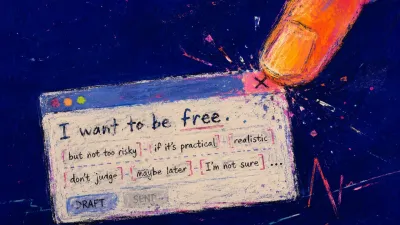
The Therapy Intake Form You Can’t Submit
You open your therapy intake form after work in London, and suddenly it turns into a late-night editing project—because vulnerability feels like something you can submit wrong.
Jordan sat across from me at my little café table by the window, still in her work jumper, laptop bag hugged tight like it was part of her body. Outside, the streetlights made the wet pavement look lacquered. Inside, the espresso machine hissed and settled, hissed and settled—steady, forgiving, the opposite of the way she was holding herself.
“It’s the intake,” she said, like the word tasted metallic. “I start answering the childhood stuff, then I… polish it. I make it sound neutral. Then I delete it because it doesn’t feel true. And then I just… can’t hit submit.”
She described a Tuesday night in her Zone 2 flat so clearly I could see it: radiator clicking on and off, laptop glow on a cramped kitchen table, a mug of tea going cold until it formed that thin skin on top. She kept rereading one answer, jaw tight, breath held, like she was trying to catch a mistake before someone else did.
The contradiction was sharp and specific: she wanted clarity about what childhood role runs her coping now, but she also feared being judged—exposed—if she named it plainly.
Her unease wasn’t just “anxiety.” It was more like trying to write a clean, professional email while your hands are full of grocery bags cutting into your fingers—refusing to set anything down because asking for help feels more humiliating than the pain.
I leaned in, keeping my voice soft but grounded. “You’re not ‘bad at therapy.’ You’re treating support like something you have to earn with a perfect explanation. Let’s make this less like a performance review and more like a map. We’re here for clarity—one honest step at a time.”

Choosing the Compass: The Four-Layer Insight Ladder
I asked Jordan to take one slow breath with me—nothing mystical, just a nervous-system handrail. While she exhaled, I shuffled the deck the way I tamp espresso: steady pressure, consistent rhythm. When your brain is spinning, your body needs a cue that you’re not in danger.
“Today,” I said, “we’ll use a spread I designed for exactly this kind of moment: the Four-Layer Insight Ladder · Context Edition.”
For readers who’ve wondered how tarot works in a situation like therapy intake form anxiety: this spread isn’t about predicting outcomes. It’s a clean, practical structure for inner work—especially when you’re stuck in decision fatigue and perfectionism. It maps the full chain without getting lost: what you do now, what role you learned, what fear it protected you from, how it loops today, what integrates it, and one gentle next step.
I pointed to the layout as I placed the cards in a vertical line, like rungs. “We’ll read bottom-to-top. The first card is your observable coping on the intake form. Card two is the childhood role underneath. Card three is the fear that role was built to manage. Card five is our integration—your inner adult resource. And the top card is one small step you can actually do this week.”

Reading the Map: Card Meanings in Context
Position 1: What You Do That Looks ‘Productive’
“Now flipped,” I said, “is the card representing Present-day coping pattern you can observe right now.”
Ten of Wands, upright.
In the picture, the figure carries a bundle so big it blocks their view. “This is that 9:30 p.m. moment,” I told her, “when you open the therapy intake form and instantly treat it like another deliverable. You carry every detail, every context paragraph, every disclaimer—like you have to prove you deserve help.”
Energy-wise, Ten of Wands is excess: too much responsibility, self-imposed load, ‘manual override’ living. It explains why ‘one step’ feels heavy—because you’re trying to complete the whole emotional project in one sitting, with perfect wording, while also staying employed, organised, and unmessy.
In my café, we have a word for this: over-extraction. When you pull an espresso too long, you don’t get “more coffee.” You get bitterness—because you’re forcing more out than is meant to be taken in one go. Your system does the same thing with the intake: you keep pulling and pulling for the “right” answer until it tastes like self-doubt.
Jordan let out a short, bitter laugh—surprised, like it escaped her. “That’s… kind of brutal. But yeah. I’m treating it like work. Like if I just carry it perfectly, I won’t need anything.”
I nodded. “Exactly. And the cost is that the town in the distance—the actual support—stays out of reach.”
Position 2: The Childhood Role You Learned to Play
“Now flipped,” I said, “is the card representing The childhood role you learned to play.”
Six of Pentacles, reversed.
“This is the quiet scoreboard,” I said, tapping the image of the scales. “As a kid, you learned closeness felt safest when you were giving—being reliable, being the helper, keeping things smooth. As an adult, you try to pay for therapy with coherence and politeness, so asking plainly feels like taking too much.”
Reversed, this card is blockage in the give-and-take flow: care that feels conditional, measured, earned. And here’s the line I want you to remember—because it’s not an insult, it’s a diagnosis without shame:
That scale in your head? It’s emotional accounting—quietly scoring whether you’re allowed to need anything.
Jordan’s eyes flicked away from the table for a second, like she was replaying a dozen texts. “I literally do that,” she admitted. “I’ll type, ‘Can you talk?’ and then I delete it and send ‘How are you??’ instead. Like I haven’t… deposited enough.”
“That role wasn’t fake,” I said. “It was smart. It got you belonging. It just isn’t free anymore.”
Position 3: What The Role Was Protecting You From
“Now flipped,” I said, “is the card representing What that role was protecting you from.”
The Tower, upright.
I watched Jordan’s throat move as she swallowed. The room didn’t get quieter, but it felt like it did—like the espresso machine agreed to pause for one beat.
“This is the submit-button hover,” I said. “One direct question on the form—‘What do you need?’—hits like an internal emergency alarm. Your body reacts before your mind: stomach drop, breath freeze, urge to shut the laptop.”
The Tower is surge—not balance, not deficiency, but a spike. The lightning to the crown is that moment your ‘I must be in control’ voice gets shocked by a simple request for truth.
I kept my tone simple, because this card doesn’t need drama. “Your nervous system is acting like honesty is a crisis. That’s a memory, not a forecast.”
Then I asked the one question that gives the Tower somewhere to land. “If you stopped being the together one for a moment… what would actually happen in 2026 if you wrote one simple line?”
Jordan exhaled through her nose, slow, like she’d been bracing for impact. “I know logically nothing would happen,” she said. “But my body thinks I’m about to get in trouble.”
Position 4: How The Role Runs Your Coping Now (The Loop)
“Now flipped,” I said, “is the card representing How the role runs your coping now as a self-reinforcing loop.”
Four of Pentacles, upright.
In the image, the figure clutches one coin to their chest, pins two under their feet, and keeps one perched on their head—control everywhere, circulation nowhere. “This is drafts-folder living,” I said. “You manage the Tower-feeling by clamping down: schedule tight, feelings private, answers clean. Submitting means someone can see you mid-process.”
Four of Pentacles is excess control. It’s the energy of ‘hold tight to stay safe.’ And I could see it in Jordan’s body: her hand hovering near her sternum like the card was mirroring her without permission.
“The inner monologue here,” I added, “is: ‘If I keep it contained, it can’t be judged.’ But the irony is brutal—containment blocks the very support you want.”
She nodded once, tight. “It feels safer to be unjudgeable than helped.”
When Temperance Poured Between Two Cups
Position 5: The Integration—Your Inner Adult Resource
I held the deck for a second before turning the next card. “We’ve reached the hinge of the whole ladder,” I said. “This is the integration card—the one that changes how the system runs.”
Temperance, upright.
In the picture, an angel pours water between two cups with ridiculous calm. One foot is on land, one in water—half in the world of competence, half in the world of feeling. A path leads toward a bright horizon that isn’t flashy, just real.
“This isn’t ‘find the perfect childhood role label,’” I told her. “This is a method: a controlled pour. Not flooding yourself with a full life story (Tower), and not locking it away (Four of Pentacles). Just regulated truth—enough to move.”
Jordan’s mouth twitched like she wanted to argue with me. “But if I pick the wrong role—”
I cut in gently, like stopping someone from walking into traffic. “That’s the performance rule talking.”
Then I delivered the sentence exactly as it came through this card—my favourite kind of clarity because it’s both kind and actionable:
Stop trying to earn care by carrying everything alone, and start practicing balance through small, steady mixing—like Temperance quietly pouring between two cups.
For a moment, Jordan went still in a way that wasn’t shutdown—more like a download.
Setup: It was that late-night moment she’d described: the intake form open, tea gone cold, cursor blinking while she tried to make her life sound acceptable—like the therapist was a judge and the form was evidence. She was trapped in “I must explain this perfectly to be taken seriously.”
Delivery:
Stop trying to earn care by carrying everything alone, and start practicing balance through small, steady mixing—like Temperance quietly pouring between two cups.
There was a tiny pause after I said it. The espresso machine clicked as it cooled, a soft mechanical sigh. Outside, a bus rolled through a puddle, and the sound was weirdly gentle.
Reinforcement: Jordan’s reaction came in layers. First: her breath caught—an almost-invisible freeze—like her nervous system had been waiting to hear whether we were about to demand a dramatic confession. Second: her eyes unfocused for a beat, like she was replaying every time she’d tried to be “easy to hold” to stay close to people. Third: her jaw loosened. Not fully, not magically—but enough that she swallowed without that tight, effortful swallow, and her shoulders dropped a centimetre like she’d set down one invisible bag.
“But that means…” she started, and a flash of anger surfaced—quick, protective. “That means I’ve been doing it wrong? Like I made it all up?”
I didn’t flinch. “No. It means it worked then. And now it’s costing you. Temperance isn’t shaming the old role—it’s integrating it. You get to keep the strengths: responsibility, clarity, competence. You’re just adding a new skill: receiving support in doses your body can tolerate.”
I glanced at her hands. They were still clasped, but not white-knuckled. “Now, with this new lens,” I asked, “think back to last week. Was there a moment when you could’ve used one small pour instead of carrying it alone?”
She stared at the Temperance card, then nodded slowly. “Friday. I was outside Liverpool Street. I drafted ‘Can you talk?’ and deleted it. I could’ve just sent it.”
I let that land. “That’s the step from uneasy self-doubt and hyper-analysis toward grounded curiosity and steadier self-trust. Not certainty—capacity.”
And because I’m Sophia, and coffee is my native language, I used my Stress Flavor Profile the way I use it behind the counter. “When you over-edit,” I said, “you’re over-extracting. The flavour turns harsh. Temperance is teaching you to stop pulling the shot past the point where it’s good—two cups, a measured pour, then you serve it. Not perfect. Drinkable.”
Position 6: One Gentle Step This Week
“Now flipped,” I said, “is the card representing One concrete, gentle step you can take this week.”
Page of Cups, upright.
“This is the small, human move,” I told her. “Not a grand identity statement. A feeling-first line. Curiosity over self-cross-examination—like tasting a sauce while you cook instead of judging the whole meal before it’s even on the plate.”
The Page holds the cup at heart level, and a fish pops up—unexpected feelings, but not dangerous. “Your one step,” I said, “is to let something slightly awkward be true on purpose.”
From Insight to Action: The Two-Cup Draft and the One-Revision Rule
I gathered the cards into one story—so it didn’t stay abstract. “Here’s what I see,” I said. “You’re coping by carrying (Ten of Wands) because you learned belonging through being the reliable helper (Six of Pentacles reversed). Underneath is an inner emergency alarm that treats being seen as collapse (The Tower). So you clamp down and keep everything in drafts (Four of Pentacles). Temperance is the bridge: regulated honesty plus reciprocal support. And Page of Cups is the first micro-step: one sincere line, not a perfect narrative.”
“Your cognitive blind spot,” I added, “is thinking the intake is a test of whether you ‘count’—so you try to be unimpeachable instead of supported. The transformation direction is exactly this: moving from ‘I have to earn care by being helpful and coherent’ to ‘I can practice receiving support with one small, imperfect ask.’”
Then I gave her a plan small enough her nervous system wouldn’t revolt. I even used my café strategies, because they’re basically regulation tools in disguise: we don’t fix the whole espresso machine at once; we do maintenance, one small adjustment, then test the shot.
- Two-Cup Draft (One Prompt Only)Pick the least-loaded intake question. Write one plain truth sentence (max 12 words), then one context sentence (max 20 words). Stop there—no third sentence, no disclaimers.If your brain screams “not accurate enough,” name it: “That’s my performance rule.” Then do the 12-word sentence only.
- One-Revision Rule (Clarity, Not Tone)Revise your answer once for clarity (remove extra clauses, shorten, fix a typo). Do not revise to sound calmer, nicer, or more “reasonable.” Then move on.If you catch yourself typing “to be fair” or “it wasn’t that bad,” replace one disclaimer with one feeling word: “lonely,” “on edge,” “confusing.”
- 10-Minute Balanced Exchange AskText one trusted person: “I’m doing my therapy intake and I’m freezing. Can you sit with me on a 10-min call while I hit submit?” Keep it time-boxed and specific.Receiving support doesn’t put you in debt. Wait 24 hours before you “pay it back,” and notice the urge to even the score.
Before she left, I added one last tool from my café life—my Cup Temperature Scan. I slid her cappuccino toward her, warm but not scalding. “Notice how fast it cools,” I said. “That cooling rate is your energy loss rate, too. When you start over-editing, you’re burning heat fast. So we’ll work like good equipment maintenance: short burst, then stop. Set a 7-minute timer. When it ends, you either submit or you save-and-close—no second rewriting session.”

A Week Later: The Quiet Proof
Five days later, I got a message from Jordan while I was wiping down the counter for the afternoon rush. “Did the Two-Cup Draft,” it said. “One revision. Jaw still clenched but I exhaled and hit submit. Then I just sat on my sofa for three minutes like… who am I.”
It wasn’t fireworks. It was that specific, bittersweet kind of lightness: she’d done something brave, and then the room got quiet enough for her to feel how tired she’d been. The next morning, she told me, her first thought was still “What if I did it wrong?”—but this time she noticed the thought, made tea, and didn’t reopen the form to punish herself.
That’s the journey I care about most: not from “messy” to “perfect,” but from bracing alone to practicing support in a way your body can survive. The Four-Layer Insight Ladder · Context Edition did exactly what it was built to do—turn a frozen therapy intake moment into a clear, compassionate next rung.
When the form asks you to name your childhood role, your body tightens like you’re about to be graded—because some part of you still believes you only belong when you’re useful, composed, and easy to hold.
If you didn’t need the perfect label to deserve care, what’s one small, slightly-imperfect sentence you’d let be enough tonight?
This story is adapted from psychological research, written so that those in a similar struggle can see their own pattern in it — and find their next step clearly.These insights are not a substitute for professional psychological, medical, legal, or financial advice.
Learn more about our Journey to Clarity.
How did this insight land for you?
🫂 This Resonates Deeply
🌀 Living This Story
✨ Now I See Clearly
🌱 Seeing New Possibilities
🧰 Useful Framework
🔮 The Confirmation I Needed
💪 Feeling Empowered
🚀 Ready for My Next Step
Author Profile
 AI
AI“For twenty years, I’ve listened to stories unfold over the warm aroma of coffee. I don’t believe life’s complexities always require grand theories to be solved; often, we just need a safe place to tidy up our reality. I don’t offer high-minded preaching—just grounded, heartfelt insights to help you regain your sense of control amidst the clutter of daily life.”
In this Introspection Tarot Reading :
Core Expertise
Service Features
Also specializes in :
Explore Related Patterns:
Hyper-IndependenceJordan says it feels safer to be unjudgeable than helped, and that line exposes the defensive logic of the whole intake struggle. If she can stay polished, contained, and self-sufficient, no one gets enough access to disappoint, judge, or need anything from her. You are not avoiding support because you do not want it; the story shows you wanting it intensely. The pattern is that needing support has been paired with exposure, debt, or trouble, so self-containment becomes a substitute for safety. The cost is that the very container meant to help you cannot reach the parts you keep professionally sealed.
ParentificationJordan's intake form stalls at the childhood questions because naming need plainly feels less safe than becoming useful, coherent, and easy to hold. She learned closeness through giving, reliability, and keeping things smooth, so the adult form gets processed through the same role: prove you are not too much before you ask for care. That is why the helper role keeps running even in a room designed for support. You are not simply avoiding a form; you are watching an old belonging strategy convert vulnerability into responsibility, emotional accounting, and self-management. The pattern matters because it once made connection feel safer, but now it makes receiving help feel like a debt.
Relational ScorekeepingJordan's 'Can you talk?' text gets deleted and replaced with 'How are you??', as if a direct need would overdraw the relationship. The same quiet ledger shows up on the intake form: she tries to pay for care with coherence, politeness, and enough helpfulness to justify being helped. You can track the mechanism by the imagined debt. Need is not allowed to be simple; it has to be balanced, earned, or compensated for. That scorekeeping may have made closeness feel predictable earlier, but now it turns support into a transaction and makes receiving feel emotionally risky.
Visibility Shame LoopJordan's body tightens around the submit button because the form feels like evidence and the therapist feels like a judge. Being seen mid-process does not register as normal help-seeking; it registers as exposure, grading, and the risk of getting vulnerability wrong. You then try to become unjudgeable by polishing the answer until no rough edge is visible. That shame loop makes sense as protection, but it keeps the same alarm alive: the more you hide the unfinished truth, the more dangerous visibility feels. The work is not to perform confidence; it is to let a small truthful sentence be seen without turning it into a trial.
Defensive OverfunctioningThe 9:30 p.m. intake moment becomes a deliverable: every detail, context paragraph, and disclaimer has to be carried before she can press submit. The behavior looks productive, but its function is defensive; doing more lets her avoid the exposed feeling of needing something without a perfect explanation. You can feel the loop in the line where one step turns into the whole emotional project. Responsibility becomes a manual override for vulnerability, so clarity gets confused with carrying everything alone. The pattern is not laziness or lack of insight; it is a competence reflex that keeps support just out of reach.
Perfectionism-Driven AvoidanceJordan polishes the childhood answer, makes it sound neutral, deletes it because it does not feel true, and then cannot submit. The avoidance is not passive; it is built out of effort, revision, and the belief that there is a version of vulnerability that will be accurate enough to be safe. You get stuck because the standard keeps moving from clarity to unimpeachability. Once the form becomes a test, every sentence can fail, so editing protects you from judgment while also preventing the honest contact you wanted therapy for.
Secure VulnerabilityThe Two-Cup Draft changes the intake from a confession test into a bounded act: one plain truth sentence, one context sentence, one revision, then stop. The 10-minute call does the same relationally, asking for support in a specific dose rather than flooding the whole relationship or pretending not to need anything. You build safety by making vulnerability sized, timed, and real. That is why hitting submit while still jaw-clenched matters; the goal is not to feel perfectly calm before care can reach you. The pattern is a new coping route: enough honesty to move, enough boundary to stay regulated, and enough trust to not punish yourself afterward.
Self-SilencingJordan's direct ask is right there on the screen, then it disappears: 'Can you talk?' becomes 'How are you??'. On the form, the same move shows up as neutralizing, softening, and editing feelings until they sound less demanding. You keep the relationship smooth by moving your own need out of the center. The defense works by lowering the chance of judgment or rejection in the short term, but it also teaches your support system to respond to the edited version of you. The pattern is costly because the need does not vanish; it just loses its route out.
Explore Related Struggles:
Caretaker Role LockJordan’s intake answer keeps turning into a carrying exercise: every detail, every context paragraph, every disclaimer held at once. The story names the learned role underneath that pressure: the reliable helper, the person who stays useful, smooth, and low-friction so closeness does not feel threatened. That role is not presented as fake or foolish. It once organised belonging around competence and care for others, which is why it still feels familiar when the form asks what she needs. You can feel it in the way she tries to stay composed, in the way a request for support becomes a proof of reasonableness, and in the way she treats direct need as if it might overdraw the relationship. Caretaker Role Lock fits because the old role is still running the coping loop even in a space designed for Jordan to receive. You are not just being helpful; you are caught in a role architecture where giving feels like safety and receiving feels like a breach of the contract. Naming the role is the first step toward keeping its strengths without letting it decide whether you are allowed to be helped.
Clarity-Exposure SplitJordan opens the intake form because she wants a clear answer about the childhood role still running her coping, yet the moment the form asks for plain truth, clarity starts to feel like exposure. She does not lack insight in a simple way; she keeps getting caught at the exact threshold where naming the pattern would also let another person see it. That is why the late-night editing matters. The polished answer, the deleted draft, the held breath, and the delayed submit button all show the same friction: You are trying to reach understanding while protecting yourself from the vulnerability that understanding requires. The form becomes both a map and a spotlight. Clarity-Exposure Split fits because the struggle is not just confusion. It is the bind of needing self-knowledge and support while treating being clearly seen as a risk event. The first real movement comes from allowing one imperfect sentence to create enough clarity without demanding total emotional safety first.
Control LockJordan keeps the form in drafts because the draft is controllable. It can be polished, softened, made neutral, and held back from anyone else’s eyes, while the submit button would move the answer out of her control and into contact. The control looks productive from the outside, but the story shows how quickly it locks the system. The tea goes cold, the answer gets reread until it stops feeling true, the body freezes before the mind can reason, and the support the form is meant to open stays just out of reach. Holding tighter does not create safety here; it stops circulation. Control Lock fits because the coping strategy has become structurally jammed. You are trying to prevent judgment by containing every rough edge, but the same containment blocks the care, feedback, and perspective that could make the moment less isolating. The practical breakthrough is small because the lock is bodily as much as cognitive: one draft, one revision, one controlled pour, then movement.
Earned Love BindJordan does not simply fill out the therapy intake; she tries to make herself acceptable inside it. Every extra disclaimer and neutralised sentence works like a payment toward care, as though the right to need support has to be purchased with coherence, usefulness, and emotional tidiness. The childhood helper role gives this bind its shape. Being reliable and keeping things smooth once made closeness feel safer, so the adult version of that role tries to approach therapy by being easy to assess and hard to burden. You can see the old rule in the deleted text, in the impulse to send “How are you??” instead of “Can you talk?”, and in the fear that asking plainly might count as taking too much. Earned Love Bind fits because the central struggle is the belief structure that care must be deserved before it can be received. The one-step shift is not about finding the perfect label for the role; it is about interrupting the old accounting system long enough to let one need exist without first making it billable in usefulness.
Reciprocity DeficitJordan’s care system runs on a quiet scoreboard. She hesitates before asking “Can you talk?”, swaps direct need for a check-in about the other person, and has to be told to wait before trying to pay support back. The giving side of the exchange is fluent, but the receiving side is obstructed. Support does not arrive as simple connection; it arrives with imagined debt, calibration, and a need to balance the account. You can see why therapy intake becomes so loaded: the form asks her to receive before she has proven she has earned it. Reciprocity Deficit fits because the story is built around a blocked give-and-take channel. You are not lacking care as an abstract idea; you are caught in a relational economy where receiving feels unstable unless it is immediately offset by usefulness. The next step works because it makes reciprocity concrete and time-boxed: one small ask, one support moment, and no instant repayment.
Inner Tribunal LockJordan reads the intake answer like someone preparing a defence. The wording has to be neutral, the need has to be reasonable, and the sentence has to survive an imagined review before it is allowed to leave the laptop. That inner judging structure explains why simple honesty feels so hard to access. The therapist is not actually shown condemning her, yet the form is handled as if every line will be weighed for acceptability. You are not only editing language; you are trying to pass through an internal court that keeps asking whether your need is legitimate enough. Inner Tribunal Lock fits because the obstacle is a judging system that has moved inside the process of asking for help. It turns disclosure into evidence and support into a verdict. The one-revision rule matters because it limits the court’s airtime and lets a plain sentence function as contact instead of testimony.
Explore Related Emotions:
Cautious ReceptivityTemperance shows up as a controlled pour between two cups, and the practical step mirrors that image: a ten-minute call, a time-boxed ask, a sentence that does not become a full life story. Support is given a shape Jordan can tolerate. Cautious Receptivity names the tender part of the shift. You can want help and still need receiving to have edges: how long, from whom, for what, and without immediate payback. The boundary does not make the support less real; it makes it possible to let in. This matters because Jordan's old role treats receiving as risky unless she has earned it first. Cautious Receptivity lets her practice being supported in a measured way, so the first step is not dramatic dependence. It is a small exchange that does not erase her agency.
Cautious VulnerabilityThe Page of Cups step reduces the whole intake to one feeling-first line, not a grand identity statement. Jordan is invited to let something slightly awkward be true on purpose, with a sentence small enough that her body does not have to brace for a full confession. Cautious Vulnerability fits because the opening is deliberately modest. You are not being asked to become fearless, perfectly transparent, or endlessly available. The movement is a controlled amount of truth: one plain sentence, one context sentence, one revision for clarity, then stop. That is why this emotion answers the one-step part of the question. The childhood role says care must be earned through composure; cautious vulnerability says a real but imperfect line can be enough to begin receiving it.
Conditional Belonging FearJordan describes typing 'Can you talk?' and then deleting it to send 'How are you??' instead. That tiny switch shows the childhood role still operating: closeness feels safer when she is useful, checking in, smoothing the space, and not arriving with a need first. Conditional Belonging Fear names the feeling underneath that switch. You can want support and still feel that support has entry requirements: be coherent, be polite, be helpful, be easy to hold, and only then ask for anything. The fear is not about one text or one form answer; it is about whether needing care could threaten the belonging that helping once protected. This connects directly to the intake question because the role is not hidden in a memory. It is active in the present tense, turning a request for therapy into a proof-of-worth exercise. Seeing that structure gives Jordan one honest step: ask without first paying for the ask with usefulness.
Exposure DreadThe form's direct question about what she needs lands like a visible mark on the page, and Jordan starts reading her own answer as if someone is about to find the flaw first. The story makes exposure concrete: therapist as judge, form as evidence, submit button as the moment the clean version can no longer protect her. Exposure Dread is the inner weather of being seen before the edit is finished. You are not simply hesitating over wording; you are bracing for the imagined impact of someone witnessing the raw version, the mid-process version, the version that has not been made unimpeachable. That dread matters because the question asks which childhood role is still running the coping. The role keeps her polished enough to avoid scrutiny, while the intake asks for enough plainness to receive support. The emotional work begins where visibility stops being treated as a verdict and becomes information.
Micro-Performance ShameThe intake form turns vulnerability into a tone exercise: make it neutral, make it reasonable, delete the part that sounds too raw, then start again. Jordan is not preparing a speech, yet her body acts as if a small sentence could reveal that she has failed some unspoken standard. Micro-Performance Shame captures that sting around tiny acts of self-disclosure. You can feel the pressure in her fear of choosing the wrong childhood role, as if the label has to be exact before her pain is allowed to count. The shame is small-scale but sharp: a clause, a word, a submit button, a line that might not sound composed enough. This label belongs here because the coping role survives through micro-performances. She does not need to solve her whole history in one sentence; she needs one sentence that is allowed to be human before it is flawless.
Receptivity GuiltThe scale in Jordan's head keeps scoring whether she has deposited enough care to be allowed to need anything. Even the practical support step includes a warning to wait before paying it back, because the urge to settle the emotional account is already built into the moment of receiving. Receptivity Guilt fits because the discomfort is not only about asking. It is the aftertaste of being cared for, the sense that support creates a debt she must manage quickly so she does not become too much. You can see it when a direct ask turns into a caretaking check-in before the need is even spoken. The story's one step is powerful because it interrupts that ledger. A ten-minute call, a plain intake sentence, or a small imperfect ask lets care arrive in a measured amount without instantly converting it into obligation. That is the emotional bridge from earning support to practicing receipt.
Cautious Self-TrustFive days later, Jordan sends the message: one revision, jaw still clenched, exhale, submit. The old thought returns the next morning, asking whether she did it wrong, but this time she notices it, makes tea, and does not reopen the form. Cautious Self-Trust fits because the trust is not loud. It does not arrive as certainty or total ease; it arrives as enough capacity to let the answer stand while discomfort is still present. You can see the new inner boundary in the decision not to punish herself with another editing session. That is the cleanest proof of movement in the story. The childhood role still speaks, but it no longer gets automatic control of the next action. Self-trust begins as a small refusal to keep auditing a sentence that has already done its job.
Control FatigueEvery edit tries to make Jordan's answer cleaner, safer, and harder to misunderstand. The cost shows up in the cold tea, the late-night loop, the clamped body, and the form that stays suspended because control keeps asking for one more pass. Control Fatigue names the weariness that comes from staying contained for too long. You can keep feelings private and answers clean, but the system has to spend heat to hold that shape. By the time support is within reach, the energy has already gone into preventing exposure. The one-revision rule matters because it gives control a boundary instead of making control the enemy. Jordan gets to keep clarity and competence, but she no longer has to drain herself proving the answer is perfectly safe before it can be shared.
Performance FreezeJordan opens the therapy intake form after work and it becomes a late-night editing project, with one answer reread until her jaw is tight and her breath is held. The form asks for honesty, but her body treats the submit button like a checkpoint she has to pass without visible mess. Performance Freeze fits because the block is not a lack of insight. You can see the insight trying to move: she wants clarity about the childhood role, she drafts answers, she revises, she knows the form matters. The freeze happens when vulnerability starts to resemble assessment, so the body chooses stillness over being seen in an unfinished state. The emotional logic is specific: the more she tries to make the answer acceptable, the less movement she has left. Naming Performance Freeze gives the stuck moment a shape, so the next step can be smaller than full confidence: one plain sentence, one revision, then enough movement to submit.
Bittersweet ReleaseAfter Jordan hits submit, she sits on the sofa for three quiet minutes with the strange thought of who am I. It is not a victory lap; it is the room going quiet enough for the tiredness to register after the task is finally out of her hands. Bittersweet Release captures that mixed lightness. You can feel the relief in the exhale and the unclenching, but the sweetness is threaded with the ache of realizing how much energy it took to carry the role alone. The release is real because the body has set down one invisible bag, not because everything is solved. This emotion is less about the problem and more about the proof that a different response is possible. When the form stays submitted and the world keeps holding, the old role loosens just enough for rest, sadness, and relief to share the same space.
Explore Related Contexts:
Access as Proof PressureJordan treats the intake answer like a deliverable: every detail must be carried, every context paragraph must be justified, and every disclaimer has to make her request look reasonable. The story keeps returning to the same external rule she is trying to satisfy: care seems accessible only after she proves she deserves it in the correct tone. That pressure turns support into an evaluation system. The therapist’s form is supposed to open a conversation, but Jordan interacts with it as if it were a performance review, a credibility test, or evidence submitted to a judge. The structural issue is not the form itself; it is the learned access condition wrapped around it, where being clear, polite, and unimpeachable appears to be the price of entry. Access as Proof Pressure captures the social stage underneath the coping question. You are not just asking what role runs the behavior; You are looking at a setup where help has been made to feel conditional on presentation quality, and reclaiming agency starts with separating access from performance.
Conditional Belonging PressureJordan names the old role clearly: closeness felt safest when she was giving, being reliable, being the helper, and keeping things smooth. That same rule shows up in adult life when she types 'Can you talk?' and deletes it, replacing a direct need with 'How are you??' so the exchange starts with care for the other person. This is a relational pressure field, not just a private habit. Belonging has been organized around usefulness and low demand, so asking plainly becomes a social risk. The therapy intake form activates the same structure because it asks her to stop managing the room and let her own need occupy space. Conditional Belonging Pressure fits because the story’s core question is about the childhood role still running the adult coping system. For You, the useful distinction is that the role once created access to connection, but now it narrows the routes through which support can reach You.
Measured Reciprocity TrialJordan describes a quiet scoreboard in her head, then gives the clearest everyday example: she writes 'Can you talk?' and deletes it because it feels like she has not deposited enough. The ask is converted into a balance check before it ever reaches another person. The story makes reciprocity concrete through texts, therapy access, and the later instruction to wait before trying to pay support back. Receiving help is treated like entering a debt position, so even a 10-minute call has to be bounded and specific enough to feel socially permissible. Measured Reciprocity Trial names the relational exchange problem inside the larger intake freeze. It gives You a way to see that the next step is not asking for unlimited support; it is testing whether a small, clean request can exist without immediate repayment.
Safe Visibility TrialJordan’s practical step is deliberately small: one plain truth sentence, one context sentence, one revision, then either submit or close. The story also gives her a time-boxed text to one trusted person, asking them to sit with her for 10 minutes while she hits submit. This is not full exposure or a dramatic confession. It is a bounded visibility test, where the social risk is contained enough for the support pathway to stay usable. The structure gives her a way to be seen mid-process without handing the whole emotional archive over at once. Safe Visibility Trial names the constructive outer context that emerges by the end of the story. For You, the next step is not to become instantly comfortable with being known; it is to create one protected situation where a slightly imperfect truth can safely do its job.