The Warm Phone on Line 1
If you’re the late-20s city friend who can manage a campaign calendar but still rewrites the “can anyone help me move Saturday?” text three times after a rent increase, I already know this probably isn’t bad planning. It’s hyper-independence in friendship, and it often shows up exactly where practical help should feel easiest.
Jordan came to me with the kind of question people often type into a search bar at 12:07 a.m.: why do I feel guilty asking friends to help me move, and why does receiving help make me feel like a burden? She told me about 8:14 on a Friday morning, standing on Line 1 with her tote pressed to her knee while the train brakes screamed into the station. Her phone warmed in her hand with a text that said, “I’ve got my car Saturday if you want it,” and she said relief hit first, then her chest went hollow, her shoulders climbed, and her stomach clenched so hard it felt as if kindness had turned into an alarm.
She laughed when she said it, but it was the kind of laugh people use when they are trying to make the bruise smaller. “I know they mean it,” she told me. “And I still feel bad saying yes.” In her words I could hear the true split: she wanted to accept a friend’s help with moving, and she was just as afraid that needing help would make her heavier, more inconvenient, somehow too much. The shame in her felt like trying to carry stacked banker boxes through a doorway that was already too narrow—everything tightened precisely when setting one box down would have made the passage easier.
I leaned forward and said the first thing I wanted both her and any reader in the same spiral to hear: Help is not a character test. Then I added, gently, “Let’s not argue with the feeling yet. Let’s map it. That’s how we begin finding clarity.”

Choosing the Compass: A Four-Card Spread for Receiving Help
I asked her to put both feet on the rug and take one breath longer on the exhale than the inhale while I shuffled. I use that moment as a reset, not a performance; it helps the mind stop rehearsing and lets the real question settle where the cards can mirror it.
For her, I chose the Situation-Obstacle-Advice-Outcome spread, a tarot spread I often use for burden anxiety around receiving moving help. When people ask me how tarot works in a moment like this, this is my most practical answer: I’m not using the cards to predict whether a friend secretly resents them. I’m using them to trace the chain between visible behavior, hidden fear, corrective energy, and the next grounded step. For a very specific pain point—why accepting help feels shameful—this lean four-card structure is clearer than a more sprawling spread because it keeps the reading close to the actual trigger instead of letting the story drift.
The first card would show me the surface pattern: the minimizing, the over-apologizing, the “it’s basically nothing” text. The second would reveal the deeper obstacle underneath that behavior. The third, and I suspected this would be the hinge, would offer the inner medicine. The fourth would show what happens when support stops feeling like private debt and starts becoming mutual care with names, timing, and real hands on real boxes.
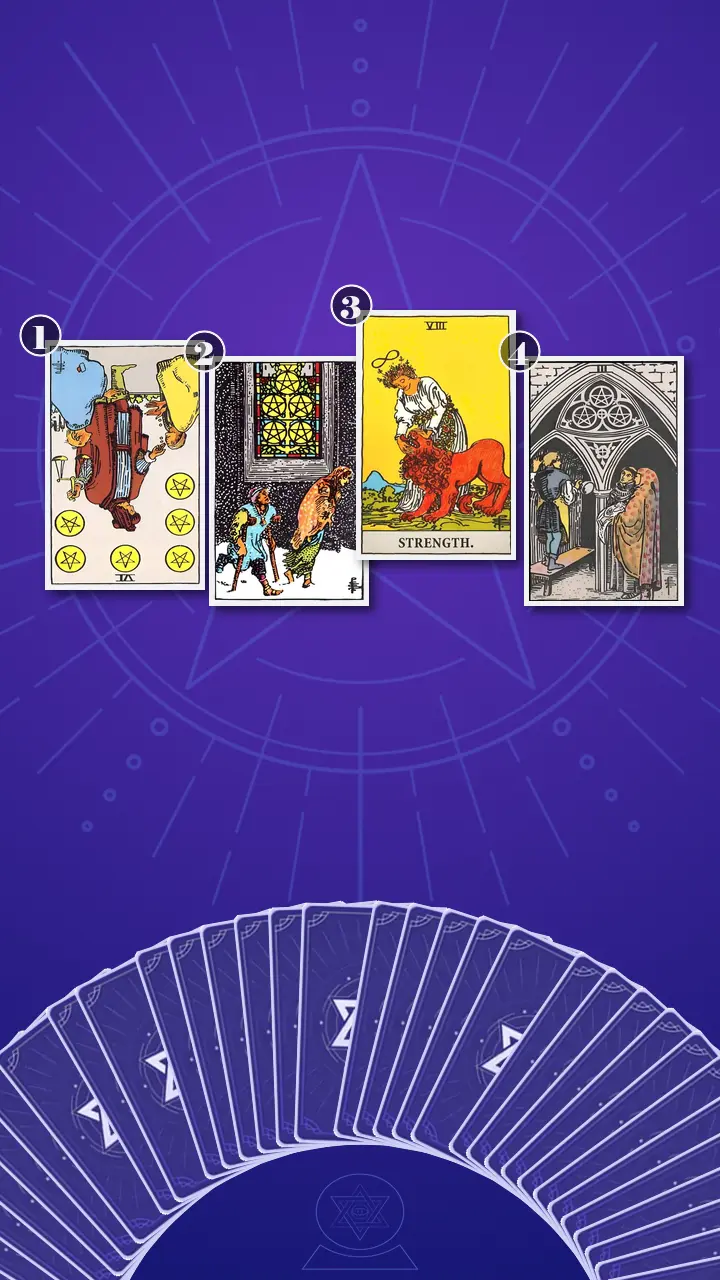
The Invisible Invoice and the Winter Window
Position 1: The Balance Sheet Hidden Inside the Group Chat
I turned the first card. “This position presents the observable behaviour,” I said, “the minimizing, the over-apologizing, and the resistance to practical help.”
The card was Six of Pentacles, reversed.
I told Jordan this was the exact moment when a sincere “I can help Saturday” text turns into an invisible invoice. In modern life, this is the mental app running in the background: gas, coffee, pizza, future favors, how much of their weekend this costs, whether you should down-rank your own need before anybody notices it has weight. I could almost see her Thursday-night version of it—packing tape stuck to her thumb, half-finished Notion checklist open, reply box blinking while she typed some version of “Honestly it’s basically just a few boxes and maybe one shelf.”
In reversed form, the Six of Pentacles shows blocked Earth and distorted balance. The support is real, but the scales tilt in your mind before anyone lifts a single box. Instead of receiving, you start over-correcting. You make the task smaller. You apologize before anybody answers. You plan the Interac e-Transfer before moving day has even happened. The card was not telling me Jordan was greedy or ungrateful; it was showing me that kindness was getting translated into debt the second it crossed her screen.
I asked her, “When someone says they can help on Saturday, what exact line do you type next?”
She answered without thinking. “Only if it’s super convenient.” Then she gave a quick, pained laugh and looked down at the table. “Okay,” she said, “that’s accurate enough to be rude.”
I smiled. “Not rude. Precise. The card is showing the ledger, not judging you for having one.” Her fingers loosened from the paper cup she had been holding, just a little, which told me the recognition had landed.
Position 2: Standing Outside the Warm Room
I turned the second card. “This position reveals the underlying fear and limiting belief,” I told her, “the part that reads needing help as deficiency, imposition, or lack.”
The card was Five of Pentacles, upright.
This one always changes the temperature of a room. Jordan had described friends who were kind, employed, busy, normal—people with jobs, partners, weekends they protected. But this card showed that even with support available, her inner world still felt like standing outside a lit café in February while her people are literally waving her in and some part of you keeps insisting you don’t belong at the table. In her life it looked like packing alone after midnight even after someone offered their car, because the real pain wasn’t lack of help. It was the old conclusion that more competent adults wouldn’t need it.
Here the energy wasn’t excess; it was a scarcity wound, a deficiency story. Her nervous system read practical help through a winter filter: They probably mean it now, but what if they regret it later? I have spent decades watching weather in people as carefully as weather over hills, and I’ve learned that a held breath is often the first snowflake of an old belief. When I said, “You are not an inconvenience just because the task is inconvenient,” the room went very still.
A shadow from the window frame crossed the table right then, and Jordan’s body answered before her words did. First her breath stopped. Then her eyes lost focus, as if she were replaying half a dozen old moments at once. Then her shoulders lowered on a long exhale she clearly had not meant to let out.
Quietly, I asked, “When practical help becomes real, what is the worst thing you imagine the other person will secretly feel about you by the end of the day?”
She pressed her thumb into the cup lid. “That I took over their whole Saturday,” she said. “That I’m more work than I look.”
There it was—the actual obstacle. Not boxes. Not scheduling. A worth wound dressed as logistics.
When Strength Asked Her to Unclench
Position 3: The Card at the Hinge
When I turned the third card, even the radiator seemed to stop clicking. “This position identifies the key shift,” I told her, “the inner posture that can interrupt self-protection and let support be received more cleanly.”
The card was Strength, upright.
I felt the whole spread change. Three of the cards were Earth cards or Earth-heavy concerns—boxes, rent, bodies, labor, timing, money, the sheer weight of ordinary life. In my Nature Empathy Technique, I start by asking what the body and the elements are doing. When I use Elemental Balance in a reading, I’m looking for whether Earth, Water, Fire, and Air are working together or turning against each other. Jordan had plenty of Earth—responsibility, logistics, effort—but it had frozen into over-control. Strength brought Fire into the middle of that frozen ground. Not dramatic fire. The kind that warms your hands enough to loosen them.
This is where I use Body Signal Interpretation most clearly. Jordan’s tight jaw, lifted shoulders, and hard stomach were not proof that she was too much; they were her inner lion baring its teeth the instant vulnerability became visible. The work here was not to shame the lion into silence. It was to meet it with steadiness. I told her plainly: being helped does not make you heavier. It lets friendship hold one ordinary human need without turning it into proof that you are too much.
Years ago, long before most of my clients were texting me screenshots of draft messages, I learned on Highland mornings that frost-hardened soil never softens because you argue with it. It softens when warmth returns. That is how I read Strength. Not as “be tougher,” but as “bring warmth back into the place that has been bracing.”
I pictured her on the TTC again: the train jerking, the phone warm in her palm, relief flashing for half a second before the shame spiral tried to take the wheel. She was trapped in that familiar thought loop: I need the help, but if I accept it cleanly, I become too much.
You do not have to bare your teeth and carry every box alone; Strength asks you to loosen the jaw of self-protection, say one true need, and let care be met with calm instead of apology.
I let the sentence sit between us for a breath.
Jordan froze first. Her fingers hovered above the edge of the table, not touching the card, not pulling away either. Then I watched recognition move through her in layers. Her eyes widened, then drifted past me toward the rain-bright window as if she were replaying that exact unread draft in her head—the one where “Can you help with the bookshelf and first carload?” had been swallowed by “No worries, I can manage.” Her jaw shifted. Once. Then again. The muscles at the hinge of it softened, and one shoulder dropped before the other, like a coat sliding off a peg. When she finally spoke, her voice came out thinner than before. “But if I ask that clearly,” she said, “won’t I sound demanding?”
“No,” I told her. “Specific is not demanding. Specific is kind. A clear ask is kinder than a panic apology spiral.” I watched her take that in. There was the slightest sting in it, the bittersweet part that comes whenever clarity exposes how much effort you’ve been spending on hiding. Her eyes shone, not dramatically, just enough to catch the light. She gave a shaky little laugh—the kind people make when relief and embarrassment arrive together. Then she inhaled all the way down into her ribs for what sounded like the first full breath of the reading.
I asked her, “Now, with this new perspective, think back to last week—was there a moment when this insight might have changed how you felt?”
She nodded immediately. “The text about the car,” she said. “I would’ve just answered the actual question.”
That was the hinge. Not instant confidence. Something more believable and more powerful: the first step from shame-tightening and self-erasure toward grounded appreciation and steadier trust.
The Shared Plan on the Table
Position 4: When Mutual Care Gets a Blueprint
I turned the final card. “This position shows the actionable next step and the integrative direction that emerges when help is approached as mutual care rather than private debt.”
The card was Three of Pentacles, upright.
I loved how cleanly it landed after Strength. The modern version was immediate: elevator booked, one friend on bookshelf duty, one on carloads, boxes labeled kitchen first and fragile, coffee order decided, arrival window clear. In other words, moving day stops being a secret final exam in worth and becomes a shared project board. Google Calendar blocks, condo elevator bookings, and a Notes app checklist are not cold bureaucracy in a city like Toronto; they are the real architecture of urban mutual care.
Energetically, this card brought Earth back into balance. Healthy Earth is practical, named, visible, collaborative. It does not ask anyone to mind-read. It does not keep twenty mental tabs open while pretending nothing is needed. I could feel Jordan understand that clear roles would actually lower the awkwardness she feared.
She tilted her head. “I always think making a plan makes it feel too official.”
“Only if you think being helped is a verdict,” I said. “If it’s friendship, then structure is mercy.”
Her mouth softened into the first real smile I’d seen from her that day. Not huge. Just enough.
Blueprint Before Guilt
When I looked across the full spread, the story it told was beautifully consistent. First came the surface pattern: a sincere offer converted into reciprocity scorekeeping, as if every kind text arrived with an invisible invoice attached. Beneath that was the colder truth: an old belief that needing practical support places you outside warmth, belonging, or adult competence. Strength sat at the center as the antidote, teaching her to stay present through the body’s shame spike instead of obeying it. And the reading ended exactly where healing had to become real—in a shared plan, where friendship could hold weight without anyone turning it into a moral debt.
I told Jordan her blind spot was not that she asked too much. It was that she believed minimizing made the help easier. In practice, the self-erasure was what made support clunky, vague, and lonelier. Her direction of change was simple to say and harder to practice: shift from treating help as proof that she was too much to treating help as a normal form of mutual friendship. Or, as I put it, move from a private debt ledger to a visible blueprint.
Then I gave her actionable advice—small enough to try, concrete enough to matter:
- The Bounded Ask TextBefore tonight is over, text one specific friend: “If your offer still stands, could you help with the bookshelf and first carload from 10 to 11:30 on Saturday?” One task. One time window. One honest sentence.Before you hit send, do my 5-minute balcony energy awakening practice: put both feet on the floor or balcony, feel the air on your face, and make your exhale slightly longer than your inhale. If your body spikes, save the draft first—but keep the ask clear and let the other person decide freely.
- Blueprint Before GuiltMake a shared note with exactly three moving tasks: elevator booking, bookshelf, and two carloads. Give each person an arrival window instead of “swing by whenever,” and label the boxes that matter most so nobody has to guess.Keep it minimal: one screenshot, one checklist, one timing note. Structure does not make you needy; it makes collaboration possible.
- Thank Once, Then PauseWhen someone helps, say, “Thank you, that genuinely made this easier,” and let that sentence stand. Wait at least 24 hours before offering money, gifts, or a favor back.Gratitude does not need to become instant repayment. Lowest-bar version: count to ten before opening Interac. If the urge still hits fast, step into a shower for one minute and use the water-flow meditation I teach: let the stream run over your shoulders and ask whether you’re appreciating the help or trying to erase the vulnerability.
These were not grand rituals. They were real next steps for how to ask for help without over-apologizing, how to accept help without feeling indebted, and how to let support look ordinary instead of shameful.

A Week Later, the Kettle Still Unopened
A week later, Jordan sent me a screenshot of a message thread. She had written: “If your offer still stands, could you help with the bookshelf and first carload from 10 to 11:30 on Saturday?” No paragraph of disclaimers. No triple “no pressure.” Just the ask. Her friend replied, “Absolutely.” Jordan told me the shame spike still came—tight chest, quick scan for hidden inconvenience—but this time she didn’t let it write the whole script.
That evening in her new kitchen, the kettle box was still unopened. She ate takeout on the floor, stared at the labeled boxes for a minute, and let herself feel both wrung out and quietly proud.
I loved that detail because it was the whole reading in miniature. This Situation-Obstacle-Advice-Outcome tarot spread for burden anxiety around receiving moving help hadn’t turned her into someone who never flinched. It had done something more useful. It moved her from shame-tightening and self-erasure toward grounded appreciation and steadier trust. It showed her that being helped does not make her heavier; it lets friendship become real enough to hold an ordinary human need.
You do not have to shrink the box to deserve a hand.
Sometimes the hardest part is not carrying the box but staying present in the split second when someone offers to lift it with you and your whole body wants to become smaller before they notice how much effort this really takes.
If help did not automatically mean debt, what would your one honest, clearly bounded ask sound like this week?
This story is adapted from psychological research, written so that those in a similar struggle can see their own pattern in it — and find their next step clearly.These insights are not a substitute for professional psychological, medical, legal, or financial advice.
Learn more about our Journey to Clarity.
How did this insight land for you?
🫂 This Resonates Deeply
🌀 Living This Story
✨ Now I See Clearly
🌱 Seeing New Possibilities
🧰 Useful Framework
🔮 The Confirmation I Needed
💪 Feeling Empowered
🚀 Ready for My Next Step
Author Profile
 AI
AI“As the seventh generation of a Highland healing family, I see modern anxieties as a simple, temporary disconnection from nature's rhythm. I bring 67 years of lived seasons not to instruct you, but to hold space for you. Using tarot as a mirror, I want to gently guide you out of the chaos, helping you breathe deeply and rediscover the organic, steady heartbeat of your own life.”
In this Introspection Tarot Reading :
Core Expertise
- Somatic Shadow Sensing: Identifying where chronic mental fatigue and unexpressed emotions are physically trapped within your body's architecture.
- Ecosystem Bandwidth Restoration: Using the metaphor of nature's self-cleansing cycles to diagnose and clear the 'mental static' of an overstimulated nervous system.
Service Features
- The Grounding Transmutation Ritual: A sensory, physical practice designed to literally discharge excessive mental rumination into the earth, instantly restoring bodily presence.
Also specializes in :
Explore Related Patterns:
Guilt ConditioningJordan says she knows her friend means the offer, and she still feels bad saying yes. That split matters because the guilt is not coming from the actual friend's refusal or resentment; it activates before the friend has done anything except offer practical support. Guilt Conditioning shows up when accepting help feels like breaking an invisible rule. You move into apology, disclaimer, or repayment not because the other person demanded it, but because your nervous system has learned to treat having needs as something that must be justified.
Hyper-IndependenceThe friend's offer to bring a car on Saturday hits Jordan with relief first, then a hollow chest, raised shoulders, and a clenched stomach. Her system does not treat help as neutral logistics; it treats it as exposure, so the safest move becomes rewriting the text, minimizing the task, and preparing to manage alone. You can see Hyper-Independence in the way a clear need gets swallowed by 'No worries, I can manage.' The defense protects dignity by keeping control in your own hands, but it also turns friendship into a place where support has to be resisted before it can be received.
Relational ScorekeepingThe sincere 'I've got my car Saturday if you want it' text becomes a background calculation of gas, coffee, pizza, future favors, and the cost of a friend's weekend. Before anyone lifts a box, Jordan's mind is already building an invoice around the offer. Relational Scorekeeping turns care into something that must be balanced immediately so vulnerability does not linger. You are not just receiving help in that loop; you are trying to erase the emotional exposure of being helped by proving you can pay the balance back fast enough.
Self-AbandonmentThe sentence 'Can you help with the bookshelf and first carload?' gets swallowed by 'No worries, I can manage.' That is the exact moment the real need disappears from the relationship before the friend has had a chance to answer it. Self-Abandonment works by pre-rejecting your own need in order to protect the other person from an inconvenience they may not even experience. You become smaller to keep the connection smooth, but the cost is that support gets vague, lonely, and harder for anyone to actually give.
Shame BindingJordan's fear is not just that moving is inconvenient; it is that needing help might make her 'more work than I look.' The body response around the offer, the tight jaw, lifted shoulders, and hard stomach, shows how quickly an ordinary need becomes tied to worth. Shame Binding is the mechanism that fuses a practical request with the feeling of being too much. You are not simply deciding whether to accept a car ride; you are trying to survive the old belief that needing support exposes something unacceptable about you.
Mind ReadingEven after the friend offers the car, Jordan's attention moves toward what they might secretly feel by the end of the day. The imagined answer is not neutral; it is that she took over their whole Saturday and became more work than she looked. Mind Reading fills missing data with predicted resentment, then treats that prediction as more trustworthy than the actual offer. You feel like a burden because the nervous system is responding to an imagined hidden reaction, not only to what the friend has plainly said.
Emotional ReciprocityThe final plan turns moving day into elevator booking, one friend on bookshelf duty, one on carloads, labeled boxes, coffee, and a clear arrival window. Support stops living as a private debt in Jordan's head and becomes something named, shared, and practical. Emotional Reciprocity lets care move in both directions without demanding instant repayment. You can thank someone once, let the help matter, and allow the relationship to hold an ordinary human need without converting it into a moral balance sheet.
Secure VulnerabilityA week later, Jordan sends one clear sentence asking for help with the bookshelf and first carload from 10 to 11:30. The shame spike still comes, but this time it does not get to rewrite the entire message into disclaimers. Secure Vulnerability is not the absence of flinching. It is the ability to let one real need be visible while staying steady enough to let the other person answer freely, which gives friendship a chance to become real support instead of another test of whether you are too much.
Explore Related Struggles:
Burden Identity FusionWhen Jordan says she worries her friend will feel she "took over their whole Saturday," one ordinary moving need becomes much larger than logistics. The box, the car, and the bookshelf all start carrying the fear that her presence itself is too much to hold. You feel like a burden not because the task has weight, but because needing help gets fused with being weight. A practical request stops being a request and becomes a quiet identity verdict: if someone has to make room for you, maybe you are the problem. That fusion is why the body tightens at the exact moment relief should be possible. The work is not to pretend the move is effortless; it is to separate the inconvenience of a task from the worth of the person asking for help.
Kindness Debt LoopThe offer of a car turns into an invisible invoice before moving day even starts. Jordan is already counting gas, coffee, pizza, future favors, and the cost of someone else’s Saturday while the boxes are still sitting on the floor. You are not simply feeling grateful; you are mentally prepaying for the kindness so the vulnerability of receiving it does not stay exposed. The friend offers help in the language of care, but your inner ledger translates it into obligation, cost, and future repayment. That loop makes support feel heavier than the task itself. The more you try to settle the debt before it exists, the less room there is to experience the offer as friendship.
Low-Maintenance Worth LockJordan’s first automatic line is "Only if it’s super convenient," even after the friend has already offered. Then the move gets edited down into "basically just a few boxes," as if the request has to become tiny before it is allowed to exist. You are trying to make your need light enough to deserve care. The ask becomes a performance of being easy: no pressure, no inconvenience, no real weight, no clear claim on anyone’s time. The trap is that being low-maintenance starts replacing being honest. Support becomes harder to give because the real shape of the need is hidden, and you end up lonelier inside the very friendship that was trying to help.
Support Access SplitJordan’s friend texts, "I’ve got my car Saturday if you want it," and relief arrives before her body clamps down. She wants the help, but the moment support becomes reachable, the reply box turns into a place where she edits herself smaller. That is the split: the door to support is open, yet crossing it feels like exposure. You are not rejecting the friend’s kindness outright; you are trying to access it while simultaneously protecting yourself from what accepting it might seem to reveal. The struggle shows up in the gap between available care and usable care. You can see the hand being offered, but your system starts negotiating, apologizing, and shrinking before you let yourself take it cleanly.
Nurture-Competence SplitJordan can manage a campaign calendar, a moving checklist, and the practical architecture of city life, but accepting a friend’s car makes an older standard come alive: more competent adults would not need this. The support is concrete, yet it gets processed as evidence against her capability. You are caught between being capable and being cared for, as if those two states cannot occupy the same room. The friend is offering ordinary help, but your inner metric treats the need as a downgrade in adulthood. This is why the question hurts more than the move itself. You are not only asking for a carload; you are trying to ask without feeling that your competence has been put on trial.
Vulnerability Containment StrainJordan’s body answers the offer before her words do: hollow chest, lifted shoulders, clenched stomach, tight jaw, and fingers hovering above the table. The practical question is simple, but the moment of being helped makes vulnerability visible. You are not failing to appreciate kindness; you are trying to stay present while your body treats need as exposure. The strain lives in that split second when care arrives and every reflex wants to tighten, apologize, or disappear. The shift at the end is small but important: the shame spike still comes, yet it no longer writes the whole script. You begin to hold the sensation long enough to answer the actual question instead of letting self-protection answer for you.
Explore Related Emotions:
Cautious ReceptivityJordan sends one bounded ask, with one task and one time window, and leaves out the long disclaimer. The tightness still rises, but it no longer gets full control of the message. For you, this is not effortless openness. Cautious Receptivity names the more believable step of letting help come close while the old reflex is still present, choosing a clean yes over another round of apology, minimization, or retreat.
Conditional Belonging FearJordan has friends who are kind and available, yet her inner picture is still a winter window, a lit cafe, and a part of her standing outside while everyone waves her in. The facts say she is included, but the felt atmosphere says she has to qualify for the warmth. For you, belonging can feel conditional on staying competent, undemanding, and light enough not to interrupt anyone's life. Conditional Belonging Fear names the quiet fear that needing practical help might move you from inside the friendship to outside the room.
Dependency ShameJordan receives a simple offer of a car, and her body reacts before she can reason with it. Her chest goes hollow, her shoulders rise, and the task of saying yes starts to feel heavier than the boxes themselves. For you, needing a hand stops being a practical detail and becomes a question of whether your need makes you too much. Dependency Shame names that braced inner weather, where ordinary support feels like exposure and the body tries to shrink before anyone can notice the weight you are carrying.
Low-Maintenance ShameJordan keeps editing the ask downward until the real need is almost hidden. A bookshelf becomes maybe one shelf, a carload becomes a small favor, and a clear request gets replaced by 'No worries, I can manage.' For you, staying easy to help can become a way of trying to stay easy to love. Low-Maintenance Shame names the pressure to be the friend with no real weight, no awkward logistics, and no request large enough to make anyone reconsider their warmth.
Receptivity GuiltBefore anyone lifts a box, Jordan is already calculating gas, coffee, pizza, future favors, and the possible cost of someone else's Saturday. The offer lands, but her mind immediately starts trying to settle a debt that has not been created. For you, receiving help becomes emotionally noisy because appreciation is crowded by the urge to repay, apologize, or make the need smaller. Receptivity Guilt captures the specific ache of wanting to say yes while feeling as if yes itself makes you owe something.
Transactional UneaseThe group chat becomes a balance sheet before the move begins. Jordan is not just thinking about boxes and timing; she is tracking invisible costs, imagined inconvenience, and the future favor she may need to offer back. For you, care loses softness when every offer starts to feel like a silent price tag. Transactional Unease names the discomfort of being in a warm friendship while your inner system keeps converting support into obligation, cost, and repayment pressure.
Grounded AgencyThe elevator booking, the bookshelf, the first carload, and the 10 to 11:30 window turn the request into something people can actually hold. Jordan stops making everyone guess and gives the need a shape. For you, agency returns when the ask has edges. Grounded Agency is the steadier inner state that appears when you stop treating clarity as pressure and start seeing it as a way to let both people choose, show up, and stay intact.
Reciprocal WarmthThe friend says they have a car, the plan becomes real hands on real boxes, and the reply comes back as a simple 'Absolutely.' Under the fear, there is a concrete warmth already present in the relationship. For you, Reciprocal Warmth is the feeling that support can move both ways without becoming a moral debt. It lets friendship be practical, timed, and ordinary, while still carrying the softness of being met instead of measured.
Hypervigilant AnxietyAfter Jordan finally sends the clear text, the old scan still appears. Her chest tightens, her attention searches for hidden inconvenience, and her mind checks whether the friend might regret saying yes. For you, the kind offer does not simply arrive as kindness; it has to pass through an internal alert system first. Hypervigilant Anxiety captures that restless watching for resentment, where the body tries to protect you by detecting danger inside care before anyone else has even reacted.
Explore Related Contexts:
Care Reciprocity TestThe car offer does not stay simple for Jordan. It immediately brings in the cost of gas, the coffee order, the pizza, the future favor, and the worry that her friend might secretly decide the help was too much by the end of Saturday. Care Reciprocity Test fits because the story is built around one question: can care be received without being instantly converted into repayment? The advice to say “Thank you, that genuinely made this easier” and wait before offering money or gifts is not just etiquette. It is a way of testing whether the friendship can hold gratitude without turning every act of support into a contract. For You, the external structure is a reciprocity pressure point. The friend’s help creates a real exchange, but the exchange does not have to become a moral debt that must be erased immediately. Clear thanks, clear tasks, and a pause before repayment give the relationship enough space to show whether mutual care can remain mutual.
Low-Maintenance Friendship PressureJordan describes her friends as kind, employed, busy, and normal, with jobs, partners, and weekends they protect. Against that social backdrop, her moving request starts to look oversized to her, even though it is an ordinary city-life favor involving a car, a bookshelf, and a defined Saturday window. Low-Maintenance Friendship Pressure is the outside rule shaping the scene: be easy, be convenient, do not take up too much time, do not make your need too visible. That rule is why “I need help with the bookshelf and first carload” gets compressed into “it’s basically just a few boxes,” and why a real logistical need gets treated as something that has to be made nearly weightless before it can enter the friendship. For You, this context explains why accepting help can feel like becoming a burden even when the other person offers freely. The pressure is not only about the move; it is about performing a version of friendship where needing less is mistaken for being considerate. The shift is to let clarity replace disappearance: one task, one time window, one honest sentence.
Scorekeeping FriendshipJordan receives a simple text, “I’ve got my car Saturday if you want it,” and the offer immediately becomes a private calculation of gas, coffee, pizza, future favors, and whether her friend will regret giving up part of the weekend. The help is concrete and available, but the social exchange is filtered through an invisible ledger before anyone has touched a box. That is why Scorekeeping Friendship fits the story so closely. The pain point is not that the friend is demanding repayment; it is that the friendship exchange has been turned into a balance sheet where care must be neutralized fast enough to avoid feeling like debt. You can see the structure in the “Only if it’s super convenient” line, the urge to downplay the move, and the impulse to plan an Interac transfer before moving day has even happened. For You, this context names the external script pressing on the moment: friendship support feels less like mutual care and more like a transaction that has to be settled. The path back to agency begins when the offer is allowed to stay what it is long enough for You to respond to the actual help being offered, not to the imagined invoice attached to it.
Adulting Performance PressureJordan is a late-20s city friend who can manage a campaign calendar, navigate transit, handle checklists, and deal with a move after a rent increase. The contradiction is that the same competent adult life that requires logistics, timing, and practical support also tells her that needing a friend’s car might expose some failure of independence. Adulting Performance Pressure names the social stage around the moving-day anxiety. The story is packed with ordinary urban adulthood infrastructure: Line 1, rent pressure, elevator bookings, labeled boxes, shared notes, arrival windows, and payment apps. Inside that system, asking for help becomes more than coordination; it starts to feel like a public test of whether You are managing life correctly. This context is related rather than primary because the friendship exchange is the sharper pain point. Still, it matters because the burden feeling intensifies when practical support is interpreted as evidence that a competent adult should have been able to handle everything alone. Seeing that pressure as a social script gives You room to separate logistical help from personal adequacy.