A 24-Hour Pause: Turning a Pressured Yes Into a Paced Conversation

Finding Clarity in the 10:47 P.M. Draft
I have met plenty of people who can calmly handle last-minute client revisions at a Toronto agency but freeze when a Hinge date asks, “What are we?” For Alex, DTR anxiety did not look like visible indecision. It looked like an automatic yes.
Alex joined my video reading from the small bedroom of an apartment they shared with a roommate. The radiator clicked beneath the window, blue phone light washed across their fingers, and they showed me the message that had arrived at 10:47 on Tuesday night: “Are you ready for us to be exclusive?”
They had typed, “I think I need a little more time.” Then they had watched the cursor blink, imagined the silence hardening on the other side of the screen, deleted the sentence, and sent, “Yes, I want this too.” Their phone had felt warm in their palm. Their jaw had stayed locked, and every breath had hovered high in their chest.
“I said yes because the silence after their question felt unbearable,” Alex told me. “I do want a relationship. I just don't know whether I want this pace.”
I could hear the contradiction clearly: Alex wanted connection, but they feared that taking time to assess the connection would make it disappear. The pressure moved through their body like a consent pop-up covering an entire screen. Clicking “Accept all” restored access for the moment, but only by granting permissions they had not had time to read.
“I don't think you need a card to issue a verdict about this relationship,” I said. “I think you need enough room to see the sequence between the question and your answer. Let me help you draw a map of that sequence. The silence is uncomfortable; it is not a deadline.”

Choosing the Compass: The Shadow Spread for Relationship Self-Reflection
I asked Alex to place their phone face down and take one slower breath than usual. I shuffled while they held one question in mind: “Why does my answer race ahead of what I actually want?” I treat this small ritual as a transition of attention, not as a supernatural test. It gives the nervous system a moment to stop reacting and start observing.
I chose a five-card layout called The Shadow Spread. This spread works well for repeated relationship patterns because it does not ask me to speculate about what a partner secretly thinks or predict what the relationship will become. Instead, it traces a complete internal chain: visible behaviour, relational trigger, underlying fear, conscious resource, and practical integration.
This is how tarot works in my relationship readings. The images create enough distance for a person to examine a pattern without reducing themselves to that pattern. Card meanings in context become a structured mirror, while the querent's lived evidence decides whether the reflection is useful.
I arranged the cards as a compact cross. The central card would show Alex's observable automatic yes. The card to the left would reveal what activated it. The lower card would expose the fear pulling the decision downward. On the right, the key card would identify a resource capable of changing the response. The card above would translate that resource into a repeatable way of pacing commitment.
“Nothing here will tell you that you must stay, leave, commit, or refuse commitment,” I said. “We are looking for the point at which your choice stops feeling like your own, and the point at which you can reclaim it.”
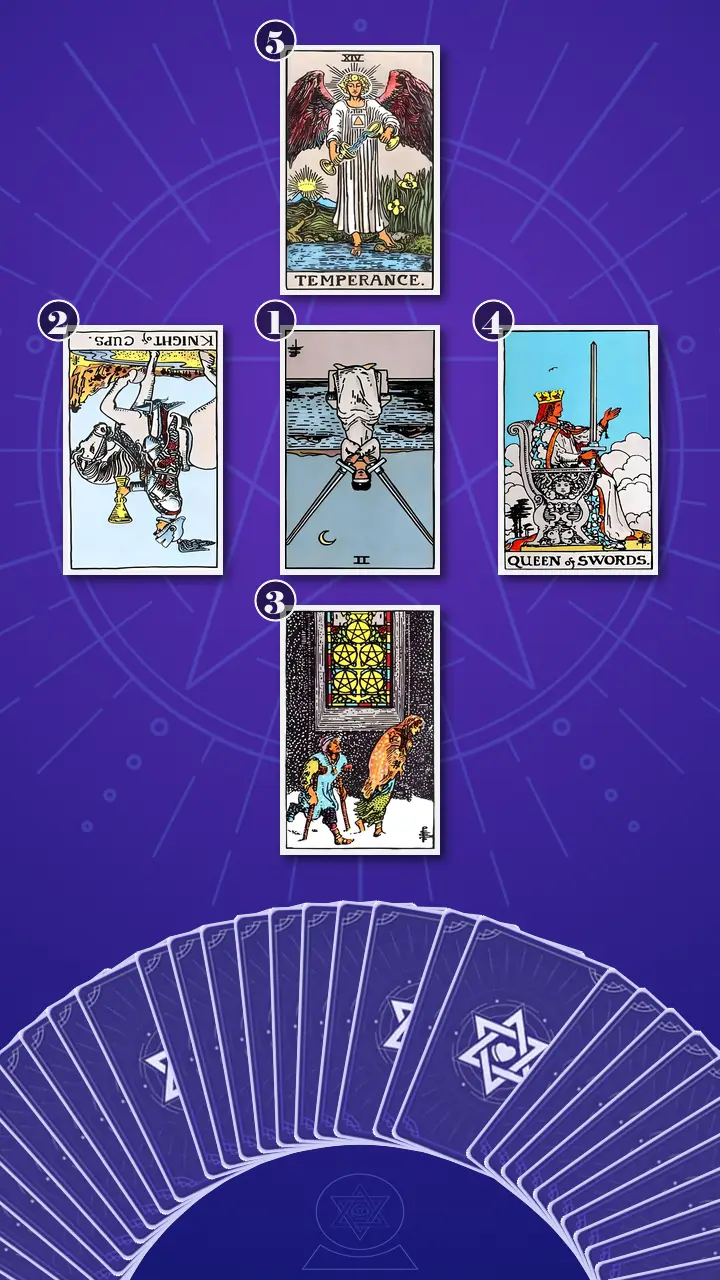
The Crossed Swords Behind a Bright Yes
Position 1: The Answer That Ends the Silence
“The card I am turning now represents the observable behaviour: agreeing to commitment under pressure before you have articulated your own readiness.”
Two of Swords, reversed.
I pointed to the blindfold covering the seated figure's eyes and the two swords crossed protectively over their chest. Upright, the card can hold a difficult choice in suspension. Reversed here, its air energy had become blocked by mental overload and then discharged through a rushed answer. The tension ended, but discernment did not return.
I brought Alex back to 10:47 p.m.: the warm phone, the clicking radiator, the typing cursor, and the partner's question sitting unanswered. I spoke the inner monologue I could see in the image: “I could say I need time, but then they might pull away, so maybe I should just say yes and work out how I feel afterward.”
Alex had been studying the imagined reaction on the other side of the screen more closely than their own reasons for yes or not yet. Like the reversed blindfold, attention had turned toward protecting the connection from conflict while access to their own view of the choice became obstructed.
“A yes that ends the tension is not the same as a yes you chose,” I said.
Alex's breath paused. Their thumb stopped rubbing the edge of their mug, their gaze slipped away from the card as though the message thread were replaying behind their eyes, and then a short, bitter laugh escaped. “That is so accurate it's kind of brutal.”
“Accurate does not have to mean condemning,” I replied. “Your answer performed a job. It reduced the immediate threat of disconnection. We can respect why that response developed without letting it keep making decisions for you.”
I also warned against turning the card into a rule that every relationship label must be refused. That would be the same fear wearing a harder costume. The aim was not a default no. It was enough breathing room to discover whether the honest answer was yes, no, or not yet.
Position 2: The Romantic Offer and Its Hidden Subtitle
“The card I am turning now represents the relational trigger: romantic momentum and the emotional weight attached to a request for commitment.”
Knight of Cups, reversed.
The knight extended one golden cup while the white horse moved at a noticeably measured pace. I read the reversal as water energy in excess and distortion: the feeling surrounding an invitation had become louder than the practical agreement contained inside it. The card did not define Alex's partner as manipulative. Wanting clarity, asking for exclusivity, or feeling disappointed did not make the other person a villain. The card asked how Alex responded when romantic tone arrived carrying borrowed urgency.
Alex described the end of an affectionate date near Ossington. Low music had settled under the conversation, the warmth between them had felt real, and hopeful future language had made the night seem larger. Then their date had said, “If this is real, I think we should make it official.” Alex had felt the rush of being chosen and assumed they needed to match the sentence's certainty.
“Being chosen is a feeling; commitment is an agreement,” I said. “One can feel wonderful without automatically answering whether the terms of the other fit you.”
I used one of my diagnostic tools, Dialogue Loop Auditing, to slow the exchange into exact lines. I wrote the spoken phrase in one column: “If this is real, we should make it official.” In the second, I wrote the subtitle Alex's fear had added: “If you do not match my certainty now, the connection is not real and may be withdrawn.”
“The first sentence came from the conversation,” I said. “The second came from the alarm inside the conversation. Your reaction makes sense when those two sentences sound identical. Our work is to separate them.”
Alex's fingers tightened once around the mug and then loosened. “I was answering the meaning I thought was underneath it,” they said, “not the actual question.”
I nodded. I did not want Alex to replace compliance with suspicion or interrogate every affectionate phrase for hidden pressure. The Knight's correction was simpler: enjoy the emotional invitation, then independently verify the agreement. A polished relationship trailer is not the same as the feature list. Exclusivity, app use, communication expectations, and future planning still need ordinary words.
Position 3: The Toronto Winter Inside the Question
“The card I am turning now represents the underlying fear: that asking for time will lead to exclusion and prove that belonging depends on compliance.”
Five of Pentacles, upright.
I looked at the two figures moving through snow beneath an illuminated stained-glass window. The earth energy here felt contracted. Scarcity had narrowed the frame until a temporary disagreement looked like permanent exile, and the possibility of negotiation became almost invisible.
Alex told me about rereading, “Oh, I thought we were on the same page,” on the TTC the next morning. Wet coats crowded the carriage, brakes squealed into Bloor-Yonge, and their chest had hollowed as they imagined their date reopening Hinge and finding someone more certain. No one had ended the relationship. By the next stop, however, Alex was already drafting a brighter yes to prevent an outcome that had occurred only in their imagination.
“This fear is like standing on a freezing Toronto pavement and treating one closing streetcar door as the final route home,” I said. “They asked for an answer. Your fear heard that access to the relationship was about to be revoked. Those are not the same event.”
Alex went very still. Their shoulders rose, their eyes fixed on the warm window in the card, and then their chest dropped with one long exhale. “I don't know how to let someone be disappointed without assuming the next thing is abandonment.”
“We do not need to pretend their disappointment is unreal,” I said. “Their disappointment can be real without becoming your emergency. It may lead to another conversation. It may reveal a genuine difference in pace. What it cannot do is prove that your need for time is a defect.”
I kept the window in the card visible as I spoke. I would never use it to promise that every partner would stay or that every conflict would resolve warmly. I used it to show how fear crops the available picture. Temporary uncertainty, actual withdrawal, incompatibility, and collaborative pacing are different possibilities. Alex deserved to assess evidence before allowing scarcity to choose among them.
When the Queen of Swords Changed the Script
Position 4: An Open Hand Beside a Clear Boundary
The radiator chose that moment to stop clicking. The room became so quiet that I could hear a distant streetcar bell through Alex's window. I turned the reading's key card.
“The card I am turning now represents the conscious resource that can transform the pattern: clear, warm language establishing a boundary before an answer is given.”
Queen of Swords, upright.
The Queen held one sword vertically beneath a clearing sky. Her other hand remained open. I read her as air energy restored to balance: discernment no longer crossed defensively inside Alex's chest, but organised into one outwardly spoken truth. The blade was the limit. The open hand was continued contact.
I placed the Queen beside the reversed Two of Swords. At the beginning of the spread, two blades had become an internal barricade. Here, one blade became a sentence. Alex did not need more private analysis so much as a new direction for the clarity they already possessed.
I brought them back to the setup of the old scene. At 10:47 p.m., the message asks whether they are ready to be exclusive. They type “I need more time,” delete it, send a brighter yes, and open Notes while their jaw stays tight and the relief has already begun to sour.
As an artist, I often recognise emotional patterns through scene blocking before I recognise them through theory. I saw Alex positioned as the Immediate Reassurer, responsible for keeping the scene warm, while the other person occupied the Urgency Holder, whether or not they consciously intended to. The silence cued Alex to rescue the scene. Their bright yes restored harmony. Their real lines were postponed until the audience had gone home.
I call this Toxic Script Identification, but I am careful about what the word “toxic” modifies. It does not diagnose either person. It describes a repetitive script that produces self-erasure: a request creates tension, Alex reads tension as impending loss, Alex reassures, the room relaxes, and Alex processes their own position alone. A different partner might bring a different tone, but the script would keep assigning Alex the same role until Alex changed their line.
The old belief that delay equals rejection does not deserve the final word; Alex can state their pace with warmth and precision, like the Queen of Swords holding an open hand beside an upright blade.
I let the sentence remain in the quiet for several seconds. Then I gave them the central insight in its simplest form.
A pause is not a rejection of connection; it is what lets your eventual yes belong to you.
Alex's breath stopped first. Their fingers hovered above the mug, frozen halfway to the handle, and their pupils widened slightly. Then their gaze lost focus. I could see them replaying several conversations in sequence, each one ending with the same overly bright agreement. Colour rose along their cheeks.
“But doesn't that mean all those earlier yeses were wrong?” they asked. The words came out sharper than anything they had said before. Anger arrived first, then hurt underneath it. “I thought I was being easy to love.”
“It means those answers were shaped by conditions you can now see more clearly,” I said. “I am not asking you to prosecute your past self. That response kept connection close when uncertainty felt unbearable. We are giving your present self another option.”
Their jaw shifted. Their shoulders lowered by a few centimetres, their hand closed once and then opened flat against the desk, and their eyes brightened without spilling into tears. The exhale that followed sounded relieved, but not triumphant. Clarity had removed one burden and exposed a new vulnerability: if the silence was not a deadline, Alex would have to remain present long enough to hear their own answer.
“Now, with that new perspective, think back to last week,” I said. “Was there a moment when this insight could have made you feel different?”
“When they said, ‘I thought we were on the same page,’” Alex replied after a pause. “I could have let that be their feeling instead of treating it like an instruction.”
I invited Alex to set a five-minute timer and open a blank note with three lines: “The exact request is...” “My body is telling me...” and “Before I answer, I need....” Then I asked them to draft, without sending, “I care about this, and I want to answer honestly, so I will come back to you tomorrow.”
I made the permission around the exercise explicit. Alex could stop after one line, change every word, or leave it entirely if it made them feel more trapped. The point was to create room, not force a specific answer or turn boundary-setting into another performance test.
This was the reading's key emotional movement: from relational pressure, anticipated exclusion, and rushed agreement toward the first act of self-trust. Alex had not suddenly become certain about commitment. They had become clearer about the conditions under which their answer could be informed and voluntary.
Temperance and the Pace of Two People
Position 5: Two Cups, Three Headings, One Future Check-In
“The card I am turning now represents integration: translating the pause into paced commitment, specific agreements, and scheduled check-ins.”
Temperance, upright.
I traced the water moving carefully between two cups and the figure standing with one foot on land and one in water. Here, water and earth had reached balance. Emotion remained present, but practical ground gave it proportion. Commitment no longer appeared as a binary leap that had to settle the whole future in one conversation.
I also pointed back to the reversed Knight of Cups. Earlier, one cup had arrived as a finished romantic proposition carried toward Alex. Temperance gave us two cups and an ongoing exchange. The emotional offer was not rejected; its architecture changed. Agency no longer sat entirely inside the incoming request.
“I want you to imagine a note with three headings,” I said. “‘True now.’ ‘Not decided.’ ‘Revisit on.’”
Alex began filling it aloud. Interest in continuing the relationship belonged under “True now.” Whether exclusivity meant deleting apps, changing communication frequency, or making future plans belonged under “Need to discuss.” A decision about a label could be revisited on Sunday afternoon instead of leaking through an open-ended stream of messages.
“I do not need the whole future settled to name the step that is true today,” Alex said, testing the sentence slowly.
“Exactly,” I replied. “Temperance turns commitment into a staged rollout rather than switching on every feature at once. One explicit step can be discussed and tested. Consent can be repeated. A calendar check-in gives uncertainty an agreed place to go, instead of letting it generate background notifications all week.”
I noticed Alex unlock their phone, open Notes, and create the three headings before I had suggested doing it later. Their mouth tightened briefly at “Not decided,” then softened. The category existed without apologising for itself.
I also named what was absent from the spread: no Wands had appeared. Alex's desire and self-directed action had not been leading the old decision. I did not read that absence as a flaw. I read it as an invitation to create agency through a small verbal pause, not a dramatic confrontation.
“A pause does not close the door; it lets your answer enter the room,” I said.
The Twenty-Four-Hour Rewrite
I drew one line through the entire spread. Alex's work had trained them to equate speed, reassurance, and smoothness with competence. In dating, that useful professional habit had followed them into a scene where a quick reply was not always an honest reply. Romantic momentum activated the response. Fear of exclusion made the request feel scarce and urgent. The bright yes restored connection for a few hours, but the Notes app later held the missing half of the conversation.
The Queen of Swords showed the available resource: Alex already knew how to be precise. Temperance showed how to keep that precision relational rather than rigid. The goal was not to choose independence over closeness. It was to let closeness and personal pace remain audible in the same conversation.
I named the cognitive blind spot directly: Alex had been treating a partner's disappointment as evidence of abandonment, and treating immediate reassurance as the price of belonging. That collapsed several distinct events into one. A partner could feel disappointed without leaving. A difference in pace could be discussed without guaranteeing agreement. A relationship could also reveal a real incompatibility, but an automatic yes would not prevent that; it would only delay the information.
The transformation direction was concrete: replace the immediate yes with a standard 24-hour pause, identify one personal need or condition, and then return to discuss the actual terms. Tarot had made the mechanism visible. Alex would remain the person deciding what to do with that visibility.
The Pattern Interruption Script: Actionable Next Steps
I turned my Pattern Interruption Script into three small practices. I designed each one to interrupt the old scene at a precise moment, before Alex became responsible for making the silence disappear.
- Rehearse the 24-hour line Save this in the Notes app or text-replacement settings before the next DTR conversation: “I care about where this is going, and I want to answer honestly. I will come back to this tomorrow.” Record two Voice Memos this week, then ask one trusted friend to play the partner for a three-minute role-play while Alex practises saying the line without adding an apology.Treat the script as a handrail, not a performance. Change every word except the response time if needed. The minimum version is: “I need until tomorrow to answer honestly.”
- Separate facts from the abandonment forecast Before replying to a pressured message, mute the thread for twenty minutes and open two Notes columns: “What happened” and “What my fear predicts.” Put the partner's exact words in the first and the imagined consequence in the second. Spend sixty seconds noticing jaw, breath, shoulders, and the urge to answer, then write one reason for yes, one reason for not yet, and one boundary.Set a five-minute limit and use fragments. Body sensations are information, not an automatic verdict about the relationship. One fact and one feared outcome are enough to begin.
- Define commitment in actual terms Create a ten-minute note titled “Commitment, in actual terms” with the headings “Ready now,” “Not ready yet,” and “Need to discuss.” In the next conversation, ask one concrete question, such as what exclusivity would change about apps, dates with other people, and communication expectations. If both people want to continue, schedule one specific check-in, such as Sunday afternoon.Reduce the task to one definition and one date. A check-in is not a promise to reach yes later, and neither person owes agreement just to preserve the connection.
“The interruption is not successful because it makes your partner respond perfectly,” I told Alex. “It is successful because it gives both people accurate information. Their response belongs to them. Your pace, words, and eventual decision belong to you.”

Six Days Later: The Quiet Proof
Six days later, I received a message from Alex. Another commitment conversation had begun, and their jaw had tightened exactly as before. They had noticed it, placed the phone face down, and sent the pause sentence after five minutes instead of a reflexive yes.
The person they were dating replied, “I don't love waiting, but okay.” Alex's first impulse had been to repair the discomfort with an immediate answer. Instead, they wrote the exact reply under “What happened” and placed “They will replace me tonight” under “What my fear predicts.” They returned to the conversation the next day with one practical question about exclusivity.
Alex had not solved their entire dating life. They had not become immune to guilt, and the relationship's outcome was still unwritten. The change was smaller and more important: they had remained emotionally present without allowing someone else's urgency to answer on their behalf.
They slept through the night. Their first thought in the morning was still, “What if this costs me?” They smiled anyway, because fear had arrived after the boundary instead of writing it.
I thought again of the Queen's open hand beside her upright blade. Tarot had not given Alex courage as if courage were hidden inside cardboard. The cards had externalised a familiar script, and Alex had chosen to change one line. That was the real Journey to Clarity: not perfect certainty, but self-trusting participation in a decision that still contained risk.
I know that when the room goes quiet after “What are we?” some of us feel our jaw lock and our answer rush ahead, because keeping the connection suddenly seems more urgent than hearing our own pace. Simply noticing that rush means the old script is no longer playing to an empty theatre.
If your hesitation were allowed to be information rather than a verdict on your worth, what one true sentence would you place between the Queen's open hand and upright sword, giving yourself enough room to hear it before your next answer?