One Text from an Old Flame: Weighing Warmth and Mismatch Together

When One Text from an Old Flame Outshouted Months of Mismatch
If you are a late-twenties communications worker who can approve a company email after two edits but reread an old flame’s six-word text twelve times, you probably know text-message overthinking by muscle memory.
Alex, a 28-year-old non-binary communications coordinator in Toronto, joined me after one of those nights. They had felt steady for weeks. Then, at 11:46 p.m. on a Thursday, a familiar name lit the lock screen in their dim west-end apartment: Hey, this made me think of you.
As Alex described the scene, I could picture it precisely. The radiator clicked against the quiet. Traffic hissed over wet pavement below, and blue screen light floated across the ceiling while the phone grew warm in their palm. Their chest lifted before they had decided what the message meant; then their stomach drew tight, and their thumb began scrolling upward through the old thread.
They searched for the first appearance of the shared joke. Affectionate fragments filled the screen, bright and immediate. The recurring conversations about inconsistency, different needs, and uncertain direction remained farther up the thread, technically available but suddenly difficult to retrieve.
“I know we didn’t fit,” Alex told me, rotating their coffee mug between restless hands. “But why does one warm sentence feel louder than months of mismatch? I keep asking whether I miss them or the version of us that the message brings back.”
The longing they described felt less like a gentle memory and more like an elevator door opening behind the sternum onto a room they thought they had left—followed immediately by a cold fist settling under the ribs. Hope rushed in first. Context arrived late.
I told Alex I was not going to decide whether the text meant reunion, breadcrumbing, closure, friendship, or nothing in particular. I was not going to tell them to reply, block, forgive, reconcile, or perform indifference. “We’re going to make the frame wider,” I said. “Let’s give the warmth somewhere to exist without asking it to erase the mismatch. Our journey today is about finding clarity, not forcing certainty.”

Choosing a Wider Map: The Shadow Spread · Context Edition
I asked Alex to place both feet on the floor and take one unhurried breath while I shuffled. I treat this pause as a transition for attention, not a mystical test. The point is to interrupt the reflex to decode the sender and bring the question back to the person who still has to live with the answer.
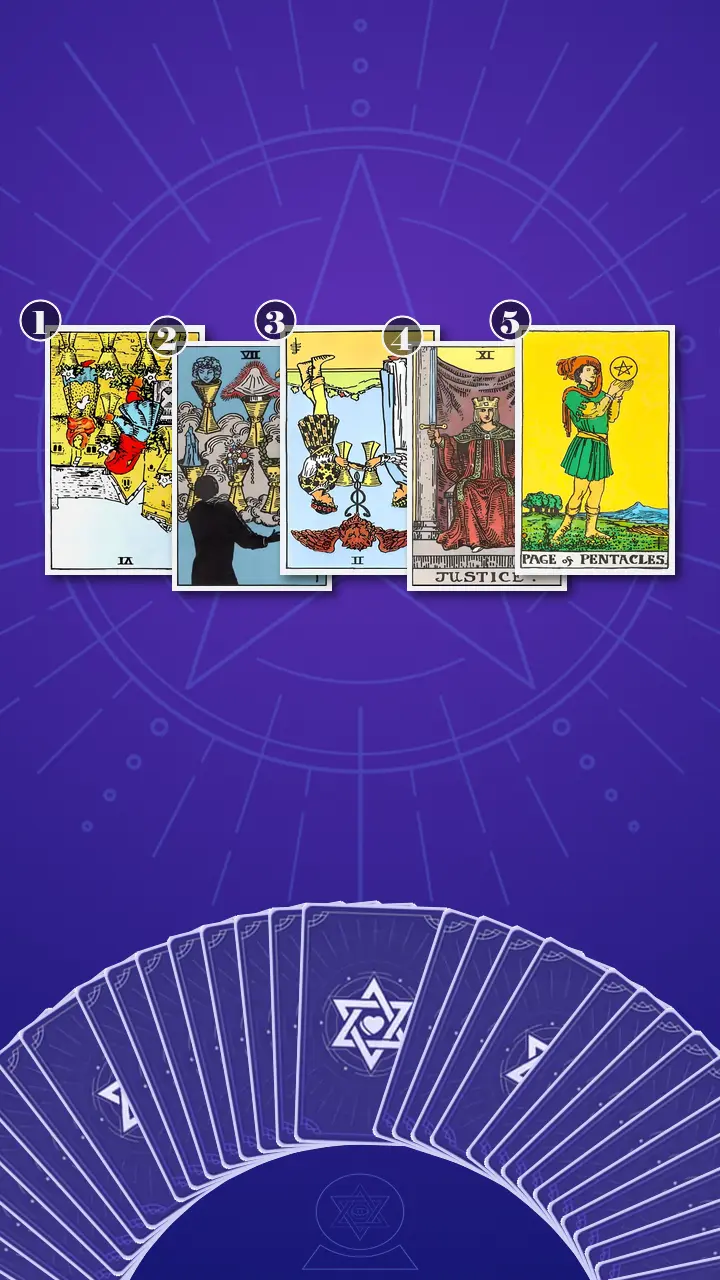
I chose The Shadow Spread · Context Edition, a five-card tarot spread designed to trace the entire internal sequence behind the message. For anyone wondering how tarot works in a situation like this, I use the cards as structured prompts: each position isolates one part of the pattern so that an emotionally vivid moment cannot quietly become the whole story.
A broad relationship spread would have placed too much attention on the old flame. A Celtic Cross would have introduced life areas Alex had not asked about. This smaller spread was more precise. It would move from the visible digital trigger, through projection and selective nostalgia, into the relational truth Alex was protecting themselves from. It would then identify an integration point and end with a grounded experiment.
I placed the cards in a straight line. The first would show the observable trigger. The second would reveal the story multiplying around it. The third, at the visual center, would hold the mismatch and the belonging fear beneath it. The fourth would offer the antidote: balanced discernment. The fifth would turn that discernment into a practical next move.
The layout looked like a message thread being widened into a full conversation with reality. That was exactly the scale of attention Alex needed.
Reading the Whole Thread, Not Just the Latest Bubble
Position One: The Highlight Reel in Blue Light
The first card I turned over represented the presenting trigger: the observable moment when one text causes Alex to reread the past and set the mismatch aside.
It was the Six of Cups, reversed.
In the card, a flower-filled cup is offered with unmistakable tenderness, while a figure in the background is already walking away. Reversed, the card does not say that the affection was fake. It shows memory energy becoming blocked into selective recall: tenderness moves close to the camera while temporal distance and unfinished context slip out of focus.
I connected it directly to Alex’s 11:46 p.m. routine. A familiar joke arrives. They search the old conversation for its first appearance. The screen fills with affectionate lines, while the repeated discussions about inconsistency remain somewhere beyond the visible frame. The old thread is no longer functioning as a full archive; it has become a warm highlight reel, like a photo app serving one perfect memory without showing the ordinary months around it.
“The problem isn’t that you remember the good part,” I said. “The blockage appears when remembering the connection replaces remembering the whole relationship. Nostalgia becomes excessive; context becomes scarce.”
I asked Alex to picture the first five minutes after the notification: the warm phone, the blue light, the thumb scrolling upward. “What sentence is running through you while you do that?”
They gave a brief laugh, but bitterness caught at its edge. “I know what happened, but this feels like maybe the good part was the truest part. That’s so accurate it’s almost cruel.” Their fingers tightened around the mug, then loosened.
“The card isn’t accusing you of being irrational,” I replied. “It’s showing how quickly your attention narrows when recognition returns. Being affected is not a failure. We’re simply noticing what the feeling does to the frame.”
Position Two: One Sentence, Seven Open Tabs
The next card represented the projection pattern: the limiting mental story that turns one message into several imagined meanings and keeps the cycle running.
I turned over the Seven of Cups, upright.
A silhouetted figure faces seven cups suspended inside a cloud. Each cup contains a different possibility: treasure, danger, status, desire, mystery. The figure has many images to consider but very little solid ground. In Alex’s life, this was the morning subway after the text, when one sentence opened seven mental browser tabs before the next station.
It could be a casual check-in. Unless it’s an apology. Maybe they regret the ending. What if the timing has changed? Maybe the chemistry never went away. It could be friendship. But what if it finally means reconciliation?
No additional information had arrived, yet the imagined field kept expanding. This was the Seven of Cups in excess: abundant possibility paired with a deficiency of evidence. It was also the relationship version of a recommendation algorithm taking one click and building an entire feed around it. Longing supplied the engagement data, and the mind kept serving more of the same story.
I asked Alex to separate the observable wording from the futures their mind had generated. They looked down and counted quietly on their fingers. “Changed timing, regret, a test to see if I still care, and maybe wanting to try again,” they said. Their jaw shifted when they noticed that none of those ideas appeared in the actual sentence.
“That gap matters,” I said. “Uncertainty can feel like promise when hope is doing the interpretation. But one message is a data point, not a verdict on the relationship.”
I watched their eyes return to the card. Their breathing had slowed, although one thumb still rubbed the edge of the mug as if part of them wanted to reopen the thread and check.
Position Three: The Connection Was Real, and It Still Did Not Align
The central card represented the relational truth: the mismatch—and the fear about belonging—that the renewed emotional pull protects Alex from fully acknowledging.
I turned over the Two of Cups, reversed.
The two figures still hold their cups toward one another. The emotional recognition remains visible. Yet the reversal introduces blocked reciprocity, uneven exchange, or a deficiency in the conditions required for a sustainable partnership. The distant mountains matter here: feeling recognized in one moment does not tell me whether two people can travel toward the same life.
I described the card as a split-screen. On one side, the familiar joke still lands. Alex feels seen, attractive, and immediately understood. On the other side, the same conversation keeps returning: Alex asks for consistency and receives ambiguity; they ask what the connection is becoming and leave with less clarity than they brought in.
“The connection was real, and the mismatch was real,” I said. “The word and is doing important work. Warmth is real; it is not a compatibility report.”
This was where I used a method I call Daily Friction Deconstruction. Instead of letting the relationship collapse into dramatic questions such as Who cared more? or Were we meant to be?, I brought Alex back to the mundane mechanics: Who initiated plans? What happened when a need was stated directly? Did communication become clearer over time? Were availability and future direction compatible? Did repair lead to a changed pattern, or only another intense conversation?
After twenty years of listening to relationship stories over cooling cups of coffee, I have learned that incompatibility often reveals itself through small, repeated mechanisms rather than one cinematic betrayal. The details may look ordinary, but ordinary is where a relationship has to function.
Alex’s shoulders rose. Their fingers went still, and their gaze slipped toward the dark window as though a specific conversation had begun replaying there. “I kept asking for consistency,” they said eventually. “They kept saying they cared, but they couldn’t tell me what they were available for. I would leave those conversations feeling like I’d asked for too much.”
“That is the mismatch we need to keep in view,” I said. “Not because the affection was counterfeit, and not because anyone has to become the villain. Emotional recognition and sustainable mutuality are related, but they are not interchangeable.”
Alex swallowed and looked back at the reversed pair. I saw the three-stage reaction move through them: their breath paused; their focus went distant as the repeated conversations surfaced; then a long exhale lowered their shoulders. The tenderness had not disappeared. It simply no longer occupied the screen alone.
When Justice Widened the Screen
Position Four: The Scales Beside the Notification
The fourth card represented the integration point: the key shift from treating emotional intensity as proof to weighing attraction, compatibility, and present values together.
As I turned it, the radiator in Alex’s apartment stopped clicking. The sudden quiet made the distance between us feel smaller. A narrow strip of streetlight passed through their blinds and rested beside their face like a clean, pale blade.
The card was Justice, upright.
Justice holds balanced scales in one hand and an upright sword in the other. The scales preserve complexity; the sword creates distinction. The grey pillars provide structure around both. This was balanced energy rather than emotional excess or suppression: honest self-accountability without self-punishment, and discernment without pretending the feeling should not exist.
At 11:46, Alex had been trapped inside the small spotlight of a familiar name: their chest lifted, their stomach tightened, and every warm possibility rushed forward while the repeated mismatch fell outside the frame. I could see them still trying to choose between it mattered and it failed.
I thought of the many phones I had watched light up beside coffee cups during two decades of readings. What flashed through my mind was not a grand prophecy. It was the quiet relief people felt when they discovered they did not have to put the past on trial in order to examine its pattern fairly.
I call that process Emotional Clutter Sorting. I asked Alex to place three things in separate mental containers: the old flame’s actual sentence, the emotional weather it created tonight, and the compatibility pattern the relationship demonstrated over time. Loneliness after work belonged in the emotional-weather container. The familiar joke belonged in the message container. Repeated ambiguity after direct requests for consistency belonged in the relational-evidence container.
None of those containers was fake. None deserved ridicule. But mixing them together had allowed a six-word text to carry the weight of a whole relationship review.
In everyday terms, Justice looked like a Notes app opened before the reply box: the sender’s exact words, the hope stirred in Alex’s body, the repeated mismatch, and the value Alex wanted their next action to respect. The scales held warmth and evidence side by side. The sword drew a clear line between what the sender wrote and what longing autocomplete added.
One vivid text cannot make the mismatch disappear; treat attraction as information rather than proof, and use Justice's scales and sword to weigh the whole pattern.
I let the sentence remain between us for a moment. Then I gave Alex its shortest form.
Attraction tells you what the message stirred; it does not prove that the mismatch disappeared.
Alex’s breath stopped first. Their index finger froze against the mug, and their shoulders rose as though they had braced for impact. Their eyes drifted away from the card and went unfocused; I could see memory replay rather than argument forming. Then their mouth tightened. “But doesn’t that mean I was wrong before?” they said, sharper than anything they had said all evening. “Like I either misjudged us then or I’m romanticizing it now.”
I did not rush to sand down the anger. “No,” I said. “It means your earlier discernment and your present feeling can both be honest. A feeling can return without the conditions changing.”
Their fist opened slowly, one finger at a time. Color rose along their lower eyelids; they blinked, exhaled a quiet “Oh,” and let their shoulders fall. Relief arrived first, then a slight light-headed stillness—the vulnerable blank that appears when a mystery becomes a choice and choice becomes responsibility. Outside, wet tires whispered along the street, while the blade of light between the blinds stayed steady.
“Now, with this new perspective, think back to last week,” I said. “Was there a moment when this insight could have made the experience feel different?”
Alex nodded after a pause. “On Line 1. I read the message again before Bloor-Yonge and thought the way my body reacted must mean I still belonged with them. If I’d treated the reaction as information, I could have let it be longing instead of turning it into a decision.”
That was the breakthrough. It was not a leap from caring to not caring. It was a first movement from emotionally flooded selective recall and imagined possibility toward grounded discernment that could hold attraction beside compatibility evidence. Alex did not have to prosecute the past or reopen it. They could weigh it.
The Page Put the Phone Face Down
Position Five: One Message as One Data Point
The final card represented the grounded experiment: a concrete practice that could help Alex observe the whole pattern before replying, withdrawing, or assigning the message a larger meaning.
I turned over the Page of Pentacles, upright.
The Page studies one pentacle held at eye level. Behind the figure, green fields and furrowed earth replace the opening cards’ clouds and emotional water. The card’s energy was balanced and practical: careful attention, patient learning, and a willingness to begin with one observable thing rather than demand a final answer from the night.
In Alex’s life, the Page became a saved Notes template. They could record the message’s actual wording, the body reaction, the story being added, and one repeated pattern from the relationship. Then they could place the phone face down, eat dinner, take a shower, commute, or sleep before returning to the decision.
“The Page is not asking you to solve the whole relationship through the perfect reply,” I said. “It is asking you to examine one message as one data point. You can study this without solving your entire history tonight.”
I also made the autonomy explicit. “You do not have to make the feeling disappear before you choose a boundary. You may reply, wait, mute the thread, block contact, or decide that no response fits your values. The practice is not a hidden instruction to engage. Access to you is not owed because the message felt warm.”
Alex reached for their phone, opened Notes, and typed four short headings. The motion was ordinary—no dramatic closure, no declaration about the future—but I watched their hands become steadier as the Page’s earth energy translated insight into something they could actually use.
The Whole-Thread Reality Check
I gathered the five cards into one story for Alex. The reversed Six of Cups showed the past returning as selective nostalgia. The Seven of Cups showed projection turning one signal into many possible futures. The reversed Two of Cups named the protected truth: genuine affection had coexisted with recurring misalignment, and remembering that mismatch touched a deeper fear that renewed attention—and the sense of belonging attached to it—might disappear.
Justice restored proportion. The Page of Pentacles moved that proportion into a repeatable observation. The elemental flow was clear: three Cups cards began in emotional water, Justice introduced the air of naming and separating, and the Page brought the reading onto solid ground. Alex did not need a dramatic burst of action. They needed a change in the scale of attention.
“Your blind spot is not that you still care,” I told them. “It is that your nervous system has been promoting vividness into evidence and attention into belonging. The transformation is not from warmth to coldness. It is from letting the latest notification become the headline and verdict to reviewing the whole relational record before you choose.”
I framed the following practices as experiments, not rules. They were designed to return control to Alex, not to produce a predetermined relationship outcome.
Two Small Practices for the Next Charged Message
- The Justice Three-Column PauseWithin ten minutes of receiving an emotionally charged message, set a six-minute timer and open a private note with three headings: Words on screen, What this stirs, and What the pattern showed. Copy the sender’s exact sentence under the first heading. Under the second, name one body sensation and one emotion. Under the third, write one repeated alignment or mismatch. Leave the reply unsent until the timer ends and, if possible, until after one normal activity such as dinner, a shower, a commute, or sleep.Tip: Three fragments are enough. If the full exercise feels too activating, write only one observable fact and one remembered mismatch. You may stop at any point, and you do not owe the sender a response.
- The 24-Hour Micro-Boundary ResetFor the next charged contact, choose one non-negotiable boundary for the following 24 hours in the shared digital space: mute the thread, keep the reply in drafts, or charge the phone outside the bedroom and wait until the next morning to reconsider. Before sending anything, ask: Would this response still fit my values if no second message arrived?Tip: Protect one interval, not your entire future. If 24 hours feels too large, begin with one full meal or one night’s sleep. The purpose is to reduce mechanical friction and restore choice—not to force no contact or reconciliation.
“Let neither tenderness nor mismatch cancel the other,” I said. “That is where your self-trust starts becoming observable.”

A Week Later: Quiet Proof in the Morning Light
A week later, I received a message from Alex. The old flame had sent a shared song late in the evening—the kind of Spotify link whose first four seconds could change the emotional weather of an entire room. Alex felt the familiar lift in their chest and the tightening below it, but this time they opened the saved note before opening the old thread.
They copied the exact message. They wrote chest lift, longing, hope. Then they recorded the repeated mismatch: I asked for consistent availability; the answer remained ambiguous. They muted the thread, put the phone face down in the kitchen, and went to bed without demanding a complete decision from themselves.
The next morning, their first thought was still, What if I’m wrong? They told me they smiled at it, made coffee, and reread the whole picture—not the thread.
Alex eventually sent one sentence saying they needed time before deciding whether they wanted to reopen contact. The message did not solve their life, settle the old relationship, or remove every trace of longing. It simply reflected their present values more accurately than an impulsive reply would have.
That was the quiet proof of this Journey to Clarity. The cards had not made Alex’s choice. The Shadow Spread · Context Edition had given them a structured way to see the trigger, projection, relational truth, integrating value, and next practice. Alex supplied the honesty, the boundary, and the action.
If tonight one familiar name lights your screen and your chest lifts before your stomach tightens, remembering the mismatch may feel as though it could cost you that brief, bright sense that you still belong somewhere with them. I hope you remember what I watched Alex discover: allowing warmth and incompatibility to remain visible means the frame is already widening.
If you placed Justice’s Notes-app scales beside the latest notification—warmth on one side, the repeated pattern on the other—what one small choice would feel most loyal to your present self?