Romantic FOMO Softened a Dealbreaker; One Criterion Guided the Reply
The 11:40 p.m. Edit: When Romantic FOMO Renegotiates a Dealbreaker
I met Maya, a 28-year-old Toronto UX researcher who could document every detail of a new connection yet, after a great Hinge date, change “dealbreaker” to “concern” before accepting another invitation. She had seen a specific behavior that conflicted with a non-negotiable in her relationship-values note. Then chemistry made her wonder whether the standard was too rigid. So she kept the next date, even though her body had already tightened around the answer.
She told me it happened at 11:40 p.m. on the sofa in her shared apartment. Apple Notes was open beside the dating app, the phone was warm in her palm, and the refrigerator hummed through the otherwise quiet kitchen. She edited one word, sent two screenshots to the group chat, and tapped yes on the invitation. The new plan produced a quick wash of relief; the pressure in her chest stayed exactly where it was.
“Why do I keep wanting to stay when early dealbreakers appear?” she asked me. “I can see the dealbreaker and still find ten reasons it might not count. One more date always feels more reasonable than ending it now.”
I watched her thumb rub the edge of her phone case as she spoke. Her longing felt less like a soft ache than a magnet behind the sternum, pulling her hand back toward the message thread whenever she tried to set the phone down. Underneath it, I could hear doubt, hope, and the quieter fear that leaving might prove she was too difficult to choose.
“I’m not here to tell you that you’re too rigid, and I’m not going to predict what this person might become,” I said. “I want us to look at what happens between noticing a limit and acting on it. We’ll give the fear, the chemistry, and the evidence separate seats at the table. Then you can decide. Let’s draw a map through this fog without pretending the map gets to choose your destination.”

Choosing a Compass for Chemistry and Compatibility
I asked Maya to put both feet on the floor, take three slower breaths, and hold one question in mind: “What keeps my boundary negotiable after I have already seen the relevant behavior?” I shuffled while she breathed. I use this brief pause as a transition from mental replay into focused observation, not as a performance of mystery.
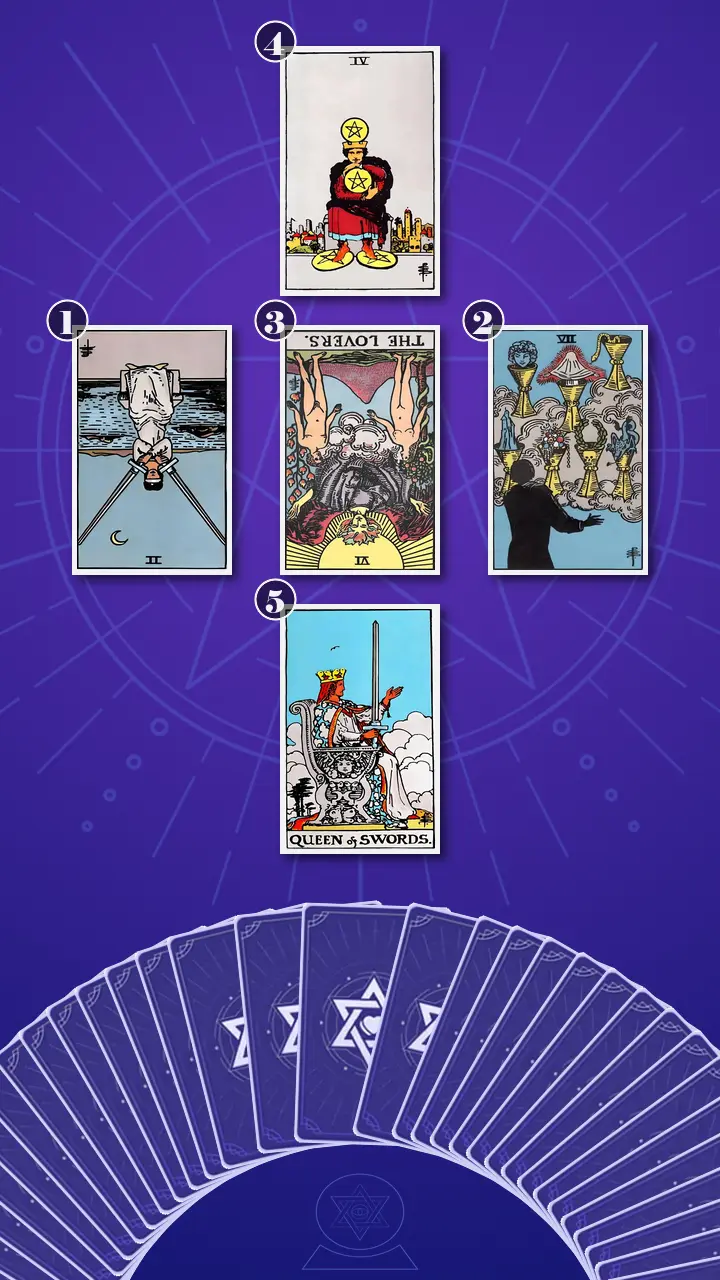
I chose the Relationship Spread · Context Edition, a five-card relationship tarot spread designed here for dating-boundary clarity. The classic Celtic Cross could have supplied ten different lenses, but Maya’s question did not need more interpretive volume. It needed a compact structure that could separate her current behavior, the potential she projected onto the connection, the actual values dynamic, the fear that kept her holding on, and the path back to independent judgment.
This contextual edition also avoids claiming access to the other person’s private thoughts. I read the second position as the possibility Maya experiences and supplies, not as a psychic report on someone else’s mind. That distinction matters. This is how tarot works best in my practice: as a structured mirror for card meanings in context, never as a verdict that removes choice.
I placed the third card in the center as the value-alignment axis. The first and second cards sat to either side, showing blocked judgment and projected possibility. Above the center, the fourth would reveal what was pressing down on the decision. Beneath it, the fifth would ground the reading in an integration path. The cards formed a compact compass, with Maya’s values as the needle rather than a prediction about whether the relationship would last.
Reading the Map Between Evidence and Hope
Position 1: The Finding Buried Under Twelve Open Tabs
I began with the card representing Maya’s current stance: the observable pattern of noticing an early dealbreaker, reopening the question, and continuing contact instead of applying the limit she had stated.
I turned over the Two of Swords, reversed.
I pointed to the loosened blindfold, the two blades crossed defensively over the figure’s chest, and the restless water behind her. “I don’t read this as failure to notice what happened,” I said. “I read it as a blockage in converting perception into a usable decision. The relevant evidence is present, but the mind keeps holding competing explanations in place.”
The card mirrored Maya’s exact modern-life scenario. She had seen the behavior she listed as a dealbreaker, reopened the message thread, searched for context, and drafted several possible explanations before replying. In her Toronto apartment, the dating app remained open while Apple Notes quietly downgraded the boundary from “dealbreaker” to “concern.” The reversal showed obstructed Air: too little functional discernment and an excess of arguments competing for authority.
“At work, you would record the observed behavior as a finding,” I told her. “Here, you observe the finding and immediately generate enough alternative hypotheses to make it unusable. It’s like keeping twelve browser tabs open after the key UX research result is already on the screen.”
I placed the evidence and the explanation side by side. The evidence was the behavior she had seen. The explanations included stress, bad wording, a misunderstanding, different communication styles, or the possibility that the person would respond differently later. Any explanation might eventually gain support, but none had yet changed the original event.
“The internal operating system sounds like this,” I said. “I am not avoiding the answer; I am trying to make the answer impossible to regret.”
Maya gave one short laugh, but there was no amusement in it. Her fingers tightened around the phone case, her eyes dropped to the spread, and then her grip slowly loosened. “That is so accurate it’s a little brutal,” she said. “I keep asking for clarity after I already have information.”
“Accurate doesn’t have to mean condemning,” I replied. “Your research instinct is useful. The issue is that reassurance-seeking has turned one personal criterion into an endless study with no stopping rule. What did you observe, and what did you do during the next hour instead of acting on it?”
“I saw the message, changed the label, asked the group chat, and kept the date,” she said. I heard the sequence become simpler as she spoke. She had not failed to perceive the boundary. She had reopened the decision until continuing contact felt temporarily safer.
Position 2: The Relationship Futures Floating in the Cloud
I moved to the card representing the pull that made staying appealing: the hoped-for future and emotional possibility Maya attached to a connection that was still new.
I turned over the Seven of Cups, upright.
I traced the seven cups suspended on clouds in front of the silhouetted figure. Each cup held a different, partly obscured promise. In Maya’s dating life, those cups looked like open browser tabs: the version where the person learned, the version where the chemistry deepened, the version where the mismatch became irrelevant, and the version where this turned into the rare connection she feared she might otherwise lose.
After the strong date, Maya had started building several future versions of the relationship from limited early evidence. She scrolled through promising messages and treated those possible futures as reasons to stay, even though the present behavior had not materially changed. I read this as an excess of imaginative Water. Hope was flooding the evaluation until possibility carried the emotional weight of proof.
“Potential is a possibility; evidence is an event,” I said. “Hope isn’t foolish, and I’m not asking you to mock the future you wanted. I’m asking you not to file that future in the same column as something that has already happened.”
I offered her the sentence beneath the projection: “I am not attached only to what happened; I am attached to what this could still become.”
Her eyes stayed on one of the cloud-borne cups. I watched her mouth press into a thin line, then soften as she exhaled. “I’ve already imagined introducing them to my friends,” she admitted. “We’ve been on three dates.”
“That imagined scene tells us what you want,” I said. “It does not tell us whether this particular connection can support it. When you picture the relationship becoming secure, which present behavior actually supports that picture?”
She named two warm moments, then stopped. Neither addressed the behavior connected to the dealbreaker. I did not use that gap to force an answer. I simply left the two categories visible: a real attraction and an unsupported projection.
Position 3: The Mountain Between Wanting and Alignment
I returned to the center and turned over the card representing the core connection dynamic: whether the chemistry Maya felt was aligned with the values protected by her early dealbreakers.
The card was The Lovers, reversed.
I centered the image between us. The two figures remained visible beneath the angel, but the reversed orientation brought my attention to the mountain rising between them. I saw that mountain as the distance between attraction and value congruence. The attraction did not disappear because a mismatch existed, and the mismatch did not disappear because the attraction was genuine.
Maya had placed the chemistry beside the non-negotiable in her Notes app and found that both statements were true: “I want to keep seeing them” and “This behavior conflicts with something I said matters.” The reversed Lovers showed a blockage in alignment, not an absence of feeling. The choice became difficult precisely because the feeling was real.
“Chemistry can be real without being compatible,” I said. “The useful question is no longer ‘Is this attraction genuine?’ It is ‘Does continued participation match the standard I chose for myself?’”
I asked her the sharper inner question: “Are you waiting for more information, or waiting for the information to become less inconvenient?”
Her breathing paused. Her gaze lost focus for a moment, as if she were replaying the message beside the memory of the date. Then she released a quiet “Oh,” and her shoulders lowered by less than an inch.
“I think I’m waiting for it to hurt less,” she said. “I keep hoping another good date will make the dealbreaker feel less important.”
I let that admission sit without trying to brighten it. Naming value misalignment can produce grief because it asks someone to release an imagined future before that future has had time to fail visibly. “That makes sense,” I said. “You’re not only evaluating a person. You’re feeling the possible loss of a story. But grief about potential is not evidence that staying is aligned.”
Position 4: The Calendar Invite Held Against the Chest
I raised the next card into the position representing the primary challenge: Maya’s protective strategy of holding onto a possible connection so she would not have to experience immediate loss, uncertainty, or threatened belonging.
I turned over the Four of Pentacles, upright.
The figure clutched one pentacle to his chest, balanced another above his head, and pinned two beneath his feet. I translated those coins into concrete forms of access: the active text thread, the next invitation, the open Saturday no longer feeling empty, and the reassurance that someone promising might continue to choose her.
Maya had kept replying and scheduling dates partly because ending the connection would create an immediate blank space. The notifications would stop. The calendar slot would reopen. The future she had started furnishing in her mind would lose its address. I read the upright Earth here as excess and rigidity: preservation had tightened into a grip, leaving too little room for her to stand on her own criteria.
“One more date can be information, or it can be attachment with a calendar invite,” I said. “The difference is whether you can name the specific unknown you’re testing and what evidence would resolve it. If you can’t, ‘one more data point’ may be a softer name for postponing loss.”
Maya pulled her elbows closer to her body. “I call it patience because admitting I’m afraid to lose access feels more exposing,” she said. “If I end it, Saturday is quiet again. And part of me thinks that means I’m back at zero while everyone else is getting engaged.”
I noticed how the apartment seemed to join the card at that moment. The refrigerator clicked off, and the sudden quiet made the empty-weekend fear almost audible between us.
“A quiet Saturday is a real feeling,” I said. “It is not proof that this connection is secure, and it is not a verdict on your worth. The Four of Pentacles asks what you think leaving would prove about your belonging. It also asks what holding on is slowly costing. In your case, the immediate loss is possibility; the slower cost is confidence that your own limits mean what you say they mean.”
I did not tell her that leaving would automatically produce a better relationship. Tarot could not promise that, and kindness did not require a false promise. I could offer something steadier: temporary loneliness and structural incompatibility were different variables, and Maya retained the right to decide which behaviors her relationships could include.
When the Queen Raised One Clear Sword
Position 5: The Boundary That Does Not Need a Courtroom
I reached the position representing Maya’s integration path: a concrete way to distinguish present evidence from projected potential, communicate a boundary, and act consistently without demanding total certainty.
I turned over the Queen of Swords, upright.
The room seemed to narrow around the card. Outside the apartment window, tires moved through wet Toronto streets with a low, even hiss; inside, the Queen held one sword vertically beneath a clearing sky. Her other hand remained open. I read that combination as balanced Air: one usable line of judgment paired with continued receptivity. Clarity did not require Maya to become cold, punitive, or closed to love.
The image created a direct symbolic answer to the opening card. The Two of Swords had shown two crossed blades protecting the chest while the decision remained stalled. The Queen held one blade and looked forward without a blindfold. I saw the movement from accumulated arguments to one criterion, and from defensive indecision to direct communication.
The sight also brought an old professional association to mind. In my years of reading life through planetary cycles, I learned that a useful map must distinguish a passing transit from the structure it passes over. I never use that distinction to hand human agency to the stars. I use it to ask a practical question: is the pressure temporary weather, or is it revealing a structural variable that will continue to matter?
I call that lens Decision Timing Calibration. Maya’s 11:40 p.m. environment was not structurally ideal for a high-stakes crossroads choice. The empty weekend, the engagement posts, the late hour, the warm phone, and the quick relief of another invitation were temporary macro-friction. They made preserving contact feel urgent, but they did not change the compatibility evidence.
Then I applied Cyclical Variable Filtering. I stripped away the temporary variables and kept only what could affect the relationship’s longer orbit: the observable behavior, the value it conflicted with, any direct response to a clearly communicated boundary, and the action Maya had already decided that behavior would require. A lonely evening was cyclical. A behavior that crossed one of her chosen limits was structural information. The filter did not decide how serious the limit should be. Maya did.
I asked her to picture 11:40 p.m. again: warm phone, humming fridge, Notes app still saying dealbreaker, new message asking about next weekend. She had sent screenshots, renamed the limit “concern,” and felt relief even though no relevant fact had changed.
I said, “A dealbreaker protects your values only when you decide what action it calls for before hope starts renegotiating it. You do not need perfect certainty about the person’s future; you need one honest criterion for what is happening now.”
You do not need to turn a dealbreaker into another debate; name what is true, choose the boundary it requires, and let the Queen's raised sword separate evidence from imagined potential.
For one beat, Maya stopped breathing. Her fingers hovered above the blank screen of her phone as if an invisible reply box were still open. Her pupils widened; then her gaze drifted past the card, replaying the night she had edited the note. Color rose around her eyes. Her shoulders dropped, her fist slowly opened, and a breath left her chest with a tremor that sounded almost like relief. Then the relief caught on something sharper. “But doesn’t that mean I was wrong the whole time?” she asked, sudden anger tightening her voice. “Like I betrayed myself by going on the next date?” I heard the release turn into the light dizziness of new responsibility: once the pattern was clear, she could no longer pretend that more analysis was neutral. “No,” I said. “It means your strategy preserved hope when loss felt unbearable. You can respect why it formed without letting it run the next decision. Clarity is not a retroactive punishment.”
I waited until her breathing steadied and asked, “Now, with this new perspective, can you think of a moment last week when this insight might have made you feel differently?”
“When the invitation came in,” she said. “I thought I had to decide whether this person was secretly right for me before I could say no to one more date. I could have decided only whether that date matched the boundary I had already written.”
That was the hinge of the reading. I watched Maya move one small step from contracted longing, doubt, and reassurance-seeking toward evidence-based clarity, direct boundaries, and steadier self-trust. She had not stopped caring. She had separated caring from the job of evaluating compatibility.
“The Queen’s open hand matters as much as her sword,” I told her. “You can stay open-hearted without making your boundary argue its case. You are allowed to leave before the future has finished explaining itself.”
Drawing One Line Through the Dating Spiral
I read the five cards together as one coherent pattern. Maya’s professional strength had taught her to gather context, but romantic FOMO recruited that strength into a loop with no endpoint. The reversed Two of Swords showed the stalled conversion of evidence into a decision. The Seven of Cups filled that pause with best-case futures. The reversed Lovers revealed that attraction and values were both real but not aligned. The Four of Pentacles explained why she protected access to the connection: immediate possibility felt more tangible than the gradual loss of self-trust. The Queen of Swords restored functional Air through one observable criterion, one direct statement, and one action Maya could choose herself.
I also pointed out what the spread did not contain: there were no Wands. Insight was present, imagination was abundant, and preservation was active, but decisive Fire had to be introduced deliberately. I did not frame that absence as a warning. I framed it as an invitation to make one small, observable move.
The cognitive blind spot was not that Maya lacked standards. It was her belief that a boundary became legitimate only after she had gathered enough context to eliminate regret, secured her friends’ agreement, and disproved every hopeful future. That standard of certainty could never be met. Its real function was to postpone grief while attachment deepened.
The transformation direction was precise: before the next date, Maya would translate one dealbreaker into an observable criterion and one preselected response. She would compare present evidence with that criterion instead of asking imagined potential to overrule it. Her written boundary would become a compass line rather than a pencil mark she had to erase whenever chemistry grew loud.
When I proposed a pause, Maya frowned. “But if I take three days, won’t I look avoidant or play games?” she asked.
“The pause isn’t a test for the other person, and it isn’t a power move,” I said. “You can send a brief logistical reply if one is needed. The purpose is to stop a temporary emotional tide from scheduling the next stage of the connection before your own criterion gets a voice.”
The Evidence-Before-Potential Plan
- Begin the 72-hour Orbital Pause. When a message confirms a behavior you have already defined as a dealbreaker, pause for up to 72 hours before accepting another date. If a reply is needed, use a simple line such as, “I need a little time before I make plans.” Mute the thread for the evening and pause the group-chat poll so the decision is not crowded by fresh interpretations. This is a calculated delay, not a rule or punishment. If you feel calm and clear sooner, you may decide sooner; if safety is involved, prioritize distance and support immediately.
- Write one observable criterion and one preselected response. During the pause, set a ten-minute timer and open your relationship-values note. Replace a character judgment with a visible behavior, such as, “They dismiss a clearly stated boundary after I name it.” Beneath it, write, “If this happens again, I will not schedule another date.” Add the date and context, then stop when the timer ends. Write only the behavior, not a full theory of the person. Your boundary does not need a friend vote, a courtroom-level case, or the other person’s agreement.
- Run the Potential, Evidence, Action check. Before replying to the next invitation, make three columns with no more than three bullets each. Put imagined futures under Potential, events that actually occurred under Evidence, and your chosen response under Action. Circle one evidence sentence and compare it with the criterion you wrote before chemistry entered the conversation. If you choose to step back, draft one neutral sentence: “That does not work for me, so I’m going to step back from dating.” If the exercise becomes another research spiral, stop after one item per column. You may communicate once when appropriate, or choose not to continue without turning your limit into a debate.
I reminded Maya that none of these next steps required emotional numbness. She could feel grief, fear, relief, anger, and attraction without appointing any single emotion as the judge. The purpose of the plan was not to guarantee a painless choice. It was to give her own voice a fair hearing before romantic FOMO converted another non-negotiable into something to watch.

A Week Later: The Quiet Proof of Self-Trust
Five days later, I received a message from Maya. She had used the Orbital Pause, written her one criterion, and completed the three columns without sending another screenshot to the group chat. The Evidence column contained one sentence. The Potential column contained three futures. Seeing them separated made the imbalance visible.
She chose not to schedule the next date. She sent one neutral boundary sentence, muted the thread, and watched a show with her roommate. She slept through the night. Her first thought the next morning was still, “What if I was wrong?” This time, she noticed it and smiled.
I did not read that smile as proof that the decision was objectively correct, and I did not treat the cards as the source of her change. The cards had organized the pattern. Maya had supplied the missing Fire by making a choice consistent with her own criterion.
That was the real Journey to Clarity: not a perfect forecast, but a movement from holding two competing explanations across the chest to raising one clear standard while keeping the other hand open. Maya could remain receptive to connection without asking hope to rewrite what she had observed.
When chemistry makes your chest tighten and your thumb hover over Send, it can feel safer to erase your own limit than risk learning that leaving might mean you are too difficult to choose. If that is where you are tonight, I want you to remember that recognizing the negotiation already places you beyond its starting point. A temporary low tide can ache without defining your worth, and an unanswered future does not cancel the evidence in front of you.
If you let one clear fact stand beside the hope instead of underneath it, what small preselected response would let the Queen’s open hand, rather than the crossed swords of fear, feel most like your own voice?