Finding Clarity in the 8:47 p.m. TTC Refresh
If you’ve ever opened your Notes app to draft a breakup text after a single delayed reply—welcome to the anxious attachment + texting anxiety spiral.
Taylor sat across from me in my little studio office in Toronto, coat still half-on like she might bolt if I asked the wrong question. She was twenty-eight, the kind of woman people describe as “capable” at work—quick Slack replies, crisp meetings, a calendar that looks like a color-coded fortress. And yet her hands kept sliding back to her phone like it was hot.
“It’s embarrassing,” she said, voice steady in the way people sound when they’re trying not to sound like anything at all. “One weird pause, one ‘seen’ with no reply, and I’m… already packing.”
I pictured what she’d described in her intake note—8:47 p.m. on Line 1 heading home. The train rocking, fluorescent lights buzzing overhead, her phone warm from constant refreshing. One small digital cue—seen—and her throat tightening like a drawstring, stomach going sharp, brain stacking backup plans like Tetris: gym, laundry, early sleep. Not because she loves routine. Because wanting someone feels like standing in open air without a coat.
“So the question is…” she glanced down, thumb hovering over the screen like a nervous tic. “What abandonment story is driving my reaction? Because I hate that I’m always ready to leave. I want intimacy, but my body reacts like it’s danger.”
There’s a particular kind of anticipatory dread that shows up in the body before it ever becomes a thought—like your nervous system has already written the ending and stamped it URGENT. It makes you efficient. Detached. “Fine.”
I leaned forward, keeping my tone soft and plain. “I believe you. And I’m not going to treat that reaction like drama. We’re going to treat it like information. Let’s try to map the pattern—so you can choose what you do next, instead of the fear choosing for you.”

Choosing the Map: The Four-Layer Insight Ladder Tarot Spread
I asked Taylor to take one slow breath in through her nose and out through her mouth—not as a ritual for the universe, just as a handrail for the nervous system. As I shuffled, I slid a fragrance blotter across the table the way I would in a perfume evaluation. “If it helps,” I said, “pick a scent you like—something neutral. We’re not doing magic. We’re giving your body a steady sensory anchor while we talk.”
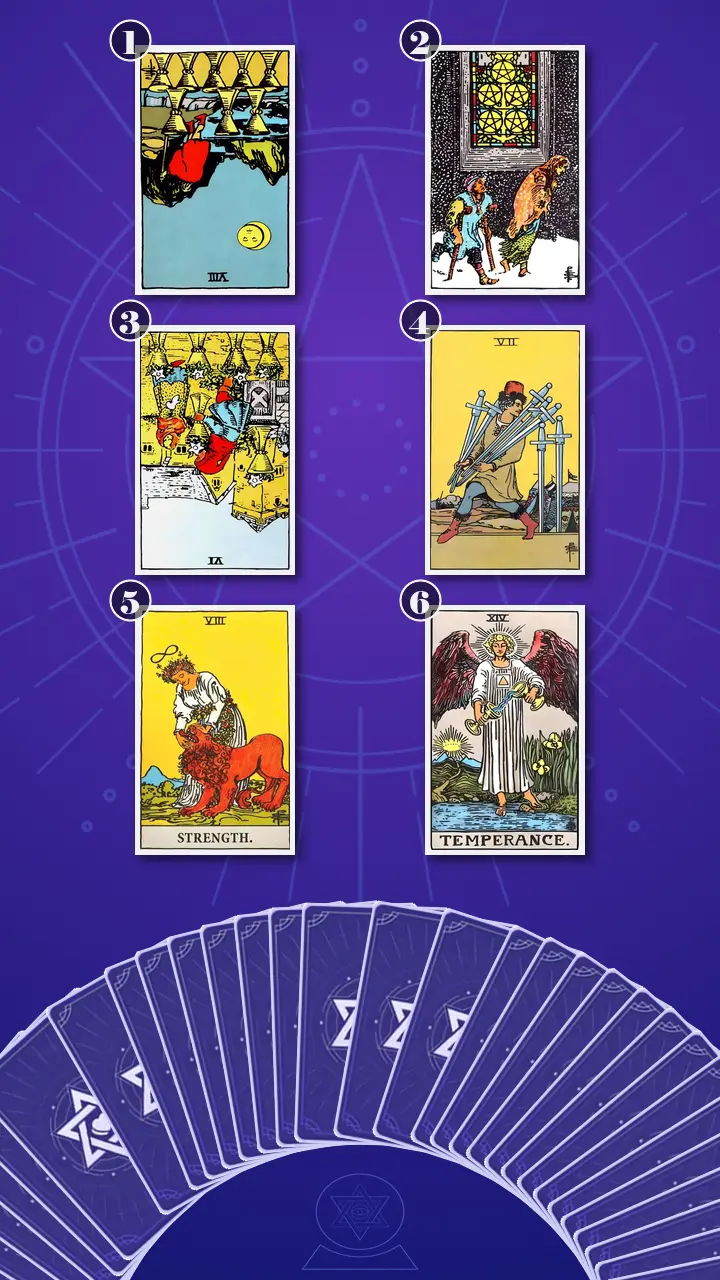
For this reading, I chose a spread I use constantly for relationship patterns and abandonment triggers: the Four-Layer Insight Ladder · Context Edition. It’s a compact 6-card tarot spread laid out as a 2x3 grid—like a ladder you descend from reflex into choice.
Here’s why it works for a “suitcase by the door” reflex: it starts with what you do on the surface, then pinpoints the exact modern trigger that lights you up (texts, tone, scheduling), then traces the intensity back to an older imprint. Only after that do we name the protective strategy—and then, crucially, we end on capacity-building and a practical integration step. No fatalistic “this means they’ll leave.” Just: this is the loop, and here’s how you interrupt it.
I pointed to the empty spaces as I spoke. “Top row: your surface reaction and what triggers it. Middle row: the origin story and the protective strategy. Bottom row: the healing resource and the next step you can actually practice this week.”
Reading the Ladder: The Exit Plan, the Cold Trigger, the Old Script
Position 1 — Surface reaction: the observable “suitcase by the door” behavior
“Now flipping,” I said, “is the card that represents your surface reaction: the visible ‘suitcase by the door’ behavior and the immediate impulse it creates.”
Eight of Cups, reversed.
Even before I spoke, Taylor’s jaw tightened in recognition. The image is a cloaked figure walking away at night—cups stacked behind them, mountains in the distance. Reversed, it’s not a clean departure. It’s the energy of almost leaving. Half-in, half-braced.
“In modern life,” I said, “this is when you’re not fully breaking up and you’re not fully in it either. You sense a tiny temperature change—slower texts, less warmth—and you start acting like you’ve already been left. Shorter replies. Fewer bids. More ‘I’m busy anyway.’”
I kept my tone precise. “Energetically, reversed here reads like a blockage. The part of you that craves secure closeness is blocked by the part of you that thinks closeness is a setup.”
Taylor let out a small laugh—one of those half-laughs that arrives with a sting. “That’s… rude,” she said, looking at the card like it had accessed her search history. “Like, yes. The second I start to care, I feel stupid.”
“Your suitcase isn’t drama,” I said, letting the words land gently. “It’s a strategy.”
And in my mind, I saw the split-screen the cards were already building: Left side: the body—tight throat, phone in hand, refreshing. Right side: the strategy—opening Notes, drafting the clean ending, suddenly becoming booked and breezy. ‘I’m fine’ out loud versus ‘I’m bracing’ inside. Intimacy versus control. Tenderness versus logistics.
Position 2 — Trigger cue: what activates the abandonment alarm
“Now,” I said, “this card represents the trigger cue: what specifically activates the abandonment alarm in everyday modern life—texts, tone, scheduling, social signals.”
Five of Pentacles, upright.
Two figures in a snowstorm. A warm stained-glass window nearby. It’s one of the most somatic cards in the deck for scarcity and exclusion.
“A late reply isn’t a verdict—your nervous system just treats it like one,” I said, because sometimes naming it plainly is the first mercy.
I watched Taylor’s shoulders rise and hover as if she were bracing for cold air. “This card says your trigger-state isn’t just mental. It’s temperature,” I continued. “A delayed reply drops you into scarcity. Chest tight. Stomach keyed up. Jaw set. Restless urge to do something—anything—to get out of the feeling.”
“It’s like,” she said, then stopped. Her fingers pressed briefly to the base of her throat.
“Like you’re outside a lit café in winter,” I offered, “and you decide you don’t deserve to go in before anyone even told you the door was locked.”
Her exhale came out slow, as if her body had been waiting for permission to put the weight down. She nodded once, small. The resonance here wasn’t intellectual; it was physical.
Position 3 — Origin story: the older attachment imprint
“Now we go deeper,” I said. “This card represents the origin story: the older attachment imprint your current trigger is borrowing its intensity from.”
Six of Cups, reversed.
Upright, it can be sweetness and memory. Reversed, it often points to a past that’s either edited or unresolved—where the story you tell yourself leaves out what was missing.
“This isn’t only about today’s text,” I said. “It’s about an older template that taught you: closeness can change without warning. So when a normal wobble happens now, your system reacts with the intensity of then.”
Taylor’s eyes went a little unfocused, the way they do when someone is replaying a scene they don’t fully want to admit they still carry. She didn’t give me a dramatic childhood monologue—most high-functioning people don’t. She gave me one sentence, and that was enough.
“I learned to… not ask,” she said quietly. “Because asking made things worse. Or it made me look… pathetic.”
“That makes sense,” I said. “If you learned that needing was unsafe, your brain will treat ‘I want you’ as a risk signal.”
I could almost hear the loop clicking into place: Trigger (they’re less available) → Belief (“If I need them, they’ll leave”) → Behavior (pull back, detach, pack the suitcase) → Relief (control returns) → Cost (less intimacy, more ambiguity) → belief strengthens (“See? People don’t stay”).
Position 4 — Protective strategy: control-through-distance
“Now,” I said, “this card represents the protective strategy: what you do to feel in control when the alarm is on—how you pre-empt closeness.”
Seven of Swords, upright.
The figure on the card is carrying swords away while looking back. It’s not villainy. It’s strategy. It’s the quiet exit plan.
“This is what I call exit-plan competence,” I said, without judgment. “Like saving a draft email you never send—just having it there makes you feel less trapped.”
I made it concrete, because this is where people finally feel seen: “Delayed replies on purpose. Calendar-filling. The ‘low effort’ posture. Telling yourself you’re just independent—while privately drafting the breakup speech in Notes.”
Taylor covered her mouth with her hand, and another laugh escaped—this one half relief, half horror. “The Notes app part is… too real.”
“Control-through-distance still costs you closeness,” I said. “It gives you short-term relief, but it also teaches the other person they can’t reach you. And then your fear goes, ‘See? I knew it.’”
She stared at the spread, and I could see the split-screen again: Body—cold, tight, braced. Strategy—cool, busy, unbothered. The contradiction wasn’t a personality flaw. It was a system.
When Strength Put a Hand on the Lion
Position 5 — Healing resource: the inner capacity you can build
I let the room go a little quieter before turning the next card. The buzzy city sounds outside my window—streetcar bell, distant traffic—felt suddenly far away, like we’d stepped into a smaller, truer space.
“We’re turning over what I consider the core card of this reading,” I said. “This one represents your healing resource: the inner capacity you can build so fear doesn’t make the decision.”
Strength, upright.
The image is simple and almost shocking in how gentle it is: calm hands on a lion, an infinity symbol above the head. Not domination. Regulation. Relationship with instinct.
“Strength isn’t being unbothered,” I said. “It’s staying present while you’re bothered.”
Before I went any further, my perfumer’s brain caught a detail I’d noticed when Taylor walked in: she wore a clean skin-musk—soft, close, almost like warm laundry. Not loud. Not demanding. The kind of scent that disappears unless someone leans in.
This is where my Attraction Analysis often adds a lever of clarity. I asked, “When you’re triggered—when the abandonment alarm hits—do you reach for scents that feel clean and self-contained? Like you’re making yourself… un-grabbable?”
Taylor blinked. “I… yeah. I hate anything too sweet. Anything that feels like it needs attention.”
“That’s not random,” I said. “Fragrance preference can mirror relationship strategy. Clean musks are beautiful—quiet intimacy. But in a trigger-state, ‘clean’ can become ‘untouchable.’ Like: if I stay neutral, nobody can accuse me of wanting.”
Her posture shifted—tiny, but real. A micro-softening at the shoulders.
The Aha Moment (Setup)
This was the exact TTC moment she’d described: the ride home where she refreshes messages, sees “seen,” and her chest tightens—so she starts stacking backup plans: gym, laundry, early sleep. Not because she loves being efficient, but because wanting someone feels like standing in open air. In her head, safety had become synonymous with leaving first.
The Aha Moment (Delivery)
Stop treating your fear like a fire drill and start treating it like a lion you can soothe—Strength turns the packed suitcase into calm, honest presence.
I let a beat of silence sit there, like a drop of perfume settling onto skin.
The Aha Moment (Reinforcement)
Taylor’s reaction came in layers—the way truth usually arrives when it’s finally safe enough to land.
First: her breathing froze for a second, like she’d been caught doing something in a mirror. Her fingers stopped moving. Phone face-down. Still.
Second: her eyes went distant, not dissociated—more like she was running a quick internal replay. You could almost see the scenes flicker: the “no worries :)” text, the delayed replies on purpose, the Notes app bunker, the calendar filling up like sandbags against a flood.
Third: the release. Her shoulders dropped a fraction. Her mouth opened, then closed, then she let out a breath that sounded like the first time you exhale after realizing you’ve been holding your breath for an entire conversation.
“But… if I don’t leave first,” she said, and there it was—an unexpected edge of anger, not at me but at the whole unfair architecture of it—“doesn’t that mean I was wrong? Like I did all of that for nothing?”
I shook my head. “No. It means you were brilliant at surviving. Your system built an alarm and an evacuation plan. We’re not shaming the plan. We’re updating it.”
I slid the blotter strip closer. “Strength is you learning to soothe the lion—your body—before you text. Not to perform chill. Not to flood. Just to stay present long enough to make one honest bid for connection.”
Then I gave her a practice, because insight without a next move can turn into another kind of spiral. “Try this as a 10-minute Strength Pause—stop anytime if it ramps you up too much.”
“Set a 3-minute timer,” I said, demonstrating with my own hands: one on chest, one on lower belly. “Breathe slower than you want to. Then write the message you’re tempted to send—the clean exit, the ‘no worries’ vibe. Under it, write one lower-drama truth that doesn’t plead or accuse: ‘Hey—my brain’s doing the thing. Are we still on for tonight?’ Or: ‘Can you give me a quick heads up if plans change?’”
Her eyes glistened—not cinematic tears, just that thin brightening that comes when someone is finally allowed to be honest without being made wrong for it.
I asked the question I always ask at this point, because it turns insight into lived memory: “Now, with this new lens—can you think of last week, any moment where this would have changed how you felt?”
She nodded, swallowing. “Wednesday,” she said. “Line 1. I literally wrote the breakup text. I didn’t send it, but I wrote it. And then I acted busy for two days.”
“That’s the shift,” I said softly. “This isn’t about predicting whether someone will stay. This is about moving from hair-trigger dread and control-through-distance to steadier self-trust and calm, honest bids for connection—one moment at a time.”
Position 6 — Integration step: the next small practice
“Last card,” I said, “represents the integration step: the next small, actionable practice to retire the exit-plan habit and build secure relating.”
Temperance, upright.
The angel pours between two cups—measured, steady. One foot on land, one in water. A path leading to a distant crown. It’s pacing. Calibration. The opposite of emergency evacuation.
“Temperance is the middle temperature,” I said. “Not flooding—sending five texts, over-explaining, chasing certainty. And not freezing—silent treatment, disappearing, turning cold. It’s one clear sentence, then waiting without punishing.”
I couldn’t help a small internal flashback to my training in Paris, weighing materials on a scale so sensitive it could register a single drop. Too much of one note and the whole fragrance collapses. Temperance is that kind of craft: not less feeling, but better proportion.
“One clear sentence beats a whole disappearing act,” I added, and Taylor’s mouth twitched like she might finally believe it.
The One-Page Plan: From ‘Suitcase’ to One Clear Sentence
I leaned back and traced the story the spread had told, so Taylor could hear it as one coherent narrative instead of six separate cards.
“Here’s the arc,” I said. “When closeness starts to feel real, Eight of Cups reversed shows you going half-packed—ready to leave, not because you don’t care, but because caring feels dangerous. Five of Pentacles is the trigger-state: the body goes ‘outside in the cold’ from one ambiguous cue, like ‘seen’ or a reschedule. Six of Cups reversed says that intensity is borrowed from an older lesson—closeness wasn’t stable, and needing felt risky. Seven of Swords is the coping tactic: control-through-distance, exit-plan competence, the Notes app bunker. Then Strength arrives as the antidote: regulate, soothe the lion, and stay present long enough to be honest. Temperance is how you practice it—small, paced experiments with connection.”
“Your cognitive blind spot,” I continued, “is that the suitcase reflex feels like self-respect, but it’s often self-abandonment in a nicer outfit. The transformation direction is exactly what Strength and Temperance offer: from pre-emptive withdrawal to one small, direct bid for connection at the moment you feel the urge to detach.”
Taylor made a face—half cringe, half fear. “But what if I can’t do it in the moment?” she asked. “Like, I can’t even find five minutes because I’m commuting, or I’m in a meeting, or I’m just… spiraling.”
“That’s real,” I said. “So we lower the bar. We make it one sentence. We make it two minutes. We make it something you can do on a platform, in a washroom stall, or while your kettle boils. The goal isn’t perfection. It’s: don’t abandon yourself first.”
Then I gave her the actionable advice—simple enough to start, structured enough to trust.
- The 20-Minute Exit-Text DelayWhen you feel the urge to send the clean ending (“all good, we can stop this”), wait 20 minutes first. Put your phone down and do one physical reset: wash one dish, take a quick shower, or walk around the block before you type anything.If 20 minutes feels impossible, do the “2-minute version”: one slow exhale longer than your inhale, five times. The point is to interrupt the fire-drill feeling.
- The One-Sentence BidSend one plain check-in when you notice yourself going cold: “Hey, checking in—are we still on for tonight?” or “No rush—just want to know what to expect so I can plan my evening.”Make it easier by pairing it with a sensory anchor: dab your signature scent on your wrist and inhale once before you hit send. Then set a 30-minute no-check window (Focus mode) so you don’t turn the bid into a monitoring job.
- The ‘Then vs Now’ Two-Column CheckWhen the old story flares, take 5 minutes to write: “What happened then” vs “What is happening now.” List three concrete differences between the past situation and your current relationship.Keep it observational, not a life essay. One line each is enough. This isn’t about blaming your past; it’s about giving your present a fair trial.
Before we wrapped, I offered one optional Temperance-style intimacy practice from my own toolkit—something that blended my worlds without turning the session into a perfume ad. “If you decide this person is safe enough to practice with,” I said, “try a shared blending moment sometime—smelling two or three simple notes together, choosing one you both like. It’s a low-stakes way to practice closeness and mutuality without forcing a heavy conversation. Temperance loves tiny, consistent rituals.”

A Week Later: Ownership, Not Certainty
A week later, Taylor texted me a screenshot. Not of a perfect relationship outcome—of a moment where she didn’t run.
It was a simple thread: someone had replied late, plans were wobbly, and instead of going efficient and “fine,” she sent one line: “Hey—just want to know what to expect so I can plan my evening.” Then she put her phone on Focus and made tea. No dramatic speech. No disappearing act. Just presence.
She added: “I still felt the spike. I still wanted to be cold. But I didn’t pack the suitcase. I asked. And regardless of their response, I felt… less trapped.”
In my work, that’s what a real Journey to Clarity looks like. Not certainty. Not a guarantee that someone stays. But the first quiet proof that you can feel the alarm and choose your response—moving from hair-trigger anticipatory dread and control-through-distance toward steadier self-trust and calm, honest bids for connection.
When you finally start to care, your body treats it like a countdown—so you go efficient, detached, and ‘fine,’ not because you don’t want closeness, but because you’re terrified it will prove you were never safe to need anyone.
If you didn’t have to be fearless—just honest for one sentence—what’s the smallest, calmest bid for connection you’d be willing to try the next time you feel your emotional suitcase sliding toward the door?
This story is adapted from psychological research, written so that those in a similar struggle can see their own pattern in it — and find their next step clearly.These insights are not a substitute for professional psychological, medical, legal, or financial advice.
Learn more about our Journey to Clarity.
How did this insight land for you?
🫂 This Resonates Deeply
🌀 Living This Story
✨ Now I See Clearly
🌱 Seeing New Possibilities
🧰 Useful Framework
🔮 The Confirmation I Needed
💪 Feeling Empowered
🚀 Ready for My Next Step
Author Profile
 AI
AI“As a perfumer for fifteen years, I’ve learned to perceive human boundaries through the delicate metaphor of scent. Relationships need the right amount of space to breathe, and I've seen too many kind souls exhaust themselves trying to please everyone. I’m here with warmth and understanding—not to teach you to be guarded, but to help you gently clear the air and rediscover the comforting, safe boundaries that are rightfully yours.”
In this Love Tarot Reading :
Core Expertise
- Intimacy Distance Calibration: Using the metaphor of scent diffusion to diagnose whether your relationship suffers from emotional suffocation or detached coldness.
- Boundary Permeability Assessment: Objectively evaluating where your personal identity ends and your partner's begins, identifying unhealthy enmeshment.
Service Features
- The Blank Space Protocol: A behavioral challenge to intentionally create comfortable emotional or physical distance, allowing the 'oxygen' needed to reignite mutual attraction.
Also specializes in :
Explore Related Patterns:
Anxious AttachmentTaylor's coat-still-half-on posture, constant phone checking, and instant readiness to draft a breakup text all point to a nervous system that treats closeness as unstable before the relationship has actually ended. A delayed reply or a single seen message does not stay small in her body; it becomes an abandonment cue that pushes her toward protection. The mechanism is not a lack of care. It is a defensive attachment strategy: wanting someone activates threat, so her mind tries to reduce exposure by preparing to leave first. The story names the split clearly: she wants intimacy, but her body reacts like intimacy is danger. Anxious Attachment fits because the central loop is not simply texting anxiety. It is the deeper pattern where ambiguous availability gets filtered through an old expectation of being left, making You monitor, brace, and pre-emptively pull away in order to avoid feeling powerless.
CatastrophizingTaylor's reaction begins with a small cue: seen with no reply, a slower text, less warmth, or plans getting wobbly. The story shows how quickly that cue gets upgraded into a whole ending, as if the nervous system has already stamped the situation urgent. Catastrophizing fits because the mind leaps from ambiguity to abandonment without enough present-tense evidence. The body supplies intensity, the attention tunnel narrows, and the imagined worst-case scenario starts to feel like the most responsible thing to prepare for. For You, the packed suitcase is the behavioral output of that cognitive distortion. It is not that the fear is fake; it is that the fear is using an old emergency template to interpret a modern delay, making a normal wobble feel like proof of rejection.
Emotional CutoffTaylor's shorter replies, fewer bids, busy performance, and Notes app bunker show a sharp reduction in emotional contact right when she most wants reassurance. The story frames this as going cold, becoming efficient, and acting fine while the body is braced. Emotional Cutoff fits because the defense works by shutting down access. Instead of saying, "I feel activated and need clarity," the system protects itself by lowering warmth, limiting visibility, and making the other person less able to reach the vulnerable part. For You, the cutoff can feel clean because it interrupts panic. But it also blocks the very repair signal You are looking for, turning a moment that could invite one honest sentence into a silence that keeps both people guessing.
Hyper-IndependenceTaylor's calendar-filling, delayed replies on purpose, low-effort posture, and clean skin-musk preference all show the same move: become self-contained when wanting someone feels too exposed. She does not only withdraw; she makes the withdrawal look competent, busy, and unbothered. Hyper-Independence fits because independence becomes a defense against need rather than a free choice. The story explicitly links asking with feeling pathetic and wanting with danger, so self-sufficiency becomes the safer identity to perform. For You, this pattern can feel like self-respect from the inside because it restores control. The hidden cost is that the part of You that wants closeness has to go undercover, which makes direct connection feel riskier every time it matters.
Rejection SensitivityTaylor's abandonment alarm is activated by subtle signs: a delayed reply, a seen message, less warmth, a reschedule, or plans that feel uncertain. The reaction is disproportionate to the cue because the cue is being filtered through the expectation that closeness can disappear without warning. Rejection Sensitivity fits because the mind scans ambiguous social signals for evidence of exclusion. The story gives the exact felt sequence: throat tightens, stomach sharpens, the body goes cold, and the brain starts building backup plans before a real conversation has happened. For You, the sensitivity is not weakness; it is a threat-detection system calibrated by older relational learning. The work is not to pretend the spike is irrational, but to separate the old rejection template from the present facts before You decide what the other person's silence means.
Self-AbandonmentTaylor says she learned to not ask because asking made things worse or made her look pathetic. That sentence gives the whole suitcase reflex its emotional logic: before anyone else can reject her need, she rejects the need herself. Self-Abandonment fits because the behavior is not only leaving the other person emotionally. It is leaving her own honest experience behind, replacing a real bid for clarity with "no worries," a clean exit, or a performance of being fine. For You, this pattern can hide inside self-protection. It feels safer to abandon the need first than to risk having someone else mishandle it, but the cost is that the present relationship never gets a clear chance to respond to what You actually feel.
Self-SabotageTaylor's Wednesday moment is the clearest behavioral anchor: she wrote the breakup text, did not send it, and then acted busy for two days. That choice brought short-term relief because it made her feel less exposed, but it also reduced warmth and made the connection more ambiguous. The psychological mechanism is a self-protective loop that starts to damage the exact thing it is trying to protect. The alarm says, "Leave first so it hurts less," and the behavior creates distance that can later be mistaken for proof that closeness was unsafe all along. Self-Sabotage fits because the cost is built into the strategy. You are not randomly ruining intimacy; You are using a control move that once made emotional sense, but in the present it can turn fear into evidence by making connection harder to reach.
Compulsive CheckingTaylor's hands keep sliding back to her phone, and the TTC scene makes the pattern visible: the screen is warm from constant refreshing after one small digital cue. The behavior is concrete, repetitive, and body-led before it becomes a fully formed thought. Compulsive Checking works here because the checking is not neutral information-gathering. It is a nervous-system ritual meant to reduce uncertainty, but each refresh keeps attention locked onto the threat cue and makes the absence of a reply feel more meaningful. For You, the phone becomes a false control panel for attachment safety. The more You check, the more the body believes there must be danger to check for, which keeps the abandonment alarm active even when the actual data is still incomplete.
Explore Related Struggles:
Distance-Intimacy SplitTaylor names the split directly when she says she wants intimacy, but her body reacts like it is danger. The delayed reply is small, but the exposure of wanting someone feels as open and unprotected as standing outside without a coat. You are not choosing between caring and not caring. Both forces are active at once. One part reaches for secure closeness, while another part treats that same closeness as the place where humiliation, waiting, or abandonment could land. Distance-Intimacy Split captures the way connection becomes both the goal and the threat. The struggle is not a lack of desire. It is the collision between wanting to be met and needing enough distance to feel safe inside that wanting.
Exit Readiness TrapTaylor does not just worry after a delayed reply. She starts packing before anyone has left. On Line 1, a seen receipt turns into a breakup draft in Notes, backup plans, short replies, and two days of acting busy. The exit plan gives you control at the exact point where closeness starts to matter. It creates a temporary floor under your feet, but the relationship receives distance instead of information, so the silence you feared becomes easier to recreate. Exit Readiness Trap fits because the suitcase is not the ending. It is the reflex that tries to outrun the ending. Seeing the packed bag as a protective signal gives you a small opening to choose one honest bid before the escape route takes over.
Low-Maintenance Worth LockTaylor's clearest origin sentence is quiet, not dramatic. She learned to not ask, because asking made things worse or made her look pathetic. That lesson still shows up in the clean, breezy, low-effort posture she reaches for when she wants reassurance. You survive the risk of needing by making your needs look smaller than they are. The no worries text, the delayed reply on purpose, and the self-contained presentation all protect dignity, but they also hide the part of you that wants a direct answer. Low-Maintenance Worth Lock fits because worth has become tied to not requiring too much. The story points toward a different kind of dignity, where asking one clear sentence is not neediness. It is self-contact under pressure.
Read Receipt Worth LockOne small digital cue, seen, becomes large enough to change Taylor's whole evening. Her throat tightens, her stomach goes sharp, and the phone starts carrying the emotional weight of whether she is still wanted. The read receipt does not simply report that a message was viewed. In the loop, it becomes evidence about belonging, desirability, and whether the connection has already turned cold. You end up reading a tiny interface signal as if it were a relationship verdict. Read Receipt Worth Lock fits because the phone becomes a courtroom for your value before the other person has actually answered. The opening is to separate the cue from the conclusion, long enough to make one grounded request instead of building a whole ending from a pause.
Scarcity Compass LockThe delayed reply drops Taylor into a cold-body state. Chest tight, stomach keyed up, jaw set, she feels like she is outside the lit cafe before anyone has actually told her the door is locked. The problem is not that every delay is harmless or every cue should be ignored. The struggle is that ambiguity immediately moves the compass toward exclusion. You start navigating from scarcity before the present situation has been given a fair read. Scarcity Compass Lock fits because the body starts using lack as its map. When safety becomes leaving first, even a normal pause can feel like proof that there is no room for you inside the connection.
Vulnerability Containment StrainStrength reframes Taylor's task as staying present while bothered. The goal is not to become unbothered, perform chill, flood the other person with five texts, or disappear into cold silence. You are asked to hold the spike without letting the spike write the whole script. That takes containment, because the vulnerable part wants contact while the protective part wants the clean exit before contact can expose anything. Vulnerability Containment Strain fits because the pressure point is the moment before the response. One honest sentence becomes the practice of letting need be visible without turning it into pleading, punishment, or disappearance.
Monitoring-Safety FusionTaylor's hands keep returning to the phone, and the phone is warm from constant refreshing. The screen becomes the place where her body tries to settle itself, one check at a time. Monitoring gives you something to do when waiting feels unbearable. It creates the illusion of control, but it also keeps your safety wired to the next notification, the next timestamp, the next sign that may or may not mean anything. Monitoring-Safety Fusion fits because the checking is no longer just information gathering. It becomes a substitute for internal steadiness. The no-check window matters because it gives your body a chance to learn that safety can exist even while the answer is still pending.
Explore Related Emotions:
Cautious Self-TrustA week later, Taylor sends a screenshot of a moment where she did not run. Someone replied late, plans were wobbly, and she sent one clear line before putting her phone on Focus and making tea. Cautious Self-Trust fits because the proof is modest but real. She still feels the spike and still wants to be cold, but she discovers that the feeling does not have to become the behavior. You can hear the new trust in “regardless of their response, I felt less trapped.” The abandonment story loses some of its authority when she learns that her safety can come from her own response, not only from someone else’s immediacy.
Cautious VulnerabilityThe integration step is not a dramatic confession. It is one clear sentence, then waiting without punishing: no five-text flood, no disappearing act, no cold performance of being above it. Cautious Vulnerability names the kind of openness Taylor can actually tolerate. It lets her ask for clarity without handing the entire relationship over to panic or pride. You can feel how carefully sized this vulnerability is. It does not demand fearlessness; it asks for one honest bid that keeps her connected to herself while leaving the other person free to answer.
Clarity ReliefTaylor’s final update is not a perfect romantic outcome; it is a screenshot of a moment where she did not run. She still feels the spike, still wants to go cold, and still chooses one clear check-in before setting the phone down. Clarity Relief fits because the relief comes from seeing the loop clearly enough to interrupt it. The relationship remains uncertain, but the inner sequence is no longer invisible. You can feel the pressure leave the story at the exact point where certainty stops being the goal. She does not need a guarantee that someone stays in order to feel less trapped; she needs proof that the alarm can be heard without being obeyed.
Dependency ShameTaylor’s clearest origin sentence is quiet: she learned not to ask because asking made things worse or made her look pathetic. Later, the same imprint reappears when she says the second she starts to care, she feels stupid. Dependency Shame names the sting underneath the suitcase reflex. The issue is not only fear that someone might leave; it is the humiliation attached to needing anything in the first place. You can see why the body chooses distance so quickly. If need has been coded as embarrassing, then asking for clarity feels like losing dignity, and leaving first feels like the only way to avoid being seen wanting.
Grounded AgencyThe turning point is physical: Taylor’s fingers stop moving, the phone goes face-down, and her breath finally releases. The room narrows into something steady enough for her to notice the difference between an alarm and an action. Grounded Agency captures that shift from being driven by the reflex to choosing a response inside the reflex. She is not promised that someone will stay; she is shown that she can stay with herself long enough to ask clearly. You can feel the story move from prediction to ownership. The power is not in controlling the reply, but in reclaiming the sentence she sends before fear writes it for her.
Guarded LongingTaylor says she wants intimacy, then describes her body reacting as if wanting someone is dangerous. She does not stop caring; she starts managing the evidence of care by getting busy, going breezy, and making herself harder to reach. Guarded Longing captures that split. The longing is real enough to hurt, but it has to pass through a protective filter before it can become a direct bid for connection. You can feel the abandonment story in the way desire becomes something to hide. Wanting a person is treated like exposure, so the system wraps tenderness in distance and calls the distance independence.
Hard-Won ComposureTaylor’s shoulders drop only after the reaction is treated as information instead of drama. The practice is deliberately small: wait before the exit text, breathe slower than the body wants, write the clean ending, then write one lower-drama truth underneath it. Hard-Won Composure fits because this steadiness is not effortless chill. It is composure built in contact with the spike, while the urge to bolt is still present. You can see the agency returning in inches. The abandonment alarm still sounds, but it no longer gets instant control of the phone, the sentence, or the next move.
Hollow ControlOn the train, Taylor starts stacking backup plans: gym, laundry, early sleep. Later, the same structure appears as delayed replies, a filled calendar, and a clean exit text sitting ready in Notes. Hollow Control names the relief that works only by shrinking the relationship. The plans make her feel less trapped for a moment, but the cost is that closeness becomes harder to reach and the original fear gets more evidence to feed on. You can feel the abandonment story in the bargain she is making with herself. If she leaves first, she gets control back; if control requires leaving herself emotionally unreachable, the safety starts to feel empty.
Inner Child AcheTaylor does not give a dramatic backstory; she gives one sentence: “I learned to not ask.” That restraint matters because the story is not using the past as spectacle, only as the place where a present-day reaction borrowed its intensity. Inner Child Ache fits the ache of that older lesson. The current text delay touches the younger part of her that learned closeness could shift without warning and that needing something might make the situation worse. You are not dealing with a random overreaction. The body is responding with an old scale of danger, where asking once felt unsafe and silence became the way to stay intact.
Message DreadThe 8:47 p.m. TTC refresh gives the whole reaction a precise shape: the train rocking, fluorescent lights buzzing, the phone warm in Taylor’s hand, one “seen” cue sitting there with no reply. The message thread becomes the place where her body starts measuring whether closeness is still safe. Message Dread names the specific pressure of that modern trigger. It is not just wanting a text back; it is the way a delayed reply becomes a felt verdict, tightening the throat and sharpening the stomach before the mind can slow down enough to check the facts. You can see the abandonment story hiding inside the notification gap. The phone does not create the wound, but it gives the old script a glowing surface to project onto: if they pause, they are leaving; if they are leaving, you need to get out first.
Rejection ChillTaylor describes a delayed reply as something that lands in the body: shoulders rising, throat closing, stomach going sharp. The image of standing outside a lit cafe in winter captures the exact temperature of the trigger, where warmth seems visible but not reachable. Rejection Chill belongs here because the story repeatedly turns ambiguity into physical coldness. A pause in texting is felt less like neutral timing and more like being quietly left outside, even before anyone has said no. You are watching a body prepare for exclusion before the relationship has supplied proof. That chill is the abandonment story in somatic form: closeness is nearby, but the door might lock at any second, so the safest move seems to be stepping back before the cold gets worse.
Relational Catastrophe DreadTaylor sits with her coat still half-on, thumb hovering over her phone, already rehearsing an exit after one delayed reply. The body is not waiting for evidence; it is moving as if the relationship has already entered an emergency state. That is why Relational Catastrophe Dread fits the story so precisely. A small cue like “seen” does not stay small inside her system. It becomes a forecast, a countdown, a full-body preparation for being left before the other person has actually chosen distance. You are not looking at simple insecurity here. You are looking at the inner weather of a person whose nervous system turns ambiguity into an ending, then tries to survive the imagined ending by leaving first.
Self-Betrayal AcheTaylor literally writes the breakup text, does not send it, and then acts busy for two days. The later interpretation is precise: the suitcase reflex can feel like self-respect while quietly becoming self-abandonment. Self-Betrayal Ache belongs here because the deepest cost is not only possible distance from the other person. It is the moment Taylor’s own honest need gets replaced by the “no worries” version of herself. You can feel the pain of leaving yourself first. The abandonment story says distance will protect your dignity, but the ache comes from realizing your real voice never got to enter the room.
Performative CalmTaylor’s voice stays steady in the exact way people sound when they are trying not to sound like anything at all. At work she is capable, fast, crisp, and color-coded, while the private scene is a warm phone, a tight throat, and a breakup draft in Notes. Performative Calm fits because her composure is doing a job. It keeps the outside polished while the inside is already bracing, planning, and rehearsing how not to be caught needing too much. You are seeing an abandonment story that has learned social fluency. The surface says “I’m fine,” but the inner system is not fine; it is trying to look low-maintenance enough that nobody can use her wanting against her.
Explore Related Contexts:
Digital Intimacy Boundary ConfusionTaylor's closeness with the other person is being negotiated through texts, tone, scheduling, read receipts, and the physical habit of checking the phone. The same device that gives access to connection also becomes the place where uncertainty keeps replaying. That creates boundary confusion around digital intimacy. A check-in can become a monitoring job, a late reply can become a relational referendum, and the phone can shift from a communication tool into a constant exposure surface. Digital Intimacy Boundary Confusion fits because the story is not only about wanting reassurance. It is about trying to conduct intimacy through systems that reveal fragments of availability without revealing intention, leaving you to decide how much checking, asking, waiting, and self-protection is actually reasonable.
Mixed Signal LimboTaylor is not responding to a clean rejection; she is responding to slower texts, less warmth, a late reply, and plans that feel wobbly. That matters because mixed signals keep you suspended between evidence and interpretation, where there is enough contact to stay engaged but not enough clarity to feel socially anchored. In that limbo, the relationship does not offer a stable next step. You are neither being clearly invited in nor clearly released, so the body of the story starts building its own exit route: shorter replies, fewer bids, the Notes app breakup draft, and the posture of being busy anyway. Mixed Signal Limbo names the external structure around the reaction. The abandonment story gains force because the current connection is being experienced through low-resolution cues, not direct mutual definition, and that leaves your agency caught between asking, waiting, and leaving first.
Read Receipt PressureAt 8:47 p.m. on Line 1, Taylor keeps refreshing her phone until the single 'seen' marker becomes the main social fact in front of her. The delayed reply is small, but the interface makes it visible, timestamped, and difficult to negotiate with; you are left with evidence that the message was viewed and no clear evidence of what it means. That is the pressure point: modern intimacy gets compressed into platform cues that look precise while carrying too little context. When a read receipt starts functioning like a verdict, your agency narrows to refreshing, drafting, withdrawing, or trying to perform indifference. Read Receipt Pressure fits because the abandonment reaction is not floating in a vacuum. It is being triggered by a specific digital stage where availability is exposed, interpretation is underfed, and your next move has to be chosen before the relationship has actually given you clear information.