One Vague Text Became an Imagined Romance, Then a Three-Line Note

The Whole Romance Inside One Ambiguous Text
If you are a late-twenties hybrid creative in Toronto who can interpret vague product feedback all day but lose an evening to "We should do that again sometime :)," you may know ambiguous-text limerence from the inside. Casey, a 28-year-old product designer, joined my video call from their shared apartment at 11:48 p.m. on a Tuesday.
They were lying sideways on the sofa with the same chat open. Blue screen light caught in the dark window; the refrigerator hummed through my headphones. Casey flexed their fingers around the phone and said, "It is literally warm now." They had typed and deleted a third reply, sent a screenshot to a friend, and checked whether the sender had viewed their story. The message had not changed, but its possible meanings had multiplied.
It was only one warm, noncommittal line, yet by midnight Casey had assembled three tones of reply, two competing friend theories, and the opening scenes of a relationship. They wanted permission to hope, but they had no clear plan, question, or statement of romantic intention from the other person. The core conflict was painfully simple: Casey wanted the text to confirm a romance, while everything the text left unclear felt almost impossible to tolerate.
"I know it was only one text," they said, pushing their hair back and immediately reaching for the phone again, "but it did not feel random. I keep thinking there is a version where they are trying to tell me something. Why do I keep building a romance around one ambiguous text?"
I watched their jaw tighten each time the screen woke. Their longing looked less like a soft ache and more like a notification vibration trapped beneath the ribs, a small electrical pulse that kept restarting before the body could settle.
"Of course it felt significant," I said. "You like them, and the message gave you warmth without enough definition to place that warmth anywhere. You are not only wondering what the text means. You are trying to make what it leaves unclear feel survivable."
I lifted my coffee, now only faintly warm, and kept my voice level. "I am not going to use tarot to claim I know what they secretly feel. That would only add another theory to the pile. I want us to see how the pile is being built, where your attention gets caught, and which part of the process you can actually choose. Let us make a map of the fog."

Choosing the Transformation Path Grid
I asked Casey to put both feet on the floor, read the message once, and then place the phone face down. I shuffled slowly while they took one unforced breath. The pause was not a mystical test; it was a way to move from reacting to observing.
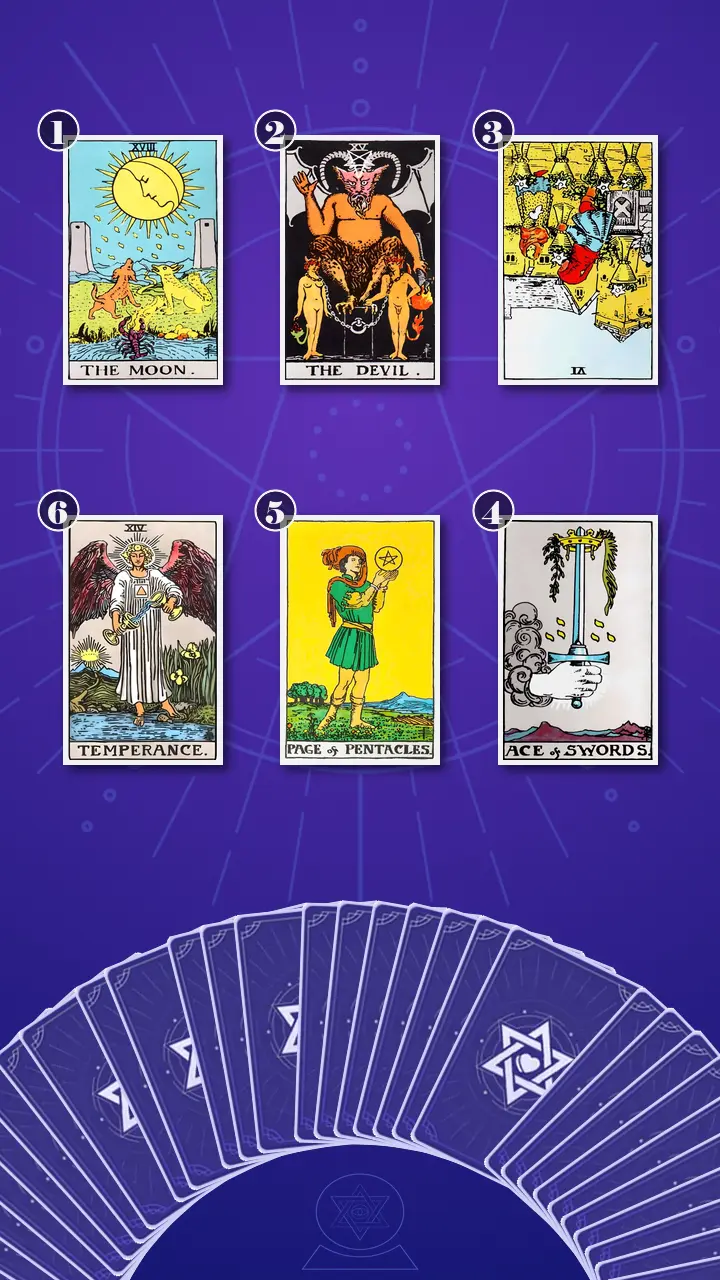
I chose the six-card Transformation Path Grid · Context Edition, a focused tarot spread for limerence, mixed signals, and digital dating uncertainty. I arranged the cards in two rows of three, moving across the top row and then switching back through the lower row like a message thread reaching its final repeated line and being rewritten.
For anyone wondering how tarot works in a reading like this, I use the cards as a structured set of perspectives, not as surveillance into another person's mind. A larger Celtic Cross would have introduced questions we did not need, while a simple feelings spread could have kept the focus on guessing the sender. This grid was the smallest useful map of the full system: current behavior, blockage, root, catalyst, practical action, and integration.
I pointed to the upper row. "The first card will show how the ambiguous text is operating now. The second will identify what makes the checking loop rewarding enough to repeat. The third will show the familiar emotional template beneath it." Then I traced the turn into the lower row. "The fourth is the intervention. The fifth turns that insight into a small experiment. The sixth describes a capacity you can practice, not a promised relationship outcome."
Following the Message Into Moonlight
Position 1: The Moon and the Low-Resolution Future
"The card I am turning over now represents the present behavior," I said, "specifically, how one ambiguous text is becoming repeated analysis, projected meaning, and an imagined romantic trajectory." I revealed The Moon, upright.
I showed Casey the winding path disappearing between two towers. The landscape was visible, but not clearly enough to know where the path ended. "This is partial light," I said. "It lets you feel the shape of something without confirming its destination."
At 11:48 p.m., Casey had reread one warm but noncommittal message beneath the blue light of their phone. On the first pass, perhaps the smiley was deliberate. On the second, perhaps the late hour implied intimacy. On the third, perhaps the absence of a plan meant the sender was nervous. The sequence became: "It could mean interest. But if it means interest, maybe they are being careful. And if they are being careful, perhaps this is finally becoming real."
I could hear Casey's Figma-comment brain leaking into dating. At work, inspecting context around a vague line of stakeholder feedback might prevent a bad redesign. Here, however, Casey was designing an entire relationship roadmap from one unvalidated sentence. More interpretive skill did not create more source material.
I read The Moon as Water in excess and visibility in deficiency. Casey's sensitivity was not the problem; it was supplying rich emotional colour where the available communication had left blank space. The attraction was genuine, but the route from this message to a romance remained out of view.
"Your feeling is real; the conclusion is still unconfirmed," I said. "The Moon does not say your attraction is foolish. It asks whether reflected light is being treated as full daylight."
Casey gave a short laugh that caught halfway up their chest. "That is so accurate it is kind of brutal." Their mouth kept the shape of a smile, but their eyes dropped to the face-down phone.
"Accurate does not have to mean condemning," I replied. "You built meaning because uncertainty was uncomfortable and hope mattered. We are examining the route, not putting you on trial for taking it." Their fingers stopped tapping against their knee.
Position 2: The Devil's Loose Chain
"The card I am turning over now represents the principal blockage: the part of the limerence loop that makes checking, fantasizing, and waiting for another cue feel rewarding enough to continue." I revealed The Devil, upright.
I immediately directed Casey's attention to the loose chains around the figures. "I am not reading this as proof that the sender is dangerous, manipulative, or fated to hurt you," I said. "The Devil is describing your relationship with the loop, not making a moral claim about either person."
At 12:16 a.m., Casey knew the chat contained no new information but opened it again because rereading briefly restored the possibility of being chosen. A story view created ten seconds of brightness. The silence that followed sent their thumb back to the chat, the profile, and then the group conversation where friends were still debating the smiley.
"I know this will not add information," I said, giving voice to the mechanism, "but maybe this time I will notice the clue that settles it."
The Devil showed a blockage created through repetition. The desire itself was not excessive; the checking had become an intermittent reward system. Each small action offered a quick return of hope while gradually placing more of Casey's attention and self-worth under the control of the next cue. It was like an algorithm learning that uncertain notifications kept them engaged, then serving the same possibility back through active-status dots, story views, and selected chat memories.
"More analysis cannot extract information the other person has not communicated," I said. "Five rereads may change your emotional intensity five times, but the source document still contains one sentence."
Casey's shoulders rose. Their hand moved an inch toward the phone before they noticed and pulled it back. Then they exhaled through their nose. "So the chain is not the message?"
"The message is the cue," I said. "The chain is the sequence of ordinary actions that keeps giving the cue another hour of your life. Because those links are observable, they are also interruptible. Not all at once, and not through shame, but one link at a time."
Position 3: The Six of Cups and the Edited Archive
"The card I am turning over now represents the underlying root: the familiar emotional template that makes uncertain attention feel valuable enough to decode and secure." I revealed the Six of Cups, reversed.
I described the flower-filled cups as an emotionally curated archive. Reversed, the card suggested that a tender or familiar script was being carried into the present without enough review. Casey had scrolled backward through six weeks of messages, pausing on the warmest lines while moving quickly past delays, cancelled plans, and undefined intentions. An older compliment had begun to outweigh today's lack of a clear invitation.
"This feels familiar, so it must be meaningful," I said. Then I turned the sentence carefully. "But what if familiar is not the same as reciprocal?"
The reversed Cups showed memory caught in blockage. It did not require me to invent a dramatic childhood explanation or tell Casey what their past must mean. It only asked what I could test in the present: when communication became unclear, did selected fragments of warmth acquire disproportionate weight?
Casey's breath paused. Their index finger remained suspended above the phone as if an old scroll had been interrupted mid-motion. Their eyes lost focus for a few seconds, and I watched recognition move across their face before a low "Oh" left their chest. Their shoulders dropped, but their expression held both tenderness and embarrassment.
"I have done this before," they said. "Different person, same archive. I always think the earlier warm moment explains the current silence."
"Familiar intensity is not the same thing as present reciprocity," I said. "And the answer is not to prove you are over it by deleting everything tonight. Abruptly shutting the connection down could preserve the same pattern under a harder surface. The useful question is simpler: what present-day gap are you asking an old message to explain?"
When the Ace of Swords Drew a Straight Line
Position 4: The Catalyst That Refused to Guess
A streetcar bell sounded through Casey's cracked window, one clean note against the refrigerator hum. The timing made the room feel briefly sharper. I turned the first card in the lower row.
"The card I am turning over now represents the catalytic intervention: the shift from interpretive certainty-seeking to a clear separation of literal evidence, inferred meaning, and personal need." I revealed the Ace of Swords, upright.
The sword rose in a single vertical line, a direct counter-image to The Moon's winding path. I saw Air entering a Water-heavy spread: clear naming where feeling had been flooding interpretation. The Ace did not ask Casey to become detached. It asked them to stop requiring attraction to perform the additional job of certainty.
At 11:48 p.m., the chat was still open, the phone warm in Casey's hand, and one vague sentence had already become three drafted replies, two friend theories, and half an imagined relationship. I could see how desperately analysis had been trying to make uncertainty feel survivable.
Over twenty years of listening to people talk across coffee cups, I have often watched a story become unmanageable because every fear, fact, hope, and bodily reaction has landed in the same pile. I thought of clearing a crowded cafe table at closing time: the work begins when each object is returned to its proper place.
I call my diagnostic version of that work Daily Friction Deconstruction. I strip away the dramatic accusations, such as "I am not being chosen" or "they secretly want me but are afraid," and examine the mundane mechanics: a cue appears, a thumb reopens the chat, an app switches, a screenshot is sent, hope spikes, and an hour disappears. The loop is built through ordinary movements, which means agency can re-enter through an ordinary movement too.
I took a blank page and drew one upright line down the centre, echoing the sword. On the left I wrote only the literal text: "We should do that again sometime :)." On the right I wrote the romantic story constructed from timing, punctuation, online status, and hope: "They want a relationship but are afraid to be direct." Beneath both, I added a third line: "I want to know whether they intend to make another plan."
"A feeling can be real without being evidence," I said. "You can want this and still admit you do not know. Clarity is not coldness here. It protects your attraction from being forced to carry certainty it has not received."
An ambiguous text is not a hidden promise; name what is actually there, and let the Ace of Swords separate evidence from the romance your mind is supplying.
For one beat, Casey stopped breathing. Their thumb hovered above the dark phone, then went completely still. Their pupils widened as their gaze shifted past my video window, as though the last six weeks of messages were replaying behind it. "But doesn't that mean I made all of this up?" they said, the words sharper than anything they had said before. "Doesn't it mean I was wrong?" Their shoulders remained high, but their hand slowly opened against their knee. I told them no: the feeling belonged to them and was therefore real; the certainty was an added draft, not a moral failure. Their eyes reddened at the rims. A shaky breath left them, followed by a longer one that seemed to come from lower in the chest. Their shoulders finally sank. For a moment they looked almost dizzy, as if putting down the burden of decoding had also revealed the responsibility of choosing without a guaranteed outcome. "That is relieving," they whispered, "and honestly a little scary."
I let the silence hold for a few seconds before I asked, "Now, with this new view, think back to last week. Was there a moment when this insight might have made you feel different?"
Casey looked down. "The stand-up. They viewed my story while my teammate was talking. I decided the view meant they were choosing the right time to reply, and then I barely heard the rest of the meeting."
"Try the three lines," I said.
Casey answered slowly. "The fact is that they viewed the story. The story is that they were thinking about me and planning a reply. What I need is direct follow-through, not a viewer-list clue." Their lips pressed together, then softened. "I can still be excited that they saw it. I just cannot call it a conversation."
I watched the transformation begin in that distinction. It was not a leap from longing to indifference. It was one precise movement from compulsive certainty-seeking toward reality-based curiosity: Casey could remain interested without promoting interest into mutual commitment.
Learning to Hold One Data Point
Position 5: The Page of Pentacles' Seven-Day Experiment
"The card I am turning over now represents the practical action: how you can make the cue-to-fantasy sequence visible before another checking action occurs." I revealed the Page of Pentacles, upright.
The Page held one pentacle at eye level with steady, undramatic attention. After the Ace's conceptual clarity, I read this card as Earth restoring a missing practical container. Its energy was balanced: patient enough to gather experience, bounded enough not to turn the exercise into another all-night investigation.
I translated the image into a plain Notes template with four fields: Cue, Story, Action, Outcome. For seven days, Casey could record one sequence at a time. If the sender viewed a story, Casey would name the fantasy it triggered, wait twenty minutes before opening the profile, and later note whether any direct communication had actually occurred.
"This urge is data about my pattern, not data about their intentions," I said. "You are studying what checking does. You are not building a detective dashboard for scoring the sender."
Casey smiled properly for the first time. "I could absolutely turn this into a colour-coded Figma file with components."
"Which is why it needs to stay almost boring," I replied. "Four lines. Seven days or five entries, whichever comes first. No prediction column, no response-time score, and no retrospective redesign of your entire dating life."
Their pen moved across the notebook beside them. I could see the shift in how they were holding attention. Under The Devil, attention had been held by a cue. Under the Page, Casey could hold one cue at eye level and examine what followed.
Position 6: Temperance and Reciprocity-Sized Interest
"The card I am turning over now represents integration: the capacity to stay open to attraction while matching time, attention, and emotional investment to demonstrated reciprocity." I revealed Temperance, upright.
I centred the image of one foot in water and one on land. "Water is your genuine feeling," I said. "Land is the communication that can actually support weight. Temperance does not ask you to leave either one. It asks you to stop pouring the whole river into a cup the connection has not yet offered."
In Casey's daily life, this could look unremarkable. They might notice the first chest flutter, wait for it to settle, and then check the actual conversation. They could reply warmly without naming the exchange a romance, mute the chat during dinner without pretending not to care, or ask one clear question if and when that felt right. Passive digital traces would remain what they were: traces, not active reciprocity.
I also noted what the spread lacked. There was very little Fire. I did not see a need for more pursuit, urgency, chemistry, or dramatic confession. The movement came through Air, then Earth: name the distinction, practise it in one repeatable way, and let emotional proportion develop over time.
"I do not have to call this nothing, and I do not have to call it a relationship," Casey said.
"Exactly. Interest can stay; investment can wait for evidence."
Their shoulders lowered again, this time without the collapse that had followed the Ace. They picked up the phone, looked at the message once, and returned it face down. The attraction had not vanished. It had simply stopped being the only thing in the room.
The One-Page Route Back to Clarity
I gathered the cards into one coherent account. The Moon showed a present built from partial visibility. The Devil showed how a brief reward kept the checking loop active. The reversed Six of Cups revealed an older relational script in which selected warmth was asked to explain current silence. The Ace introduced a clean dividing line; the Page gave that line a repeatable practice; Temperance showed the resulting capacity to feel without overfunding an unconfirmed story.
The blind spot was not that Casey had feelings. It was the assumption that emotional intensity, interpretive effort, and the number of collected clues increased the amount of evidence. Beneath that assumption sat a more painful equation: if the sender did not clearly choose them, perhaps Casey's worth had also been left undecided. The cards did not prove or disprove the romance. They showed that no sender's ambiguity deserved that much authority.
I then used my Emotional Clutter Sorting lens. I placed genuine attraction in one pile; the sender's literal communication in another; and the extra charge of a quiet apartment, late-night fatigue, work-trained interpretation, notifications, and fear of not being chosen in a third. None of those piles cancelled the others. Sorting them simply stopped environmental pressure and romantic evidence from being mistaken for the same thing.
"The shift is small but structural," I told Casey. "Instead of repeatedly interpreting the message, write down what it literally says, one meaning you inferred, and one need of your own. Then choose from what is known. You may reply normally, ask a direct but low-pressure question, wait, mute the chat, or disengage. Tarot does not choose among those options for you."
- Make the five-minute Text-Story-Need split.The next time you reopen the chat, copy the exact message into Notes under three headings: "Literal Text," "Story I Added," and "What I Need." Write no more than three bullets total. Circle any story claim that would require the sender's confirmation, then leave it labelled "unknown." Before replying, read only the need and choose one valid option: respond normally, ask one clear question, or wait.Start with one phrase under each heading if five minutes feels too large. The note is for clarifying your information, not investigating their profile or proving the subtext.
- Run the one-week Cue, Story, Action, Outcome log.Pin a four-line template in Notes. When the urge to search the chat history appears, record the current cue and the story first. Set a twenty-minute timer and complete one bounded task, such as washing one mug or finishing one design comment, before deciding whether to scroll. After seven days or five entries, review once and count which actions produced new information.Keep the log intentionally plain. No colour-coded clue system, sender score, or prediction field. If twenty minutes feels unrealistic, begin with two minutes and leave the phone face down within reach.
- Use the 24-Hour Micro-Boundary Reset.For one chosen day, establish one non-negotiable time or physical boundary in the shared apartment. Casey chose to mute the chat from 8:30 to 10:30 p.m. and leave the phone on the kitchen counter while eating with their roommate and finishing the dishes. During that window, only a direct reply, question, plan, or follow-through would count as reciprocity; story views and active status would not.This is a one-day experiment, not a performance of detachment. Pick a boundary small enough to keep. Warmth remains allowed; the aim is to let one part of the evening belong to you again.
Casey looked at the third action and frowned. "But if I mute it and they message, what if I miss the moment? I know two hours sounds ridiculous, but that is the part my brain will fight."
"Then the boundary is doing useful diagnostic work," I said. "Missing an immediate notification is not the same as missing a relationship. A connection capable of becoming mutual can survive dinner and dishes. If two hours feels too sharp, choose twenty minutes. The boundary needs to be real, not impressive."
I reminded Casey that matching investment to reciprocity was not a dating game and did not mean calculating how long to withhold a reply. They were free to be warm, direct, enthusiastic, or cautious. Proportion simply meant that one passive view could not be allowed to spend an entire evening's attention as though it were an active conversation.

A Week Later, the Chat Was Still Quiet
Six days later, I received a message from Casey. They had used the three-column note after another story view. Under Literal Text, they wrote, "No new text." Under Story I Added, they wrote, "They are watching because they want me to make the next move." Under What I Need, they wrote, "A direct plan, or enough distance to return to my own evening."
They also completed four entries in the evidence log. None of the profile checks had created new information; they had only raised or lowered hope for a few minutes. Seeing that pattern on one plain screen felt different from hearing a friend offer yet another interpretation.
Casey chose to send one low-pressure message: "I enjoyed seeing you too. Would you like to pick a day to do it again?" Then they put the phone on the kitchen counter, ate with their roommate, and left the question where it belonged: with the person who could answer it.
On the seventh night, Casey slept. Their first thought in the morning was, "What if I got it wrong?" The chat was still quiet. Casey told me they smiled, made coffee, and opened the design task they had abandoned the previous week.
I did not regard that quiet chat as failure, just as I would not have treated an immediate reply as proof that the cards had predicted a romance. The change was smaller and more durable: Casey had asked for information without making the answer a verdict on their worth. Tarot supplied a map; Casey decided where to draw the line, when to place the phone down, and how much of their attention the available evidence could hold.
That was the real Journey to Clarity: not charged longing becoming indifference, and not uncertainty disappearing on command, but compulsive certainty-seeking becoming reality-based curiosity. Feeling remained. So did vulnerability. What changed was ownership.
When one vague text makes your chest flutter and your hand keep reaching for the phone, the hardest part may be holding both truths at once: you want the possibility, and you are frightened that the silence around it says something about your worth. The moment you notice those truths as separate, the Devil's loose chain has already begun to slacken.
If you allowed the text to remain unclear for tonight, what single Ace of Swords line could you draw, across a note, a time boundary, or the shape of your evening, to help your attention feel like your own again?