Sending Two Honest Sentences: Ending Relationship Limbo's Auto-Renewal

The Blank Thursday in Relationship Limbo
I recognized the composed 29-year-old product designer who handled ambiguous briefs all week, then got the Sunday Scaries from seeing Thursday left open for a relationship plan that still had no time or place. Maya sat across from me at 9:18 p.m. in a high-rise rental near Toronto’s west end, her phone warm in one hand while the radiator clicked and streetcar brakes scraped below the window.
She opened the relationship thread, typed, “Can we talk about where this is going?”, deleted it, and reopened a Figma deck that was not due until Tuesday. I watched her shoulders drop when the message disappeared, as if postponing the question had released a small clamp around her throat.
“Why do I keep waiting calmly while this relationship stays in limbo?” she asked. She wanted the connection to become more defined, but she also wanted to preserve the calm of not asking, because a direct conversation might replace possibility with an answer she could not control. Nothing was technically wrong; nothing was becoming clear either.
I heard suspended longing in the way she spoke: it was like sitting in a waiting room where the lights stayed on, the chairs stayed warm, and no appointment had ever been scheduled. The silence did not hurt loudly. It occupied her evenings, her drafts, her commute, and the little pause before every message preview.
“I don’t hear a person who is failing at patience,” I told her. “I hear someone using patience to protect hope while quietly paying for it with time and attention. We can look at the pattern without blaming you or predicting what the other person will do. Let’s give this fog a map, so the next choice belongs to you.”

Choosing the Five-Card Shadow Spread
I invited Maya to put both feet on the floor, take one slow breath, and hold the question without trying to make it sound more reasonable. I shuffled slowly over the warm coffee-scented table, using the ritual as a transition into focused observation rather than as a performance of mystery.
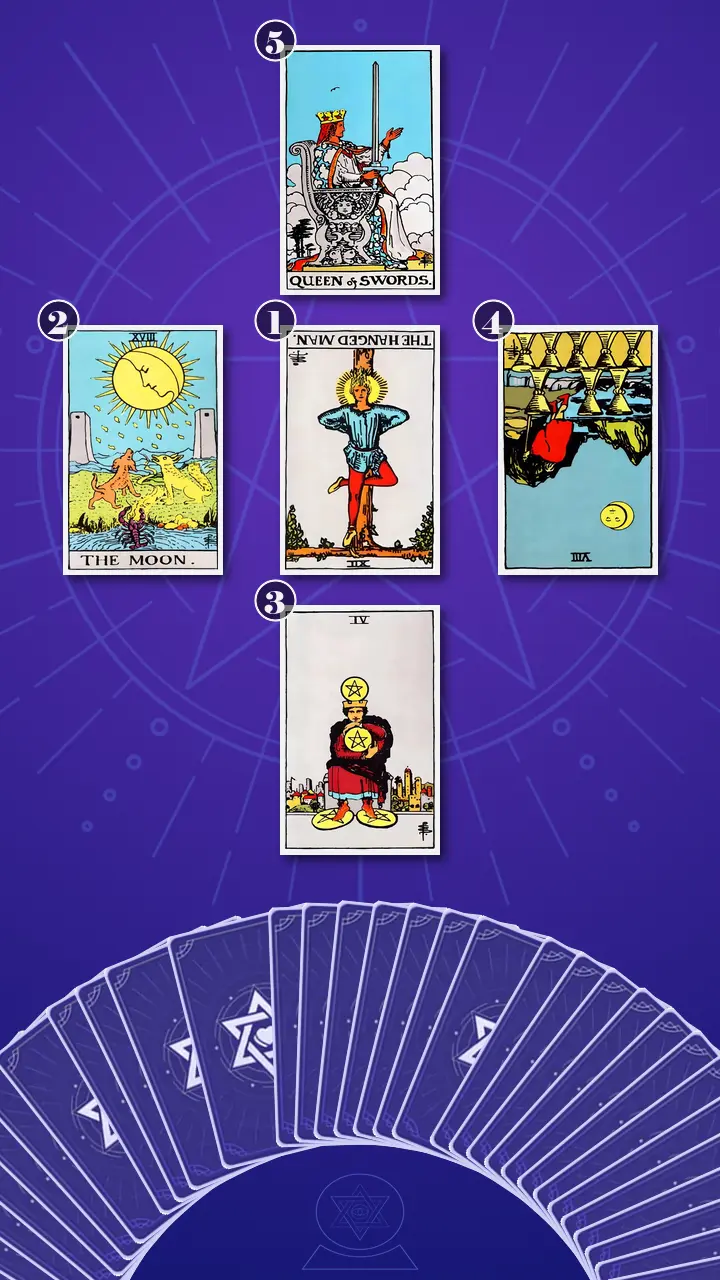
I chose the five-card Shadow Spread because this is an inner-excavation question. Maya was not asking me to predict whether another person would commit, return, or choose a particular future. She was asking why her own waiting pattern kept renewing itself. A five-card structure was enough to trace the visible behavior, the trigger, the fear beneath it, the protective payoff, and the practice that could integrate the insight.
This is how tarot works in this reading: I use the images as a structured mirror. The cards cannot give me access to someone else’s private intentions, but they can help me separate observable facts from hopeful interpretation and turn a vague emotional loop into a sequence I can examine with Maya.
I explained the map aloud. “The first position shows the shadow shaping your conscious behavior: the way you keep yourself available while postponing clarity. The second shows what activates it, especially warm contact and vague plans. The third reveals the fear that makes holding on feel protective. The fourth shows what waiting lets you postpone. The fifth gives us an integrating practice: direct language, receptive listening, and a boundary that governs your own availability.”
The spread was designed to keep the inquiry ethically centered on Maya’s choices. It would not tell her to stay or leave. It would help her decide from clearer information instead of from the relief that arrives when a difficult question is deleted.
Reading the Map Beneath the Maybe
Position 1: The Calendar Hold That Never Became a Plan
“This position presents the diagnosis-level behavior you can observe: repeatedly maintaining emotional availability while postponing a direct conversation about the relationship.”
I turned over The Hanged Man, in reversed position. The suspended figure was calm, but one foot held him in place. The crossed leg formed a shape that looked almost deliberate, and the halo around his head made immobility appear thoughtful, even enlightened.
I connected the image to Maya’s Sunday night. She left Thursday open again, drafted a direct relationship question, deleted it, and turned to a work deck that was not urgent. In the modern life of a product designer, the empty calendar block could easily be called giving it space. But a calendar hold with no host, no agenda, no confirmed start time, and no review date was not producing new perspective. It was simply consuming the possibility of another plan.
Reversed energy here was blockage rather than meaningful pause. A chosen pause has a purpose and a date for reassessment. Maya’s pause had become self-perpetuating delay: postponing the question gave her immediate physical relief, but it produced no usable relationship information. The same behavior returned each week and was rewarded by the temporary feeling that she had remained calm, mature, and low-maintenance.
I asked her to try the sentence that had been circling the room: “I keep calling this patience because admitting it is self-perpetuating delay would mean I have to choose.” I placed mature patience beside delay, and temporary calm beside usable clarity, without treating either side as a moral verdict.
Maya gave a short laugh with a bitter edge. “That is a little brutal,” she said. Her fingers stopped above her phone, then curled around it before loosening again. I told her that the card was not calling her foolish or passive; it was showing the protective logic clearly enough for her to decide whether the protection still worked.
She looked down at the blank Thursday in her calendar. I saw the small drop in her stomach before she named it: the absence of conflict had been mistaken for evidence that waiting was working.
Position 2: The Warm Text Under Moonlight
“This position identifies the immediate relational trigger: the ambiguity and partial information that activate mixed-signal analysis and make waiting feel safer than asking.”
I turned over The Moon, in upright position. The card did not accuse the night of being false. It showed a narrow path between two towers, illuminated only in fragments, with a familiar dog and a wilder wolf responding to the same uncertain light.
I brought Maya back to a Tuesday at 6:42 p.m. on the TTC after several quiet days. Her phone had lit up with an affectionate message and a suggestion to “do something soon.” The carriage had smelled of damp coats, the fluorescent lights had hummed, and the metal pole had been cold beneath her palm. She told me that relief had spread through her chest before she reread the message six times by Bloor-Yonge.
“The fact is: the message was warm, and no day was named,” I said. “The story my hopeful brain added is: this warmth proves the relationship is moving.” A warm message can be real without being proof of movement. The Moon’s upright energy was partial visibility, not deception by default. It showed how incomplete information invited hope and apprehension to write competing explanations in the gaps.
I asked her to separate intuition from fear-driven interpretation. The observable facts could fit in one column: an affectionate sign-off, a vague suggestion, no confirmed plan. The other column held the meanings she had supplied: maybe this is finally shifting, maybe they are almost ready, maybe asking now would interrupt something naturally developing.
Maya’s eyes moved as if she were replaying the message thread. Her thumb hovered over the screen, and then she set the phone face down. The warmth had not been dismissed; it had simply been returned to its proper size. It was information about warmth, not a substitute for direction.
Position 3: The Grip That Protects Access
“This position reveals the mechanism beneath the pattern: the fear that clarity could remove belonging, and the resulting attempt to preserve control by holding on.”
I turned over the Four of Pentacles, in upright position. The seated figure pressed one pentacle to the chest and pinned two beneath the feet. The city remained behind him, but his posture made the world feel distant. Security had tightened into a grip.
I connected that image to Friday at 4:56 p.m. in Maya’s open-plan office. A friend had invited her for drinks on Ossington, but she left the invitation half-answered because the person she was dating might become available. Keyboard taps and the espresso machine hissed around her while she kept checking the message preview. Her private logic, she told me, was, “I don’t want to close off the chance.”
The Four of Pentacles showed an earth energy trying to freeze Moon-like uncertainty into a tolerable status quo. By staying deliberately undemanding, Maya preserved access to the connection. But preserving access was not the same as evaluating reciprocity. The closed posture kept her from learning whether the relationship could hold a stated need, a clear question, or a plan that included her time as something valuable.
At this point I used one of my practical lenses, Emotional Clutter Sorting. I separated the actual relationship question from the surrounding debris: fatigue after work, social comparison, the pressure to appear independent, and the ordinary mess of city life. I could not conclude from vague plans alone that the connection was incompatible. I could see that Maya was gripping it so tightly that she had no room to assess what it was.
“If I ask for more information, I might lose the only version of this I currently have,” she said. Her hands tightened around the phone, and her chest lifted with a shallow breath.
“That fear makes sense,” I replied. “But belonging at any price is not the same as belonging that can include stated needs. The question is not whether you can preserve the connection exactly as it is. The question is whether the connection has room to become reciprocal when you stop disappearing your requirements.”
Maya nodded, though her expression held more apprehension than agreement. The root was not a lack of self-respect. It was an attempt to prevent loss before she had tested whether honesty would actually cause it.
Position 4: The Auto-Renewing Waiting Period
“This position exposes the defensive payoff within the limiting cycle: waiting postpones grief, departure, and the need to define what you will no longer accept.”
I turned over the Eight of Cups, in reversed position. The stacked cups contained a visible gap. A cloaked traveler had begun the difficult path but could not complete the departure. Reversed, the image did not tell Maya to stay or go. It showed the repeated return to an arrangement she already knew was emotionally incomplete.
I brought her to the Saturday morning after a close night together. Pale light had come through her blinds, and she had quietly abandoned the personal deadline she set the previous week because she thought, “Maybe this is finally shifting.” By Wednesday, the plans were vague again, but the warmth of Saturday had reset the internal clock.
“Each affectionate interaction is acting like an auto-renew toggle on a subscription you never consciously chose to continue on the same terms,” I said. “You are not choosing to stay forever; you are only postponing the review again.”
The reversed water energy was blocked movement. Waiting allowed Maya to postpone grief, but it also postponed relief, discernment, and the possibility of choosing from a steadier position. You are not holding on only to a person; you are holding on to the possibility of not having to grieve. That does not make the affection unreal. It explains why affection keeps being asked to carry the full weight of a decision it cannot make.
Maya exhaled, then became very quiet. Her shoulders lowered by a fraction, and she ran one finger along the edge of the card. I watched recognition move through her in stages: first the physical release, then the mental replay of every Sunday deadline she had abandoned, and finally the uneasy understanding that the first movement did not need to be a dramatic exit.
“Maybe the first boundary is just ending the automatic renewal,” she said. “Not deciding the whole relationship. Just deciding that every warm message does not get to restart the waiting period.”
“Exactly,” I said. “A private review point is not a punishment or a countdown imposed on anyone else. It is a way to stop outsourcing your timeline to the next affectionate moment.”
When the Queen of Swords Cut Through the Clouds
Position 5: The Open Hand and the Clear Blade
We had reached the card above the center, the position that translated the transformation into practice. The room seemed to narrow around the table. The radiator clicked once, a streetcar passed below, and then even those sounds felt farther away.
“This position translates the transformation framework into integration: using direct language, fact-based discernment, and a self-governed boundary to replace indefinite calm with grounded clarity.”
I turned over the Queen of Swords, in upright position. Her sword stood vertical and unmistakable. Her other hand remained open, not clenched, not pointing, not demanding. The clouds around her throne were beginning to clear.
Her modern translation was practical. Maya could schedule a twenty-minute conversation, say what she valued and what she needed clarified, listen to the answer in the words actually used, and then decide what level of time and emotional availability remained consistent with that information. She did not need to force a particular outcome. She needed to govern her own participation.
I used my Daily Friction Deconstruction lens. “I want to separate the dramatic accusation from the mechanical breakdown,” I said. “The dramatic question might be, ‘Do they care about me?’ The mechanical questions are, ‘What has actually been said? What has actually been scheduled? What agreement, if any, has changed?’ Those details do not reduce love to logistics. They tell us whether your daily reality is giving your feelings somewhere stable to stand.”
I also reminded her that a vague plan could come from many things: uncertainty, competing responsibilities, fatigue, avoidance, or a difference in what each person wants. Emotional Clutter Sorting could not decide which explanation was true from a card. A clear conversation could give Maya information that rereading messages could not.
Before I went further, I asked her to picture the Sunday night again. “On Sunday night, you keep Thursday open again, watch the cursor blink beneath a direct question, then delete it and return to work. Nothing has exploded; your throat simply loosens because certainty has been postponed for one more week.”
Then I placed the card between us and said, “You do not need to preserve the connection by staying suspended; let honest language create movement, like the Queen of Swords raising one clear blade through the clouds.”
I let the silence remain long enough for the sentence to stop being an interpretation and become a possibility.
“Calm can keep a conversation kind, but it cannot make an undefined relationship clear. Clarity begins when you name your need, hear the answer as given, and let your own boundary move next.”
Maya’s first response was not relief. Her breath caught, her eyes sharpened, and she said, “But doesn’t that mean I was wrong to wait? I thought I was being thoughtful. I thought I was giving it room.” I told her that waiting had been a reasonable protection at one point; the insight was that it had outlived its purpose. A strategy can be understandable and still become expensive.
First, she froze. Her breath stopped halfway in, her lips parted, and her fingers hovered above the blank Notes app as if the screen had suddenly become too bright. Then the meaning began to penetrate: her gaze lost focus, and I could see her replaying the deleted drafts, the open Thursday blocks, and the warm messages that had never become plans. Finally, her face softened. Her shoulders dropped, the hand around her phone opened, and a tremor moved through the exhale she released. When she spoke again, her voice was low and unsteady. “I can ask without making the answer go my way.” The relief carried a brief dizziness with it, the vulnerability of discovering that clarity would return responsibility to her. She sat a little straighter anyway. The Queen’s open hand had not promised safety; it had made room to receive information without turning it into a verdict on her belonging.
“Now, use this new perspective to recall whether there was a moment last week when this insight could have made you feel different,” I invited. “Maybe it was the warm text on the TTC, the Friday invitation you left unanswered, or the second you deleted the question. What would have changed if you had treated warmth as real but incomplete?”
This was the first clear bridge from her starting state of outward composure, suspended longing, and repeated mixed-signal analysis toward grounded clarity. It was not the end of uncertainty. It was a shift from calm endurance to direct communication, from hopeful interpretation to reality-based discernment, and from protecting belonging through silence to choosing a boundary that could include her actual needs.
The One-Page Clarity Plan
When I placed the five cards together, I saw one coherent story. The Hanged Man reversed showed a pause that had stopped producing perspective. The Moon showed why the pause felt safer: partial information allowed hope and fear to compete, while one warm message temporarily quieted both. The Four of Pentacles revealed the root, the attempt to protect access by staying undemanding. The Eight of Cups reversed showed the hidden payoff: every affectionate moment postponed grief and automatically renewed the waiting period. The Queen of Swords supplied the missing air, turning private analysis into precise language.
Maya’s blind spot was not that she cared too much. It was that she had treated calm endurance as evidence of care and warmth as evidence of movement. She had been asking herself how long she could tolerate ambiguity instead of asking what information she needed and what level of availability she chose after receiving it. The relationship had become like a browser tab kept open to preserve the session, consuming attention even when nothing on the page was changing.
The key shift was simple but not effortless: move from treating calm endurance as proof of care to requesting one clear conversation and deciding what personal boundary follows each possible answer. I told her that the reading offered actionable advice, not a guaranteed outcome. The cards gave her a better question and a more self-directed next step. They did not take the decision away from her.
Small Next Steps for the Clarity Conversation
- Open-Hand, Clear-Sword ConversationBefore Wednesday evening, open the Notes app and write two sentences: “I’ve appreciated what we’ve been building, and I’d like to talk about what each of us sees this becoming. Could we make twenty minutes to talk on Thursday or Saturday?” Send it when the wording is accurate, not when it feels perfectly fearless. During the conversation, ask the prepared question once and allow a pause rather than softening it or answering for the other person.Keep the request to twenty minutes. A boundary answers, “What will I do?” An ultimatum demands, “What must you do?”
- Facts Before Future Stories NoteAfter the next meaningful message, set an eight-minute timer and create two headings: “Observable facts” and “What I am making those facts mean.” Add no more than three bullets under each. Record the actual words, timing, and agreed plan before recording what you hope the message implies. Bring one repeated interpretation into the conversation as a question rather than treating it as evidence.If the exercise becomes another analysis spiral, stop after one fact and one interpretation. Warmth can remain meaningful without being proof of commitment.
- The 24-Hour Micro-Boundary ResetWithin the next twenty-four hours, choose one non-negotiable time boundary in your shared dating space: do not hold a prime evening for an unconfirmed plan. Reclaim one ninety-minute block with a specific plan, such as coffee with a friend, a class, or a solo cinema ticket. Then choose a private seven-day review date titled “What do I know now?” and decide what level of ambiguity you are willing to participate in after that point.This is not leverage and it is not a dramatic exit. It is one quiet action that protects your time while leaving the other person free to answer honestly.
I watched Maya copy the three lines onto paper. Her handwriting became less tidy after the second line, but she did not erase it. That mattered. She was no longer polishing the emotional question until the need disappeared. She was making the situation legible enough to choose from.

A Week Later: The Quiet Proof
Four days later, I received a message from Maya: “I sent the two sentences. We’re talking Saturday.” She had also accepted her friend’s invitation for Thursday instead of leaving the evening open for a possibility. The relationship had not been magically resolved, and I did not pretend that one conversation could guarantee commitment or closure. The change was smaller and more useful: she had stopped letting an unconfirmed plan organize her life.
When we spoke the following week, she told me the conversation had given her information rather than a perfect ending. She had listened to the actual words before deciding what they meant, and she had kept the review date on her calendar. On Sunday morning, she slept a full night but still woke with the thought, “What if I’m wrong?” This time, she made coffee, let the question exist, and chose her plans without asking uncertainty for permission.
I think of that as the first proof of the Journey to Clarity. Tarot did not make Maya brave, and the Queen of Swords did not choose for her. The reading helped her notice the difference between a pause that creates perspective and a pause that quietly renews itself. Her calm was no longer a performance of having no needs. It was beginning to come from knowing what she needed and being willing to hear what reality could offer.
If your throat tightens around one honest question and loosens the moment you delete it, I want you to know that protecting possibility can feel safer than discovering whether belonging has room for your actual needs. Noticing that pattern is already a movement back toward yourself.
If calm no longer had to mean staying silent, what is the smallest honest sentence you might allow yourself to imagine saying, perhaps one that releases the blank Thursday without demanding that anyone else choose the time?