The 11:40 p.m. Text That Felt Like Powerful Chemistry
I often meet people who can run a client workshop, manage Toronto rent, and coordinate five calendars, yet find themselves googling “why do I want them more when they pull away?” after one intense date. Maya, a 29-year-old UX designer, brought that exact contradiction into our late Tuesday video session.
At 11:40 p.m., I could see her folded into the corner of a sofa in her Toronto condo, one socked foot tucked beneath her and a half-finished bowl of pasta cooling on the side table. The radiator clicked behind her, streetcar brakes scraped along the wet road below, and she shifted her phone between her palms as though it had become too warm to hold. Then the screen lit up: “You up for a drink tonight?”
Three quiet days had passed since the last tender message. Maya had a morning commitment she valued, but I watched her legs become restless as she began drafting a breezy yes. She wanted a mutual relationship with someone who could make and keep plans, yet intermittent attention made her increase her own flexibility precisely when the other person became less consistent.
“I know they’re inconsistent, but what we have doesn’t feel casual,” she said. “I don’t want to pressure someone into choosing me. But the moment they pull away is when I want them most.”
What she called longing sounded less like a romantic glow and more like a warm wire looped behind her breastbone: every silence pulled it tighter, while every affectionate return sent a brief current through her chest and legs. Her phone had not delivered a plan, but her body reacted as if the relationship itself had returned.
“You are not foolish for feeling the chemistry,” I told her. “You may be giving chemistry a job it cannot do. I’m not here to decide whether this person is secretly ready or predict what happens next. I want us to make a map of the pattern, so you can see where your feelings end, where the evidence begins, and where your choices still belong to you.”

Choosing a Compass for Mixed Signals
I asked Maya to put both feet on the floor, let one breath move more slowly than the last, and hold a single question in mind: “What keeps making uncertainty feel more compelling than consistency?” I shuffled while she breathed. I use this pause as a transition from reacting to observing, not as a performance of supernatural certainty.
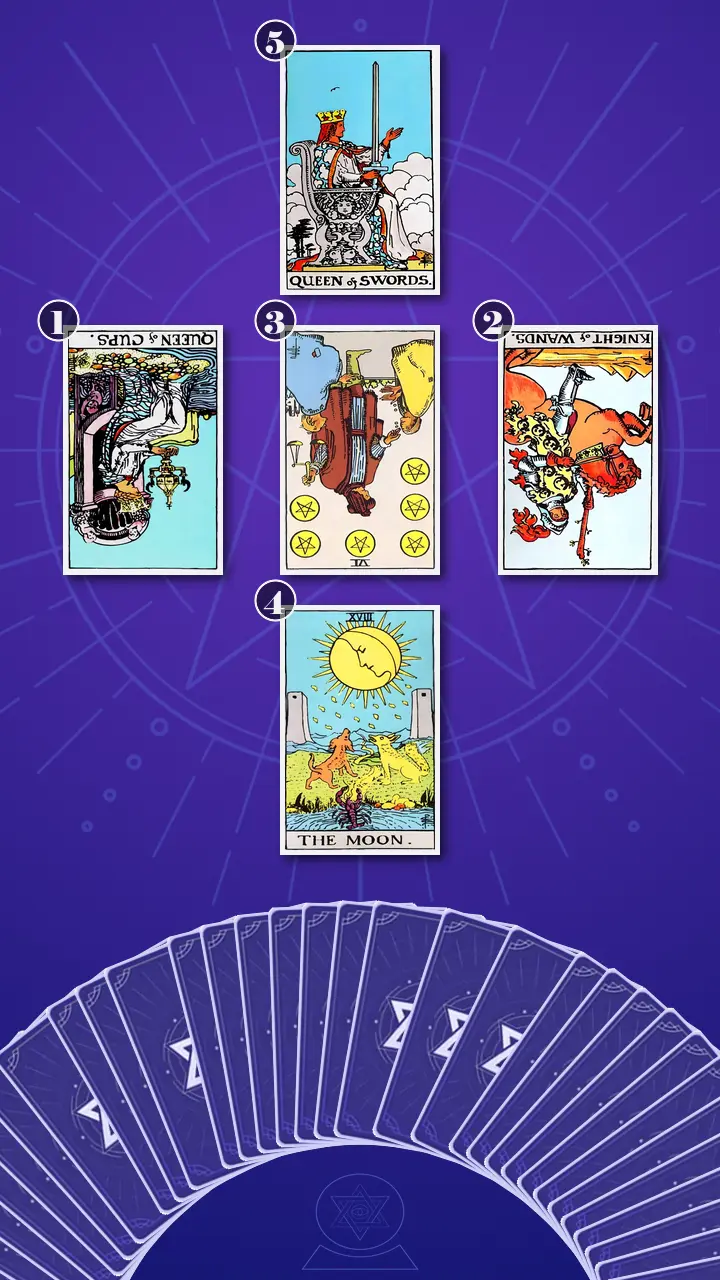
I chose the five-card Relationship Spread · Context Edition. For anyone wondering how tarot works in a relationship reading like this, I treat the spread as a structured cognitive tool: each position isolates one part of a recurring dynamic, and the card meanings in context give us images through which to compare intuition, language, and observable behaviour.
This spread was more appropriate than a forecasting-heavy layout because Maya was not asking me to read another person’s private mind. She wanted to understand her own recurring attraction to people who could express interest but could not consistently participate. The cross was the smallest useful map for that question.
I placed Maya’s emotional stance on the left and the recurring style of unstable pursuit on the right. At the centre, a third card would test the exchange they created through time, initiative, care, and follow-through. Beneath that exchange, a fourth card would reveal the hidden mechanism preserving the pattern; above it, the final card would show Maya’s path from romantic fog toward clear, self-directed participation.
From where I sat, the arrangement resembled a compass. Its centre did not ask, “Is this connection destined?” It asked the more useful question: “Is reciprocity actually present?”
Reading the Burst-and-Silence Pattern
Position 1: The Sealed Cup and the Unspoken Need
I began with the position representing Maya’s role in the pattern: her emotional stance, her real needs, and the way her attention moved toward another person’s feelings before she had named her own.
The card was the Queen of Cups, reversed.
I pointed to the ornate closed cup held between the Queen’s hands and the throne standing at the very edge of the sea. In Maya’s life, that sealed cup looked like the message thread she kept reopening. At 11:40 p.m., she could study the timing of an affectionate text, imagine the sender’s workload, and construct a compassionate account of why planning was difficult. The simpler question, “Does accepting this invitation work for me?” remained unopened.
“The Queen’s emotional intelligence is real,” I said. “Reversed, I read that sensitivity as an Excess of outward attunement and a Blockage around including your own experience. You can explain why they might be doing this, but you have not said what this is doing to you.”
Maya gave one short, bitter laugh. “That’s so accurate it’s almost mean.” Her fingers stopped over the reply box, and she turned the phone face down.
“Accuracy is not an accusation,” I said. “Your empathy is not the problem. The problem appears when empathy becomes the only evidence allowed into the room. Before you answer, what is one feeling that belongs to you, and what is one need the invitation has not addressed?”
She looked away from the screen. “I feel tense. I need plans that don’t make the rest of my life feel disposable.”
I watched her expression change as she heard her own sentence. She had spent far longer describing the other person’s possible stress than it took to identify the effect on her. The reversed Queen was not asking her to care less. It was asking her to bring herself back inside the circle of her care.
Position 2: A Trailer for a Series That Was Never Commissioned
I turned to the position representing the visible qualities Maya repeatedly found compelling in people who were not ready: intense pursuit, spontaneous closeness, and a sudden loss of direction when ordinary commitment entered the conversation.
The card was the Knight of Wands, reversed.
Maya had already described the sequence to me: an emotionally intimate date, rapid-fire messages, flirtatious voice notes, sexual charge, and jokes about places they should visit together. Then she suggested a day for the next date, and the conversation went quiet. Days later, another affectionate late-night invitation arrived, and the heat of the return felt like progress even though the next plan still had no day or time.
“The rearing horse captures the surge in your body when the message comes back,” I said. “But the rider is not establishing a dependable route. This is fire in Excess at ignition, Deficiency in stamina, and Blockage around direction. Pursuit can be sincere in the moment without demonstrating the capacity to build what you want.”
I thought of a film trailer packed with chemistry for a series that had never actually been commissioned. The trailer was not fake. Its best scenes could be vivid, moving, and genuinely shared. It simply could not prove that a whole season could be produced.
“It can’t be casual if it feels this intense,” Maya said, repeating the thought that usually arrived after the voice notes.
“The intensity is real,” I replied. “But uncertainty can intensify attention without deepening intimacy. The pattern behaves a little like an app learning that unpredictable notifications keep you checking longer. The next alert gains emotional power because you do not know when it will come, not because it has necessarily changed the quality of the connection.”
Her eyes flicked toward the face-down phone. I saw the recognition land as a quick tightening around her mouth. She was not being asked to deny the exciting date; she was being invited to compare it with the most ordinary week that followed.
Position 3: When Patience Becomes the Whole Operating System
I returned to the centre of the cross, the position representing the exchange Maya’s increased effort and the other person’s inconsistent availability created together. This was where chemistry had to become visible as time, initiative, emotional labour, and kept commitments.
The card was the Six of Pentacles, reversed.
I showed her the scales above the exchange. Reversed, those scales tilted toward a system she recognised immediately: Maya kept weekends flexible, initiated the emotional check-ins, suggested several dates, and reassured the other person whenever plans dissolved. When they offered a same-night drink, she rearranged an existing commitment and called the accommodation patience.
“This is reversed earth,” I said. “The practical structure is destabilised. There is an Excess of giving from one side and a Blockage in reciprocal participation. You give more flexibility so the connection can survive, but then the survival of the connection becomes evidence that giving more flexibility is working.”
I used a tool I call Dialogue Loop Auditing and wrote the repeated exchange exactly as Maya had reported it: “Sorry, my week has been chaos. Drink tonight?” followed by, “No worries, I can move things around.” The first line activated her fear of losing access; the second removed any need for the connection to accommodate her. The loop restored contact but produced no new evidence of readiness.
“Your sincerity cannot make an unequal exchange mutual,” I told her. “That does not mean every interaction must be perfectly fifty-fifty. It means your flexibility cannot remain the permanent infrastructure holding both names on the file.”
Maya’s breath paused. Her hand closed around the edge of a cushion, her gaze drifted as if she were replaying several Fridays, and then her grip loosened with a low exhale. “I’ve been calling it patience because calling it one-sided would mean I have to do something.”
“You may have to choose how much you participate,” I said. “You do not have to manufacture a verdict tonight. First, we make the exchange visible. Who initiated? Who confirmed? Who followed through? Who made room for the other person’s life without erasing their own?”
Position 4: The Moonlit Future Built from Three Screenshots
I moved to the card beneath the centre, representing the deeper challenge maintaining the pattern: ambiguity, imagined potential, and the fear that direct evidence might close a future Maya was still protecting.
The card was The Moon, upright.
I followed the winding path between the two towers and the dog and wolf reacting beneath the moon. Maya had fragments: one vulnerable conversation, strong attraction, affectionate voice notes, an explanation about being busy, and several unconfirmed plans. From those fragments, she had built a complete future in which enough safety and patience would eventually make the other person ready.
“You’re a UX designer,” I said. “This is like building a finished Figma prototype from three screenshots and a vague client brief. The missing information does not remain blank. Hope and fear both rush in to design it.”
The Moon upright was not proof that anyone had deceived her, and I did not present it that way. Its energy asked for humility in incomplete visibility. In this pattern, however, there was an Excess of projection filling a Deficiency of evidence. Strong feelings told Maya that she was activated; they could not confirm where the other person was going.
I asked her to recall a rainy conversation with a friend at a café near Ossington. Maya remembered the espresso machine hissing and her thumb rubbing the cardboard seam of her cup as her friend asked, “Have you actually asked what they’re available for?”
“I said we were both too busy for that conversation,” Maya told me. “But what I meant was: if I ask, I might lose this. Not knowing hurts, but it also lets every possibility stay alive.”
I divided a page into three headings: What happened, What I hope, and What remains unknown. Under the first, Maya wrote, “They sent an affectionate invitation after three quiet days.” Under the second: “I hope this means they are moving toward consistency.” Under the third: “I do not know what they are realistically available to build.”
As she read the columns aloud, the radiator stopped clicking. The quieter room seemed to expose how much noise interpretation had been making. She exhaled and said, “That’s less romantic than my version. But it’s also less impossible to solve.”
When the Queen of Swords Cut Through the Fog
Position 5: The Upright Sword and the Open Hand
The final position represented Maya’s personal integration path: defining readiness through behaviour, communicating directly, and remaining emotionally open without making her standards dependent on another person’s response. The room seemed to settle as I turned over the key card.
It was the Queen of Swords, upright.
I drew Maya’s attention to the Queen’s vertical sword and her open left hand. The sword distinguished observation from projection; the hand remained extended toward connection. This was air in Balance: precise language, independent judgment, and boundaries that did not require hostility or emotional withdrawal.
Seeing the sword, I flashed to hours spent with an editing timeline as an artist. Removing a repeated scene does not deny that the actors felt something inside it. The edit reveals whether the scene is moving the film forward or keeping everyone trapped in a beautiful loop.
I then applied Toxic Script Identification, one of the diagnostic lenses I use when a relationship pattern keeps assigning the same automatic roles. I told Maya that “toxic” described the cost of the script, not the character of either person. The recurring script cast her as The Patient Translator, responsible for converting silence into compassionate explanations, while the other person’s visible behaviour occupied the role of The Returning Spark, re-entering with enough warmth to restart the scene but not enough consistency to change its structure.
The Queen of Swords offered Maya a new role: The Discerning Participant. She could still feel the spark, but she no longer had to privately write both characters’ intentions. She could ask, listen, and let behaviour complete the information.
I brought her back to 11:40 p.m.: cold dinner, a valued morning plan suddenly negotiable, and one affectionate message making three quiet days seem irrelevant. The connection felt strongest at the exact moment its consistency was hardest to see, and she was still trying to produce the “right” interpretation before acting.
You do not have to earn clarity by enduring confusion; ask what readiness looks like, then let the Queen's raised sword separate evidence from hope.
I left a pause after the sentence. A streetcar bell sounded once below her window, clean and distinct against the wet road.
Chemistry tells you that something is happening inside you; readiness is shown by what two people can communicate, reciprocate, and sustain.
For one beat, Maya stopped breathing. Her fingers hovered above the cushion, and her pupils widened before her gaze slipped away from me, as though she were replaying every late invitation and abandoned Saturday. Then her mouth tightened. “But doesn’t that mean I got it all wrong? That I wasted months?” The anger arrived before the relief, sharp enough to redden her eyes. I let it have room. “It means you made the best meaning you could with partial information,” I said. “Clarity is not a prosecution of your past self. It is new evidence your present self can use.” Her shoulders descended by degrees. The hand gripping the cushion opened, and a trembling breath left her chest. For a moment she looked almost disoriented by the space the burden had occupied. “If I ask, I have to hear the answer,” she said. “Yes,” I replied. “And that answer describes the fit between two lives, not your worth.” I then asked, “Now, using this new perspective, was there a moment last week when this distinction could have made you feel different?”
“Friday,” she said. “I got a Story reaction after they ignored the plan I suggested. I treated the reaction like the plan had come back. I could have let it be what it was: a reaction.”
I set an eight-minute timer and asked her to add one sentence beneath Observed, Hoped, and Needed. She did not have to decide whether to stay or leave that night. When the timer ended, we stopped. I reminded her that if the exercise ever created more pressure than clarity, she could write only the observed fact or close the note completely.
This was the reading’s central movement: from activated longing and mixed-signal hyper-analysis toward evidence-based clarity, steadier self-trust, and openness to reciprocal intimacy. The Queen of Swords did not replace the Queen of Cups. She gave Maya’s sensitivity a structure through which warmth and discernment could coexist.
Rewriting the Next Ordinary Wednesday
I gathered the five cards into one continuous story. Maya’s emotional perception had taught her to notice every nuance, but fear of rejection made it easier to interpret another person than to state what she needed. Erratic pursuit then supplied bursts of heat without dependable direction. Her additional effort kept the connection alive, while The Moon allowed the continued contact to stand in for evidence that reciprocity was growing.
The pattern was not happening because Maya cared too deeply or because attraction itself was a mistake. It persisted because ambiguity captured her attention, extra effort protected the possibility, and the resulting attachment made direct information feel increasingly dangerous. She was trying to complete a relationship from scattered clues while leaving the other person’s actual readiness untested.
The cognitive blind spot was subtle: Maya measured the connection partly by the sincerity and intensity of what she gave. Because her care was real, the bond felt increasingly substantial. But her sincerity could reveal her own capacity for relationship; it could not prove that mutual capacity was present.
The transformation direction was equally precise. She did not need to become colder, play hard to get, or diagnose someone as emotionally unavailable. She needed to move from evaluating a connection by its most electric moments to evaluating it through direct communication, consistent follow-through, and reciprocal effort on an ordinary Wednesday.
Two Small Reality Checks for the Next Seven Days
- The Eight-Minute Pattern Interruption.Before replying to the next vague or last-minute invitation, open Notes and write one sentence each under “Observed,” “Hoped,” and “Needed.” Then keep any existing morning, friend, fitness, or rest plan that matters to you. If the invitation conflicts, use this simple response: “I’d like to see you. Tonight doesn’t work, but Thursday at 7 works for me.” This changes Maya’s automatic line in the dialogue loop without punishing the other person or trying to make them chase.Tip: If eight minutes feels heavy, write one observed fact and one need word. No decision is required during the exercise.
- The Open-Hand Readiness Check.During a planned call or date, ask for ten minutes and say, “I’m enjoying this, and I’m looking for something mutual and consistent. What are you realistically available to build right now?” Write down the actual answer afterward, then observe whether the next few interactions include initiated, confirmed, and kept plans. Listen without translating “I don’t know” into a hidden promise.Tip: This is a request for information, not compliance. Do not turn one imperfect week into a secret test or a final score; notice the pattern while preserving both people’s freedom to choose.
“So I’m not asking them to choose me on command,” Maya said. “I’m asking what they can actually participate in, and then I decide whether that works for me.”
“Exactly,” I replied. “Attraction is information to explore, not a reason to suspend your standards. The cards can organise the evidence, but they do not make the choice. You do.”

Six Days Later: The Quiet Proof
Six days later, I received a message from Maya: “I kept brunch, offered Thursday, and asked the actual question. They said they liked me but couldn’t offer consistency. I cried, slept eight hours, woke up thinking, What if I got it wrong? Then I made coffee and went to work.”
She had decided to step back, but I did not treat that decision as a victory predicted by tarot. The quieter proof was that she had allowed an honest answer to remain an answer. She had not bargained with it, converted it into future potential, or erased another piece of her life to keep the possibility warm.
Her Journey to Clarity had not solved love in six days. It had moved her from privately completing a relationship out of clues toward participating in connections where readiness could be communicated and demonstrated by two people. Some disappointment remained, alongside a new and slightly vulnerable steadiness. That complexity was not failure; it was what reality felt like after the fog stopped doing all the writing.
I think of the five-card Relationship Spread · Context Edition as a compass for moments like this, not a verdict. The cards did not grant Maya self-trust. They helped her see the choices through which she was already beginning to practise it.
When a quiet phone tightens your chest, assembling hope from old messages can feel safer than asking the question that separates being wanted in bright fragments from being consistently met. Simply noticing that difference means you are no longer standing at the beginning of the same scene.
If attraction could remain real without directing your whole film, what single piece of observable readiness would you want to see on the next ordinary Wednesday before you hand that connection another page of your script?
This story is adapted from psychological research, written so that those in a similar struggle can see their own pattern in it — and find their next step clearly.These insights are not a substitute for professional psychological, medical, legal, or financial advice.
Learn more about our Journey to Clarity.
How did this insight land for you?
🫂 This Resonates Deeply
🌀 Living This Story
✨ Now I See Clearly
🌱 Seeing New Possibilities
🧰 Useful Framework
🔮 The Confirmation I Needed
💪 Feeling Empowered
🚀 Ready for My Next Step
Author Profile
 AI
AI“I’ve always felt our lives are films currently in production. As an artist, I know that when you feel stuck, it’s often because you’ve bravely stayed in a painful scene for just a little too long. I’m not here to coldly analyze you. I want to sit closely with you, look at those difficult moments with profound empathy, and gently hand you the pen so you have the courage to write your next beautiful act.”
In this Love Tarot Reading :
Core Expertise
- Toxic Script Identification: Recognizing the repetitive, destructive roles you both automatically play (e.g., the Savior and the Victim) during conflicts.
- Dialogue Loop Auditing: Analyzing the specific triggering phrases that consistently escalate your arguments into dead ends.
Service Features
- The Pattern Interruption Script: A creative role-play directive to consciously change your default response to a known trigger, forcing the relationship dynamic to shift.
Also specializes in :
Explore Related Patterns:
Anxious AttachmentAt 11:40 p.m., three quiet days become almost irrelevant when one affectionate invitation appears, and Maya's body reacts as though the relationship itself has returned. Her desire becomes strongest at the point of withdrawal, while the fear of losing access makes her more willing to rearrange her life and less willing to ask what the other person can actually offer. When you experience this pattern, distance can register as a cue to restore connection rather than as information to evaluate. The resulting urgency does not prove that the bond has deepened. It shows how strongly uncertainty has activated your attachment system, making renewed contact feel like relief and direct clarity feel unusually risky.
Chemistry ChasingAn emotionally intimate date, flirtatious voice notes, sexual charge, and a late-night return give Maya vivid evidence that something real is happening inside her. She then treats that intensity as evidence that the connection cannot be casual, even while the next date remains unconfirmed and ordinary follow-through is missing. When you measure a connection by its most electric moments, physiological activation can be mistaken for relational capacity. Uncertainty makes each burst feel more significant, so chemistry begins doing the job of reciprocity, compatibility, and readiness. The pattern is not that your attraction is false. It is that attraction is being asked to prove what only sustained behaviour can demonstrate.
Intermittent ReinforcementThe sequence Maya describes repeatedly moves from intense closeness to silence and then back to an affectionate late-night return. Because the reward arrives unpredictably, each message gains more emotional power than a steady message might carry, even though it still contains no confirmed plan or evidence of greater readiness. When warmth is intermittent, you can become attached not only to the person but also to the relief produced by their return. The contrast between absence and affection amplifies attention, checking, and hope. This learning loop helps explain why inconsistent people can feel unusually compelling even when a consistently available connection would better match what you consciously want.
Pursuer DistancerWhen the other person goes quiet, Maya responds by initiating check-ins, suggesting more dates, keeping weekends flexible, and reassuring them when plans dissolve. Her pursuit restores contact, but it also allows the relationship to continue without requiring the other person to increase their own initiative or accommodate her life. When you answer distance with more relational labour, the immediate goal is often to reduce uncertainty and protect connection. The unintended effect is a feedback loop in which withdrawal generates pursuit and pursuit keeps the unequal structure functioning. The harder you work to close the distance, the less clearly you can see what the connection would look like without your extra effort.
Romantic ProjectionFrom one vulnerable conversation, strong attraction, affectionate voice notes, and several unconfirmed plans, Maya builds a complete future in which enough patience will eventually make the other person ready. The missing information does not stay blank. Her hope, empathy, and own capacity for commitment fill it with a coherent romantic direction. When you project potential into ambiguity, imagined continuity can feel as emotionally substantial as demonstrated continuity. Your feelings may accurately reveal what you want and what you are capable of giving, but they cannot establish another person's availability. Separating observed behaviour from hoped-for development lets possibility remain possibility without allowing it to impersonate a mutual plan.
Closure AvoidanceAt the cafe, Maya avoids asking what the other person is available for because the answer might make her lose the connection. She explicitly recognises that not knowing hurts while also allowing every possible future to remain alive, so continued interpretation feels safer than obtaining decisive information. When you avoid closure, ambiguity serves two opposing functions. It creates anxiety, but it also protects hope from being contradicted. The longer the imagined future remains open, the more emotionally expensive a direct answer can feel. Asking for clarity interrupts that protection strategy and replaces endless possibility with usable information about fit, participation, and choice.
Boundary DiscernmentSix days later, Maya keeps her brunch, offers Thursday instead of accepting the same-night drink, and asks what the other person can realistically build. She does not use the boundary to punish, provoke pursuit, or force commitment. She makes her own availability visible and allows the answer to describe the fit. When you practise boundary discernment, attraction and self-protection no longer have to cancel each other out. You can remain interested while distinguishing your needs from another person's capacity and your standards from their response. A clear boundary does not decide for both people. It establishes the conditions under which your participation remains aligned with the life and relationship you say you want.
Defensive OverfunctioningMaya initiates the emotional check-ins, suggests several dates, reassures the other person when plans dissolve, and constructs compassionate explanations for their silence. Her effort becomes the infrastructure that keeps the connection active, even though the other person's observable participation remains inconsistent. When you overfunction defensively, doing more than your share protects you from the immediate helplessness of waiting or losing access. It also removes valuable information, because the connection no longer has to reveal whether it can continue without your extra labour. Stepping back from translating, coordinating, and reassuring is not a punishment. It allows reciprocity, or its absence, to become visible.
Reality TestingWhen Maya divides the page into what happened, what she hopes, and what remains unknown, one affectionate invitation stops carrying the meaning of an entire developing relationship. She later treats a Story reaction as a reaction, asks the readiness question directly, and lets the stated lack of consistency remain an answer. When you use reality testing, you do not suppress chemistry or force yourself into cynicism. You give feelings, interpretations, and observable evidence separate places in the decision. This preserves emotional openness while preventing activation from becoming proof. The result is clearer self-trust because your choices can respond to what two people are actually sustaining rather than to a future assembled from partial signals.
Self-AbandonmentAt 11:40 p.m., Maya's valued morning commitment becomes negotiable before she has asked whether the invitation works for her. She studies the other person's workload, keeps weekends flexible, and rearranges existing plans while her own tension and need for dependable scheduling remain outside the decision. When you preserve connection by repeatedly excluding your own needs, short-term access is purchased with self-abandonment. The accommodation may look like patience or empathy, but its psychological function is to prevent a possible rupture by making your life absorb the uncertainty. Naming what works for you brings your experience back into the relationship without requiring you to deny the attraction or control the other person's choice.
Explore Related Struggles:
Activation-Attraction FusionAfter three quiet days, one affectionate late-night message sends a current through Maya's chest and legs, and her body responds as though the relationship itself has returned. The same shift happens when a Story reaction follows an ignored plan. A small signal of renewed access acquires more emotional force than its practical content can support. You are not imagining the chemistry when withdrawal and return produce a real physical surge. The lock forms when that surge is asked to prove that intimacy is deepening. Attraction then becomes strongest at the point of least stability, because the relief of regained contact and the desire for the person arrive as one experience. Separating activation from evidence gives you room to feel the spark without letting it define the connection's capacity.
Ambiguity DependenceAt the café, Maya avoids her friend's question about what the other person is actually available for. She later names the bargain directly. Not knowing hurts, but it also lets every possibility stay alive. The missing answer is not merely an information gap; it is protecting the future she still wants to imagine. You can remain attached to uncertainty because it postpones both loss and limitation. The connection stays open in theory, even while it remains restricted in practice, and every new fragment can be added to the unresolved possibility. This makes clarity feel dangerous rather than relieving. Seeing that bargain restores a choice between preserving unlimited potential and discovering what two real lives can actually hold.
Clarity-Exposure SplitWhen Maya is asked whether she has directly discussed availability, she says they are both too busy. She then identifies what the delay is carrying. If she asks, she might lose the connection. Later, even after forming the question, she says that asking means she will have to hear the answer. You are pulled between the stability of knowing and the exposure that knowledge creates. Direct information could end the exhausting interpretation, but it could also remove the version of the future that ambiguity has kept available. The struggle is not a lack of clarity skills. It is the cost attached to using them when truth may change your participation. Recognising that cost lets clarity become an act of agency rather than a verdict on your worth.
Potential OveridentificationMaya has one vulnerable conversation, strong attraction, affectionate voice notes, an explanation about being busy, and several plans that never become confirmed. From those fragments, she builds a complete future in which enough safety and patience will eventually make the other person ready. Her own care gives that future detail and emotional weight. You may fall for both the person in front of you and the relationship their strongest moments seem capable of becoming. As your investment deepens, the imagined future can feel increasingly shared even when much of its structure has been supplied by you. The struggle lies in separating genuine possibility from demonstrated capacity without dismissing what you felt. That distinction lets potential remain information rather than a commitment made on two people's behalf.
Momentum-Readiness SplitMaya experiences an emotionally intimate date, rapid-fire messages, flirtatious voice notes, sexual charge, and jokes about places they could visit. When she proposes a day for the next date, the conversation goes quiet. Warmth eventually returns through a late-night invitation, but the next plan still has no day or time. The friction sits between visible momentum and usable readiness. You can feel as though a relationship is advancing because its ignition is vivid, while the ordinary capacities that make mutuality possible remain absent or untested. Naming the split allows the exciting moments to stay real without making them certify what only communication, planning, and sustained participation can show.
Self-Erasure ReliabilityAt 11:40 p.m., Maya has a morning commitment she values, yet the invitation immediately makes that plan feel negotiable. She can account for the sender's schedule in detail while the simpler question of whether the invitation works for her remains unopened. Across several Fridays, her life becomes the adjustable part of the arrangement. You preserve access by becoming reliably available to someone whose availability remains uncertain. The hidden cost is that reliability is produced by repeatedly removing your own plans, needs, and limits from the decision. What looks like patience from the outside can therefore carry an internal disappearance. Bringing your life back into the equation does not cancel care; it allows connection to meet a person rather than an endlessly movable space.
Reciprocity DeficitMaya keeps weekends flexible, initiates check-ins, proposes several dates, reassures the other person when plans dissolve, and considers moving a valued commitment for a same-night drink. Her response keeps reopening the connection, but the other person is not required to make room for her life in return. You become caught in a system where your additional effort can preserve contact without producing mutuality. Because the connection survives, the effort appears to be working, even as the same survival prevents the imbalance from becoming fully visible. The deficit is not measured by whether every interaction is perfectly equal. It appears when your contribution becomes the permanent infrastructure and the relationship cannot remain standing without it.
Explore Related Emotions:
Evidence AnxietyWhen Maya's friend asks whether she has directly discussed availability, Maya says they are both too busy, then recognises the deeper concern that asking might make her lose the connection. Three screenshots and a handful of intimate moments remain easier to hold than an answer that could close the imagined future. Evidence Anxiety appears when clarity feels emotionally riskier than uncertainty because facts might remove possibilities you are not ready to release. You regain room to choose when an answer is allowed to describe the fit between two lives rather than being turned into a judgment about your worth or desirability.
Limerent RushAfter three quiet days, one 11:40 p.m. invitation makes Maya's legs restless and sends a brief current through her chest. The message contains no dependable plan, yet the sudden return of warmth is felt as though the relationship itself has returned. When contact is unpredictable, your attention can become concentrated around the next affectionate signal. The rush is real as an experience inside you, but its strength measures activation and anticipation rather than the other person's capacity to communicate, reciprocate, and remain present.
Mixed Signal DreadAn emotionally intimate date, rapid-fire messages, and affectionate voice notes are followed by silence as soon as Maya suggests an actual day for the next date. When warmth and withdrawal keep arriving from the same person, you are left scanning each new contact for proof that the connection has finally become more stable. The dread comes from having enough evidence to feel chosen in moments but not enough to know where you stand across time. Naming that contradiction allows you to stop treating every bright fragment as a verdict and begin asking whether the overall pattern gives you a place you can realistically inhabit.
Mutuality HungerMaya keeps weekends flexible, initiates emotional check-ins, suggests several dates, and reassures the other person whenever plans dissolve. She is not only longing for contact. She is longing to feel another person carry a visible share of the connection without needing her to build the entire bridge. When you deeply want mutual participation, even a small return of warmth can temporarily resemble the reciprocity you have been missing. Mutuality Hunger distinguishes the need to be consistently met from the urge to preserve access, allowing your own capacity for care to remain real without using it as evidence that equal capacity exists on the other side.
Relational WhiplashThe connection moves from intimate dates and flirtatious voice notes to days of silence, then returns through another warm late-night invitation. Each shift asks Maya's body to move abruptly between closeness, suspension, and renewed pursuit without a stable rhythm in which to settle. You can experience these reversals as proof that the bond is unusually powerful because every return produces such a dramatic change inside you. Relational Whiplash names the impact of the changing rhythm itself, helping you evaluate whether intensity is coming from sustained intimacy or from repeated emotional acceleration and braking.
Self-Betrayal AcheA valued morning commitment becomes negotiable as soon as the late-night invitation appears, and Maya has already replayed several Fridays when she rearranged her life to preserve contact. The simpler question of whether the invitation works for her disappears beneath explanations of why the other person may be struggling. The ache develops when your own needs repeatedly become the easiest part of the relationship to move. It does not mean your flexibility or empathy was foolish. It identifies the cost of keeping a connection alive by asking your routines, standards, and inner signals to become less important each time uncertainty returns.
Cautious Self-TrustMaya keeps brunch, offers Thursday instead of erasing her schedule, and asks what the other person is realistically available to build. When the answer is not what she hoped for, she steps back without translating inconsistency into a hidden future promise. Your self-trust does not need to arrive as perfect certainty. It can appear as the quieter ability to notice doubt, keep an important part of your life intact, ask for information, and believe that you can respond to the answer without abandoning either your warmth or your standards.
Bittersweet ReleaseSix days later, Maya reports that she cried, slept eight hours, woke with doubt, made coffee, and went to work. She has stepped back, but the change is not presented as a clean victory. It is visible in her decision to let an honest answer remain an answer. Release can hold disappointment and steadiness at the same time. You do not have to deny that the connection mattered in order to stop supplying it with imagined continuity, and you do not have to erase the ache before ordinary life can begin taking up its rightful space again.
Clarity ShockWhen chemistry is separated from readiness, Maya's eyes redden and her first response is to ask whether she got everything wrong and wasted months. The distinction is clarifying, but it also reorganises the meaning of every late invitation, abandoned Saturday, and affectionate return she had treated as progress. You may feel briefly disoriented when new evidence removes an interpretation that once protected possibility. Clarity Shock is not proof that your past self failed. It is the impact of seeing the same history through a sharper structure and realising that your present choices no longer have to depend on the meaning you made with partial information.
Explore Related Contexts:
BreadcrumbingA Story reaction arrives after the other person ignores Maya's proposed plan, and an affectionate late-night invitation appears after three quiet days. Each signal restores contact and relational salience, but neither one repairs the unanswered plan or creates a dependable next step. Sparse attention can gain disproportionate weight when you do not know when the next sign of interest will arrive. The external pattern is not defined by whether the sender intends to mislead; it is defined by small returns repeatedly sustaining access without expanding participation. Separating a reaction, text, or voice note from an actual plan lets you assess each signal at the level of commitment it objectively carries.
Readiness Mismatch CycleAn emotionally intimate date, rapid messages, affectionate voice notes, and future-oriented jokes are followed by silence when Maya proposes a concrete next date. Six days after she asks directly, the other person confirms the underlying split: they like her, but they cannot offer consistency. Interest and readiness are therefore present at different levels rather than moving together. When warmth repeatedly returns without increased capacity, you can experience each reconnection as progress even though the practical relationship remains unchanged. The mismatch becomes visible when chemistry is compared with what two people can actually communicate, schedule, and sustain, giving you a clearer basis for deciding whether the available relationship fits the one you want.
Situationship AmbiguityThree quiet days end with an affectionate 11:40 p.m. invitation, while earlier intimacy, sexual charge, and jokes about future trips remain unsupported by a confirmed next date. The connection contains many markers of closeness but no shared definition, planning rhythm, or agreement about what either person is building. In that undefined space, you may be asked to infer relationship status from isolated moments rather than mutual participation. Ambiguity keeps several possible futures open at once, but it also leaves one person carrying more of the interpretation and coordination. Naming the undefined structure allows you to distinguish what has been mutually established from what remains privately imagined.
Charm Without Follow-ThroughRapid-fire messages, flirtatious voice notes, sexual charge, and jokes about future travel create a vivid preview of closeness. When Maya proposes a specific day for the next date, however, the conversation goes quiet, and the eventual affectionate return still contains no day or time. Expressive pursuit can be sincere in the moment while remaining unable to support the ordinary work of continuity. If you evaluate the connection through its brightest scenes, the charm may appear to demonstrate more capacity than the weekly pattern does. Bringing follow-through into the same frame preserves the reality of the chemistry while revealing whether the connection can move beyond ignition.
Chemistry to Commitment TestMaya keeps brunch, offers Thursday as a workable alternative, and asks what the other person is realistically available to build. Their answer that they like her but cannot offer consistency converts an ambiguous stream of affectionate signals into clear information about present capacity. You do not have to invalidate chemistry in order to test whether it can support commitment. A grounded transition occurs when attraction is considered alongside direct communication, initiated and kept plans, and reciprocal accommodation on ordinary days. That test returns choice to you because the question becomes whether two available lives fit, not whether one person can interpret the connection perfectly.
Emotional Labor ImbalanceMaya keeps weekends flexible, initiates emotional check-ins, suggests several dates, reassures the other person when plans dissolve, and constructs compassionate explanations for their silence. Those efforts keep contact alive, but they also make her time and interpretation the infrastructure supporting both sides of the connection. When you perform most of the planning, reassurance, and meaning-making, the amount you invest can make the bond appear increasingly substantial. Your sincerity accurately shows your own capacity for care; it cannot establish mutual capacity on the other side. Auditing who initiates, confirms, accommodates, and follows through makes the labor distribution visible without reducing either person to a character judgment.