Getting Back Together Without Change: A Review Before the Old Routine

The 11:47 p.m. Message That Restarted the Breakup-Reunion Cycle
If you are the Toronto agency worker who can de-escalate a client call by day but cannot ask an ex one direct question at 11:47 p.m., I know how an on-again, off-again relationship loop can begin with a single warm notification.
Maya (name changed for privacy) sat across from me with both hands around a coffee she had stopped drinking. She was twenty-nine, worked as an account coordinator at a digital agency, and looked like someone who had spent the day smoothing other people's sharp edges. Rain tapped my window while the radiator clicked beneath it, and each new vibration from her phone made her thumb move before the rest of her did.
She described the previous Wednesday night. At 11:47 p.m., her ex's warm check-in had lit the ceiling of her Toronto bedroom. A streetcar ground through the wet intersection outside; the radiator hissed; the phone felt warm in her palm as she reread the message three times. She opened a note titled Reasons I Left, read the first line, closed it, and replied within minutes.
By the time Saturday plans were being discussed, neither person had mentioned the breakup. The message had sent a bright current through Maya's chest, but her stomach had dropped as though an elevator cable had slipped one floor. That was how longing lived in her body: lift first, gravity second.
“We always say this time will be different,” she told me, pressing her thumbnail against the cardboard sleeve of her cup. “But we never define different. I don't want another breakup, but I also don't want the same relationship back. Why do we keep getting back together without changing anything?”
I heard the central contradiction immediately. Maya wanted the closeness of reunion, yet the question that could protect that closeness might also end it. She was not returning because she had forgotten every reason for leaving. She was caught between the relief of being wanted again and the risk that asking what would change could make the reunion disappear.
“Missing someone is evidence of attachment, not evidence of repair,” I said. “That doesn't make the missing foolish or fake. It simply means one feeling is being asked to answer a practical question it cannot answer. Let's give the feeling its dignity, then give the pattern a proper look. We can make a map of this fog without forcing you to stay or leave today.”

Choosing the Map Before Choosing the Relationship
I asked Maya to place both feet on the floor, take one unforced breath, and hold the question in mind while I shuffled. I use that small pause as a change of pace, not as mystical theatre; it helps the nervous system stop replying long enough for the mind to observe.
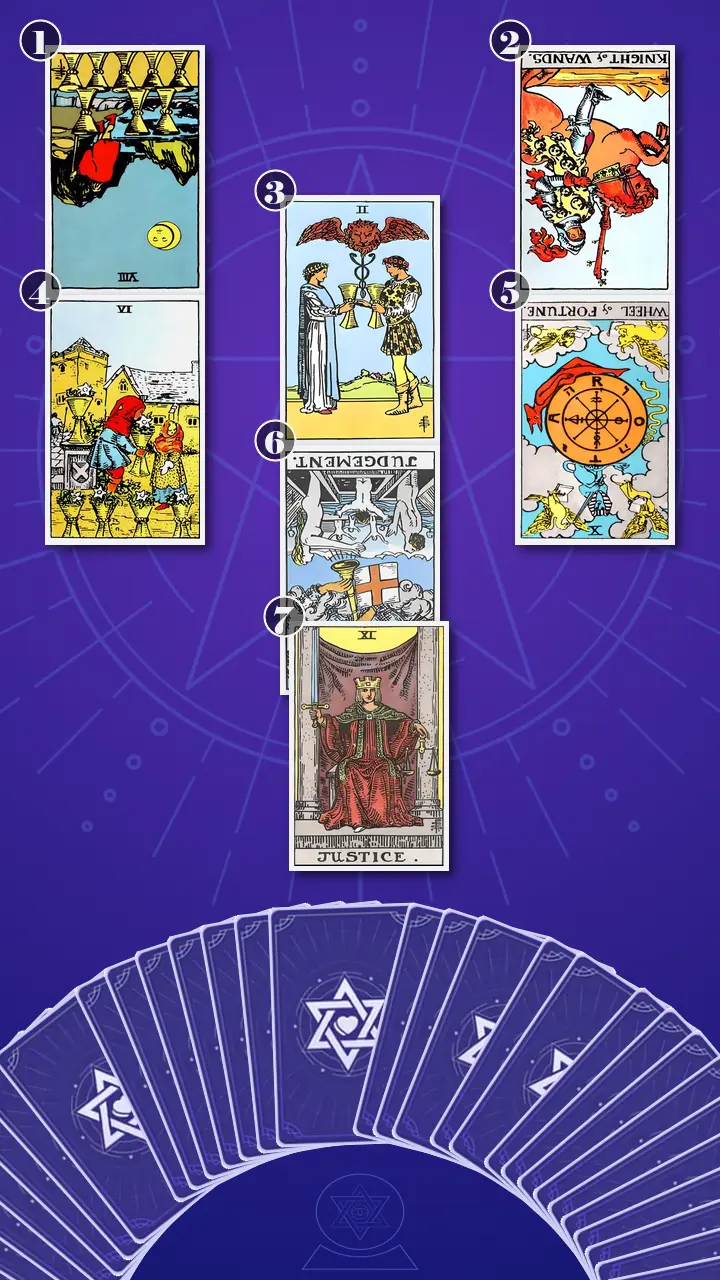
I chose the Relationship Spread · Context Edition, a seven-card relationship tarot spread designed to examine reconciliation without pretending to predict its outcome. This is how tarot works best in my practice: it externalizes a pattern so that card meanings in context can be compared with real behavior. It does not tell me what Maya's ex secretly thinks, and it does not take Maya's decision away from her.
I want to explain why this particular map mattered. A larger Celtic Cross would have introduced more environmental and future-facing material than Maya's question required. These seven positions could separate her observable contribution, the other person's observable contribution, the genuine bond, the immediate reward of reunion, the recurring obstacle, the conditional direction, and the guidance that could restore choice.
I pointed to the upper-left position. “This one will show what you visibly do when reconnection becomes possible.” I indicated the center-right position. “This one will show the repeating mechanism, not as fate, but as a sequence.” Then I touched the grounding position at the bottom. “And this one will offer a practice for deciding through affection and evidence together.”
The layout resembled two people entering a revolving door and eventually arriving at one still threshold. I told Maya that movement would not automatically count as progress in this reading. The cards would help us locate where the door could first be slowed by a conscious response.
Reading the Motion Beneath the Messages
Position One: Turning Back Before the Note Is Finished
I turned over the card representing Maya's observable stance in the reunion loop, especially her difficulty completing separation before renewed contact restored hope. It was the Eight of Cups, reversed.
I showed her the cloaked traveler, the steep moonlit path, and the visible gap in the stacked cups. Upright, the card often depicts leaving an emotionally insufficient situation to search for something more honest. Reversed here, its energy was blocked: the departure had begun, but the reflective work of leaving had not been completed before comfort called the traveler back.
“This is your 11:47 p.m. scene,” I said. “You see the warm message, open Reasons I Left, and close it after one line. Then you reply and begin arranging Saturday plans. The return ends the discomfort of separation before you have checked whether the conditions that made you leave have changed.”
I did not frame the reversal as weakness. The card was locating a mechanism: I know why I left, but if I wait, I might lose this opening. Immediate belonging moved to the foreground; unfinished separation slipped behind the glowing reply box.
“The last time contact restarted,” I asked, “what became hardest to look at once hope returned?”
Maya's breath caught. Her eyes drifted from the card to the rain-dark window as though she were replaying the screen in her hand. Then she gave one dry, bitter laugh and released the cup sleeve. “That is so accurate it's almost cruel.”
“Then let's keep accuracy from turning into accusation,” I said. “The Eight of Cups isn't shaming you for returning. It is showing the earliest moment when relief interrupts your own review. A visible moment can be redesigned.”
Position Two: The Fire That Arrives Before the Follow-Through
I turned over the card representing the other person's contribution only through behavior Maya could observe, particularly whether an intense reconnection became consistent follow-through. It was the Knight of Wands, reversed.
The horse reared beneath the Knight's raised wand. Fire was present in excess: affectionate paragraphs, confident declarations, immediate weekend plans, and the rush of “let's really do this.” Direction and continuity, however, remained underdeveloped. The meaningful evidence would appear after the first emotional surge, when there was a repair conversation to schedule, a plan to keep, or a boundary to respect.
“I can't use this card to tell you why your ex behaves that way,” I said. “I can only help you notice the pattern available to you: a vivid return followed by an unanswered question about steadiness.”
Maya told me about a recent cancellation. Four days after an affectionate reunion, a vague text had arrived while she was standing on Line 1. The rails shrieked; damp coats pressed around her; she scrolled back through the weekend's promises and examined punctuation instead of asking whether the agreed plan had been kept.
“Intensity gets the relationship moving; consistency tells you where it is going,” I said. “The reversal warns against confusing launch energy with an operating system. A push notification can create urgency while the underlying app still carries the same unresolved bug.”
Maya slowly turned her phone face down. Her jaw remained tight, but her hand stopped reaching for it.
Position Three: The Bond That Does Not Need to Be Denied
I turned over the card representing the genuine shared bond that kept drawing both people back, while keeping emotional connection separate from evidence of repair. It was the Two of Cups, upright.
The two figures exchanged cups beneath the winged lion and intertwined staff. Here the energy was balanced: affection, recognition, and participation moved both ways. I saw no need to flatten that mutual warmth into fantasy simply because the relationship had problems.
Maya described their Saturday reunion at a crowded Ossington café. The espresso machine shrieked, rain tapped the front window, and their knees touched beneath a table barely large enough for two drinks. They both softened. They listened. They laughed at an old joke before the coffees arrived. The ease was not imaginary.
“This card explains why you return,” I said. “The connection has emotional substance. But the Two of Cups is not a repair certificate. Neither cup contains a conflict plan, a boundary, an account of responsibility, or a review date.”
Maya's eyes shone, and for a moment she looked more hurt by the validation than she had by the difficult cards. “I think I've been waiting for someone to say it wasn't all fake.”
“It doesn't have to be fake for you to need more from it,” I replied. “You can honour what was mutual without requiring that warmth to prove the relationship is workable.”
Position Four: When the Playlist Makes the Past Feel Current
I turned over the card representing the reunion's immediate emotional reward and the reason difficult conversations became easy to postpone. It was the Six of Cups, upright.
The child offering a flower-filled cup stood inside a protected courtyard. The card's upright energy held tenderness, memory, and familiar safety. In balance, nostalgia can preserve meaningful history. In Maya's pattern, that energy was being overburdened: memory was asked to provide current evidence it could not contain.
She described Friday evenings in the narrow kitchen of her shared apartment. Her roommate would be out, an old takeout order would scent the room with chili oil, and their shared playlist would begin through a tinny phone speaker. One familiar joke could make her shoulders drop before either person named the last breakup.
“Spotify can restore the exact emotional weather of a relationship,” I said. “It cannot show how that relationship functions on an ordinary Tuesday. An iPhone Memories reel is not lying to you, either; it is simply an algorithm trained to serve the warmest clips while the cancellation texts remain outside the frame.”
Maya rubbed her palms against her jeans and exhaled through her nose. “This feels so natural,” she said. “I always think that has to mean something.”
“It does mean something,” I answered. “It means the comfort and history are real. It does not mean they answer every question. A reunion can be sincere and still be structurally unchanged.”
Position Five: Different Screenshots, the Same Revolving Door
I turned over the card representing the central obstacle: the self-reinforcing sequence of reunion, relief, deferred repair, and renewed disappointment. It was the Wheel of Fortune, reversed.
I traced the central wheel and the figures rising and descending around it. The energy here was blocked in repetition. There was plenty of motion, but little development. Each reunion arrived under a different date stamp and with different wording, yet the underlying decisions remained unchanged.
I asked Maya to picture the last two cycles as a four-frame montage. First came silence or a lonely date. Then a warm check-in. Next came an immediate reply and rapid intimacy. Finally, the original conflict returned after both people were emotionally reinvested. The screenshots changed; the sequence did not.
“It's relational Groundhog Day,” I said, “but not because fate has sentenced you to repeat it. In that story, the morning changes only when participation changes. Here, the first movable moment is the gap between receiving the message and resuming the old routine.”
I wrote four words on a small sheet: trigger, response, reward, cost. Beneath them, I mapped the sequence Maya had described. The trigger was renewed contact. The response was immediate availability. The reward was relief from loneliness and uncertainty. The later cost was emotional reattachment before accountability had been tested.
“The loop does not break at the next promise; it breaks at the first different response,” I said. “You may not control whether someone reaches out. You can notice what you usually do next.”
Maya leaned forward. Her index finger hovered over the word response, her gaze unfocused for a second, then her shoulders lowered by a fraction. “So I don't have to solve the whole relationship to change one part of the cycle?”
“Exactly. The Wheel is the blockage, but it is also the catalyst. One deliberate pause can give you information that another immediate reunion would hide.”
Position Six: The Conversation That Feels Deep but Skips the Review
I turned over the card representing the relationship's default trajectory if the current reunion behavior stayed unchanged. It was the Judgement, reversed.
I made the conditional nature of this position explicit. I was not predicting that Maya's relationship must fail. I was showing where the existing behavior led if no one changed it.
The angel's trumpet sounded above figures who had not fully risen into a new life. The card showed a deficiency of completed review: the wake-up call had been heard, but it had not become a different practice. Maya and her ex could spend an emotionally intense evening discussing how painful the separation had been and how much they had missed each other. When the conversation approached cancelled plans, conflict avoidance, or each person's responsibility, the subject shortened or moved to “later.”
“You have talked about how the breakup felt,” I said. “That is not the same as reviewing the behaviors that produced it. Emotional confession can be sincere and still stop before accountability.”
Maya's fingers tightened around the edge of the table. She looked down, blinking twice, and spoke more quietly. “We always say we've talked about it because we've both cried. Then I realize we never answered what either of us would actually do differently.”
“That distinction is the unanswered trumpet,” I said. “Judgement reversed asks for a relationship post-mortem, not a courtroom. The purpose is not to extract perfect admissions. It is to create a shared account of what happened and discover whether both people are willing to practise something new.”
When Justice Put Evidence Beside Affection
Position Seven: The Stillness That Finally Changes the Direction
The rain softened, and for the first time that evening the radiator went quiet. In the sudden stillness, I turned over the card representing a self-directed practice for boundaries, accountability, and observable standards without dictating whether Maya should stay or leave. It was Justice, upright.
The seated figure held balanced scales in one hand and an upright double-edged sword in the other. After cards filled with interrupted walking, rearing fire, turning wheels, and an unanswered trumpet, Justice did not rush. Its energy was balance: feeling and conduct could both be admitted, but neither could erase the other.
I brought Maya back to 11:47 p.m.: the warm message lands, her chest lifts, and Reasons I Left is already open. She closes it after one line because reunion is available now, while the harder conversation could make it disappear. The old dilemma tightened around her again.
A reunion proves the bond still has emotional force; only mutual, consistent behavior can show whether the relationship has changed.
Stop treating reunion as proof of repair; define the new behavior, observe it consistently, and let Justice's balanced scales weigh affection beside evidence.
I let the sentence remain between us without filling the silence.
For one beat, Maya stopped breathing. Her fingers stayed suspended above the table, slightly curled, while her eyes fixed on the scales. Then her pupils widened and her gaze slipped past me, as though several reunion scenes were replaying at once: the café, the playlist, the cancelled plan, the note closed after one line. Colour rose into her face. Her jaw tightened before her shoulders could soften. “But doesn't that mean I was wrong every time I went back?” she asked, and the first edge in her voice sounded closer to anger than relief. A second later, her fist loosened. Her eyes turned wet, and she released a shaky breath from deep in her chest. The release left her briefly unsteady rather than triumphant. Clearer ground meant she would have to stand on it; the cards would not make the next choice for her.
“No,” I said. “You were not wrong to feel the bond. You were asking affection to carry the entire evaluation because losing the reunion felt unbearable. Justice gives you another category of information. You can change the evaluation now without putting your past self on trial.”
“Now, with this new perspective, think back to last week,” I invited her. “Was there a moment when this insight could have made you feel different?”
Maya returned to the Ossington café. She had started to say, “We should talk about what happened,” and her ex had answered that they did not want to ruin a good afternoon. Maya had said they could do it later.
“I could have let the afternoon stay awkward,” she said. “Not to punish them. Just long enough to ask when later actually was.”
I nodded. That was the first step from longing-driven automatic reunion to evidence-based self-trust and conditional reconnection. It did not settle the relationship. It changed Maya's relationship to choice.
This was where I used what I call Daily Friction Deconstruction. I removed the dramatic accusations and looked for the mundane, mechanical failures underneath them. “Taking it slow” had no agreed contact rhythm. “We'll talk later” had no date. A cancelled plan had no shared repair process. “We'll do better” named no behaviour that a camera could record.
On Justice's scales, I replaced “You never care enough” with practical questions: Who schedules the review? How is a cancellation communicated and repaired? What contact boundary keeps reunion from silently returning to full speed? When will both people check whether the agreement is working? The lens did not make love cold. It kept vague language from hiding the same operational breakdown.
I then used Emotional Clutter Sorting to separate relationship evidence from the pressure surrounding it. Maya's brutal agency week, empty Friday kitchen, tired body, and need for familiar comfort all made reunion feel urgent. Those conditions could intensify the pull without proving either compatibility or incompatibility. Once I placed exhaustion and loneliness in their own pile, the relationship itself became easier to inspect.
“This is the Justice tarot meaning for reconciliation in your actual context,” I said. “The playlist and affectionate messages belong on one side of the scales. Kept plans, direct answers, respected boundaries, and repeated follow-through belong on the other. The sword is one clear conversation, not a threat and not a verdict. You do not have to call the love fake to ask whether the relationship works.”
I set an eight-minute timer and divided a page into two columns: Affection I Can Feel and Change I Can Observe. Maya wrote one honest item beneath each. Under affection, she wrote, “We both soften when we are together.” Under evidence, she wrote, “The repair conversation was postponed and never rescheduled.” Then she added one behaviour she would need to observe consistently before calling the reunion different: “We can discuss a difficult issue without losing the plan to revisit it.”
I reminded her that this was a private clarity exercise, not a requirement to contact anyone or decide anything that night. She could stop after two items, leave the page unfinished, or return when her body no longer felt braced against the answer.
The First Different Response
I gathered the seven cards into one coherent story. The Eight of Cups reversed showed why separation remained unfinished: renewed closeness relieved the ache before Maya reviewed why she had left. The Knight of Wands reversed showed a visible burst of reunion energy without enough sustained direction. The Two and Six of Cups confirmed that affection, recognition, and history were genuine, which explained why the return felt so persuasive.
The Wheel of Fortune reversed revealed the present mechanism: different messages kept launching the same sequence. Judgement reversed showed why the sequence survived; the pair discussed the pain of breaking up more readily than the behaviour that caused it. Justice supplied the overlooked resource: Maya's ability to name standards, compare words with conduct, and tolerate an honest answer.
The spread began in Water, moved through unstable Fire, and ended with Justice's clear, air-like sword. No Pentacles appeared. I took that absence seriously without treating it as ominous. Earth had to be supplied deliberately through calendars, response windows, repeatable actions, boundaries, and review dates. The revolving door did not need more emotional force. It needed one grounded threshold.
Maya's cognitive blind spot was not that she had forgotten the relationship's problems. She had written them down. The blind spot was treating the relief of reconnection as evidence that the relationship had become workable, then treating separation as the main problem when the unchanged interaction pattern returned.
The transformation direction was precise: before resuming the relationship, hold one calm, consensual conversation that names the previous pattern, each person's responsibility, and two observable changes with a specific review date. Reconnection could then become a conscious, conditional choice rather than an automatic response to longing.
Three Grounded Next Steps
- The 24-Hour Micro-Boundary Reset When a warm reconnection message arrives, draft your reply in Notes instead of the message thread and set a reminder for the same time the next day. During that private response boundary, write three reasons the relationship ended, three observable conditions that would make another attempt different, and one body signal you notice before replying. A pause is not punishment or a test for the other person. If twenty-four hours feels impossible, begin with two hours and send a neutral acknowledgment only if practical coordination requires it.
- The Eight-Minute Affection-and-Evidence Check On Tuesday evening, open a private phone note with two columns. Add one genuine feeling under Affection and one directly observed behaviour under Evidence. Date the evidence and describe it neutrally, such as “kept the Saturday plan” or “changed the subject when repair came up.” Record one item per column and stop. The page is information, not a verdict, a surveillance log, or a case to prosecute.
- The Consent-Based Reunion Review Before daily texting, sleepovers, or relationship-level availability resume, ask for a twenty-minute conversation in a neutral café or on a scheduled call. Use three prompts: What happened last time? What did each of us contribute? What would each of us practise differently? Define two behaviours a camera could observe and place a review date on the calendar. Use a low-pressure invitation and accept that either person may decline, pause, or suggest another time. A refusal is information, not permission to pressure; end the conversation if it becomes insulting, coercive, or unsafe.
I asked Maya to treat these as small experiments, not hoops her ex had to clear and not a disguised demand for a forever answer. Their purpose was to help her see whether affection was being matched by reciprocity. Tarot had supplied the map; Maya would decide where, whether, and under what conditions she walked.

Five Days Later: A Quiet Proof
Five days later, Maya messaged me. She had sent the twenty-minute invitation, then left the chat closed. Her ex asked for time. Maya slept through the night, woke thinking, “What if I'm wrong?” and smiled once. She still missed them; she had simply stopped letting missing press Send.
No relationship decision had been completed, and I did not mistake one steadier week for a finished transformation. The proof was smaller and more useful: Maya had interrupted the automatic reunion script long enough to hear her own standard. Her clarity was not certainty about the relationship. It was ownership of the next response.
I have watched many people assume that a tarot reading should reveal whether an ex is “the one” or whether reconciliation will succeed. I believe its more grounded value is this: the cards can place a familiar sequence where we can see it, test it against reality, and identify the point where choice is still available. The querent, not the deck and not the reader, remains the author of what happens next.
When a warm message makes your chest lift, I know it can feel almost impossible to ask what will change. The same question that protects you may also reveal that the belonging you miss cannot meet you on the other side of the revolving door. Simply noticing that tension means you are no longer standing at the cycle's unconscious beginning.
If affection did not have to decide the whole relationship tonight, what one observable change would you place on Justice's other scale before stepping through that revolving door again?