Potential Attachment and the Shift from Voice Notes to Follow-Through

The 8:47 p.m. Potential Attachment Loop
I met Casey, a 29-year-old junior product designer in Toronto, at the point where a professional strength had begun working against them. They could read a user journey, anticipate what a product might become, and spot meaning beneath the surface. In dating, that same skill had turned into rereading every message for signs of future readiness while the present plan remained undefined.
At 8:47 on a Tuesday evening, I could see a Figma file glowing on Casey’s laptop behind our video call. The radiator clicked beside them as they scrolled through Instagram Stories of rooftop dinners, then replayed a voice note about the kind of partner someone hoped to become. The phone warmed their fingertips. Their chest gave a bright pull toward possibility, followed by a hollow drop when they looked at the still-unanswered question about the weekend.
“Why do I keep falling for potential instead of actual readiness?” Casey asked. “If they can describe the future so clearly, there must be something real there. I don’t want to leave just because the present is unfinished.”
I heard the core contradiction immediately: Casey wanted a relationship that was mutually available now, yet they kept bonding with the person someone might become. Their longing felt like hearing the opening notes of a favorite song through an apartment wall, then standing motionless in the hallway because the melody might eventually become an invitation.
“You are not confused because you cannot see the future,” I said. “You are confused because the future someone described feels more emotionally real than what they are offering now. You are not falling for nothing; you are giving a future story more weight than the present evidence can carry.”
I watched their shoulders lower by half an inch. “I’m not here to tell you whether to stay or leave,” I added. “Tarot cannot decide another person’s readiness or predict who they will become. What we can do is make this pattern visible, separate what you know from what you hope, and draw a map through the fog. The choice remains yours.”

Choosing a Map for the Fog
I invited Casey to place both feet on the floor, take one unforced breath, and hold their question without trying to answer it. I shuffled slowly. I use that small ritual as a transition for attention, not as a performance of certainty.
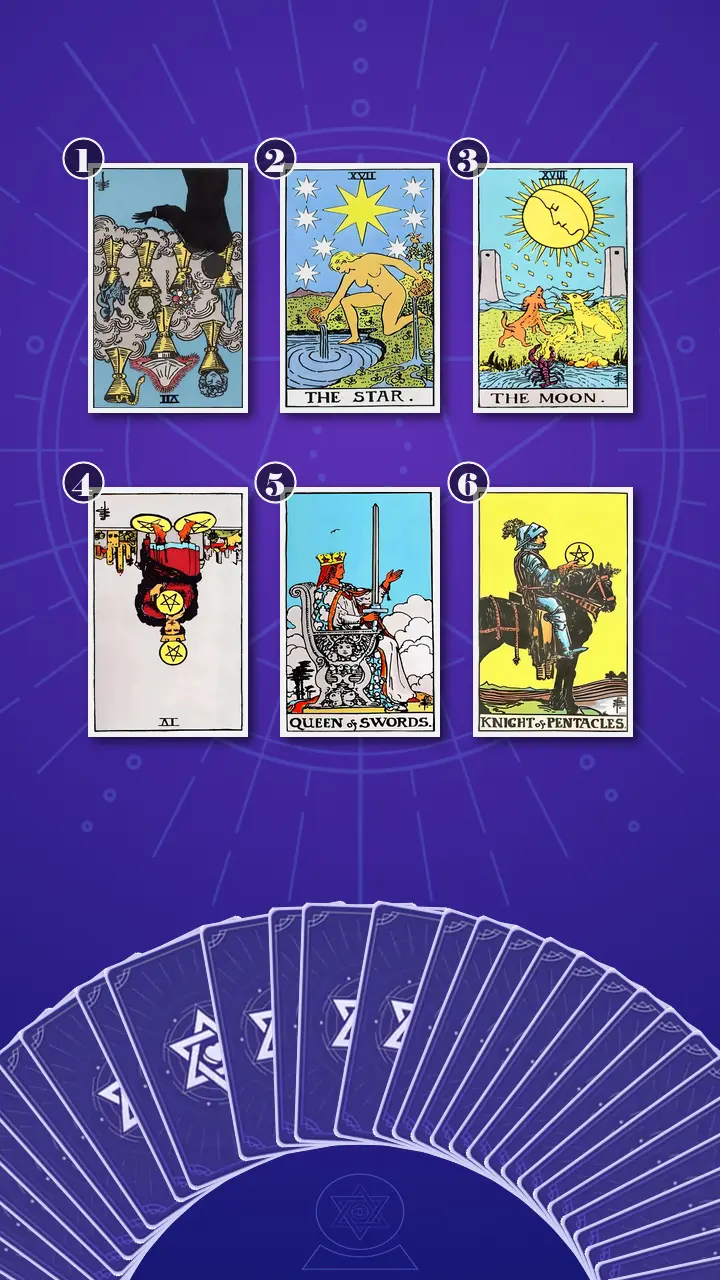
For this relationship tarot reading, I chose The Shadow Spread · Context Edition. For anyone wondering how tarot works in a situation like this, I use the cards as a structured reflection tool: each position isolates one part of a repeated pattern so emotions, assumptions, fears, and observable behavior do not blur into one overwhelming conclusion.
This six-card spread was more useful than a predictive layout because Casey’s question was not, “Will this person become ready?” It was, “Why do I keep investing as though potential were readiness?” The spread moves directly from the visible habit to the hope attracting Casey, the projection hidden beneath it, the fear keeping it in place, the discernment that can interrupt it, and an embodied next step. It keeps the reading centered on Casey’s agency rather than another person’s hypothetical future.
I placed the cards in a two-row grid. The first position would show the presenting shadow pattern. The third would reveal the projection operating inside mixed signals. The fifth, our key position, would identify the reality-based integration capable of challenging the blind spot. The sixth would bring that insight down into behavior Casey could observe in an actual calendar, not just in an emotionally persuasive conversation.
Reading the Waterline of Mixed Signals
Position One: The Future Built from Saved Messages
“The card I’m turning over now represents the presenting shadow pattern: the concrete behavior of privileging imagined potential over current readiness,” I said.
It was the Seven of Cups, in reversed position.
I pointed to the cups suspended in clouds. “This looks like what happens after an exciting date when you save someone’s thoughtful messages in a Notes page organized by values, future goals, and possible compatibility. Then the next plan stays vague, so you look at the accumulated promise instead of the missing action. Seven emotionally meaningful messages begin floating above one practical question: when are you actually meeting again?”
I read the reversal as a blockage in discernment and an excess of imaginative selection. Casey’s ability to envision possibilities was not defective; it had simply become more vivid than the evidence available to test those possibilities. The imagined relationship was receiving the emotional investment of something already happening, while inconsistent availability was being treated as a temporary design issue.
“After the last promising conversation,” I asked, “what did this person actually do next, and what future scene did your mind add when the follow-through stayed unclear?”
Casey gave one short, bitter laugh. Their thumb stopped rubbing the edge of the phone. “That is so accurate it feels kind of brutal. I have a note literally called ‘green flags.’ I don’t have a section for whether they made the next plan.”
I did not rush to turn that recognition into shame. “The card is describing a sorting habit, not a character flaw,” I said. “Your imagination is excellent at generating a future state. It just cannot also be responsible for verifying whether that future is being built.”
Position Two: The Star over the Product Roadmap
“The card I’m turning over now represents your conscious attraction: the promise, hope, and future possibility that make potential feel so compelling,” I said.
I revealed The Star, upright.
Casey’s face softened before I spoke. I understood why. The Star is not foolish hope; it is sincere openness to healing, growth, and a meaningful future. In Casey’s dating life, it appeared whenever someone described the partner they hoped to become, the home they wanted, or the personal work they intended to do. Casey felt bonded to that vision in the same way a designer can become invested in a beautifully articulated product roadmap even though the basic feature has not shipped.
I read The Star as a balanced capacity for hope being asked to compensate for a deficiency in evidence. One foot in the card rests in water and one on land. Casey did not need to drain the water or become cynical. They needed to keep one foot on the ground of current plans, mutual availability, and follow-through.
“What part of someone’s future vision begins feeling like shared reality to you before the two of you have created a shared pattern?” I asked.
Casey looked away from the cards and toward the dark apartment window. “When they talk about wanting to be more secure and intentional,” they said. “I hear it as if they are saying they’re going to be that way with me.”
“That distinction matters,” I replied. “A person can mean every word of their vision. Sincerity tells you the vision may be real to them. It does not tell you whether they can live it with you now.”
Position Three: The Moon inside the Unanswered Chat
“The card I’m turning over now represents projection and hidden influence: the inner story that makes present evidence easier to reinterpret,” I said.
The card was The Moon, upright.
I asked Casey to remember a recent Line 1 commute. They described seeing that the person had viewed their Instagram Story but had not answered the message about Saturday. Under the fluorescent buzz of the TTC carriage, Casey had compared timestamps, replayed a vulnerable conversation, and typed two friends to ask what the silence might mean. The observable fact was simple: there was no confirmed plan. The inner monologue was more elaborate: Maybe they are scared because this matters. Maybe they need to feel safe before they can show up.
“That is The Moon’s winding path in modern form,” I said. “One ambiguous message branches into several emotionally convincing theories. The dog and wolf are the familiar and alarmed parts of you reacting to the same unclear signal.”
The Moon was upright, but its energy was operating in excess through projection and in deficiency through Casey’s limited tolerance for not knowing. Uncertainty had become an algorithm that kept recommending the same person because every missing detail invited another round of analysis. The intensity of not knowing was beginning to feel like proof that the connection itself must be unusually deep.
“Which facts are clear?” I asked. “Which details are guesses? And what are you hoping the unclear parts will eventually prove?”
Casey’s breathing paused. Their gaze drifted past the screen as if the TTC window had appeared in front of them again; then their jaw released with a quiet click. “I keep treating silence like a puzzle,” they said. “I never let it mean that availability is simply unclear.”
“Exactly,” I said. “You do not need to label the silence rejection, manipulation, or hidden love. ‘Unclear’ is already usable information. Tolerating uncertainty means resisting the urge to promote your most hopeful interpretation into a fact.”
Position Four: The Saturday Held in Reserve
“The card I’m turning over now represents the underlying fear: what you believe might be lost or proven if you require actual readiness,” I said.
I turned over the Four of Pentacles, in reversed position.
I described the modern image I saw in it: a promising person’s chat pinned at the top of the phone, Saturday afternoon left open, and a clearer invitation from a friend declined because closing the romantic possibility felt like losing something rare. The figure clutching a pentacle to their chest became Casey holding a hypothetical calendar slot close enough to feel protected by it.
The reversal showed blocked movement around security. Casey was trying to loosen their grip, yet fear kept turning emotional availability into a way of holding the connection in place. The strategy briefly reduced the fear of loss, but it restricted Casey’s time, attention, and access to reciprocal choices. Their life remained paused so a future version of the relationship would always have room to arrive.
“If you stopped keeping the weekend open,” I asked, “what would you fear that choice said about your chance of belonging?”
Casey’s fingers curled around the phone, held, and then slowly opened. “That I gave up on something rare,” they said. “And maybe that I’m not the person someone finally becomes ready for.”
I let the sadness in that sentence have room. “Someone can be a good person, have real potential, and still not be available for the relationship you need now,” I said. “Keeping your time does not deny their growth. It stops their possible future from occupying your present by default.”
When the Queen’s Sword Changed the Tempo
Position Five: Clear without Cruel
The radiator chose that moment to stop clicking. The room on Casey’s side of the screen became unusually still as I reached for the central card.
“The card I’m turning over now represents reality-based integration: the discernment, boundary, and directness that can challenge this blind spot,” I said.
I revealed the Queen of Swords, upright.
Her sword stood in a clean vertical line, but her other hand remained open. I read that pairing as balanced Air energy: clear perception without contempt, direct communication without punishment, and compassion without porous standards. In Casey’s life, she looked like one sentence typed beside a blank Notes page: “I like getting to know you. What are you realistically available for right now?”
Ten years of sound energy research have trained me to notice when distress is produced by rhythms that cannot stay synchronized under pressure. Looking at these cards, I thought of two audio tracks drifting farther apart even though each sounded beautiful on its own.
I told Casey I wanted to run what I call a Communication Dissonance Audit. I do not begin with whether the words sound romantic or whether either person is sincere. I listen for the mismatch in emotional tempo and frequency. In this connection, the voice notes about growth moved in a warm, expansive legato. The calendar moved in dropped beats: vague dates, delayed answers, and no dependable rhythm of repair. Casey’s longing had synchronized with the melody of future promises while their actual life was being asked to dance to inconsistent percussion.
“The audit does not prove that the future talk is fake,” I said. “It shows that the emotional tempo of the story and the behavioral tempo of the relationship are not currently aligned. Both can be true. They still do not form one stable track.”
I asked Casey to picture the exact 8:47 p.m. scene again: the warm phone, the beautiful voice note about future growth, and the unconfirmed weekend plan they kept protecting. The story already felt like a relationship, while only the voice note and the absence of a plan were observable.
You do not have to turn potential into proof; let the Queen's raised sword separate a compelling story from the readiness actually shown.
Potential is a hypothesis, not present-tense evidence of readiness. You can honor the vision, care about the person, and still let consistent action and clear communication tell you what is available now.
I let both sentences rest. Casey’s inhale stopped first; their fingers hovered above the locked phone, and their eyes widened as though a familiar memory had been paused on a single frame. Then their mouth tightened. “But doesn’t that mean I was wrong this whole time?” they asked, the words sharper than anything they had said before. I heard anger protecting grief, so I did not argue with it. “No,” I said. “It means your hope recognized real qualities and then took on a second job as evidence. You were trying to protect belonging with the tools you had.” Their gaze lost focus while they replayed something privately. Their fist loosened, one finger at a time; their shoulders sank; their eyes shone. A long breath left them with a slight tremor. “Oh,” they said. The relief was followed by a brief, almost dizzy blankness. “Then I have to let the answer count, even if I don’t like it.”
“Now, using this new perspective, think back to last week,” I said. “Was there a moment when this insight could have made you feel different?”
Casey nodded toward the phone. “Friday. They sent a long apology and said they were working on themselves, but they still didn’t make another plan. I felt close again because of the apology. I could have let it be sincere without calling it readiness.”
I saw the key shift take shape: not from feeling to numbness, and not from hope to suspicion, but from longing-driven idealization and delayed boundaries toward clear discernment, compassionate standards, and steadier self-trust. Casey could appreciate who someone might become without granting that future version the privileges of a present relationship.
Position Six: The Calendar Becomes Evidence
“The card I’m turning over now represents the embodied next step: a small, observable standard for evaluating readiness through consistent action over time,” I said.
The final card was the Knight of Pentacles, upright.
I drew Casey’s attention to the still horse, the carefully held pentacle, and the cultivated field. This Knight does not confuse slowness with vagueness. In practical terms, Casey could watch whether plans were made, kept, repaired, and communicated across several interactions. They could keep living their own schedule instead of rewarding one intense conversation with unlimited emotional access.
I read the Knight as balanced Earth energy: patience paired with observation, steadiness paired with self-respect. It was not passive waiting for someone to change. It was the deliberate choice to let ordinary behavior carry more weight than a beautiful demonstration. In Casey’s work language, readiness was the feature that kept working across several sprints, not the inspiring product demo that disappeared once the meeting ended.
“Let the calendar carry some of the meaning the messages have been carrying alone,” I said. “You do not have to predict the whole relationship. You only need to notice whether the next real action supports the stated intention.”
Casey looked at the cards, then at the calendar tab behind our call. Their expression held relief and grief at once. “That sounds almost too simple,” they said.
“Simple does not mean emotionally easy,” I replied. “It means observable.”
Giving the Story Back to the Calendar
What the Six Cards Said Together
I read the spread back as one coherent sequence. A skill Casey had practiced for years—seeing future possibilities beneath an unfinished surface—had been rewarded at work and amplified by dating apps, vulnerable voice notes, and carefully edited relationship content. In the present, the reversed Seven of Cups showed that imagined compatibility was crowding out current data. The Star explained why: hope and shared aspiration genuinely mattered to Casey. The Moon showed the hidden mechanism, where ambiguity became a puzzle and uncertainty was mistaken for depth. The reversed Four of Pentacles revealed the fear beneath the loop: letting go of a hypothetical slot felt like surrendering belonging. The Queen of Swords restored clear language, and the Knight of Pentacles returned that language to the ground of repeated behavior.
The cognitive blind spot was not that Casey failed to notice inconsistency. They noticed it every time. The blind spot was that they treated inconsistency as a temporary footnote while promoting potential into the main evidence. It was like standing before a movie trailer and calling it the whole film, or mistaking a beautifully written roadmap for a shipped feature.
The transformation direction was equally specific: shift from bonding with who someone might become to evaluating whether their present actions consistently match the readiness Casey needs. No villain was required. No instant breakup was prescribed. The cards simply returned hope, discernment, and behavior to their proper roles.
Three Small Present-Tense Readiness Checks
I offered three experiments, with explicit permission for Casey to begin with only one. Actionable advice should reduce decision fatigue, not become another relationship project to perfect.
- The Two-Column Potential Ledger After the next promising date or intense conversation, open a private phone note called “Readiness, Not Potential.” Under “What happened,” record one observable fact: who suggested a plan, whether a time was chosen, whether a message was answered, or whether a missed commitment was repaired. Under “What I imagined,” record one future story your mind supplied. Keep the whole exercise under two minutes, and wait twenty minutes before rereading the chat for reassurance. Tip: This is an orientation tool, not a case file to send or defend. If it increases distress, close the note and return to an ordinary grounding activity.
- The Compassionate Clarity Question Choose one connection whose intentions sound promising but whose availability remains unclear. Draft one text: “I enjoy talking with you. What are you realistically available for right now?” Before sending or adding an apologetic paragraph, use my Syncopation Pause: listen to the nearest sound for three seconds, let one quiet beat interrupt the urgency, and soften your jaw as you lower the emotional BPM. Send only if the question still feels aligned, then put the phone down for ten minutes. Tip: The purpose is to receive information, not force certainty. You may ask once, decide how much access to offer, and leave the conversation if the response is disrespectful or unsafe.
- The Seven-Day Calendar Release For the next seven days, do not reserve time for a date unless a day, time, and place have been confirmed. Accept ordinary invitations, keep your rest, and allow a promising connection to meet you inside a life that is already moving. At the end of the week, review whether plans were made, kept, repaired, and communicated. Tip: Start with one weekend block. Keeping your plans is neither punishment nor a test; it is permission for your time to remain yours.
“None of these practices decides whether this person has potential,” I told Casey. “They help you notice whether the relationship available now can meet you. You remain free to stay curious, step back, ask another question, or make no final decision yet.”

A Saturday No Longer on Hold
Six days later, Casey wrote: “I sent the question. They said they couldn’t offer consistency now. It hurt. I kept Saturday and went to the gallery.” On Sunday, their first thought was, What if I left too soon? This time, they smiled at it instead of obeying it.
I did not read that message as proof that Casey had solved their dating life. I read it as a small, credible change in rhythm. They had allowed an answer to be information, kept one afternoon inside their own life, and felt disappointment without converting it into another season of waiting.
That was the quiet proof of our Journey to Clarity. The Shadow Spread had not made a decision or revealed a fixed destiny. It had made the internal sequence visible. Casey supplied the honesty, chose the experiment, sent the message, and reclaimed the calendar. The agency was theirs from beginning to end.
When you are staring at a warm phone screen with your shoulders tight and your chest bright with hope, it can feel safer to wait for someone’s future self than risk learning that their present availability cannot offer the belonging you wanted. You do not have to turn hope into proof to honor what you felt.
If hope could stay in the room without holding your Google Calendar hostage, what one present-tense sign—made, kept, repaired, or communicated—would you feel curious to notice this week?