Finding Clarity in the 11:47 p.m. Thread Re-Open
If you’ve ever promised yourself you’d respect their “space,” then found yourself reopening the thread an hour later because they were “online” (classic pursue–withdraw trap), this is for you.
Jordan showed up to our session the way a lot of Toronto weeknights feel in late winter: still wearing work clothes, hair scraped back like she’d been negotiating with her own nervous system all day. She told me about Wednesday at 11:47 p.m.—streetlight glow through the blinds, the steady hum of a fan, and her phone warm from living in her palm too long.
“I was lying on top of the duvet,” she said, staring past me like she could still see the screen. “I kept rereading the last message like it had a hidden subtext. I told myself I wouldn’t text. And then I… opened it anyway. Just once.”
Her chest felt tight, she said, and her hands had that buzzing, can’t-settle feeling—like her body was a subway platform right before the train arrives, vibrating with the need for movement. The contradiction sat right under her ribs: she wanted reconnection and reassurance, and she was terrified that if she gave space, she’d be rejected and forgotten.
“I know I should give space,” Jordan said. “But what if space just means disappearing.”
I nodded, slow and steady, the way I do when someone is already bracing for judgment. “That makes sense,” I told her. “Not because chasing is the answer—but because your body is treating uncertainty like an emergency. Let’s make a map of the chase cycle so you can step off it with dignity. This is a Journey to Clarity, not a test of willpower.”

Choosing the Compass: The Celtic Cross · Context Edition
I started the way I always do—no theatrics, just a clean transition from spiraling to observing. I asked Jordan to put both feet on the floor, inhale for four, exhale for six. Then I shuffled slowly, not as a ritual for fate, but as a way to give her mind something simple to hold while the rest of her settled.
“Today,” I said, “we’re using the Celtic Cross · Context Edition.”
For anyone reading who’s wondered how tarot works in a situation like this: I’m not using cards to predict whether someone will text back. I’m using a structure—the Celtic Cross spread—to trace a chain. In this case, it maps the visible chase-cycle behavior (what you do after they ask for space) down into the deeper driver (what your nervous system is trying to prevent), then back up into an actionable interruption point and an integration move you can actually live.
This is why the Celtic Cross is perfect for a career crossroads—and also for a relationship crossroads: it doesn’t settle for “yes/no.” It shows mechanics, and mechanics can be changed.
“We’ll start with the center,” I explained, tapping the table. “Card 1 is what you’re doing in real time. Card 3 goes underneath—what’s driving it under the surface. And Card 10 at the top of the staff is integration: the empowered way to communicate and hold boundaries so you can exit the chase cycle.”
Jordan swallowed and nodded, like she was both scared of the truth and desperate for it.
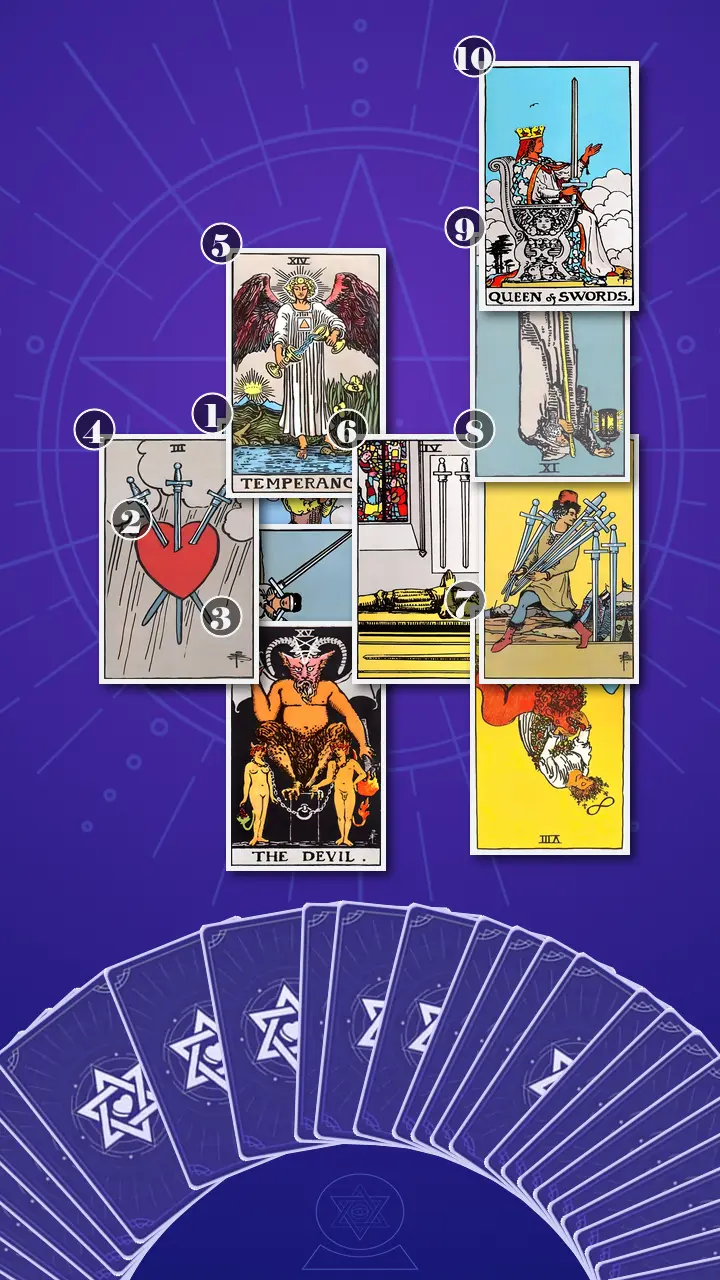
Reading the Map: The Chase Cycle, One Card at a Time
Position 1 — The current chase-cycle behavior in real time
“Now we’re turning over the card that represents the current chase-cycle behavior in real time—what you actually do after they ask for space,” I said.
Page of Swords, upright.
In the card, the Page holds the sword up like they’re on watch. The wind whips their hair and the clouds. It’s alertness—hyper-alertness.
“This is you with your phone in your hand,” I told Jordan. “Refreshing the chat. Checking Instagram. Treating ‘last seen’ like it’s a live stock ticker for your self-worth.”
Air energy is dominant here: thought, interpretation, scanning. It’s not that you’re “crazy.” It’s that your attention gets pulled outward, hunting for certainty, because your body believes certainty is the only thing that will let it unclench.
Jordan let out a small laugh that sounded like it had teeth. “That is… too accurate,” she said. “Like, kind of brutal.”
“Accurate doesn’t have to be cruel,” I replied. “It just means we’re looking at the real pattern, not the version you wish you were doing.”
Position 2 — What blocks you from stopping
“Now we’re turning over the card that represents what blocks you from stopping—the tension you keep pushing against,” I said.
Two of Swords, upright.
A blindfold. Two swords crossed right over the heart. Calm water behind her, but she can’t access it because she’s bracing.
“This is the bind,” I told Jordan. “Part of you wants to respect their boundary. Part of you wants reassurance now. And instead of choosing a container, you hold the tension until it spikes—then you reach out.”
The Two of Swords is not lack of intelligence. It’s emotional stalemate. It’s the moment you think, I can’t decide without more information, while reality is saying, more information isn’t available right now.
Jordan stared at the blindfold in the image. Her fingers tightened around her coffee cup, then loosened, like her body was practicing letting go without her permission.
Position 3 — The hidden root driver beneath the chase
“Now we’re turning over the card that represents the hidden root driver beneath the chase—the compulsion behind the urge,” I said.
The Devil, upright.
The chains in this card are always the part I focus on: they’re loose enough to slip off, but the figures don’t move. That’s what compulsion feels like—I could stop, but I can’t stop.
“Here’s the truth,” I said gently. “You’re not texting to connect. You’re texting to stop the feeling.”
I watched Jordan’s eyes flick to her phone on the table and back, like it was a magnetic field. I layered the contrast, the way the spread invites it: the blindfold of the Two of Swords—trying to decide while refusing the reality that you don’t have full info—and the loose chain of the Devil: the thumb hovering, the stomach drop, the bargaining thought—If I just send something small, I’ll calm down.
Jordan’s breath caught, then released in a long exhale. “Oh,” she whispered. Not embarrassed. More like relieved to have the mechanism named without shame.
“The Devil isn’t a moral judgment,” I added. “It’s an honest diagnosis of a loop: short-term relief, long-term cost. The loop convinces you that if you don’t act now, you’ll be replaced or forgotten.”
I let the silence hold for a beat. Then I offered one of my anchor phrases, quietly: “You don’t have to outsource your calm to their reply.”
Position 4 — What recently triggered the cycle and made it urgent again
“Now we’re turning over the card that represents what recently triggered the cycle and made it feel urgent again,” I said.
Three of Swords, upright.
The heart on the card is stark and red against grey weather. Three blades right through it. It’s not subtle. It’s impact.
“This is the moment ‘I need space’ landed in you,” I told her. “And your mind keeps touching the wound to see if it’s still there.”
Jordan nodded once, sharp. “I replay the exact wording,” she said. “Like if I can find the one line I missed, I’ll… fix it.”
“That’s the marketing brain in you,” I said, and she looked up. “You’re used to running campaigns where the right tweak changes the metric. But people aren’t dashboards. Silence isn’t a KPI.”
The Three of Swords doesn’t ask you to text your way out of pain. It asks you to treat pain as something to care for, not something to erase by chasing.
Position 5 — What you consciously want instead
“Now we’re turning over the card that represents what you consciously want instead—your stated intention and ideal outcome,” I said.
Temperance, upright.
The angel pours between two cups with a steadiness that’s almost boring—until you realize how rare steadiness feels when you’re activated. One foot in water, one on land. A path toward light.
“You’re not trying to become cold,” I told Jordan. “You’re trying to become steady.”
As a Paris-trained perfumer, Temperance always feels personal to me. Blending isn’t dramatic. It’s disciplined. It’s knowing that if you keep adding notes because you’re afraid the formula isn’t ‘enough,’ you don’t get a masterpiece—you get mud.
“Temperance is the part of you that wants a calm plan,” I said. “One respectful message, one boundary, and then you returning to your routines. No swinging between overtexting and total shutdown.”
Jordan’s shoulders lowered a fraction, like her body recognized the word plan and stopped fighting for a second.
Position 6 — The most likely near-term shift if you interrupt the pattern
“Now we’re turning over the card that represents the most likely near-term shift if you interrupt the pattern—the next emotional weather,” I said.
Four of Swords, upright.
In this image, the swords aren’t in anyone’s hands. They exist, but they’re not being wielded. The figure rests. There’s a hush to it.
I described it the way it arrives in real life: “Phone goes into a drawer. Focus mode turns on. The room gets quieter. Your shoulders drop one notch.”
Jordan’s eyes softened like she could feel the scene in her body before she believed she could do it.
“This isn’t ghosting,” I said. “This is a container.”
And I gave her the line I wanted her nervous system to borrow: “A pause isn’t a game—it’s a container.”
The Four of Swords is the first realistic interruption point for a chase cycle. Not because you suddenly stop wanting them, but because you stop reacting to the craving for relief like it’s a command.
Position 7 — How you are showing up internally
“Now we’re turning over the card that represents how you are showing up internally—your self-state, attachment activation, and agency,” I said.
Strength, reversed.
Strength is gentle hands on a lion. Reversed, it’s not weakness—it’s self-doubt about your ability to handle the surge without outsourcing it.
“This is you treating texting like the only off-switch,” I told Jordan. “The moment your chest tightens, your brain says: Do something. Do it now.”
Then I named the overcorrection risk, because I see it so often: “And when you try to prove you’re ‘strong,’ you go cold. You mute them. You open Hinge. You make plans you don’t even want. Then the loneliness hits at night and you rebound into contact.”
Jordan’s mouth tightened and then relaxed. “Yeah,” she said, barely audible. “I hate that I’m like this.”
“We’re not going to hate you into stability,” I said. “We’re going to build it in 90-second increments.”
Position 8 — The external feedback loop you’re reacting to
“Now we’re turning over the card that represents the external feedback loop: their signals, the social/digital environment, and what you’re reacting to,” I said.
Seven of Swords, upright.
This is information asymmetry. Someone holding cards close. Partial signals that make your mind fill in blanks.
“This is like trying to plan your whole week from a vague calendar invite,” I said. “No time, no agenda, just ‘TBD.’ Your brain will try to do project management on a situation that’s not giving you the data.”
We talked through the modern cues that hook her: they’re online, they viewed her story, they reply with “busy rn” or “lol,” and the gap becomes a canvas her anxiety paints on.
“Missing information is still information,” I told her. “It doesn’t mean they’re evil. It means certainty isn’t available right now. And if certainty isn’t available, chasing isn’t problem-solving—it’s self-abandonment.”
Jordan’s gaze dropped to the table. She nodded once, slow, like she was finally letting the environment share the blame.
Position 9 — The hope–fear loop that keeps you reaching
“Now we’re turning over the card that represents the hope–fear loop that keeps you reaching—what you’re afraid will happen if you stop chasing,” I said.
The Hermit, reversed.
In the Hermit, there’s a lantern—your own light. Reversed, the fear is that solitude won’t restore you; it will erase you.
“This is the part of you that treats alone time like punishment,” I said. “So you keep checking. You keep pinging. Because the quiet feels like proof you don’t matter.”
Jordan’s hands went still for the first time. Three tiny beats happened in her face: a blink that lingered too long, her jaw tightening, then her lips parting like she was about to say something she’d been hiding from herself.
“Weekends are the worst,” she admitted. “Nights. It’s like the silence gets loud.”
“That’s the reversed Hermit,” I said. “Your phone becomes a lantern you keep lifting into the dark. But it’s not guiding you. It’s just keeping you awake.”
When the Queen of Swords Held the Line
Position 10 — Integration: the empowered way to communicate and hold boundaries
I touched the last card before turning it, and the air in the room shifted. Even the fan sounded louder for a second, like the space was making room for the point of the whole reading.
“Now we’re turning over the card that represents integration: the empowered way to communicate and hold boundaries so you can exit the chase cycle,” I said.
Queen of Swords, upright.
Jordan’s eyes went straight to the sword—upright, clean, not flailing. The Queen’s gaze is direct, but not cruel. There’s an open hand, too: honest, not punishing.
Setup: I could almost see the scene in her body: that moment they asked for “space,” and suddenly she’s holding her phone like it’s a life-support device—refreshing the thread, rereading tone, trying to text her way out of silence.
Delivery:
Not another perfectly crafted text to win closeness—one clear boundary, like the Queen of Swords holding her blade upright.
I let that sentence sit between us, the way a clean scent sits in the air when you stop overspraying. In my old training, we called it the moment you stop “fixing” and let the formula reveal itself.
Jordan’s reaction came in a chain—fast, human, messy in the best way. First, she froze: breath paused mid-chest, eyes widening a fraction. Then her gaze unfocused, like her mind replayed every draft she’d typed and deleted, every “no pressure” she didn’t mean. Finally, emotion moved in: her shoulders dropped, but her mouth pulled tight with something like anger.
“But if I do that,” she said, voice sharper than before, “doesn’t it mean I’ve been doing it wrong? Like… I’ve been embarrassing myself?”
“It means you’ve been trying to survive,” I said, steady. “And survival strategies get weird when your nervous system thinks it’s about to be abandoned.”
Then I brought in the lens that makes my work mine—my Emotional Repair Pathway. “In fragrance, there’s a difference between a quick fix—covering a smell—and true repair: neutralize, ventilate, rebuild. Relationships are similar. Repair isn’t ‘more contact.’ It’s a phased system.”
I held up three fingers. “Phase one: contain—you stop bargaining with panic. Phase two: clarify—one message, one boundary, no overexplaining. Phase three: rebuild—only if the other person meets you with reciprocity.”
Jordan swallowed. Her eyes went wet, not dramatic—just honest. “So I can miss them,” she said slowly, “and still be precise.”
“Exactly,” I said. “You don’t earn clarity by chasing their nervous system—you choose clarity by setting your line and protecting your self-respect.”
I leaned in, just a little. “Now, with that new lens—think back to last week. Was there a moment where you reached for the phone, not because you had something true to say, but because you needed the feeling to stop?”
Jordan’s hand drifted to her sternum, as if to confirm where the urge lived. “Yeah,” she whispered. “Friday night. They watched my story. I felt hope for like two seconds. Then my stomach dropped.”
“That’s the exact pivot point,” I said. “This reading isn’t only about a decision. It’s about moving from restless urgency to a grounded, self-led stance—where you can tolerate uncertainty, respect their boundary, and still protect your own dignity and needs.”
The One-Message Boundary Ladder: Actionable Advice to Break the Chase Cycle
When I stitched the whole spread together, the story was painfully coherent. Page of Swords showed the vigilance—refreshing, rereading, scanning for signals. Two of Swords showed the standoff—“respect space” versus “get reassurance now,” with the blindfold of needing certainty that isn’t available. The Devil named why “just don’t text” fails: the chase is a compulsion for relief. Three of Swords reminded us the pain is real. Temperance offered the north star: moderation, pacing, a sustainable rhythm. Four of Swords opened the door: a chosen pause container. Strength reversed showed the skill to build: self-soothing without shutdown. Seven of Swords located the external trap: mixed signals and information gaps. Hermit reversed named the fear: that quiet equals erasure. And the Queen of Swords gave the exit: clean boundaries, self-respect, and direct communication without overexplaining.
The cognitive blind spot here is subtle: it’s believing that your discomfort means you must act—when actually, discomfort is often just your nervous system asking for a container.
The transformation direction is equally specific: shift from trying to get regulation through their response to creating a self-chosen pause + a clear boundary for your next contact.
Here are your next steps—small, real, and built for the moments when your hands start buzzing and your thumb wants to bargain.
- The 90-Second Relief CheckBefore any text, put the phone face-down. Set a timer for 90 seconds. Breathe slowly and label the urge in plain language: “I want relief.” When the timer ends, decide again—send nothing, draft in Notes, or take a walk.Your brain will argue. That’s normal. Lower the bar: 90 seconds counts, even if you still feel shaky after.
- The 24-Hour “Pause Container” (Four of Swords)Choose a 24-hour window where you do not open the chat thread and do not check “online” cues. Use Apple Focus mode or move the app into a folder literally named “Not Now.” Tell one friend you’re doing it so you don’t recruit the group chat as a decoding committee.Use my space-clearing strategy: open a window, wipe one surface, and add one grounding scent (a candle, a shower gel, even hand cream). You’re training your body to associate “space” with safety, not erasure.
- The Queen of Swords Draft (One Message, Two Parts)Set a 10-minute timer. In Notes (not the chat), draft ONE message with only two parts: (1) a clear boundary about space, (2) what you’ll do next (a check-in plan or stepping back). Stop at two parts. Do not add a paragraph.Remember: “One message is communication. Five messages is bargaining.” If you feel the impulse to explain, that’s your cue to end the draft and return to your life.

A Week Later: Ownership, Not Certainty
A week after our session, Jordan messaged me—not with a screenshot, not with a new theory. Just a small report like she was logging a real experiment.
“Did the 24-hour container,” she wrote. “Moved WhatsApp into a folder called Not Now. Did the 90-second thing twice. Drafted the boundary in Notes. Didn’t send it yet. But I didn’t open the thread. I went for a walk by the waterfront instead.”
It wasn’t a Hollywood ending. It was better: it was proof she could stop negotiating with panic.
She later told me she slept through the night for the first time in weeks—then woke up with the thought, What if I’m wrong? She sat up, breathed, and didn’t reach for the thread. “I was still scared,” she said. “But I didn’t abandon myself.”
That’s what I mean by a Journey to Clarity: not certainty about what they’ll do, but ownership of what you do—how you hold your line, how you protect your dignity, how you stop asking someone else’s nervous system to regulate yours.
When someone asks for space, it can feel like your chest is holding its breath—like if you don’t say the perfect thing right now, you’ll be forgotten, and that fear turns your phone into a lifeline you can’t put down.
If you let “space” be a boundary you hold too—not a silence you survive—what’s one small line or pause you’d choose this week that protects your dignity even before you get an answer?
This story is adapted from psychological research, written so that those in a similar struggle can see their own pattern in it — and find their next step clearly.These insights are not a substitute for professional psychological, medical, legal, or financial advice.
Learn more about our Journey to Clarity.
How did this insight land for you?
🫂 This Resonates Deeply
🌀 Living This Story
✨ Now I See Clearly
🌱 Seeing New Possibilities
🧰 Useful Framework
🔮 The Confirmation I Needed
💪 Feeling Empowered
🚀 Ready for My Next Step
Author Profile
 AI
AI“As a perfumer for fifteen years, I’ve learned to perceive human boundaries through the delicate metaphor of scent. Relationships need the right amount of space to breathe, and I've seen too many kind souls exhaust themselves trying to please everyone. I’m here with warmth and understanding—not to teach you to be guarded, but to help you gently clear the air and rediscover the comforting, safe boundaries that are rightfully yours.”
In this Love Tarot Reading :
Core Expertise
- Intimacy Distance Calibration: Using the metaphor of scent diffusion to diagnose whether your relationship suffers from emotional suffocation or detached coldness.
- Boundary Permeability Assessment: Objectively evaluating where your personal identity ends and your partner's begins, identifying unhealthy enmeshment.
Service Features
- The Blank Space Protocol: A behavioral challenge to intentionally create comfortable emotional or physical distance, allowing the 'oxygen' needed to reignite mutual attraction.
Also specializes in :
Explore Related Patterns:
Anxious AttachmentJordan's fear that giving space might mean being rejected and forgotten turns a simple boundary into a threat signal. The phone in her palm, the reread message, and the reflex to check whether they are online all show a nervous system trying to buy reassurance through contact. Anxious Attachment fits because the chase is not just a desire to talk; it is an attempt to regulate abandonment fear through proximity. You get a clearer interruption point when the urge is named as reassurance seeking, because then space stops being treated as proof of disappearance and becomes something you can tolerate without abandoning your own line.
Boundary DiffusionJordan promising not to text and then reopening the thread shows the boundary failing first inside her own behavior. Their request for space, her need for reassurance, and the phone's partial cues start blending together until it becomes hard to tell what is a real relational need and what is a panic-driven impulse. Boundary Diffusion fits because the line between their space and her self-respect gets blurred under pressure. You do not need to become cold to restore the boundary; the cleaner move is to separate their right to take space from your right to stop orbiting their signals.
Boundary DiscernmentThe Queen of Swords moment shifts Jordan away from another perfectly crafted text meant to win closeness and toward one clean boundary. The important detail is precision: one message, two parts, no overexplaining, and then a return to her own life rather than more bargaining with the thread. Boundary Discernment fits because the empowered move is not silence as punishment or contact as panic relief. You respect their space while also protecting your own dignity, which lets the relationship be measured by reciprocity instead of by how much anxiety you can absorb.
Certainty SeekingJordan treating last seen like a live stock ticker for her self-worth shows how uncertainty turns into a data hunt. Refreshing the chat, checking Instagram, rereading the last message, and tracking story views all become attempts to extract certainty from signals that were never stable enough to carry it. Certainty Seeking fits because the behavior is organized around the belief that one more clue will let the body unclench. You break the chase cycle by recognizing that missing information is still information, and that chasing more data can become a control strategy rather than genuine clarity.
Protest BehaviorJordan's thumb hovering over the phone and the bargaining thought that one small message will calm her down show contact becoming a distress discharge. The message is no longer only about what she wants to say; it becomes a way to make the other person respond, re-enter, or relieve the spike. Protest Behavior fits because the action tries to pull closeness back when distance feels unsafe. You can still want connection, but the audit point is whether the message communicates something true or whether it is a disguised attempt to stop the feeling right now.
Pursuer DistancerThe story names the pursue-withdraw trap in real time: they ask for space, and Jordan's attention moves closer through the thread, Instagram, online status, and possible messages. Their distance becomes the cue for her pursuit, while her pursuit risks making the whole interaction feel more pressured. Pursuer Distancer fits because the pattern is relational, not just internal. You are not only fighting a texting habit; you are stepping out of a loop where one person's pullback becomes the other person's alarm, and the only real exit is to stop making pursuit the price of emotional safety.
Emotional RegulationJordan putting the phone face-down, naming the urge as wanting relief, and using a 24-hour pause container gives her body a different off-switch. The later report matters because she still feels scared, but she does not reach for the thread, which means the surge is no longer automatically in charge of the next action. Emotional Regulation fits because the change is not about becoming indifferent; it is about building enough internal capacity to feel the spike without outsourcing calm to their reply. You break the chase cycle when discomfort becomes a signal to contain yourself, not a command to re-enter the conversation.
RuminationJordan rereading the last message and replaying the exact wording of I need space keeps her mind circling the same wound. The analysis feels productive because it looks like problem-solving, but the loop keeps her body activated and makes the urge to check feel more justified. Rumination fits because the same material is revisited without producing new agency. You interrupt it by moving from decoding to containment, because the question is no longer what the hidden subtext is; the question is what boundary protects you while the answer is unavailable.
Explore Related Struggles:
Boundary Ambiguity LockJordan hears 'I need space' and immediately has to translate it. The request could be a boundary, a delay, or the first step toward disappearing, and the uncertainty pulls her between respecting them and trying to get reassurance now. The struggle is not that you lack manners or discipline. You are being asked to honor a boundary whose meaning has not been made concrete enough for your body to trust it. Breaking the chase cycle starts when 'space' becomes something you define with your own line, such as one clear message and then a chosen pause, instead of a blank room you keep trying to fill.
Emotional Containment StrainJordan is lying on top of the duvet, physically still while her hands buzz like they need somewhere to go. The phone stays warm in her palm because the relationship tension has nowhere else to land yet. The strain sits in the gap between feeling activated and having a container strong enough to hold it. You do not need to become cold or pretend the uncertainty is easy. You need a pause that can carry the first wave without outsourcing your calm to their reply, so your next move comes from self-leadership instead of emergency relief.
Read Receipt Worth LockJordan refreshes the chat, checks Instagram, notices story views, and treats 'last seen' like a live stock ticker for her self-worth. The digital trail looks like information, but it keeps giving her partial signals instead of relational clarity. That lock forms when tiny cues become a scoreboard for whether you still matter. You keep looking because each refresh promises certainty, then leaves you with another gap to decode. Breaking the cycle means demoting those cues back to what they are, fragments of a digital environment, not a verdict on your value or a reliable map of the relationship.
Relational Pacing CollapseJordan does not only overreach. When she tries to prove she is strong, she risks going cold, muting them, opening Hinge, making plans she does not want, and then rebounding into contact when the night gets quiet. The collapse is a pacing problem at the level of the bond. Contact becomes either too much or too shut down, and neither pace lets you stay connected to your own dignity. The clean boundary move repairs the rhythm by choosing one precise message, one boundary, and then a real return to your life instead of another swing between bargaining and disappearance.
Urgency-Compass FusionThe most revealing pivot is the hand drifting to the phone when there is nothing true to say, only a feeling that has to stop. Jordan's chest tightens, her stomach drops, and the body turns discomfort into an instruction to do something now. That is where the compass gets hijacked. If you let urgency decide, every online cue becomes a command and every silence becomes a problem to solve. The exit is the 90-second interruption because it separates the urge from the action, giving you enough space to choose from dignity rather than from the spike.
Explore Related Emotions:
Certainty HungerJordan rereads the exact wording, studies online status, and treats story views as possible evidence because she believes one more piece of information might finally let her unclench. The difficulty is that the relationship is not offering the kind of information she is trying to extract from it. You are not merely hoping for a response in this state; you are asking the response to end the experience of not knowing. Certainty Hunger captures the felt need beneath the checking, and naming that need helps separate a legitimate desire for clarity from the impossible task of manufacturing certainty through repeated contact.
Contained OverwhelmJordan places the phone face-down, waits for 90 seconds, and later leaves the thread unopened for a full day. Her body is not suddenly untroubled, but the timer, the closed app, and the walk give the intensity somewhere to exist without spilling directly into another message. You are allowed to remain shaky while choosing what happens next. Contained Overwhelm names the experience of strong feeling held within boundaries sturdy enough to preserve choice, so breaking the chase cycle does not depend on making every uncomfortable sensation disappear first.
Grounded AgencyJordan moves WhatsApp into a folder called "Not Now," drafts the boundary in Notes, leaves it unsent, and takes a waterfront walk instead of reopening the thread. None of those actions determines whether the other person returns, but each one belongs fully to her. You regain Grounded Agency when your measure of progress shifts from obtaining their reply to choosing how you will meet the uncertainty. The feeling is not control over the relationship; it is the embodied recognition that you can protect your dignity without abandoning your wish for connection.
Hypervigilant AnxietyAt 11:47 p.m., Jordan lies on top of the duvet with the phone warm in her palm, rereading the final message and checking whether the other person is online. Her tight chest and buzzing hands show how thoroughly her attention has been recruited into watching for the next signal. When you remain in that watch state, uncertainty feels less like missing information and more like something requiring immediate action. Hypervigilant Anxiety names the inner weather of being unable to stand down even when you consciously intend to give space; recognizing it creates a point of choice before watching turns into another contact attempt.
Profound LonelinessJordan says weekends and nights are the worst because the silence gets loud. She keeps lifting the phone into that silence like a lantern, but checking the thread does not provide company or direction; it only keeps her awake. You may be reaching for more than a message in those moments. Profound Loneliness captures the experience of quiet becoming evidence that you do not matter, which is why respecting space can feel like submitting to erasure rather than simply pausing contact. Seeing that deeper feeling makes it possible to address the loneliness without requiring the unavailable person to remove it immediately.
Replaceability DreadJordan hears "I need space" and immediately wonders whether space really means disappearance. The same fear returns in the belief that if she does not act now, she could be replaced or forgotten, turning an undefined pause into a threat to her place in the relationship. When you experience distance this way, another person's silence can feel like evidence that you are becoming erasable. Replaceability Dread names that specific inner threat without treating it as proof of what the other person will do, allowing you to distinguish the intensity of the fear from the limited facts actually available.
Self-Betrayal AcheJordan repeatedly promises herself that she will respect the requested space, then reopens the thread because she needs the immediate feeling to stop. The action briefly reaches toward the other person while crossing the line she had tried to hold for herself. When you override your own stated intention for a moment of relief, the cost can register as Self-Betrayal Ache. Jordan's later words, "I didn't abandon myself," reveal what is being repaired: trust that you can remain beside yourself even when another person's response is unavailable.
Hard-Won ComposureA week after the session, Jordan keeps the thread closed, walks by the waterfront, and sleeps through the night for the first time in weeks. When she wakes with "What if I'm wrong?" still present, she breathes and leaves the phone alone. You do not have to become fearless to become steady. Hard-Won Composure describes the quiet achievement of holding your line while the unresolved feeling remains, making stability a lived capacity rather than a performance of indifference.
Pattern Recognition CalmJordan's breath catches and then releases when the sequence is named: uncertainty creates pressure, checking promises relief, and temporary relief keeps the loop alive. Her quiet "Oh" arrives because the behavior can finally be observed as a mechanism rather than used as evidence that something is wrong with her. You do not need certainty about the relationship to gain clarity about the sequence happening inside you. Pattern Recognition Calm is the steadier inner weather that appears when the urge becomes readable, giving you enough distance to locate an interruption point without shaming yourself for having the urge.
Mixed Signal DreadThe other person appears online, views Jordan's story, or replies with "busy rn" or "lol," offering traces of contact without enough substance to establish where the relationship stands. On Friday night, a story view produces two seconds of hope before her stomach drops again. When you receive partial signals in an already uncertain relationship, each cue can reopen the entire unresolved question. Mixed Signal Dread names the atmosphere created by intermittent visibility without dependable clarity, helping you treat incomplete information as incomplete rather than turning every digital trace into a verdict about your worth.
Solitary ClarityJordan spends the 24-hour pause walking by the waterfront rather than decoding the thread, then sleeps without checking for a new signal. The relationship remains unresolved, but the quiet now contains observable facts about what she needs, what she can control, and what the other person has not yet offered. When you stop using every solitary moment as a waiting room for someone else's response, time alone can become mentally legible again. Solitary Clarity names the emerging sense that you can hear your own position inside the silence, even before the relationship provides an answer.
Explore Related Contexts:
Mixed Signal LimboAfter they ask for space, the signals do not settle into clean distance or clean contact. They are online, they view the story, they send busy rn or lol, and the whole situation remains TBD with no agenda, no time frame, and no shared definition of what the pause is supposed to mean. That puts you in a social holding pattern where every cue seems meaningful but none of them provides enough structure to act from. The external problem is the ambiguity of the arrangement, not a lack of intelligence on your part; there is simply not enough reliable information to build certainty from. This label fits because the story keeps returning to the same gap between signal and substance. The way out begins when you stop treating mixed signals as a puzzle to solve and start treating missing clarity as part of the data you are allowed to respond to.
Relationship Boundary NegotiationThe request for space lands directly against Jordan's need for reassurance, which is why the story keeps circling the same bind: respect their boundary or reach for contact now. The real issue is not whether space exists, but whether the pause has terms that protect both people instead of leaving one person decoding silence alone. A boundary is not only their request. It also includes how long you will keep waiting without clarity, what kind of message you will send, and what you will do if the other person cannot meet you with reciprocity. That turns space from a one-sided absence into a mutual structure. This context is central because breaking the chase cycle requires a boundary you can actually hold. You do not have to punish them, disappear, or keep auditioning for reassurance; you can respect the pause while defining the conditions under which your own dignity stays intact.
Relationship Hypervigilance LoopJordan reopens the thread at 11:47 p.m., rereads the last message, checks Instagram, and treats last seen like a live signal for whether the connection is safe. The chase cycle is not happening in a vacuum; it is being fed by a digital environment that keeps producing tiny cues while withholding actual clarity. You are dealing with an external feedback system where silence is never fully silent. Online status, story views, and short replies keep the other person visible enough to restart the scan, but not available enough to resolve the question. That is why the loop feels so sticky: the phone keeps offering new fragments, and every fragment invites another interpretation. The context fits because the real pressure point is not simply wanting to text. It is being placed inside a relationship interface where uncertainty is refreshed in real time, making self-respect depend on stepping out of the signal stream before you decide what to say next.
Direct Communication TrialThe Queen of Swords moment narrows the whole exchange down to one clean move: not another perfectly crafted text to win closeness, but one clear boundary held without flailing. Jordan is asked to draft in Notes, keep the message to two parts, and stop before explanation becomes bargaining. The trial sits in the pressure to communicate without chasing. You can name that you respect the request for space, state what you will do next, and let the message end there. That makes communication finite enough to be respectful and clear enough to protect your own position. This context belongs here because the chase cycle often disguises itself as communication. A direct message is different: it does not ask the other person's reply to regulate the whole situation, and it gives you a way to hold your line before certainty arrives.
Strategic Pause WindowThe week-later report is concrete: Jordan moves WhatsApp into a folder called Not Now, uses the 90-second check twice, drafts the boundary in Notes, does not open the thread, and goes for a walk by the waterfront instead. The pause becomes real because it is built into her environment, not left as a vague intention. This is a strategic window because the time limit and physical friction interrupt the chase cycle before another message is sent. The phone drawer, Focus mode, Notes draft, and 24-hour container turn space into a structure you can enter and exit, rather than a silence you keep testing. The label fits the question because the first break in the cycle is not a perfect text. It is a chosen interval where you stop feeding the feedback loop long enough to recover agency over your next move.